
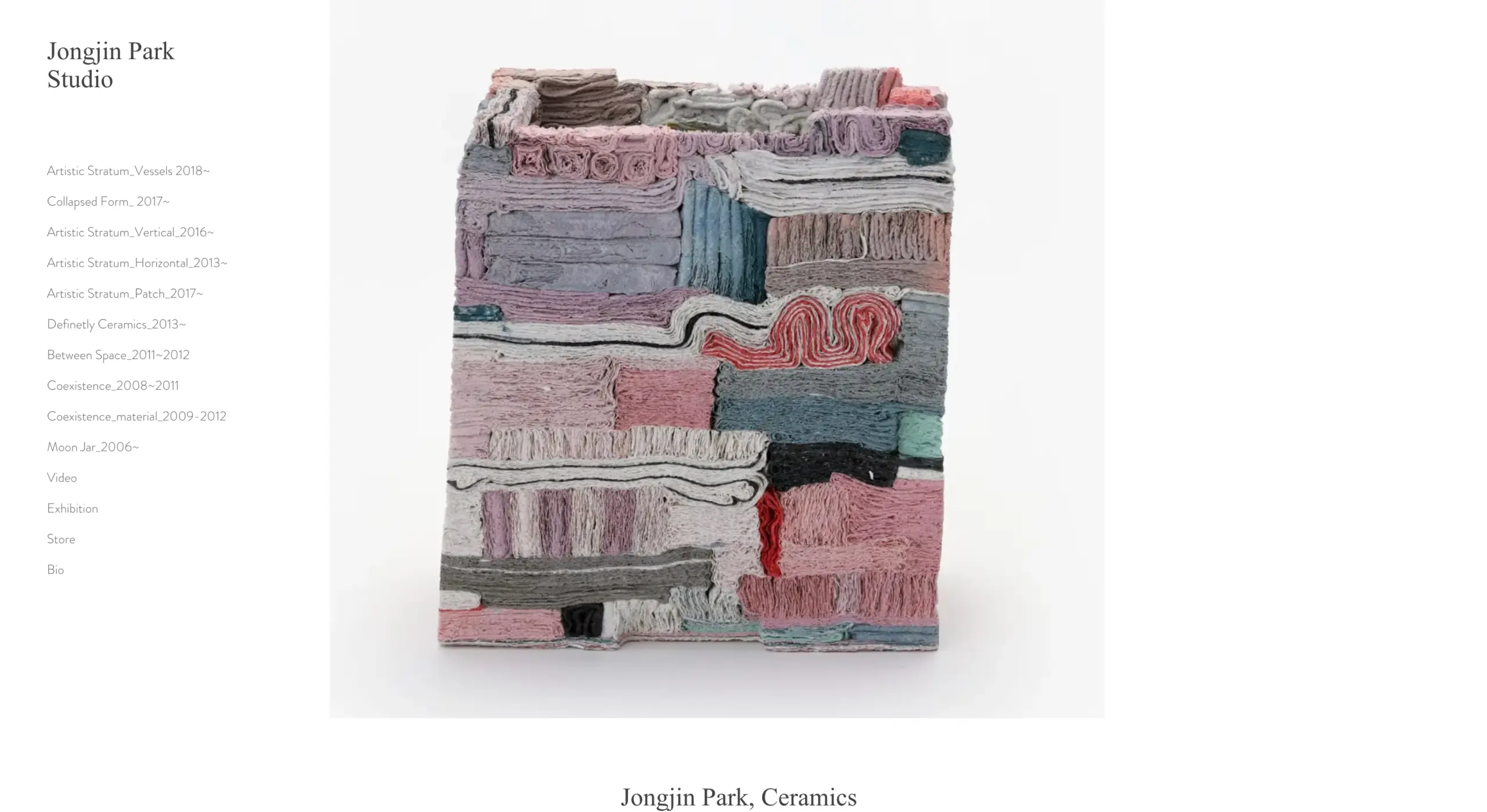
Jongjin Park is a Korean artist who has pioneered new expressive territories in contemporary craft by traversing the different material domains of paper forming and porcelain. His unique production process—immersing paper towels in porcelain slip, layering and compressing them, then firing at high temperatures to fix the paper’s structure in porcelain—has earned international acclaim as forms that simultaneously embody ephemerality and permanence.
In recent years, he has attracted attention at museums and design fairs across Europe, America, and Asia, positioned as a figure who traverses craft, sculpture, and architectural thinking. This article provides an in-depth exploration of Jongjin Park’s creative philosophy, technical structure, interpretation of representative works, and the reasons for his global recognition as a vanguard of contemporary craft.
Table of Contents
Who is Jongjin Park? A Korean Contemporary Craft Artist Fusing Paper and Ceramics
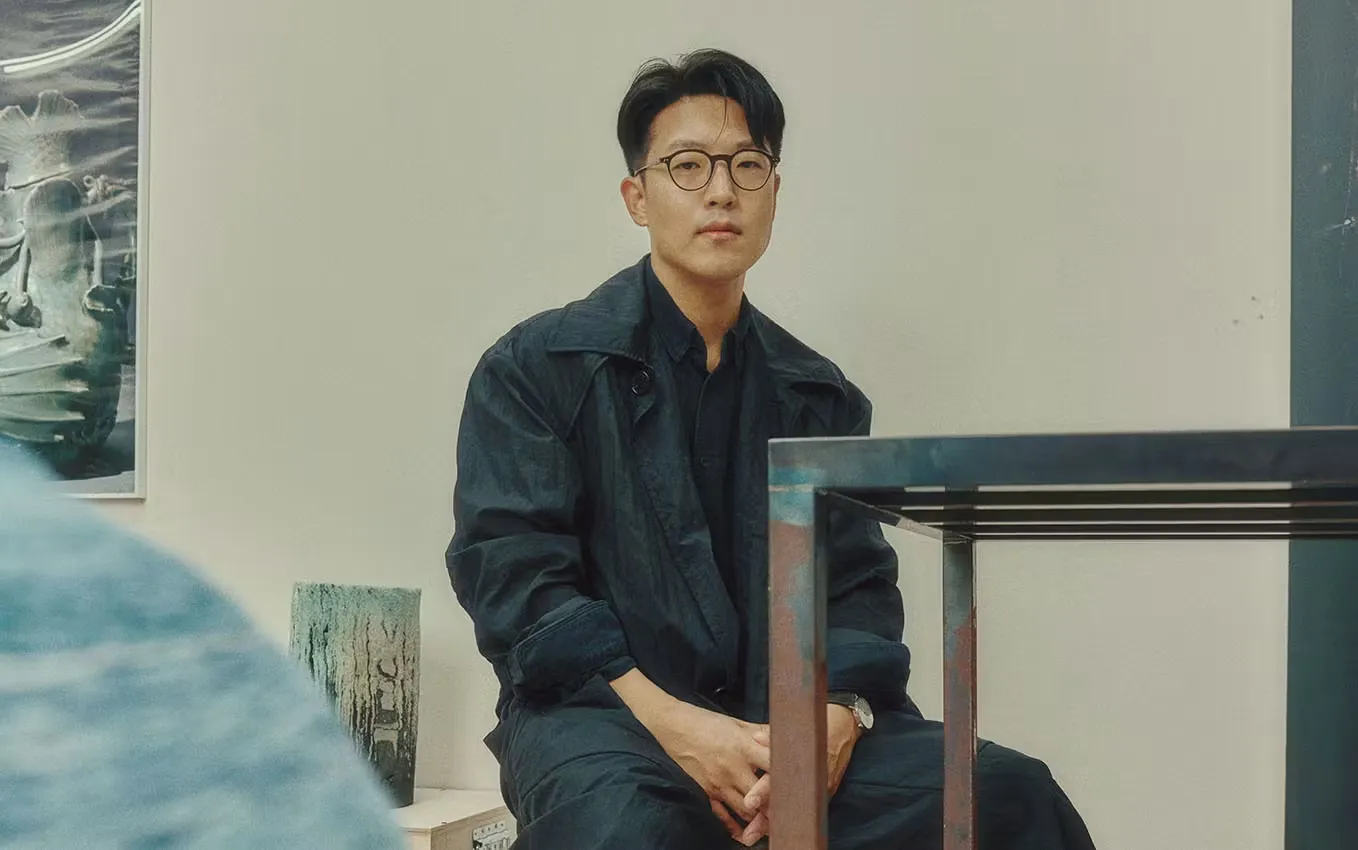
His quiet, structural works, which resist absorption into decorativeness or traditional styles, possess high affinity with contemporary spaces and international exhibitions, garnering attention as a presence that indicates craft’s current position.
Artist Biography and Background: Korean Craft Education and International Activity Base
Jongjin Park is a ceramic artist whose practice is grounded in systematic craft education in Korea. Kookmin University’s ceramic education emphasizes specialization by material while maintaining strong awareness of formative theory and connections to contemporary art. The foundational skills cultivated in this environment lead not merely to technical inheritance but to an attitude of treating materials as objects of thought.
Moreover, Park has built an activity base that doesn’t close itself into local craft perspectives, engaging early on with international exhibitions, design fairs, and overseas exhibition contexts. His position—rooted in the Joseon Dynasty’s Moon Jar tradition yet informed by study at Cardiff Metropolitan University and oriented toward the global craft and design market—strongly resonates with contemporary craft’s interests in paper and ceramic materiality experiments.
Reference: Bio | Jongjinpark.com
Practice Specificity: Expression Through Paper and Ceramic Composite Technique
The primary reason Jongjin Park attracts attention lies in his ceramic production process, where he sandwiches everyday paper materials like kitchen paper towels between layers of porcelain slip (liquid clay), then creates distinctive structure and spatiality by burning away the paper during firing.
Paper is lightweight and malleable, suitable as a material for layering, while porcelain is a material whose form becomes irreversibly fixed through high-temperature firing. Jongjin Park utilizes these characteristics to create layered spatial structures through the process of paper burning during firing.
Formative elements such as repetition, layering, and structural visualization consistently emerge through this paper-ceramic composite technique, lending unity to the entire body of work. The simultaneous pursuit of material experimentation and conceptual inquiry in ceramic production is a characteristic highly valued in contemporary craft.
Recognition at International Exhibitions and Design Fairs and Current Position
Jongjin Park’s works are positioned in the intermediate territory between craft and design at international exhibitions and design fairs such as Design Miami Seoul, PAD Paris, and Saatchi Gallery. Rather than foregrounding decorativeness or ethnicity, his works—which quietly present structure, rhythm, and material properties through layering 1,000 sheets of paper—possess high affinity with museum spaces and architectural displays.
As a trend in the current international craft market, emphasis on “expressiveness in contemporary spaces” and “conceptual clarity” is strengthening over “traditional style inheritance.” In this context, Jongjin Park, who pursues experimental fusion of paper and ceramics while rooted in the Joseon Dynasty’s Moon Jar technique, can be considered an extremely era-appropriate artist.
Represented by multiple prestigious galleries (The Future Perfect, Saatchi Gallery, Cynthia Corbett Gallery) and featured as a key figure in Korean design at Design Miami Seoul 2025, he is internationally recognized as an artist embodying an important trend in contemporary craft: the integration of material experimentation and conceptual pursuit in ceramic production.
Material Traversal Philosophy—The Necessity of the “Paper × Porcelain” Choice
What’s crucial in understanding Jongjin Park’s practice is the choice of “paper × porcelain”—seemingly contradictory materials. This is not merely material experimentation or pursuit of visual unexpectedness, but establishes itself as a response to challenges contemporary craft faces.
In recent international craft scenes, rather than the traditionality of specific materials, emphasis is increasingly placed on how structural and conceptual qualities materials possess can be converted into thought. This chapter organizes the material characteristics of paper and porcelain respectively, then examines in depth how the formative and conceptual logic traversing both establishes itself.
Paper Material Characteristics: A Medium Embodying Lightness, Malleability, and Temporality
Paper possesses unique properties among craft materials. In addition to being lightweight, it offers high freedom in operations like folding, overlaying, layering, and repeating, making it a material that easily visualizes structure itself.
Moreover, paper readily changes state with humidity, light, and aging, embodying temporality. In Jongjin Park’s paper-porcelain composite works, these characteristics are incorporated into form not merely as material qualities but as repetitive structure and rhythm.
Rather than the finished form, the process of structure continuing forward is foregrounded, raising spaces that are light yet possess tension. Because paper is a temporary, unstable material, it functions as an entity symbolizing contemporary “variability” and “incompleteness.”
Porcelain Material Characteristics: Strength, Whiteness, and Irreversibility Through Firing
In contrast to paper, porcelain is a material whose form becomes irreversibly fixed through high-temperature firing. Once fired, shape modification becomes impossible, and the process demands strong decisiveness.
Moreover, porcelain’s characteristic whiteness and high strength make forms themselves stand out, enabling formation without relying on surface decoration. In Jongjin Park’s porcelain works, decorativeness is suppressed, emphasizing clarity of form and structure.
While paper is a material that changes over time, porcelain continues to exist as “fixed form.” This irreversibility generates tension in the creative act and more strongly demands structural thinking. Porcelain is positioned as a symbol of materiality and decision in craft.
Formative and Conceptual Logic Connecting Contradictory Materials
Paper and porcelain clearly oppose each other in terms of lightness and weight, variability and irreversibility. The reason Jongjin Park’s practice earns recognition is that rather than forcibly fusing them, it establishes the contradiction itself as formative philosophy.
Common to both materials is the attitude of clarifying structure through repetition and layering. Even when materials differ, the formative logic remains consistent, allowing viewers to discern continuity of thought beyond material differences.
This traversing structural thinking is one of the important trends in contemporary craft. Jongjin Park’s “paper × porcelain” is positioned as an attempt to elevate craft from material theory to thought theory, with material choice itself becoming concept.
Technical Analysis: Development Process from Paper Forming to Porcelain Works
Viewing Jongjin Park’s practice from a technical perspective, paper forming and porcelain production are not separate expressions but are positioned on a continuum of thought. Form experiments conducted in paper don’t transfer directly to porcelain but function as stages ofstructural understanding and formative logic verification.
Here we organize the specific processes in paper forming, shaping and firing management in porcelain production, and ultimately how paper-like structure is visualized in porcelain, examining how material traversal establishes itself as technique.
Paper Forming Process: Form Generation Through Folding, Layering, and Compression
The process in paper forming is designed not as operations aimed at decorative formation but as operations to raise structure itself. Through folding, surfaces are converted to lines, and through layering, rhythm and thickness are born.
Furthermore, by adding compression, forms possessing density and tension are generated despite the lightweight paper material. These processes are not for fixing final forms but for visualizing structural repetition and deviation. Because paper has high malleability and allows easy correction and reconstruction, it functions as a place to trial formative thinking.
For Jongjin Park, paper forming is not a finished work but rather a thought device for extracting principles of form generation, and the process itself becomes an important foundation supporting subsequent porcelain production.
Shaping and Firing Management in Porcelain Production: Controlling Distortion and Shrinkage
In porcelain production, unlike paper forming, irreversible decisions are required at each stage of shaping and firing. Particularly in the process from drying to firing, design that accurately anticipates shrinkage rates and distortion is indispensable.
In Jongjin Park’s porcelain works, structural units are clarified in advance, and control is exercised at the shaping stage so distortion doesn’t collapse the whole. In firing, the speed of temperature rise and holding time directly affect form stability, and excessive tension triggers cracks and deformation.
Therefore, based on structural knowledge gained from paper forming, reconstruction into forms viable as porcelain becomes necessary. Porcelain production is positioned as a process that deliberately restricts the freedom obtained with paper and reexamines conditions for material establishment.
Surface Treatment and Texture Design: Methods for Visualizing Paper-like Structure in Porcelain
In final porcelain works, surface treatment and texture design become important elements visualizing continuity with paper forming. In Jongjin Park’s porcelain works, excessive glaze expression and color are avoided, with restrained expressions utilizing whiteness frequently chosen.
This emphasizes minute irregularities and structural lines generated by layering and repetition, fixing paper-like structural sensibility onto porcelain. Rather than being completely smoothed, surfaces retain slight fluctuations, visualizing the material conversion process itself.
The conversion from paper to porcelain is conducted not as copying form but as translating structure, and this translation precision determines work completion quality. Herein lies the core of establishing material traversal as technique.
Formative Aesthetics and Work Structure
What characterizes Jongjin Park’s works is that while being minimal formations that exclude decoration and symbolism, they embody high visual and conceptual tension. His aesthetics are constructed based on clear formative principles like repetition and layer structure, quietly guiding viewers’ gazes and bodily sensations.
Below, we organize the formative language through repetition and rhythm, light and shadow effects generated by white porcelain surfaces, and structural tension where the contradictory elements of fragility and strength simultaneously exist, three-dimensionally interpreting Park’s work aesthetics.
Minimal Formative Language Through Repetition, Layers, and Rhythm
Playing a central role in Jongjin Park’s formations is minimal formative language through repetition and layer structure. By repeatedly arranging identical or extremely similar form units, strong visual order is generated without relying on decoration.
This repetition doesn’t aim at monotony but forms rhythm through slight deviations and spacing differences, embodying quiet movement. As layers accumulate, depth is born, and viewers come to grasp works as overall structures rather than single points.
Such composition is deeply connected to contemporary craft currents that make structure itself thematic rather than flaunting craft technique. Repetition and layers are minimal units supporting Jongjin Park’s formations while functioning as formative language with strength.
Light and Shadow Design: Shadow Effects Generated by White Porcelain Surfaces
The choice of white porcelain material holds extremely important meaning in Jongjin Park’s formative aesthetics. White porcelain surfaces suppress color information to the limit, making light angles and shadow changes stand out.
Repeated layers and minute irregularities constantly change expression depending on light angle, adding temporal elements to static formations. These shadow effects, unlike visual stimulation through decoration, are established for the first time through viewer movement and viewpoint changes.
In other words, works are designed as existences that complete themselves within relationships with space rather than as fixed images. White porcelain is chosen as the material that most clearly visualizes structures mediated by light and shadow precisely because it is colorless.
Tension Generated by Duality of Fragility and Strength
The distinctive tension emitted by Jongjin Park’s works arises from the simultaneous existence of contradictory properties: fragility and structural strength. While forms appear visually delicate and light, they actually self-support through meticulously designed structures, stably existing in space.
This duality prompts unconscious wariness and concentration in viewers, making distance with works cautious. While “strength” in craft tends to be linked with utility, in Park’s works strength itself is incorporated as an aesthetic element.
Structures that seem breakable but don’t break, remaining at that boundary, can be considered one achievement of tension-bearing formations in contemporary craft.
Interpreting Representative Work Series
To understand Jongjin Park’s recognition more concretely, it’s important to interpret not individual works alone but developments as series. His production is structured not as single-work completions but as processes repeatedly verifying identical formative philosophy under different materials, scales, and placement conditions.
While paper formations and porcelain works are clearly separated, they exist in mutually referential relationships, with installation-like arrangements further expanding relationships with space. Below, we organize representative paper forming series, porcelain work series, and structural intentions in spatial displays, interpreting how the entire body of work establishes itself as a continuum of thought.
Paper Forming Series: Boundary Between Temporariness and Structure
What’s prominent in the paper forming series is the simultaneous presentation of two concepts: “temporariness” and “structure.” While paper is originally not a permanent architectural material, in Jongjin Park’s works it establishes itself as a self-supporting structure through folding, layering, and repetition.
Meanwhile, its lightness and thinness constantly embody instability, also giving an impression that refuses permanence. This ambiguous state generates tension at the boundary between temporary and structural.
Works stand as if visualizing midpoints of thought rather than completed monuments, posing the question “how far is this structure sustainable?” to viewers. The paper forming series shows possibilities for formations established through structural rationality rather than physical strength, positioned as a representative example of structural orientation in contemporary craft.
Porcelain Work Series: Three-Dimensional Expression Fixing Paper Traces
In the porcelain work series, structural thinking cultivated in paper forming transitions to porcelain, an irreversible material. Paper-like structures born from folding, layering, and repetition become three-dimensional expressions fixed in time by being replaced with the material of porcelain.
Porcelain, whose forms are fixed by firing, cannot be corrected or reconstructed like paper, so structural design precision is more strongly demanded. Jongjin Park’s porcelain works suppress decorativeness and foreground form logic itself by utilizing whiteness.
While memories of lightness seen in paper works remain, weight and tension as matter are added. The act of fixing paper traces functions as an important process converting structural thinking from temporary experiment to permanent formation.
Relationship with Space in Installation-like Arrangements
Jongjin Park’s works don’t complete themselves individually but are composed with strong awareness of relationships with space through installation-like arrangements. By arranging multiple works maintaining certain rhythms and intervals, repetitive structures expand into entire spaces, and viewers come to experience works while moving.
This arrangement can be called an attempt to reorganize space through structural order rather than visual decoration. Arrangements calculating light entry and sight line passages treat works and architecture as equal elements, incorporating the act of viewing itself into part of the work.
Installation-like development expands Jongjin Park’s production from “objects” to “relationships,” showing possibilities for contemporary craft connecting to spatial expression.
Conclusion
Jongjin Park is an artist showing new directions for contemporary craft while traversing the contradictory materials of paper and porcelain. Structural thinking like folding, layering, and repetition remains consistent even when materials change, elevating craft from problems of decoration and technique to expression of thought and structure.
Practice traversing both poles—temporariness seen in paper forming and irreversible fixation in porcelain works—strongly resonates with international craft trends of “material traversal,” “minimal structure,” and “spatial orientation.” Jongjin Park’s works, far from being merely one example of Korean contemporary craft, will attract increasing attention going forward as indicators showing where craft is heading.
