

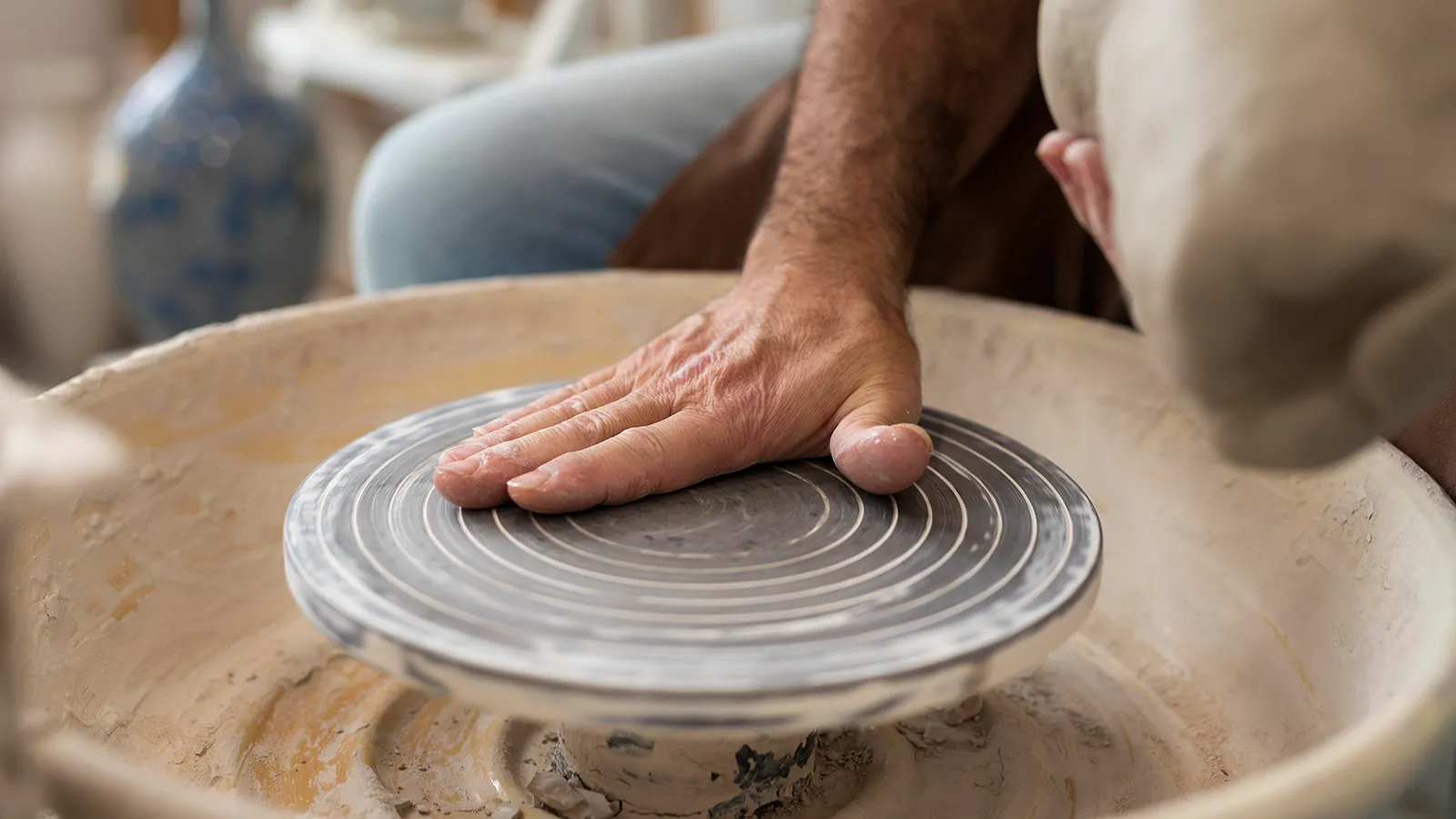
The potter’s wheel (rokuro) is a core ceramic technique that uses rotational motion to shape clay, simultaneously achieving both the rationality of vessel-making and sculptural beauty through an advanced apparatus. The principle of building forms through centrifugal force from rotation and controlled hand pressure transcends mere tool operation, reflecting the maker’s physical sensations and temporal awareness in the shaping process.
Since modern times, the popularization of electric wheels has expanded the realm of expression, and in contemporary ceramics, reinterpretation toward sculptural and structural approaches is advancing. This article systematically explains the potter’s wheel from its forming principles, main techniques, and aesthetic qualities to contemporary developments.
Table of Contents
What is a Potter’s Wheel? The Core of Ceramic Forming Technology
The potter’s wheel (rokuro) is a ceramic technique for shaping clay on a rotating platform to create circular vessels. It is the most systematized technique among ceramic forming methods, and many basic vessel forms such as bowls, basins, jars, and plates have been established through wheel throwing.
By utilizing rotational motion, it is characterized by the ability to efficiently create symmetrical and stable forms. This chapter organizes the definition and forming principles of the potter’s wheel, its role in ceramic history, and differences from other forming techniques, explaining why the potter’s wheel has been considered the core of ceramic technology.
Definition and Role of the Potter’s Wheel: The Principle of Circular Shaping Generated by Rotational Motion
The potter’s wheel refers to both the apparatus and technique of rotating a disc-shaped platform and using its centrifugal force and hand pressure to shape clay. The potter accurately centers the rotating clay and applies pressure from both inside and outside with both hands to create vessel forms with uniform thickness and smooth curves.
The greatest advantage brought by this rotational motion is that circular forms and bilateral symmetry naturally emerge. Since it ensures precision and reproducibility that are difficult to replicate by hand alone, it is also suitable for mass production and standardization of everyday vessels.
Furthermore, by changing rotation speed and finger placement, subtle expressions such as body swell and rim curvature can be adjusted. The potter’s wheel can be said to be not merely a tool, but a rational forming principle unique to ceramics that establishes shaping by linking rotation with bodily movements.
The Significance the Potter’s Wheel Has Played in Ceramic History
Potter’s wheel forming is a revolutionary technology that greatly improved productivity and shaping precision in ceramic history. Before the introduction of the wheel, vessels were mainly made by hand-building, but this method had limitations in form uniformity and production speed.
With the advent of the potter’s wheel, mass production of circular vessels became possible, and everyday wares such as tableware and storage containers spread throughout society. Potter’s wheel technology, which developed from China and West Asia as starting points, was also transmitted to Japan, forming the foundation of ceramic and porcelain culture after Sue ware.
Furthermore, the potter’s wheel became not only a mass production technology but also a means of generating sophisticated aesthetic expression, as seen in tea ceramics and famous bowls. The historical significance of wheel throwing lies in its ability to express human presence rather than mechanical perfection by leaving slight distortions and finger traces within symmetry.
Differences from Hand-Building (Tebineri) and Slip-Casting (Ikomi): Positioning as a Forming Technique
In addition to wheel throwing, ceramic forming techniques include hand-building and slip-casting. Hand-building is a method of creating forms by coiling or pressing clay, offering high freedom and suitability for asymmetrical and organic shapes.
On the other hand, slip-casting is a technique of pouring slip into plaster molds, making it possible to efficiently create complex shapes and uniform products. In contrast, wheel throwing is a technique specialized for circular vessels, characterized by simultaneously achieving precision, mass production capability, and traces of handwork.
In other words, the potter’s wheel can be said to be a forming technique positioned between industrialization and handcraft. Among the selection of techniques according to purpose and expressive intent, the potter’s wheel continues to play a role as a reference point in ceramics.
Understanding the Types and Structure of Potter’s Wheels
To understand the potter’s wheel, it is necessary to look not only at its aspect as a forming technique but also at its types and structure. The kick wheel, hand wheel, and electric wheel each differ in how they generate rotation and operational feel, affecting shaping precision and production style.
Additionally, rotation speed, stability, and centrifugal force strength directly relate to vessel rise and thickness adjustment. This chapter organizes representative types of potter’s wheels and their uses, the influence of rotation on shaping, and key structural points such as the wheel head and shaft, understanding the potter’s wheel as an apparatus three-dimensionally.
Differences and Uses of Kick Wheel (Kerokuro), Hand Wheel (Terokuro), and Electric Wheel (Dendo Rokuro)
Potter’s wheels are broadly divided into three types: kick wheels, hand wheels, and electric wheels.
The kick wheel is a system where rotation is generated by kicking a disc with the foot, characterized by the ability to adjust rotation speed through bodily sensation. While fluctuations in rotation easily occur and natural fluctuations tend to remain in the shaping, it requires high concentration and physical strength.
The hand wheel has a simple structure rotated by hand, often used for small-scale works and forming practice, and while its rotational force is weak, it is suitable for understanding operations.
The electric wheel obtains stable rotation through a motor and easy speed adjustment, making it mainstream in modern production settings.
The advantage is the ability to stably create uniform vessel forms, but because the rotation is constant, operational habits are directly reflected in the form. It is important to select potter’s wheels according to purpose and expressive intent.
The Influence of Rotation Speed, Stability, and Centrifugal Force on Shaping
In wheel throwing, rotation speed and stability greatly affect shaping results. If rotation is too fast, centrifugal force becomes strong and clay easily spreads outward.
On the other hand, if rotation is too slow, the center of the clay easily wobbles and it becomes difficult to maintain uniform thickness. Stable rotation is a prerequisite for accurately performing basic processes such as centering and pulling up. Centrifugal force is used when swelling the body of a vessel or expanding the rim, but if control is mistaken, it can cause the form to collapse.
Skilled potters advance shaping while linking rotation speed and hand pressure, predicting the movement of the clay. In other words, wheel throwing can be said to be not forceful work but precise operational technology performed with understanding of rotation and centrifugal force.
Structure and Adjustment Points of the Wheel Head, Shaft, and Wheelhead Platform
Supporting the stable rotation of the potter’s wheel are structural elements such as the wheel base, shaft, and wheelhead. The wheel base is the foundation part supporting the whole, and if it is not level, minute wobbles occur in rotation.
The shaft is the center of rotational motion, and even slight distortion or wear affects shaping precision. The wheelhead is the part where clay is directly placed, with smoothness and securing force being important. Before production, check for wobbling of the wheelhead and rotation sounds of the shaft, making adjustments as necessary. Especially with potter’s wheels used for long periods, changes in rotational resistance and micro-vibrations easily occur.
Such structural understanding and routine inspection are basic conditions for performing stable forming. The potter’s wheel can be said to be a tool where completion is affected not only by technique but also by apparatus management.
Basic Processes of Potter’s Wheel Techniques
Wheel throwing tends to appear to be intuitive work, but in reality, each process has a clear role and purpose. Particularly, the precision of initial processes greatly affects the stability of subsequent pulling up and shaping. Additionally, forming does not end with completion but needs to be designed with consideration for the next processes such as trimming and firing.
This chapter divides into three stages that form the basis of wheel throwing techniques: “centering and wedging,” “pulling up, compressing, and shaping,” and “cutting off and connection to next processes,” organizing the meaning and technical points each process holds.
Centering and Wedging: The Initial Process That Affects Forming Precision
Centering is the process of removing air and unevenness in hardness inside the clay, arranging it into a uniform state. By kneading while aligning the internal structure, distortion and cracking during rotation are prevented.
Wedging is the work of accurately fixing the centered clay to the center of the potter’s wheel, an important stage that determines the precision of the entire forming. Even if the center shifts slightly, wobbling occurs during rotation and it becomes difficult to maintain uniform thickness.
In this process, awareness of aligning the axis with rotation is required while confirming the state of the clay through hand sensation. Centering and wedging are modest work, but the care here greatly affects the freedom and completion of subsequent processes.
Pulling Up, Compressing, and Shaping: Techniques to Control Thickness and Lines
Pulling up is the process of raising the height of the vessel while lifting the rotating clay. At this time, uniform thickness is secured by balancing centrifugal force and finger pressure.
Compressing is the work of finishing the surface of the raised vessel and compressing clay particles to increase strength, also playing a role in clarifying the lines of the rim and body. In shaping, the final form is determined by adjusting the swell of the body and curvature of the rim according to the purpose and intent of the vessel.
These processes are performed continuously, and if operation is mistaken in any one place, the overall balance collapses. Pulling up, compressing, and shaping are the core parts of wheel throwing and can be said to be the stage where technique and sensation are most questioned.
Cutting Off and Connection to Trimming: Design from Forming to Next Processes
Vessels that have finished forming are cut off from the wheel head and proceed to drying and trimming processes. In cutting off, wire or tools are used to carefully separate the bottom part, requiring care not to collapse the form.
By being conscious of the thickness of the vessel bottom at this stage, subsequent trimming work becomes easier. Wheel throwing is not a process that completes the finished form on the spot but is performed with the premise of finishing the final form through trimming.
Therefore, a perspective of designing overall proportions while leaving trimming allowance during forming is important. Cutting off and connection to next processes is the process connecting forming and finishing, requiring design capability to see through the entire production.
Sculptural Beauty and the Aesthetics of Wheel Lines
The beauty of vessels created through wheel throwing is greatly affected not only by the completed form but also by the “lines” carved during the process. Throwing marks, curves of the rise, and flow toward the rim vividly reflect the maker’s bodily operation and shaping philosophy.
Below, we organize the meaning of throwing marks as traces, artist identity appearing in lines and curves, and further, the way of thinking about wheel operation that differs for each vessel form, explaining how wheel lines establish sculptural beauty.
The Meaning of Throwing Marks (Rokuro-me): Intentional Traces or Elements to Erase?
Throwing marks refer to concentric traces generated when fingers or tools touch rotating clay. These inevitably appear in wheel throwing, and can be completely erased or deliberately left.
In functional ceramics, considering mouthfeel and ease of washing, throwing marks are often finished or erased. On the other hand, in works emphasizing decorative quality, methods are used that actively leave throwing marks as part of the shaping, visualizing rotational motion and physicality.
Throwing marks are not traces of incompletion but also records showing at what stage the maker stopped their hand and which expression was chosen. Depending on how they are handled, vessels can appear inorganic or organic. Throwing marks should be grasped not as a binary choice of whether they are flaws to erase or intentional expression, but as results of judgment reflecting shaping philosophy.
Artist Identity Appearing in Lines, Curves, and Rise
In wheel throwing, the quality of lines and curves directly appears as artist identity. The way the body swells, the angle of rise toward the rim, and the modulation of lines subtly change according to finger placement, rotation speed, and how pressure is applied.
Even with the same dimensions and vessel type, if the maker changes, the impression of lines differs greatly. A tense, linear rise gives a neat and quiet impression, while gentle curves create a soft and approachable expression.
These are not elements added through decoration but are determined at the moment of forming. Wheel lines are the part where the maker’s judgment and bodily sensation appear in the purest form, and only when intent and technique match do they establish as beautiful flow.
Different Potter’s Wheel Operation Philosophy by Vessel Form (Bowl, Basin, Jar)
The potter’s wheel operation philosophy required differs greatly depending on vessel form. Bowls are vessels held in hand and placed to the mouth, so thinness of the rim and angle of return are emphasized, requiring delicate compressing and uniform thickness.
For basins, balance of capacity and stability is important, and the impression changes depending on where the body swell is created. For jars, overall center of gravity and standing posture are the top priority, requiring concentration and design capability to create the form all at once during rotation.
These differences are not merely shape differences but are derived from differences in usage and perspective. Potter’s wheel operation is optimized according to vessel form, and while being the same technique, completely different thinking is required. By understanding operation by vessel form, the depth of wheel throwing becomes clearer.
Reinterpretation of the Potter’s Wheel in Contemporary Ceramics
In contemporary ceramics, the potter’s wheel is no longer limited to being “an apparatus for making symmetrical circular vessels.” Artists, understanding the rotational principle of the wheel, deliberately disrupt control or perform division and expansion to generate new sculptural expression.
Additionally, in recent years, attempts to redefine the role of the potter’s wheel itself through connection with digital technology are also advancing. This chapter organizes the reinterpretation of the potter’s wheel in contemporary ceramics from methods that intentionally incorporate distortion, development toward large-scale and sculptural expression, and relationships with rotation control and 3D data.
Deliberately Distorting the Wheel: Fusion of Control and Chance
In traditional wheel throwing, stabilizing rotation and creating symmetrical, well-balanced forms has been considered the pinnacle of technique. However, in contemporary ceramics, expressions that deliberately disturb rotation and actively incorporate distortion and fluctuation are seen.
This is not failure due to lack of technique but intentional operation based on sufficient understanding of rotation and centrifugal force. By changing rotation speed or slightly shifting the center, moments where control and chance intersect are fixed in the shaping.
In such works, the potter’s wheel functions not as a tool for homogenization but as an apparatus that draws out physicality and material reaction. Distortion is not a flaw but becomes a trace showing how far the maker controlled and where they let go, evaluated as contemporary sculptural language.
Development of Large-Scale Works, Sectional Forming, and Sculptural Wheel Throwing
In contemporary ceramics, large-scale works and sculptural expression using the potter’s wheel are also expanding. While there are physical limitations to size in normal wheel throwing, methods are used that expand scale by creating multiple parts through sectional forming and joining them later.
This allows jars and three-dimensional structures to develop to architectural scale. Additionally, there are artists who trim and reconstruct wheel-thrown forms, developing into asymmetrical sculptural expression while starting from circular forms.
In such methods, the potter’s wheel is positioned not as a tool that determines the final form but as a starting point for shaping. Thinking that goes back and forth between forming and sculpture expands the possibilities of wheel throwing techniques from flat vessels to three-dimensional shaping.
Connection Possibilities with Digital Technology (Rotation Control and 3D Data)
In recent years, wheel throwing techniques are showing new developments through connection with digital technology. Electric wheels make it possible to maintain stable rotation speed, and the production environment is being improved.
On the other hand, trial development using 3D scanning and 3D data is advancing. Through “digital cleanup” methods that digitize hand-made rough prototypes with 3D scanners and modify and correct them to ideal shapes with 3D-CAD, the precision of design and operation is improving. This is making the boundary between handwork and digital design ambiguous.
However, directly applying digital control to the wheel throwing (rotation forming) process itself is currently limited. Digital technology is mainly utilized at the prototype design and trial development stage, and final wheel throwing is performed through traditional handwork.
Digital technology does not replace the potter’s wheel but functions as an auxiliary line that expands its possibilities, bringing new options to future ceramic expression.
Conclusion
The potter’s wheel is a core forming technology in ceramics that generates circular shaping using rotational motion. From centering and wedging to pulling up, shaping, and connection to next processes, each process has a rational structure supporting shaping precision and beauty.
Additionally, artist judgment and physicality appear in the handling of throwing marks and lines, and different operational philosophies exist for each vessel form. In contemporary ceramics, through introduction of distortion, sculptural development, and connection with digital technology, the potter’s wheel continues to be reinterpreted. Understanding the potter’s wheel becomes an important perspective for grasping ceramics not only as technique but as a system of philosophy and expression.
