

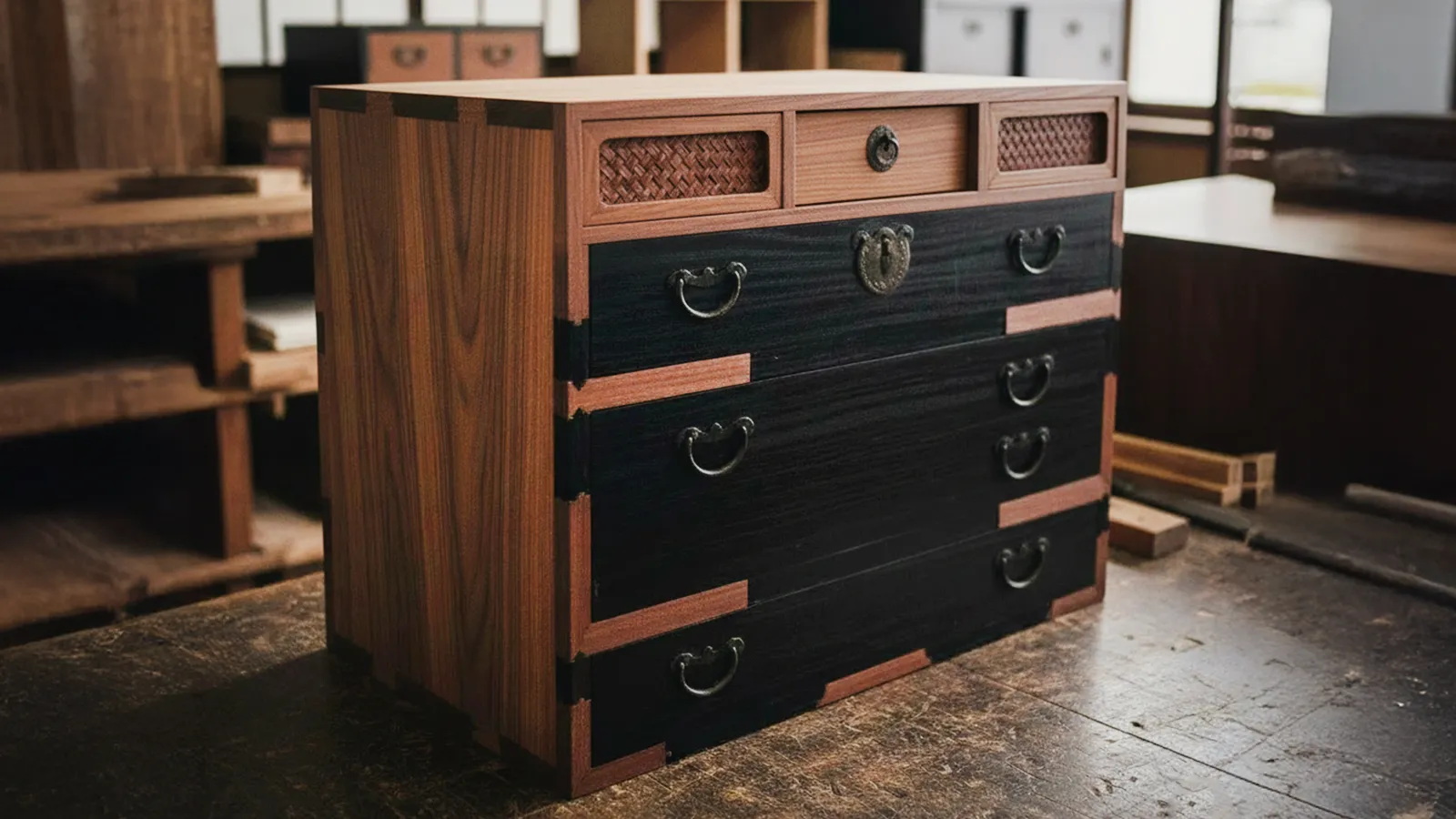
Edo Sashimono represents one of Japan’s finest furniture crafts, built entirely through advanced woodworking techniques that join wood to wood without using a single nail or metal fitting. Developed within the merchant culture of the Edo period, its forms balance rationality with aesthetic sensibility, embodying structural beauty through quiet, restrained design that holds inherent tension.
In recent years, it has gained renewed appreciation abroad as **”Japanese Joinery,”** connecting with contexts of minimal design and sustainable craftsmanship. This article systematically examines the aesthetic foundations of Edo Sashimono, the essentials of its technical structure, and its international evaluation criteria, offering a multifaceted exploration of its essence.
Table of Contents
What is Edo Sashimono? The Pinnacle of Japanese Furniture Where Woodworking Mastery Crystallizes
Edo Sashimono is uniquely Japanese wooden furniture created through advanced techniques that join wood to wood without using any nails or metal fittings. Primarily developed within the merchant culture of the Edo period, it has centered on furniture closely tied to daily life—chests of drawers, boxes, desks, and display shelves. Its essence lies not in ornamentation, but in structure itself becoming beauty.
Reading the grain flow and assembled with precision to minimize warping, sashimono pieces embody tension and high completion within their quiet presence. Here, we clarify Edo Sashimono’s position within Japanese furniture culture through its historical origins, its defining characteristic of structural beauty, and its differences from sashimono of other regions.
The Historical Context of Edo Sashimono: Edo Culture, Merchant Craftsmanship, and Occupational Specialization
Edo Sashimono was nurtured by urban culture and the maturation of the merchant class during the Edo period. With the stability of warrior society and economic development, merchants and artisans in Edo gained power, and demand grew for household items that combined functionality with quality.
Within this context, furniture production became independent from carpentry work, establishing the specialized occupation of sashimono craftsmen. As Edo was a densely populated metropolis, limited living spaces required storage furniture and portable boxes, emphasizing rational structures that eliminated waste.
As occupational specialization advanced, highly refined techniques developed for each process—wood selection and dimensional processing, precise joint cutting, and lacquer finishing. Against this backdrop, the technical system of Edo Sashimono was established, minimizing decoration while enhancing wood grain beauty through lacquer, and pursuing precision and durability to their ultimate limits.
The Defining Feature of “Nail-Free Structural Beauty”—The Sophistication of Joints, Fittings, and Grain Utilization
The defining characteristic of Edo Sashimono lies in achieving both strength and beauty through wood joinery alone, without nails or metal. Representative techniques include mortise and tenon joints, dovetail joints, and halving joints, each carrying structural significance while functioning in unseen areas.
These techniques are designed with wood’s contraction and warping in mind, creating structures that accommodate wood’s characteristic “breathing” with seasonal humidity changes. Additionally, by discerning grain direction and wood properties—understanding characteristics like quarter-sawn versus plain-sawn, and face versus back grain—and placing optimal materials accordingly, stress-free durability emerges.
While exteriors remain extremely simple, intricate calculations hide within, and this philosophy that “skill resides in invisible places” supports Edo Sashimono’s structural beauty. As a result, these pieces boast high completion as furniture capable of enduring years of use with proper maintenance.
Distinguishing Sashimono from Other Woodwork: Technical Comparison with Kyoto and Osaka Sashimono and Regional Character
Sashimono possesses regional characteristics, and comparing Edo Sashimono with Kyoto and Osaka Sashimono clarifies its nature more distinctly.
Kyoto Sashimono, influenced by court culture and tea ceremony, emphasizes decorative and design qualities, characterized by delicate chamfering and elegant proportions.
Meanwhile, Osaka Sashimono, befitting a commercial city, often shows sturdy construction conscious of practicality and mass production. In contrast, Edo Sashimono pursues thoroughly simple, rectilinear, function-oriented structures. By treating wood grain as expression and minimizing decoration, it maintains a presence that quietly integrates into spaces.
These differences reflect each city’s cultural background and living environment differences, positioning Edo Sashimono as woodworking culture demonstrating rationality adapted to urban life and the extremes of craftsman technique.
Internal Structure of Techniques—Advanced Structural Design in Dialogue with Wood
The true value of Edo Sashimono lies in the advanced structural design hidden behind its exterior simplicity. Sashimono craftsmen establish strength and precision for long-term use without nails, after discerning wood material properties. The characteristic lies in integrated design—from material selection, joint choice, to finishing methods—premised on contraction and expansion from humidity changes.
Invisible internal structure determines furniture longevity and stability, demanding both rationality and aesthetic consciousness simultaneously. Below, we unpack the “philosophy of structure” in Edo Sashimono through three layers: wood selection, joint techniques, and finishing.
The Logic of Wood Selection: Properties and Applications of Materials like Mulberry, Zelkova, and Ebony
In Edo Sashimono, wood is strictly selected according to application and structure. Mulberry is hard with resilient grain that resists chipping, enabling intricate detailing, and has been especially prized as the supreme premium material in the Edo Sashimono world. Its distinctive pale yellow-brown color transforms to dark brown with age, with mulberry from Mikurajima particularly regarded as finest quality.
Zelkova, a representative traditional material for Japanese furniture, possesses high durability, with particularly figured grain favored. Japanese ash combines strength with flexibility, its clear grain providing crisp expression suitable for visible surfaces.
Sashimono craftsmen discern material characteristics—face versus back grain, quarter-sawn versus plain-sawn—understanding annual ring direction and properties to arrange components so wood movements cancel each other out. Without sufficient material understanding, long-term warping becomes unavoidable regardless of joint precision. Wood selection is not decoration, but structural design itself.
The System of Joint Techniques: The World of Structural Innovation in Mortise and Tenon, Dovetails, Miter Joints, and More
Edo Sashimono joinery can truly be called structural engineering by hand, controlling force flow through precise structural design. Over 1,000 joint types exist, with optimal techniques selected for each component.
Representative fittings include mortise and tenon joints, the fundamental technique connecting boards and members, forming the foundation for boxes and frames. Complex techniques like hidden mitered dovetail joints are used for drawer and corner connections, providing advanced techniques securing strength against pulling forces.
These fittings remain hidden from exterior view, with intricate work concealed in unseen places, allowing surface beauty and internal strength to coexist. Low precision creates gaps or fails to accommodate wood expansion, causing long-term warping.
Joint design premises wood’s expansion characteristics, creating structures responding to seasonal humidity changes. Through minute dimensional adjustments, assembled components form mutually supporting relationships. Consequently, furniture capable of long-term use with maintenance is established.
Finishing and Surface Treatment: Texture Formation Through Wiping Lacquer, Wax Finishing, and Bare Wood Polishing
Edo Sashimono finishing is performed not to conceal but to draw out wood texture. Wiping lacquer involves rubbing thin lacquer coats to provide durability and depth, accentuating grain while stabilizing tactile quality.
Wax finishing heightens water resistance while suppressing gloss, creating calm expression suited to daily use. Bare wood polishing aligns fibers through blade work and abrasion, achieving natural luster without relying on coating—an advanced process.
These treatments cannot succeed without joint precision; slight gaps or warping become exposed in finishing. Final texture is determined by the comprehensive score of structure, material, and processing, with Edo Sashimono’s aesthetic conveying assured skill within quiet exteriors.
The Aesthetics of Edo Sashimono—The Fusion of Minimalism and Functionality
Edo Sashimono represents one culmination of Japanese woodworking technique, eliminating decoration yet precisely calculating user gestures and spatial relationships. Forms established through wood properties and structure alone appear simple at first glance, yet advanced design philosophy and aesthetic consciousness lurk behind.
Here, we organize the aesthetic pervading Edo Sashimono through three perspectives—”design,” “form by application,” and “relationship with contemporary design”—clarifying why this furniture continues receiving evaluation across eras.
Design Characteristics: The Exquisite Balance of Pulls, Legs, and Rails Creating “Edo Ma”
Edo Sashimono design places emphasis not on individual components asserting themselves, but on overall harmony. Representative elements include the treatment of pulls, legs, and rails (kamachi). Pulls are kept to minimal forms following fingertip sensation without deep carving, generating no visual noise.
Leg sections likewise avoid emphasizing floor contact points, creating impressions where furniture “blends into” rather than “sits in” space. Rails, while important structural elements supporting construction, suppress presence through grain flow and thickness adjustments.
The balance these elements create produces the “Edo Ma” sensibility respecting negative space. Rather than completing as furniture alone, resonating with surrounding elements like tatami, shoji screens, and light to complete entire spaces—this constitutes Edo Sashimono’s distinctive aesthetic.
Design Philosophy Seen in Form by Application (Document Boxes, Tea Utensils, Chests, Shelving)
Edo Sashimono’s design philosophy clearly differentiates by application. Document boxes, for instance, feature structures balancing seal quality and opening ease to protect paper and books from moisture. Sashimono storing tea utensils emphasizes dimensional sense not impeding tea ceremony movements and internal composition preventing utensils from touching.
Chests consider mobility and portability over storage capacity, with drawer depths and center of gravity placement finely designed. In shelving, shelf board thickness and spacing are adjusted to generate visual rhythm, highlighting displayed vessels and calligraphy.
These all derive not from decorative reasons but from rationality imagining usage scenes. Edo Sashimono holds great value in accumulated inevitability aligned with application elevating directly to formal beauty.
Affinity with Contemporary Design: Spatiality Utilizing Straight Lines, Surface Composition, and Material Texture
One reason Edo Sashimono continues receiving contemporary evaluation is its high affinity with modern design. Rectilinear composition, surface continuity excluding excessive curves, and the stance foregrounding material texture itself naturally overlap with minimalist and modernist philosophy.
Particularly, treating wood grain not as decoration but as “information” is an element compatible with contemporary architecture and interior design emphasizing material texture. Additionally, Edo Sashimono possesses lightweight, disassemblable, repairable structure, fitting contemporary values of sustainability and long-term use.
Its lack of incongruity when placed not only in Japanese-style rooms but also in spaces using concrete or glass stems from forms based not on era trends but universal rationality. Edo Sashimono is not a relic of the past but a design resource continuing to live in contemporary spaces.
The Lineage from Edo Period Master Craftsmen to Contemporary Artisans
Edo Sashimono has been supported not by individual artist styles alone, but by occupational groups and inheritance systems cultivated within the city of Edo. Behind master craftsmen lie layered mechanisms of apprenticeship systems, guilds, and workshops, with continuous transmission of technique and aesthetic consciousness throughout history.
Below, we organize the lineage from Edo period master craftsmen to contemporary artisans, examining organizational technical transmission systems and new developments by contemporary artists.
From Edo Period Masters to Contemporary Artisans—Work Tendencies and Technical Characteristics
Edo period Edo Sashimono, while highly anonymous as craft, had craftsmen called masters through their technical excellence. Common to their works are accuracy in wood cutting, joint precision, and dimensional sense premised on user lifestyles.
The stance avoiding flashy design and prioritizing structures resistant to warping was inevitable for practical items enduring urban life. Though temporarily declining amid Meiji modernization waves, it was reevaluated as traditional craft during the Showa period, with specific workshops and artists gaining attention as technical bearers.
Contemporary master craftsmen, while faithfully following Edo period techniques, further enhance completion by incorporating material drying management and tool precision improvements. In work tendencies, suppressing excessive personal expression and emphasizing “correct Edo Sashimono” over “who made it” expresses this craft’s character.
Technical Transmission Systems and Qualification Systems Through Guilds and Workshops
Supporting Edo Sashimono technical succession are institutional mechanisms centered on guilds and workshops. From pre-Showa eras, customs existed of accumulating over ten years’ training as apprentice craftsmen under masters, continuing into modern times.
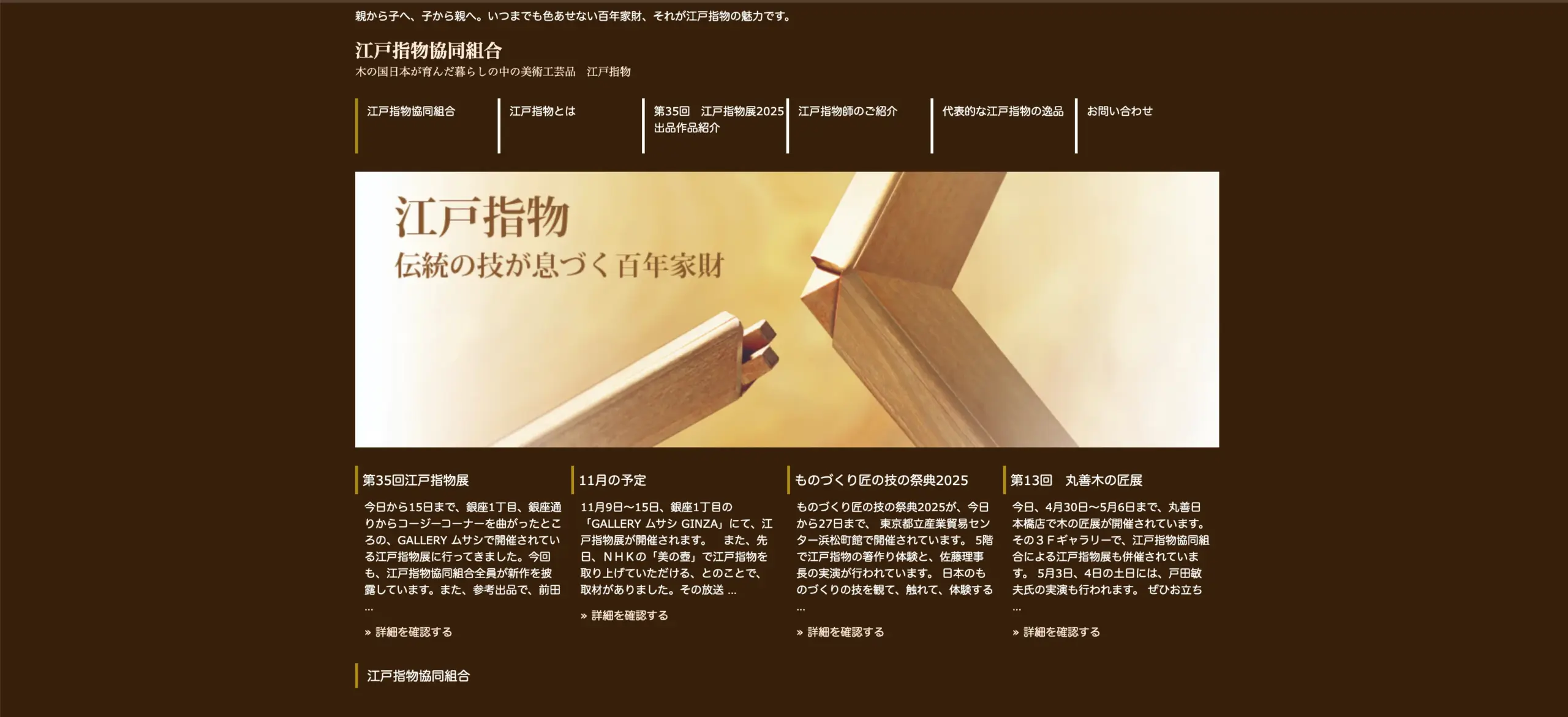
Currently, the Edo Sashimono Cooperative Association operates organizationally in Taito Ward, Tokyo. Additionally, Arakawa Ward has established the **”Master Craftsman Training Program”** as public institutional support—after a three-month trial period, supporting apprenticeship training for up to six years.
As a mechanism ensuring technical standards, the Traditional Craftsman national qualification system exists. This system requires accumulating over 12 years’ practical experience in manufacturing regions, then passing practical examinations, knowledge tests, and interviews. Even after certification, skill is confirmed every five years, functioning as a reliability indicator for markets.
Traditional craftsmen are expected to serve as “industry leaders central to successor training and regional promotion.” Particularly in fields like Edo Sashimono where joint and fitting precision determines completion, independent study or short-term mastery proves difficult, making systematic transmission systems play crucial roles.
Organizational transmission systems can be considered indispensable for preventing successor shortages and technical succession breaks, maintaining craft quality overall.
Contemporary Artists’ Challenges: Expansion into Minimal Furniture, Custom Orders, and Spatial Installations
Contemporary Edo Sashimono artists not only preserve traditional techniques but also undertake developments into new applications and markets. Representative examples include minimal design furniture and custom production for contemporary residences.
Edo Sashimono characteristics utilizing rectilinear composition and material texture have high affinity with contemporary architecture and interior design, gaining reevaluation as storage furniture and fixtures. In custom fitted furniture for residential and commercial spaces, precise dimensional adjustment and structural strength through sashimono techniques become strengths.
This expands roles from one-of-a-kind craft pieces to elements composing entire spaces. Such attempts are not distortions of tradition but contemporary practice of Edo Sashimono’s inherent philosophy of “deriving optimal solutions according to application.”
Market Trends and International Evaluation of Edo Sashimono
Edo Sashimono possesses both aspects of **”art pieces with strong authorial character” and “furniture for continued daily use,”** with markets expanding beyond one-off sales to workshop commissions, corporate installations, and spatial fittings. Domestically, quality and provenance are emphasized within traditional craft contexts, while internationally, riding tailwinds of growing interest in **”Japanese Joinery (nail-free wood joinery),”** structural beauty and material texture strengthen as evaluation criteria.
Here, we organize auction and gallery trends where evaluations form, international popularity contexts, and utilization potential in hotels and interior markets.
Evaluation Trends in Domestic and International Auctions and Galleries
Edo Sashimono is evaluated not as a field where artist names alone precede, but including work completion, provenance, and utility. In domestic galleries and department store exhibitions, “quality discernible by handling”—wood cutting precision, surface alignment, drawer action, rail and leg proportions—becomes value’s center.
Additionally, treatment of rare materials and design philosophy premising repair and maintenance for long-term use underpin evaluation. In international galleries and design contexts, introductions discussing “joint structure,” “wood expression,” and “rectilinear and surface composition” rather than decorative qualities have increased, understood within functionality and minimalism contexts.
Consequently, demand easily emerges in middle territory between collectible design one-offs and quality lifestyle furniture practical items, with purchase motivations leaning toward “value of ownership while using” rather than speculation.
Japanese Joinery Popularity Overseas and Edo Sashimono’s Positioning
As “Japanese Joinery” has become widely known abroad, the technology itself of joining wood without nails (wood joinery) has come to be recognized as advanced design value. Particularly in Europe and America, this technology is associated with assembly rationality, durability, and sustainability (repairability), with fertile ground for high evaluation as “structural functional beauty” and “rationality elevated to beauty.”
Within this trend, Edo Sashimono can differentiate itself through a different approach from the “architectural dynamic joinery (visual joints)” that has gained prior attention overseas. Namely, precision as lifestyle tools, extremely restrained pull and rail (kamachi) forms, and “hidden aesthetics (iki)” treating highly advanced joints as deliberately concealed, making wood grain itself the design.
Using “Japanese Joinery” recognition as an entry point of interest, then shifting value recognition toward “sophistication as furniture for urban living” and “tranquility blending into spaces” becomes Edo Sashimono’s unique strength in international markets. By presenting not just structural explanations of techniques but actual usage experiences and presence in contemporary spaces, it can establish a solid position.
Utilization Potential in Interior Markets and Luxury Hotel Installations
In luxury hotel and high-end residential interior markets, comprehensive quality including material quality, narrative qualities, and operational aspects (durability, repair, renewal) is demanded. Edo Sashimono’s strengths lie in raising spatial quality through rectilinear and surface composition avoiding excessive assertion, while enduring long-term operation through nail-free structure and precise processing.
Concrete installation visions include:
- Custom guest room fixtures (side tables, storage, minibar surrounds)
- Built-in storage and signage fixtures for lobbies and lounges
- “Regional craft stories” linked with in-house retail and experience programs
Particularly in hotel projects, not just design but cleaning workflows, damage replacement, humidity change considerations and other operational conditions are strict, making systems where designers, workshops, and operations teams coordinate specifications important.
As Edo Sashimono can balance “quiet luxury” with “renewable practical quality,” if proposals integrating it into overall spatial quality design are made, installation potential is sufficient.
Summary
Edo Sashimono has balanced functionality adapted to urban life with restrained aesthetic consciousness, based on advanced woodworking techniques established through wood properties and structure alone without nails. In design, minute differences in pulls, rails, and legs influence overall spatial quality, while application-specific forms derive rational shapes optimized for lifestyle tools like document boxes, chests, and tea utensils.
Its techniques are maintained not confined to individual artists but within inheritance systems through workshops and guilds, developed by contemporary artists into minimal furniture and spatial installations. Furthermore, internationally, reevaluation advances as lifestyle furniture possessing structural beauty and material texture against the background of expanding “Japanese Joinery” concepts, with growing utilization potential in interior markets and luxury hotels.
Edo Sashimono is not past tradition but craft continuing to connect with contemporary spaces and markets. Understanding its essence becomes an important perspective for developing Japanese craft value toward the future.
