

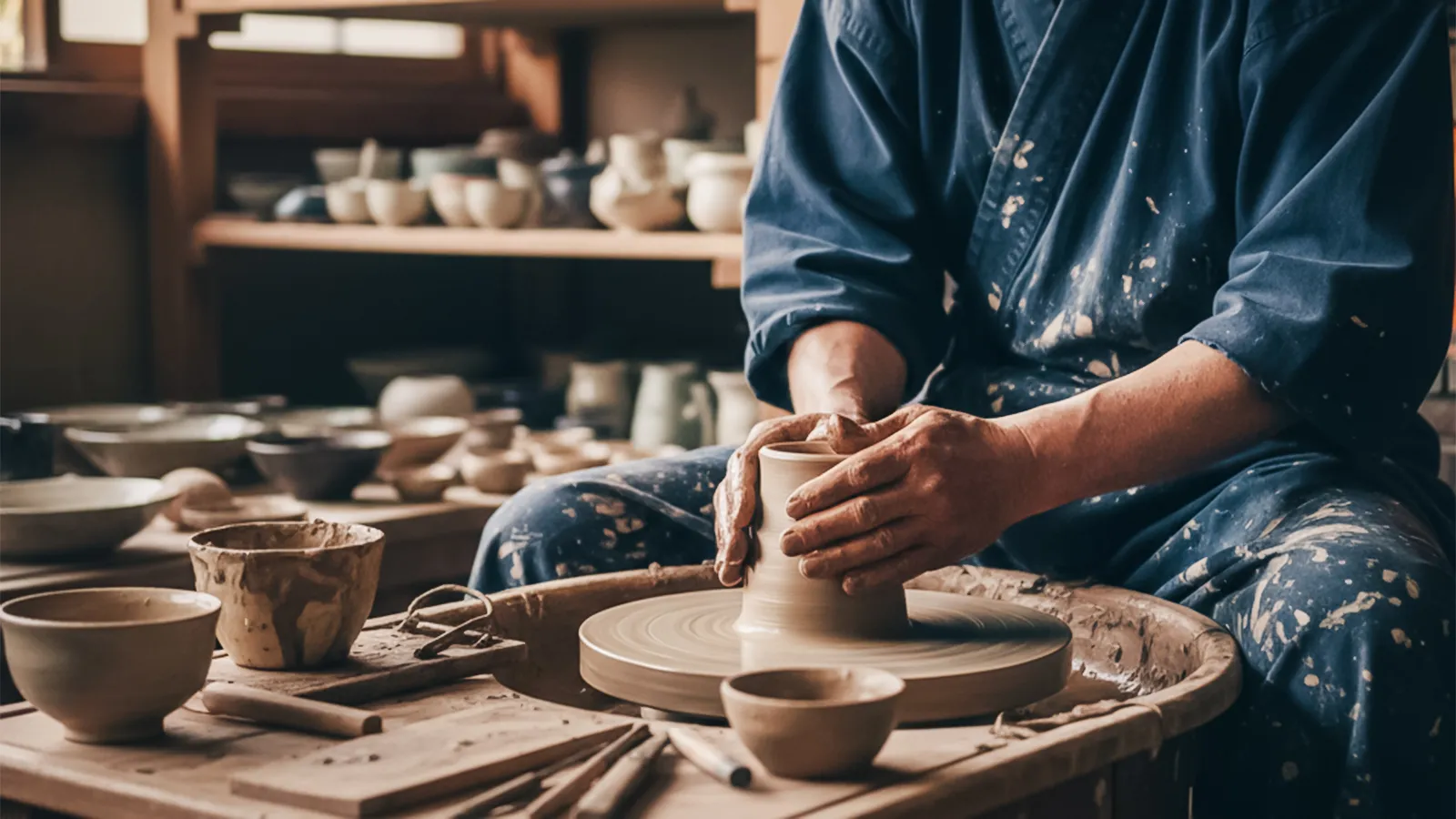
The history of Japanese ceramics has been shaped by master craftsmen who pioneered innovative techniques and aesthetic sensibilities in each era. Among them, ceramicists designated as “Living National Treasures” (Holders of Important Intangible Cultural Properties) are not merely possessors of advanced technical skills, but figures who have supported the very foundation of Japanese ceramics through establishing systematic techniques and nurturing successors.
This article carefully selects ten Living National Treasure ceramicists who left significant footprints in Japanese ceramic history, and organizes their representative techniques, artistic styles, and key evaluation points.
Table of Contents
Ten Living National Treasure Ceramicists | Masters Who Shaped Japanese Ceramic History
Japanese ceramic history has been richly shaped by regional clay, fire, and the philosophy of makers. Among them, ceramicists designated as “Living National Treasures” (Holders of Important Intangible Cultural Properties) embody not only technical excellence but also spirituality and cultural value.
In this chapter, we highlight representative Living National Treasure ceramicists who determined the course of Japanese ceramics from among many masters.
Shoji Hamada (Mingei Pottery / Mashiko) | The Origin of Folk Craft Pottery Embodying Beauty in Use
Shoji Hamada was a ceramicist representing the Mingei (folk craft) movement who established the value concept of “beauty in use” in modern Japanese ceramics. Based in Mashiko, Tochigi Prefecture, he embodied the philosophy that beauty dwells in vessels used in daily life.
Hamada’s works are characterized not by eccentric forms but by simple, powerful shapes and the expression of natural glazes. Influenced by Korean and Okinawan crafts, he created landscapes where randomness and inevitability coexist through techniques such as hakeme (brush marks) and flowing glazes.
What’s important is that Hamada emphasized anonymity and communality rather than putting “authorship” at the forefront. This attitude greatly contributed to the development of Mashiko ware and continues to influence many ceramicists today. The concept that mingei pottery is not decorative items but tools for living has a universality that connects to contemporary craft movements.
Toyozo Arakawa (Shino / Seto-guro) | Rediscovery of Momoyama Ceramics and a Turning Point in Modern Ceramics
Toyozo Arakawa was a figure who dramatically changed the direction of modern ceramics by rediscovering Shino and Seto-guro from the Momoyama period, which had long been thought lost. He discovered ancient kiln sites in Kani City, Gifu Prefecture, and revived the essence of Momoyama ceramics in modern times based on knowledge gained there.
Arakawa’s Shino is characterized by a milky white surface from thickly applied feldspar glaze and simple iron-painted patterns, with scorching and warping from the flames also incorporated as景色 (landscape/aesthetic effects). This symbolizes a uniquely Japanese ceramic aesthetic different from industrial products seeking perfection.
He was designated a Living National Treasure in 1955, one of the early cases in the ceramic field. His achievement went beyond mere technical restoration, clearly demonstrating the ceramicist’s role of “excavating history and connecting it to the future.”
Osamu Suzuki (Shino) | The Pinnacle of Contemporary Shino Created by Fire and White
Osamu Suzuki is known as a ceramicist representing contemporary Shino, having elevated Shino ware expression to a new dimension. Based in Toki City, Gifu Prefecture, he built his own world through highly tense forms and firing while inheriting traditional Shino techniques.
Suzuki’s Shino is characterized by traces of fire lurking beneath thick white glaze, with reddish fire color and bold cracking radiating strong presence. While appearing rough at first glance, it is established through calculated clay selection and firing management, where one can sense a sophisticated balance between chance and control.
Designated a Living National Treasure in 1994, he proved that Shino ware is not a “past style” but an expression that continues to be updated in contemporary times. Highly valued in the collector market, it is positioned as one of the achievements of contemporary ceramics.
Toyo Kaneshige (Bizen Ware) | A Pioneer Who Elevated Bizen to the Realm of Modern Art
Toyo Kaneshige was a pioneering figure who elevated traditional Bizen ware to the context of modern art. Born in Imbe, Okayama Prefecture, he pursued expression that went beyond mere revival of everyday utensils while bearing the long history of Bizen ware, one of the Six Ancient Kilns.
Kaneshige’s works maximize the characteristics of Bizen ware, which uses no glaze, connecting the clay texture and landscapes such as goma (sesame) and hidasuki (fire cord) created by firing with the tension of the forms themselves. The refined and taut forms seen especially in jars and flower vessels clearly show an independence as decorative ceramics, drawing a clear line from mingei values.
Designated a Living National Treasure in 1956, he established a major turning point where Bizen ware expanded its evaluation axis from “craft” to “art.” His influence extends widely to successive Bizen ceramicists, forming the foundation of current Bizen ware evaluation.
Kei Fujiwara (Bizen Ware) | Avant-garde Spirit Carved Through Struggle with Clay
Kei Fujiwara is known as a ceramicist who introduced extremely avant-garde forms in Bizen ware. While learning under his teacher Baikei Mimura, Fujiwara maintained a powerful creative stance of confronting the clay itself.
Fujiwara’s works emphasize volume and distortion over refinement, possessing power as if challenging the limits of wheel forming. The rough textures and deep kiln changes created by firing are the result of extracting the materiality of Bizen ware to an extreme degree.
One can sense a will to “expose the power of clay and fire” rather than “beautifully arrange.” Designated a Living National Treasure in 1970, his evaluation lay not in conservative return to tradition but in expanding the possibilities of Bizen ware. Fujiwara’s existence strongly demonstrates that Bizen ware is not static tradition but an expression that can constantly be renewed.
Jun Isezaki (Bizen Ware) | Bold Firing Expression and Contemporary Scale
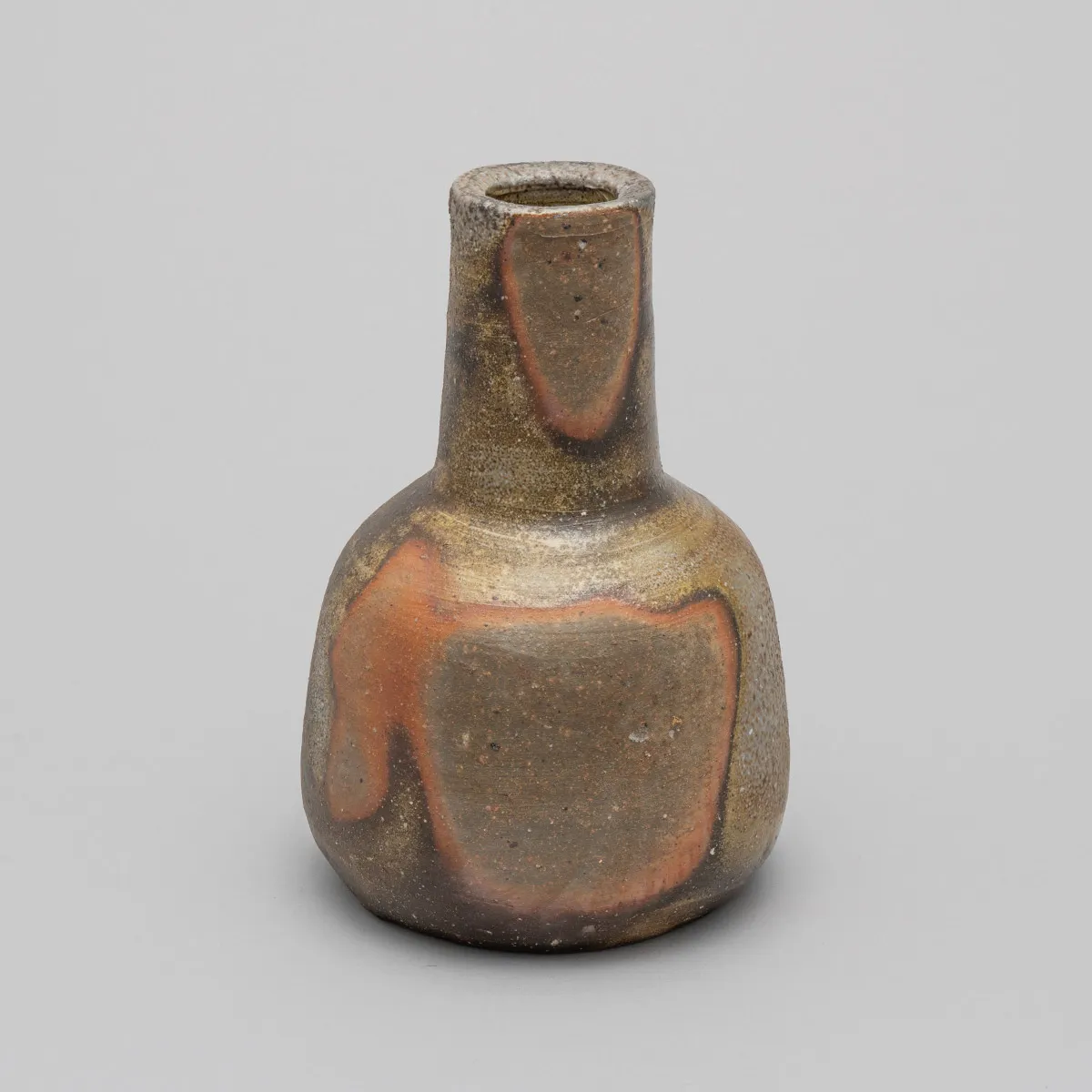
Jun Isezaki is a representative contemporary Bizen ceramicist who brought overwhelming scale and sculptural freedom to Bizen ware. Born into a prestigious Bizen family with Mitsuru Isezaki as his brother, he carved out unique expression.
Isezaki’s works include many large-scale pieces and sculptural forms, showing a direction clearly different from traditional vessel-centered Bizen ware. The intense kiln changes and bold scarlet color created by strong reduction firing are the result of actively incorporating fire as a sculptural element.
Designated a Living National Treasure in 2004, he was the fifth holder of Important Intangible Cultural Property in Bizen ware. This designation demonstrated domestically and internationally that Bizen ware is an expression that can dialogue with contemporary art. His body of work, suitable for public spaces and museum exhibitions, represents an important achievement in expanding Bizen ware’s possibilities into an international context.


Yuzo Kondo (Sometsuke) | Innovator Who Elevated Porcelain Underglaze Blue to Artistic Expression
Yuzo Kondo was an innovator who elevated porcelain sometsuke (underglaze blue) from “vessel decoration” to independent artistic expression. Through the strength and delicacy of lines and surfaces painted with gosu (cobalt oxide) and the design of negative space, he created pictorial depth in vases and large plates.
Particularly in Kyoto, in an era when “copies” of Chinese ko-sometsuke and shonzui were central, he is valued for establishing originality with neither realistic nor patterned, but free-flowing brushwork and bold composition. In his representative works, deep gosu sinks beneath the glaze while maintaining blue brilliance after firing, with the brush’s momentum becoming the landscape itself.
In appreciation, understanding deepens by observing the wavering of contour lines, gradations of shade, contrast with the white of the body, and the tension with the vessel form (such as the rise of the rim and bulge of the body). Also, since gosu changes color during firing, a sense of reverse-calculating the completed image from the sketch stage is essential. Kondo’s work became a bridge from craftsman-like reproduction to “contemporary sometsuke” where the creator’s compositional ability comes to the forefront. In collections, the pictorial composition of large plates is most easily understood, with high suitability for wall display.
14th Imaizumi Imaemon (Iro-Nabeshima) | Innovator Who Elevated Iro-Nabeshima to Contemporary Art
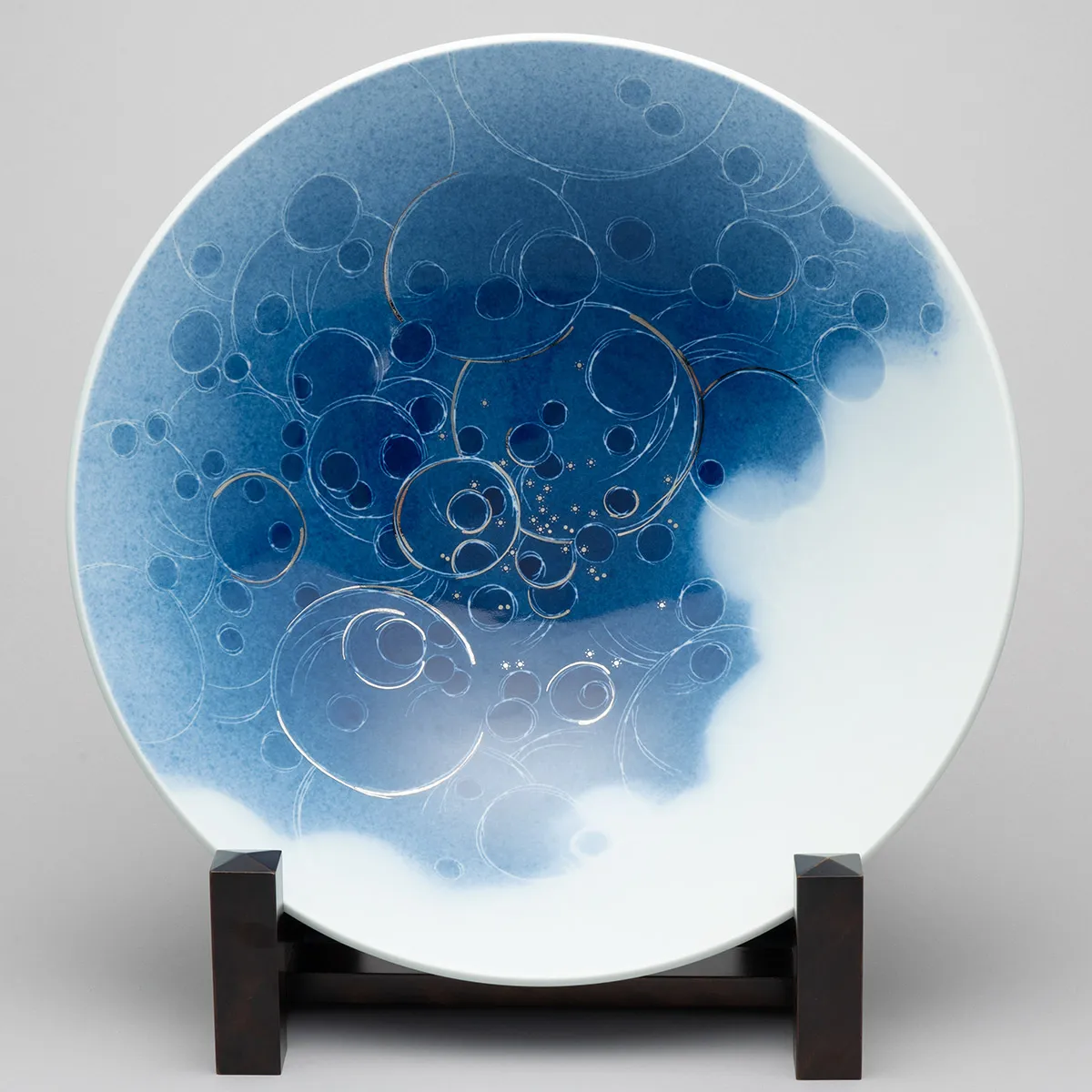
The 14th Imaizumi Imaemon was born in 1962. Born into the prestigious Imaizumi family of iro-Nabeshima with 370 years of history since the Edo period, he is an artist who inherited the tradition of color-painted porcelain while updating it to contemporary sculptural beauty. In 2014, at the historically youngest age of 51 for a ceramicist, he was designated as a holder (Living National Treasure) of Important Intangible Cultural Property “Iro-e Jiki” (color-painted porcelain). He inherited iro-Nabeshima techniques and color paint formulation techniques (secret methods passed from father to son) from his father, the 13th, and established his own world of expression by adding contemporary sensibility on top.
The 14th’s iro-Nabeshima, while based on precise overglaze painting, the beauty of negative space, and color development control, enhances strength as decorative ceramics through reinterpretation of traditional patterns and contemporary compositional openness, spacing, and rhythm of repetition. Employing unique techniques such as “sekkabokihajiki” (resist technique for white spaces), as well as light ink, blown ink, green ground with gold decoration, and platinum decoration. In the actual work, a world emerges where the sharpness of contour lines, overlapping colors, transparency of the glaze surface, and “quietness” of the white ground integrate.
The production process of color-painted porcelain is multilayered (forming, bisque firing, glazing, main firing, overglaze painting, overglaze firing), and management ability at each stage directly connects to the work’s quality. As a kiln that handles all processes, the 14th pursues perfection in details from the density of the body to temperature control of overglaze firing.

Manji Inoue (White Porcelain) | White Porcelain Expression Pursuing Ultimate Simplicity
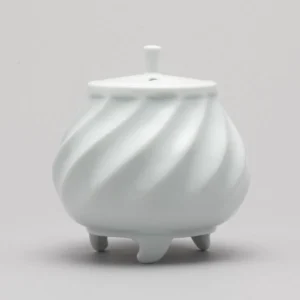
His white porcelain is known for forms that pare down elements to the ultimate and precision of the glaze surface. White porcelain cannot be disguised with decoration, and the uniformity of the body, wheel rotation precision, drying unevenness, and anticipation of firing shrinkage directly connect to the work’s value. In this demanding world, Inoue pursued “axis alignment” where curves from rim to body continue without stagnation, completing vessels whose center doesn’t waver from any angle.
The hard, clear white leveraging Arita’s porcelain clay and high-temperature firing characteristics creates shadows within the white as slight undulations emerge depending on how light hits it. In appreciation, the essence of the work becomes visible by following not the “line” of the contour but the tension of the surface, thinness of the rim, depth of the interior, and gradation of shadows. For everyday white porcelain, perspectives of “use” such as stability of center of gravity and comfort at the lips are also important. The true value of white porcelain lies not only in “absence of flaws” but in the breathing of form. Only by feeling how it settles in the hand does the value of Manji Inoue’s white porcelain truly convey.

Akihiro Maeta (White Porcelain) | The Achievement of Contemporary White Porcelain Combining Serenity and Tension
Akihiro Maeta was born in Tottori Prefecture in 1954, and after studying ceramics at Osaka University of Arts in 1977, chose the path of self-teaching in his hometown without a master. While harboring a strong longing for white porcelain, he faced 14 years of continuous trial and error and failure. Winning the Excellence Award at the Japan Ceramic Art Exhibition at age 37 became a turning point, after which he continued to deepen his white porcelain expression. In 2013, at age 59, he was designated as a holder (Living National Treasure) of Important Intangible Cultural Property “White Porcelain.”
His white porcelain is valued as an achievement of contemporary white porcelain where serenity and taut tension coexist. In addition to the precision of wheel forming, he delicately controls light and shadow through slight undulations of surfaces and the way ridge lines are raised. Fully aware of the difficulty of white porcelain where the same form can show different expressions depending on firing conditions, he established strength as decorative ceramics by achieving both well-proportioned forms and clear white.
Because it is undecorated, the “slight differences” in sculptural elements such as the sharpness of the rim, bulge of the body, and settlement of the foot determine the work’s quality. While his works are collected by international museums such as the British Museum and Switzerland’s Ariana Museum, the effectiveness of minute surface undulations becomes apparent when viewed up close, combining scale that stands out in museum exhibitions.

How to View Living National Treasure Ceramicists | Perspectives on Appreciation, Collection, and Market Evaluation
Having introduced ten Living National Treasure ceramicists in the ceramic field, what’s important is not just “who you know” but “how you see and evaluate them.” Works by Living National Treasures are not merely expensive art objects but cultural assets that condense technique, philosophy, and period characteristics.
Below, we organize how to interpret Living National Treasure ceramics from three perspectives: sculptural and technical viewpoints to grasp during appreciation, evaluation criteria in the collector market, and how craft businesses and enthusiasts can connect them to the next generation.
Appreciation Points Interpreted from Technique and Sculpture
When appreciating ceramic works by Living National Treasures, it’s important to focus on the inevitability of technique and sculpture rather than decoration or fame. For example, with white porcelain, the artist’s ability appears not in the uniformity of glaze but in the tension of surfaces, treatment of the rim, and how shadows emerge when receiving light.
With Bizen ware, one should look at how form and firing mesh rather than whether kiln changes like goma or hidasuki “happened to come out beautifully.” With sometsuke and iro-e, the speed of lines, design of negative space, and tension between vessel form and painting are key appreciation points. At the Living National Treasure level, all elements are established at a high standard, but the true value appears in “what has been pared away.”
Forms that don’t require excessive explanation, absence of breakdown, and a sense of balance that doesn’t tire even after long viewing—these are the work of masters.
Evaluation and Price Formation in the Collector Market
Ceramic works by Living National Treasures receive stable evaluation in domestic and international collector markets, but prices are not uniform. What affects evaluation includes multiple factors such as production period, work genre (tea ceramics, flower vessels, large works), condition, exhibition history, and whether featured in catalogues.
For example, even with the same artist, ambitious works from before the mature period or pieces where representative techniques clearly appear tend to receive higher evaluation. Also, in overseas markets, since the “Living National Treasure” system itself is unique to Japan, how carefully one can explain techniques and historical background directly connects to price formation.
Recently, demand is increasing for sculptural and decorative forms rather than practical works, with connectivity to contemporary art becoming one evaluation criterion. When collecting, understanding not just the price but where the work stands within the artist’s oeuvre will lead to long-term satisfaction.
Ideas for Utilization and Communication to Pass On to the Next Generation
To pass Living National Treasure ceramics to the next generation, not only “preservation” but “utilization” and “communication” are essential. Not limited to museum exhibitions, by actually using them, placing them in spaces, and combining them with contemporary architecture and interiors, works acquire new contexts.
Craft businesses and galleries can broaden international understanding by organizing production backgrounds and techniques as narratives and communicating not only in Japanese but also in English. Also, with photos and videos, ingenuity is required to complementarily convey information such as texture, weight, and light reflection.
Works by Living National Treasures are not “completed past” but existences that continue to dialogue with contemporary life and aesthetic sensibilities. Continuously updating their value is the most practical method of connecting ceramic culture to the future.
Influence on Contemporary Ceramics and Current Evaluation
The techniques and philosophies built by Living National Treasure ceramicists continue to deeply influence current contemporary ceramics. This goes beyond mere technical inheritance, existing as figures who pose fundamental questions to successor artists and viewers such as “What is ceramics?” and “Where is the boundary between craft and art?”
Also, in recent years, not only domestic evaluation but positioning in overseas museums and international exhibitions has gained importance. Here, we organize the influence that Living National Treasures have had on contemporary ceramics from three perspectives: artist development, international evaluation, and the significance of the system itself.
Technical and Philosophical Influence on Successor Artists
The influence that Living National Treasure ceramicists have given to successors can be broadly divided into specific technical inheritance and the creative stance itself. For example, in fields such as Bizen ware, Shino, and white porcelain, fundamental techniques such as clay selection, forming precision, and firing management have been highly systematized and shared with disciples and entire regions.
However, what’s more important is the philosophical aspect of “why use that technique?” Shoji Hamada’s beauty in use, Toyozo Arakawa’s historical rediscovery, and Manji Inoue’s thorough simplicity showed successor artists a creative axis that doesn’t pander to trends or markets.
As a result, in contemporary ceramics, artists who assert originality in sculpture, scale, and exhibition methods while building on traditional techniques have increased. The existence of Living National Treasures functions not as “forms” to imitate but as reference points for thinking.
Evaluation and Positioning in Overseas Museums and International Exhibitions
In recent years, ceramic works by Living National Treasures have also occupied important positions in overseas museums and international exhibitions. In Western museums, cases of introducing Japanese ceramics not as “decorative crafts” but as sculptural expression on par with sculpture and contemporary art have increased.
Especially works of white porcelain and Bizen ware are valued for their minimalist forms and strength of materiality having affinity with the context of modern art. On the other hand, since the “Living National Treasure” system itself is not sufficiently understood overseas, carefully translating and contextualizing techniques and historical backgrounds is essential.
In international exhibitions, individual expression as artists tends to be emphasized, with sculptural persuasiveness of works rather than titles being questioned. In this regard, Living National Treasure ceramicists have shown completeness that can withstand evaluation without relying on the system.
Meaning and Challenges of the “Living National Treasure” System
The Living National Treasure system is an important mechanism for protecting Japan’s intangible cultural properties and passing them to the next generation. In the ceramic field, it has played a role in preventing discontinuation of techniques and supporting regional culture. On the other hand, fixation of selection criteria and evaluation tending to be biased toward past achievements are pointed out as challenges.
Contemporary ceramics has expanded its expressive territory, with installations and fusion with different materials also progressing, so artists who cannot be fully evaluated within conventional frameworks have increased. Still, the symbolism that the Living National Treasure title possesses remains significant, playing a role in guaranteeing the credibility of Japanese crafts domestically and internationally.
Going forward, the question will be how to utilize the system as an open cultural asset rather than fixing it as “authority.” Living National Treasures in ceramics have reached a stage where they are being reinterpreted as existences that contain questions for the future, not past honors.
Conclusion
This article organized the flow of Japanese ceramic history, the technical and philosophical significance of each artist, and evaluation in contemporary times, centered on ten Living National Treasure ceramicists in the ceramic field. From Shoji Hamada who embodied mingei philosophy to masters who brought innovation in diverse fields such as Bizen, Shino, white porcelain, sometsuke, and iro-Nabeshima, they are not merely inheritors of tradition but existences who updated the value of ceramics itself in their respective eras.
Also, the Living National Treasure system is simultaneously a framework for technical preservation and an important cultural apparatus connecting to contemporary ceramics and international evaluation. In appreciation, collection, and business utilization, perspectives that comprehensively interpret sculpture, technique, and background without relying only on titles are essential. Knowing Living National Treasure ceramicists is an entry point for thinking that connects Japanese craft culture from past to future and serves as an effective guideline even in contemporary times.
