

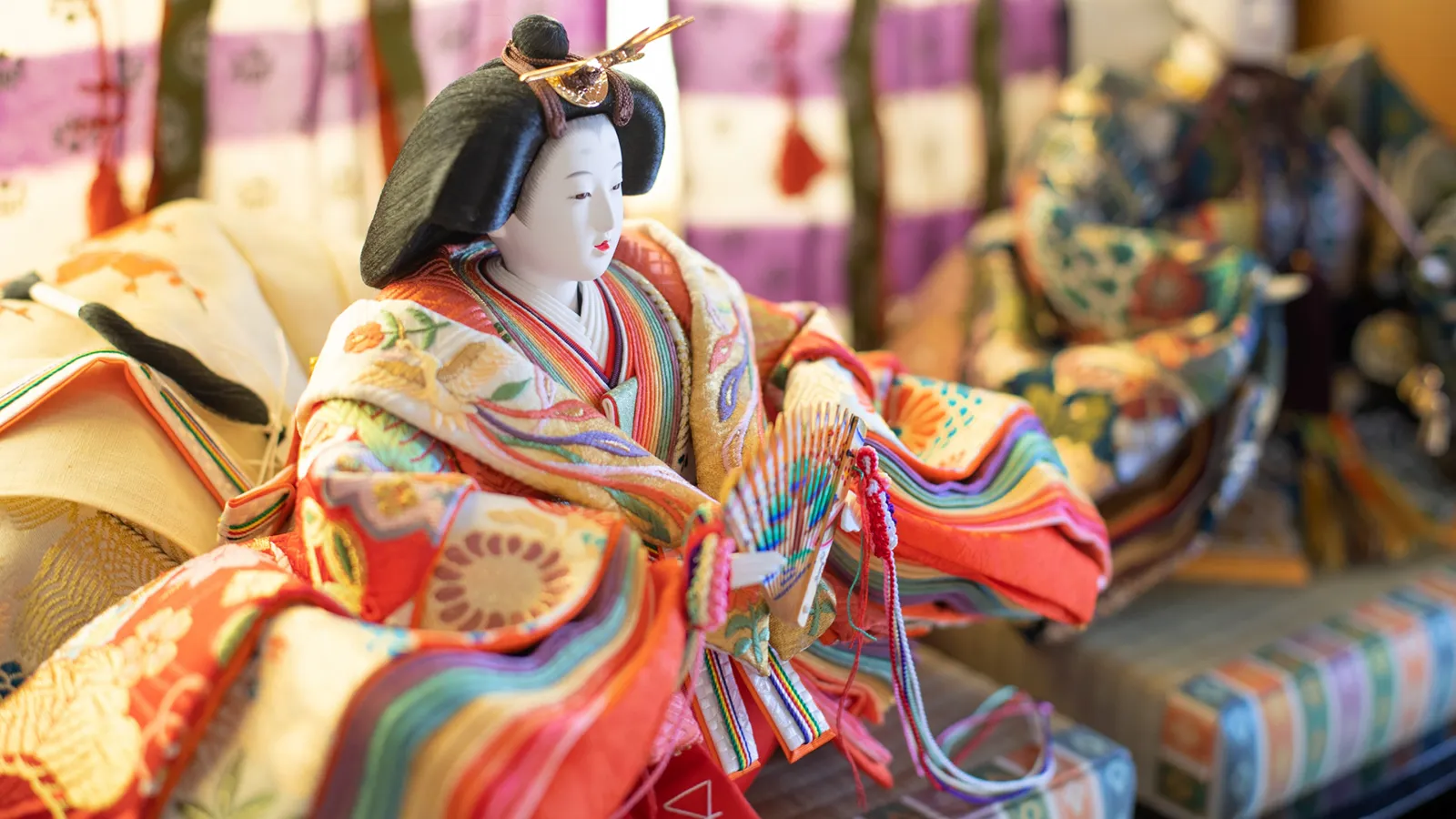
Kyō ningyō (Kyoto dolls) is a collective term for Japanese dolls nurtured within Kyoto’s imperial court culture and townspeople’s culture, representing traditional crafts established through delicate artistry and highly specialized division of labor. With diverse lineages including hina dolls and gosho dolls, these creations embody Kyoto’s unique aesthetic sensibility in every aspect—from facial features and costumes to construction and coloring.
Their distinctive characteristic lies in valuing elegance and restraint over realism, earning recognition as embodiments of Japanese “kata” (forms) and spirituality. In recent years, they have been reevaluated not only as objects of appreciation but also from cultural and craft history perspectives. This article provides a detailed exploration of the essence of Japanese doll culture through the origins, aesthetic beauty, and technical structure of Kyoto dolls.


Table of Contents
What Are Kyō Ningyō? Japanese Doll Culture Embodying Kyoto’s Aesthetic Sensibility
Kyō ningyō is a collective term for Japanese doll culture that developed centered in Kyoto, not referring to a single style or technique. While encompassing diverse doll categories such as hina dolls, ichimatsu dolls, and gosho dolls, they share the common characteristic of strongly reflecting “Kyoto’s aesthetic sensibility.”
By fusing the elegance derived from aristocratic culture with the refined decorative qualities cultivated by merchant culture, Kyoto dolls became established as highly appreciable crafts. Here, we examine their essence from three perspectives: organizing the definition of Kyoto dolls, the cultural background of Kyoto as a city, and the role these dolls have played.
Definition of Kyō Ningyō: A Collective Term Represented by Hina, Ichimatsu, and Gosho Dolls
Kyō ningyō is not a name referring to one specific type of doll, but rather a collective term encompassing all Japanese dolls created and developed in Kyoto. Representative examples include hina dolls connected to court ceremonies and seasonal festivals, ichimatsu dolls combining realism with charm, and gosho dolls beloved in aristocratic society.
What these share is not only the sophistication of materials and techniques, but also refined expression that avoids excessive exaggeration. Facial features are gentle, coloring is restrained, and even costumes and postures are designed with negative space in mind. While Kyoto dolls “model human forms,” they prioritize elegance and symbolism over realism, distinguishing them from regional dolls and toy dolls. This collective nature is an important premise for understanding Kyoto dolls as a unified cultural sphere.
The Unique Historical Background Where Aristocratic and Merchant Cultures Intersected in Kyoto
The unique development of Kyoto dolls stems from the special cultural environment of Kyoto itself. As the long-standing capital, Kyoto nurtured court arts based on aristocratic culture while simultaneously developing a highly refined merchant culture. In doll making as well, the formal expressions used in court rituals and seasonal ceremonies intersected with the familiarity rooted in townhouse life.
This resulted in creations that were luxurious yet maintained dignity. Additionally, Kyoto had established foundations for craft production through division of labor, with head makers, costume makers, tool makers and others honing their specializations. This highly developed division of labor system elevated the overall quality of the dolls and served as a crucial factor in establishing Kyoto dolls as comprehensive crafts.
The Role of Kyō Ningyō as “Display Dolls”
Kyoto dolls developed as “display dolls” rather than children’s toys. Hina dolls symbolize prayers and rites of passage during seasonal festivals, while ichimatsu and gosho dolls were often treated for appreciation and gift-giving purposes. Therefore, beauty of appearance and harmony with space were emphasized over durability and mobility.
The design of postures and gazes, premised on placement in tokonoma alcoves or sitting rooms, is a distinctive feature of Kyoto dolls. Even today, Kyoto dolls are being reevaluated as objects for interior decoration and artistic appreciation. Rather than mere folk toys, they continue to embody Kyoto’s aesthetic sensibility as presences that bring quiet tension and narrative quality to spaces.
The Advanced Division of Labor Supporting Kyō Ningyō
Behind Kyoto dolls’ sustained high quality and dignity lies an extremely refined division of labor system. Rather than a single artisan handling everything, specialists take charge of each process, establishing the dolls as comprehensive crafts.
This division of labor exists not for efficiency but as a mechanism to elevate the technique and aesthetic sensibility of each process to the utmost limit. Here, we delve into the structure of specialized differentiation supporting Kyoto doll production, the spirituality of facial painting that governs expression, and the aesthetics of materials and patterns in costume creation.
The Structure of Specialized Differentiation by Head Makers, Costume Makers, Body Makers, and Finishers
The production process of Kyoto dolls is broadly handled by specialists such as head makers, hair attachers, hand and foot makers, accessory makers, and costume dressers. Head makers create the doll’s face and head, forming the foundational expression through gofun coating and carving. Hair attachers plant black silk threads one by one into the head and arrange the hairstyle. Hand and foot makers insert wire into fingers, build them up with gofun, and paint details down to the fingernails.
Accessory makers create small items suited to the doll, such as fans, shaku (ceremonial batons), and bows. Costume dressers prepare the framework of the body, then cut, tailor, and dress the doll in pure silk garments, determining the overall impression. Only when the achievements of each process are unified does a high-quality Kyoto doll finally come to completion. This division of labor structure is not mere role distribution but is sustained by collaborative relationships respecting each other’s skills, symbolizing the maturity of Kyoto’s craft culture.
Facial Expression and Spirituality Embodied in Face Painting
One element determining the impression of Kyoto dolls is the facial expression created through face painting. Face painting is handled by head makers or specialized painters, who express the doll’s inner nature through minimal brushwork on eyebrows, eyes, and mouth. The expressions of Kyoto dolls do not strongly assert joy, anger, sorrow, or pleasure, but rather retain ambiguity that can be interpreted diversely according to the viewer’s emotions.
This restrained expression can be said to be the core of Kyoto’s aesthetic sensibility. Face painting demands high concentration and spirituality, as hesitation at the moment of applying the brush directly manifests in the expression. Therefore, it is a process that questions not only technique but also the maker’s state of mind. The quiet presence of Kyoto dolls is supported by this spiritually-imbued facial expression.
Pure Silk, Yūsoku Patterns, and Color Sensibility in Costume Creation
Costume creation for Kyoto dolls is a process where material selection, patterns, and color sensibility are highly integrated. The fabric used is primarily pure silk, whose luster and texture elevate the overall dignity of the doll. Patterns frequently employ yūsoku (court) patterns and classical designs, not as mere decoration but with conscious awareness of relationships to status, seasons, and rituals.
Additionally, colors are vibrant yet subdued, creating depth through layering multiple hues. The sophisticated sensibility required to adjust pattern scale to match the doll’s size is also demanded, strongly reflecting the costume maker’s capabilities. Kyoto doll costumes are not mere dress-up elements but rather an expressive domain condensing Kyoto’s dyeing and weaving culture and aesthetic sensibility, serving as a crucial element establishing the doll as comprehensive art.
The Sculptural Beauty and Stylistic Characteristics of Kyō Ningyō
The appeal of Kyoto dolls lies not only in detailed craftsmanship but in the serene sculptural beauty permeating the whole. The emphasis on appearances that harmonize with the viewer’s gaze and space, while avoiding excessive decoration and emotional expression, distinguishes them from dolls of other regions.
Here, we organize the unique stylistic beauty of Kyoto dolls through the aesthetic sensibility embedded in facial features, the “static” sculptural form created by posture and center of gravity, and differences in sculptural philosophy from Edo and Iwatsuki dolls.
The Aesthetic Sensibility Embedded in Refined and Gentle Facial Features
The facial features of Kyoto dolls are characterized by gentleness that does not strongly assert emotion. Eyes and mouths are kept small, leaving space through subtle angles and line variations for expressions to change according to the viewer’s emotions. This is sculptural form intended to be a presence that quietly resonates with the viewer’s inner self rather than fixing specific narratives or emotions.
The white of gofun is not made excessively bright, but creates depth of expression responsive to changing light through soft shadows. Kyoto doll faces are not “beautifully painted” but rather “create a state where beauty emerges,” embodying Kyoto’s aesthetic sensibility of restraint and implication. This understated expression supports the dignity that remains engaging even after prolonged viewing.
“Static” Sculptural Form Created by Posture, Center of Gravity, and Overall Balance
What is emphasized in Kyoto doll sculptural form is stability over movement. Whether standing or sitting, the center of gravity is low, with natural, unstrained appearances constructed through slight forward lean or neck angle. This is because designs are premised not only on the beauty of the doll itself but on harmony with Japanese architectural spaces such as tokonoma alcoves and sitting rooms.
The volume of costumes and spread of sleeves are also calculated as elements supporting posture, with meticulous attention paid to maintaining overall balance. This “static” sculptural form aims not to attract gazes through staging but to radiate presence while blending into the space. Kyoto dolls can be said to be crafts that change the quality of space without movement.
Differences in Sculptural Philosophy from Dolls of Other Regions (Edo and Iwatsuki)
To understand the sculptural philosophy of Kyoto dolls, comparison with dolls from other regions is useful. Edo dolls tend to emphasize realism and narrative quality, giving clear individuality to expressions and movements.
Meanwhile, Iwatsuki dolls developed through mass production and standardization of hina dolls, characterized by brilliance and high completeness.

Additionally, the greatest characteristic of Hakata dolls is their delicate handcrafted sculptural form and soft expressions. By carefully painting the unglazed white ceramic skin by hand, each piece is finished with distinct individuality.

In contrast, Kyoto dolls prioritize overall harmony rather than asserting individual elements. Face, posture, and costume all remain at a reserved level of expression, forming dignity as a totality. This difference is not about superiority but about the direction of aesthetic pursuit. Kyoto dolls are crafts that complete themselves together with viewers and spaces, and this quiet sculptural philosophy continues to convey Kyoto’s cultural foundation to the present.
Representative Types of Kyō Ningyō
Kyoto dolls do not conform to a uniform style but have developed diverse types according to purpose and historical background. While all share Kyoto’s aesthetic sensibility as their foundation, they reflect different contexts such as court ceremonies, celebratory culture, and period customs.
Here, we examine three representative types—yūsoku hina, gosho dolls, and ichimatsu/maiko dolls—organizing their sculptural characteristics and cultural roles. By surveying these, one can understand that Kyoto dolls are not merely a collection of dolls but a microcosm of Kyoto culture.
Yūsoku Hina: Prestigious Hina Dolls Depicting Court Ceremonies
Yūsoku hina are considered the most prestigious hina dolls, faithfully depicting Kyoto’s court ceremonies and aristocratic culture. Costumes are based on yūsoku attire, with strict significance assigned to patterns and color usage, while the paired male and female placement and postures reflect the order of court rituals. Facial features emphasize elegance over realism, characterized by gentle, restrained expressions.
This is because hina dolls are not individual portraits but symbols of an idealized court world. In addition to their role as seasonal festival decorations, yūsoku hina also function as appreciable crafts conveying Kyoto’s costume culture and aesthetic sensibility. In recent years, modern interpretations have progressed, including simple compositions adapted to spaces rather than limited to tiered displays.
Gosho Dolls: Celebratory Dolls Symbolized by White Skin and Soft Sculptural Form
Gosho dolls are Kyoto dolls notable for their rounded, soft sculptural form and white skin created with gofun. Originally used in the imperial court and aristocratic society as gifts for birth celebrations and auspicious occasions, they are sculpted not as realistic children but as symbolic presences of innocence and health, characterized by simple postures and restrained decoration.
Wearing minimal clothing, the volume and curves of the skin itself become the center of beauty, strongly demanding sculptural precision. Among Kyoto dolls, gosho dolls have particularly high abstraction and are being reevaluated from modern sculptural perspectives. Beyond their role as celebratory dolls, the reason they attract domestic and international attention as objects of appreciation with quiet presence lies here.
Ichimatsu Dolls and Maiko Dolls: Expressions Changing with the Times
Ichimatsu dolls and maiko dolls are presences that have strongly reflected the characteristics of their eras among Kyoto dolls. Ichimatsu dolls, while possessing realistic elements depicting children, maintain the refined expressions and balanced sculptural form characteristic of Kyoto dolls.
Meanwhile, maiko dolls, as presences symbolizing Kyoto’s geisha district culture, incorporate brilliance into costumes, hairstyles, and standing poses.
These dolls continue to update their expressions in response to changing trends and aesthetic sensibilities of the times, not remaining fixed in established styles. They serve as excellent examples demonstrating that Kyoto doll culture is not merely about “preserving tradition” but also “accepting change.” Ichimatsu and maiko dolls continue to convey to the present that Kyoto dolls are a living culture.
Practical Perspectives for Appreciation and Collecting
The value of Kyoto dolls is not determined solely by their immediate visual brilliance. Overall completeness becomes important, including the dignity of facial features, costume tailoring, material selection, and structure that maintains integrity over long periods. Furthermore, evaluation changes significantly depending on the maker, production period, and state of preservation.
Here, from the perspective of viewers and collectors, we organize specific points for discerning quality Kyoto dolls and practical perspectives essential for long-term preservation and display.
Points for Identifying Quality Kyō Ningyō: Face, Costume, and Construction
When identifying quality Kyoto dolls, the first focus should be facial expression. Check whether the balance of left and right eyes and eyebrows is overly symmetrical, or whether natural presence exists within slight asymmetry. Next, in costumes, the texture of pure silk, dignified pattern placement, and harmony between colors are important. The standard for evaluation is not flashiness but depth and composure when layered.
In terms of construction, examining whether there is strain in sleeve and hem processing and joints with the body reveals the maker’s skill. Higher quality Kyoto dolls maintain quiet tension without breaking down from any viewing angle. The point of Kyoto doll appreciation is that completeness of details directly connects to overall dignity.
How to Verify Box Inscriptions, Maker’s Marks, and Production Period
When evaluating Kyoto dolls as collectibles, verification of box inscriptions and maker’s marks is essential. Box inscriptions on original boxes become important clues for knowing the maker or workshop name, work title, and purpose. However, since replacement boxes and rewritten inscriptions exist, careful judgment is necessary including brushwork, paper quality, and signs of aging.
Regarding maker’s marks, formats vary, including those inscribed on the head or inside the body, and attached certificates. Production periods are often not clearly recorded, so comprehensive estimation from costume pattern tendencies, facial feature styles, and construction techniques is necessary. The attitude of verifying while consulting trustworthy specialty shops and research materials will enhance collection quality.
Preservation and Display Precautions: Humidity, Light, and Pest Control
The most important aspect of Kyoto doll preservation and display is environmental management. Gofun and pure silk are vulnerable to humidity changes, with high humidity causing mold and low humidity causing cracking and peeling. The ideal humidity is around 50-60%, with avoiding rapid changes being fundamental. Additionally, direct sunlight and strong lighting cause fading of coloring and dyeing, requiring caution. When displaying, indirect lighting and short-term exhibition are advisable.
For pest control, avoid direct use of insect repellents and store in boxes or cases with high sealing properties. While Kyoto dolls are crafts “to be enjoyed through display,” they are also delicate cultural properties. To convey their beauty to the next generation, awareness that handling methods themselves are part of appreciation is important.
Contemporary Developments of Kyō Ningyō
While based on styles and division of labor cultivated through long history, Kyoto dolls are showing new developments in response to modern living environments and international perspectives. No longer limited to seasonal festival decorations or tokonoma alcoves, their value is being updated through reinterpretation in the context of living spaces and art exhibitions.
Here, we organize the current position of Kyoto dolls from three perspectives: harmony with contemporary spaces, international evaluation, and the balance between tradition and change.
Works Conscious of Harmony with Contemporary Spaces and Interiors
Recent Kyoto dolls increasingly feature works conscious of harmony with modern residences and gallery spaces. Rather than large, brilliant tiered displays, there is a trend toward selecting sculptural forms that stand alone or costume compositions with restrained color palettes. This is because, with minimal spaces becoming mainstream regardless of Japanese or Western style, it is necessary to carefully adjust the visual load dolls place on spaces.
Postures and gaze angles are also designed assuming wall display or shelf placement, with detailed expression emphasized on the premise of closer viewing distances. Through such initiatives, Kyoto dolls are expanding their role from “crafts for ceremonies” to “art crafts placed in everyday spaces.”
International Evaluation and Role as Symbols of Japanese Culture
Internationally, Kyoto dolls are increasingly attracting attention as symbols of Japanese culture. Particularly, the restrained expressions and quiet appearances are evaluated as aesthetic sensibilities different from Western realistic sculpture, and are introduced in museum exhibitions and cultural exchange projects. Hina dolls and gosho dolls, when introduced alongside backgrounds of seasonal festivals and celebrations, serve as mediators conveying the spiritual role of dolls in Japanese society.
However, to avoid ending as merely exotic displays, careful explanation of production techniques, division of labor, and material significance is essential. Kyoto dolls can be said to function as cultural devices conveying not only visual beauty but also Japanese values and temporal sensibilities.
The Current Position of Kyō Ningyō: Preserving Tradition While Embracing Change
Contemporary developments of Kyoto dolls can be understood as attempts to reconsider methods of succession rather than denying tradition. While maintaining core styles such as facial features and postures, they are expanding points of contact with contemporary society by allowing flexibility in material selection, display methods, and purpose proposals.
Additionally, participation of young artisans and collaboration between workshops, designers, and art professionals are creating possibilities for new expression. Kyoto dolls are not completed crafts of the past but a culture that continues to explore optimal forms for each era. Their current position can be characterized as crafts equipped with the strength to accept change while centering on quiet sculptural beauty.
Conclusion
Kyoto dolls are presences forming the core of Japanese doll culture, condensing the aesthetic sensibility and craft techniques nurtured by the city of Kyoto. The production system supported by advanced division of labor, sculptural beauty symbolized by restrained expressions and postures, and diverse developments including hina dolls, gosho dolls, and ichimatsu dolls have established Kyoto dolls not as mere decorative items but as comprehensive crafts.
Furthermore, in contemporary times, they are acquiring new roles through harmony with living spaces and art exhibitions, and cultural evaluation overseas. The essence of Kyoto dolls can be said to be the flexibility to update expression according to eras and viewing environments, not merely strictly preserving tradition. Understanding Kyoto dolls is the act of interpreting Kyoto’s aesthetic sensibility itself, serving as an important entry point for knowing the depth of Japanese crafts.
