

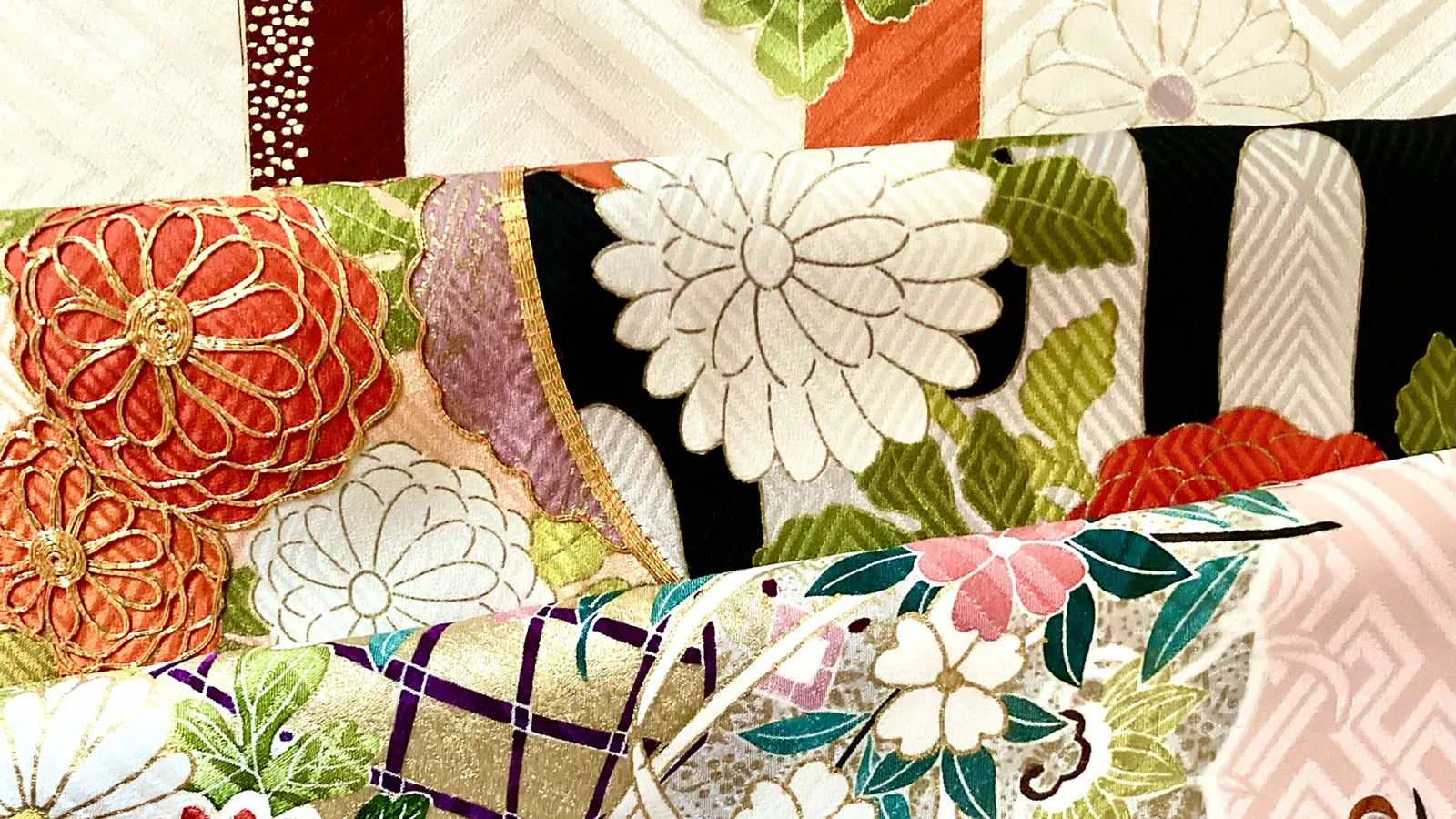
Kyo-Yuzen is a representative Japanese dyeing technique that developed against the backdrop of Kyoto’s townspeople culture and aristocratic aesthetic sensibilities. Its defining characteristics include the use of hand-drawn sketches and paste resist, with colors applied one at a time in a process that creates painterly expressions on fabric reminiscent of Japanese painting.
The realistic depictions of plants and flowers, classical patterns, and compositions that make skillful use of negative space embody Kyoto’s refined sensibilities. Today, Kyo-Yuzen is being reevaluated not only in kimono production but also in the fields of fine arts and contemporary design. This article provides an accessible explanation of Kyo-Yuzen’s essence, focusing on its origins, technical structure, and appeal as a pictorial dyeing art.
Table of Contents
What is Kyo-Yuzen? Kyoto’s Pictorial Dyeing Technique
Kyo-Yuzen is a representative Japanese dyeing technique that developed in Kyoto, positioned as a pictorial craft centered on “drawing patterns.” Unlike dyeing from other regions that primarily uses stencils, its major characteristic lies in the fundamentals of brush-based line drawing and color application.
As such, Kyo-Yuzen, while being a textile art, has developed as a craft with deep connections to painting and Japanese painting. Here, we’ll clarify the definition of Kyo-Yuzen, explore its relationship with the townspeople culture that formed its background, and examine the role it has played in kimono culture.
Defining Kyo-Yuzen: Its Position as “Dyeing Craft” That Draws Patterns
Kyo-Yuzen is a craft based on “dyeing techniques” that express colorful, painterly patterns on kimono. In hand-drawn Yuzen (tegaki-yuzen), outline lines are drawn on white fabric using paste resist, and colors are then applied inside with a brush, with the painterly expressiveness being a major characteristic. On the other hand, stencil Yuzen (kata-yuzen), which uses stencils to repeat patterns, has also developed since the Meiji period, and today’s Kyo-Yuzen encompasses both hand-drawn and stencil dyeing techniques.
In hand-drawn Yuzen, patterns are created individually for each piece, so the design, lines, and color scheme strongly reflect the maker’s sensibilities. In this respect, hand-drawn Kyo-Yuzen occupies a unique position as “painted dyeing,” distinct from woven textiles and mass-produced stencil dyeing. Patterns include plants and flowers, landscapes, and auspicious motifs, with emphasis placed on composition and color harmony reminiscent of paintings. Additionally, Kyo-Yuzen features vibrant multicolor use and high decorative qualities that sometimes incorporate gold leaf and embroidery, and its high level of aesthetic completion despite being a dyeing technique is what has elevated Kyo-Yuzen to a comprehensive artistic craft.
Origins: The Relationship Between Fan Painter Miyazaki Yuzen-sai and Townspeople Culture
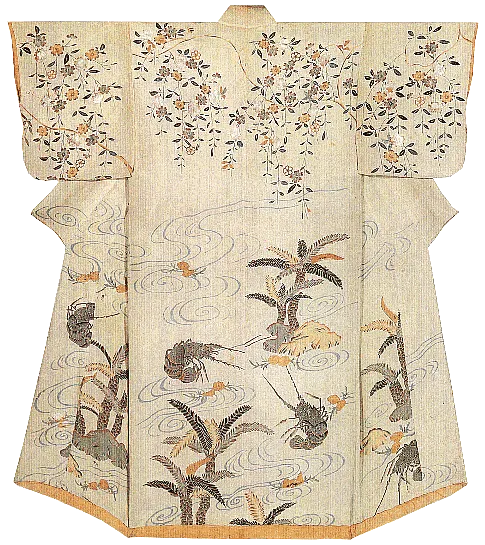
Meanwhile, in Kyoto at that time, against the background of aristocratic culture, dignity and refinement in dress, along with the expression of individuality through patterns, were valued. As this connected with such aesthetic sensibilities, sumptuary laws restricted and prohibited luxurious woven textiles, gold and silver foil printing, embroidery, and overall tie-dyeing (so-kanoko), leading townspeople to seek gorgeous dress as an alternative. Yuzen dyeing, which was not a direct target of these prohibitions, achieved visual richness comparable to luxurious woven textiles and gold and silver decorations through resist paste and multicolor expression, and was welcomed as something that satisfied the townspeople’s desire for beautiful clothing.
Furthermore, among the economically and culturally rising townspeople class, demand grew to demonstrate taste, culture, and aesthetic sensibility through dress, which also propelled the development of Kyo-Yuzen. Kyo-Yuzen can be said to be a craft born and nurtured in an environment unique to Kyoto, where court culture and townspeople culture intersected, and social constraints of sumptuary laws and the desire for beauty competed.
The Role Kyo-Yuzen Has Played in Kimono Culture
Kyo-Yuzen is a technique that made it possible to “wear as if viewing a painting” in kimono culture. Used primarily for formal wear and ceremonial dress, patterns and color tones have been carefully selected according to the wearer’s age, status, and occasion. The incorporation of seasonal elements and narrative qualities into patterns is a particularly distinctive feature of Kyo-Yuzen.
The compositional skill of arranging multiple motifs on a single kimono and calculating the flow of visual attention is deeply connected to Japanese painting concepts. Kyo-Yuzen has functioned not merely as a decorative technique but as a medium for expressing the wearer’s dignity and culture. This role has been cultivated alongside the maturation of kimono culture and continues to be passed down today as a craft symbolizing Kyoto’s aesthetic sensibilities.
The Advanced Division of Labor That Constitutes Kyo-Yuzen
The reason Kyo-Yuzen can achieve both pictorial perfection and extremely high precision lies in the division of labor that has been cultivated in Kyoto over many years. Rather than a single artisan handling everything, each process is undertaken by specialists, allowing techniques to be subdivided and expression to be refined to the extreme.
This division of labor is not a system for efficiency but a cultural device for “bringing a single bolt of kimono fabric to the highest standard.” Here, we’ll examine the structure of process differentiation, the actual number of artisans involved and production periods, and the depth of expression that exists precisely because of this division of labor.
Process Differentiation: Designer, Itome Paste Application, Color Application, Steaming, and Washing
Kyo-Yuzen production proceeds through clearly differentiated processes. First, the designer envisions the wearer and purpose, creating the pattern composition and color design. Next, in the itome paste application process, resist paste is applied along the pattern’s outline, defining the color boundaries. The precision of these lines greatly affects the final dignity of the piece.
In color application (sashi-yuzen), artisans use brushes to apply dyes one color at a time, adding dimension through gradation and shading. Subsequently, the steaming process fixes the dyes, and washing (mizu-moto) removes excess paste and dye. Each process is an independent specialized technique, and even slight errors in judgment can affect the whole, requiring high levels of experience and concentration.
The Reality of the Number of Artisans and Production Period for One Bolt
Completing one bolt of Kyo-Yuzen involves the participation of a dozen to sometimes nearly twenty artisans. The process from design creation to finishing is not linear but proceeds with verification and fine adjustments, so the production period often extends from several months to over half a year.
Particularly for ceremonial wear or high-ranking pieces, careful consideration is repeatedly given to seasonal expression and color matching. While this long production period may seem inefficient, each process being carried out at the optimal timing ultimately guarantees high completion quality. Kyo-Yuzen can be said to be a craft where taking time itself generates value.
Precision and Depth of Expression That Exists Because of Division of Labor
Kyo-Yuzen’s division of labor system is not something that fragments expression but rather a mechanism for deepening it. Each artisan’s dedication to their own process makes lines more beautiful, colors more clear, and overall composition more refined. Additionally, the tacit understanding and shared aesthetic sensibilities cultivated between processes create the final sense of unity.
This is a realm difficult to reach through consistent production by individual artists. The completion quality of Kyo-Yuzen is established not by adding individual techniques but through the synergistic effect of division of labor. This structure itself can be said to be the foundation that has supported Kyo-Yuzen as a comprehensive art rather than merely a dyeing technique.
Characteristics of Kyo-Yuzen as a Technique
The reason Kyo-Yuzen stands apart from other dyeing techniques is that the three elements of line, color, and decoration are highly integrated. Through the outline lines created by itome paste, delicate color expression through applied dyeing, and the addition of gold decoration and embroidery, painterly and decorative completion is achieved despite being dyeing.
Here, we’ll examine the three elements that characterize Kyo-Yuzen as a technique and approach the core of its expressive power.
Outline Lines and Pattern Clarity Created by Itome Paste
The foundation supporting Kyo-Yuzen’s expression is the outline lines created by itome paste. Itome paste is a technique of placing resist paste as extremely fine lines along pattern outlines, serving to prevent dye from bleeding. Through this process, patterns maintain clear lines without losing their outlines in the finished piece.
Lines are not merely boundaries but important elements that affect the rhythm and tension of the entire pattern. If too thick they become heavy, if too thin they become weak, so judgment of line width according to design and purpose is required. The precise and clear pattern composition seen in Kyo-Yuzen can be said to be greatly supported by the precision of this itome paste application.
Gradation Expression and Color Gradation Through Applied Dyeing
In color application (sashi-yuzen), artisans use brushes to apply dyes one color at a time. At this time, “gradation” expression that naturally connects shading is frequently used, adding depth and dimension to dyeing that tends to be flat.
The technique of gently dissolving boundaries between colors requires advanced experience and sensibility, and is controlled expression that doesn’t rely on chance. While Kyo-Yuzen’s colors are vivid, they somehow convey calmness, which is established through the accumulation of gradations. The pictorial character of Kyo-Yuzen is well expressed in the point that beauty is constructed not through the strength of single colors but through the relationships between overlapping colors.
Decorative Quality Created by Combinations with Gold Decoration and Embroidery
In Kyo-Yuzen, after the dyeing process, gold decoration and embroidery are applied to add even higher decorative qualities. Gold decoration is a technique of using gold leaf or gold powder to emphasize parts of patterns, with the brilliance when receiving light adding gorgeousness to the entire kimono.
Meanwhile, embroidery makes patterns stand out through the three-dimensionality of thread, adding tactile expression. These decorations are not applied excessively but are used in a supporting role to enhance dyed expression. The sensibility to discern the balance of dyeing, lines, and decoration is what determines the completion quality of Kyo-Yuzen. Through these multilayered combinations of techniques, Kyo-Yuzen has built a rich world of expression that transcends the framework of dyeing craft.
Differences from Other Regional Yuzen
While Yuzen dyeing has developed throughout Japan, its expression and aesthetic sensibilities differ greatly by region. Among these, Kyo-Yuzen has built a unique position centered on “elegance.”
Here, through comparison with representative other regions—Kaga-Yuzen and Tokyo-Yuzen—we’ll clarify the distinctive characteristics and aesthetic contours unique to Kyo-Yuzen.
Comparison with Kaga-Yuzen: Differences in Realism and Color Use
Kaga-Yuzen is characterized by painterly patterns centered on subdued, realistic plant and flower motifs. Its aesthetic sensibility based on natural observation is expressed in “outer gradation,” which dyes darker on the outside and lighter in the center, and “insect holes,” which incorporates fluctuations of nature such as insect-eaten leaves and withering as design elements.
In contrast, Kyo-Yuzen features many “stylized elegant patterns” such as flowers, birds, wind and moon, and court patterns, with a tendency to emphasize decorative qualities and compositional beauty rather than pure realism. Additionally, while Kaga-Yuzen tends to use “deep, subdued color tones” based on the Kaga five colors (crimson, indigo, ocher, grass green, and ancient purple), Kyo-Yuzen doesn’t have fixed basic colors and generally expresses itself gorgeously with multicolor use. Furthermore, Kyo-Yuzen is also characterized by using decorations such as gold and embroidery to maintain dignity within gorgeousness.


Comparison with Tokyo-Yuzen: Edo Preferences and Decorative Sensibility
Tokyo-Yuzen (Edo-Yuzen/Tokyo hand-drawn Yuzen) developed against the background of Edo period townspeople culture, valuing aesthetic sensibilities such as “chic” and “urbane sophistication.” It tends toward clean compositions that utilize negative space, with characteristics including subdued color tones using a limited color palette and refreshing color use effectively employing indigo and white.
Meanwhile, Kyo-Yuzen features many painterly, gorgeous designs, with high decorative expression characterized by multicolor use plus decorations such as foil and gold and silver powder. These differences can be understood as tendencies reflecting the spirit of urban culture (Edo’s chic/simplicity versus Kyoto’s elegance/gorgeousness), and it’s appropriate to view them not as one being superior but as aiming for different directions of beauty.
Kyo-Yuzen’s Unique Aesthetic Sensibility Centered on “Elegance”
At the core of the aesthetic sensibility running through Kyo-Yuzen is the value of “elegance” (miyabi). Rather than foregrounding showiness or realism, it creates quiet gorgeousness through refined composition, restrained coloring, and pattern placement that utilizes negative space.
This is a sensibility cultivated in Kyoto, a land where court culture and townspeople culture overlap. Rather than giving viewers a strong impression, Kyo-Yuzen has aspired to expression whose depth is felt through repeated viewing. What emerges through comparison with other regional Yuzen is that Kyo-Yuzen has consistently pursued “dignified dress” as a craft. This elegant aesthetic sensibility can be said to be the reason Kyo-Yuzen holds a special position within Japanese dyeing culture.
The World of Design and Patterns
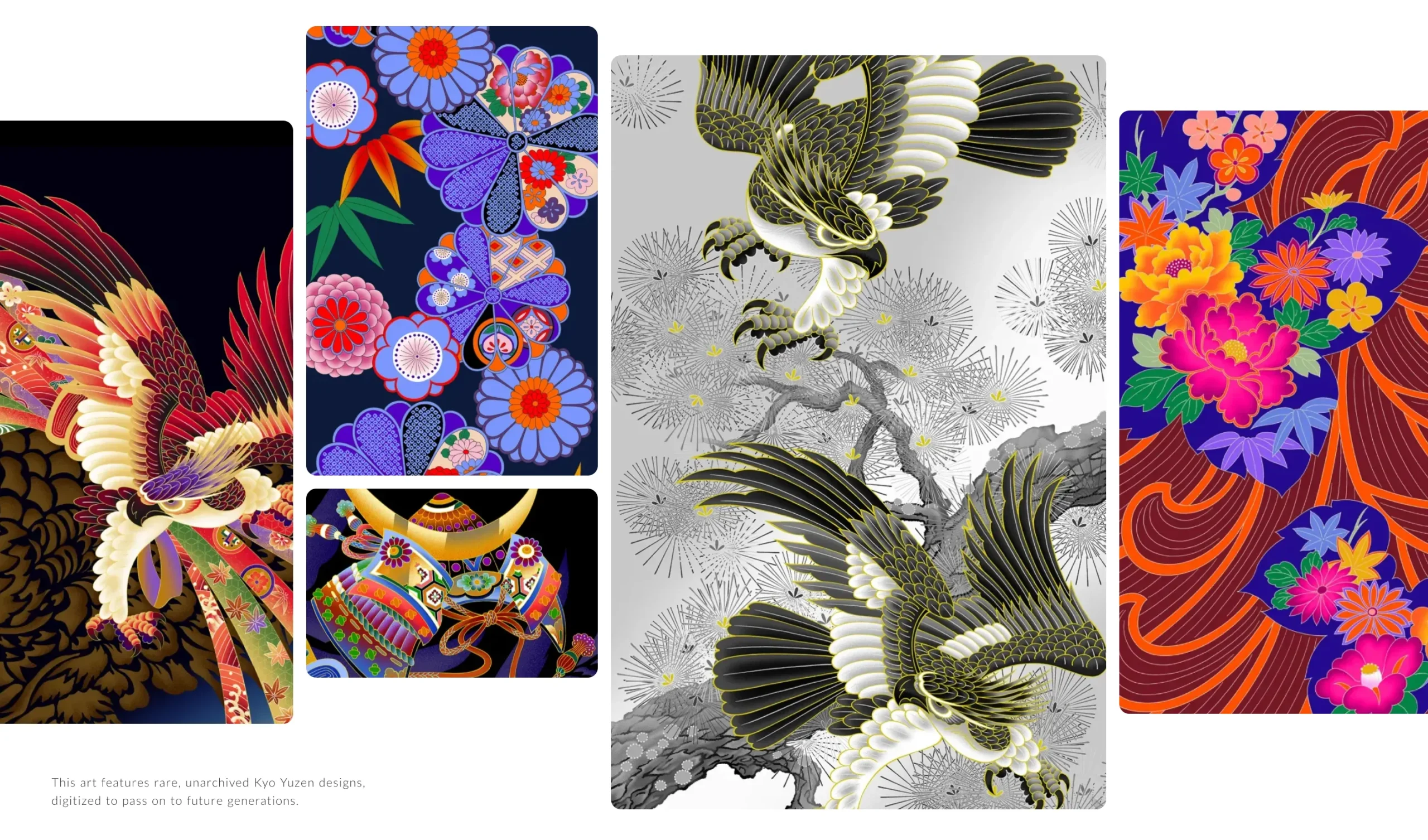
Here, we’ll examine the Kyoto-like sensibilities seen in nature, the four seasons, and classical patterns, design composition influenced by aristocratic and court culture, and the flow of design changes over time and contemporary reinterpretations.
Kyoto-like Sensibilities in Nature, Seasons, and Classical Patterns
While Kyo-Yuzen patterns frequently use plants, flowers, landscapes, and seasonal scenery, these are not mere natural depictions. Motifs such as cherry blossoms, autumn leaves, flowing water, and mist are arranged as symbols containing seasonal feelings, auspiciousness, and narrative qualities.
By restraining realism and organizing lines and color planes, patterns acquire universality that transcends time and place. Such expression strongly reflects Kyoto-like sensibilities that reconstruct beauty extracted from nature rather than copying nature as is. Viewers can read the passage of seasons and subtle emotions through patterns, and this lingering impression can be said to be the charm of Kyo-Yuzen design.
Design Composition Influenced by Aristocratic and Court Culture
Kyo-Yuzen design is said to reflect the aesthetic sensibilities cultivated in Kyoto, the ancient capital of a thousand years, and is also characterized by the adoption of highly classical motifs in designs, including not only flowers, birds, wind and moon but also court patterns (patterns derived from court and aristocratic costume culture).
Patterns are not only “overall patterns” evenly scattered across the entire kimono but also commonly seen in compositions like hem patterns or shoulder-hem patterns that place patterns at key points such as the hem or shoulders, utilizing negative space.
This approach of “utilizing negative space while placing main subjects at key points” shares something with the rhythm of picture scrolls and Yamato-e screen composition, creating an effect that naturally guides the viewer’s gaze.
Additionally, kimono design in general includes “literary designs” with themes from classical literature such as “The Tale of Genji,” with known examples of patterning scenes and symbols through painterly expression like Yuzen. By incorporating classically-derived designs, Kyo-Yuzen designs can become expressions that leave room for “interpretation” that prompts viewers to understand the background.
Design Changes Over Time and Contemporary Reinterpretation
Kyo-Yuzen designs are not fixed but have changed according to each era’s aesthetic sensibilities and social conditions. In the Edo period, classical patterns and compositions with strong narrative qualities were mainstream, but since the modern era, realistic expressions and new color schemes have also been incorporated.
In contemporary times, reinterpretations responsive to changes in lifestyle are progressing, such as designs that abstract traditional patterns and minimal compositions using limited colors. Nevertheless, the fundamental aesthetic sensibility of valuing negative space and maintaining dignity remains unchanged. Kyo-Yuzen maintains its value as an ongoing craft not by merely preserving past designs but by continuing to update them in line with the times.
Perspectives on Appreciation and Collection
Kyo-Yuzen is both a craft to be worn and dyeing culture with high completion quality as an object of appreciation and collection. In evaluation, the accumulation of fundamental elements such as line quality, color depth, and use of negative space is more important than showiness or rarity.
Additionally, ways of viewing value differ according to forms such as fabric bolts, tailored kimono, and fabric pieces. Here, we’ll examine specific points for distinguishing good Kyo-Yuzen, evaluation criteria by form, and precautions for long-term preservation.
Points for Distinguishing Good Kyo-Yuzen: Line, Color, Negative Space
When discerning quality Kyo-Yuzen, the most important aspect is the quality of lines created by itome paste. Verify that lines are uniform yet not mechanical, with natural variation in strength according to the pattern’s modulation. Next, regarding color, not only vividness of color development but the naturalness of gradation and smoothness of gradation are important.
Even when multiple colors are used, if the whole is harmonious, it can be said to be a high-dignity finish. Furthermore, what deserves attention is the treatment of negative space. Those where patterns are not overcrowded and the fabric’s white or ground color is intentionally preserved better convey Kyoto-like compositional beauty. Whether line, color, and negative space mutually support each other is the core of Kyo-Yuzen appreciation.
Differences in Value as Fabric Bolt, Kimono, and Fabric Piece
Kyo-Yuzen is distributed and preserved in three forms—fabric bolts, tailored kimono, and fabric pieces—with different ways of viewing value for each. Fabric bolts have the appeal of allowing one to imagine the overall design composition and appearance when worn, making it easy to purely evaluate the completion of dyeing techniques and composition. Kimono tailored as garments gain added meaning and historical background from wear, increasing their value as cultural materials.
On the other hand, fabric pieces are characterized by allowing partial appreciation of design and techniques separate from their function as dress. Considering which form to approach Kyo-Yuzen in according to purpose and preservation environment will enhance collection quality.
Preservation and Management Precautions: Consideration for Light, Humidity, and Fold Creases
The most important points in preserving Kyo-Yuzen are measures against light, humidity, and fold creases. Direct sunlight or strong lighting causes dye fading, so it’s desirable to limit displays to short periods. For humidity, too high causes mold while too low causes fiber deterioration, so maintaining a constant environment is important.
Additionally, in long-term storage, fold creases can damage patterns, so periodically refolding or considering rolled storage is advisable. While Kyo-Yuzen is a delicate craft, with proper management it is work that maintains beauty for a long time. The awareness that handling itself is part of understanding Kyo-Yuzen is required as an attitude toward appreciation and collection.
Contemporary Developments of Kyo-Yuzen
While facing the reality of shrinking kimono culture, Kyo-Yuzen is showing new developments with its techniques and aesthetic sensibilities themselves as the core. Rather than adhering to traditional uses, it is characterized by expanding its expressive domain into contemporary living spaces and international contexts, utilizing its characteristics as pictorial dyeing.
Here, we’ll examine examples of applications beyond kimono, evaluation in overseas markets, and issues and possibilities for passing on to the future.
Applications Beyond Kimono: Art, Interior, Fashion Accessories
In recent years, movements can be seen expanding Kyo-Yuzen beyond kimono into art pieces, interior goods, and fashion accessories. For example, there are initiatives to utilize Kyoto’s textile techniques including Kyo-Yuzen in the interior field, proposing them as art panels, partitions, shades, and such.
There are also examples of cushion covers using Kyo-Yuzen fabric and wallpaper incorporating Kyo-Yuzen designs, with uses expanding to incorporate fabric (or designs) into spatial design.
Furthermore, development of accessories suited to contemporary dress is progressing, such as scarves, bags, and leather goods. The fact that established Kyo-Yuzen brands officially line up items beyond kimono indicates that attempts at use conversion are continuing.

Evaluation in Overseas Markets and Positioning as a Symbol of Japanese Culture
Overseas, there are cases where Yuzen dyeing (including Kyo-Yuzen) is introduced and exhibited as one of the representative techniques of Japanese textile culture. For example, in overseas museum exhibitions, Yuzen-dyed kimono are treated as examples demonstrating “painterly expression through dyeing (resist dyeing).”
Additionally, on the Kyo-Yuzen production side, initiatives are being undertaken to aim for cultural exchange and development of new sales channels through work production and exhibitions using themes from overseas clothing cultures (e.g., caftans).
On the other hand, to avoid being superficially consumed overseas as a “Japanese” decorative image, it’s important to convey the production process (sketching, paste application, color insertion, steaming, washing, etc.), division of labor system, and background of why these techniques are necessary. While Kyo-Yuzen is an entity that evokes Japanese culture, it can be said to be a domain where understanding as craft expression deepens through context presentation.
Issues and Possibilities for Connecting Traditional Techniques to the Future
To connect Kyo-Yuzen to the future requires balancing preservation of techniques with renewal of expression. Issues such as aging of artisans supporting the division of labor system and lack of successors, and the gap between production costs and market prices, remain significant problems.
On the other hand, the expansion of uses and rising international evaluation also indicate new possibilities. Rather than entrusting everything to conventional kimono demand, a perspective that reconsiders the techniques themselves as cultural resources is required. Kyo-Yuzen is not a perfected craft of the past but an expression that continues to live while changing roles with each era. Renewing it without losing sight of its essence can be said to be the most realistic path for passing techniques on to the next generation.
Conclusion
Kyo-Yuzen is a Kyoto-unique pictorial dyeing technique with clear outline lines created by itome paste and delicate color expression through applied dyeing as its core. Nurtured in townspeople culture beginning with Miyazaki Yuzen-sai, it has been highly refined within kimono culture while incorporating the aesthetic sensibilities of aristocratic and court culture. The division of labor system that handles everything from design to finishing is an important foundation supporting precision and depth of expression, establishing Kyo-Yuzen as a comprehensive craft.
Compared to other regional Yuzen, its uniqueness is clearly expressed in compositional beauty and sense of negative space that values “elegance” over realism and decorative qualities. Furthermore, in contemporary times, it is acquiring new roles through expansion into art, interior, fashion accessories, and reevaluation overseas. By not merely preserving past techniques but continuing to renew expression according to the times, Kyo-Yuzen will continue to be an entity that connects Japanese dyeing culture to the future.
