

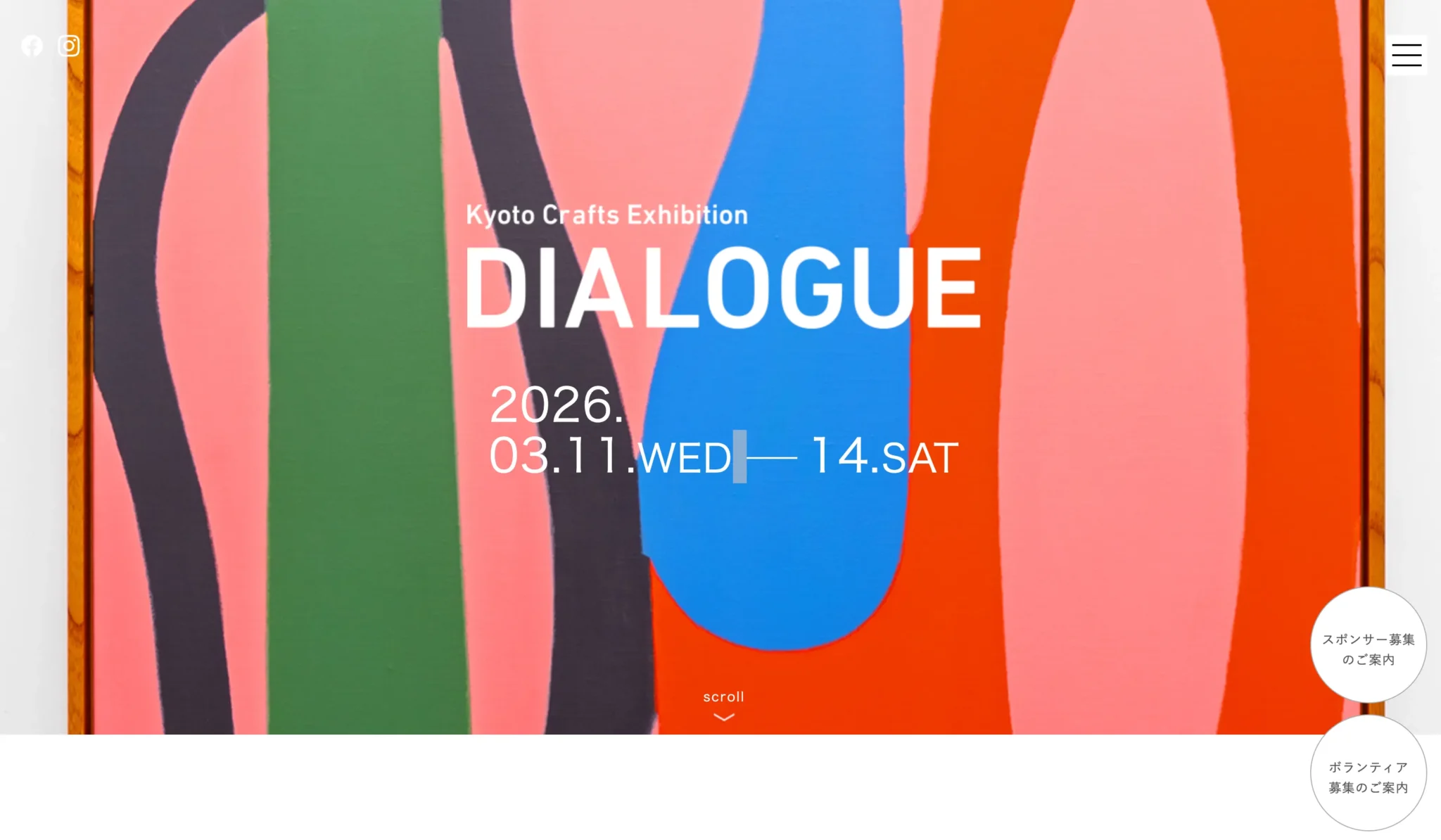
Kyoto Crafts Exhibition DIALOGUE 2026 is an exhibition project held in Kyoto designed to visualize the current state of contemporary crafts and design.
Rather than being a simple exhibition and sales event, it aims to build relationships through dialogue among craft artists, production regions, buyers, and curators, attracting significant interest from craft professionals both in Japan and abroad.
A distinctive feature is that multiple venues throughout Kyoto City operate in conjunction with the event schedule, allowing artwork appreciation, business meetings, and intellectual exchange to occur simultaneously.
This article organizes the overview and schedule of DIALOGUE 2026 while clearly explaining its unique characteristics and positioning compared to typical craft fairs and art fairs.
Table of Contents
What Is Kyoto Crafts Exhibition DIALOGUE?
Kyoto Crafts Exhibition DIALOGUE is an international exhibition of contemporary crafts held in Kyoto. Based on the techniques and philosophy of traditional crafts, it aims to connect with contemporary expression and international distribution contexts.
It has been conceived not merely as a venue for exhibition and sales, but as a place for “dialogue” connecting makers and users, production regions and markets, and crafts and design.
Here, we’ll organize the background of DIALOGUE’s birth, the significance of the 2026 event, and the meaning of holding it in Kyoto, interpreting the significance this exhibition holds.
Event Origins: DIALOGUE’s Vision for New Distribution and Dialogue in Crafts
DIALOGUE is an exhibition and sales event for crafts and handmade work that started in 2018, planned not to treat crafts simply as traditional culture or tourism resources, but to reconsider how they can function in contemporary life and international markets.
Behind this lies the challenge faced by craft artists and production regions who, despite possessing excellent techniques and philosophy, have had limited evaluation and sales channels within conventional distribution structures.
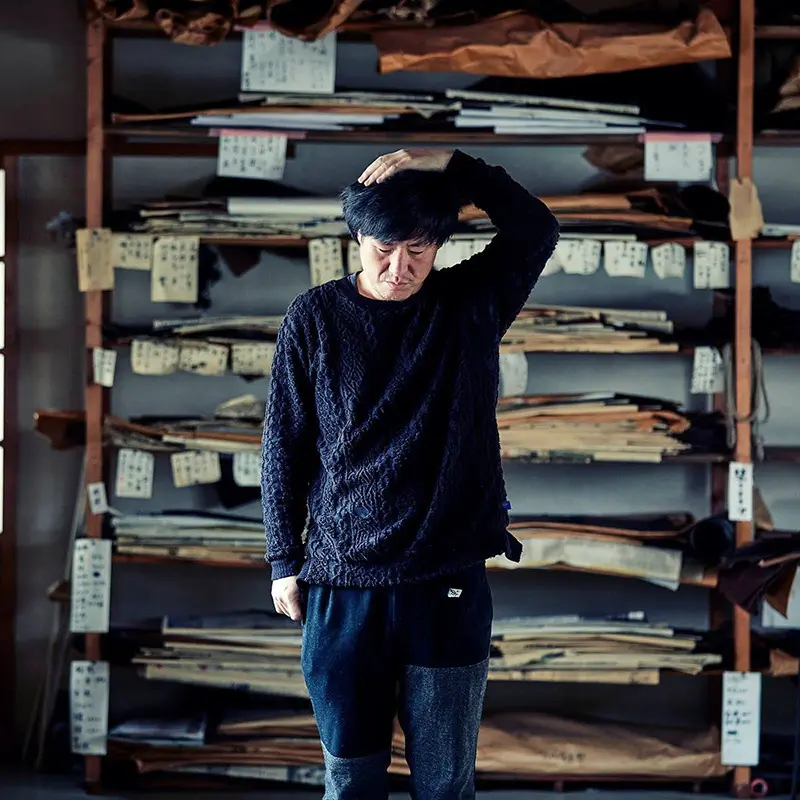
At DIALOGUE, rather than simply lining up finished works, the emphasis is on presenting production backgrounds, materials, and philosophy to generate deep understanding and dialogue with viewers and buyers.
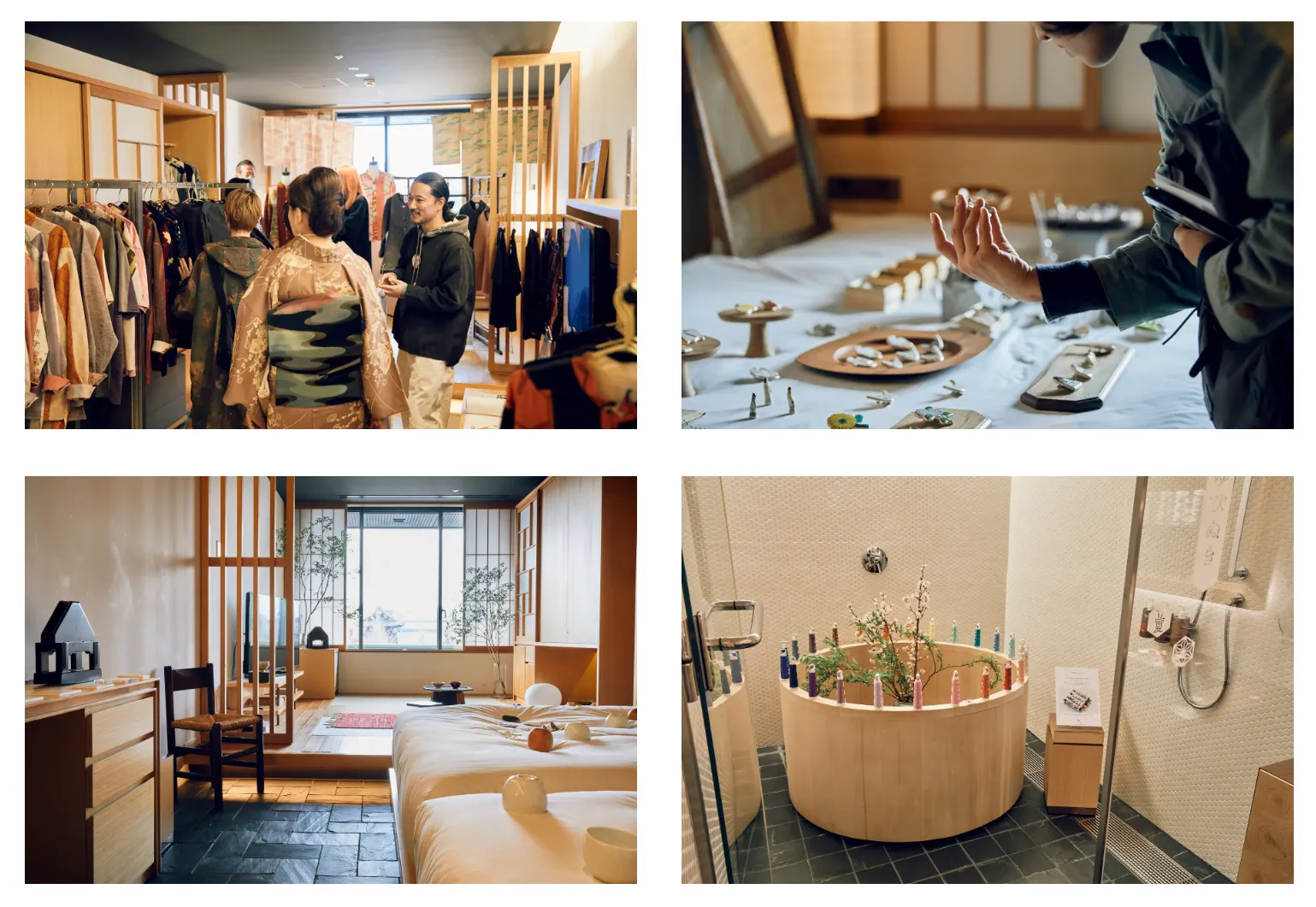
Using the guest rooms of Hotel Kanra Kyoto as exhibition spaces, the environment is arranged so makers can express their own worldview. The exhibition’s uniqueness lies in creating “genuine encounters” and “genuine dialogue” by sharing the value formation process itself, rather than relationships judged solely on price or specifications.
The 2026 Event’s Position and Evolution to Date
The 2026 DIALOGUE is positioned as a milestone event building on past accumulations.
Previous events primarily featured Japanese craft artists and production regions, introducing works with contemporary interpretations, but with each passing year, international perspectives and market connections have been strengthened.
For 2026, the exhibition composition is mindful of actual transactions and continuous relationship building, not just introduction and outreach. How can crafts be positioned as sustainable activities rather than consumed as transient trends? The 2026 event holds important meaning as one answer to this question.
The Meaning of Being Held in Kyoto: Connecting Historic City and Contemporary Crafts
There is clear meaning in DIALOGUE being held in Kyoto.
Kyoto is a place that has nurtured crafts as living culture and urban culture throughout its long history. At the same time, precisely because of the strong layers of tradition, new expressions and distribution attempts can become less visible.
DIALOGUE presents contemporary crafts as ongoing culture against this Kyoto backdrop.
By placing contemporary craft works within historical spaces, it becomes visible that past and present are continuous rather than disconnected. Holding the event in Kyoto is not to preserve tradition but to continuously renew it, symbolizing DIALOGUE’s philosophy.
Kyoto Crafts Exhibition DIALOGUE 2026 Event Information
Kyoto Crafts Exhibition DIALOGUE 2026 is an international contemporary crafts exhibition held in Kyoto.
Rather than treating crafts simply as exhibition objects, it’s designed as a venue connecting makers and users, production regions and markets.
For 2026, the schedule and venue have already been announced on the official website, with a structure separating buyer-focused business days from general admission days.
Here, we’ll organize the detailed schedule, venue characteristics, and practical points regarding access and attendance.
Kyoto Crafts Exhibition DIALOGUE 2026
- Dates: March 11 (Wed) – March 14 (Sat), 2026
BUYERS DAY | March 11: 11:00-18:00 / March 12: 11:00-18:00 (Admission by invitation only)
MARKET DAY | March 13: 11:00-20:00 / March 14: 11:00-17:00 - Venue: Hotel Kanra Kyoto (190 Kitamachi, Shimogyo-ku, Kyoto 600-8176) and other locations
- Admission Fee: 1,000 yen (MARKET DAY only)
Includes a 500-yen shopping voucher usable for purchasing exhibited items - Exhibitor Information: Bottom of this page
- Organizer: “KYOTO KOUGEI WEEK” Executive Committee
- Co-organizers: Hotel Kanra Kyoto, Kyoto Prefecture
- Cooperation: Kyoto City, KYOTO CRAFTS MAGAZINE, Kyoto Museum of Traditional Crafts
- Official Website: http://www.dialoguekyoto.com
- Ticket Purchase: https://dialogue2026ticket.peatix.com/
- Contact: DIALOGUE Secretariat (info@dialoguekyoto.com)
Kyoto Crafts Exhibition DIALOGUE 2026’s event period runs for four days from March 11 (Wed) to March 14 (Sat), 2026.
Of these, March 11 (Wed) and 12 (Thu) are designated as “BUYERS DAY,” a business-focused period for buyers and related parties, with admission limited to invitation holders only.
Hours are 11:00 to 18:00.
The following March 13 (Fri) and 14 (Sat) are “MARKET DAY,” open to general visitors for exhibition viewing, work purchasing, and dialogue with exhibitors.
Admission is 1,000 yen and includes a 500-yen shopping voucher usable for purchasing exhibited items, with unlimited re-entry during the event period.
The venue is Hotel Kanra Kyoto (190 Kitamachi, Shimogyo-ku, Kyoto City), and this ninth edition features a record 88 businesses and brands, including 33 first-time exhibitors.
By clearly separating business meetings from general admission, both transaction quality and visitor experience are balanced. It’s important to choose dates according to your visit purpose.
Venue Information: Held at Hotel Kanra Kyoto
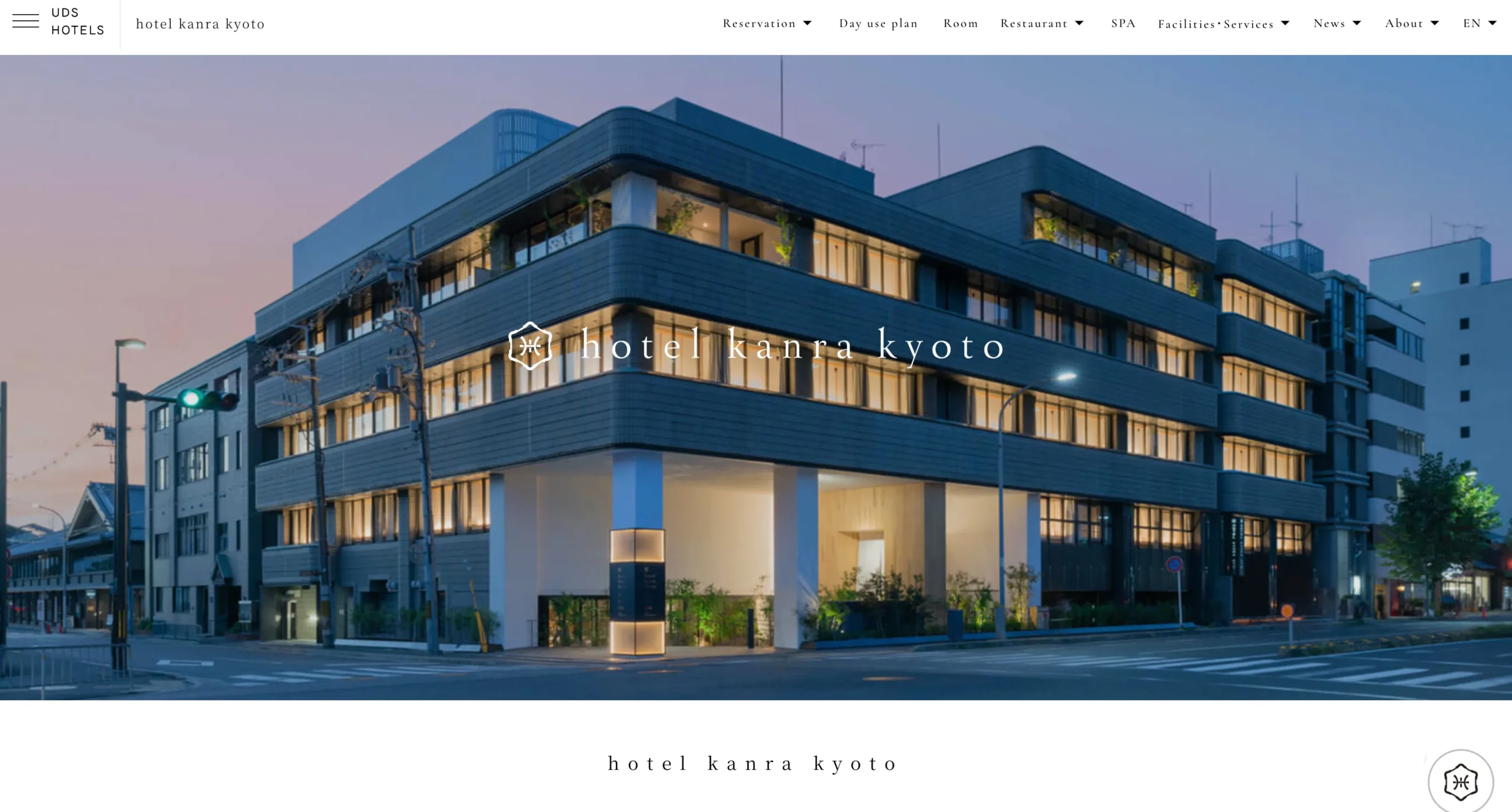
This exhibition uses the hotel’s guest rooms and common spaces as exhibition booths. Unlike typical exhibition halls, a distinctive feature is experiencing craft works in an environment close to living spaces.
It’s easy to concretely imagine how craft items appear and are used in actual spaces, receiving high praise from buyers and architecture professionals.
The venue itself becoming part of the exhibition experience can be said to be a characteristic unique to DIALOGUE.
Access and Important Points for Visitors
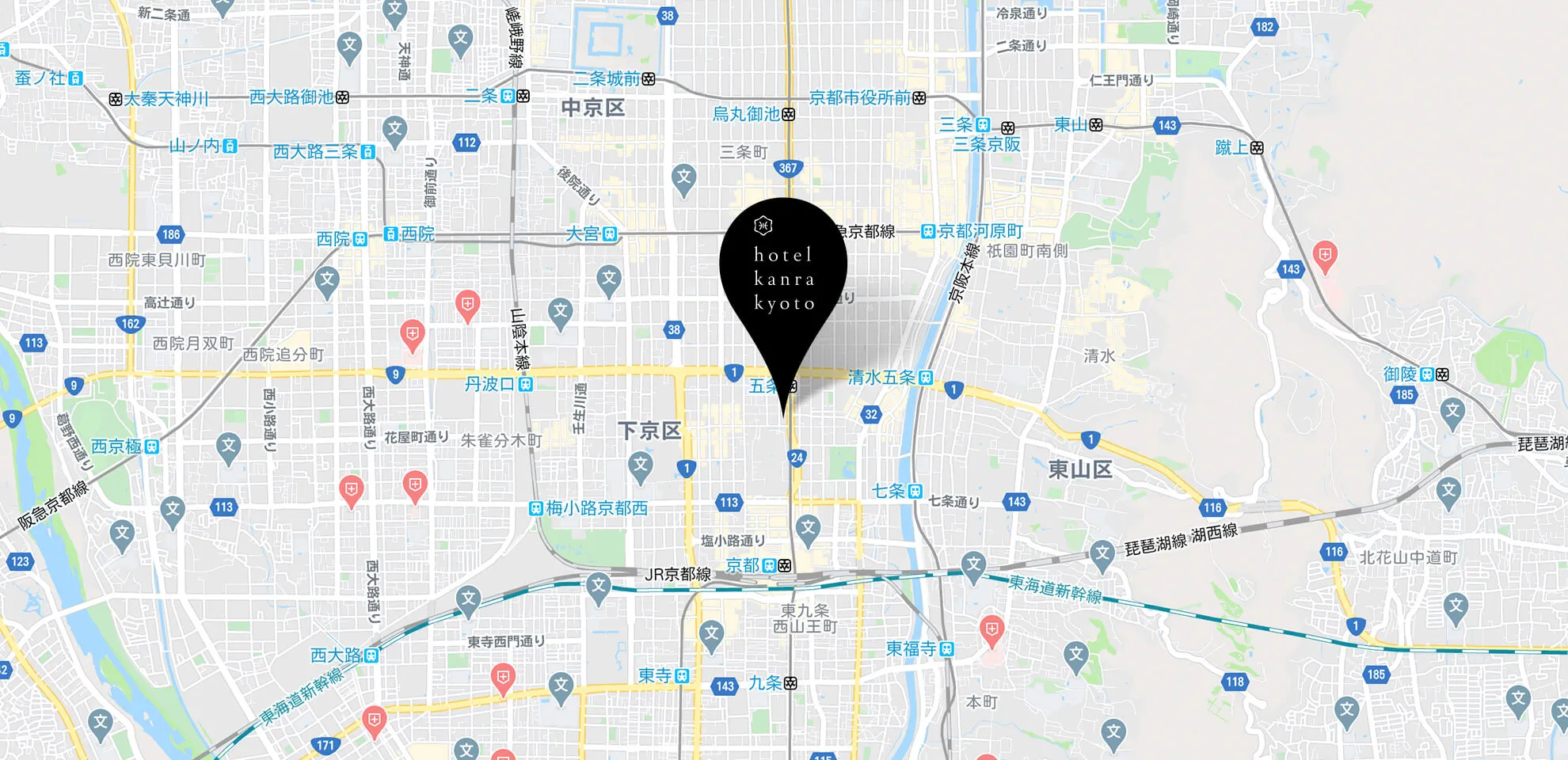
UDS HOTELS
Nearly half the route can use underground passages, providing comfortable travel even on rainy days. Note that the hotel has no parking lot, so visitors arriving by car should use nearby coin parking.
Also, since BUYERS DAY and MARKET DAY have different admission requirements, you need to confirm in advance which dates apply to you. MARKET DAY tickets can be purchased in advance on Peatix, but same-day purchase is also possible.
As detailed attendance information is updated regularly on the official website, checking the latest information before your visit ensures peace of mind.
DIALOGUE’s Exhibition Concept and Curatorial Philosophy
A major characteristic of Kyoto Crafts Exhibition DIALOGUE is that it’s designed not as an “exhibition” displaying finished works, but as a “place for dialogue” to renew values and relationships surrounding crafts.
Rather than depending on existing genre divisions like crafts, design, and art, presentation methods aligned with the realities of contemporary production and distribution have been pursued. Here, we’ll organize the reasons for centering on dialogue, cross-disciplinary exhibition design, and methods of presenting crafts positioned between mass production and one-of-a-kind pieces.
Why “Dialogue” Is Centered Rather Than “Work Exhibition”
Traditional exhibition formats showing only finished products don’t adequately share important information such as materials, techniques, production philosophy, and reasons for pricing.
DIALOGUE emphasizes making makers’ intentions and production backgrounds visible, creating structures where viewers and buyers can respond.
Through this bidirectionality, crafts become not objects to be unilaterally evaluated, but entities whose value is formed through understanding and agreement. Centering on dialogue can be said to be a strategy for correctly conveying value, not a compromise to adapt crafts to the market.
Exhibition Design Crossing Crafts, Design, and Art
DIALOGUE’s exhibition design deliberately blurs the boundaries between crafts, design, and art. Not only technical perfection as crafts, but also spatial presence and conceptual strength are incorporated as evaluation axes.
Therefore, exhibition methods aren’t limited to showcase-style displays but employ architectural spatial composition and placements mindful of interior contexts.
This allows works to be presented as both “objects for appreciation” and simultaneously “entities with potential for use.”
Cross-disciplinary exhibition design serves to connect crafts to broader cultural and market contexts without confining them to specific specialized domains.
Presenting the “Intermediate Territory” Between Mass Production and One-of-a-Kind
What DIALOGUE particularly emphasizes is the “intermediate territory” of crafts existing between mass-produced products and one-of-a-kind art.
This territory includes collections of works based on handcraft yet possessing certain reproducibility and supply capacity.
In response to the practical challenges that complete one-of-a-kind pieces are difficult to distribute while mass production loses craftwork qualities, DIALOGUE has presented implementable forms of contemporary crafts.
Visualizing this intermediate territory shows makers sustainable production models and opens possibilities for continuous transactions for buyers.
The stance of addressing this territory head-on when considering the future of crafts can be said to be the core of DIALOGUE’s curatorial philosophy.
Characteristics of Exhibiting Artists and Brands
Kyoto Crafts Exhibition DIALOGUE’s exhibitor composition is characterized by comprehensively capturing crafts from throughout Japan without bias toward specific genres or production regions.
From traditional regional crafts to contemporary expressions by individual artists appear in the same space, three-dimensionally visualizing the current state of crafts.
Here, we’ll organize the characteristics of DIALOGUE’s unique lineup by focusing on the breadth of exhibiting regions, trends by material, and the composition where workshops and individual artists coexist.
Composition Gathering Craft Production Regions and Artists from Throughout Japan
DIALOGUE includes participation from craft production regions and artists throughout Japan while centered in Kyoto. In 2026, 58 groups representing 88 brands (a record number) from across the nation will exhibit, with 33 brands participating for the first time.
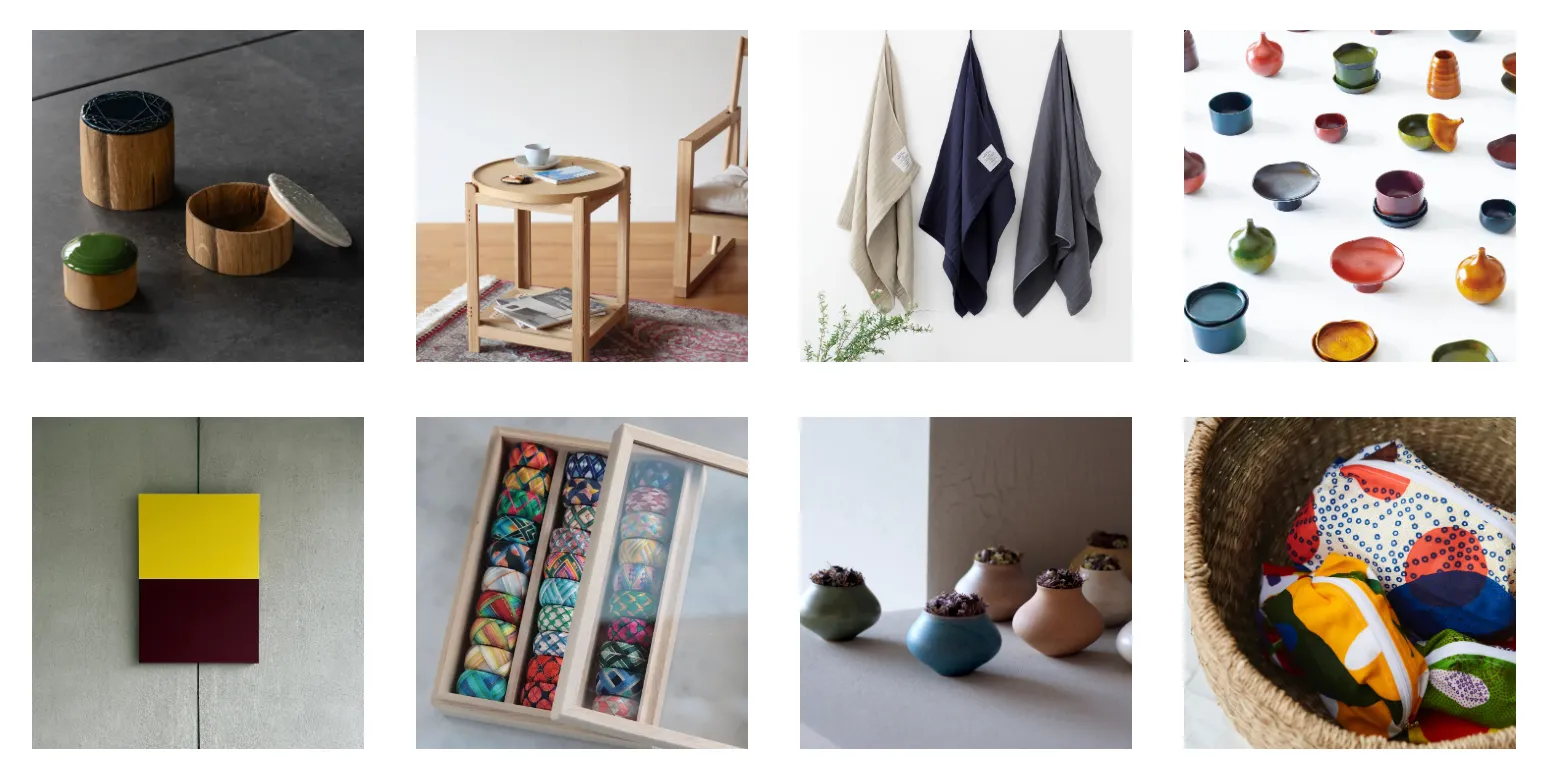
From production regions throughout the country including Echizen washi, Tango chirimen, Banshu-ori, and Seto-yaki, techniques and materials cultivated in each region are brought together, spanning ceramics, lacquerware, textiles, metalwork, and woodwork, as well as apparel, accessories, and lifestyle goods, with different backgrounds and philosophies presented simultaneously.
What’s important is that rather than stopping at simple regional introductions, selections are made from the perspective of how to connect with contemporary life and markets.
In making selections, emphasis is placed on the “words” and “thoughts” of makers who create work rooted in diverse backgrounds, regions, and nature, which is essential as society necessarily learns about and acts on environmental and diversity issues. There is screening for exhibition participation, and not all applicants are accepted.
Therefore, works preserving traditional styles and works with contemporary interpretations appear side by side, allowing visitors to understand the diverse possibilities of crafts while comparing them.
The nationwide scale composition and exhibition gathering makers with diverse backgrounds demonstrate that DIALOGUE is not a local event but a venue for surveying contemporary crafts as a whole.
Exhibition Trends by Material: Ceramics, Lacquer, Metalwork, Textiles, Woodwork
Looking by material, DIALOGUE’s exhibition has a relatively balanced composition.
Ceramics range widely from everyday vessels to highly sculptural works, easily reflecting trends in contemporary crafts. Lacquerwork shows many expressions mindful of application to contemporary spaces while based on traditional techniques.
Metalwork presents diverse scales from jewelry to living tools, emphasizing material strength and texture.
Textiles are characterized by exhibitions mindful of relationships with interiors and architecture, in addition to the beauty of fabric itself. Woodwork shows many works utilizing structural integrity and material feel, demonstrating balance between practicality and sculptural qualities. Being able to survey trends by material is also DIALOGUE’s attraction.
Lineup Where Traditional Succession Workshops and Individual Artists Coexist
A characteristic feature of DIALOGUE’s exhibitor composition is that generational succession workshops and individual artists are introduced in the same context.
Works by workshops, backed by technical stability and supply capacity, have strong aspects as implementable crafts.
Meanwhile, individual artists’ works tend to foreground experimentalism and artistic identity, pushing the expressive boundaries of crafts.
By placing both side by side without separation, it’s shown that the future vision of crafts is not single-tracked. The essence of DIALOGUE’s lineup can be said to be the composition demonstrating that traditional succession and individual expression aren’t opposing but can coexist simultaneously.
Utilization Value for Buyers and Businesses
Kyoto Crafts Exhibition DIALOGUE holds high value not only as an exhibition for appreciation but also as a venue for practical business meetings.
It’s designed for easy participation by diverse businesses handling crafts, including department stores, specialty shops, and museum shops, enabling not just new transaction creation but also utilization aimed at medium to long-term relationship building.
Here, we’ll organize its practical value from three perspectives: affinity with distribution channels, characteristics of business opportunities, and exhibition design philosophy.
Affinity with Department Stores, Select Shops, and Museum Shops
DIALOGUE is an exhibition with high affinity for craft-handling businesses like department stores, select shops, and museum shops.
Many exhibited works possess strong artistic identity while having certain supply capacity and reproducibility, receiving praise for being easy to incorporate into store deployments and special exhibitions.
With a wide range of price points and uses presented from everyday vessels to interior objects, visitors can make selections while imagining their company’s customer base and sales environment.
Also, because production backgrounds and creation philosophies are carefully shared, they’re easy to utilize for story design during sales, providing value beyond simple procurement.
Business Opportunities Leading to New Transactions, Custom Orders, and Collaborations
Business meetings at DIALOGUE aren’t limited to those aimed at short-term orders.
Through exhibitors and buyers sharing production backgrounds and challenges, many cases develop into custom production, joint projects, and continuous initiatives.
In crafts where mass production isn’t the premise, it’s important to align in advance on specification adjustments, pricing, and delivery timing concepts, and DIALOGUE provides sufficient dialogue time for this.
The major characteristic of this exhibition can be said to be its function as a venue for relationship building with future collaborations in mind, not just as an entry point for new transactions.
Exhibition Design Premised on Continuous Relationship Building
DIALOGUE is designed not as an exhibition generating one-time transactions but premised on continuous relationship building.
By separating business days from general admission days, businesses can face exhibitors in a calm environment, enabling careful discussions about conditions and directions.
Also, being able to track artists’ and brands’ growth through annual events is a major advantage for businesses with long-term perspectives.
By functioning as a venue for nurturing relationships not just with works but with people and philosophies, DIALOGUE forms a foundation of trust in craft distribution.
Significance of Participation for Craft Artists and Production Regions
Kyoto Crafts Exhibition DIALOGUE has become an important venue for craft artists and production regions not simply as a sales opportunity but for reviewing activity directions and positioning.
Unlike exhibitions that tend to be reduced to short-term results, a characteristic is the emphasis on value formation and market relationship building from medium to long-term perspectives.
Here, we’ll organize participation significance from three perspectives: branding effects, direct feedback from the market, and a foothold for overseas expansion.
Medium to Long-term Branding Effects Beyond Sales Objectives
Participation in DIALOGUE brings medium to long-term branding effects beyond sales at the event itself.
Because presentation includes not just individual works but production backgrounds, material selection, and regional philosophy, it has a structure that remains memorable for visitors and businesses.
This enables artists and workshops to convey their value along with context without falling into price competition.
Also, by continuously exhibiting through annual events, activity changes and maturation become visible, accumulating reliability as a brand.
Being able to acquire evaluation axes not dependent on short-term sales holds great meaning for continuing crafts sustainably.
Feedback Environment for Directly Receiving Market Voices
DIALOGUE provides an environment where direct dialogue with market stakeholders like buyers, architecture professionals, and shop operators is possible.
Being able to receive frank opinions about works and concrete requests regarding price points, supply systems, and uses on the spot is a valuable opportunity for artists and production regions.
By sharing voices like “why are they chosen” and “where do people hesitate” that are difficult to see through indirect evaluation or sales data alone, realistic examination of future production and deployment directions becomes possible.
This feedback environment can be said to be an important mechanism for maintaining healthy tension with the market without confining crafts to a closed world.
Foothold for Overseas Expansion and Next-Stage Steps
DIALOGUE becomes a foothold for advancing to the next stage for craft artists and production regions considering overseas expansion.
Through international buyers and international project personnel visiting, it’s possible to encounter international evaluation standards while remaining in Japan.
Rather than suddenly stepping into overseas exhibitions or exports, being able to first confirm reactions from international perspectives domestically is a major advantage.
By grasping which elements of works are viable and where adjustments are needed, next developments can be considered in sustainable forms. DIALOGUE functions as a realistic starting point for gradually expanding the sphere of craft activities.
Differences from Other Craft Exhibitions
Kyoto Crafts Exhibition DIALOGUE has philosophy and design different from typical craft exhibitions and art fairs.
Its uniqueness lies in reconsidering craft value formation and distribution itself rather than primarily pursuing sales or attendance.
Here, we’ll organize these differences from three perspectives: differences from domestic craft fairs and art fairs, positioning as not an exhibition-sale event, and ideological connections with international collectable design exhibitions.
Comparison with Craft Fairs and Art Fairs
Typical craft fairs tend to emphasize immediate sales and awareness expansion for visitors, prioritizing accessibility and clear price point indication.

Meanwhile, art fairs tend to foreground work scarcity and market value, with craft backgrounds and production processes not always adequately shared.
DIALOGUE is positioned between these but isn’t absorbed by either logic.
By carefully presenting work backgrounds and philosophy while emphasizing dialogue aimed at distribution and implementation, it has a character different from simple sales events or market exhibitions. This positioning separates crafts from transient consumption.
DIALOGUE’s Unique Position as Not an Exhibition-Sale Event
DIALOGUE doesn’t take the form of an exhibition-sale event. While purchases are possible, that’s not the main purpose; forming understanding and agreement first is prioritized.
The structure separating business days and general admission days, and exhibition design sharing production backgrounds, are intended for medium to long-term relationship building rather than short-term buying and selling.
This makes artists less likely to be drawn into price competition, and makes it easier for businesses to consider sustainable transactions.
The stance of not premising immediate sales can be said to be an important condition for presenting crafts as “entities with reasons to be chosen.”
Ideological Connections with International Exhibitions like Design Miami and Collectible
DIALOGUE’s philosophy has many connections with international collectable design exhibitions.
Points in common with international exhibitions overseas include capturing crafts as an intermediate territory that’s neither product nor art, emphasizing artistic identity, material understanding, and spatiality.

However, DIALOGUE isn’t simple imitation in that it has Japanese craft production regions and succession structures as background.
Its uniqueness is supported by the stance of translating to internationally viable evaluation standards while starting from regional character. DIALOGUE’s clear positioning lies in connecting ideologically with international exhibitions while transmitting from the Japanese context.
Conclusion
Kyoto Crafts Exhibition DIALOGUE has redefined exhibitions not as a “place to display and sell” crafts but as a “place to share value and nurture relationships.”
It’s designed for artists, production regions, buyers, and businesses to deepen mutual understanding through dialogue, generating sustainable distribution and evaluation not dependent on short-term results.
While connecting with craft exhibitions both domestically and internationally, DIALOGUE presents contemporary craft possibilities from the Japanese context, and can be said to be an important indicator when considering how crafts will engage with society and markets going forward.
Exhibitor List (In Japanese Alphabetical Order)
Atelier Rikka | Silk Thread Accessories
Awagami Factory | Washi Paper
ANDO Kyoto Main Store | Shibori Products
Ikegami Hat Workshop | Hats
ISHIGAMI RYOICHI | Woodwork Products
Ishikawa Luku Craft (asada | Lacquerware・Kutani Wa Glass | Kutani-yaki・Koyama Chopstick Store | Lacquered Chopsticks・Nushiya | Lacquer Accessories・#000 BLACK KOGEI | Mizuhiki・masuisai | Lacquer Accessories・YAMAZAKI NOTOJOFU | Noto-jofu・Yuiyu-YUIYU- | Lacquerware)
INDIGO CLASSIC | Indigo-dyed Apparel
WOVE MELT | Banshu-ori
Echizen Washi Youth Association | Echizen Washi
F-TRAD | Lifestyle Products
Ennichi | Apparel
Oe Silk | Tango Silk
OP(Object-Position) | Daily Craft Items
OKOTOKOTO | Apparel
casane tsumugu | Woodwork Products
Kazarino-KAZARINO- | Metal Fittings
Kaji Kobo Hiromitsu | Forging
Kawabata Denim Factory | Hand-woven Denim
Gangu Kogeisha | Folk Toys
Kishimoto Hikimono | Wood Turning
kitt | Cut & Sew
kiten.kyoto | Textile Goods
Kimono Upcycle Soreido | Kimono Upcycling
Kyodo Gangu Akarisha | Papier-mâché
Kiyohara Textile | Nishijin-ori
cravatta by renacnatta | Apparel Goods
Classic Ko | Maki-e Jewelry
Koshungama | Kyo-yaki/Kiyomizu-yaki
COCOO | Lacquer Products
KOZOU HAKO STYLE | Joinery
Gobu | GOBU | Horse Leather Products
Zailin | Objects
Sasaki Kyoko | Lacquer Arts
Sato Wood Container | Woodwork Products
Sanminegama | Seto-yaki
Chêne | Apparel
Shiotani Mika | Woodwork Products
sisam | Apparel
Shanari Shirt | Apparel
SHUKA/Taneka | Seed Confections
Shogado | Washi Paper
Super Namaki Lab | Woodwork Products
Sugano ORGANIC | Organic Cotton Underwear
Studio Kou Kou -kou kou- | Contemporary Tea Utensils
sumiiro | Silver Jewelry
Sericy | Skincare Products
Soraigama | Kyo-yaki/Kiyomizu-yaki
SOIE CÉLESTE | Tango Chirimen
Tatsumi Toshiyuki | Woodwork Products
Tatetsunagi | Tango Chirimen
tané textile | Hand-woven Apparel
tamaki niime | Banshu-ori
TERAS | Sashiko Products
Tosengama | Kyo-yaki/Kiyomizu-yaki
TOKINOHA | Kyo-yaki/Kiyomizu-yaki
torinoko | Folk Toys
NEW TRADITIONAL | Folk Toys
Némaki | Apparel
Bizen Letterpress Workshop | Letterpress Printing
Between black & white / fujietextile | Textile Art
Hiragana | Accessories
Hirabayashi Oshie Workshop | Oshie
Hirayama Daily Goods Store | Furniture
PHAPHIC | Fabrics
/fan/fun | Kyo-sensu
BLANKED | Gauze Blankets
HEP DESK | Footwear
Bench Work Tatenui | Kyo-sashimono
MARUSHIN by SHINTO TOWEL | Towel Gifts
Miyake Kogei × Kyoto Seika | Kyo-yuzen
Murayama Woodwork | Kyo-kumiko
mokuhiroto | Woodwork Products
moi.toi. | Jewelry
yahae | Socks
Yamato Textile Factory | Tango Chirimen
Yamamoto Dyeing Factory・Keiko Roll | Kata-yuzen
YŌRAI | Washi Paper
RELIEFWEAR | Apparel
re loss / Nippon Sweden | Leather Products
LinNe | Orin
LOCAL FABRIC | Roomwear
