




Japan’s traditional crafts have long supported stable demand as regional culture and daily necessities, but in recent years they face major changes in both domestic demand and industry scale. While demand as everyday items has shrunk due to changes in lifestyle and population decline, there is a growing movement to view craft products as “culturally valuable products,” and new markets are forming in some sectors.
Different demand structures and distribution formats have emerged in ceramics, lacquerware, textiles, metalwork, and other fields, with each production area’s adaptability determining success or failure. This article provides a comprehensive overview of changes in domestic demand and industry scale for traditional crafts as a whole, while explaining in detail sector-specific demand trends and future challenges.
Table of Contents
Changes in Domestic Demand and Industry Scale for Traditional Crafts: Understanding the Big Picture
The domestic market surrounding traditional crafts shows a long-term declining trend, but in recent years new demand is beginning to emerge through changes in usage and distribution formats. What’s important for craft businesses is not simply understanding that “demand is decreasing,” but structurally grasping which sectors are experiencing what types of demand changes.
Here we’ll organize the definition and scope of the traditional craft industry, explain how to understand domestic demand and industry scale, and overview long-term changes since the high economic growth period.
Definition and Target Sectors of the Traditional Craft Industry
Japan’s traditional craft industry is generally discussed centered on designated items based on the “Law Concerning the Promotion of Traditional Craft Industries.” Within this framework, requirements include certain historical background, traditional techniques, handcraft production systems, and regional characteristics.
Target sectors span widely including ceramics, lacquerware, textiles, woodwork, metalwork, Japanese paper, and others, encompassing a broad range of uses from daily necessities to decorative items and ceremonial tools. However, craft sectors not included in legal designations and craft expressions with contemporary interpretations also constitute part of the industry in practice. From a business perspective, it’s important to understand that the legal definition and actual market structure don’t necessarily align.
How to Understand Domestic Demand and Industry Scale
When grasping domestic demand and industry scale for traditional crafts, judging by a single indicator like total sales or production value is not appropriate. Compared to the high growth period, the frequency of craft product use in daily life has decreased, and quantity-based demand has shrunk.
On the other hand, certain demand has been maintained or reorganized by usage type, including high value-added products, gifts, interior uses, and tourism-related demand. While industry scale is shrinking, the number of businesses and production formats are diversifying, with increasing weight on direct sales by small businesses, custom production, and B2B transactions. A perspective that captures demand by “quality” and “usage” rather than quantity is essential.
Long-term Trends Since the High Economic Growth Period
During the high economic growth period, traditional crafts formed a large market quantitatively, backed by expanding housing demand and established gift-giving culture. However, due to lifestyle changes, westernization of housing, and proliferation of mass-produced goods, demand gradually decreased from the 1970s onward. After experiencing the bubble collapse and demographic changes, the entire industry entered a long-term contraction phase.
On the other hand, since the 2000s, movements to evaluate crafts by cultural value and storytelling have strengthened, and usage redefinition is progressing. Looking at long-term trends, we can understand this as a transition from an era of quantitative expansion to an era of value re-editing and selection.

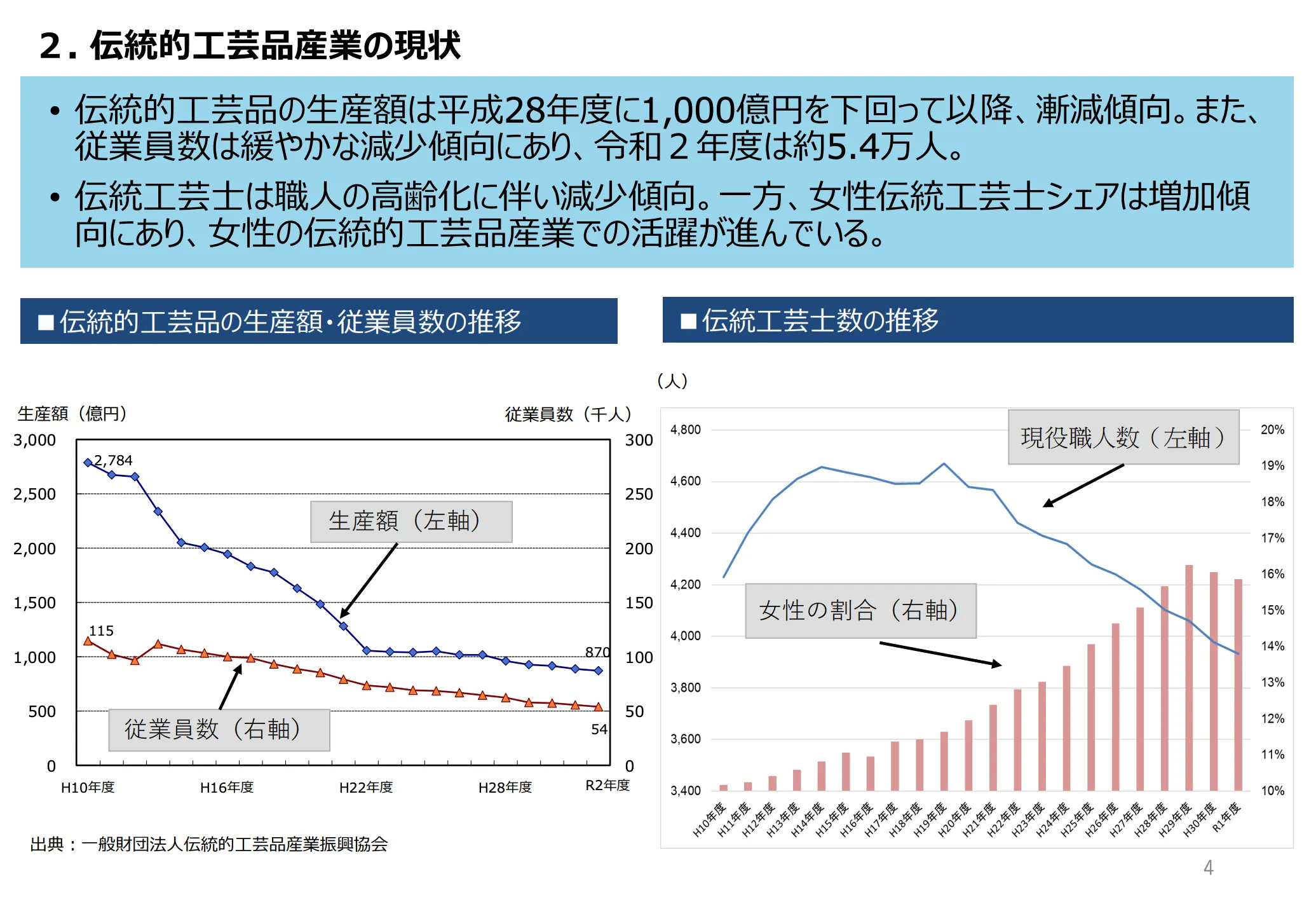
【Reference Data: Production Value Trends for Traditional Crafts】
According to public records, domestic production value for traditional crafts (designated items based on the Law Concerning the Promotion of Traditional Craft Industries) peaked around 1983 at approximately 540 billion yen. It then entered a long-term declining trend, shrinking to about 102 billion yen around 2015 and approximately 87 billion yen in fiscal 2020.
As these figures show, the traditional craft industry must be understood as an industry whose market structure has changed over several decades, not as experiencing “short-term difficulties.” The demand structure and production model changes discussed in this article have occurred premised on this long-term market contraction.
Factors Behind Changes in Domestic Demand
Behind changes in domestic demand for traditional crafts are not single factors but complex changes in living environments, consumption structures, and values. Demand reduction should be understood not as a simple story of “crafts becoming unnecessary,” but as the result of major changes in how they’re used and chosen.
Here we’ll organize factors behind domestic demand changes from three perspectives: lifestyle changes, purchasing behavior changes due to price range and durability, and consciousness differences accompanying generational change.
Lifestyle Changes and the Decline of “Crafts in Use”
From the postwar period through the high economic growth era, traditional crafts were widely used in daily life as practical items. However, with westernization of housing, changes in family composition, and simplification of household practices, the role crafts played has gradually shrunk. For example, the decrease in Japanese-style rooms directly reduced opportunities to use lacquerware and textiles.
Additionally, changes in dietary habits have greatly altered the types and frequency of tableware use. As a result, the positioning shifted from “crafts used daily and naturally replaced” to “crafts used in specific situations.” The collapse of the assumption of use has led to quantity-based demand reduction.
Declining Purchase Frequency Due to Price Range and Durability
Traditional crafts tend to have higher price points because they presume handwork. Additionally, high durability and long usability have been valued. However, in the context of changing market structures, this characteristic has also created an aspect of declining purchase frequency. Once purchased, they don’t need replacing for a long time, resulting in demand that doesn’t circulate easily.
Compared to products frequently replaced as daily necessities, sales volume is harder to grow. For businesses, while high unit prices and durability are strengths, they make it difficult to capture market expansion on a volume basis.
Generational Change and Shifts in Consumer Consciousness
Consumer generational change has also greatly impacted domestic demand changes. For the high growth period generation and those after, traditional crafts were naturally accepted as part of living culture, but younger generations have fewer touchpoints. On the other hand, young people don’t judge value solely by the word “traditional,” but tend to emphasize design, storytelling, and compatibility with modern life.
Due to this consciousness difference, conventional product compositions and appeal methods are harder to reach them. Understanding generational change not as demand disappearance but as a shift in evaluation criteria is important for considering future business strategies.
Industry Scale Contraction and Structural Change
The contraction of the traditional craft industry is not merely a result of demand reduction, but is deeply connected to changes in production structure itself. Decreases in business and worker numbers, transformation of division of labor systems, and production model transitions mutually influence each other, greatly changing the industry’s overall shape. What’s important for craft businesses is not viewing contraction pessimistically, but understanding what options are emerging amid structural change. Here we’ll organize from three perspectives: human resource base changes, division of labor reorganization, and production model transitions.
Declining Business and Worker Numbers and Aging
In many traditional craft sectors, business and worker numbers show long-term declining trends. In addition to successor shortages, the length of training periods and profitability challenges have made new entry difficult. As a result, aging is progressing on-site, and time constraints for skill succession are tightening.
This is not merely a numbers problem but affects the overall production area’s responsiveness and supply capacity. On the other hand, reduced numbers have also enabled faster decision-making and more agile business operations in some cases. Personnel reduction is both a risk and an opportunity to review management structure.

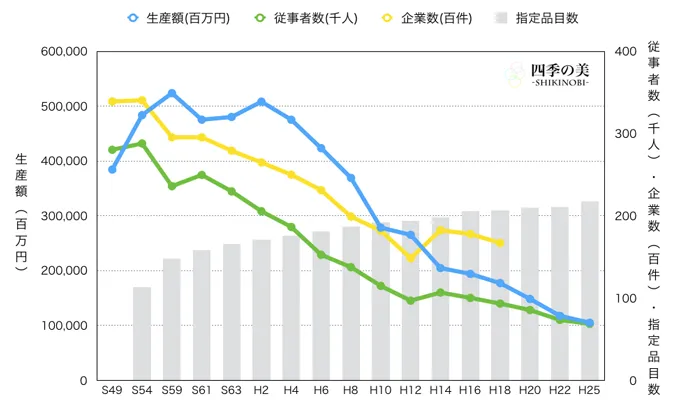
【Reference Data: Worker Numbers and Aging Status】
According to public records, the number of people engaged in the traditional craft industry has been declining long-term, standing at approximately 54,000 as of fiscal 2020. An industry that once numbered in the hundreds of thousands has now shrunk significantly. Additionally, looking at worker age composition, the proportion of elderly workers is high, with successor shortages directly impacting the sustainability of the entire industry. Declining business and worker numbers are not merely labor shortages but are closely tied to difficulties maintaining division of labor systems and reduced production capacity.
Impact of Division of Labor Collapse and Process Consolidation
Much of traditional crafts was previously supported by highly divided production systems. However, with declining business numbers and shrinking demand, maintaining division of labor systems has become difficult, and process consolidation is advancing. While a system where one craftsperson handles multiple processes is rational efficiency-wise, it also makes accumulating specialization difficult.
On the other hand, being able to grasp the entire process has created advantages of improved quality control and expression consistency. Division of labor collapse should be understood not as mere decline but as a process of production system reorganization.
Transition from Mass Production to Small-Volume, High-Value-Added Models
The traditional craft industry previously assumed stable supply of certain volumes, but now it’s shifting to high-value-added models based on small-volume production. Rather than competing on price with mass-produced goods, this model presents technique, materials, and storytelling as value.
This transition raises unit prices while suppressing production volumes. Therefore, while sales structures become more unstable, possibilities for accumulating brand value also increase. Though industry scale is shrinking, room remains to improve business quality and sustainability.
Differences in Demand Trends by Sector
Domestic demand for traditional crafts is not uniformly decreasing, but shows different changes by sector. While usage conversion is progressing in sectors that served as daily necessities, sectors that originally had ceremonial or aesthetic characteristics are experiencing character changes in demand through shifting evaluation criteria.
Additionally, recent movements to acquire new demand by connecting with interior and architectural sectors are visible. Here we’ll organize differences in demand trends for major sectors.
Ceramics and Lacquerware: Declining Daily Necessities Demand and Usage Conversion
Ceramics and lacquerware were sectors widely used in daily life, but quantity-based demand for daily necessities has greatly decreased due to lifestyle changes. With most tableware and household items replaced by mass-produced goods, daily use frequency has declined. However, demand hasn’t completely disappeared—usage conversion is progressing.
For example, positioning has strengthened not for daily use but as “special vessels,” “for guests,” and “gift items.” Additionally, cases of acquiring new support bases through reconstruction into designs suited to contemporary dining tables and food service spaces are visible. In ceramics and lacquerware sectors, redefining usage is key to maintaining demand.
【Representative Movements: Usage Conversion in Ceramics and Lacquerware Production Areas】

For example, some ceramic production areas are moving away from conventional daily necessities markets and shifting focus to commercial tableware for restaurants or design-focused small-lot products. In lacquerware sectors, cases are increasing of maintaining unit prices and added value by strengthening product composition toward gifts and special-use items rather than daily use. The characteristic is that production areas and workshops are clearly defining “which usage creates value” and reconstructing sales channels and product design together.
Textiles, Dolls, and Metalwork: Shift Toward Ceremonial and Aesthetic Uses
In sectors like textiles, dolls, and metalwork, while demand as daily consumer goods is limited, demand centered on ceremonial and aesthetic characteristics is primary. Kimono and dolls are connected to life ceremonies and annual events, and while usage frequency is low, certain demand is maintained. In metalwork sectors as well, the weight of sculptural works and commemorative creations premised on appreciation rather than practical items is increasing.
These sectors have structures where value and completeness per piece are emphasized over quantity, and demand tends to be stable while small-scale. Because evaluation criteria are clear, price range increases are more easily accepted.
【Representative Movements: Demand Based on Ceremonial and Aesthetic Characteristics】
In sectors like textiles, dolls, and metalwork, in addition to demand connected to life ceremonies, annual events, and commemorative purposes, the weight of markets evaluated by “aesthetic value (artistry and design)” is increasing. While not frequent replacement consumption, because purchase reasons are clear, relatively high price ranges are easily accepted if value explanation and quality consistency can be secured.
New Demand in Craft × Interior and Architectural Sectors
Recently attracting attention is new demand connecting crafts with interior and architectural sectors. In residential and commercial spaces, craft products with material texture and traces of handwork are valued as elements that enhance spatial value rather than uniform mass-produced goods. Uses are diversifying including lighting, wall decoration, fixtures, and furniture, with expanding B2B transaction possibilities.
In this sector, involvement from the design stage rather than quantity is important, requiring craftspeople to have specification adjustment and continuous supply capabilities. Connecting crafts with spatial creation can be said to be a relatively growth-potential area within domestic demand.
【Representative Movements: Collaboration with Architecture and Spatial Sectors】
Recently, cases are increasing where craft artists and workshops participate from the design stage of residences, accommodation facilities, and commercial spaces, handling lighting, fixtures, wall decoration, furniture, etc. These B2B-type demands emphasize “design responsiveness,” “specification adjustment,” “delivery and continuous supply,” and “maintainability” rather than quantity, characterized by crafts being incorporated as elements that enhance spatial value.
New Demand Emerging in the Domestic Market
While the domestic traditional craft market shows overall maturation and contraction trends, new demand is emerging from different contexts than before. Rather than mass consumption as daily necessities, demand emphasizing value, experience, and symbolism is central, and while the purchasing base and uses are limited, the characteristics are high unit prices and continuity. Here we’ll organize the nature of newly forming domestic demand from three perspectives: collection demand, spatial design sector introduction, and gift and corporate demand.
Collection Demand by Affluent and Discerning Segments
Recently, collection demand is visible from affluent and discerning segments who view craft products as art works or design objects. This segment emphasizes artistry, philosophy, and production background over practicality, and tends to have relatively low price sensitivity.
While quantities aren’t large, unit prices per piece are high, and impact on artist and workshop reputation formation is significant. Additionally, cases of continuously collecting works by the same artist can lead to medium-to-long-term relationship building. For businesses, positioning as a market emphasizing brand value and reputation accumulation over sales volume is important.
Expanding Introduction in Food Service, Accommodation, and Spatial Design Sectors
Movements to introduce craft products as spatial design elements in restaurants, accommodation facilities, commercial spaces, etc. are spreading. Using crafts as tableware, furnishings, lighting, and decorative elements is expected to enhance overall spatial value and experience quality. This sector differs from individual consumption in sometimes requiring certain volumes and continuous supply as B2B transactions.
On the other hand, because spatial compatibility and storytelling are emphasized over price, it’s also a domain where conveying craft added value is easier. Collaboration from early stages with designers and operators is key to acquiring demand.
Possibilities in Gift, Corporate Demand, and Commemorative Product Markets
Gift and corporate commemorative product markets also hold certain possibilities within domestic demand. In situations requiring symbolism and formality such as anniversaries, awards, and gifts to business partners, craft products that mass-produced goods cannot easily substitute are sometimes chosen. While this demand is easily influenced by economic conditions and corporate activities, because uses are clear, specifications and price ranges are easy to design. If capabilities like name engraving and design adjustment exist, this leads to differentiation. Gift and corporate demand is a market where reliability and reproducibility are valued over quantity, holding potential for stable transactions for businesses.
Collaborations with Popular Characters Creating “New Entry Points”


One approach that easily generates new demand in the domestic market is collaborations with popular characters and IPs. Even for segments with few opportunities to encounter traditional craft contexts, using “favorite characters” as entry points can direct interest toward works, making it easier to expand awareness and create experiential value.
For example, like the “Pokémon Crafts Exhibition,” cases are emerging where popular characters are combined with Japanese master techniques, exhibiting works by craftspeople including Important Intangible Cultural Property holders (so-called Living National Treasures). Such projects have strengths not in mere merchandising but in being able to present craft techniques, materials, and production backgrounds as “appreciation experiences.” As a result, they hold potential to ripple across multiple demand areas including collection demand, gift demand, and corporate/facility tie-ups.
Changes in Distribution Structure and Impact
Traditional craft distribution structure has long been supported by indirect distribution centered on department stores and specialty shops, but recently this premise is changing significantly. With sales channel diversification, opportunities for craftspeople to have direct contact with customers are increasing, creating changes in pricing and expression leadership. This can be said to be a movement redefining the nature of craft business itself, not merely an increase in sales channels. Here we’ll organize from three perspectives: transition from conventional distribution, expansion of direct sales and exhibition-style sales, and changes in pricing authority.
Breaking Away from Department Store and Specialty Shop Dependence
Previously, major sales channels for traditional crafts were handled by department stores and craft specialty shops. While these distribution channels played major roles in customer attraction and credibility, there was also an aspect where sales conditions, pricing, and expression content tended to be led by the distribution side. Recently, with department store market contraction and changes in sales floor composition, conducting transactions in the same form as before has become difficult. As a result, building systems not dependent on specific distribution has become important. Breaking away from dependence should be understood not as sales channel loss but as a movement to diversify risk and increase business independence.
Expansion of Direct Sales, E-commerce, and Exhibition-Style Sales
Direct sales, e-commerce, and exhibition-style sales are becoming established as realistic options for craft businesses. Sales through company websites and online platforms enable direct relationship building with customers, making it easier to convey production backgrounds and value. Additionally, exhibition-style sales make it easier to gain understanding of prices and delivery times through dialogue while showing actual products. On the other hand, operational burdens like customer attraction, shipping, and customer service increase, making operational system development essential. Sales channel expansion is not simply increasing sales destinations but an initiative accompanying overall business redesign.
Movements to Return Pricing Authority to Craftspeople
With distribution structure changes, movements to reclaim pricing authority on the craftsperson side are visible. Previously, wholesale and retail prices were often determined by distribution side standards in many cases, making it difficult for craftspeople’s labor and techniques to be sufficiently reflected. By facing customers directly through direct sales and exhibitions, it becomes possible to explain price rationale and value, enabling convincing pricing.
However, raising prices itself is not the goal—design premised on sustainable production and quality maintenance is required. Recovering pricing authority can be said to be an important element for increasing business sustainability.
Relationship Between Domestic and Overseas Demand

In considering the market environment surrounding traditional crafts, domestic and overseas demand cannot be understood separately. While overseas expansion has progressed against the backdrop of domestic market contraction, a cycle where overseas evaluation influences the domestic market is also emerging.
What’s important for craft businesses is not viewing overseas as merely alternative markets, but understanding the structure where domestic and foreign demand mutually interact. Here we’ll organize the relationship between domestic market contraction and overseas expansion, the impact of overseas evaluation on domestic brands, and how to balance both.
Aspects Where Domestic Market Contraction Promoted Overseas Expansion
Long-term contraction of domestic demand has become an opportunity for many craft businesses to become conscious of overseas markets. With business continuity becoming difficult through conventional domestic sales channels alone, movements seeking new sales destinations and evaluation criteria have strengthened, resulting in overseas expansion emerging as a realistic option.
Particularly in regions with high interest in Japanese culture and handwork, craft products tend to be easily accepted as products with cultural value. However, overseas demand is not a simple substitute for domestic demand, with price ranges, volumes, and transaction conditions differing greatly. While domestic market contraction is the trigger, overseas expansion needs to proceed premised on different business structures.
Impact of Overseas Evaluation on Domestic Brand Value

Overseas exhibitions and evaluations also impact brand value domestically. International exhibition and overseas gallery handling track records become elements visualizing craftspeople and workshop credibility, leading to domestic market evaluation improvement in some cases. Particularly in pricing and artistry explanation, the fact of “being evaluated overseas” tends to be a persuasive element.
On the other hand, expressions and prices optimized for overseas don’t necessarily fit the domestic market as-is. Overseas evaluation is material reinforcing brand value, and how to translate it to the domestic market is left to business judgment.
How to Balance Domestic and Foreign Demand
Balancing domestic and foreign demand is an important management issue for many craft businesses. Leaning too heavily toward overseas demand makes one susceptible to exchange rate, international situation, and logistics risks. On the other hand, depending only on domestic demand creates large market size constraints.
Therefore, a concurrent strategy positioning the domestic market as foundation while treating overseas as a place for growth and evaluation is realistic. Organizing domestic and foreign demand roles by separating uses and product lines is also effective. Rather than opposing both, a perspective utilizing them complementarily leads to sustainable business operations.
Summary
Domestic demand and industry scale for traditional crafts exist within a major flow of long-term contraction, but looking at the substance, we can see that changes in “demand quality” and “structure” have progressed rather than simple decline. While demand as daily necessities has decreased due to lifestyle changes, new demand is emerging in contexts like aesthetics, spatial design, gifts, and corporate demand.
Additionally, with changes in business numbers and division of labor systems, production structure has consolidated and downsized, with transitions to small-volume, high-value-added models progressing. On the distribution front as well, the axis has shifted from department store dependence to direct sales, e-commerce, and exhibition-style sales, with movements visible where craftspeople reclaim pricing and expression leadership. Furthermore, domestic and overseas demand exist in mutually influencing relationships, and the perspective of using foreign demand as a place for growth and evaluation while basing on domestic demand is important. What will be required of craft businesses going forward is not a defensive posture premised on demand reduction, but strategic business operations that understand changed market structures and identify domains where their strengths can thrive.


