




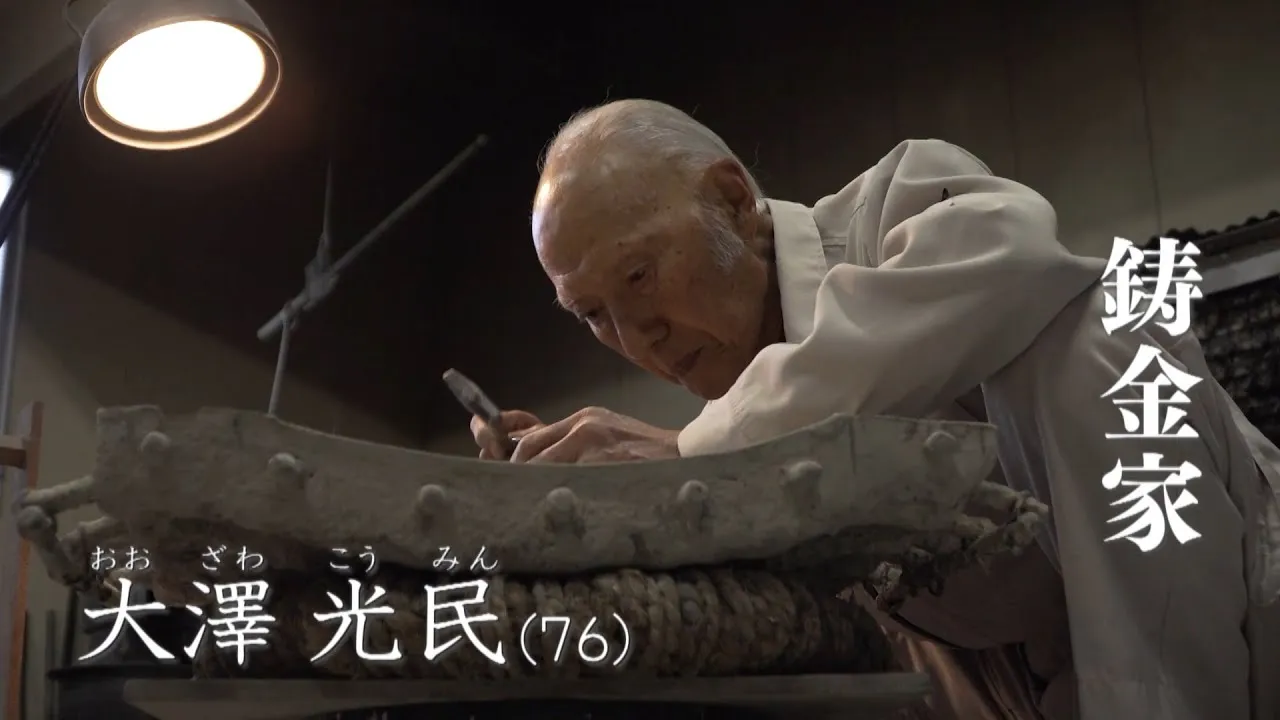
Takaoka City, Toyama Prefecture—in this historic casting town with 400 years of tradition, there lived a great craftsman who continuously breathed new life into metal. This is Komin Ozawa, who was designated as a holder of Important Intangible Cultural Property “Metal Casting” (Living National Treasure) in 2005.
The moment when molten metal at approximately 1400 degrees is quietly poured into a mold made of clay. That scene, where tense air intersects with passion for creation, resembles a ritual. Red and white lines emerging against a jet-black base—an expression that, despite being metal, conveys organic warmth. How is such work born?
This article explores the complete picture of Ozawa’s signature technique “igurumi” and the traditional “yakigata casting” method he cherished throughout his life, while introducing his underlying philosophy that “tradition is something always new.”
Komin Ozawa (birth name: Yukimasa, metal casting artist, Living National Treasure) passed away on October 29, 2023, due to pneumonia and heart failure. He was 82 years old. We express our sincere condolences and pray for his soul.


Table of Contents
The Maverick Born in Takaoka: Transformation from Craftsman to Artist and the Miracle Born from “Failure”

Takaoka City in Toyama Prefecture is renowned as the production center of Takaoka copperware. Its history began in 1609 when Toshinaga Maeda, lord of Kaga Domain, invited casters to promote industry. How did Komin Ozawa, born and raised in this land, begin his journey to becoming a Living National Treasure?
From Eldest Son of a Farm Family to “Town Casting Shop,” Then Awakening as an Artist
Ozawa was not originally born into a traditional craft family. Born as the eldest son of a full-time farming family in Takaoka City, he happened to choose work at a nearby “town casting factory” during the farming off-season.
In his early twenties, young Ozawa spent his days endlessly making figurines and busts. However, after more than ten years of service, a doubt and yearning began to sprout within him. “I want to create from start to finish with my own hands, not just handle one part of divided labor.” “I want to create one-of-a-kind works, not mass-produced items.”
This desire drove him to quit the factory after 11 years and become independent. Around that time, he became a first-generation student at a traditional industry technical training school established by Takaoka City, learning “sculptural design” and “the mindset for craftsmanship” from metalwork artist Taizo Kasai and others. This was the turning point where the craftsman who had been making “products” transformed into an artist creating “works.”
Coincidence or Divine Inspiration: The Forgotten Iron Rod That Led to the Origin of “Igurumi”
The “igurumi” technique, Ozawa’s greatest achievement, actually had its seed of innovation born from a single “mistake.”
One day, while casting a Buddhist statue, Ozawa forgot to remove an iron rod called a “kogai” that had been inserted to support the core mold, and sent it to the coloring process as is. Naturally, the finished piece bore a circular mark where the iron rod’s cross-section remained.
Normally, this would clearly be a “defect,” destined to be discarded as a failed work. However, Ozawa’s eyes saw it differently. “Could I use this intrusion of foreign metal as a pattern instead?” What if he could intentionally place non-melting metals within molten metal to create new expressions? This reversal of thinking was the moment that would define the future Living National Treasure, Komin Ozawa.
Three Years of Silence and Exploration: Transition from Nitten to Traditional Crafts
After independence, Ozawa made a spectacular start, being selected for the Nitten exhibition three consecutive years. His works at that time centered on modern, abstract forms. However, he paused again at this point. While the Nitten world pursued “sculptural beauty,” what attracted him was the world of traditional crafts that finds beauty within practicality—”use and beauty.”
He stopped submitting to Nitten and entered a three-year period of silence. During that time, he reexamined his techniques and continued questioning himself: “What expression can only I create?” “What should be preserved as Japanese traditional crafts?” What he arrived at was the “igurumi” technique inspired by failure and a return to the labor-intensive “yakigata casting.” This decision would bring fresh winds to the Takaoka copperware world.
The Innovation of the Unique “Igurumi” Technique: The Challenge of “Weaving” Metal into Metal

“Igurumi” is a technique where different metals with higher melting points (such as copper wire or stainless steel wire) are placed in advance inside a mold, then molten alloy is poured in to integrate the different metals. This is not simple post-process decoration like inlay, but an extremely difficult technique that incorporates design into the casting process itself.
The Story of “Light” and “Water” Drawn on a Jet-Black Canvas

Many of Ozawa’s works feature designs where red glowing copper wire and white shimmering stainless steel wire run through a base finished in jet black. This has a clear theme. The red copper wire symbolizes “light (sunlight),” while the white stainless steel wire represents “water (moonlight).”
Light and water are the sources of life, the very energy of nature itself. Ozawa attempts to express fundamental themes of the natural world using metal, which should be hard and cold. The black vessel body represents the universe or earth, while countless lines running through it express pouring light or flowing water.
A series of works titled “Igurumi Line Pattern Flower Vases” change their metallic luster depending on the viewing angle, creating an illusion as if a water surface is shimmering with reflected light. They are stationary objects yet artistic works containing eternal “movement.”
Fusion of Calculation and Chance: The Organic “Fluctuation” Created by Heat
The true charm of “igurumi” lies in how the lines are not perfectly straight like those drawn with a ruler. During the production process, metal wires placed inside the mold are exposed to tremendous heat and pressure when molten metal exceeding 1000 degrees is poured in.
At this moment, the metal wires warp, twist, or partially melt due to thermal expansion. Ozawa draws detailed blueprints and fixes wires at equal intervals with nails, but what expression the lines will ultimately show remains unknown until the furnace is opened and the mold is broken.
This “natural deformation by heat” gives works organic warmth that artificial objects lack and a uniqueness that cannot be replicated. Meticulously calculated placement and the accidental effects of flame—Komin Ozawa’s works are completed through the fusion of these two elements.
The Difficulty of Bonding Different Materials: The Craftsman’s Soul Poured into Gaps of Mere Millimeters
This technique faces extremely difficult technical challenges. That is the problem of “compatibility” between the base alloy and the embedded metal wires.
If the molten metal temperature is too high, even the internal wires will melt and mix; conversely, if too low, the wires and base material won’t fuse, creating gaps that ruin the work. Additionally, stainless steel and copper have different thermal conductivity and expansion rates. Simultaneously casting these and controlling them so cracks or warping don’t occur during the cooling and solidification process requires years of experience, intuition, and excellent temperature management skills.
Ozawa continuously imagines, within the invisible space of gaps mere millimeters wide inside the mold, how molten metal will flow and envelop the wires. This imagination and concentration are the essence of a Living National Treasure’s skill.
Return to and Inheritance of the Traditional “Yakigata Casting” Technique: The Unique Texture Created by Handwork

The reason Ozawa was designated a Living National Treasure wasn’t solely for developing the innovative “igurumi.” Another major reason was his stubborn adherence to and advanced embodiment of the traditional “yakigata casting” technique that was disappearing under the wave of efficiency.
Turning Away from Efficiency: Why It Must Be “Yakigata”
After the high economic growth period, productivity became emphasized in the casting world too, and “gas molds” and “green sand molds” that harden quickly using gas became mainstream. However, Ozawa deliberately continued choosing the extremely time-consuming and labor-intensive “yakigata casting.” When he became independent, wholesalers told him, “Stop such time-consuming methods and make things cheaply and quickly.”
Yet the reason he insisted on yakigata was the “texture” and “breathability” that only yakigata can produce. This technique, which fires materials mixed with clay, Japanese paper, and straw at high temperatures, gives the mold itself high breathability. This allows gas generated during casting to escape cleanly, making pinholes (holes from air bubbles) in the cast surface less likely and producing a beautiful, dense surface with high metal density.
Alchemy of Clay, Paper, and Straw: “Kamitsuchi” and “Aratsuchi”
The yakigata-making process is truly a dialogue with clay. What Ozawa uses is special clay called “kamitsuchi.” This is made by mixing fibered Japanese paper and several types of clay into liquefied clay called “hajiru.”
The moment 1400-degree metal is poured in, the Japanese paper fibers contained in the clay burn up instantly. This creates countless microscopic cavities. These become escape routes for gas, enabling perfect casting.
Furthermore, the outside is covered with rough clay called “aratsuchi” mixed with straw. This similarly serves to ensure breathability and prevent the mold from exploding. The wisdom of predecessors from an age without electricity or machinery—Ozawa respects each of these processes and kneads the clay and shapes the mold with his own hands.
Ten Hours of Firing and One Moment of Triumph: Confronting 1400-Degree Molten Metal
After mold-making is complete, comes the “firing.” The mold is placed in a kiln and heated to 900 degrees over approximately 10 hours. If moisture inside the mold isn’t completely evaporated during this process, a steam explosion will occur at the moment of pouring, ruining everything. Ozawa checks the kiln every two hours and judges when firing is complete based on years of experience.
Then comes the climax: “casting.” The melting furnace temperature is 1400 degrees. In the scorching hell where the workshop temperature reaches nearly 50 degrees Celsius in midsummer, Ozawa, dressed in protective gear, carefully yet boldly pours the glowing liquid scooped from the crucible into the mold.
“After pouring the metal, I don’t know the result until I break the mold tomorrow. That’s why it’s tense, and that’s why it’s rewarding.” Ozawa’s expression as he speaks combines the severity of a craftsman with the excitement of a boy. The next day, when he breaks the cooled mold with a hammer and the work emerges from within—when the “igurumi” appears as imagined, months of hardship are rewarded.
Conclusion: Tradition Is Something Not to Be Preserved but to Be “Created”
Even today, the sound of pounding clay and the roar of furnaces echo in Komin Ozawa’s workshop. “Traditional crafts may have an image of being old things. However, incorporating ways of thinking and sensibilities suited to the current era is what true ‘tradition’ really is.”
Deep respect for the techniques of predecessors, and an eagerness for innovation that doesn’t rest on them. His style of layering modern expression through igurumi onto the foundation of the classical yakigata casting technique truly embodies “learning from the past to understand the present.”
Light and water, red and white, clay and metal—Ozawa’s works, which harmonize contradictory elements within a single vessel, teach us the beauty of “harmony.” The flame of passion that this one Living National Treasure continues to kindle in Takaoka, Toyama Prefecture, serves as a guidepost for the next generation of craftspeople and will continue to solidify new “traditions.”


