




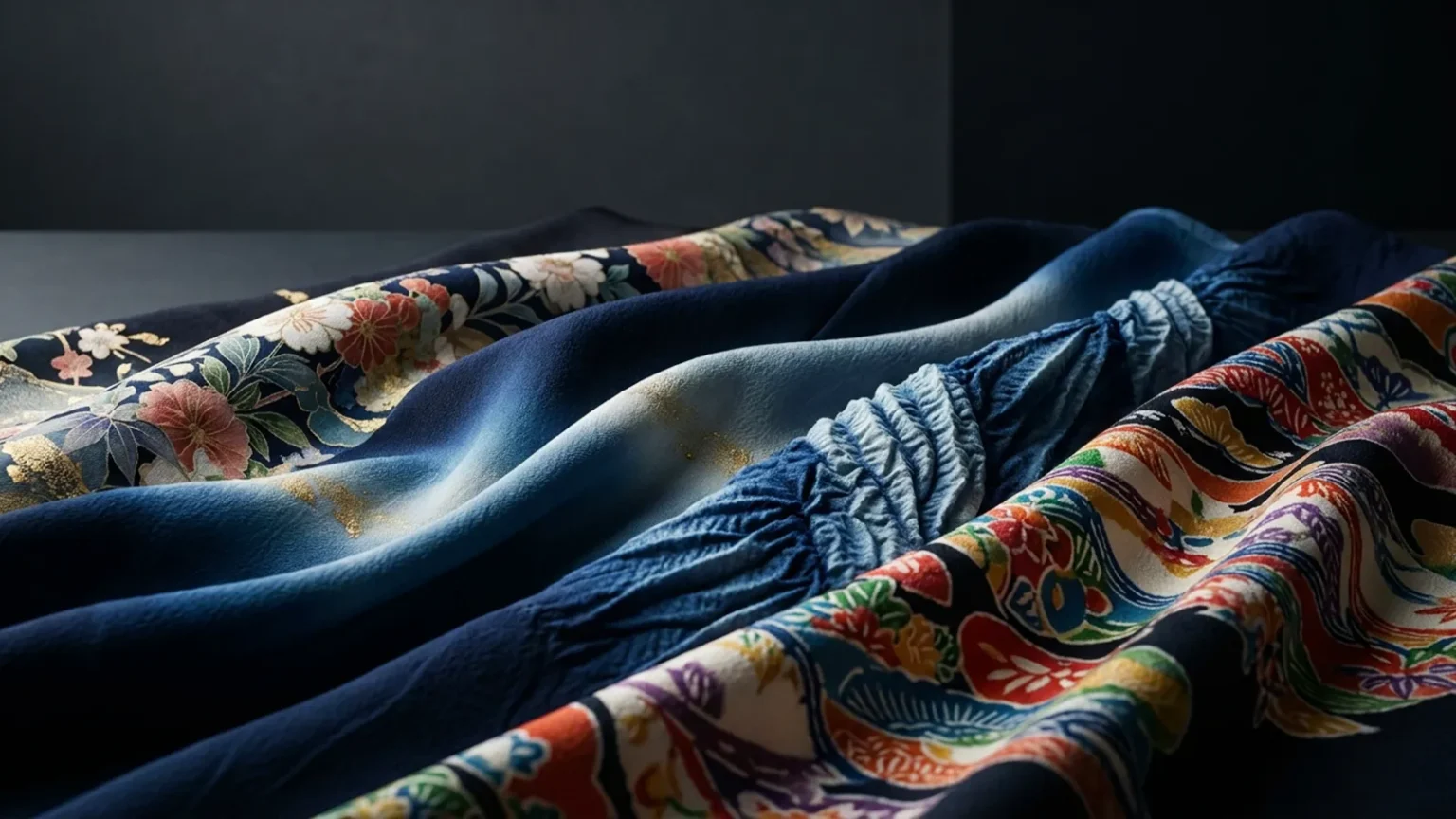
Yuzen, aizome, shibori — most people have come across these names at some point, but few could explain off the cuff what distinguishes one from another, or where each tradition comes from.
Japanese textile dyeing has developed over many centuries, with each region shaping its own techniques and visual sensibilities. The sheer number of traditions can make the field feel difficult to navigate, but with the right framework, the overall picture comes into focus quite naturally.
This guide organizes Japan’s dyeing traditions across four axes — technique, region of origin, typical uses, and how to identify each style — to serve readers ranging from craft enthusiasts to gift-seekers to designers looking for reference material. For deeper coverage of individual techniques, see the dedicated articles elsewhere on Kogei Japonica.
Table of Contents
Key Terms: What to Know Before You Begin
Entering the world of Japanese dyeing means encountering a cluster of terms that are easy to confuse. This section establishes the definitions used throughout the article.
Dyeing (Senshoku) vs. Dyed Textiles
The Japanese word senshoku refers to the technique or process of applying color and pattern to yarn or fabric. “Dyed textiles” refers to the finished cloth or object produced by that process.
In practice: yuzen is a dyeing technique; a kimono made using that technique is a dyed textile. The two terms overlap in casual use, but the distinction matters when discussing craft classification.
Dyes themselves fall into two broad categories: natural dyes derived from plant or animal sources, and synthetic dyes developed from the nineteenth century onward. Before synthetic dyes became widespread following the Meiji period, all Japanese dyeing relied on natural sources — indigo (ai), madder (akane), and safflower (benibana) among the most widely used.
Dyed Textiles vs. Woven Textiles
Dyed textiles and woven textiles both involve fabric, but they differ fundamentally in the sequence of production.
“Dyed textiles” in the Japanese craft tradition typically refers to piece-dyed (ato-zome) work: the cloth is woven first as a white ground, then color and pattern are applied. Yuzen and Edo komon — the fine-pattern stencil dyeing of the Edo period — are both piece-dyed traditions.
“Woven textiles,” by contrast, are produced using yarn-dyed (saki-zome) methods: the yarn is dyed before weaving, and the pattern emerges from the arrangement of pre-colored threads. Kasuri — Japanese ikat — is the most prominent example, with its characteristic blurred motifs formed entirely at the weaving stage. Keeping this distinction in mind sharpens the overall picture considerably.
How to Organize Japanese Dyeing Traditions
Because technique names are numerous and visual identification alone is unreliable, this article uses five structural categories:
- Hand-painted — applied directly to cloth using a brush or resist-paste tube (yuzen, tsutsugaki)
- Stencil-dyed — pattern repeated using cut paper stencils (kata-yuzen, Edo komon, katazome, bingata)
- Resist-tied (shibori) — cloth folded, stitched, or bound to create dye-resist areas (Arimatsu-Narumi shibori, Kyo-kanoko shibori)
- Immersion / natural dye — cloth submerged in dye bath (aizome, kusa-ki-zome)
- Yarn-dyed / woven — yarn dyed before weaving (Kurume kasuri, Honba Oshima tsumugi)
With these five categories in place, an unfamiliar technique name becomes much easier to situate.
Japan’s Major Dyeing Techniques at a Glance

The sections below cover the principal techniques by category, with a focus on what distinguishes each one visually and technically. A good approach is to read through the full overview first, then return to any technique you want to explore further.
Yuzen Dyeing
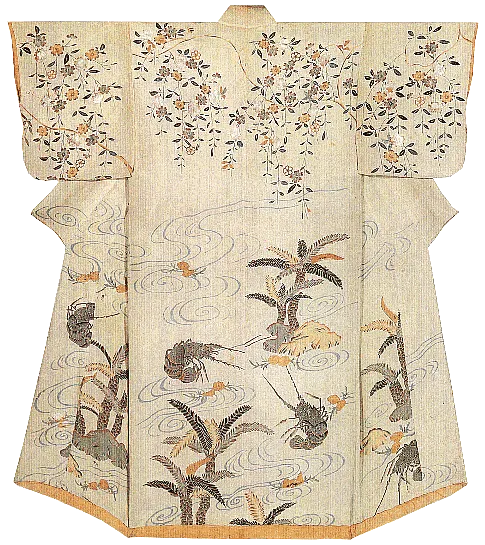
Yuzen is a resist-dyeing technique in which a rice-paste resist is used to prevent colors from bleeding into one another, allowing painterly, multi-color compositions — flowers, birds, landscapes — to be rendered directly on silk. It is the defining tradition of Japanese pictorial textile dyeing.
The technique traces its origins to the mid-Edo period, when the Kyoto fan painter Miyazaki Yūzensai adapted his drawing style to cloth dyeing. From Kyoto, the method spread across the country, taking on distinct regional characteristics as it did.

Kyoto Kogei Sensho Cooperative
In hand-painted yuzen, the design is first sketched using a water-soluble blue dye called aobana. Resist paste (itome-nori) is then applied along the outlines of each motif, and color is filled in section by section. Once complete, the paste is washed away, leaving the characteristic fine white outlines. It is a painstaking process carried out across many stages.
The three principal yuzen regions are Kyoto (Kyo-yuzen), Kanazawa in Ishikawa Prefecture (Kaga yuzen), and Tokyo (Tokyo tegaki yuzen, or Tokyo hand-painted yuzen).
| Region | Character |
|---|---|
| Kyo-yuzen (Kyoto) | Rich palette, painterly compositions. Combines visual splendor with formal refinement. |
| Kaga yuzen (Kanazawa) | Naturalistic botanical motifs, restrained color palette. Known for outward gradation (soto-bokashi) and the insect-eaten effect (mushi-kui). |
| Tokyo tegaki yuzen | Reflects the Edo aesthetic of iki — understated elegance expressed through restraint and precision. |
Shibori (Resist-Tied Dyeing)

Shibori is a resist-dyeing technique in which cloth is stitched, bound, folded, or clamped to block the dye from reaching certain areas. The undyed portions form the pattern. Because even a slight variation in binding produces a different result, the finished surface retains a quality that is entirely particular to hand work.
Resist-binding techniques have been practiced in Japan since at least the Nara period. Their most celebrated concentration is in the Arimatsu and Narumi districts of Nagoya in Aichi Prefecture, where Arimatsu-Narumi shibori has been refined over several centuries into a tradition of over one hundred classified binding methods. The range includes nuishibori (stitched resist), kumo (spider-web binding), Miura shibori, kanoko shibori (fawn-spot binding), and sekkashibori (snowflake pattern), among others.
Kyoto’s Kyo-kanoko shibori — kanoko meaning “fawn spot,” for the resemblance of the pattern to the dappled markings of a young deer — is regarded as a high-end specialty, worked in fine-grained bound silk. One characteristic of shibori across all its variants is that the dye reaches both faces of the cloth simultaneously, producing a three-dimensional surface texture that stencil dyeing does not replicate.
Katazome (Stencil Dyeing) and Bingata
Katazome is a dyeing technique in which a cut paper stencil is laid over the cloth and dye or color paste is applied through the openings. Because the same stencil can be used repeatedly, the technique was well suited to production at scale and became widely adopted during the Edo period.
Its most refined expression is Edo komon, a style of stencil dyeing in which the repeat pattern is so fine that the fabric appears to be a solid color from a distance. Only up close does the underlying geometric or natural motif become visible. The tradition originated in the stencil-dyed formal wear (kamishimo) of Edo-period feudal lords and later spread to general use.

Okinawa’s Ryukyu bingata is the island’s defining textile tradition, employing two methods: stencil dyeing (katatsuke) using cut paper stencils, and tsutsuhiki, a freehand technique in which color paste is applied through a cone-tipped fabric tube. Both approaches use a combination of mineral pigments and plant dyes on cotton, silk, or banana-fiber cloth (bashōfu). The tradition also includes ai-gata (indigo bingata), dyed with Ryukyuan indigo. Its origins go back to around the mid-fifteenth century, when bingata was worn exclusively by women of the royal court and samurai class. The saturated, multi-color palette — reds, yellows, blues, greens — sets it apart visually from virtually every other Japanese dyeing tradition.
Aizome (Indigo Dyeing) and Kusa-ki-zome (Natural Dyeing)

Aizome uses indigo extracted from plants such as Japanese indigo (tade-ai) and Ryukyuan indigo to produce a range of blues from pale sky to deep navy. Color depth builds through repeated immersion and oxidation. Tokushima Prefecture, historically one of Japan’s major indigo-growing regions, remains a central reference point for Awa aizome (Awa indigo dyeing) cultivation and craft.
Kusa-ki-zome — natural dyeing more broadly — covers the full range of plant-based dye methods, of which aizome is one. Madder, safflower, persimmon tannin (kakishibu), and mugwort are among the more commonly used sources. The soft color register and the way the colors develop with use and age are qualities that synthetic dyes do not replicate. In recent years, interest in kusa-ki-zome has grown alongside broader attention to material sourcing and production processes.
Kasuri and Yarn-Dyed Weaving

Kasuri — Japanese ikat — produces its distinctive blurred-edge patterns not through dyeing applied to finished cloth, but through the weaving of pre-dyed yarn. Sections of thread are bound or resist-dyed before weaving; when the threads are woven together, the dyed and undyed areas align to form the motif, with characteristic soft edges at every boundary.
The most widely known example is Kurume kasuri from Fukuoka Prefecture, worked in cotton with aizome-based patterns of understated geometric designs. It holds the status of an Important Intangible Cultural Property of Japan. Kasuri is included here alongside the piece-dyed traditions because, taken together, they map the full range of Japanese textile production.
Japan’s Major Dyeing Traditions by Region
Japan’s dyeing traditions are shaped by local climate, available materials, cultural history, and the particular tastes that developed within each region. When selecting a kimono or a craft object as a gift, knowing the regional associations makes the choice considerably clearer.
Kyoto: Kyo-yuzen, Kyo-komon, Kyo-kanoko Shibori
Kyoto has been the center of Japanese textile dyeing culture for centuries, its aesthetic sensibility formed in close proximity to the imperial court and the world of tea ceremony.
Four Kyoto dyeing traditions hold national designation as traditional crafts under Japan’s Act for the Promotion of Traditional Craft Industries: Kyo-yuzen, Kyo-komon (Kyoto fine-pattern stencil dyeing), Kyo-kanoko shibori, and Kyo-kuro-montsuki-zome (Kyoto formal black dyeing). Across these traditions, the defining qualities are chromatic richness, precise execution, and a range extending from formal ceremonial wear to everyday dress.


Ishikawa / Kanazawa: Kaga Yuzen
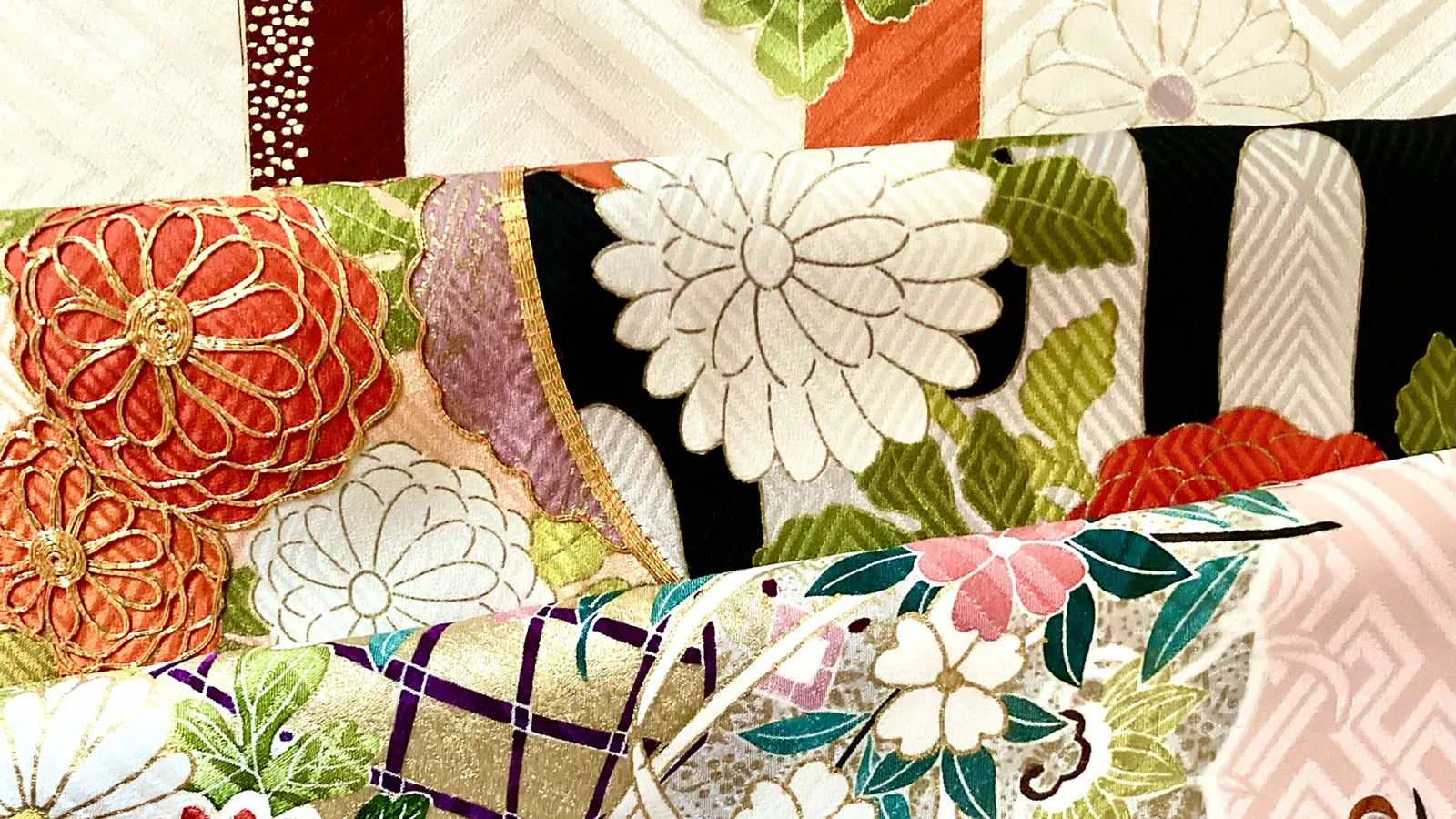
Kaga yuzen’s history begins with a local dyeing method known as ume-zome (plum dyeing), and by the mid-seventeenth century a refined technique called Kaga o-kuni-zome had been established in the region. In 1712, the Kyoto-based fan painter Miyazaki Yūzensai relocated to Kanazawa at the invitation of a local dye house, where he developed new pictorial designs and helped consolidate the use of itome-nori resist paste — a technical contribution that gave Kaga yuzen much of its subsequent character.
The palette is built around five core colors — deep red (enji), indigo (ai), ochre (ōdo), grass green (kusa), and antique purple (kodai-murasaki) — applied to naturalistic botanical compositions. Two techniques are particular to Kaga yuzen: soto-bokashi, a gradation applied from the outer edge of a form inward, and mushi-kui, in which portions of a leaf or petal are rendered as if partially eaten by insects. Another distinguishing feature is the near-total absence of gold leaf and embroidery in the finishing — a point of clear contrast with Kyo-yuzen.


Aichi: Arimatsu-Narumi Shibori
The Arimatsu and Narumi districts of Nagoya constitute Japan’s most significant concentration of shibori production. The tradition received national designation as a traditional craft in September 1975 — the first in Aichi Prefecture to do so.

The range of binding methods developed here exceeds one hundred distinct techniques — a body of knowledge so extensive that no single craftsperson is said to have mastered all of them. The Arimatsu district retains a streetscape of Edo-period merchant houses along the old Tōkaidō road, and was designated a Nationally Important Preservation District for Groups of Historic Buildings in 2016. Visiting the area offers an opportunity to encounter the dyeing tradition within its original commercial and architectural setting.
Tokyo: Tokyo Tegaki Yuzen and Tokyo Some-komon
Tokyo’s dyeing traditions carry the imprint of Edo-period urban culture, where the aesthetic of iki — an ideal of understated refinement, elegance held in reserve — shaped everything from architecture to dress. Elaboration for its own sake was not valued; what mattered was precision, restraint, and the quality of what was held back.
Tokyo some-komon (Tokyo stencil komon dyeing) received national traditional craft designation in 1976. Its defining quality is intricate geometric pattern at a scale fine enough to read as solid color at a distance — a direct continuation of Edo komon’s visual language. Tokyo tegaki yuzen shares the same cultivated quietness: a cooler palette and tighter composition than Kyo-yuzen or Kaga yuzen, with its own distinct character.

Okinawa: Ryukyu Bingata
Ryukyu bingata is Okinawa’s central textile dyeing tradition. With origins going back to around the mid-fifteenth century, it began as formal wear for women of the royal family and samurai class. Where most mainland Japanese dyeing traditions favor restrained color, bingata works with an expansive palette — reds, yellows, blues, greens — rendered with a clarity and intensity that reflects its southern origins.
Two techniques are used: katatsuke (stencil dyeing using cut paper stencils) and tsutsuhiki (freehand application through a paste-filled fabric tube). Both employ mineral pigments and plant dyes applied by hand. The tradition was designated a nationally recognized traditional craft in 1984.
Other Regions of Note
Kurume kasuri (Fukuoka Prefecture) is the best-known yarn-dyed ikat tradition nationally, valued for its soft cotton hand and aizome-based geometric patterns. Tokushima Prefecture’s Awa aizome has historically served as a primary source of indigo for Japanese dyeing more broadly, functioning as both a cultivation and dyeing center. Nagoya yuzen is characterized by single-color gradation work and classical motifs, its quietness a deliberate counterpoint to the more elaborate Kyoto tradition.

Choosing by Use: What Each Tradition Is Suited For
Technique names and regional associations are useful reference points, but they do not always answer the practical question of what to choose for a specific purpose. This section organizes the traditions by typical use.
Kimono
The dyeing technique used in a kimono is closely tied to its degree of formality. Hand-painted yuzen — whether Kyo-yuzen, Kaga yuzen, or Tokyo tegaki yuzen — and Kyo-kanoko shibori occupy the higher end of the formality register, appropriate for ceremonial occasions. Edo komon and stencil-printed yuzen sit somewhat lower on that scale, suited to a wider range of occasions including everyday and casual wear.
Ryukyu bingata is worn for formal occasions but also, in its more vivid colorways, as regional dress and summer festive wear. Understanding how dyeing technique relates to a kimono’s formality level is useful when selecting a gift.

Scarves, Accessories, and Everyday Objects
For those looking to bring dyed textiles into daily life, accessories are a practical starting point.
Aizome scarves and handkerchiefs work well with both Japanese and Western dress, and the color deepens over time with use. Arimatsu-Narumi shibori has extended well beyond kimono into contemporary garments — T-shirts, dresses, scarves — making it accessible to a wider range of buyers. Kusa-ki-zome pouches and tenugui (hand towels) in soft, plant-derived colors are among the more consistently well-received gift items for visitors to Japan.

Gifts and Interior Objects
When selecting dyed textiles as gifts, the occasion and the recipient’s context both matter.
For celebratory gifts, Kyo-yuzen or Kaga yuzen fabric lengths and small dyed accessories are common choices; for condolence occasions, Kyo-kuro-montsuki-zome (formal Kyoto black dyeing) is the standard. For international recipients, Arimatsu-Narumi shibori tenugui and scarves, or bingata pouches, tend to communicate their craft origins clearly and travel well.
For interior use, aizome noren (fabric dividers), kusa-ki-zome wall hangings, and katazome wrapping cloths sit comfortably in both traditional Japanese settings and spare contemporary interiors.

A Note for Designers
Japan’s dyeing techniques offer a substantial body of reference for textile and graphic designers.
The itome (resist-paste outline) in hand-painted yuzen produces a quality of line unlike anything achievable through printing or weaving. The soft gradations and tonal variation in shibori provide organic texture references that are difficult to replicate digitally. Katazome’s repeat structures function as a direct precedent for modular pattern design. And the tonal layering of kusa-ki-zome — adjacent values of the same hue at slightly different intensities — offers a coherent approach to color palette construction.
How to Identify Dyeing Techniques: What to Look For
When examining a dyed textile in person — whether in a gallery, a shop, or a collection — a few consistent visual and tactile cues can help identify the technique used.
Yuzen: Reading the Resist Lines
The most immediate identifying feature of hand-painted yuzen is the itome: a fine white outline running along the edges of every motif. This is where the itome-nori resist paste was applied during production and subsequently washed away, leaving the unpainted ground exposed as a thin white line.

In hand-painted work, these lines carry a slight irregularity — a quality of movement that distinguishes them from the uniformly clean edges of machine-printed or stencil-produced yuzen (known as utsushi-yuzen). The color layering in hand-painted work also tends to be more complex. Stencil-printed yuzen patterns are more regular and consistent, and are priced accordingly.
Shibori: Surface Texture and Dye Penetration
The clearest evidence of shibori is what remains after the binding is released: fine surface relief known as shibori-ato — residual crinkle and compression in the cloth that gives shibori its characteristic three-dimensional texture. This is not simply a surface effect; it is woven into the structure of the fabric itself.

On genuine shibori, the undyed areas feel slightly raised and soft to the touch. A useful check is to turn the cloth over: because the dye reaches both faces simultaneously during immersion, the undyed resist areas will be white on both sides. In stencil dyeing, the reverse side may show less complete dye penetration. Kanoko shibori and Miura shibori each have sufficiently distinctive pattern structures that, with some familiarity, they can be identified by sight.
Katazome and Bingata: Pattern Regularity and Color Character
Stencil-dyed cloth is characterized by clean, even pattern edges and — when a repeat is present — a high degree of regularity across the repeat. The precision reflects the use of a fixed stencil rather than a freely moving hand.
In Ryukyu bingata, the stencils are cut using a technique called tsukibori (push-carving), which produces edges with a particular softness. The combination of mineral pigments with plant dyes results in colors of unusual clarity and saturation. Boundaries between color areas are well-defined, and the overall palette is more intense than in any mainland Japanese stencil dyeing tradition. Edo komon is nearly the inverse: the pattern repeat is so compact that the stencil work is perceptible only under close examination, at which point regular intervals and the precision of each small motif become the key clues.

Reading Designation Labels and Product Markings
When purchasing, it is worth checking for the nationally designated traditional craft label. Textiles produced under Japan’s Act for the Promotion of Traditional Craft Industries carry an official symbol mark — a red-ground label with text in both Japanese and English — that indicates the piece meets the production standards established under national certification. It is one of the clearest indicators available to buyers at the point of purchase.


As of October 27, 2025, 244 product categories hold national designation, of which 14 are textile dyeing traditions — including Kyo-yuzen, Kaga yuzen, Arimatsu-Narumi shibori, Ryukyu bingata, and Tokyo some-komon. The absence of the mark does not disqualify a piece: there are skilled producers working outside the designation system. But where the mark is present, it provides a reliable baseline.
(Source: Traditional Crafts — Ministry of Economy, Trade and Industry)
Dyeing in Contemporary Life
These traditions are not confined to museums or ceremonial dress. Dyed textiles in Japan are produced, used, and engaged with in daily life — and there are multiple ways for international visitors and enthusiasts to encounter them directly.
Workshops as a Starting Point
Hands-on experience tends to produce a more durable understanding of a craft than reading alone. Dyeing workshops are one of the most accessible entry points.
Aizome and kusa-ki-zome workshops are available at craft studios and cultural facilities across Japan, with most sessions running a half-day and producing a finished piece — a handkerchief, tenugui, or small cloth — by the end. Shibori binding workshops are offered in the Arimatsu district, where the production environment itself adds context. Yuzen hand-painting workshops are available at multiple studios in Kyoto and Kanazawa. The experience of working through even one stage of a technique tends to change how a person looks at the finished objects afterward.
Natural Dyeing and Sustainability
Interest in aizome and kusa-ki-zome has grown in recent years alongside broader attention to material sourcing and production. Plant-based dyeing methods and small-scale handcraft are seen by some practitioners and consumers as part of a wider reconsideration of how textiles are made.
Many of the plants used in kusa-ki-zome are also everyday food or garden plants: onion skins, mugwort, and spent coffee grounds are all viable dye sources, which has attracted interest from those thinking about upcycling and reduced-waste production. That said, natural dyes come with real practical considerations — susceptibility to fading and bleeding — that make straightforward comparisons with synthetic dyes difficult. The two approaches have different properties; choosing between them involves understanding those properties in relation to the specific use.
In Summary
Trying to learn Japanese dyeing traditions by memorizing names in isolation is an uphill approach. The five-category framework — hand-painted, stencil-dyed, resist-tied, immersion/natural dye, and yarn-dyed woven — gives any new technique name a place to land.
Regionally, the broad map looks like this: Kyoto for polychrome pictorial techniques with formal register; Kanazawa for naturalistic, restrained yuzen; Aichi for the concentrated shibori tradition; Okinawa for the intense, multi-color palette of bingata. Having that map in place makes a visit to any of these regions more legible.
For visual identification, three cues cover most cases: the resist-paste outline in yuzen, the surface relief of shibori, and the regularity of stencil-dyed pattern repeats. Where possible, handle the cloth — the tactile information adds considerably to what the eye alone picks up.
The names are only the beginning. Behind each one is a body of material knowledge, regional history, and craft judgment that continues to shape how these textiles are made and used today.


