

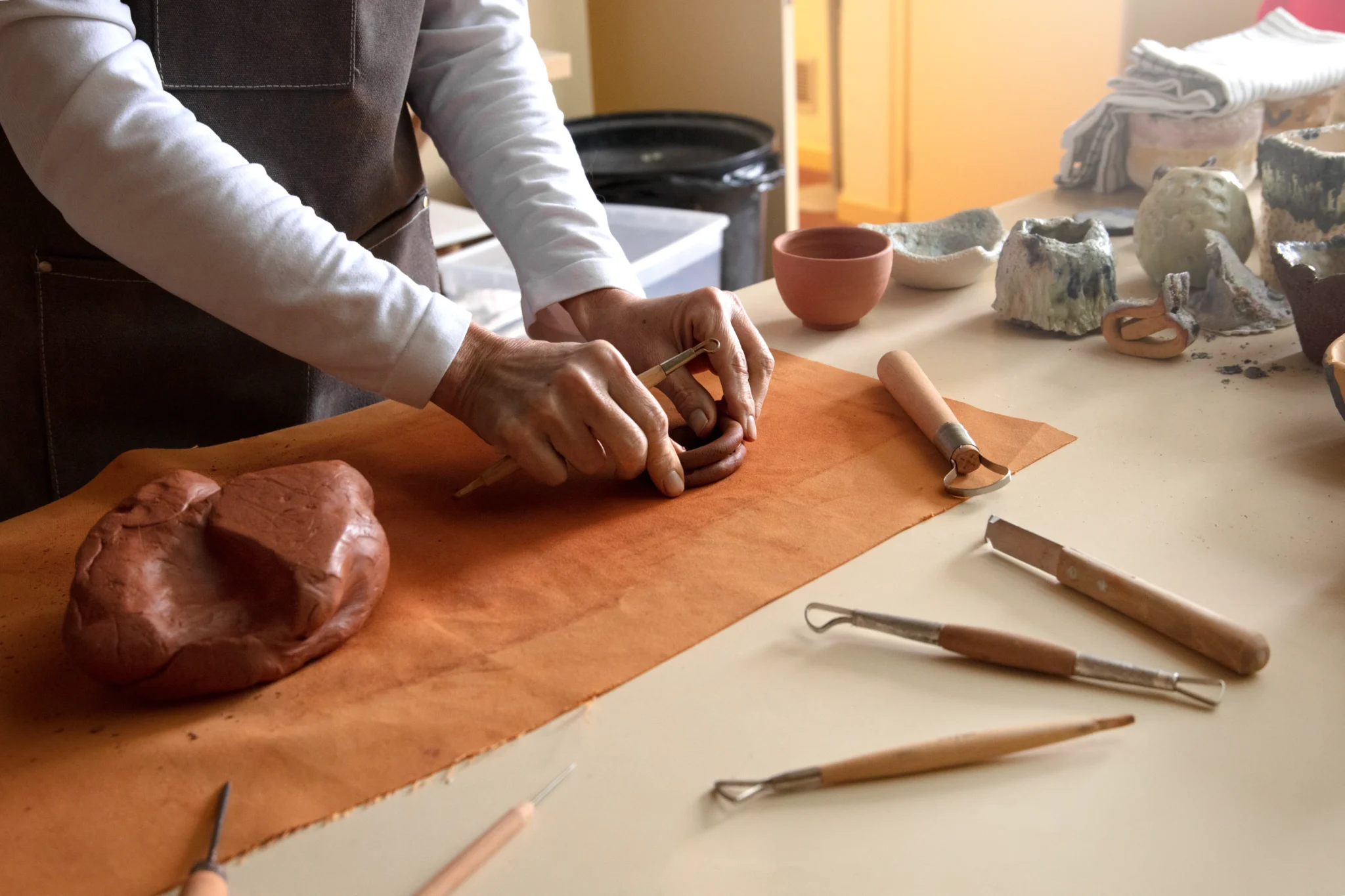
Hand-building (tebineri) is the most primitive technique in ceramics, where vessels and sculptural forms are created by shaping clay directly with hands without using a pottery wheel (rokuro). It encompasses multiple methods including coil building, pinch building, and slab building. A distinctive characteristic is that the thickness of the clay and the force applied are directly reflected in the form, making it easy for the maker’s physical sensations to remain as expressions in the work.
Unlike wheel-throwing, which pursues uniformity, hand-building readily incorporates distortions and fluctuations as positive aesthetic qualities. In contemporary ceramics, it has been reinterpreted as a foundation for sculptural and structural expression. This article provides a detailed explanation of the basic structure of hand-building, representative techniques, and approaches to understanding its aesthetic beauty.
Table of Contents
What is Hand-Building? The Most Primitive Forming Technique in Direct Engagement with Clay
Hand-building (tebineri) is the most primitive forming technique in ceramics, creating forms by kneading, stacking, and spreading clay with hands without using a pottery wheel. Because it doesn’t rely on mechanical rotation, the maker’s physical sensations and thoughts are directly reflected in the form, creating a direct dialogue with the clay.
Here, we’ll organize the definition of hand-building, examine its position and origins in ceramic history, and explore why hand-building continues to be chosen in contemporary ceramics.
Definition of Hand-Building: A Method of Creating Forms Using Only Hand Power Without a Wheel
Hand-building is a general term for methods of forming vessels and sculptures by kneading, pressing, stretching, and stacking clay with fingers and palms. Representative techniques include pinch building, coil building, and slab building, all sharing the commonality of guiding form through hand movements without relying on rotational motion.
While it’s difficult to achieve the uniformity and bilateral symmetry of wheel-throwing, expressions such as variations in thickness, distortions, and fluctuations in volume naturally emerge.
These have been evaluated not as defects but as unique charms of hand-building. Because the process proceeds while directly sensing clay resistance and moisture, it demands high concentration and experience from the maker, but in return, the forms acquire individuality and strong presence.
The Position and Origins of Hand-Building in Ceramic History
Hand-building (tebineri/tedzukune) is positioned as one of the oldest forming methods in ceramic history. In the early stages when pottery began to be made, wheel-throwing had not yet become widespread, and “hand-making (pinch, coil building, etc.)” was the primary method.
Jars and bowls made by coil building are known as techniques used in many regions since ancient times, employed not only for daily containers but also for ceremonial vessels depending on the region.
Subsequently, the pottery wheel developed around ancient Mesopotamia around the late 5th to 4th millennium BCE and spread as an efficient means of creating uniform, rotationally symmetric vessels.
While wheel-throwing became advantageous for vessels requiring mass production and uniformity, hand-building never disappeared and has continued to be chosen according to expression and purpose, such as for forms requiring freedom of shape, decoration, and asymmetric forms.
Why Hand-Building Continues to Be Chosen in Contemporary Ceramics
The reason hand-building continues to be chosen in contemporary ceramics lies in its ability to generate values different from efficiency and reproducibility.
Hand-building is closer to the act of “raising” forms rather than “making” them, and the production process itself takes on artistic quality. Distortions and thickness irregularities are read as traces of the artist’s physicality and time, showing high compatibility with sculptural expression.
Additionally, it easily accommodates free forms and large-scale creations that are difficult with wheel-throwing, and is frequently used in works evaluated within the context of contemporary art.
Hand-building is both primitive and simultaneously extremely contemporary. As long as there are expressions that can only be achieved through direct engagement with clay, hand-building will continue to survive as a fundamental ceramic technique.
Representative Forming Techniques in Hand-Building
Hand-building includes several basic forming techniques that have been selectively used according to purpose and expressive intent.
All share the essential characteristic of not relying on wheel rotation but rather manipulating clay masses or surfaces.
Here, we’ll examine the three most fundamental techniques—pinch building, coil building with excellent structural properties, and slab building with high sculptural freedom—organizing their characteristics and potential applications.
Pinch Building: The Most Basic Forming Method and Its Applications
Pinch building is the most basic hand-building technique, preparing a clay mass and creating form by pressing the center with thumbs while hollowing out the interior.
It’s suitable for relatively compact vessels like bowls and small dishes, characterized by the ability to form while maintaining the clay’s sense of volume. While experience is needed to maintain uniform thickness, this process naturally produces simple, stable vessel forms.
Applications include joining multiple pinched forms to expand the shape or intentionally leaving thickness variations to emphasize sculptural expression.
While pinch building appears simple, the finished result varies greatly depending on finger pressure and rotational rhythm, making it arguably the forming method that most directly expresses the maker’s sensations.
Coil Building: A Structural Technique for Raising Forms Through Layering
Coil building (coil forming) is a forming technique where clay is stretched into rope-like coils, which are then stacked in rings to build up vessel walls.
As a representative hand-building method without using a wheel, it has been used worldwide since ancient times. It’s particularly suited for relatively large forms like tall jars and bowls with considerable height and volume.
The process requires firmly pressing stacked coils together to unify the joints, pressing and smoothing from inside and out to ensure strength. Weak joints can lead to cracking during drying or firing, requiring care and patience.
Additionally, layering traces can be intentionally left to emphasize rhythm and texture, or they can be completely smoothed to achieve an appearance close to wheel-throwing.
The major appeal of coil building lies in its ability to simultaneously design structure (support method and thickness) and expression (traces and surface finish), allowing flexible development according to sculptural intent.
Slab Building: A Sculptural Approach Developing from Plane to Volume
Slab building is a forming technique where clay is rolled into slabs, cut from these planes, and assembled to construct three-dimensional forms.
It’s suitable for box shapes, angular forms, and geometric creations, characterized by high compatibility with architectural thinking. Depending on slab thickness and joint treatment, expressions can range from sharp to organic.
Because precise design accounting for drying shrinkage is required, planning becomes crucial, but this also makes it a technique that readily realizes intended forms.
Slab building is applied not only to vessels but also to sculptural and installation works, making it an approach particularly suited to contemporary expression among hand-building techniques.
Distinctive Sculptural Characteristics of Hand-Building
The appeal of hand-built works lies in their sculptural richness that cannot be measured by high finish quality or uniformity.
Elements like bilateral asymmetry and thickness fluctuations are not signs of immaturity but results of the direct relationship between clay and person taking form.
Here, we’ll organize how expressions and forms unique to hand-building emerge and clarify differences in sculptural philosophy as seen through contrasts with wheel-throwing.
Expression and Human Touch Inherent in Bilateral Asymmetry
The bilateral asymmetry seen in hand-built works holds important meaning not as coincidence but as evidence of human intervention.
Through finger placement, pressure application, and changes in posture and viewpoint during forming, forms slightly tilt and lines deviate from evenness. Such differences rarely emerge from mechanical rotational motion and naturally appear precisely because of hand-building.
Fingerprints and pressing traces remaining on surfaces function not as decoration but as records of the making process.
Viewers can perceive not just the finished form but the physical process that led to it, bringing them closer to the work. Bilateral asymmetry creates not instability but tension that holds the gaze, giving the form its unique expression.
Organic Forms Generated by Thickness, Distortion, and Fluctuation
In hand-building, maintaining perfectly uniform vessel thickness is difficult, and differences naturally emerge.
These thickness variations affect post-firing shrinkage and glaze pooling, consequently forming organic shapes. Distortions and fluctuations function not as elements that collapse form but as factors that convey volume and center of gravity.
Particularly, subtle undulations at rims and body sections create shadows depending on light angle, giving movement to static forms.
Hand-built forms prioritize visual and tactile comfort over measurable dimensions, possessing an aspect that completes through not only viewing but also touching. Such organic forms carry warmth absent in industrial products, directly appealing to the user’s senses.
Sculptural Philosophy as Seen in Differences from Wheel-Throwing
While wheel-throwing emphasizes balance and reproducibility based on a rotational axis, hand-building doesn’t fix an axis and incorporates the very process of form establishment into the sculpture. With wheel-throwing, the fundamental thinking involves envisioning the finished form beforehand and increasing precision toward that goal.
Conversely, with hand-building, forms are updated through mid-process judgments and clay conditions, and production proceeds dialogically.
This difference indicates not merely technical variation but philosophical divergence. Hand-building is a method that emphasizes process over result and chooses presence over perfection. This is precisely why no two hand-built works are alike, establishing themselves as forms strongly inscribed with the maker’s thought and physicality.
Production Process and Technical Points
While hand-building forming appears sensory and free, material understanding and process management greatly influence completion quality. Particularly clay selection, moisture adjustment, judgments during forming, and connections from drying through firing are crucial elements determining work success.
Here, we’ll organize basic yet practical technical points in hand-building production across three process stages.
Clay Selection and Moisture Management: Preparation Process for Drawing Out Plasticity
In hand-building, clay type (particle fineness and stickiness) and moisture management greatly influence the finish.
If clay is too hard or lacks plasticity, it cracks easily during the spreading process; conversely, if too soft, it doesn’t support itself and causes shape collapse and distortion. Awareness of adjusting to workable firmness (sometimes explained as “about earlobe softness” as a guideline) according to purpose and expression is important.
During the wedging stage, it’s important not only to remove air from the clay but also to make the overall firmness (moisture state) uniform (the common organization being rough wedging to mix and even firmness, then spiral wedging to remove air). Remaining air can lead to firing defects, so careful clay preparation before forming is essential.
Additionally, cracks can occur not only from moisture excess or deficiency but also from thickness irregularity, uneven drying, and poor adhesion. Since hand-building directly reflects fingertip pressure in the form, the more stable the clay state, the easier it becomes to guide form without applying excessive force. Careful attention to preparation processes directly connects to subsequent forming stability.
Precautions for Preventing Cracking and Distortion During Forming
Common troubles during forming include cracking and distortion. Most cracks result from localized drying or abrupt thickness changes. Therefore, constantly being conscious of overall moisture balance during work and adjusting as needed with damp cloths or spray bottles is important. Also essential is the judgment to avoid forcing form progress and instead divide processes with rest periods.
Regarding distortion, posture and force application during forming have significant impact. Touching only one side intensively disrupts the center of gravity, and drying emphasizes tilting. Hand-building requires not just “looking neat from one direction” but a perspective that checks while rotating the entire circumference. The sensibility to discern not complete elimination of cracks and distortion but what to tolerate and what to correct is technically demanded.
Connecting to Drying, Trimming, and Firing
Post-forming processes are crucial stages for stabilizing hand-built work completion quality. Drying fundamentally proceeds not rapidly but while adjusting ventilation to dry the whole uniformly. Especially for works with thickness variations, measures like covering with plastic to equalize drying speed are necessary. In the trimming process, while large trimming like wheel-thrown works isn’t performed, it plays an important role in stabilizing foot rings and adjusting weight balance.
Toward firing, after confirming complete drying, bisque firing is performed to stabilize the clay body. Since hand-built works tend to retain internal stress, firing schedules with gradual temperature increases are desirable. Viewing the continuum from forming through firing as one flow and carefully connecting each process becomes the reliable path leading hand-built works to completion.
Hand-Building as the Technique Where Artistic Identity Most Readily Appears
Hand-building is a method where artistic identity particularly readily appears among ceramic techniques, as the maker’s judgment and physical sensations intervene at every forming process stage. In hand-building, which doesn’t presuppose uniformity or reproducibility, what’s inscribed in the form is not form completion quality but how one engaged with clay through what thoughts and sensations.
Here, we’ll organize hand-building’s expressive potential from three perspectives: the value of uniqueness, relationships with decoration and embellishment, and development toward abstract sculpture.
The Value of Uniqueness Where the Same Form Never Emerges Twice
Hand-building’s greatest characteristic lies in the extreme difficulty of intentionally reproducing the same form. Because slight condition differences—finger movements, force application, clay moisture, forming judgments—affect the sculpture, completed works inevitably become one-of-a-kind. This uniqueness generates value different from mass production or serialization, being evaluated as existence embodying the artist’s time and physicality.
Particularly in contemporary ceramics, since production acts and thought processes behind works are emphasized, irreproducibility itself functions as part of the work’s artistic quality. Hand-building can be said to be a technique appreciated including not just resulting forms but “the reason that form was reached.”
Compatibility with Decoration, Carving, and Embellishment
Hand-building also excels as a technique where fluctuations and thickness variations born at the forming stage naturally resonate with decoration and embellishment. Expression through carving and trimming demonstrates effectiveness especially on surfaces with irregularities and distortions rather than uniform vessel forms. Additionally, decorative techniques like slip application, glaze layering, inlay, and sgraffito, when applied to hand-building’s non-uniform surfaces, generate landscapes where chance and necessity intersect.
Embellishment becomes not afterthought decoration but is layered while reading forms born from forming, converging overall into unified expression. Hand-building’s strength lies not in making decoration the protagonist but in its ability to incorporate decoration as part of the sculpture.
Development Toward Abstract Sculpture and Object Expression
Hand-building is also a technique that readily develops beyond the functional framework of vessels toward abstract sculpture and object expression. Because it’s not bound by rotational symmetry, it can actively incorporate volume imbalance and irregular composition, showing high compatibility with sculptural thinking.
In contemporary ceramics, forms with ambiguous interior-exterior distinctions and forms without function are often evaluated, and hand-building becomes the foundation supporting such expression. The process of exploring forms while stacking, carving, and collapsing clay combines improvisation and construction, directly visualizing the artist’s thinking. Hand-building, while being a primitive technique, continues to be chosen by many artists as the most free contemporary expressive means.
Perspectives on Appreciation and Collection
When appreciating and collecting hand-built works, perspectives that read traces of physicality and thought embodied in the sculpture become more important than quantifiable completion standards. Values that cannot be captured by uniformity or overly neat forms reside in hand-building.
Here, we’ll organize specific focal points when viewing works, evaluation approaches including “incompleteness,” and how to interpret differences between functional vessels and viewing ceramics.
Points for Viewing Hand-Built Works: Thickness, Center of Gravity, Tactile Quality
When evaluating hand-built works, first attention should go to thickness distribution and center of gravity placement.
Rather than uniformity, viewing where volume is concentrated and where weight is reduced reveals the maker’s sculptural intent. Whether the base is stable and whether visual center of gravity matches actual holding sensation are also important judgment criteria.
Additionally, tactile quality is an indispensable element in hand-built works. Surface irregularities, fingerprints, and trimming traces complete through not only vision but touch.
Whether smoothness was aimed for or roughness deliberately retained, and whether that choice is consistent, determines work completion quality. An attitude of evaluating through multiple senses—viewing, holding, touching—is required.
How to Evaluate Completion Quality and “Incompleteness”
In hand-built works, elements that “appear incomplete” are sometimes intentionally retained. Distortions, uneven thickness, rough surface treatment, etc., are often not technical deficiencies but sculptural choices. Therefore, when judging completion quality, it’s necessary to discern not whether it’s neat but whether that incompleteness contributes to the work’s overall expression.
Whether formal instability generates tension or is merely processing deficiency becomes the core of appreciation.
Works where intent and result align give incompleteness persuasive power and strongly convey the artist’s philosophy. Evaluating hand-building is an act that asks not “how far was it finished” but “why was it stopped there.”
Reading Differences Between Functional Vessels and Viewing Ceramics
Hand-built works include both functional vessels used daily and viewing ceramics that don’t presuppose utility.
In functional vessels, how functional elements like rim feel, ease of holding, and stability are incorporated into the sculpture is important.
Conversely, in viewing ceramics, formal tension, volume placement, and spatial relationships are emphasized over usability. The difference between both exists not only in utility but in sculptural judgment standards themselves.
In collecting, it’s important to discern which realm the work aspires toward and evaluate according to that intent. Hand-building is a technique that can traverse boundaries between utility and viewing, and that very fluctuation generates work depth.
Hand-Building’s Current Position in Contemporary Ceramics
While being a primitive forming technique, hand-building continues to acquire new meaning in contemporary ceramics. This is because its ability to present values different from wheel-centered production systems and industrial uniformity strongly connects with contemporary expressive environments.
Here, we’ll organize hand-building’s current position from three perspectives: reinterpretation by contemporary artists, relationships with international ceramics and contemporary art, and reasons for emphasis in educational settings.
Reinterpretation and Avant-Garde Expression by Contemporary Artists
In contemporary ceramics, hand-building is redefined not as mere traditional technique but as expressive means. Many artists once deconstruct the functional framework of vessels and treat volume, distortion, and gravitational sensation itself as themes. Hand-building forming, because it leaves judgments during production and physical movements directly in the sculpture, enables expression where thought and action are inseparable.
Consequently, works establish themselves not as finished forms but as existence embodying process.
In avant-garde works, sculptures that explore boundaries between stability and instability through repeated layering and collapsing are frequently seen. Hand-building is chosen by contemporary artists not as a technique that preserves form but as a method for questioning form itself.
Connections with International Ceramics and Contemporary Art
Hand-building (tebineri/hand-building) also connects with contexts of international contemporary ceramics and contemporary art.
Particularly recently, examples where ceramics are presented beyond the “vessel” framework as sculptural volumes or installations have increased, and hand-building, which enables forms not dependent on rotational symmetry, is sometimes chosen as production means.
Additionally, the materiality of clay as a medium and how processes like forming and drying relate to work meaning and appearance can be organized as readily connecting with contemporary art thinking that emphasizes materiality and process.
Hand-built forms are readily evaluated not through technical novelty itself but through relationships with materials and sculptural intent (spatial relationships, physical scale, surface traces, etc.), and Japanese hand-built works are also connected to international exhibition contexts from such perspectives.
Reasons for Emphasis in Education and Workshops
Hand-building continues to be emphasized in education and workshop settings.
The reason lies in its ability to experientially understand relationships with materials before technical acquisition. While wheel operation requires certain training, hand-building allows relatively early contact with clay properties and forming principles.
Failures and distortions are readily accepted as part of learning, showing good compatibility with educational policies that evaluate process over result.
Additionally, because finished forms aren’t fixed to one outcome, each participant’s interpretation and individuality naturally emerge. Hand-building plays an important role in contemporary times not only as technical education but as means for nurturing sculptural thinking and self-expression.
Summary
Hand-building is ceramics’ most primitive yet contemporary forming technique, raising forms through direct engagement with clay without using a wheel.
Based on fundamental techniques like pinch building, coil building, and slab building, it actively incorporates elements like bilateral asymmetry and thickness fluctuations, inscribing the maker’s physicality and thought into the sculpture.
Its uniqueness and irreproducibility strongly visualize artistic identity, deeply connecting with contexts of contemporary ceramics and contemporary art.
From functional vessels to viewing ceramics and educational settings, hand-building plays an important role as a technique embodying an attitude that emphasizes process over result.
While standing continuously between completion quality and incompleteness, hand-building, which sublimates dialogue with clay into sculpture, will continue developing in diverse forms as a foundation of ceramic expression.
