




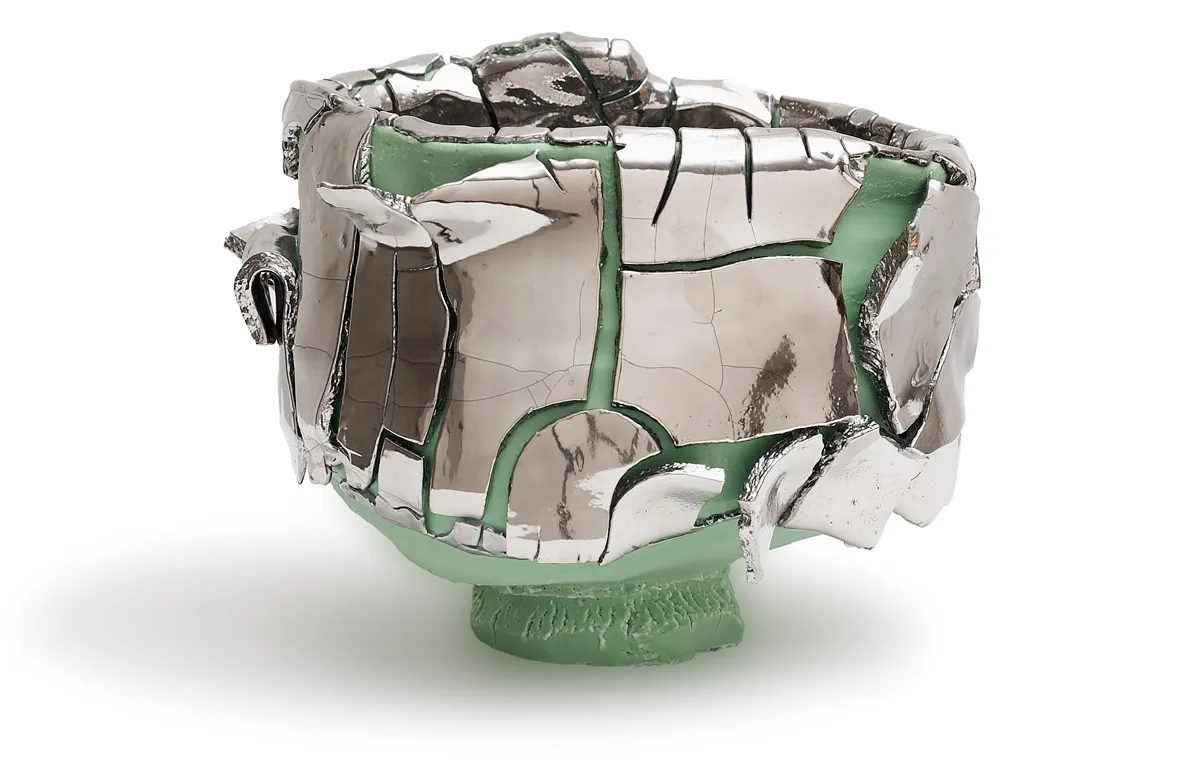
Takuro Kuwata is a contemporary ceramic artist who has earned high acclaim both domestically and internationally for continuously challenging and renewing the established concepts of ceramics. While starting from traditional vessel forms and firing techniques, he has expanded ceramics from “perfected craft” to “ever-evolving expression” by incorporating processes such as gold decoration, glaze cracking, and intentional destruction and repair into his works. His practice connects with diverse fields including fine art, design, and fashion, extending to presentations at international art fairs and museums.
This article provides a multifaceted exploration of Kuwata’s artistic philosophy, technical characteristics, interpretation of his representative works, and his influence on contemporary ceramics.
Table of Contents
Takuro Kuwata: The Artist Redefining the Conventions of Contemporary Ceramics

Takuro Kuwata is a contemporary ceramic artist who, while deeply understanding the framework of traditional ceramics, continues to shake its very foundations from within. Starting from the functional format of vessels, he has created works that actively incorporate elements such as distortion, destruction, and excessive glaze expression, crossing the boundaries between ceramics and contemporary art.
Here, we will examine the artist’s journey and creative background, his relationship with the context of Mino ware, and the reasons why he is highly regarded in contemporary art and design fields, building a three-dimensional understanding of Kuwata as an artist.
Biography and Career: International Activities Based in Tajimi, Gifu, Born in Hiroshima
Takuro Kuwata is a ceramic artist born in 1981 in Hiroshima Prefecture.
After graduating from Kyoto Saga University of Arts Junior College in 2001, he apprenticed under ceramic artist Susumu Zaima in 2002, and completed his studies at the Tajimi City Pottery Design and Technical Center in 2007.
He is currently based in Tajimi City, Gifu Prefecture, where he conducts his creative activities.
Tajimi is known as a major production area for Mino ware, a region where the ceramics industry, with over 1,300 years of history, is highly concentrated.
In this environment, Kuwata thoroughly mastered the fundamental techniques of ceramics, including materials, glazes, and firing.
However, feeling uncomfortable with the production area’s values emphasizing mass production and perfection, he began exploring his own unique expression from an early stage.
While incorporating traditional ceramic techniques such as “kairagi” and “ishihaze,” he developed a challenging style that overturned conventional tea bowl norms by adding vivid colors and pop forms not typically used in traditional vessels.
As he gained attention through presentations in Japan, his works began to be introduced at galleries and art fairs overseas.
His works are now in the collections of museums worldwide, including the Art Institute of Chicago and the University of Michigan Museum of Art.
He received the LOEWE Craft Prize Special Mention in 2018 and the Japan Ceramic Society Award in 2022, establishing himself as an artist recognized not only in Japan but also within the international contemporary art context.

Unique Expression Emerging from the Context of Mino Ware
Kuwata’s works start from the context of functional ceramics cultivated by Mino ware.
While fully understanding the production area’s values of uniform, high-quality vessel making, he deliberately chose expressions that deviate from those standards.
His approach of intentionally distorting vessel forms, overflowing glazes, and incorporating cracks and defects as part of the work represents an attempt to positively reconstruct elements previously considered “failures” or “incomplete.” This is not a denial of tradition but rather an act of making visible the possibilities that tradition has always contained.
Because of Mino ware’s accumulated technical expertise, these deviations don’t end as superficial experiments but stand as expressions with strong persuasive power.
Why He Is Highly Regarded in Contemporary Art and Design
The reason Takuro Kuwata is highly valued in contemporary art and design fields lies in the fact that his works are not confined to value standards internal to ceramics.
While maintaining the scale and everyday quality of vessels, their surface treatment and structure are sculptural, and when placed in space, they radiate a strong presence as objects.
Furthermore, his handling of color and texture has design sophistication, naturally connecting with architectural and interior contexts.
Viewers are simultaneously confronted with multiple interpretations—utility, decoration, destruction—and must update their relationship with the work. This multiplicity is what establishes Kuwata’s work as contemporary expression and serves as the driving force that continues to renew ceramic conventions.
Kuwata’s Sculptural Philosophy and Aesthetics
What runs through Takuro Kuwata’s works is an attitude of accepting the established concept of vessels, then breaking them down, reconfiguring them, and redefining them.
While taking as his premise the perfection and stability that traditional ceramics have accumulated, he deliberately exposes instability and dissonance, thereby questioning the very value standards of ceramics.
Here, we organize the formative processes that characterize Kuwata’s production, his approach to completion and incompletion, and his positioning at the intersection of Japanese aesthetics and contemporary art.
The Sculptural Process of “Breaking, Repairing, and Covering”
Kuwata’s sculptural process does not end with “forming.”
The process of deliberately breaking forms once established as vessels, creating cracks and defects, and then covering them with kintsugi (gold joinery) or glazes carries important meaning. The act of breaking is not destructive impulse but rather an operation to disassemble what has been considered a completed state.
The subsequent repair and decoration are not performed to restore the original form but to overwrite it with different values.
As a result, multiple timelines coexist simultaneously in the work, and the traces of production themselves become fixed as part of the sculpture. This cyclical process of “breaking, repairing, and covering” gives Kuwata’s works their distinctive tension and depth.
Aesthetic Consciousness Shaking the Boundary Between Complete and Incomplete

In Takuro Kuwata’s works, the very question of “whether it is complete” becomes ambiguous.
The state where glaze drips excessively, surfaces are rough, and forms are distorted would typically be considered incomplete or failed by general ceramic standards. However, Kuwata deliberately chooses this state and presents it as complete.
What matters is not whether it is orderly but how strong a presence that form can possess.
When elements that appear incomplete support the overall tension of the work, they become sculptural necessity.
Kuwata’s aesthetic consciousness can be said to attempt to renew viewers’ evaluation standards by shaking the boundary between complete and incomplete rather than treating them as binary opposites.
The Intersection of Japanese Aesthetics and Contemporary Art
Kuwata’s sculptural philosophy is deeply connected to both Japanese aesthetics and contemporary art.
The sensibility of finding value in defects and imperfection resonates with the lineage of wabi and sabi in Japanese culture.
However, his expression is not overly introspective and possesses the power to dominate space through the intensity of color and texture.
This strongly connects with the objecthood and materiality emphasized by contemporary art. Kuwata’s works are characterized by using Japanese aesthetic consciousness as material while translating it into a visual language that works internationally.
It is precisely this stance at the intersection that positions him as an artist who cannot be contained within the framework of contemporary ceramics alone.
Representative Techniques and Production Processes
Takuro Kuwata’s works differ significantly from conventional ceramic processes that proceed unidirectionally from forming to firing.
Rather than finishing after creating forms, he expands the timeline of production itself by breaking, adding, covering, and further manipulating.
Here, we organize from three perspectives the representative techniques supporting Kuwata’s works and the philosophy behind his production processes.
Methods Utilizing Cracks and Defects in the Firing Process
In Kuwata’s works, phenomena such as glaze cracking and dripping that occur during firing—traditionally considered failures in craft—are instead utilized as essential elements of the work.
Traditional techniques such as “kairagi” (cracking that occurs when glaze contracts more than the clay body during firing) and “ishihaze” (explosions when stones mixed into clay burst during firing) were originally considered failures but came to be positively evaluated as having “character” throughout history.
There are no failures in vessels that come out of the kiln; even unexpected developments in form or color become starting points for the next creative idea.
Finger marks from kneading and attaching clay, glaze wrinkles and cracks from firing—these are recognized as traditional techniques and expressions in the ceramic world.
Kuwata seeks to maximize and liberate phenomena that the clay demands, which cannot be controlled even when attempting to do so.
As if extracting natural energy, unexpected colors and forms emerge visually.
Through this process, new sculptural possibilities open up beyond the original image of balanced vessels. The fundamental philosophy of this technique is that forming is not simply an act of arranging shapes but rather that unexpected structural changes emerge through dialogue between materials and the firing environment, from which new expressions arise.
The Structure of Surface Decoration Using Gold, Silver, and Pigments

What supports the visual intensity of Kuwata’s works is surface decoration using gold, silver, and pigments. In particular, gold, platinum, and strong-colored pigments are intentionally applied to emphasize phenomena such as glaze cracking (kairagi) and dripping that occur during firing. Metallic luster and strong colors form new layers on the vessel’s surface, visually colliding with the ceramic as material.
Works emphasizing “kairagi” with platinum are collected by the National Crafts Museum, and this decorative technique functions not as mere ornament but as a structural element to beautify and reconstruct the visual expression of firing-induced phenomena (cracks and distortions originally considered failures in ceramics).
As a result, viewers’ gazes are drawn not to the form itself but to events occurring on the surface. Emphasizing traditional techniques such as glaze cracking and dripping with gold, silver, and pigments becomes a process for giving new value to phenomena originally considered failures and expanding the expressive possibilities of traditional ceramics. Through this process, works simultaneously embody deep understanding of traditional craft and innovative visual language that shakes its framework.
Post-Firing Processing: Production Process Extending the Timeline
What is important in Takuro Kuwata’s production is that works are not completed even after firing. In conventional ceramics, firing is the final process, but Kuwata’s works undergo processes of destruction, rejoining, and decoration after firing. This means that works contain not a linear timeline of “before firing” and “after firing” but coexisting multiple temporal layers.
Post-firing processing relativizes the irreversibility in ceramics and postpones the concept of completion. Works are presented not as once-completed entities but as aggregates of traces that have continued to receive manipulation. This expansion of the timeline is an important factor that establishes Kuwata’s works as contemporary expression.
Relationship with and Distance from Mino Ware
Essential to understanding Takuro Kuwata’s works is his relationship with Mino ware. Kuwata is not positioned outside the production area critiquing tradition but has embodied techniques and values from within before taking distance and reconstructing them.
Here, we organize how he builds upon Mino ware techniques and contexts, where he deviates, and how he connects regional characteristics to international contexts.
Strategy of Building Upon Yet Deviating from Regional Techniques
Kuwata’s expression stands upon Mino ware’s advanced technical foundation. Precisely because he accurately understands fundamental techniques such as forming, glazing, and firing, intentional distortion, destruction, and excessive glaze expression can be established.
In other words, these deviations do not arise from ignorance or rebellion but are choices premised on deep understanding of regional techniques. The strategy of once accepting Mino ware’s values emphasizing mass production and perfection before departing from them gives his works persuasive power. Rather than denying tradition, it can be said to be an act of making visible and shifting the preconditions that tradition holds.
Practice Questioning the Framework of Traditional Craft
Kuwata’s practice is also an attempt to question the very framework of traditional craft. Normally, craft emphasizes technical succession and style preservation, but Kuwata does not regard these as absolute values. By intentionally dismantling craft’s evaluation axes of perfection, uniformity, and utility, he poses the question “what constitutes craft?” to viewers.
This attitude is a practice of shaking tradition from within rather than critiquing it from outside. Therefore, works function both as craft and simultaneously as craft criticism. Because it has the specific context of Mino ware, this question does not end as abstract theory but holds practical intensity.
The Power to Translate Regional Characteristics into International Context
One of Takuro Kuwata’s major characteristics is his power to translate regional characteristics into international visual language. The local production character of Mino ware has aspects that don’t easily translate to overseas contexts as is. However, Kuwata transforms regional techniques into global expression through sculptural operations that are universally understandable, such as destruction, reconstruction, and excessive surface treatment.
Viewers can receive strong impressions from the work’s materiality and tension even without knowing Mino ware’s history. Furthermore, knowing the background gives regional characteristics deeper meaning. Kuwata’s works function as entities rooted in the production area yet not closed off, open to the international contemporary art context.
Perspectives for Appreciation and Collection
When appreciating and collecting Takuro Kuwata’s works, perspectives different from general ceramic works are required. It is necessary to read not only perfection and technical precision but also traces of destruction and repair, overlapping of time, and relationships between layers generated on surfaces.
Here, we organize specific points for viewing works, axes of value judgment, and considerations for exhibition and preservation.
Points for Viewing Works: Firing Phenomena, Decorative Layers, and Traces of Time
When encountering Kuwata’s works, first focus on phenomena such as glaze cracking (kairagi) and ishihaze that occurred during firing.
These are elements traditionally considered failures in ceramics, but Kuwata intentionally emphasizes them with gold, platinum, and strong-colored pigments, reconstructing them into essential elements of the work. By observing their position, scale, and how they guide the gaze, the artist’s aesthetic judgments regarding phenomena occurring during firing emerge.
Next important is the structure of surface layers. Observing the order in which different materials such as glaze, metal, and pigment are layered and where they collide reveals multiple temporal layers inherent in the work. Cracking from glaze contracting more than the clay body, the luster of gold or platinum placed on top, and the coloration of pigments—these layers show traces where the instantaneous process of firing and the intentional creative act of decoration are overlaid.
Additionally, perspectives rooted in tea ceremony appreciation culture are important. When appreciating tea bowls, one observes the foot ring to read the artist’s individuality. This is similar to reading something from brushstrokes in Western painting, but the Japanese appreciation method of carefully examining even the underside of vessels is essential for understanding holistic beauty that includes not just surface flashiness but relationships with internal structure. Beginning with attraction to the surface and being drawn from there into deeper contemplation—this depth of appreciation brings out the true value of Kuwata’s works.
Value Judgment by Uniqueness, Series Character, and Production Period
Takuro Kuwata’s works maintain consistent sculptural vocabulary while existing in multiple parallel series, so value judgment requires considering not only individual perfection but also production period and positioning within series. Early works from when he apprenticed under Susumu Zaima from 2002 more clearly retain traditional Mino ware vessel forms, while after completing studies at Tajimi City Pottery Design and Technical Center (2007), expression evolved to add color and platinum to traditional techniques such as kairagi and ishihaze.
Parallel production of multiple series such as “Chawan (tea bowl),” “Cup,” and “Ku (Craft Line)” has formed diverse creative worlds ranging from large one-of-a-kind pieces rooted in tea culture to everyday vessels and further to sculptural objects. Even within the same series, individual differences are significant, with works based on traditional glaze effects coexisting with works using experimental color combinations. Because glaze treatment and decorative techniques differ by production period, understanding a work’s presentation timing enables reading changes in the artist’s thinking and technical developments. Deeper evaluation becomes possible by discerning representativeness and experimentality within series.

Considerations for Exhibition Environment and Preservation Management
Kuwata’s works contain abundant visual information and are susceptible to exhibition environment influences. Excessively strong lighting can overly emphasize reflections from metal and pigments, making surface layer structures appear monotonous. Therefore, lighting design where shadows naturally emerge is desirable. Regarding preservation, attention is needed for the use of mixed materials.
Metal parts and pigments are susceptible to humidity and temperature changes, making environmental management more important than for general ceramics. Though Kuwata’s works appear as robust objects, they are also aggregates of delicate layers. Understanding the material characteristics of works and conducting exhibition and storage accordingly is a fundamental attitude for engaging with collections over time.
Market Evaluation and International Positioning

Takuro Kuwata’s works have established a unique position in the contemporary art market, not confined to the framework of ceramics. While having a craft background, his expressions circulate as art and are recognized as collectable entities both domestically and internationally. Here, we organize how he is handled at galleries and art fairs, approaches to price formation, and his presence crossing multiple markets.
Handling at Domestic and International Galleries and Art Fairs
Kuwata’s works are not limited to craft-specialized exhibition spaces but have been introduced at galleries handling contemporary art and international art fairs. On such occasions, works are often treated not as “ceramic works” but on equal footing with sculpture and objects, with exhibition methods chosen that consider spatiality and installation character.
Traces of destruction and repair, strong colors, and metallic surfaces have high visibility even in photographs and from distance, making them compatible with international exhibition environments.
This handling demonstrates that Kuwata’s works do not close within local craft contexts but function as global visual language.
Price Formation as Collectable Art
The pricing of Takuro Kuwata’s works is formed not only by physical elements such as materials and size but also by production period, series, and presentation context. Because expressive changes from early works to the present are clear, positioning within the artist’s career significantly influences price evaluation. Additionally, the fact that all are one-of-a-kind productions with no presumption of reproduction enhances value as collectable art.
Pricing follows contemporary art market thinking more than craft market conventions, emphasizing the context in which works were presented and how they have been evaluated. This structure clearly shows that Kuwata’s works circulate not as “vessels to use” but as “works to own and appreciate.”
Presence Crossing Craft, Art, and Design Markets
Takuro Kuwata’s greatest characteristic is establishing himself while crossing different markets of craft, art, and design. Material understanding backed by craft techniques, contemporary art concepts, and design sensibility toward space and color all operate simultaneously. Therefore, he attracts interest from different layers including craft collectors, art collectors, and design-oriented architectural professionals.
The ambiguity of not being completely absorbed into any single market is precisely Kuwata’s strength and supports the sustainability of his evaluation. In the contemporary era where market boundaries are becoming fluid, Takuro Kuwata can be said to be solidifying his international positioning as an entity embodying these changes.
Conclusion
Takuro Kuwata is a contemporary ceramic artist who, while standing within the traditional production area of Mino ware, has continued to renew its value standards from within. Starting from the existing format of vessels, he has established expressions that shake binary oppositions such as complete and incomplete, craft and art, through production processes layering destruction, repair, and decoration.
His works, while supported by deep understanding of regional techniques, possess the power to translate regional characteristics into international visual language and have gained solid evaluation in domestic and international art markets. Additionally, his influence on young artists and practice redefining the relationship between craft and contemporary art hold significance beyond that of an individual artist.
Takuro Kuwata’s activities serve as an indicator of where contemporary ceramics can go and will continue to expand that range through ongoing renewal of expression.


