

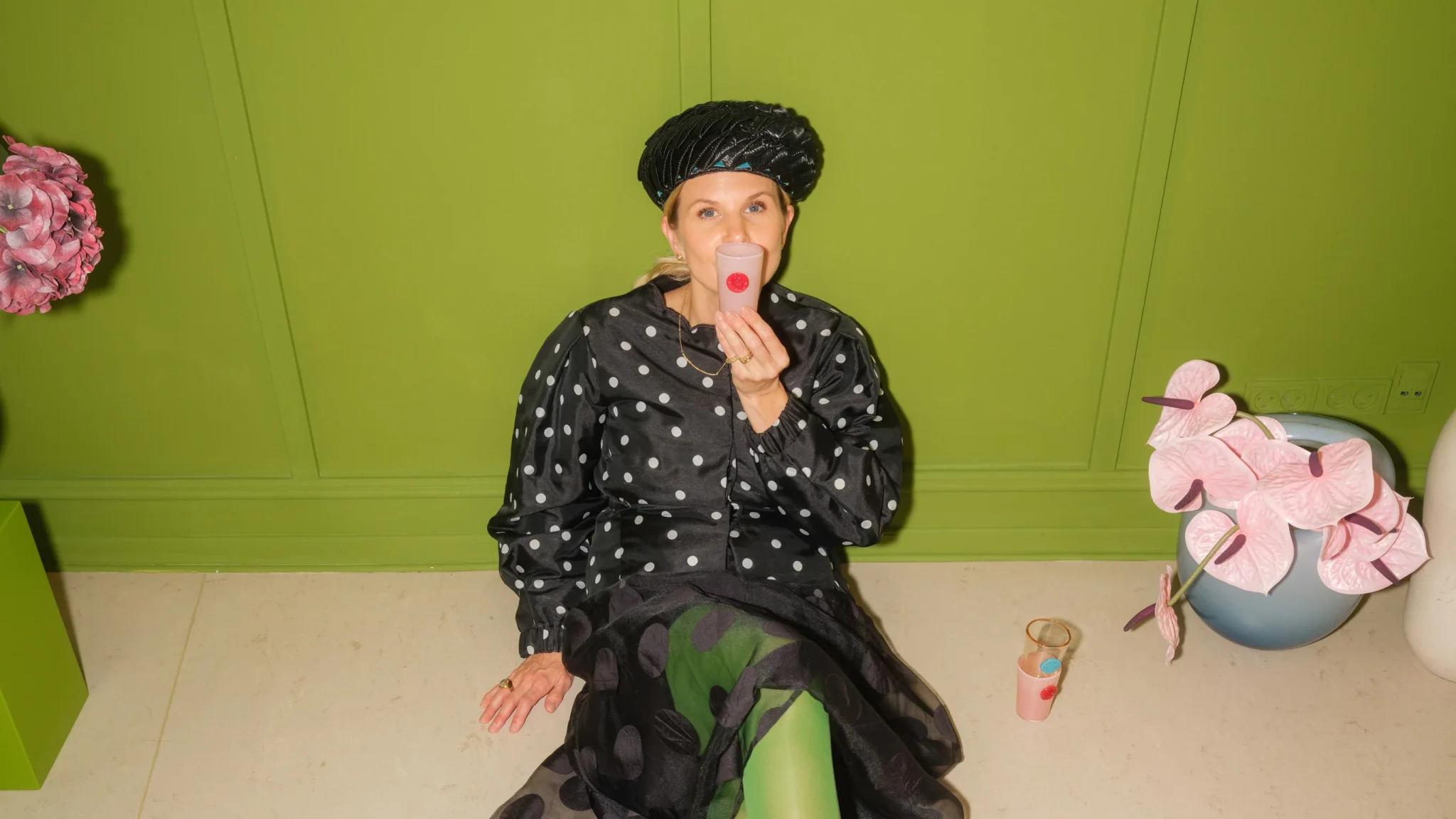
Helle Mardahl is a Danish contemporary glass artist who has garnered attention by simultaneously imbuing glass with both “sweetness” and “unease.” Her soft color palettes and organic forms evoke candy and cream confections, creating an initially charming and approachable impression. However, the sense of gravity, distortion, and excess embedded in her work simultaneously evokes subtle anxiety and tension in viewers.
Her significant contribution lies in expanding the scope of glass expression through an approach that differs from the minimalism rooted in Nordic design. This article provides a detailed analysis of Helle Mardahl’s unique position in contemporary glass expression through examining her creative background, formative philosophy, and interpretation of her representative works.
Table of Contents
Helle Mardahl: The Danish Contemporary Artist Who Brings “Sweetness and Unease” to Glass
Helle Mardahl is a Danish-born contemporary artist who has attracted attention for expressions that simultaneously establish both “sweetness” and “unease” in glass. While her pastel colors, organic swells, and dessert-like textures appear approachable at first glance, they possess a strong sculptural quality that doesn’t fit neatly within the framework of utility.
Rather than simply being cute, the lingering tension as objects of contemplation is why she’s supported in today’s collectable design market. Here, we’ll organize the artist’s background and base of operations, as well as her position bridging glass craft and collectable design.
Helle Mardahl’s Background and Biography
Helle Mardahl’s expression exists at the intersection of the aesthetic sensibility of functionality and rationality cultivated by Danish design, and artistic formative thinking. After studying fashion design at Central Saint Martins in London (graduating in 2001), her experience running her own fashion label and working as a multimedia visual artist formed the foundation of her distinctive aesthetic.
When she established her glass production studio in Copenhagen in 2017, Mardahl, while fully understanding the simplicity and everyday approachability generally valued by Nordic design, deliberately introduced excess, ornamentation, and intensely sweet colors. By inverting the transparency and rigidity inherent in glass through soft and voluptuous organic forms, she has created a unique space at the boundary between design and art. Her works are inspired by childhood memories and cinematic worlds like “Alice in Wonderland” and “Charlie and the Chocolate Factory,” realized through one-of-a-kind hand-blown glass.
Why Copenhagen as a Base and the Expansion of International Recognition
The fact that Helle Mardahl is based in Copenhagen is closely related to her work’s evaluation framework. Copenhagen, a major Nordic design hub, is a city where design and art intersect, and ornamentation and conceptuality are strongly valued. Mardahl’s works are often presented as objects placed in spaces rather than as everyday glassware, making them highly compatible with the city’s cultural soil.
Furthermore, through 3 Days of Design, design fairs, and international galleries, recognition has spread beyond the Nordic framework. Being based in Copenhagen functions as a strategy to connect her work to both the tradition of Nordic design and the context of international collectable design.
A Position Bridging Glass Craft and Collectable Design
Helle Mardahl’s works belong completely to neither traditional glass craft nor mass-produced products. While possessing uniqueness based on handcraft techniques, they blur their purpose and foreground their presence as objects of contemplation. As a result, the works exist not as “vessels to use” but as “objects to own, place in space, and gaze upon.”
This creates a position that bridges craft, design, and art. The sweet colors and forms are visually powerful and leave strong impressions in interior and exhibition spaces, while the excess maintains the work’s tension. Helle Mardahl can be said to be an existence that renews the boundary between contemporary collecting culture and craft through the medium of glass.
Formative Concept and Aesthetics
Helle Mardahl’s forms are, at first glance, approachable, sweet, and decorative. However, capturing the work through this impression alone means missing its essence. Her glass works have a structure that uses the emotion of “cuteness” as an entry point while shaking viewers’ perceptions through unease and excess. Here, we focus on the reference sources for her forms, the unease behind the sweetness, and the distance taken from the context of Nordic design.
The Meaning of Forms That Evoke Candy and Desserts
The rounded forms and layered compositions seen in Helle Mardahl’s works evoke candy, cakes, and cream confections. These have immediate visual impact and give viewers positive and light impressions. However, these references don’t stop at mere decorative motifs.
The qualities of “satisfaction” and “excess” that sweet things possess are skillfully incorporated into the forms. By transforming glass—a material that is inherently hard and cold—into soft, melting shapes, the image of the material itself is inverted. This discrepancy creates the work’s distinctive tension.
Unease and Excess That Don’t End with “Cute”
While Mardahl’s works foreground cuteness, they leave a somewhat unsettling sensation. Forms swell excessively, colors are used to emphasize sweetness to excess, and they clearly distance themselves from utility.
This excess can be said to be a mechanism that prevents comfort from lasting. Viewers, while initially feeling attraction, are gradually confronted with the question “what is this form for?” By not allowing the emotion of cuteness to be consumed and retaining it as unease, the work transforms from mere decoration to an object of contemplation. This sense of balance is the core of Mardahl’s aesthetics.
Intentional Deviation from Nordic Design Minimalism
Nordic design has held simplicity, functionality, and restrained color as virtues. Helle Mardahl’s forms clearly distance themselves from these traditional values. However, this is neither rebellion nor denial. With full understanding of the context of Nordic design, she deliberately emphasizes ornamentation and emotional elements that could be considered opposites.
This intentional deviation makes visible the norms that Nordic design has implicitly embraced. Precisely because it’s a cultural sphere where minimalism has been assumed, Mardahl’s excessive forms carry strong meaning. Her works, by moving outside Nordic design, bring its internal structure into relief.
Glass as Material and Technical Characteristics
Supporting Helle Mardahl’s expression is a deep understanding of glass as material and technical choices that deliberately exaggerate its physical properties. Different from the common image of glass as transparent and light, by foregrounding weight, thickness, and presence, she renews the impression of the material itself. Here, we focus on forming through blown glass, the handling of colored glass, and design philosophy conscious of weight.
Organic Form Formation Through Blown Glass
Mardahl’s works acquire organic and soft forms through forming based on blown glass. Blown glass, where form changes according to breath volume, rotation, and gravitational pull, is a technique that easily incorporates fluctuation rather than uniformity.
Actively utilizing these characteristics and leaving contours and swells that aren’t overly refined, physicality is inscribed in the forms. Roundness and steps are intentionally controlled while not completely fixed. This semi-controlled state produces the softness like desserts and melting impressions, giving the works distinctive intimacy.
Visual Effects Created by Layering Colored Glass and Transparency
The handling of colored glass is also an important characteristic of Mardahl’s work. Rather than completing in single colors, by layering multiple colored glasses, depth of tone and transparency are born. By changing colors between outside and inside, or arranging colors in layers, sight doesn’t remain on the surface but is guided inward.
This layering changes impressions depending on viewing angle and light, and while static objects, they evoke temporal fluctuation. Even with sweet pastel colors, they don’t become monotonous because of this visual complexity created by layered structure.
Design Philosophy That Deliberately Emphasizes Thickness, Weight, and Balance
Helle Mardahl’s glass works often have more weight than expected when held. This weight is not a defect but an intentionally designed element. By giving thickness, the materiality of glass is emphasized and the preconception of fragility is betrayed. While giving visually light and sweet impressions, they actually possess solid presence.
This gap gives the work unease and tension. Balance also, rather than being uniformly stable, sometimes chooses arrangements that appear slightly unstable. This design philosophy can be said to be an attempt to redefine glass not as mere decorative material but as sculptural material with strength.
Reading Representative Works and Series
Helle Mardahl’s works become clearer in their philosophy when understood not just through individual forms but through structures repeated as series. Forms such as bowls and vases evoke the context of vessels, but presence in space is emphasized over utility. Here, we’ll read Mardahl’s series development by focusing on the sculptural quality seen in representative forms, manipulation of boundaries between vessels and objects, and the relationship between repetition and uniqueness.
Sculptural Presence Seen in Bowl and Vessel Works
Helle Mardahl’s bowl and vessel-shaped works, while referencing “vessels” in name, actually exist as sculptural objects. The bowls and vessels here refer not to names indicating specific uses but to broad concepts of “formats (shapes) that could hold something” like basins, flower vases, and jars.
The official collection includes series such as “Bon Bon Signatures” and “Bonbonniere,” which contain bowl-shaped and vessel-shaped works, but not all bowl and vessel works correspond to specific series names. What’s important in Mardahl’s forms is not the series names themselves but how the existing format of vessels is reinterpreted.
Thickly swelling edges, stepped layered forms, and visually exaggerated weight can be said to be designs that prioritize presence when placed in space over convenience during use. The lack of frontality and different impressions from any viewing angle are also sculptural elements.
By referencing vessel formats while intentionally distancing from their functional premises, works function not as everyday items but as objects that compose space. In this way, the transformation to sculpture while retaining “vessel-ness” clearly expresses Helle Mardahl’s formative strategy.
Design Strategy That Blurs Boundaries Between Vessels and Objects
Mardahl’s works intentionally blur the question of “whether they can be used.” While having structures and openings that can hold water, daily use is often not assumed due to weight and shape. This halfway quality is not a defect but strategic design premised on contemplation.
By retaining the semiotics of vessels, clues for understanding are provided, while distancing from utility prompts viewers to reinterpret. As a result, boundaries between craft and sculpture, design and art become ambiguous, and works are no longer absorbed into single categories. This ambiguity itself can be said to be the factor that makes Helle Mardahl stand out in the context of collectable design.
Coexistence of Repeated Motifs and Uniqueness
While Helle Mardahl repeatedly uses specific forms, stepped compositions, and color schemes as motifs, she never completely homogenizes the works. There are always differences in size, color layering, degree of swelling, and center of gravity position, and each exists as an independent one-of-a-kind work. Through this balance of repetition and difference, consistency and tension are born throughout the series.
The structure where individual pieces have high completion when viewed alone, and the formative philosophy becomes clearer when multiple pieces are arranged, also connects to high collectability. The maturity of Mardahl’s series development appears in emphasizing artist identity through repetition while guaranteeing value through uniqueness.
Evaluation as Collectable Design
Helle Mardahl’s works occupy a position evaluated as “collectable design,” transcending the frameworks of glass craft and product design. They’re characterized by distribution structures premised on limited production and uniqueness, with sculptural quality and philosophical content valued over utility. Here, we’ll organize the background of this evaluation from three perspectives: treatment at international fairs, factors forming market value, and demand as interior objects.
International Recognition Centered on 3 Days of Design
Helle Mardahl’s works have been continuously introduced as representative examples of collectable design at the Nordic region’s largest design festival, “3 Days of Design.” At the 2023 “The Sensory Society” exhibition, Dezeen magazine noted she “left a strong impression,” garnering significant attention. She has also expanded international recognition through participation in Maison & Objet in Paris.

These fairs value originality of form, philosophical content, and artist identity over functionality and mass producibility. Mardahl’s glass works have high visibility through sweet colors and excessive forms, radiating strong presence even in exhibition spaces. Her expression, which intentionally deviates from the context of Nordic design, appears fresh to international viewers and is evaluated as a representative example of “new Scandinavian design.”
The Impact of Limited Production and One-of-a-Kind Pieces on Market Value
Mardahl’s works significantly influence market value through being produced as limited editions or one-of-a-kind pieces rather than being premised on mass production. Even within the same series, there are always individual differences in size, color layering, and degree of form swelling, with no complete reproduction. This uniqueness gives special quality to the act of ownership itself, strongly stimulating collector psychology.
Additionally, limited production numbers suppress supply to the market, with scarcity supporting price formation. Prices are determined not only by materials and size but tend to comprehensively evaluate presentation context, position within series, and production year. This structure can be said to be value formation close to the contemporary art market.
Demand and Contemplative Quality as Interior Objects
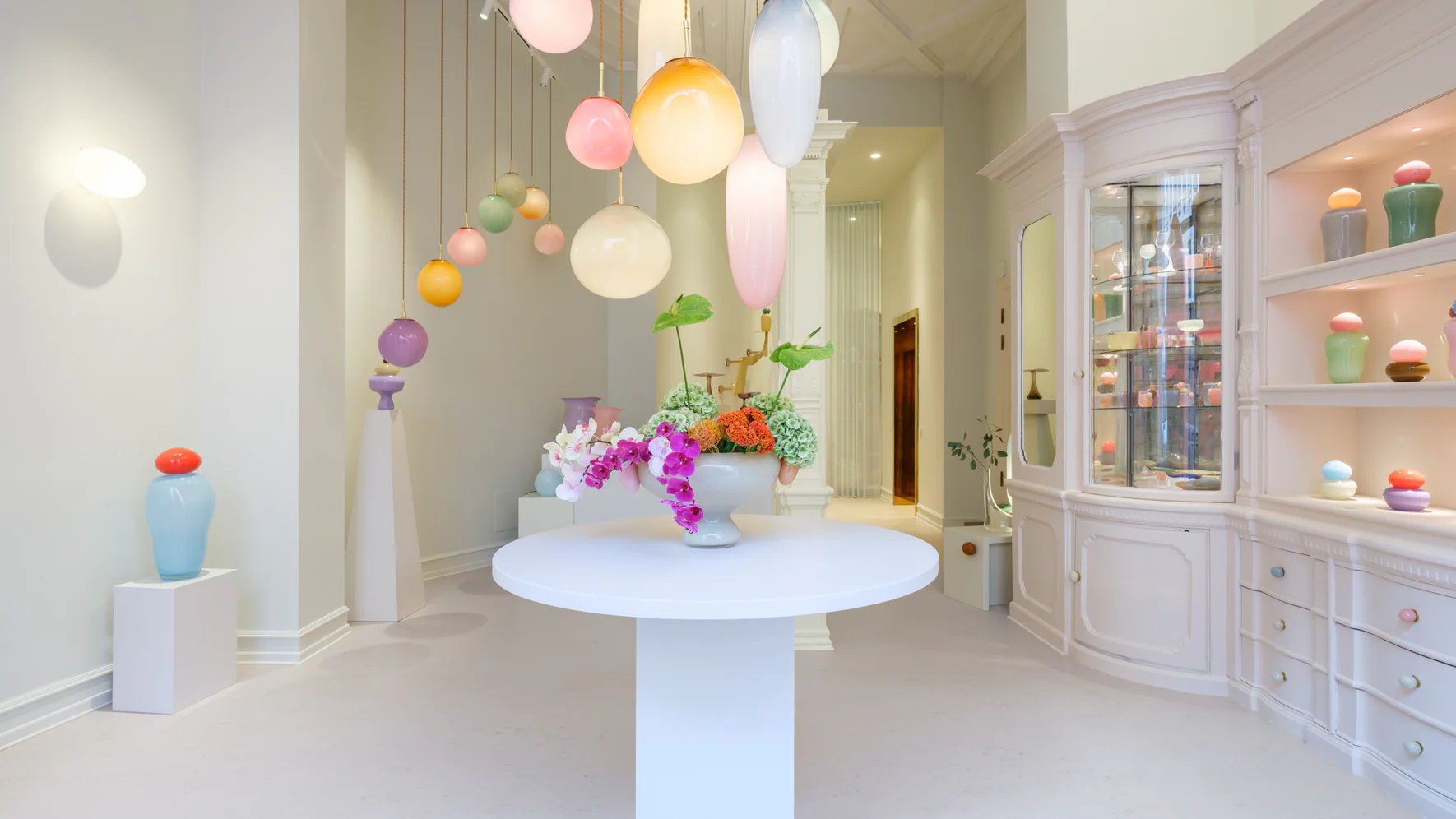
Through weight, thickness, and design that blurs purpose, works are positioned not as “things to use” but as “things to place and gaze upon.” This contemplation-premised character creates demand in the intermediate realm between art and interior. The contemporary value of Mardahl’s work lies in functioning as part of space while simultaneously existing as independent works.
Perspectives on Viewing and Collecting
When viewing and collecting Helle Mardahl’s works, perspectives that read the glass-specific structure and physical properties beyond just judging by cuteness or color impressions become important. How colors layer, internal structure, and changes in appearance depending on exhibition environment significantly influence work evaluation. Here, we’ll organize specific points when viewing forms, impression changes through exhibition, and preservation and management precautions unique to heavy glass.
Points for Viewing Works: Color Layers, Bubbles, and Form Balance
When viewing Mardahl’s works, first pay attention to the layered structure of colored glass. Even parts that appear single-colored may have different colors inside and outside, or multiple colors layered. The thickness of these layers and how boundaries appear differ with each work, being important elements for judging uniqueness.
Additionally, bubbles and fine fluctuations characteristic of blown glass are evaluated not as defects but as part of the form. It’s important to discern whether they’re intentionally left and don’t disrupt overall balance. Furthermore, by viewing the overall form balance—placement of swells and steps, placement of center of gravity—the structural completion behind the cuteness can be read.
Impression Changes Through Exhibition Environment: Light, Background, Distance
Helle Mardahl’s glass works change impressions greatly depending on exhibition environment. Whether natural or artificial light, and intensity levels greatly affect how color layers and transparency appear. Overly strong light makes colors appear flat, while soft light draws out internal structure and depth.
Regarding backgrounds, white walls emphasize form contours, while dark backgrounds highlight color sweetness. Distance is also important—approaching allows recognition of layers and bubbles, while stepping back brings out the sculptural quality of the overall form. Consciously arranging exhibition conditions becomes key to deepening work understanding.
Preservation and Management Precautions: Risks Unique to Heavy Glass
Mardahl’s works weigh more than they appear, requiring management precautions different from typical thin glass. Installing without confirming shelf or pedestal load capacity increases risk of tipping or falling. Additionally, thick glass is susceptible to temperature differences, with rapid environmental changes potentially creating internal stress.
Places where direct sunlight or air conditioning wind directly hits should be avoided, maintaining stable environments is desirable. When moving or cleaning, don’t lift with one hand—always support the bottom. Management understanding the characteristics unique to heavy glass connects to long-term collection maintenance.
Conclusion
Helle Mardahl has established unique expression bridging craft, design, and art by simultaneously giving glass sweetness and unease. Organic forms through blown glass, forms emphasizing color layers and weight, and attitudes intentionally distancing from utility are important elements supporting evaluation as collectable design.
In addition to international design fair and market evaluations, contemplative quality in interior spaces is also high, strongly connecting with contemporary collecting culture. Helle Mardahl’s works can be said to continue updating the possibilities of glass expression in contemporary ways, incorporating critical qualities that don’t stop at cuteness.
