
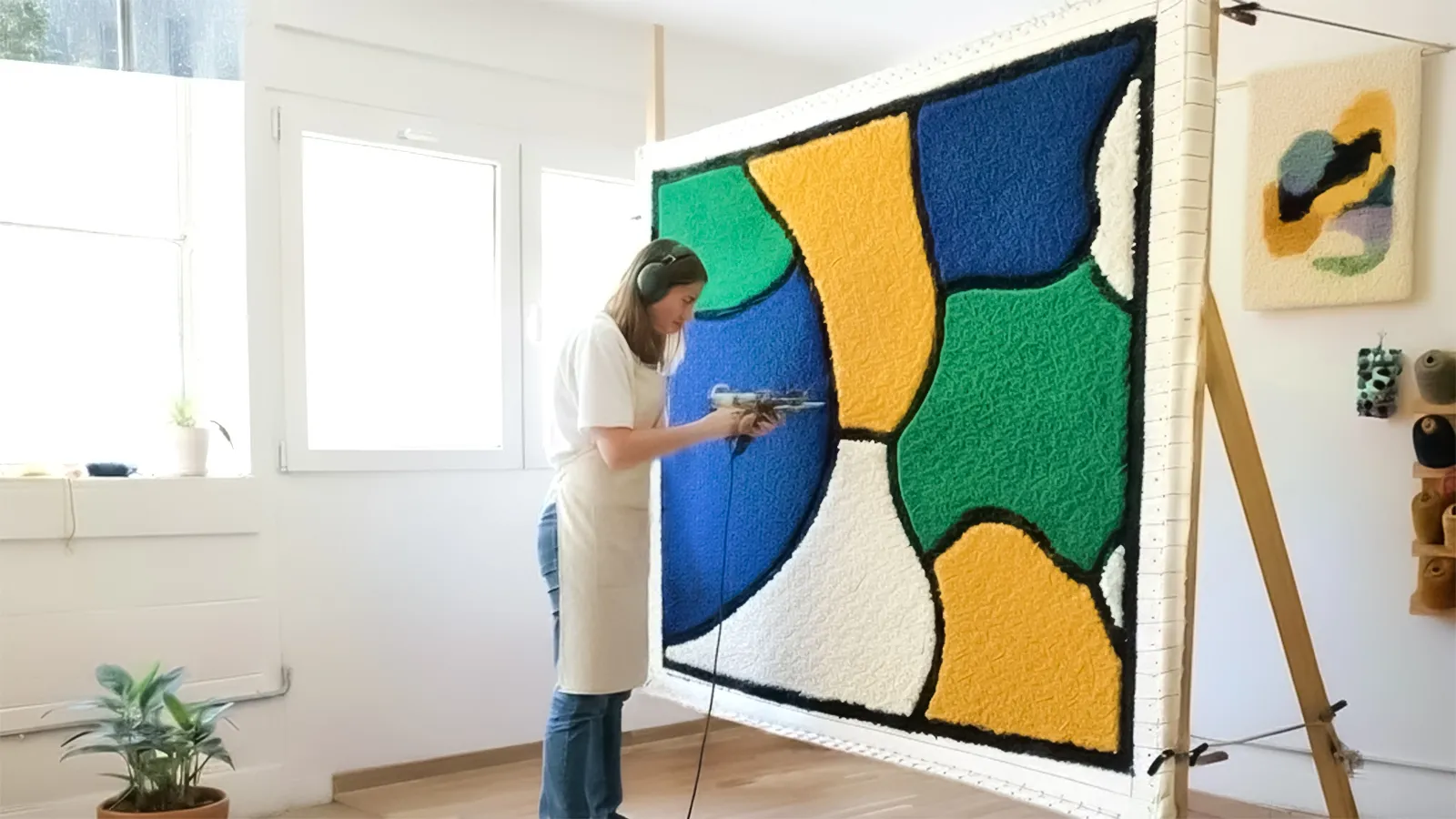
Tufting is a technique for creating rugs and textile works by using a specialized tufting gun to punch yarn into fabric, and in recent years, it has been spreading worldwide, particularly in Europe and North America. Its distinguishing features are the clarity of the production process and the ability to achieve three-dimensional expression in a short time, making it widely accepted from DIY to professional production.
Additionally, its graphic compositional strength and freedom of color expression offer a unique appeal different from traditional weaving, strongly connecting with the realms of art and design. This article organizes the basic production process of tufting, its characteristics as a form of expression, and the cultural expansion progressing worldwide, explaining the complete picture of this new craft.
Table of Contents
What is Rug Tufting? A New Craft Movement Spreading Worldwide
Rug tufting is a relatively new production technique that uses a specialized tufting gun to punch yarn into fabric, forming pile. Compared to traditional hand-weaving or knotting processes, it is characterized by the ability to create large rugs in a short time, and in recent years, it has been spreading rapidly, particularly in Europe and North America.
Starting from the context of DIY and craft, it has now expanded into the realms of art works and interior design, being utilized for gallery exhibitions and commissioned production. This chapter organizes the basic structure of the tufting technique, the reasons it attracts beginners, and its contemporary development beyond craft, decoding the essence of this movement.
Tufting Basics: Rug Production Technique Using a Specialized Gun to Punch Yarn
The greatest characteristic of tufting is the use of an electric or manual tufting gun to rapidly punch yarn into base fabric at high speed. By stretching canvas-like fabric on a wooden frame and running the gun from the back side, loop pile or cut pile is formed on the surface.
By adjusting the thickness and material of yarn and the height of pile, the softness and three-dimensionality can be varied, which is also appealing. After production, adhesive such as latex is applied to the back surface to fix the pile, completing the work. Through this process structure, production speed is dramatically improved compared to weaving or knotting, and free curves and bold color schemes become easier.
As a result, graphic-heavy expression different from traditional rug production becomes possible, which is a major technical characteristic.
“Not as Difficult as Expected” — Reasons That Attract Beginners
The background to tufting’s worldwide spread includes the characteristic that “it looks specialized but is actually easy to start.” The necessary tools are relatively limited—a gun, frame, base fabric, and yarn—and basic operations can be learned in a short time.
The fact that mistakes can be corrected by removing yarn and that the process to completion is visually easy to understand also provides great reassurance for beginners. Additionally, because production time is short, it’s easy to gain a sense of accomplishment, and it is well-suited for sharing the production process on social media, which has helped drive its popularity.
Even craft beginners and those without art education can experience bringing their own images to life, creating an entry point that traditional handicrafts did not have. This psychological and technical low barrier has been a major factor in establishing tufting as a contemporary craft.
From DIY to Art: Expansion Beyond the Framework of Craft
While tufting initially centered on DIY and workshop uses, in recent years, evaluation as art works and spatial decoration has been increasing. Three-dimensional rugs with abstract painting-like compositions or sculptural thickness are increasingly being exhibited as wall works, transcending their function as flooring materials.
In the context of contemporary art and design, spatial intervention using soft materials and the presentation of tactility are emphasized, and tufting serves as an expressive means that meets these requirements. Additionally, adoption is progressing as custom-made furniture and interior for commercial spaces, transforming into an entity that crosses the boundaries of craft, design, and art.
Tufting is being positioned not merely as a trendy technique but as a new form of craft reflecting contemporary production environments and values.


Why Tufting is Trending Now
The background to tufting’s worldwide spread involves not just the novelty of the technique itself but is closely related to changes in contemporary media environment and social consciousness. The fact that the production process itself has visual appeal and results can be obtained in a short time presented a value different from traditional crafts.
Furthermore, it resonates with the reevaluation of “the act of moving one’s hands” that became apparent after the pandemic, permeating beyond the boundaries of hobby, expression, and work. This chapter organizes the essence of the tufting trend from three perspectives: social media and video culture, the structure of accomplishment, and social background.
Background of Social Media and Video Culture as Catalysts
In the dissemination of tufting, the influence of social media and video platforms has been extremely significant. The moment yarn is punched in, and the process of plain fabric being rapidly filled with color, has excellent compatibility with short-form videos, with the production process itself becoming content.
In particular, the fact that process videos attracted viewers’ interest is a characteristic different from traditional craft communication. Additionally, because it is visual information that doesn’t depend on language, it is easily understood across borders, and the trend spread simultaneously in Europe, North America, and Asia.
In this environment, intuitive appeal was prioritized over specialized explanations, and tufting was received as a “craft you can see and imitate.” Social media is not merely a promotional tool but is deeply involved in forming the value of the technique itself.
“Accomplishment-Oriented Making” with Fast Completion
One reason tufting is supported is the sense of speed from production to completion. Compared to traditional weaving or ceramics that require several days to weeks, the fact that visually complete works can be obtained in a short time matches contemporary lifestyles.
Particularly for beginners, processes where results are not easily visible tend to cause frustration, but with tufting, progress is immediately visualized. This sense of “it takes form as much as you do” creates a sense of accomplishment and motivation to continue.
Additionally, the fact that mistakes can be corrected relatively easily also reduces psychological burden. This structure has transformed making from specialized skills to experiential expression, becoming a factor that involves a wide range of people.
Return to “Hands-On Expression” After the Pandemic
After the pandemic, while life surrounded by digital environments accelerated, the desire for actions accompanied by physicality became apparent. Tufting, while using electric tools, is an expression where hand movements and sensations are directly reflected in the work, responding to this desire. Sensations such as material resistance, sound, and vibration that cannot be obtained through screen-based creation provide immersion in the act of production itself.
Furthermore, because the finished product is actually used in daily living spaces, the production experience is sustainably connected to life. In this way, tufting is positioned not merely as a trend but as an entity symbolizing the return to “tactile expression” in contemporary society.
Tufting Production Process
Tufting is a technique for creating rugs and wall art by using a specialized tufting gun to punch yarn into fabric. While it appears to be intuitive work at first glance, the level of completion is greatly influenced by each process from preparation to finishing.
In particular, design planning, gun operation, and finishing processing mutually influence each other, so it is important to understand the entire process before proceeding with production. This chapter systematically organizes the flow of tufting production, from design creation and sketch preparation, to tufting gun operation basics, to finishing processes including adhesion, cutting, and backing.
Design Creation and Sketch Preparation: Simplicity is the Key to Success
In tufting production, the initial design creation and sketch preparation are the most important processes that determine the level of completion. Because tufting is a technique that constructs surfaces with yarn, overly detailed lines or complex patterns are difficult to reproduce and tend to result in unclear finishes.
Therefore, simple designs with limited colors and clear outlines are said to succeed more easily. Because the sketch is drawn on the back side of the fabric, it should be noted that it will be reversed left to right when completed.
By clarifying color placement and boundary lines at this stage, hesitation during gun operation is reduced, leading to a uniform finish. Design is not just decorative but is a blueprint for facilitating the production process, and can be said to be the process where technical judgment in tufting is first required.
Tufting Gun Operation Basics and Precautions
Tufting gun operation is the core work in the production process. Because the gun punches yarn into fabric at a constant speed, the basics during operation are to stretch the fabric uniformly and apply the gun vertically. If the angle shifts, the yarn entry becomes unstable, and unevenness tends to occur on the surface.
Additionally, when drawing lines, it is important not to move too fast unnecessarily, but to proceed at a constant rhythm. For curved sections, rather than trying to draw all at once, proceeding in small increments stabilizes the shape. In terms of safety, it is essential not to bring hands close to the gun needle tip and to reliably turn power on and off.
While the tufting gun is convenient, if handled incorrectly, it can lead to fabric damage or injury, so it is necessary to carefully acquire basic operations.
Finishing Process: The Moment It Becomes a Work Through Adhesion, Cutting, and Backing
A work after tufting is finished cannot be said to be complete as is, and becomes established as a work for the first time through the finishing process. First, adhesive is applied to the back surface to fix the yarn, ensuring durability.
After sufficient drying, the pile height on the surface is cut and adjusted, making the design clear. Because this cutting work greatly changes the sharpness of outlines and the overall impression, careful judgment is required.
Finally, by applying backing, it provides the role of non-slip and reinforcement, increasing practicality. By carefully performing these processes, a mere collection of yarn is elevated to a tufting work that can withstand viewing and use. Finishing is an important process that determines the overall level of completion.
The Appeal and Difficulty of Tufting
Tufting is a production technique that has been attracting attention in recent years for its ability to create works with visual impact in a short time. On the other hand, due to its characteristic of handling yarn, fabric, and machinery simultaneously, it also possesses unique difficulties.
The expressive power to freely manipulate color and texture, and the freedom of form not bound by uniformity, are great appeals, but when actually producing, sound, vibration, and physical demands cannot be ignored. This chapter organizes both the expressive appeal of tufting and the difficulties understood only after experiencing it.
Expressive Power to Manipulate Color and Texture Simultaneously
The greatest appeal of tufting lies in the ability to control color and texture simultaneously. While in painting, color is the main feature, and in weaving, texture tends to be emphasized, in tufting, expression that appeals to both vision and touch is possible through yarn color and thickness, and punching density.
For example, even with the same color, by changing the pile length, shadows are created, and a screen with three-dimensionality can be composed. Additionally, by combining yarns of different materials, matte surfaces and glossy surfaces can coexist within the same work.
Because these elements are determined at the production stage rather than in post-processing, the maker’s judgment is directly reflected in the expression. Tufting can be said to be a technique positioned between flat expression and three-dimensional expression in its ability to handle color and texture in a design-oriented manner.
Even Failures Become Works: Beauty That Stands Without Uniformity
One characteristic of tufting is that it tends to succeed as a work even without uniformity. Even if yarn density differs partially or lines waver slightly, it is often received as expression.
This derives from the fact that tufting is a technique that positively incorporates traces of handwork. While being production using machinery, operational habits and fluctuations in judgment remain in the results, creating value as a one-of-a-kind piece.
Of course, not all unintended failures are affirmed, but the large margin where some unevenness functions as individuality lowers the psychological hurdle for beginners as well. The fact that perfection is not overly pursued and the production process including can be regarded as expression can be said to be an element that supports the beauty of tufting.
Sound, Vibration, Physical Strength — Challenges Understood After Actually Trying
Tufting involves more physical burden than it appears. Because the tufting gun generates loud sound and vibration during operation, fatigue accumulates in the arms and shoulders during long work sessions.
Additionally, because the gun must be continuously pressed against the tightly stretched fabric on the frame, a certain amount of physical strength and posture-holding ability is required. While not accustomed to the vibration, lines are unstable and it is not uncommon to be unable to move as intended.
Furthermore, depending on the work environment, soundproofing and safety measures may also be required. These challenges are first realized through actual experience, and by understanding them in advance, reasonable production plans can be made. While tufting appears accessible, it is important to recognize that it is a technique accompanied by physicality.
Expansion of Workshop and Studio Culture

With the spread of tufting, workshops and dedicated studios where production can be experienced are increasing in various places. Particularly in urban areas, studios equipped with tools and work environments serve as bases, becoming places where a wide range of people from beginners to experienced practitioners gather.
These spaces function not merely as places to produce but as cultural sites where people, techniques, and expressions intersect. This chapter organizes the cultural expansion from the spread of tufting studios, the background to the popularity of experiential workshops, and their aspect as communities.
Tufting Studios Increasing Primarily in Urban Areas
In recent years, tufting-dedicated studios have been opening primarily in urban areas such as Tokyo and Osaka. These studios are characterized by providing full-scale production environments and tools such as large frames and tufting guns.
Additionally, in urban areas where residential space is limited, studios serve as practical production bases. Many studios not only rent tools but also provide technical support and instruction by staff, establishing a system where even beginners can engage in production with peace of mind.
Reasons for concentration in urban areas include good accessibility and the tendency for people with high interest in design and art to gather. Studios play a role not merely in providing space but in spreading the technique and raising the quality of expression.
Reasons Why Experiential Workshops Are Gathering Popularity
One reason tufting workshops are gathering popularity is that completed forms can be taken home in a short time. Even with a few hours of experience, visible results such as rugs or mini works can be obtained, making it a technique where a sense of accomplishment is easily gained.
Additionally, the fact that the production process, which appears specialized, is actually designed to be experienced step by step also lowers the barrier to participation. Furthermore, the fact that finished products can be used as interior items is also a factor gathering support.
Because works are incorporated into daily life, the experience remains not as something transient but as continuing value. Workshops function as an entry point where the appeal of tufting can be understood as a real experience, playing an important role connecting to the next production motivation.
Tufting as Community: Shared Production Experience
Tufting studios and workshops function not only as places to learn production techniques but also as places for community formation. By producing in the same space, participants naturally interact by sharing progress and concerns.
It is characterized by the fact that not just the level of completion but the production process itself becomes a topic, and experience is shared as value. By disseminating works and production scenes through social media, the community also expands outside the studio, leading to information exchange and motivation for return visits.
In this way, tufting is an individual production technique that develops within relationships with others. The shared production experience forms an important foundation supporting the expansion of tufting culture.
Future of Tufting Culture
While tufting is a technique that spread rapidly triggered by social media, the possibility of it establishing itself as culture beyond that is also attracting attention. The immediacy of obtaining results in a short time and the expressive power that easily reflects individuality are characteristics that traditional crafts do not have.
This chapter considers whether tufting will remain a transient trend or take root as a sustainable craft culture, while organizing its development into craft, design, and education fields, and its future vision as a technique redefining the “joy of making.”
Transient Boom or Established Craft?
The background to tufting attracting attention includes visual clarity and ease of sharing production experience. Therefore, the possibility of it being consumed as a temporary boom has also been pointed out.
However, on the other hand, the fact that demand as practical items and spatial elements such as rugs and wall works is stable can also be said to have conditions for establishment. As a technique, it is not limited to simple reproduction but expands the range of expression through material selection and finishing methods.
The fact that there is a conduit developing from workshops to individual production and further to commissioned production also supports continuity. How to balance the dissemination power as a trend with the depth as craft will be the turning point for future tufting culture.
Possibility of Development into Craft, Design, and Education Fields
Tufting is a technique that can connect with existing craft and design fields. In terms of selecting materials and constructing surfaces through handwork, it has craft elements, and the design of color schemes and compositions has affinity with graphic and interior design.
Additionally, because results are visible in a relatively short time, it is a technique that is easy to introduce in educational settings. The ease of gaining a sense of creative accomplishment and the fact that failures are easily converted to learning are elements with good compatibility with making education.
As utilization progresses in these fields, tufting has the possibility of being positioned not as an independent trendy technique but as an expressive means used across disciplines.
Future as a Technique Redefining the “Joy of Making”
The essential value that tufting possesses lies in redefining the “joy of making.” While not requiring advanced training and enabling reach to a certain level of completion, it has a structure where room for expression is endless if pursued further.
This means that beginners and experienced practitioners can share the same technique while engaging at different depths. The sound and vibration of work, and the sensation of yarn filling surfaces, create a physical immersive experience, providing satisfaction different from digital-centered life.
Tufting is cultivating a culture that finds value not just in finished products but in the production process itself, and will continue to evolve as a technique questioning the meaning of “making.”
Summary
Tufting is a technique that constructs surfaces with yarn using a specialized gun, with a major characteristic being expressive power that can handle color and texture simultaneously. While the production process is clear and can reach highly complete works even in a short time, gun operation and finishing require physicality and judgment.
In recent years, it has shown cultural expansion starting from studios and workshops, with community formation and sharing of experiential value progressing. Furthermore, development into craft, design, and education fields is expected, and tufting can be said to be establishing itself as a contemporary craft redefining the “joy of making” beyond a transient trend.
