

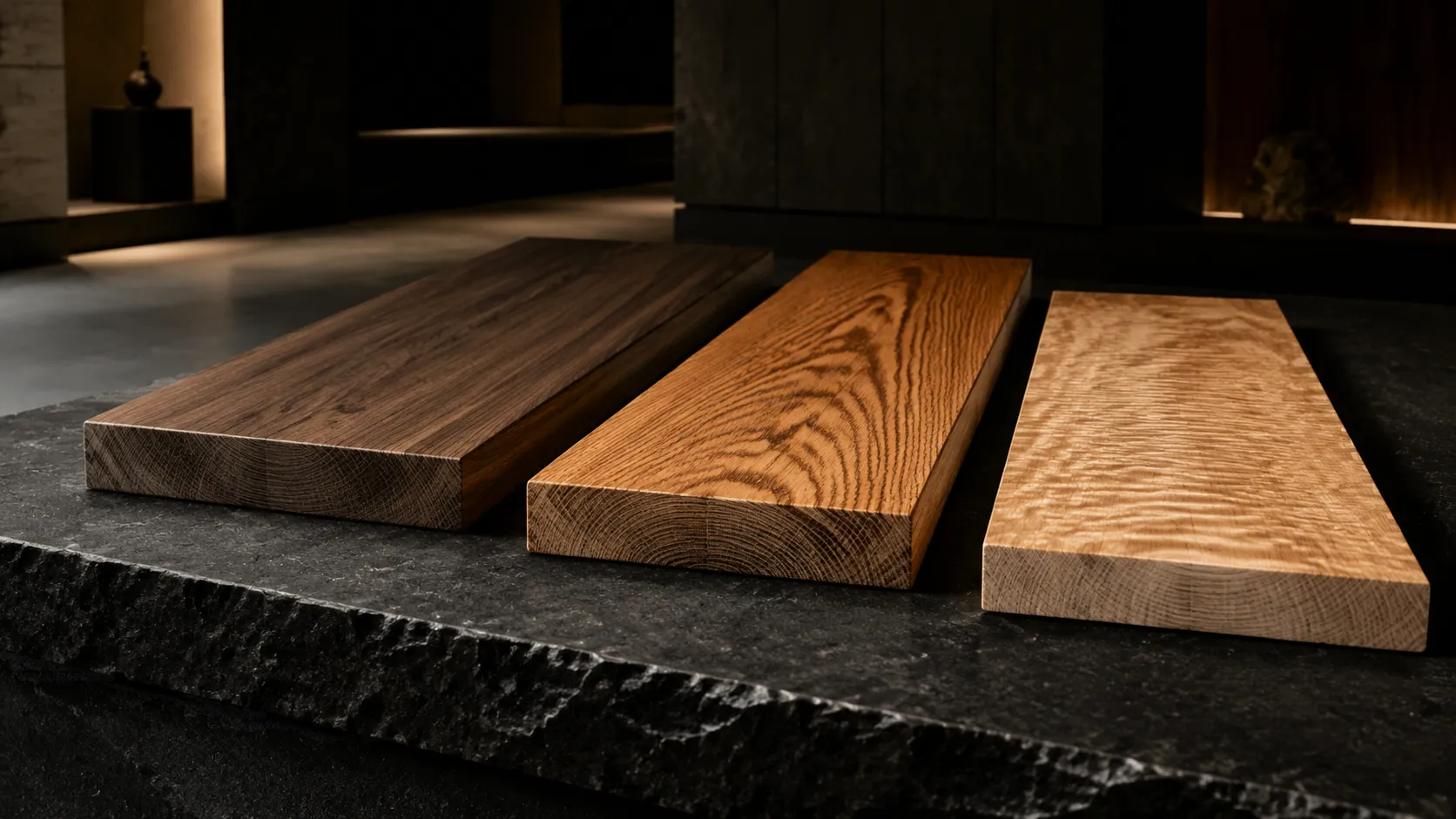
Many people have looked at a piece of wooden furniture or a wooden vessel and thought, “what beautiful grain.” Yet if you were asked whether that grain is masame (straight grain), itame (flat-sawn grain), or a distinctive moku (figure), you might suddenly find yourself unsure.
When you look at wood grain, the basics are to check not only the surface pattern but also the direction of the growth rings, the end grain (koguchi), and how the board was cut from the log. Once you can tell masame, itame, and moku apart, you gain clues not only to how a piece of furniture or a vessel looks, but to how the maker selected and oriented the material within the work.
The first thing to keep in mind, though, is that masame and itame on one hand and moku on the other are not three equivalent categories of grain. Masame and itame are terms relating mainly to the worked face and to how the board is cut, while moku refers to a distinctive pattern appearing on the face because of the wood’s structure, grain arrangement (mokuri), and so on.
This article sets out the difference between masame and itame, the rift-sawn face (oimasa), figure such as ray fleck (toraf), blister figure (tamamoku), and curly figure (chijimimoku), how to read the end grain, the relationship with warping and dimensional change, and the points to check when buying a piece of woodwork.
Table of Contents
Where do you look to read grain? Start with the end grain, growth rings, and worked face
The first step in reading grain is not to look at the surface pattern alone. Looking at the relationship between the growth rings that appear on the end grain and the worked face makes it easier to understand why masame and itame take on different expressions.
Grain pattern, grain direction, and figure are not the same thing
The first distinction to understand is the difference between “grain pattern” (mokume), “grain” in the structural sense (mokuri), and “figure” (moku). In everyday speech they are sometimes used with overlapping meanings, but for understanding wood accurately it is clearer to distinguish them.
In its glossary of wood-quality terms, the Japan Wood Research Society treats mokuri as a term for the arrangement and run of the elements that make up wood, and mokume as the pattern produced on the worked face by that grain. Moku, in turn, is set out as a decorative pattern appearing on the face because of irregularities in the arrangement of the wood’s elements, among other causes.
(Source: Glossary of Wood-Quality Terms | Japan Wood Research Society)
Grain pattern, grain, and figure: the basics
“Grain” (mokuri) is the direction in which the wood’s structure is arranged; “grain pattern” (mokume) is the pattern that appears on the worked face because of that grain and other factors. “Figure” (moku) refers, among these, to a distinctive, decorative pattern arising from the wood’s growth, structure, and grain.
| Term | Reading | Basic meaning |
|---|---|---|
| Grain (structural) | mokuri | The direction and arrangement of the wood’s structural elements |
| Grain pattern | mokume | The pattern appearing on the worked face because of grain and other factors |
| Straight grain | masame | Grain appearing mainly on a radial worked face |
| Flat-sawn grain | itame | Grain appearing mainly on a tangential worked face |
| Figure | moku | A distinctive, decorative pattern arising from wood structure, grain, and so on |
| End grain | koguchi | The cross-section cut at a right angle to the trunk’s axis |
For example, there is no tree species called “tamamoku.” Tamamoku is not the name of a species but one of the figures that appear on the worked face.
In the same way, masame and itame do not mean different species. Even within a single tree, different worked faces appear depending on where the material is taken from and in which direction.
Looking at the end grain makes the cut easier to understand
When you look at furniture or a wooden vessel, if you can, look at the end grain on the side or the base.
The Japan Wood Research Society defines end grain as “the cross-section of wood when cut at a right angle to the axis of the trunk.” Because the direction of the growth rings is easy to check on the end grain, it is a better clue to how a board was cut than looking only at the grain on the broad worked face.
(Source: Glossary of Wood Science Terms | Japan Wood Research Society)
If you look at a cross-section of a log, the growth rings appear as concentric circles around the centre. If material is taken from that log along a roughly radial direction, from the centre outward, then on a broad worked face the growth rings tend to appear as relatively parallel lines. This is the basis for understanding masame.
When wood is cut roughly tangential to the growth rings instead, arched or curving grain tends to appear on the face. This is itame.
Before wondering “what is this pattern called,” look and ask “where in the log, and in which direction, was this board cut from?” In that order, grain becomes not a term to memorise but information for reading the structure of the wood.
The basics of masame, itame, and oimasa
The Japan Wood Research Society treats the flat-sawn face as a conventional term for the tangential section of a trunk or of wood, and the straight-grain face as a conventional term for the radial section. A cut or worked face between masame and itame is called oimasa (rift-sawn).
(Source: Glossary of Wood Science Terms | Japan Wood Research Society)
| Type | Cut / worked face | How the grain tends to look | What to look at |
|---|---|---|---|
| Masame (straight grain) | A roughly radial face | Tends to look parallel and straight | Whether the growth rings on the end grain run roughly perpendicular to the face |
| Itame (flat-sawn grain) | A roughly tangential face | Tends to look arched and curving | Whether the growth rings on the end grain run more nearly parallel to the face |
| Oimasa (rift-sawn) | Between masame and itame | An expression between straight and curving | Do not force it into an either/or of masame or itame |
In real woodwork, perfect masame and perfect itame do not appear on their own as they do in a textbook diagram. A tree is not a uniform cylinder, and the shape of the growth rings and the state of growth differ from one tree to the next.
So there is no need, least of all for beginners, to declare from one part alone that “this is definitely masame” or “this is definitely itame.” Looking at the end grain and the whole worked face, and understanding it in terms of “closer to masame” or “closer to itame,” better reflects what you actually see in real objects.
What is the difference between masame and itame? It is not only the pattern
Masame and itame show different worked faces mainly because of the direction in which material is taken from the log. The difference is not only in appearance; it is also relevant to understanding the wood’s dimensional movement and how the material may be used.
Why masame tends to look parallel
With masame, the worked face is a roughly radial face running from the centre of the log outward. So on the surface of a long board, the growth rings tend to appear as relatively parallel lines.
Looking at masame on a cabinet door, a box, or a tray, you may get the impression that the grain direction is aligned and the eye tends to follow the grain in one direction.
That said, it would be misleading to think of masame as “plain” or “without much figure.”
Depending on the species and the wood structure, a distinctive figure such as the ray fleck described below can appear on a masame face. When you look at masame, observing not only the parallel rings but also the sheen and speckled patterns that appear between them brings the relationship between wood structure and worked face into view.
Why itame tends to look arched and curving
Itame is a worked face cut along a roughly tangential direction, following the log’s growth rings.
Because rings stacked in arcs are cut lengthways, the grain can appear on a broad face as arches, waves, or bamboo-shoot-like curves.
On a tabletop, you may see an expression in which the grain spreads out widely from the centre toward the edges. This sense of movement is one of the attractions of itame, not a defect.
When looking at craftwork, there is no useful hierarchy here — masame is not inherently more refined, nor is itame inherently inferior. It is more important to look at which worked face was appropriate to use for the form and purpose of the work.
What is oimasa?
Oimasa refers to a cut or worked face between masame and itame.
The Japan Wood Research Society’s glossary of wood science terms likewise sets out oimasa as “intermediate between itame and masame,” and the oimasa face as “an intermediate worked face between the masame face and the itame face.” “Rift-sawn” is given as the English equivalent.
(Source: Glossary of Wood Science Terms | Japan Wood Research Society)
In real objects, worked faces on which the characteristics of masame and itame shift from one to the other partway are not unusual. Rather than forcing everything into an either/or, knowing oimasa lets you understand wood more continuously.
Masame is not necessarily “better” than itame
Under the same conditions of species and dimensions, masame material can be harder to obtain than itame material because of the constraints of how it is cut. But that does not mean “masame is superior wood to itame.”
There are works that bring out largely moving itame on a tabletop or the front face, and works that set straight masame at the centre of the form.
What matters with wood is not “which is superior,” but “for what purpose, and with what visual effect, was that cut chosen?”
This view matters especially when looking at craft. If you understand grain only as a ranking by rarity or price, the woodworking wisdom of matching material to purpose becomes hard to see.
How should you think about the relationship with warping and shrinkage?
Wood changes dimension as it dries and takes up moisture, but the amount of that change is not the same in every direction.
In the Forestry and Forest Products Research Institute’s test materials on wood shrinkage, tangential and radial shrinkage are measured separately. The Institute’s materials on processing large-diameter timber also explain that, among the axial, radial, and tangential directions, tangential shrinkage is the largest as wood dries.
(Source: Wood Shrinkage Testing | Forestry and Forest Products Research Institute)
(Source: Development of Efficient Processing Technology for Large-Diameter Timber | Forestry and Forest Products Research Institute)
This directional difference helps explain why masame and itame material can behave differently as wood moves.
That said, memorising it as “masame doesn’t warp” or “itame always warps” is not accurate. Actual warping and cracking involve several conditions together: species, the part of the tree, moisture content, drying method, member dimensions, joinery method, and the environment of use.
The cut is an important factor, but it alone cannot determine the stability of a finished piece.
What is “moku”? How do you look at ray fleck, blister figure, and curly figure?
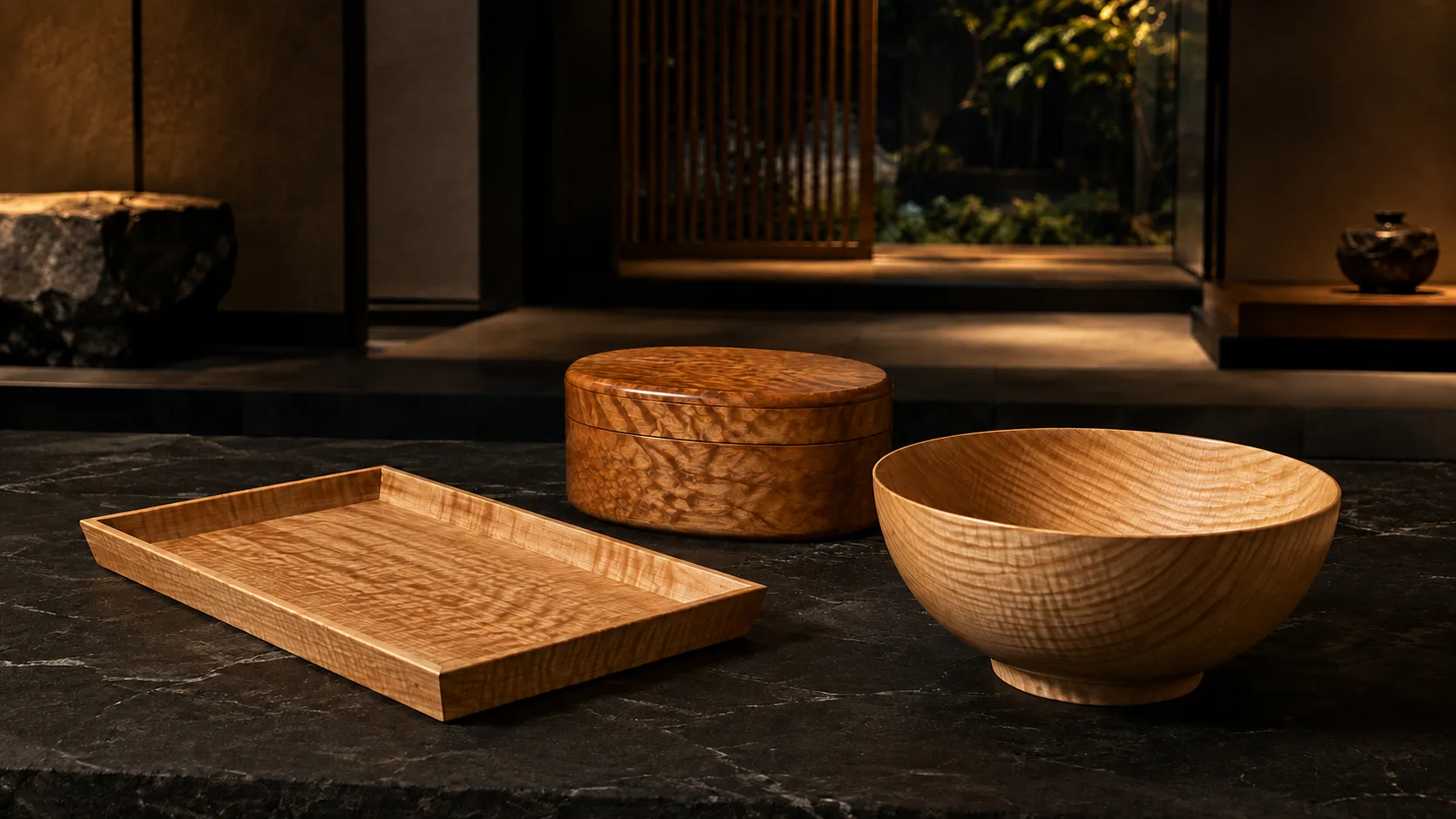
Moku is not masame or itame itself, but a distinctive, decorative pattern that appears on the worked face owing to the wood’s growth, structure, grain, and so on. The cause and the face on which it tends to appear differ by type of figure.
The Japan Wood Research Society sets out moku as a decorative pattern appearing on the worked face because of irregularities in the arrangement of the wood’s elements, among other causes. Figure can arise from a range of causes, including uneven growth, grain, and broad rays.
(Source: Glossary of Wood-Quality Terms | Japan Wood Research Society)
Ray fleck
Ray fleck (toraf) is a distinctive figure seen when broad rays appear on the radial section, among other causes. The Japan Wood Research Society gives “ray fleck” and “silver grain” as the English terms.
(Source: Glossary of Wood Science Terms | Japan Wood Research Society)
In real objects, elongated flecks or band-like markings may be seen crossing the grain, or the figure may show a different sheen depending on the angle of the light.
Ray fleck is a good reminder that masame does not necessarily mean visually plain or monotonous. By changing the worked face, different structures inside the wood appear as visual features.
Blister figure
Blister figure (tamamoku) is a figure that looks like a series of connected circles or ovals.
The Japan Wood Research Society sets it out as a figure arising from uneven growth, in which the growth rings appear as circles or ovals on the worked face, mainly on the tangential section.
(Source: Glossary of Wood-Quality Terms | Japan Wood Research Society)
Blister figure is sometimes explained simply as “a pattern that comes from a burl,” but technical sources treat tamamoku and burl figure (kobu-moku) as distinct terms. So it is more accurate not to memorise tamamoku as simply equal to a burl.
When you see blister figure in craftwork, look not only at the rarity of the pattern but also at where the maker has placed it within the work.
Curly figure and wavy figure
Wavy figure (hajōmoku) is a figure in which a wave-like pattern appears on the worked face owing to wavy grain. The Japan Wood Research Society sets out the finer form of this figure as curly figure (chijimimoku).
(Source: Glossary of Wood-Quality Terms | Japan Wood Research Society)
In other words, rather than curly figure and wavy figure being entirely different types, it is clearer to understand them as a relationship in which the fine kind of wavy figure is called curly figure.
Wavy-figured wood used for the backs of violins and the like is also called “fiddleback” or “fiddleback figure,” but this does not mean that not all curly or highly figured wood should be called fiddleback.
With curly figure and wavy figure, the strength of the pattern can look different depending on the viewing angle and the direction of the light. This is one reason why the expression of some wood is hard to grasp fully from online photographs alone.
Does “more figure” mean “higher value”?
Figure can affect the evaluation of wood and of a work, but you cannot judge a work’s value simply by how abundant, dramatic, or rare its figure appears.
Species, the size of the material, its condition, the cut, processing precision, finishing, the form of the work, the maker’s hand, distribution conditions — several factors are involved in an actual evaluation.
If you are looking at craftwork, rather than guessing the name of the figure, looking at points like the following leads to a better understanding of the work.
- Where the distinctive pattern is placed within the work
- How the form of the work relates to the direction of the grain
- Whether the grain is aligned across several members, or varied
- How the surface finish makes the wood’s expression appear
- Whether the grain choice suits the structure and intended use of the piece
| Name | Reading | Visual character | Main cause / structure | What to observe |
|---|---|---|---|---|
| Ray fleck | toraf | Speckled or band-like pattern | Broad rays appearing on the radial section | The relationship between the masame face and sheen |
| Blister figure | tamamoku | Circular or oval pattern | Uneven growth | The placement of the pattern on the tangential section |
| Wavy figure | hajōmoku | Wave-like pattern | Wavy grain | How the appearance changes with the direction of light |
| Curly figure | chijimimoku | Fine wave-like pattern | Fine wavy figure | The relationship between fine ripples and the finish |
| Bird’s-eye figure | chōganmoku | Small eye-like pattern | Local changes in fibre run | The distribution of the pattern |
| Ribbon figure | ribon-moku | Band- or stripe-like pattern | Interlocked grain | The stripes appearing on the radial section |
*The names and scope of figures can vary in expression by specialist field and by commercial usage. This article takes the Japan Wood Research Society’s terminology as its basis.
How do you read a craftsperson’s cut from the grain?
In woodwork, not only choosing the species but also deciding which part of a piece of timber to use, and which face to make the front of the work, is part of the design. Looking at the grain is an entry point to thinking about those decisions.
Editor’s Note
If you look at a piece of craftwork and stop at “the grain is beautiful,” you may be overlooking one important part of the work. What interests me more than the natural pattern itself is which part the maker decided to keep, and which face to show. The grain is made by nature, but there is human judgement in turning it into the composition of a work.
Which grain is placed at the “front” of the work
When you look at a piece of woodwork, try asking, “why is this the front face?”
There are works that place largely moving itame at the centre, and works that make fine masame the visual focus. Even on a single board, the grain’s expression changes between the centre and the edges.
Natural wood is not a material on which a person has drawn a pattern. But which material is chosen, which position it is cut from, and which side is turned to the front are decided by a person.
The beauty of wood grain lies where natural variation and the maker’s choices intersect.
Connecting grain, or deliberately varying it
With works made up of several members, such as boxes and furniture, look not only at the grain of each piece but also at the relationship with the neighbouring material.
Sometimes material is arranged so the grain reads as continuous; sometimes the direction is changed to make the outline of each member stand out.
Aligning all the grain is not always the right thing. Deliberately changing the direction to suit the structure or the visual rhythm of the work is also a possibility.
In other words, grain is not only the pattern of the material but also one element that makes up the “composition” of the work.
How does grain look on the curved surface of a vessel?
With a wooden vessel, you need a slightly different way of looking than with a flat board.
Because the surface of a bowl or dish is curved, the direction and spread of the grain change with your viewing position even on a single work. Grain that looked straight from the front can look strongly curved when you turn the vessel.
If it is a work you can pick up, rather than looking from one direction only, rotate it and look from several angles. Looking at the base and around the foot too helps you understand how the wood may run through the work.
Looking at grain is not gazing at a flat pattern, but also thinking about how the wood’s structure runs through a three-dimensional form.
With sashimono and furniture, look at the grain of each member
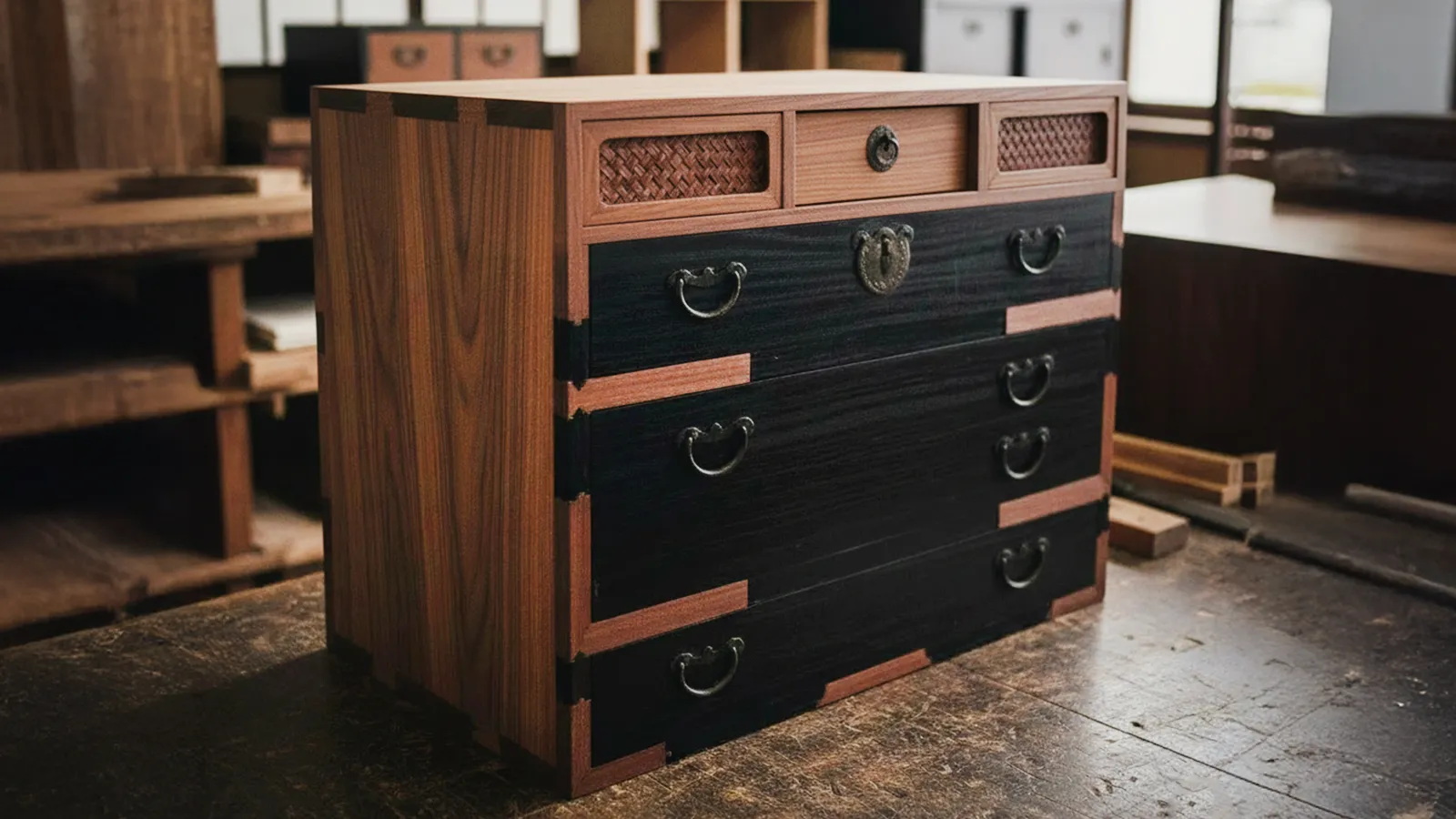
Sashimono (traditional Japanese fitted joinery) and furniture are well suited to practising how to look at grain.
This is because several members with different roles are combined: the top, the side panels, the rails (kamachi), the drawers, the legs.
What kind of grain is the top? Does the drawer front read as connected to the neighbouring member? Are the side panels changing the grain direction? Looking one by one like this makes it easier to think about the relationship between material choice and structure.
If you want to know more about the choice of wood and joinery itself, our article on Edo sashimono, which focuses on joining techniques that rely on neither nails nor metal fittings, may also be a useful reference.

As woodwork that combines the colours and characters of different woods and turns them into geometric patterns in their own right, Hakone yosegi-zaiku (Hakone marquetry) also offers another way to understand how wood colour and grain can become part of a design.

How does grain relate to strength, warping, and use?
Grain and the cut are important clues for thinking about the properties of wood, but grain and cut alone cannot determine strength, warping, or quality. Species, the state of drying, member dimensions, processing, structure, and the environment of use need to be considered together.
Wood has different properties in different directions
Wood is not a uniform material that deforms in the same way in every direction.
A tree has an axial direction along the trunk, a radial direction from the centre outward, and a tangential direction following the growth rings. The Forestry and Forest Products Research Institute’s materials also measure the shrinkage of wood separately for the tangential and radial directions, among others.
(Source: Wood Shrinkage Testing | Forestry and Forest Products Research Institute)
Knowing this directionality shows that masame and itame are not merely a difference of pattern but a classification related to the structure inside the wood.
Masame does not mean it will “never warp”
If you read about wood, you will often encounter the claim that “masame is less prone to warping.” Given the difference in shrinkage by direction, that tendency can be explained.
But “a relatively low tendency to warp” and “will not warp” are different things.
Actual deformation of wood involves several factors: drying, internal stress, moisture content, the part of the tree, the thickness of the member, the joinery method, and the setting environment.
Rather than checking only whether it is masame or itame at the time of purchase and judging “this will definitely not warp,” it is important to have the maker or workshop explain the drying, structure, finish, and handling.
Choosing the cut according to use
A concrete example showing that masame and itame have no simple hierarchy is the Akita cedar bucket (oke) and barrel (taru).
Materials from the Tōhoku Regional Forest Office of the Forestry Agency introduce the example that traditional Akita cedar buckets use masame material, while barrels use itame material.
(Source: Traditional Crafts: Akita Cedar Buckets and Barrels | Tōhoku Regional Forest Office, Forestry Agency)
The important point of this example is that masame and itame do not form a hierarchy of quality, but are chosen according to use.
When looking at grain, rather than only thinking “this one is rarer, so it is better,” thinking “why was this cut chosen for this use?” makes the techniques of craft easier to understand.
Do not judge strength from grain alone
You cannot make a simple judgement that grain being even means it is strong, or that a distinctive figure means it is weak.
The performance of wood involves many conditions: species, density, knots, fibre direction, moisture content, state of drying, member dimensions, direction of load.
It is also not appropriate to lump things together as “figured wood is all weak because the fibres are complex” or “figured wood is all prone to cracking during processing.” With ray fleck, blister figure, wavy figure, and the like, the underlying causes themselves differ.
Grain and figure are important visual clues, but not judging the overall performance or value of a work from one feature alone is the basis of looking at woodwork.
When buying furniture, vessels, or woodwork, how do you check the grain?
When buying, do not judge only by “whether the grain is rare”; check the species, the cut, the form, the finish, and the use together. When choosing a piece, it is important to look at the work as a whole.
A seven-point checklist for looking at woodwork
When looking at furniture, vessels, or a studio piece of woodwork, checking the following seven points in order makes things easier to sort out.
- Species: what wood is used
- End grain: in which direction the growth rings run
- Grain: in which direction the grain runs relative to the form of the work
- Figure: if there is a distinctive pattern, where it is placed within the work
- Members: whether the grain of several boards is connected or changed in direction
- Finish: how lacquer, oil, and so on make the grain appear
- Use: whether the maker or seller provides clear guidance on use, storage, and environmental conditions
One finish that brings out the grain of the bare wood is wiping lacquer (fukiurushi). If you would like to know more about the relationship between grain and surface finish, this may also be a useful reference.

Five questions you may ask the maker or shop
When buying a studio piece, there is no need to think “I can’t ask because I don’t have the knowledge.” On the contrary, by checking about the material, you can learn the background of the work in concrete terms.
- What species is used in this work?
- Which part of the tree was this material taken from?
- How were the grain and the cut chosen?
- What finish has been applied to the surface?
- Is there anything to be careful of in use and storage?
Among these, the question “why did you choose this material?” is effective.
You may learn about considerations that are not apparent from appearance: workability, use, feel, the finished result, the relationship with local materials.
Choosing a piece of craftwork is not choosing only the finished pattern. Knowing the reasons behind the choice of material and technique greatly changes the level of detail you notice in the work.
For companies, hotels, and shops, how do you handle “individual variation”?
When introducing natural-wood craftwork or furniture into hotels, ryokan, restaurants, shops, offices, and the like, you need to consider different factors than you would when buying a single piece.
One of the most important considerations is the natural variation of the material. Even when made in the same species and the same design, the grain, colour, knots, and figure will not necessarily be exactly the same.
For projects such as introducing the same tray into several guest rooms, making a series of shop fittings, or ordering a set quantity of wooden products as corporate gifts, sharing conditions like the following in advance can reduce mismatches in expectation.
- How much individual variation in grain and colour is acceptable
- How far size and shape are to be standardised
- How standards for finish and colour tone are set
- Whether repeat production or replacement is possible
- Everyday maintenance methods
- The possibility of specification changes due to the wood-supply situation
This does not mean making natural wood uniform like an industrial product.
The key is deciding how much natural variation to embrace, and where consistent product specifications need to begin. Sharing that boundary between the maker and the client is important when specifying craft for commercial interiors or business use.
At Kogei Japonica, we take enquiries about product development and planned production with craft artists and workshops, and about renting craftwork or using it in spaces such as hotels, offices, and shops. When introducing woodwork too, you can consider not only the grain but also the use, quantity, setting environment, finish, and maintenance.

If you would like to look at the relationship between grain and furniture through a concrete piece of craft, our article on Iwayado tansu (Iwayado chests), which brings out the grain of zelkova (keyaki), may also be a useful reference.

Artists, craftspeople, and workshops involved in woodwork and wood craft can also apply through Kogei Japonica’s craft artist and craftsperson registration to have their work featured and to be considered for partnerships with companies and brands.

Frequently asked questions about grain
Finally, here we sort out, in a question-and-answer form, the questions that often arise when looking at woodwork: the relative merits of masame and itame, the meaning of figure, the relationship with warping, and so on.
- Q. How do you tell masame and itame apart?
- Checking the growth rings on the end grain, not only the surface pattern, makes it easier to judge. Generally masame tends to look straight and itame arched or curving, but there is also oimasa, which is intermediate between the two.
- Q. Between masame and itame, which is the better grain?
- Neither is inherently better. The choice is made according to the tendency of dimensional change from the cut, the use of the work, the width needed, the design, and so on. A classification of “masame is high quality, itame is lower” is not appropriate.
- Q. What is the difference between grain pattern and figure?
- Grain pattern is the pattern that appears on the worked face because of grain and other factors. Figure refers to a distinctive, decorative pattern arising from the wood’s growth, structure, grain, and so on. Masame and itame describe the cut and resulting grain pattern, while figure describes a different kind of visual feature.
- Q. What is ray fleck?
- It is a speckled figure seen mainly when broad rays appear on the radial section. In English it is called ray fleck, silver grain, and the like.
- Q. What is blister figure?
- It is a figure in which circular or oval patterns appear, mainly on the tangential section, owing to uneven growth and the like. Rather than understanding it only as “a burl pattern,” it is considered separately from burl figure.
- Q. What is curly figure?
- Among the wavy figure that appears from wavy grain, the finer form is referred to as curly figure. The pattern can look three-dimensional depending on the direction of the light and so on.
- Q. What can you tell from the end grain?
- The end grain shows how the growth rings run relative to the worked face, giving a clue for thinking about the cut — masame, itame, oimasa, and so on.
- Q. Can you tell how prone to warping something is from the grain?
- It is a clue for thinking about the tendency of dimensional change from the cut, but future warping cannot be judged from grain alone. Species, drying, moisture content, dimensions, structure, and the environment of use are also involved.
- Q. Is the grain the same if the species is the same?
- It will not be the same. Even in the same species, the expression of the worked face changes with the individual tree, the part of the trunk, the state of growth, and the cut. The grain of natural wood differing from one piece to the next is the norm.
- Q. Is figured wood expensive?
- Price cannot be decided by the presence or absence of figure alone. Price varies according to species, the condition of the figure, the size and quality of the material, the processing and finishing of the work, the maker’s hand, the distribution route, and so on.
- Q. When buying furniture or a wooden vessel, where should you look first?
- After first looking at the overall form and use of the work, checking the species, the direction of the grain, the end grain, the connections between members, the finish, and the points to be careful of in use makes it easier to judge.
Once you know about grain, furniture and vessels that used to end at “the grain is beautiful” start to look a little different.
The aim is not to memorise every name such as masame, itame, ray fleck, and blister figure.
What matters is becoming able to think, “why does this pattern appear here?” and “why did the maker use this face in the work?”
A tree develops its structure as a living organism over time. Where that tree is cut, in which direction it is used, and which face is brought to the front of the work are matters of human judgement.
The interest of craft lies not in choosing between nature and human skill as the source of value, but in seeing where the two meet.
The next time you have a chance to pick up a wooden vessel or piece of furniture, look not only at the beautiful grain on the front, but also a little at the side and the base. There, more than the name of the grain, you will find clues for thinking about how that work was made from a single tree.
