




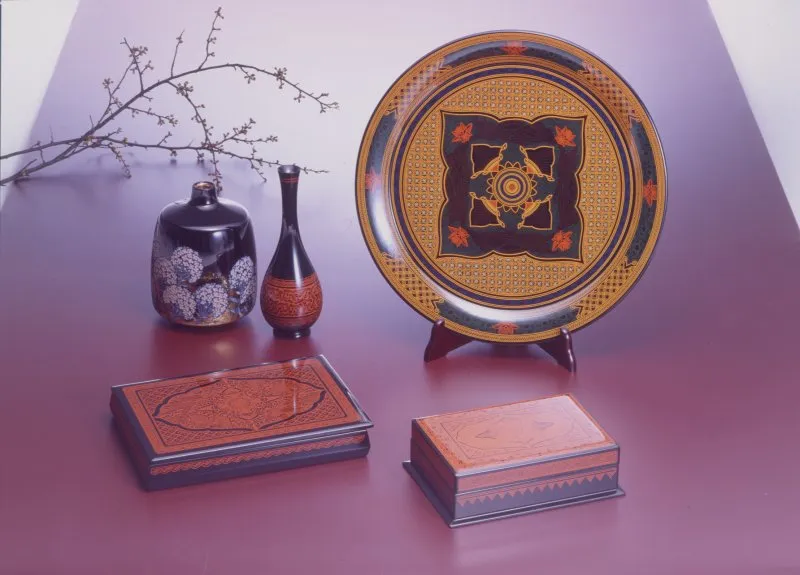
Kagawa lacquerware (Kagawa shikki) is a rare “multi-technique regional” lacquerware production center in Japan that systematically encompasses multiple decorative techniques—including kinma, zonsei, choshitsu, and goto-nuri—rather than relying on a single specific technique. During the late Edo period, under the protection and craftsman training of the Takamatsu Domain, these techniques were consolidated, forming a unique aesthetic that combines both practicality and artistic appreciation.
In recent years, the flexibility of its division-of-labor structure and design adaptability have been reevaluated, leading to growing connections with contemporary artists and overseas markets. This article provides a detailed explanation from a craft perspective of the background that gave birth to Kagawa lacquerware, the characteristics of its techniques and production structure, and its value and potential in the modern era.
Table of Contents
What is Kagawa Lacquerware? Japan’s Premier Lacquer Art Region Where Multiple Techniques Coexist

Kagawa lacquerware is one of Japan’s leading lacquer art production regions, developed primarily in Takamatsu City, Kagawa Prefecture, and is known for its extremely distinctive structure of “one region, multiple techniques.” While most regions are concentrated in specific techniques, Kagawa has multiple decorative techniques coexisting in parallel, each bearing its own unique aesthetic sensibility and purpose.
This background stems from the cultural accumulation as a castle town and a local character that values practical items. This chapter organizes the essence of Kagawa lacquerware from three perspectives: the historical background of its establishment, the rare structure of multi-technique coexistence, and its perfection as lifestyle crafts.
Background of Establishment: The History of Takamatsu Lacquer Art Nurtured in Tamamo Castle Town
The origins of Kagawa lacquerware lie in the castle town culture nurtured under the Takamatsu Domain lords, the Matsudaira family (particularly the first lord, Matsudaira Yorishige), during the mid-Edo period. Under the domain’s patronage, lacquerware for samurai furnishings, gifts, and temple-related items was produced, forming the foundation of Takamatsu lacquer art.
Particularly noteworthy is that lacquerware was positioned not merely as decorative craft but as practical items closely connected to daily life and rituals. With stable demand within the domain, craftsmen were able to advance division of labor and technical sophistication. Subsequently, Tamakaji Zokoku, a master craftsman of the late Edo period, researched lacquerware techniques from China and Thailand, developing and popularizing unique advanced techniques, making Takamatsu lacquer art known nationwide.
After the Meiji era, techniques were refined through export crafts and exhibition participation, and after the war, the production area name “Kagawa lacquerware” became established. The history where castle town-derived refinement merged with the straightforwardness characteristic of regional production areas supports the current diversity of Kagawa lacquerware.
The Greatest Characteristic of Kagawa Lacquerware—The Rare Structure of “One Region, Multiple Techniques”
The greatest characteristic of Kagawa lacquerware is that multiple major techniques coexist in a single production region. Representative examples include kinma, zonsei, choshitsu, goto-nuri, and zokoku-nuri, each possessing different decorative philosophies and processes.
Kinma creates vivid line drawings by carving and filling grooves with colored lacquer, while choshitsu expresses patterns by carving down through layers of lacquer. Zonsei combines line engraving with coloring, and goto-nuri is characterized by a durable finish that brings out the feel of the base material. The reason these developed in the same region is likely due to the flexibility in the production area to select optimal expressions according to purpose and demand.
The structural strength of Kagawa lacquerware lies in the fact that techniques have coexisted in a complementary relationship rather than competing with each other.
Aesthetic Sensibility Balancing Practicality and Appreciation: Perfection as Lifestyle Crafts
Kagawa lacquerware is also evaluated for balancing high aesthetic appreciation with practicality at a high level. While patterns and colors have a clear presence, weight, thickness, and texture are carefully adjusted on the premise that they will be used as everyday utensils.
For example, even with highly decorative techniques like choshitsu and kinma, excessive relief is avoided and designs are made that don’t compromise stability during use. This is the result of Kagawa lacquerware developing not only as tea ceremony utensils or display items but also as daily implements like trays, bowls, and stacked boxes.
The attitude of not asserting beauty too strongly and completing it through use resonates strongly with contemporary values of lifestyle crafts and craft design. Kagawa lacquerware can be said to be a production region that embodies the essence of Japanese lacquer art, where beauty resides within practicality.
Systematic Understanding of the Five Representative Techniques
Essential to understanding Kagawa lacquerware is the perspective of systematically grasping the multiple techniques that characterize the production region. In Kagawa, rather than being consolidated into a single technique, techniques with different origins and expressive principles coexist in parallel, each sharing responsibilities for purpose and aesthetic sensibility.
Below, we focus on particularly representative techniques—choshitsu, goto-nuri, and the decorative technique group of zonsei, kinma, and zokoku-nuri—and organize their formative principles and aesthetic directions. By understanding the differences in techniques, the reason why Kagawa lacquerware is “a production region that values diversity itself” will become clearer.
Choshitsu: The Pinnacle of Three-Dimensional Expression by Carving Multi-Layered Colored Lacquer
Choshitsu is one of the representative techniques of Kagawa lacquerware and enables extremely sophisticated three-dimensional expression even within lacquer art. Multiple colors of lacquer are applied in many layers over the base, and after repeated drying and polishing, carving down along patterns reveals the cross-sections of the color layers themselves as the design.

Rather than drawing on a flat surface, colors change according to carving depth, so patterns naturally develop shading and volume. This process requires time and effort, and slight carving errors affect the overall impression. Therefore, choshitsu can be said to be an accumulation of technical skill and concentration.
Kagawa’s choshitsu is characterized by not leaning toward excessive decoration and emphasizing harmony with vessel form, sublimating into expression that combines both aesthetic appreciation and practicality.
Goto-nuri: The Powerful Wiping Lacquer Aesthetic Created by Red and Black
Goto-nuri is a technique that retains strong practicality among Kagawa lacquerware, characterized by a powerful expression through wiping lacquer. By repeatedly applying and wiping off lacquer on the wood base, it brings out the wood grain while creating clear forms through the contrast of red and black.

The essence of this technique lies not in layering decoration but in drawing out the expression of the material itself. Because it excels in durability and is suitable for daily use, it has developed as daily implements like trays and serving stands. The beauty of goto-nuri resides in the overall volume and color balance rather than detailed craftsmanship.
While premised on practicality, the strong presence it radiates demonstrates the perfection of Kagawa lacquerware as lifestyle crafts.
Zonsei, Kinma, and Zokoku-nuri: The Lineage of Decorative Techniques Where Lines, Points, and Colors Stand Out
Zonsei, kinma, and zokoku-nuri are positioned as a group of techniques responsible for decorativeness through lines and colors.

Zonsei applies line engraving to the lacquer surface and adds coloring, creating light and pictorial expression.

Kinma is a technique of filling carved grooves with colored lacquer, characterized by detailed line drawings and vivid color contrasts.

Meanwhile, zokoku-nuri has its individuality in taking advantage of lacquer texture and color changes while performing decoration with relatively high freedom.
These techniques have played the role of bearing visual splendor, unlike choshitsu and goto-nuri. However, in Kagawa, decoration never surpasses vessel form or purpose, and balance with practicality is always maintained. The maturity of Kagawa lacquerware as a technique system is expressed in using lines, points, and colors while never losing moderation.
Internal Structure of Techniques—The Production Process Supporting Kagawa Lacquerware
The diverse techniques of Kagawa lacquerware are not established merely by superficial decorative differences. At their foundation lie consistent production philosophy and rational process design, from wood base selection to undercoating, lacquering, decoration, and polishing.
Particularly important is the point of balancing durability as practical items with lightness for easy daily handling—an element common to all Kagawa lacquerware. Here, we focus on the internal structure of the production process and organize the design philosophy supporting techniques and Kagawa’s unique system where division of labor and individual workshops coexist.
Undercoating Process and Wood Base Selection: Design Philosophy Balancing Durability and Lightness
Fundamentally supporting the quality of Kagawa lacquerware are wood base selection and the undercoating process. For wood bases, lightweight materials with high workability that don’t easily warp or crack are selected, and thickness and structure are finely adjusted according to purpose.
To keep weight down while securing strength, designs are adopted that don’t make items unnecessarily thick and complement durability through lacquer coating and undercoating. In the undercoating process, cloth application and base lacquering are carefully layered to suppress wood base movement while creating a foundation that stabilizes subsequent lacquering and decoration processes.
Because low precision at this stage directly affects final finish and durability, it’s extremely important despite being invisible from the outside. The background to Kagawa lacquerware’s reputation as “light yet durable” lies in such rational design philosophy being implemented even before decoration.
Texture and Depth Created by Repeated Lacquering, Decoration, and Polishing
The texture of Kagawa lacquerware is not completed in a single lacquering or decoration session but is formed by repeatedly cycling through lacquering, decoration, and polishing. By repeatedly applying and drying lacquer, refining the surface through polishing, and lacquering again, layer thickness and uniformity are created.
In techniques like choshitsu and kinma, these layers themselves become material for design, enabling expression with depth. Meanwhile, in wiping lacquer like goto-nuri, wood grain expression is adjusted through the balance of polishing and wiping, simultaneously drawing out power and dignity.
What’s important is that polishing is not merely a correction process but active work for designing texture. This repetition creates the calm luster characteristic of Kagawa lacquerware and the expression that deepens with use.
Coexistence of Division of Labor and Individual Workshops: Kagawa’s Unique Production System
The production system of Kagawa lacquerware has a major characteristic in the coexistence of division of labor and individual workshops. The division-of-labor system, where wood base craftsmen, undercoating specialists, lacquerers, and decoration craftsmen are involved in each process, has contributed to technical sophistication and quality stability.
On the other hand, individual workshops where one person handles all processes also exist, creating works reflecting artistry and unique interpretations. The fact that these two systems are not mutually exclusive but have been used selectively according to purpose and artistic nature has supported the diversity of Kagawa lacquerware.
Through the circulation of technical accumulation through division of labor and expression renewal through individual workshops, the entire production region continues to evolve without becoming rigid. Kagawa lacquerware can be said to be an extremely mature production region in that its production system itself is flexible.
Design and Aesthetics—The Pattern World Depicted by Kagawa Lacquerware

The appeal of Kagawa lacquerware lies not only in the diversity of techniques but also in the design and aesthetics formed across them. Patterns are not mere decoration but are designed on the premise of vessel purpose, form, and usage context, holding meaning within overall harmony.
Imagery based on nature and auspiciousness, geometric composition, and restrained colors form a visual language that makes Kagawa lacquerware instantly identifiable. Below, we decode the pattern world depicted by Kagawa lacquerware from three perspectives: pattern vocabulary, relationship with vessel form, and color sensibility.
The Breadth of Decorative Vocabulary Seen in Natural, Auspicious, and Geometric Patterns
The patterns of Kagawa lacquerware can be broadly organized into three systems: natural patterns, auspicious patterns, and geometric patterns. Natural patterns like plants, birds, waves, and clouds frequently feature expressions that organize lines and planes without leaning too much toward realism.
This is likely the result of seeking beauty that doesn’t assert itself too strongly within the limited canvas of a vessel. In auspicious patterns, designs symbolizing longevity and prosperity are used, but in Kagawa, there’s a tendency to incorporate them as repetition and rhythm rather than pushing symbolism to the forefront.
Furthermore, geometric patterns used in kinma and zonsei are composed through the accumulation of lines and points, giving tension and order to the entire vessel. The coexistence of these pattern groups has enabled Kagawa lacquerware to acquire a broad decorative vocabulary adaptable to various purposes and preferences.
Relationship Between Vessel Form and Decoration: Formal Analysis of Trays, Bowls, Stacked Boxes, and Box Items
In Kagawa lacquerware, patterns are not entities independent from vessel form but are designed integrally with shape. Trays, with their high flatness, emphasize compositions that guide the eye from center to periphery and arrangements that utilize negative space.
In bowls, density of patterns is varied between inside and outside, considering viewpoint changes when held in the hand, with awareness of the usage experience. Stacked boxes are characterized by designs considering both continuity between tiers and both stacked and opened states.
In box items, the boundary between lid and body and corners become key to form, with three-dimensionality emphasized through line engraving and color transitions. What emerges from such analysis is that in Kagawa lacquerware, decoration doesn’t cover vessel form but functions as an element that establishes form.
Characteristics of Color Sensibility: Visual Effects Brought by Red, Black, Yellow, and Green
The colors of Kagawa lacquerware are characterized by being based on red and black while effectively using colors like yellow and green. Red gives warmth and presence to vessels, while black tightens the whole and clarifies form.
In contrast, yellow and green are used as accents in techniques like choshitsu and kinma, making pattern outlines and depth stand out. What’s important is that despite using multiple colors, it doesn’t lean toward gaudiness. Colors don’t assert themselves as planes but appear as lines and layers, playing a role in guiding the eye.
Through this restrained color sensibility, Kagawa lacquerware blends naturally not only in Japanese spaces but also in contemporary interiors. The aesthetics unique to Kagawa lacquerware are condensed in the point of simultaneously conveying vessel three-dimensionality and pattern meaning through color.
The Current Position of Artists, Workshops, and Succession
Kagawa lacquerware not only preserves the technique system formed over long history but continues succession and renewal even in modern times through organic involvement of artists, workshops, and educational institutions. Precisely because it’s a multi-technique production region not fixed to specific styles, individual artists’ capabilities and interpretations are easily reflected in the overall expression of the production region.
This chapter organizes the “current position” of Kagawa lacquerware from the existence of important bearers including Living National Treasures, expression expansion by contemporary artists, and the human resource development mechanism centered on the Kagawa Prefectural Lacquer Art Research Institute.
Living National Treasures, Important Intangible Cultural Property Holders and Their Influence

One factor that has elevated Kagawa lacquerware’s reputation domestically and internationally is the existence of Living National Treasures and Important Intangible Cultural Property holders. These artists not only embody highly perfected forms of specific techniques but have functioned as reference points for the technical level and aesthetic sensibility of the production region.
Their works serve as indicators showing the orthodoxy of techniques and the pinnacle of expression, playing an important role as learning targets for successors. Moreover, through official recognition, the reliability and awareness of Kagawa lacquerware itself increased, bringing ripple effects to markets and educational settings.
The structure where individual prestige transforms into evaluation of the entire production region holds great meaning in the succession of Kagawa lacquerware.
He studied at Takamatsu Technical High School and the Kagawa Prefectural Lacquer Art Research Institute, deepening his mastery of basket-base kinma under Living National Treasure Ota Hitoshi, and has accumulated numerous awards at the Japan Traditional Crafts Exhibition and elsewhere.
His style is characterized by creating depth and three-dimensionality through point-engraving kinma on light, strong vessels using bamboo, and based on the philosophy of “lacquerware that comes alive through use” balancing aesthetic appreciation and practicality, he works on conveying the appeal and succession of Kagawa lacquer art from bases including the “Lacquer House” on Ogijima Island.
Expression Expansion by Contemporary Artists: Contemporary Forms Using Traditional Techniques
Contemporary Kagawa lacquerware artists are stepping into new expressive domains in vessel form and purpose while strictly preserving traditional techniques. Beyond conventional trays and bowls, objects adapted to contemporary lifestyles, forms linked with architectural spaces, and installation-like works have emerged.
What’s important is not that techniques themselves are transformed but that the premise conditions of form are renewed while using traditional processes. When decorative techniques like choshitsu and kinma connect with contemporary forms and scales, new visual experiences are born.
Such attempts can be said to be important movements positioning Kagawa lacquerware not as past style but as ongoing craft.
Human Resource Development and Technical Succession Centered on Kagawa Prefectural Lacquer Art Research Institute
Supporting the succession of Kagawa lacquerware from an institutional aspect is the human resource development mechanism centered on the Kagawa Prefectural Lacquer Art Research Institute. At this institute, students can systematically learn from basic wood base, undercoating, and lacquering to various decorative techniques, cultivating human resources capable of responding to both division-of-labor and individual workshop approaches.
The characteristic is that education is conducted not merely for technical acquisition but including material understanding, production ethics, and production region history. After completion, career paths are diverse, with some entering workshops and others becoming independent artists, forming a structure where learning circulates throughout the production region.
The Kagawa Prefectural Lacquer Art Research Institute continues to play an important role as the core entity for passing the multi-technique nature and flexibility of Kagawa lacquerware to the next generation.
Market Viability and Contemporary Applications
Kagawa lacquerware, rather than remaining limited to evaluation as appreciative craft, is enhancing affinity with contemporary markets through combining practicality and narrative qualities. The characteristic of multiple techniques creates multiple pathways from collector markets to interior, commercial use, tourism, and experiential offerings, contributing to demand dispersion and stability.
This chapter organizes evaluation axes domestically and internationally, implementation value in dining and lodging sectors, and the potential for brand expansion through experiential offerings and overseas dissemination.
Evaluation in Domestic and International Markets: Positioning in Collector and Interior Sectors
In the domestic market, Kagawa lacquerware’s core evaluation lies in the rarity as a “multi-technique production region” and the high perfection that withstands practical use. Artist works are supported for collectors, while standard vessels like trays and bowls are appreciated as interior and daily implements, with value differentiated by purpose.
Overseas, rather than decorative splendor, the rationality of processes and depth of texture are easier to understand, with choshitsu and kinma tending to be evaluated as “visualization of effort.” Additionally, the red-and-black-based color scheme doesn’t limit spaces and easily adapts to contemporary living environments, which is a strength.
As a result, Kagawa lacquerware is easily positioned in the intermediate domain between art and craft, so-called collectable design, with value formation progressing on the premise of long-term ownership and use over time.
Practical Value in Dining, Lodging, and Amenity Implementation
In restaurants and lodging facilities, Kagawa lacquerware has high implementation value as vessels combining practical quality and presentation power. Undercoating and lacquering designed for durability, lightness for easy handling, and colors that enhance cuisine match commercial requirements.
Trays and stacked boxes are easy to incorporate into serving logistics, while bowls and small dishes function as elements that elevate the impression of cuisine. Furthermore, if adopted as amenities or interior fixtures, it’s possible to simultaneously convey regionality and narrative.
What’s important is not just visual luxury but design capability including operational aspects like washing, storage, and renewal. Because Kagawa lacquerware is craft assuming usage contexts, it can be a realistic choice even for commercial implementation.
Potential for Brand Expansion Through Experiential Offerings, Tourism, and Overseas Dissemination
Kagawa lacquerware has good compatibility with experiential content combining production experiences, workshop tours, exhibitions, and sales, with large development potential as tourism resources. Precisely because of multiple techniques, it’s easy to experientially demonstrate process differences like carving, lacquering, and polishing, making it easy to incorporate learning elements, which is a strength.
By linking these with English explanations and overseas-oriented dissemination, the uniquely Kagawa value of “technique diversity” can be conveyed internationally. Design integrating experiential offerings, product sales, and spatial presentation leads to brand building not dependent on single-item sales.
Kagawa lacquerware holds the potential to realize sustained evaluation and demand expansion by disseminating not only the vessels themselves but also the production region’s structure and production philosophy.
Summary
Kagawa lacquerware is an extremely unique existence among Japanese lacquer art production regions. While one region-one technique is typical, a structure has been formed where multiple techniques including choshitsu, goto-nuri, zonsei, kinma, and zokoku-nuri coexist, each sharing responsibilities for purpose and aesthetic sensibility. Behind this lie the history of Takamatsu lacquer art nurtured in Tamamo castle town and a local character valuing practical items.
In production aspects, a rational process of repeating lacquering, decoration, and polishing has been established based on wood base selection and undercoating processes, with a flexible system where division of labor and individual workshops coexist supporting technical accumulation and renewal. Even in design, patterns, vessel forms, and colors are closely connected, balancing aesthetic appreciation and practicality at a high level.
Furthermore, in contemporary times, through the existence of Living National Treasures and Important Intangible Cultural Property holders, human resource development by the Kagawa Prefectural Lacquer Art Research Institute, and expression expansion by contemporary artists, tradition continues to be renewed without becoming fixed. Even in market aspects, multiple pathways including collectors, interior, dining and lodging, experiential offerings, and tourism have emerged, with evaluation steadily expanding domestically and internationally.


