




Ceramics, crafted from clay and stone through processes of forming, firing, and decoration, represent one of humanity’s oldest craft traditions. Classified into earthenware, porcelain, and stoneware based on clay properties and firing temperatures, each type differs in texture, strength, and application.
Furthermore, the choice of glazes, decorative techniques, and firing methods dramatically alters their appearance, with each production region developing its own unique aesthetic sensibility and technical system. In recent years, beyond their recognition as artistic crafts, ceramics have expanded their presence in design markets and international art fairs. This article systematically organizes the fundamental structure of ceramics, regional characteristics, and market value, providing a detailed explanation of their complete picture.
Table of Contents
What Are Ceramics? The Basic Structure of Vessel Culture Born from Clay and Fire
Ceramics refers to vessels and sculptural objects formed from clay and hardened through high-temperature firing. While appearing as simple everyday items at first glance, ceramics involve complex elements including material selection, firing temperature, techniques, and cultural background.
Ceramics are broadly classified into earthenware, porcelain, and stoneware, each with distinct properties and uses. Additionally, Japanese ceramics occupy a unique position in world ceramic history, having developed in both practical and artistic directions. This chapter first organizes the basic classifications and structures to grasp the overall picture of ceramic vessel culture.
Differences Between Earthenware, Porcelain, and Stoneware: Organizing Materials, Firing Temperatures, and Uses
Ceramics are primarily classified into three types: earthenware, porcelain, and stoneware.
Earthenware uses clay-based soil and is fired at relatively low temperatures (approximately 800-1200°C), resulting in a porous body with a soft, warm character. With water absorbency and a warm texture, it is often used for everyday vessels and folk craft works.
In contrast, porcelain uses porcelain stone as its raw material and is fired at high temperatures (approximately 1300°C), producing a white, hard body. With virtually no water absorbency and the ability to be formed thin, it is suitable for tableware and highly decorative vessels.

Stoneware occupies an intermediate position between the two, firing clay at high temperatures (1200-1300°C or higher) to create a texture harder than earthenware but less white than porcelain. Highly valued as practical items due to its excellent durability and low water permeability, these differences should be understood not as superiority rankings but as criteria that broaden options for use and expression.

Japan’s Position in World Ceramic History
Ceramic history is ancient, developing independently in various regions worldwide, but Japanese ceramic history is characterized by forming a unique aesthetic sensibility while building upon technical transmission from China and the Korean Peninsula. Particularly in Japan, rather than complete symmetry or uniformity, accidental elements such as clay texture, warping, and glaze landscapes have been accepted as beauty.
This derives largely from tea ceremony culture’s influence, where vessels were treated not merely as tools but as entities embodying spirituality. Unlike the official kiln normative beauty of China or the decorative porcelain of Europe, Japanese ceramics occupy a unique position in being inseparable from “the act of use.”
In world ceramic history, Japan can be said to be both a recipient of technology and a presenter of philosophy connecting life and beauty.
From Daily Vessels to Art Objects—The Expanding Role of Ceramics
The role of ceramics has greatly expanded over time. What originated as daily necessities like tableware and storage containers gradually developed into the realms of ritual, decoration, and fine art.
In Japan, a culture took root that found value in the form and glaze qualities even of everyday vessels, blurring the boundary between daily use and appreciation. Since the modern era, individual artist production has advanced, and ceramics have come to be evaluated as art objects in the market.
Meanwhile, the development of mass production technology has also spread stable-quality everyday vessels. Within this polarization, ceramics continue to balance being both “things to be used” and “things to be viewed.” Even in contemporary times, ceramics continue to play an important role as a medium connecting living culture and sculptural expression.
Expression Differences Determined by Materials and Firing
The expression of ceramics is greatly influenced not only by forming skill but also by what clay is used and under what firing conditions it is fired. The properties of the clay as material determine the foundation of the vessel’s color, weight, and tactile feel, while firing methods and temperatures shape the final strength and landscape.
In other words, the individuality of ceramics can be said to be born from “the combination of clay and fire.” This chapter organizes how vessel expression is determined from three elements: clay types, firing techniques, and firing temperatures.
Types and Properties of Clay: Characteristics of Earthenware Clay, Porcelain Clay, and Refractory Clay
Clays used in ceramics are broadly classified into earthenware clay, porcelain clay, and refractory clay.
- Earthenware clay is sticky and easy to form, and because it contains impurities such as iron, after firing it develops a warm color tone with clay texture. It is characterized by water absorbency and a soft texture.
- Porcelain clay is made by crushing and refining porcelain stone, contains few impurities, and after firing becomes a white, dense body. While somewhat limited in forming freedom, it enables thin forming and produces the transparent expression characteristic of porcelain.
- Refractory clay has properties that withstand high temperatures and is characterized by minimal deformation during firing. Used in stoneware and vessels requiring heat resistance, it is also a material where the particle quality of the clay itself readily appears as expression. These clays are selected according to use and expressive intent.
Firing Techniques: Differences Created by Oxidation Firing, Reduction Firing, and Wood-Fired Kilns
Firing techniques greatly influence the color tone and glaze development of ceramics. Oxidation firing is a method of firing with sufficient oxygen supplied inside the kiln, characterized by stable color development that easily reproduces intended colors.
It is often used for white porcelain and bright glaze tones. Reduction firing fires in a state with suppressed oxygen, causing changes in metal components within the glaze and producing colors with depth. The expression of celadon and iron glazes is achieved through this reduction state.
In wood-fired kiln firing, ash from the fuel falls onto the vessels becoming natural glaze, so even identical pieces develop different landscapes individually. The flow of fire and ash deposits create coincidental effects, resulting in expressions with strong individuality.
Firing Temperature and Vessel Character: The Relationship Between Strength, Water Absorption, and Texture
Firing temperature is a crucial element determining the physical properties and texture of vessels. With low-temperature firing, the body’s vitrification is insufficient, resulting in high water absorbency and vessels with a light, soft impression.
While offering ease of handling as everyday vessels, durability requires consideration. As firing temperature increases, clay and glaze melt more thoroughly, and the body becomes dense with high strength. Water absorption decreases, producing a hard, sharp texture, though it may also feel heavier or colder.
The choice of firing temperature represents not merely performance differences but design philosophy regarding how vessels should be used and what expression they should possess. Ceramics can be called a vessel culture where character is determined by temperature.
Glaze and Decorative Technique Systems

As elements determining the expression of ceramics, glazes and decorative techniques are as important as clay and firing. Glazes are vitreous layers covering the vessel surface, serving both functional and aesthetic purposes. Additionally, decorative techniques applied on top have given vessels meaning, narrative, and visual individuality.
Here, after organizing the basic role of glazes, we systematically explain representative decorative techniques and expressions born from the coincidental nature unique to ceramics.
The Role of Glazes: Functionality and Beauty Provided by Vitreous Matter
Glazes melt during firing and serve to cover the vessel surface with vitreous matter. Their primary function is to suppress water absorbency and prevent the penetration of stains and odors.
This enables ceramics to be used safely and hygienically as everyday vessels. Simultaneously, glazes are aesthetic elements determining color, luster, and texture. Transparent glazes highlight clay texture and underglazes, while opaque glazes form soft color surfaces.
Furthermore, expression changes greatly even with identical compositions depending on glaze thickness and flow. Glazes can be said to be important design elements integrating vessel functionality and beauty rather than mere surface treatment.
Representative Decorative Techniques: Painting, Sgraffito, Inlay, and Divided Glazing
Ceramic decorative techniques are diverse, with representative ones including painting, sgraffito, inlay, and divided glazing.
- Painting is a technique of drawing patterns with pigments on the body or glazed surface, enabling linear depiction and color expression.
- Sgraffito carves patterns after applying slip or glaze, revealing the underlying clay color to produce clear contrast.
- Inlay is a technique of embedding different clays or colored clays into carved grooves, forming precise patterns within smooth surfaces.
- Divided glazing uses multiple glazes selectively to emphasize vessel form or provide visual segmentation.
These techniques are selected according to vessel use and form, playing a role in balancing decoration and function.
Kiln Change, Landscape, and Crazing—Ceramic Expression Born from Coincidence
One charm of ceramics lies in expressions born from uncontrollable coincidence. Changes in color tone and texture caused by temperature fluctuations during firing, flame flow, and glaze melting states are called “kiln change,” and identical results cannot be obtained even under the same conditions.
Expressions appearing through glaze flowing, pooling, and changing color are perceived as “landscape” and become important elements of appreciation. Additionally, fine cracks caused by differences in shrinkage rates between glaze and body are called “crazing” and have been evaluated not as defects but as design.
These elements are born at the intersection of maker intent and natural phenomena, and are also why ceramics differ from industrial products. The attitude of accepting coincidence and elevating it to beauty can be said to be the essence of ceramic expression.
Japan’s Major Production Regions and Styles
Japanese ceramics have developed while connecting with natural environments, history, and living culture throughout the country. Even as the same “vessels,” clay properties, kiln structures, firing techniques, and decorative consciousness differ by production region, appearing as stylistic differences.
In Japan, while vessel-making premised on practical use has been conducted since ancient times, unique aesthetic sensibilities have been nurtured in each region. Here, we organize Japan’s major production regions and styles from three perspectives: the Six Ancient Kilns forming the foundation of pottery culture, production regions representing porcelain culture, and the influence of regionality on vessel individuality.
The Six Ancient Kilns and Their Lineage: Seto, Shigaraki, Bizen, Tokoname, Tamba, Echizen

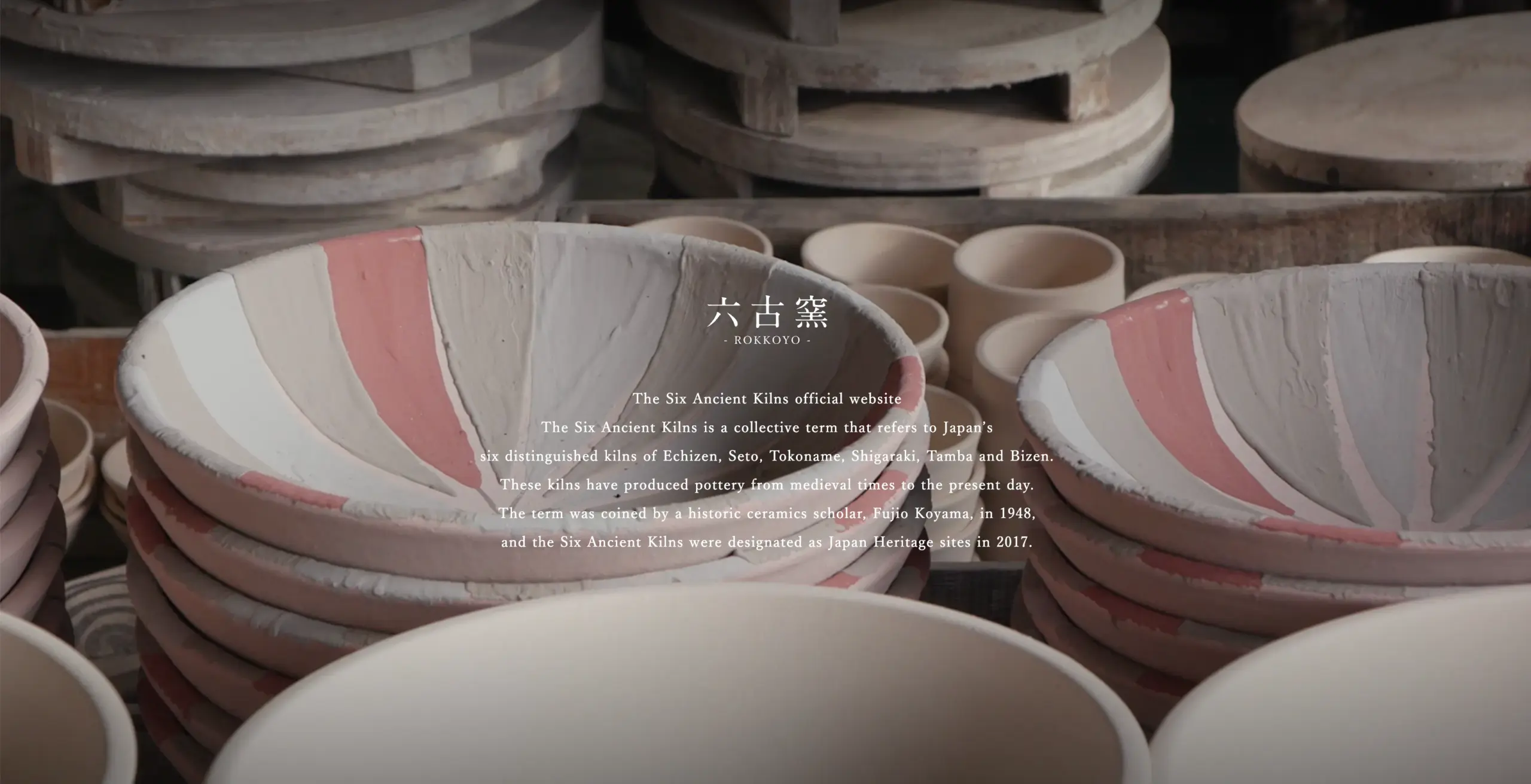
The Six Ancient Kilns refer to six representative Japanese pottery production regions where production has continued from medieval times to the present.
- Seto developed glazing techniques early and has produced a wide range of vessels from everyday wares to tea ceramics.
- Shigaraki is characterized by rough clay and simple expression through natural glaze, strongly retaining the influence of flame and ash.
- Bizen is a fired pottery style using no glaze, emphasizing landscapes created by clay and fire.
- Tokoname is represented by large jars and vessels, pursuing practicality and durability.
- Tamba and Echizen are characterized by deep landscapes through natural glaze, with ash from wood-firing falling onto vessels during kiln firing, creating different expressions for each piece.
These production regions have formed practical vessel culture rooted in agricultural life. The Six Ancient Kilns can be said to be entities transmitting the prototype of Japanese pottery to the present.
Development of Porcelain Culture: Characteristics of Arita, Imari, Kutani, and Tobe
Japanese porcelain culture began in earnest from the early modern period. Central to this was Arita, where porcelain born here was distributed to various regions from Imari Port.

Imari ware applies underglaze blue and overglaze decoration to white porcelain bodies, gaining international recognition for its gorgeous decorative qualities.

Kutani ware is characterized by powerful line drawing and rich colors, bringing pictorial expression to porcelain.

Meanwhile, Tobe ware applies flowing underglaze blue to thick, durable white porcelain, developing as everyday vessels. Even within porcelain, regions have divided between those emphasizing decorative qualities and those prioritizing practicality, expanding the expressive domain of Japanese porcelain.
Vessel Individuality Created by Regionality and Relationship with Daily Life
Japanese ceramics cannot be understood separately from regional daily life. In agricultural villages, durable vessels withstanding storage and cooking were required, while in urban areas, refined vessels corresponding to food culture and rituals developed.
In cold regions and humid areas, thickness and firing conditions were adjusted, with repeated innovations suited to daily use. Such environmental factors are reflected not only in clay and kiln selection but also in vessel forms and decorative consciousness.
Japanese ceramics have been formed not as uniform national styles but through accumulated choices according to regional living conditions. This diversity itself can be said to be a major characteristic of Japanese vessel culture.
Viewing Points by Form and Use
In understanding ceramics, focusing on the relationship between form and use is important beyond just materials and techniques. Vessels are not mere three-dimensional objects but have been formed with intended usage situations and movements in mind. Vessel forms such as bowls, plates, jars, and flower vases each require different proportional sensibilities and stability, with evaluation criteria changing according to use.
Additionally, elements emphasized do not necessarily align between ceramics primarily for practical use and those for appreciation. This chapter organizes the sculptural beauty seen in representative vessel forms, differences in evaluation axes between utilitarian and contemplative ceramics, and the roles of ceramics by usage domains such as tea ceremony, cuisine, and interior design.
The Aesthetics of Vessel Form: Proportion and Stability in Bowls, Plates, Jars, and Flower Vases
The sculptural beauty of ceramics is influenced by the perfection of vessel form itself before decoration. Bowls, premised on being held in hand, have rim curves and foot ring sizes affecting both ease of holding and visual stability.
Plates have strong planarity, with edge rise and thickness distribution determining the negative space receiving food and center of gravity. For jars, the relationship between capacity and center of gravity is important, with body swell and mouth tightening creating overall tension. Flower vases consider weight when containing water and plant spread, emphasizing resistance to tipping and harmony with space.
Common to these vessel forms is that proportion is necessarily derived not from visual design but from use and structure. The beauty of ceramics is a result, established through accumulated design philosophy embodying the act of being used.
Differences in Evaluation Axes Between Utilitarian and Contemplative Ceramics
Ceramics are sometimes discussed as divided into utilitarian and contemplative ceramics, but the difference appears clearly not only in use but also in evaluation axes. In utilitarian ceramics, elements directly connected to daily use such as ease of holding, weight feel, durability, and ease of washing are emphasized.
Glaze stability and foot ring processing become evaluation criteria as structures withstanding long-term use. Meanwhile, in contemplative ceramics, visual and philosophical elements such as sculptural originality, technical sophistication, and artist expressive intent become central, with ease of use not necessarily prioritized.
However, in Japanese ceramic culture, these two have not been clearly separated, and an intermediate domain of usable art and appreciable practical items has long existed. This overlap of evaluation axes generates the diversity and depth of Japanese ceramics.
The Role of Ceramics in Tea Ceremony, Cuisine, and Interior Design
Ceramics play different roles depending on usage context. In tea ceremony, vessels are entities integrated with procedures and gestures, with form, texture, and glaze tone connecting to spirituality.
In the context of cuisine, ceramics function as backgrounds for presenting food, with color and surface texture influencing food impressions. In the interior design domain, as flower vases or objects, they create spatial rhythm and serve as focal points for sight lines. Common to these is that ceramics do not complete in isolation but demonstrate value within relationships with people, spaces, and actions.
While requirements differ by use, ceramics have been incorporated into living culture while flexibly changing roles. This adaptability can be said to be one reason vessel culture has been inherited across eras.
Contemporary Ceramic Trends and Market Value
Contemporary ceramics are expanding beyond traditional frameworks of everyday vessels and artistic crafts into diverse fields. While objects and installation works foregrounding individual artist expression are increasing, Japanese ceramic technical capability and aesthetic sensibility are being re-evaluated in overseas markets.
Additionally, applications spanning practical use and spatial production in architecture, design, and culinary fields are expanding. This chapter organizes contemporary ceramic trends and market value from three perspectives: expressive expansion by contemporary artists, evaluation axes in overseas markets, and applications to other fields.
Expression Expansion by Contemporary Artists: Objects and Installations
In recent contemporary ceramics, objects and installation works not premised on vessel function have increased. These aim at “viewing” and “spatial composition” rather than “using,” with scale expansion and formal liberalization progressing.
In addition to traditional wheel throwing, using molds, layering, and segmented structures has enabled sculptural expression. Additionally, some artists deliberately emphasize coincidence through glazes and firing, making the relationship between control and uncertainty their subject.
Such works have high affinity with museum and gallery spaces, playing a role connecting ceramics from craft to contemporary art contexts. Contemporary ceramics are greatly expanding their expressive domain while encompassing material and technical traditions.
Evaluation in Overseas Markets: Strengths and Popular Genres of Japanese Ceramics
In overseas markets, Japanese ceramics maintain high evaluation. One reason is the high level of completion backed by material understanding and firing technology.
Particularly, fired pottery utilizing clay texture and works emphasizing subtle glaze changes tend to be received as uniquely Japanese aesthetic sensibilities. Additionally, “beauty of use” originating from tea ceremony culture and attitudes valuing individual differences over perfection are evaluated as values different from mass-produced goods.
Popular genres include works with imaginable uses such as tea bowls and flower vases, plus objects with minimal forms also gathering support. Japanese ceramics can be said to occupy a unique position in international markets in being able to present tradition and contemporaneity simultaneously.
Applications to Design, Architecture, and Culinary Fields and Future Possibilities
Contemporary ceramics are advancing applications not only in art markets but also in design, architecture, and culinary fields. In the culinary field, artist ceramics have come to be actively adopted as vessels supporting culinary expression.
In architecture and interiors, ceramics are used as tiles, wall constructions, and three-dimensional works for spatial production, with material strength being evaluated. In the design field, attempts combining with different materials such as lighting and furniture parts are also seen.
Common to these is that ceramics are being redefined not as mere vessel materials but as elements composing space and experience. Going forward, through cross-disciplinary collaboration, the role of ceramics has possibilities for further expansion.
Conclusion
Ceramics are a vessel culture established on foundations of clay and fire, formed through the overlapping of multiple elements including materials, firing, glazes, decoration, form, and use. Differences between earthenware, porcelain, and stoneware derive from raw materials and firing temperatures, and in Japan diverse styles have been nurtured while connecting with regionality and daily life.
Furthermore, in contemporary times, development is progressing beyond boundaries of practical use and appreciation into objects, spatial production, and overseas markets. Systematically understanding ceramics provides not merely vessel knowledge but clues for interpreting the relationship between living culture and aesthetic sensibility.


