

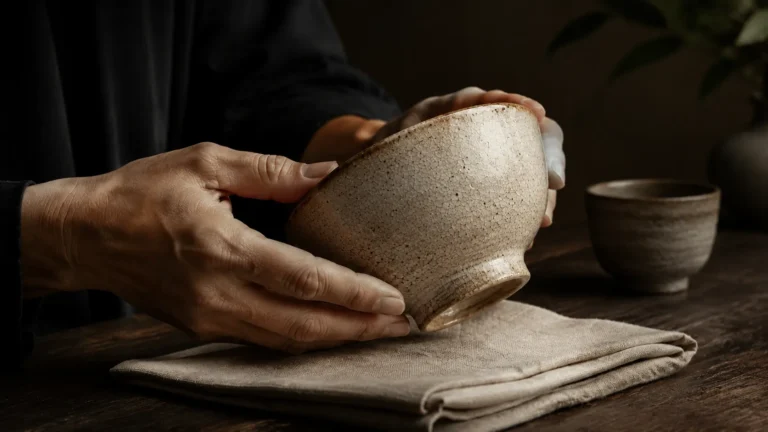
Have you ever bought a piece by an independent maker, found fine crack-like lines, black dots or tiny holes on the surface, and worried that it might be faulty?
To put it plainly: crazing (kannyū), iron spots (tetsupun or iron flecks), pinholes and the like cannot be judged as “faulty” or “returnable” simply because they exist. In technical terms they are sometimes treated as defects; in other cases they are deliberately incorporated as part of a maker’s expression, or accepted as the individual variation of a given piece.
In practice, the Pottery Day official site explains that crazing “is sometimes regarded as a flaw,” while in other cases it is turned into a deliberate pattern. Toki City, a ceramics-producing area, also gives specific guidance on crazing, iron spots and pinholes as individual variation in handmade ceramics.
Cracks that reach the body of the piece, chips, sharp breakage and leaks are another matter. The fact that a piece is handmade, or made by an independent maker, does not mean you have to accept problems that affect its use.
This article sorts things into three tiers—“likely no problem,” “worth checking with the maker or shop,” and “stop using”—so that even first-time buyers of maker’s pieces can judge with confidence, setting out the difference between crazing, black spots, pinholes, ishihaze and glaze unevenness on the one hand, and the breakage genuinely worth watching for on the other.


Table of Contents
Are Crazing, Iron Spots and Pinholes Defects? Start With Three Tiers
The surface of a fired piece carries many changes born of making and firing, and you cannot decide from appearance alone whether something is faulty. Start by sorting it into three tiers: no problem, worth checking, stop using.
When you find something that bothers you on a piece, thinking of it as a straight either/or—”is this character, or a fault?”—makes the judgement harder.
The first thing to check is not whether it looks beautiful, but whether it affects the piece’s function, whether it was part of the condition you could expect at purchase, and whether it has changed during use.
| Verdict | Typical conditions | What to check | Basic response |
|---|---|---|---|
| ○ Likely no problem | Crazing, iron flecks and slight glaze unevenness consistent with the intent or product description | Whether it was there from purchase, and whether it affects use | Use in line with the piece’s or seller’s guidance |
| △ Worth checking | Holes of unknown depth, ishihaze-like flaking, changes that have spread after use, and so on | Sharpness, depth, water seepage, difference from the product description | Check with the maker or shop, with photos attached |
| × Stop using | Clear cracks, chips, sharp breakage, leaks and the like | Whether a crack has reached the body of the piece | Stop using and consult the seller |
Note that “○” does not mean every instance of the same-named phenomenon is guaranteed safe. Even for the same pinhole, the judgement changes with size, depth, position and the intended use of the piece.
From the standpoint of ceramics technology, moreover, crazing, pinholes and the like are sometimes the subject of research and countermeasures as “ceramic defects.” Toki City’s ceramics testing station, Cerateching Toki, also organises the various phenomena that arise during firing as “ceramic defects.”
(Source: 陶磁器の欠陥(原因と対策)|土岐市)
What we do not want to confuse here is that a “defect” in ceramics technology and a “faulty, returnable product” for the consumer do not necessarily mean the same thing. As with deliberate crackle glaze (kannyū-yū), some works actively use, as expression, a phenomenon that would normally be something to suppress.
○ Conditions That Are Likely No Problem
Crazing, iron flecks, and variation in the depth of the glaze (yūyaku) that are described as part of the work’s specification do not, in themselves, signify breakage.
Toki City likewise notes that ceramics made by hand may show, besides differences in size, shape and pattern, crazing, variation in glaze depth, iron spots and pinholes.
(Source: 陶磁器の個体差|土岐市)
That said, this does not mean “crazing, black spots and small holes on any piece are fine.” The first step is to check whether it is a characteristic anticipated for that maker or that product.
△ Conditions Worth Checking With the Maker or Shop
You are under no obligation to force a condition you cannot judge on sight into the category of “landscape” yourself.
- A hole or hollow that is deeper than expected
- A surface that looks about to flake away
- A raised part that feels sharp
- A crack-like line that has changed markedly since purchase
- A line that bothers you at the same spot on both the inside and outside of the piece
- Seepage to the outside when you put water in
- A clear difference from the individual variation described on the product page
In cases like these, checking with the seller before continuing to use the piece is the surer course.
× Conditions Where It Is Better to Stop Using
Where there is a clear crack, chip or heavy damage, judge it separately from “character” or “change over time.”
The Pottery Day official site also advises against using pottery with cracks, chips or heavy scuffs, since it can break unexpectedly.
(Source: その他の商品・陶器の扱い方|陶器の日公式サイト)
Respecting a maker’s expression and judging whether a piece is safe to use are two different questions. Not blurring this line matters for both maker and user.
What Is Crazing? A “Crack in the Glaze” Is Not the Same as a Crack in the Body
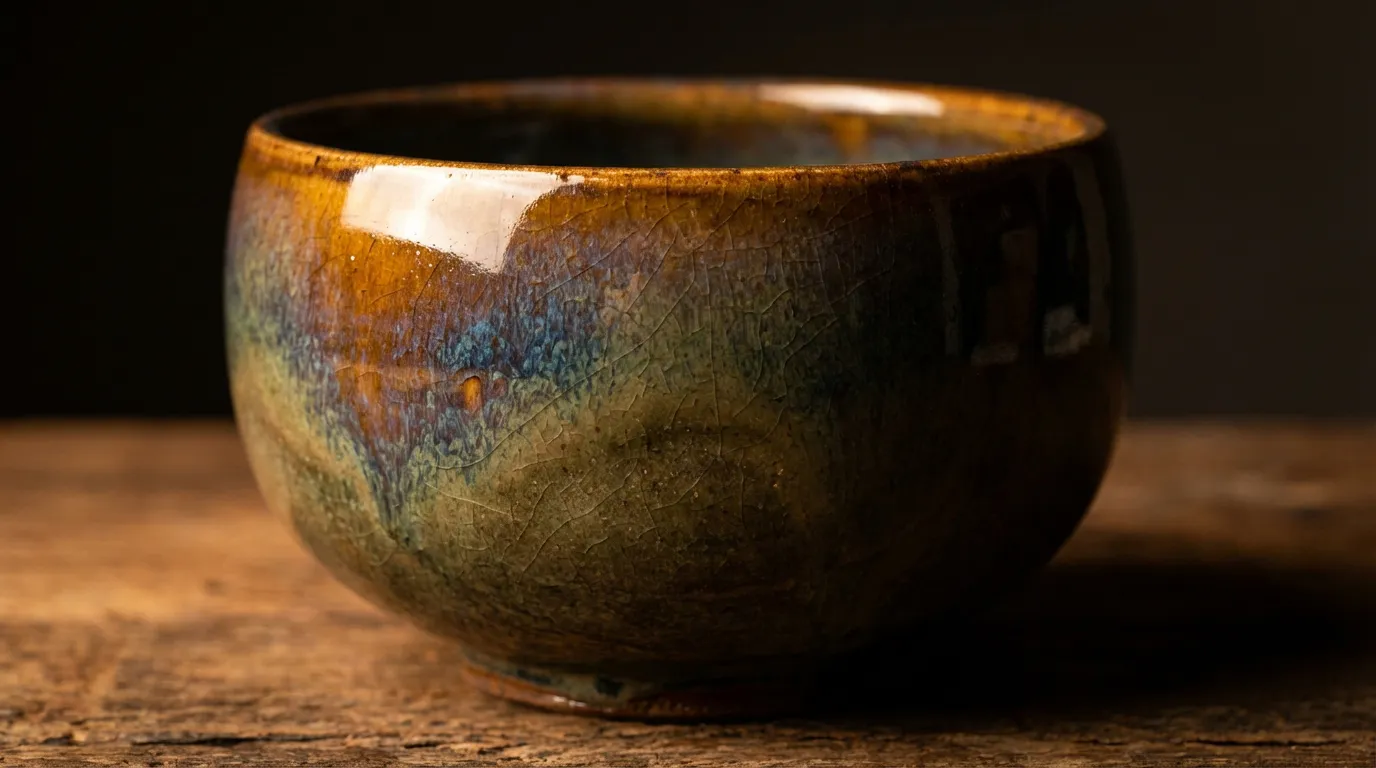
Crazing is a network of fine cracks that appears mainly on the surface of the glaze. It differs in meaning from a crack in the body of the piece, which breaks through to the clay body (kiji), and it is sometimes taken up deliberately as expression.
Crazing is what most surprises first-time buyers of maker’s pieces into thinking “surely this is cracked.”
The Pottery Day official site describes crazing as “cracks appearing on the glaze surface,” arising from the difference in shrinkage rate between the clay body and the glaze. It also notes that while it is sometimes regarded as a flaw, in other cases it has been turned deliberately into a pattern.
(Source: 用語辞典|陶器の日公式サイト)
This is the important point. “Crazing equals faulty” is no more true than “crazing is always fine.” You need to consider the full context—the maker’s intent, the use of the piece, and any change during use.
Why Does Crazing Form?
In pottery, a formed clay body is coated with glaze and fired at high temperature. The glaze melts in firing and, on cooling, becomes a glassy layer covering the surface of the piece.
At this stage, the clay body and the glaze do not necessarily have exactly the same properties of thermal expansion and contraction. Differences such as these create stress in the glaze layer, and what appears as fine cracks is crazing.
Kogei Japonica’s foundational article explains the workings of glaze and firing in more detail.
How Do You Tell Crazing From a Real Crack?
It can be hard for an ordinary buyer to tell crazing from a structural crack with certainty from a photograph or appearance alone.
So avoid quick assumptions such as “a net pattern must be crazing” or “a single line must be breakage.”
The following are useful points of reference for checking.
- Whether the fine lines appear on the glaze surface only
- Whether a large crack is visible at the same place on both the inside and outside of the piece
- Whether you can feel a step or a sharp catch when you run a finger over it
- Whether the shape of the piece is offset across the crack
- Whether there is any functional change such as leaking
- Whether crazing was noted in the product description at purchase
In the trade in antiques, old art and ceramics, a crack in the body is sometimes called nyū, and a chip at the rim or elsewhere hotsu. But an ordinary buyer has no need to diagnose a condition from terminology alone. If there is a clear crack or chip, prioritise stopping use and checking, whatever it is called.
Can Crazing Increase After Purchase?
Crazing that was not conspicuous at purchase can become more noticeable with the passage of time or the conditions of use.
The Pottery Day official site notes that when moisture is absorbed into the clay body from the base during use or storage, age-crazing can occur early in the glaze and become a cause of leaking and the like.
(Source: その他の商品・陶器の扱い方|陶器の日公式サイト)
In other words, you cannot rule uniformly that “a line appeared after purchase, so it is immediately faulty,” nor that “it is crazing, so it can be left alone.”
If a line grows quickly, if leaking occurs, or if a deep crack in the body is suspected, stop using the piece and consult the maker or seller.
Black Spots, Pinholes, Ishihaze and Glaze Unevenness—What Is the Difference?
The black spots, small holes, unevenness and colour variation seen on a piece each have a different background. Even when they look alike, it matters not to lump them all together as “only to be expected from pottery.”
Depending on the clay and glaze, kiln conditions, and the conditions of glazing (seyū) and firing, various changes appear on the surface of a piece.
Here we sort out the conditions that buyers of maker’s pieces find hardest to judge.
Black Spots and Iron Flecks
On white or pale pieces, small black or brown spots can stand out.
Toki City explains, as part of the individual variation of handmade ceramics, that iron contained in the clay can appear as small black spots on the surface through firing.
(Source: 陶磁器の個体差|土岐市)
Even so, you cannot tell from appearance alone that a black spot means “it’s iron, so it’s fine” or “it isn’t mould.” Black spots on ceramics can have several origins in the raw materials or the manufacturing process, and it is difficult to identify the substance from appearance alone at home.
If the black spot has been present since purchase, as though fired into the glaze surface, first check the product description. Where blackening has appeared after use, or where the surface condition or smell has changed, do not treat it as the same thing as firing-derived iron flecks; check the state of washing and drying.
Pinholes
A pinhole is a small hole or dimple that forms in the glaze surface.
The Pottery Day official site explains that pinholes arise from various causes, such as gas given off by the body or glaze during firing, or dust that settled before the glaze was applied.
(Source: 用語辞典|陶器の日公式サイト)
Toki City likewise notes, as one example of the individual variation of handmade ceramics, that small pinholes may be seen on the glaze surface.
(Source: 陶磁器の個体差|土岐市)
A single pinhole is not, by itself, enough for a consumer to conclude that a piece is defective, returnable or unusable.
On the other hand, if the hole is large or deep enough to trap food, flaking around it, or with a sharp part, it is better to check with the seller.
Note that food-use ceramics are subject to standards for utensils and packaging under Japan’s Food Sanitation Act, and the Consumer Affairs Agency publishes the current standards and materials on revisions to the cadmium and lead standards. But the standards for the leaching of lead, cadmium and the like are a separate issue from the presence of a pinhole. Take care not to conclude food-use safety from appearance alone.
(Source: 器具・容器包装、おもちゃ、洗浄剤|消費者庁)
Ishihaze
In pottery descriptions, the word “ishihaze” is sometimes used.
It generally refers to a localised swelling or flake-like expression arising from particles contained in the clay, but you should not judge a piece’s condition or usability from the term “ishihaze” alone.
While it is accepted as expression on some pieces, if the protrusion is sharp, the surface looks about to flake, or a piece has come away during use, check with the seller whatever the name.
Glaze Unevenness, Running and Colour Variation
Glaze does not always form a perfectly even surface the way ordinary paint does.
Depending on the thickness of the glazing, the shape of the piece and the firing conditions, variation in colour, running of the glaze and differences in sheen can arise. Toki City also notes that variation can appear according to how the glaze takes and how it fires.
(Source: 陶磁器の個体差|土岐市)
Some makers deliberately incorporate these variations into the work’s expression.
Unevenness in itself does not immediately signify a fault. But being handmade does not, of itself, justify every possible condition either.
Marks Born of the Making Process, Such as Spur Marks
Pottery can retain marks arising from firing and the making process. A buyer may perceive marks seen on the underside or inside of a piece as “damage.”
What matters is to distinguish whether such a mark is something anticipated in the making process, or damage caused by delivery, storage or use.
If you are unsure, do not decide “defect” or “landscape” from a photograph alone; check the product description or the guidance from the maker or seller.

Where Should You Draw the Line Between “Landscape” and “Defect”?
In craft, changes born of clay, glaze, flame and the making process are sometimes valued as the expression of a work. But aesthetic value and whether a piece functions properly as a vessel are separate axes.
In explanations from shops and makers that deal in pottery, you will sometimes see the word keshiki, literally “landscape”—a term for the expressive surface effects produced through firing.
It is an important idea in the context of appreciating the expressions born of firing—the running of glaze, changes of colour, kiln transformation (yōhen), crazing and so on.
But if every condition a buyer feels uncertain about is explained away with the single phrase “it’s landscape,” the functional problems that ought to be checked become invisible too.
Maker’s Pieces Cannot Be Judged by the Same Uniformity as Industrial Products
With maker’s pieces, some works are not intended to match perfectly in dimensions, colour or surface finish.
Even in the same series by the same maker, the expression of each single piece can change with the thickness of the glaze, the position in the kiln and the firing environment.
One of the appeals of choosing maker’s pieces is not simply “tolerating variation.”
Part of the appeal is choosing one particular piece, the differences born of material and making process included.
Even So, Don’t Settle Everything With “It’s Handmade”
At the same time, the words “handmade,” “one of a kind” and “individual variation” should not be used to shut down a buyer’s questions.
Editor’s Note|”Landscape” Is Not a Free Pass
Introducing craft makers and their work, I feel that the words “landscape,” “one of a kind” and “unique to handwork,” while very handy for conveying a work’s appeal, can also become words that paper over a lack of explanation.
With the same crazing or iron flecks, there are makers who want to show them actively, and makers who adjust glaze and firing to suppress them as far as possible. In other words, whether to embrace a particular variation as part of the work’s keshiki is itself part of a maker’s aesthetic and design.
That is why lumping things together as “this much is only to be expected from pottery” is not only insufficient as an explanation to buyers; it also obscures the differences in intent and technique from one maker to the next.
Respecting the individual variation of craft and being vague about the conditions that ought to be checked in a vessel are two different things. The axis of “landscape” carries meaning only when maker and user can share concrete reasons.
What “Individual Variation” Makers and Shops Should Explain
In online sales especially, buyers cannot pick up the actual piece to check it.
Rather than writing only “there is individual variation because it is handmade” on the product page, presenting the following information concretely reduces mismatches in understanding.
- Whether crazing is present
- The possibility of black spots or iron flecks appearing
- How pinholes are handled
- The range of glaze colour and variation
- Individual variation in dimensions and shape
- Whether prior treatment such as sealing (me-dome) is needed
- Whether microwaves, dishwashers and the like may be used
- Examples of breakage or change for which enquiry is recommended
Such explanations do not protect only the buyer.
For the maker too, they are an important part of product communication that prevents a work’s true characteristics from being mistaken for a “defect.”
What Should You Check Before Discussing a Return or Exchange?
If you find something that bothers you on a piece, don’t jump to calling it faulty; sort out the description at purchase, your history of use, and any change in condition before consulting the seller, and it will be easier for the seller to assess the situation.
There is no need to hold back for fear that “if I enquire, they’ll think it’s a complaint.”
Checking on a condition you’re unsure about is a natural step in continuing to use maker’s pieces properly.
Review the Original Product Description
The first things to check are the product page on the online shop, any enclosed instructions, and official guidance from the maker or manufacturer.
- There is crazing
- Iron flecks or black spots may appear
- There is individual variation in glaze depth
- Pinholes may be seen
- Sealing (me-dome) is recommended
- Not for microwave or dishwasher use
Check for wording such as the above.
Whether the product page carries a clear explanation and photographs in advance is also important evidence when judging “individual variation” in a sales sense.
Check Whether It Was Before or After Use
Sort out, too, when the condition that bothers you arose.
Whether it was there from opening, appeared after several uses, followed a drop or impact, or came after using a heating appliance or dishwasher—each changes what you should check.
As far as you can remember is fine; convey your history of use to the seller.
Photograph From Four Angles
When enquiring to a shop or maker, preparing the following photographs—not just a close-up of the part that bothers you—so that the condition is clear will help it come across.
- The whole piece
- A close-up of the part that bothers you
- The opposite side or the underside
- The inside and outside of the piece corresponding to the spot in question
If the size is hard to make out, one method is to place a ruler or the like nearby when photographing.
Items to Convey When Enquiring to the Shop
For an enquiry, it is enough to summarise the following concisely.
- Product name
- Date of purchase
- Number of uses
- Whether it was present when you bought the piece
- When you noticed the change
- The presence or absence of leaking, sharpness, flaking and so on
- Photographs that show the condition
You do not need to lead with a conclusion such as “this is faulty, isn’t it.”
Asking “there are fine lines on the glaze surface, and I can’t tell whether it is crazing or a condition I should avoid using—could you check?” makes it easier for both sides to confirm the condition.
Note that conditions for returns, exchanges and refunds differ by seller. Don’t generalise into “maker’s pieces can be exchanged” or “handmade items can’t be returned”; check the sales conditions of where you bought it.
Five Things to Check Next Time You Buy Online
Next time you buy a maker’s piece online, checking the following helps reduce mismatches in understanding after purchase.
- Concrete examples of individual variation: whether there are photos and explanation, not just “variation applies”
- Use: whether the use—tableware, flower vessel, decorative and so on—is clear
- Conditions of use: whether there is guidance on microwave, dishwasher, oven and the like
- Care method: whether there are specific cautions such as sealing or how to dry
- Enquiry terms: whether a point of contact is given for damage or faults on arrival
There is no need for the buyer alone to put up with “it’s one of a kind, so of course it differs from the photo.” Being able to understand in advance what kinds of variation to expect is also important information for buying craft with confidence.
To Use a Piece for a Long Time, How Should You Handle It After Purchase?
Pottery differs from work to work in water absorption, glaze, decoration and firing conditions. Don’t judge by generalities alone; give priority first to the method of use shown by the maker, manufacturer or seller.
The Pottery Day official site introduces pottery (tōki) as ware made by applying glaze to a water-absorbent, clay-based body, and explains that it has different properties from porcelain.
(Source: やきものの素材|陶器の日公式サイト)
Follow the Maker’s or Manufacturer’s Instructions First
Avoid blanket rules such as “pottery always needs sealing” or “you can’t use a dishwasher with maker’s pieces.”
Even among pottery, the clay, glaze, firing, decoration and design of the work differ.
Where there is guidance on use for the individual product, giving that guidance top priority is the basic rule.
Dry Thoroughly After Washing
In water-absorbent pottery, moisture can remain in the body after washing.
The Pottery Day official site, too, notes that absorption of moisture from the base can bring on age-crazing early and become a cause of leaking, and advises drying the base well and using and storing the piece in a place free of moisture.
(Source: その他の商品・陶器の扱い方|陶器の日公式サイト)
Rather than putting a piece away damp in a sealed cupboard straight after washing, dry the whole piece thoroughly, especially around the foot ring (kōdai).
Don’t Rule on Microwave and Dishwasher Use Uniformly
Whether a microwave, dishwasher, oven and the like can be used cannot be determined simply by whether a piece is pottery or porcelain.
The conditions differ with decoration, glaze, water absorption and the design of the piece.
We recommend checking the usage labelling shown by the work, manufacturer or seller, and if the wording is unclear, enquiring before use.
If You Notice a Crack, Chip or Leak, Don’t Keep Using It
If a clear crack or chip arises during use, stop using the piece for now, however attached to it you are.
The Pottery Day official site advises against using pottery with cracks, chips or heavy scuffs, since it can break unexpectedly.
(Source: その他の商品・陶器の扱い方|陶器の日公式サイト)
The same site also shows that age-crazing can become a cause of leaking. Avoid continuing to use a piece where leaking can be confirmed on the assumption that “it’s only crazing, so it’s fine.”
FAQ|Questions About Crazing, Black Spots and Pinholes
Finally, we sort out the questions that most often cause hesitation when you have bought a maker’s piece. The basic rule is not to judge by the name of a phenomenon alone, but to check the piece’s function and the explanation for each product.
- Q. Is crazing a defect?
- A. Not necessarily. Crazing is a crack that forms in the glaze surface; while it can be a flaw, it is also sometimes used deliberately as a pattern or expression. Check the work’s specification and the seller’s explanation.
(Source: 用語辞典|陶器の日公式サイト) - Q. How do you tell crazing from a crack in the body?
- A. You may not be able to tell from appearance alone. If there is a clear crack running through the inside and outside of the piece, a step, a sharp catch or leaking, do not judge it as crazing yourself; stop using the piece and check with the seller.
- Q. Can water leak from crazing?
- A. Under some conditions it can lead to leaking. The Pottery Day official site notes that age-crazing from absorption at the base can become a cause of leaking. Don’t keep using a piece that leaks; check it.
(Source: その他の商品・陶器の扱い方|陶器の日公式サイト) - Q. Are black spots on pottery mould?
- A. You can’t tell from a black spot alone. Iron in the clay can appear as black spots through firing, but this needs to be considered separately from staining that arose after use. Nor can you conclude that “if it won’t wipe off, it must be iron.”
- Q. Can a piece with a pinhole be used as tableware?
- A. The presence of a pinhole alone doesn’t decide usability. Give priority to the work’s stated use, and if the size, depth, flaking or sharpness bothers you, check with the maker or seller.
- Q. Is ishihaze a defect?
- A. You can’t tell whether something is acceptable or defective from the name alone. It is sometimes treated as the expression of a work, but if there is a sharp protrusion, flaking, or a piece coming away during use, we recommend checking.
- Q. Can crazing increase after purchase?
- A. Crazing can appear over time. Dry thoroughly after washing, and follow the handling method for each work.
- Q. When should I contact the shop?
- A. Leaking, a clear crack, a sharp chip, flaking, a change that has advanced markedly after use, and a state clearly different from the product description are useful guides. When you cannot judge, it is fine to check with photos attached.
- Q. With a maker’s piece, is a small chip “character” too?
- A. No. Expression at the making stage and breakage of the vessel are separate. Where there is a sharp chip, especially at the rim, stop using the piece.
- Q. Can I use a microwave or dishwasher?
- A. This can’t be judged uniformly across all pottery. Check the individual conditions of use shown by the work, maker, manufacturer or seller.
Maker’s pieces have an appeal distinct from the uniformity of industrial products. But if you explain that value by saying “everything is character” or “everything is individuality,” you end up moving further from understanding pottery.
Crazing, iron flecks, pinholes and the running of glaze each have a reason bound up with material and the making process. And at the same time, a vessel is not only for appreciation; it is an object meant to be held, used, washed and lived with day after day.
That is why what Kogei Japonica wants to value is not concluding that “it has value because it is imperfect,” but knowing why that change arose, how it functions within the work’s overall expression, and how to live with it as a vessel.
What is needed between maker and user is not unconditional tolerance. It is sharing, concretely, the maker’s intent, the properties of the material and the cautions for use. Through that accumulation, craft becomes not “something special and hard to handle,” but something that can become part of everyday life for years to come.
And if you are a maker, workshop or business selling craft and are unsure “how far to explain individual variation” or “how to convey a work’s expression alongside its cautions for use,” do make use of Kogei Japonica’s support for opening sales channels and communicating your work. We support product descriptions and content design that convey a work’s value without diminishing it, and without misunderstanding on the buyer’s part.

