

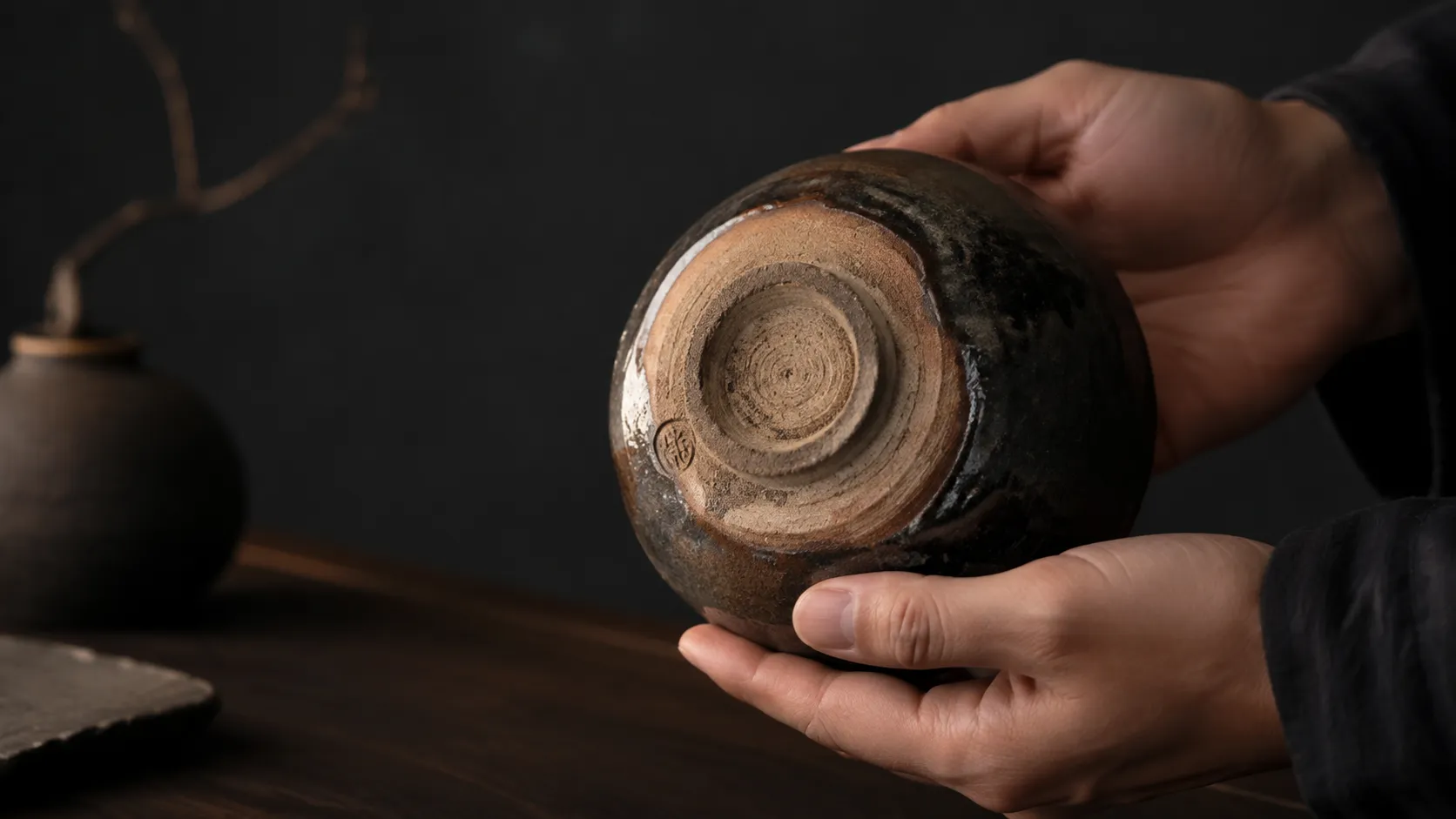
When you pick up a bowl or plate, the first things you notice are usually its colour and form, the painted decoration, and the character of its glaze (yūyaku). But if you want to look a little more closely at a studio piece or an older ceramic, try turning it over gently, just once.
The foot, or kōdai, is the supporting part formed at the base of a vessel. Beyond the foot itself, looking at the footring’s contact surface (tatamitsuki), the trimming, the clay, the glaze, the traces left by firing (shōsei), and any mark or signature (mei) offers further clues to how the piece was made.
That said, the foot is not something that lets you easily determine a vessel’s place of origin, its maker, its date, or its authenticity (shingan). The point is not to “guess correctly,” but to begin by observing the forms and traces in front of you.
Table of Contents
What is the kōdai? Reading the information hidden in a vessel’s “foot”
The kōdai is the part formed at the base of a tea bowl, plate, or similar vessel that supports it. The part of the footring that actually touches the table or shelf is called the tatamitsuki.
In its “Introduction to Ceramics,” the Museum of Oriental Ceramics, Osaka describes the foot as “the supporting part formed at the base of a vessel,” and classifies feet by forming method as the applied foot (tsuke-kōdai) and the carved foot (kezuridashi-kōdai), and by shape as forms such as the bull’s-eye foot (janome-kōdai) and the ring foot (wa-kōdai). It can also take a square form to suit the shape of the vessel.
In other words, rather than remembering “kōdai = a round foot” alone, it is more accurate to understand it as the structure of the base that supports the vessel.
(Source: Guide to Appreciation | Museum of Oriental Ceramics, Osaka)
When you turn a vessel over, you find a different set of clues than you see on the upper surfaces: not only the foot, but the inside of the foot, the tatamitsuki, the areas left without glaze, the traces produced during firing, and any signature or potter’s stamp.
The foot is not merely “decoration on the underside,” either. It is a structure that steadies the vessel, and part of the modelling that shapes the whole piece’s height, balance, and stance.
Definitions: foot, footring contact surface, exposed clay, spur marks, and throwing rings
Let us first set out the main terms used in this article.
Kōdai (foot)
The supporting part formed at the base of a vessel. Some are made by carving the foot out, others by attaching a separately made piece of clay.
Tatamitsuki (footring contact surface)
The part of the foot that rests directly on a table or shelf.
Exposed clay / rotai
The part where the ceramic body (kiji) is left uncovered by glaze and shows through. Depending on the work or the source, terms such as rotai are used. In this article, we describe it as “exposed clay” so that it is clear to newcomers.
Me-ato (spur marks)
Traces left on the base or the inner base of a vessel by the tools, sand, or stones used to support it during firing. Their shape and size differ by region, period, and firing method.
Rokuro-me (throwing rings)
A term for the rotational traces seen on a vessel’s surface that accompany forming on the potter’s wheel (rokuro) and similar work. They need to be observed separately from trimming marks and from the wire marks (itokiri) left when a vessel is cut from the wheel.
The definitions of the foot, the tatamitsuki, and spur marks can also be checked in the “Introduction to Ceramics” of the Museum of Oriental Ceramics, Osaka. Spur marks in particular are worth noting, as they do not simply mean “traces left from stacking vessels to fire them.”
(Source: Guide to Appreciation | Museum of Oriental Ceramics, Osaka)
What can you learn by turning a vessel over?
The underside of a vessel can hold clues to the different stages of making — forming, trimming, glazing (seyū), and firing. The aim of looking underneath is not to judge good from bad, but to deepen your understanding of the making process.
On the upper surfaces, the form, the painted decoration, the colour of the glaze, and its texture are what first catch the eye. Turn the vessel over, though, and other information comes into view — the way it was trimmed, the body, the boundary of the glaze, the traces produced during firing — letting you think about the making from a different angle.
Even so, you cannot simply divide it into “the upright vessel is the finished part, the underside is a record of untouched stages.”
The foot, too, is trimmed and shaped; on some pieces glaze is applied close to the tatamitsuki, or the glaze inside the foot is deliberately removed. A signature may be added. The underside, too, reflects a series of deliberate making decisions.
For that reason, when you turn a vessel over to look, rather than thinking “every trace of the maker’s hand is preserved here,” it is more useful to ask, “which stage of making might this form or trace relate to?”
Editor’s Note: looking underneath is “observation,” not “appraisal”
The underside of a vessel is sometimes spoken of as “a secret place for telling the genuine from the false.” For me, though, the interest lies not in arriving at the “correct answer,” but in learning to observe.
Turn a finished vessel over, and what looked on the upper surfaces like a single piece of modelling begins to appear as “something made by forming clay, trimming it, applying glaze, and firing it in a kiln.”
Of course, you cannot determine the making process from a single trace alone. Even so, simply becoming aware that a making process existed beyond the finished piece changes the level of detail you begin to notice in a vessel.
Learning to look at craft is not only a matter of how many names and places of origin you know; it is also the ability to observe carefully what is in front of you and to ask, “why is it like this?”
What can the way a foot is trimmed tell you?
The rotational and trimming marks around the foot are clues for thinking about forming and finishing methods. Even so, you cannot determine “wheel throwing” or “hand-building” from the traces alone.
The foot is one area where traces of the making process can be especially easy to see.
With vessels formed on the wheel, the piece may be turned upside down once it has dried to a certain degree, and the base trimmed to shape the foot and the body. There are also methods, as with the applied foot, of attaching a separately made part.
What matters is not to judge that “more visible trimming marks mean more valuable handwork” or “the smoother it is, the higher the skill.”
How much is trimmed, and how much of the trace is left, differs according to the type of vessel, the material, the technique, the use, and the maker’s approach to form.
Common kōdai forms: ring, bull’s-eye, cut, split, and bamboo-node feet
The foot comes in a variety of shapes.
The Museum of Oriental Ceramics, Osaka gives representative forms such as the ring foot (wa-kōdai) and the bull’s-eye foot (janome-kōdai). In Hagi ware, distinctive forms such as the cut foot (kiri-kōdai) and the split foot (wari-kōdai) are also well known.
- Wa-kōdai (ring foot): a foot made in a ring shape
- Janome-kōdai (bull’s-eye foot): a form that appears as a bull’s-eye, made by trimming the base into a ring and so on
- Kiri-kōdai / wari-kōdai (cut foot / split foot): a form in which part of the foot is cut, or trimming is added
There are also names used as tea-ceramic appreciation terms, such as the bamboo-node foot (take-no-fushi-kōdai), but foot names divide finely according to the type of vessel and the context. For beginners, it is better to focus first on observing the shape of the actual object than on covering every name.
The cut foot is well known as a feature of Hagi ware, but Hagiyaki Kaikan (Hagi Ware Hall) explains that this method is not unique to Hagi ware, and that not all Hagi ware has a cut in the foot.
(Source: About Hagi Ware | Hagiyaki Kaikan)
As for the famous story that the cut foot originated in “deliberately flawing the vessels of the official kiln so that ordinary people could use them,” Hagiyaki Kaikan also presents evidence that complicates this story, along with several competing theories, and does not treat it as a settled origin.
(Source: What is the cut in the foot for? | Hagiyaki Kaikan)
Seeing a feature and identifying a place of origin from that one feature are two different things. This is a point well worth remembering when looking at the foot.
Can you tell wheel-thrown from hand-built pottery?
The rotational traces left on a vessel’s surface are one clue for thinking about wheel throwing.
Hand-built vessels, on the other hand, may show irregular unevenness left by fingers or tools.
Even so, you cannot settle the forming method from this alone.
The surface may be trimmed after forming on the wheel to remove the rotational traces, and several forming methods may be combined. What look like swirling lines on the base may also be not “throwing rings” but “wire marks” (itokiri) produced when the vessel was cut from the wheel with a wire.
Rather than judging by a simple either/or — “there are lines, so it is wheel-thrown; there are none, so it is hand-built” — observe several places together, such as the form, the sides, and the base.


What do the footring contact surface, exposed clay, and spur marks tell you?
The tatamitsuki, the areas of exposed clay, and the spur marks each carry information relating to contact, material, and firing. But “what you can see” and “what you can determine from it” need to be kept separate.
Rather than fixing your gaze on the foot alone, observing its surroundings as a single group deepens your understanding of the vessel further.
A comparison: what to observe, and what it can suggest
| Where to look | What to observe | Clues to consider | What not to assume |
|---|---|---|---|
| Foot | Shape, height, width | Modelling, forming method | Do not determine origin or date from shape alone |
| Footring contact surface | Width, texture, wear | Contact, finishing, and wear from use | Do not judge skill by roughness alone |
| Trimming | Direction, depth, how facets are taken | The finishing stage after forming | More trimming marks does not necessarily mean crude |
| Exposed clay | Colour, texture | The clay body and aspects of firing | Do not determine the clay’s origin or type from colour alone |
| Glaze | How far it is applied, the boundary | Clues for considering glazing and firing methods | Do not determine making method from the glaze margin alone |
| Spur marks | Position, shape, size | The support method during firing and kiln packing | Spur marks do not always mean stack-firing |
| Signature / potter’s stamp | Characters, incising, stamp | Clues for researching the maker, kiln, or workshop | Do not determine maker or authenticity from the signature alone |
A common misunderstanding: “exposed clay” does not mean “unfinished”
Some vessels have no glaze around the foot, and the clay shows.
Looking at such parts, some people may think, “did they forget to apply glaze?” or “is it unfinished?” But in ceramics, the very existence of body areas not covered by glaze is not unusual.
At the same time, you cannot assume in every case that the maker deliberately left the clay exposed as a design choice.
The reasons why glaze is not applied differ from work to work: the firing method, the way the vessel is supported, the glazing method, the type of vessel, the design.
In specialist sources, such an area of exposed body is sometimes described as rotai.
Where the clay shows, the colour and texture of the body are easier to observe than on the upper surfaces, but you cannot identify the place of origin or the raw material from the clay’s colour alone.
The same is true of spur marks.
The Museum of Oriental Ceramics, Osaka describes spur marks as “traces left on the base or inner base of a vessel by the tools, sand, or stones used to support it during firing.” Because the material and shape of the supports differ by region and period, the shape and size of spur marks vary as well.
(Source: Guide to Appreciation | Museum of Oriental Ceramics, Osaka)
So spur marks are not mere “flaws,” but neither is it right to explain them all as “traces left from stacking vessels to fire them.”
Rather than treating every trace as a flaw to be judged, thinking “why is this mark here?” is the first step in reading a vessel.
What is the difference between vessels with a signature or stamp and those without?
A signature or potter’s stamp is an important clue for researching the maker, kiln, or workshop, but you cannot judge a work’s value by the presence or absence of a signature alone.
Inside the foot or on the base, characters or a stamp may be left.
Some relate to the maker’s name, others to the kiln or workshop. There are also vessels with no signature.
What matters is not to take the view that “having a signature means expensive” or “unsigned means low value.”
Types of signature: stamped, written, and kiln marks
There are various ways of expressing a signature.
- In-mei (stamped mark): a mark made with a stamp and so on
- Sho-mei (written mark): a mark written by hand
- Kama-mei (kiln mark): a mark indicating a kiln or workshop
Characters may also be incised into the body, or written in glaze or pigment.
The reasons a vessel is unsigned, on the other hand, vary by period, kiln, distribution context, and the maker’s own practice. Guessing at the making intent without direct information from the maker or workshop — such as “they left it unsigned because they wanted the work itself to be seen” — is best avoided.
When you want to confirm the maker, rather than looking at the signature alone, it helps to check the following together:
- The overall form and decoration of the vessel
- The foot, the base, and the signature
- Accompanying materials such as the signed storage box (tomobako) or an explanatory slip (shiori)
- Records from the time of purchase
- The official website of the maker or workshop
- Information from authorised dealers or galleries
- Specialist materials from museums and the like
A signature is not “the answer”; it is one starting point for researching a work’s background.
For reference: seven things to check on the underside of a vessel
Here we gather the content so far, in the order you might observe when actually holding a vessel.
Seven points to look at when you turn a vessel over
- 1. Look at the shape, height, and width of the foot
- 2. Look at the width and texture of the footring contact surface
- 3. Look at the direction and depth of the trimming
- 4. Look at the colour and texture of the exposed clay
- 5. Look at how far the glaze is applied
- 6. Look at firing traces such as spur marks
- 7. Look at the signature or potter’s stamp
And finally, we suggest turning the vessel back over and looking at the vessel as a whole once more.
If looking at the foot becomes an end in itself, you drift away from the vessel as a whole.
Going back and forth between the upper surfaces and the underside makes it easier to see how the foot connects with the modelling and texture of the whole piece.
A checklist for observation, and frequently asked questions
When looking at the foot, you do not need to memorise every technical term. Simply checking in the order of “shape,” “contact surface,” “trimming,” “clay,” “glaze,” “firing traces,” and “signature” already widens how you see a vessel.
The checklist does not have to be followed strictly in order. You may start from wherever draws your attention.
What matters is not to rush to an answer from a single feature.
FAQ
- Q. What is the kōdai?
- A. It is the supporting part formed at the base of a tea bowl, plate, or similar vessel. The part of the footring that actually touches the table or shelf is called the tatamitsuki.
- Q. Why is there no glaze on the foot?
- A. There is no single reason why a foot may be left unglazed — it depends on the glazing method, the firing method, the way the vessel is supported, and the design. It cannot be said across the board that the foot is always left without glaze, or that the exposed clay is always a deliberate design choice.
- Q. Are spur marks a defect in a vessel?
- A. Spur marks are traces left by the tools, sand, or stones used to support a vessel during firing. They are not something to judge immediately as a defect. Their shape also differs by region, period, and technique.
- Q. Is a vessel with no signature on the foot of lower value?
- A. No. You cannot judge a work’s value by the presence or absence of a signature alone. To research the maker or provenance, check the whole vessel, accompanying materials, purchase records, and official information from the maker or workshop together.
- Q. Can you identify the maker or kiln just by looking at the foot?
- A. The shape of the foot or a signature may be a clue, but you cannot determine the maker or kiln from that alone. You need to cross-check several sources.
- Q. Does a cut foot mean Hagi ware?
- A. No. Hagiyaki Kaikan explains that the cut foot is not a method seen only in Hagi ware, and that not all Hagi ware has a cut in the foot.
- Q. Can a vessel with a chip or crack in the foot still be used?
- A. It depends on the size, position, and progression of the chip or crack, and on the vessel’s use. Especially where a crack continues up into the body, or with vessels that hold hot food and drink, we suggest checking with the shop where you purchased it, the maker, or a repair specialist.
- Q. Can you tell wheel-thrown from hand-built just by looking at the base?
- A. Rotational traces or finger marks may be clues, but you cannot determine it from the base alone. The traces may be trimmed away in finishing, or several forming methods may be combined.
In closing
The kōdai is the supporting part formed at the base of a vessel.
But turn a vessel over to look, and you find not only the foot itself but a range of clues for thinking about the making — the tatamitsuki, the trimming, the exposed clay, the boundary of the glaze, the spur marks, the signature.
At the same time, the foot is not an “appraisal tool” for easily determining place of origin, maker, date, or value.
Avoid judgements based on a single feature alone — “a cut foot, so Hagi ware”; “no rotational traces, so hand-built”; “unsigned, so low value” — and look at the whole vessel together with primary information.
At Kogei Japonica, we see the aim of looking at the foot not as “guessing the right answer,” but as returning your gaze from the finished vessel to the materials and making process behind it.
The next time you have a chance to pick up a vessel, try turning it over, just once.
The foot, the tatamitsuki, the trimming, the clay, the glaze, the traces of firing, the signature. And finally, look at the upright vessel once more.
By repeating that back-and-forth, alongside a first impression of “beautiful” or “I like this,” your appreciation of the vessel, together with your awareness of how it was made, can gradually deepen.
