




When people hear the name “Émile Gallé,” many picture a glass flower vase with plants or insects rendered in a dreamlike way.
That understanding is not wrong. But to grasp Gallé’s work through glass alone is to lose sight of his ceramics and wooden furniture, and of the Gallé firm that linked several production sites and their artisans.
Émile Gallé was a craftsman and businessman who worked not only in glass but in ceramics and wooden furniture, expressing his view of nature and his Japonisme across materials.
From around age seventeen, in 1863, Gallé helped with his father’s business and began designing pottery. Ceramics came earlier than the glasswork that would later establish his international reputation, placing it close to the starting point of his work as a maker.
From July 11 to September 23, 2026, the Ibaraki Ceramic Art Museum is holding the special exhibition “Gallé’s Ceramics II: A World of Fantasy and Invention.” Taking this exhibition as its starting point, this article sets out the difference between Gallé’s ceramics and his glass, how Japonisme appears in his work, the production structure of the Gallé firm, and the background to the decline of his ceramics activity.
Table of Contents
Émile Gallé Was Also a Ceramicist — Where Did That Work Begin?

Émile Gallé (1846–1904) was involved in designing pottery before he earned his reputation as a glass artist, and he went on to work across ceramics, glass, and wooden furniture.
Gallé’s father, Charles, ran a business in fine ceramics and glassware based in Nancy. He did not, however, manufacture everything in-house from start to finish. According to the Suntory Museum of Art’s official account, Charles commissioned production from manufactories in various places and finished the results as his own products.
Gallé began helping with his father’s business in 1863, designing pottery, and in 1866–67 he studied glassmaking at Meisenthal. So rather than a simple sequence in which he finished with ceramics before moving fully to glass, it is more accurate to think that for a certain period he explored several materials in parallel.
(Source: In Special Cooperation with the Musée d’Orsay: Émile Gallé, 170th Anniversary — Exhibition Structure|Suntory Museum of Art)
It is also not accurate to assume that, for works bearing Gallé’s name, he personally handled everything from preparing the raw materials to forming, firing, decoration, and finishing. They need to be understood as including, alongside Gallé’s own concept and design, the work of artisans involved in the firm and of outside manufactories.
Gallé’s ceramics are not simply “unusual pottery made by a glass artist.” Through their form, surface, coloring, and imagery, they are an important body of work in which you can trace the view of nature and the formal thinking that also carry through to his later glass and furniture.
Overview of “Gallé’s Ceramics II: A World of Fantasy and Invention” at the Ibaraki Ceramic Art Museum

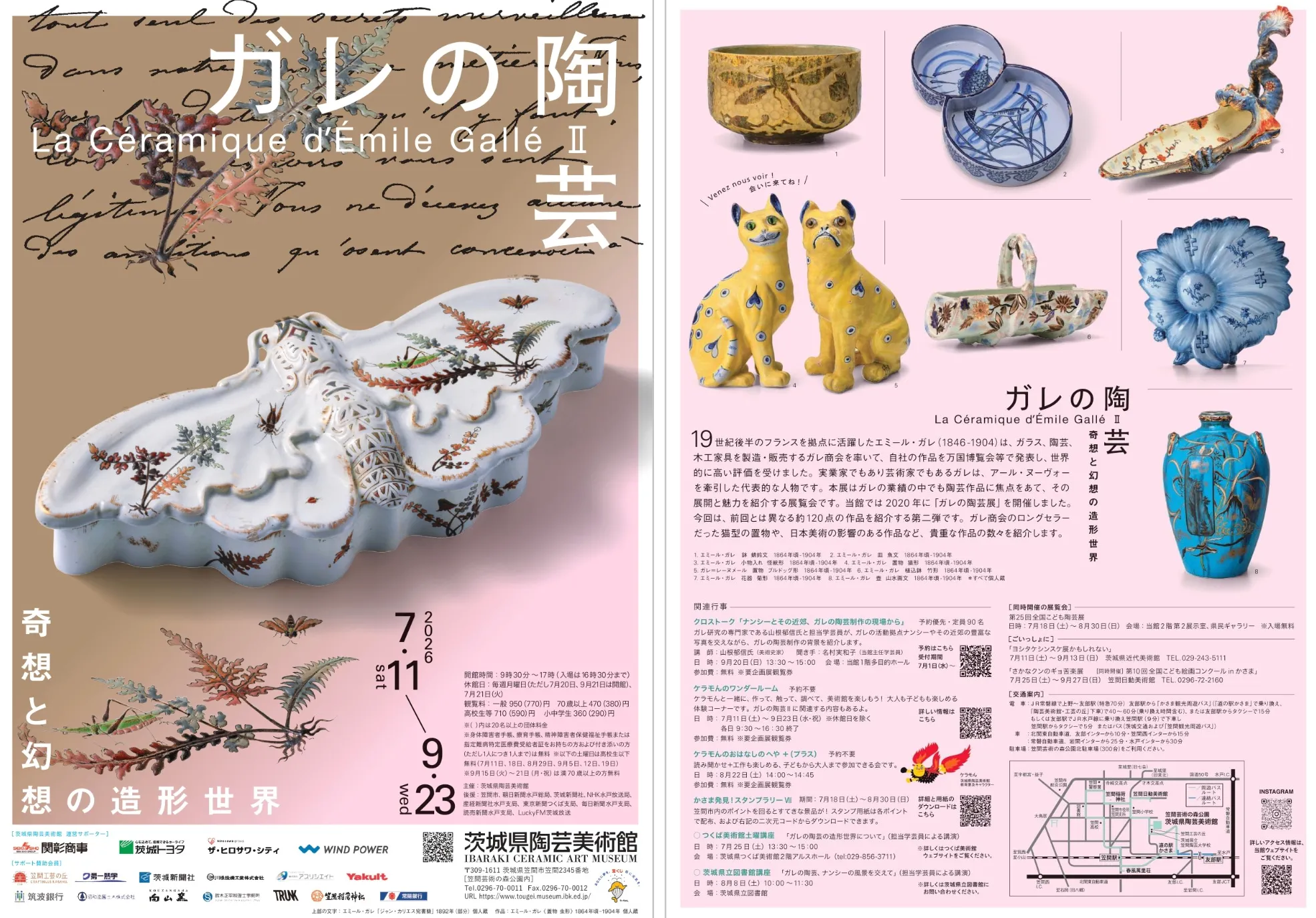
The 2026 “Gallé’s Ceramics II” is an exhibition presenting around 120 works, different from those in the first installment held in 2020.
The exhibition presents such works as the cat figurines that were a long-selling item for the Gallé firm, works quoting the Hokusai Manga, and pieces entered in the world’s fairs. The Ibaraki Ceramic Art Museum’s official web page states “around 120 works,” while the official press materials state “121 works,” so this article uses “around 120 works.”
| Item | Details |
|---|---|
| Exhibition | Gallé’s Ceramics II: A World of Fantasy and Invention |
| Dates | Saturday, July 11 – Wednesday (national holiday), September 23, 2026 |
| Venue | Ibaraki Ceramic Art Museum, Special Exhibition Room, Basement Level 1 |
| Hours | 9:30–17:00. Admission until 16:30 |
| Closed | Mondays. Open on July 20 and September 21; closed July 21 |
| General admission | ¥950. Groups of 20 or more ¥770 |
| Age 70 and over | ¥470. Groups ¥380 |
| High school students, etc. | ¥710. Groups ¥590 |
| Elementary and junior high students | ¥360. Groups ¥290 |
| Organizer | Ibaraki Ceramic Art Museum |
Admission is free for high school students and younger on July 11 and 18, and August 29 and September 5, 12, and 19. There is also a free-admission period for those aged 70 and over from September 15 to 21. Check the official information before your visit for the conditions attached to free admission and discounts.
On September 20, during the exhibition, a cross-talk titled “Nancy and Its Surroundings: From the Site of Gallé’s Ceramic Production” is planned, between a Gallé researcher and the curator in charge. For anyone who wants to know not only the works but Gallé’s base of activity and the background to his production, it is a related program worth watching for.
(Source: Special Exhibition “Gallé’s Ceramics II: A World of Fantasy and Invention”|Ibaraki Ceramic Art Museum)
Why Did the Image of “Gallé the Glass Artist” Become Fixed?

It is not that Gallé’s ceramics did not exist; rather, later exhibitions, holdings, circulation, and publications tended to present the glass works as representative, and this is thought to have strengthened the perception of “Gallé equals glass.”
Gallé entered ceramics, glass, and furniture in the world’s fairs and elsewhere, raising his international standing. Among these, the glass works, which drew on layers of light and color, made a strong visual impression, and later museum exhibitions and introductions to his work also treated them as central.
Still, it is not appropriate to explain this with a single reason — “because the glass won awards at the world’s fairs, the ceramics were forgotten.” The surviving state of the works, museums’ collecting policies, circulation in the market, the accumulation of research, and how easily something photographs and displays are all thought to relate to how the image of an artist forms.
As one example, in the Museum of Fine Arts, Houston’s public collection data, of 17 works under Émile Gallé’s name, 13 are registered as glass, 3 as ceramics, and 1 as a drawing or similar. This indicates the composition of the holdings at that museum; it is not a figure that proves the evaluation or surviving numbers worldwide. Even so, it serves as one example of Gallé’s glass being collected and presented more than his ceramics.
(Source: Works of Émile Gallé|The Museum of Fine Arts, Houston)
How World’s Fairs and Media Shaped Gallé’s Image
When introducing a craftsman, media and search services tend to condense the person into a short title. Labels such as “ceramicist,” “glass artist,” or “textile artist” serve as a way in to understanding, but they can also narrow the full picture of a maker who worked across several materials or with a division of labor.
The fact that many exhibitions centered on Gallé’s glass works have been held is also thought to influence the general image of the artist. By contrast, the Ibaraki Ceramic Art Museum held an exhibition presenting around 90 ceramic works in 2020, and in 2026 planned a second installment with the works changed over.
These two exhibitions show that Gallé’s ceramics are not a one-off curiosity but have a breadth that can make up more than one special exhibition.
(Source: Gallé’s Ceramics: Fin-de-Siècle Brilliance — Insects, Plants, Japonisme|Ibaraki Ceramic Art Museum)
Gallé’s Ceramics and Glass — What Is the Difference?
In ceramics, opaque mass, vessel form, and the surface produced by glaze and coloring matter; in glass, transmitted light, reflected light, and layers of color become major elements of expression.
The difference between Gallé’s ceramics and glass is not simply whether the material is clay or glass. Even when he handles the same plants, insects, or waterside creatures, the way form and decoration are assembled changes with the material.
| Point of comparison | Ceramic works | Glass works |
|---|---|---|
| Main materials and techniques | Ceramic works including glazed pottery and faience. The individual body clay, glaze, and coloring technique differ by work | Combines cased glass, acid-etching and the like, developing expression that draws on layers of light and color |
| Working of light | Reflection and shadow from the sheen of glaze, gilding, and surface relief | Appearance changes with transmitted light, reflected light, and interior layers of color |
| Form | Vessels, planters, lidded pieces, figurines in the shape of animals and insects, etc. | Flower vases, vessels, lighting, etc. |
| Expression of nature | The vessel’s contour and mass themselves can be brought close to plants and creatures | Water surfaces and a sense of air can be expressed through light, transparency, and overlapping color |
| Japonisme | Appears in imagery, composition, vessel form, surface decoration, and so on | Appears in natural themes, composition, empty space, color expression, and so on |
| What to look at when viewing | Mass, vessel form, glaze, coloring, and the modeling of the sides and back | Light source, viewing angle, layers of color, surface working, transmission and reflection |
| Opportunities to see them | Many of the main works in the 2026 exhibition are privately held, so a chance to compare them together is uncommon | Held in several museums in Japan and abroad, and often presented in exhibitions and collection information |
Faience is generally used as a term for glazed pottery, but the range of what the material label covers can differ by region and by holding institution. Rather than explaining all of Gallé’s ceramics with a single technique, it is important to check the material recorded on each work’s label.
The Musée d’Orsay explains that Gallé, up to the end of the 1880s, used aquatic motifs in decoration first in ceramics and then in glass. What matters is that he did not mechanically transfer the same design from ceramics to glass, but converted it into a form suited to each material.
(Source: Hand With Seaweed and Shells, Emile Gallé’s Artistic Testament|Musée d’Orsay)
How Does Japonisme Appear in Gallé’s Ceramics?

Gallé’s Japonisme appears not only in Japanese-derived imagery but in how he frames nature, in asymmetrical composition, and in the relationship between vessel form and decoration.
Japonisme is a phenomenon in the later nineteenth-century West in which the imagery, composition, forms, and expression of nature of Japanese art were taken up and reconstructed into painting, ceramics, glass, furniture, and more.
At the 1867 Paris world’s fair, Gallé helped with his father Charles’s entries and stayed in Paris for about half a year. Many Japanese works of art and craft were presented at that fair. In 1871 he stayed in London and is said to have visited the South Kensington Museum — now the Victoria and Albert Museum — where he closely studied the Asian and Oriental holdings.
(Source: In Special Cooperation with the Musée d’Orsay: Émile Gallé, 170th Anniversary — Exhibition Structure|Suntory Museum of Art)
That said, explaining Gallé’s Japonisme only as “imitating Japanese patterns” is not enough. There was a process of selecting the imagery he could obtain, re-placing it to suit the vessel’s curved surface and use, and combining it with French decorative culture and Gallé’s own observation of nature.
Analyzing Motifs in Specific Exhibited Works
The main works in the 2026 exhibition include “Bowl with Dragonfly Design,” “Plate with Fish Design,” “Jar with Landscape Design,” “Chrysanthemum-Form Flower Vessel,” “Bamboo-Form Planter,” and “Insect-Form Lidded Piece.”
The dragonfly, fish, chrysanthemum, bamboo, and insect are motifs that also appear repeatedly in Japanese art. But the mere fact that the same motif is used cannot establish all of it as a direct influence from Japanese art.
The title “Jar with Landscape Design,” for example, calls to mind a relationship with East Asian landscape expression, but the specific source referred to and any direct relationship with Japanese art need to be checked against the work’s description and the exhibition catalogue.
On the other hand, for works quoting the Hokusai Manga, their inclusion is announced in the Ibaraki Ceramic Art Museum’s official materials. At the venue, looking at which of Hokusai’s images were chosen and how they were reconstructed to suit the vessel’s curved surface and use brings Gallé’s editorial judgment — which is not mere imitation — into view.
Works are also on display whose direct relationship with Japanese art is not made explicit, such as the cat figurines that were a long-selling item for the Gallé firm. Rather than lumping everything together under Japonisme, it is important to read the imagery, form, and production background of each work separately.
(Source: Special Exhibition “Gallé’s Ceramics II: A World of Fantasy and Invention”|Ibaraki Ceramic Art Museum)
Glossary Box
Japonisme (Japonisme)
The influence that Japanese art and craft had on Western art and design in the later nineteenth century, and its reception and reconstruction. It does not mean merely Japanese-style decoration.
Faience (faience)
Used as a term for glazed pottery. Because usage varies by region and by holding institution, the material and technique of an individual work need to be checked against official work information.
École de Nancy (School of Nancy)
An art movement centered on Nancy, France, from the end of the nineteenth century into the early twentieth. In 1901 the Provincial Alliance of the Art Industries was formed, and Gallé served as its first president. It took nature as an important source of creation and worked across glass, furniture, ceramics, architecture, and more.
Why Is Gallé Said to Have Withdrawn From Ceramics? — A Workshop-Management View
Gallé’s ceramics activity is said to have declined in the 1890s, but this article has not confirmed a primary source that would establish the reason as a single management decision.
The development of the glass division, demand for the ceramic works, relations with commissioned manufactories, and the allocation of technicians and equipment may all have played a part. But it cannot be stated as fact that “he stopped ceramics in order to concentrate management resources on glass.”
Looking at the confirmable work information, the three faience plates held by the Museum of Fine Arts, Houston are given production dates of 1880–1892. That museum, meanwhile, holds several glass works from the 1890s onward. This is only one museum’s holdings, but it does give material for thinking about how, in Gallé’s production, glass came to weigh more heavily in his later years.
(Source: Works of Émile Gallé|The Museum of Fine Arts, Houston)
Kogei Japonica’s View
There is no need to force the background to Gallé’s stepping back from ceramics into a choice between “failure” and “strategic retreat.” Separating confirmable fact from management hypothesis, and looking at what a workshop handling several materials kept and what it scaled back, has value in itself.
The Business Logic of Concentrating on One Material
In craft businesses today, too, whether to maintain several materials or concentrate on a particular technique is an important management decision.
Concentrating on a single material has advantages: it is easier to deepen the technique, easier to consolidate capital investment, and easier to convey a brand image. On the other hand, work in other materials that an artist or workshop took on in the past can become hard to see, and later evaluation may become fixed on the representative material alone.
That the Ibaraki Ceramic Art Museum planned Gallé ceramics exhibitions twice, in 2020 and 2026, shows that his ceramics are a body of work worth reconsidering. But it cannot be concluded from those two showings alone that the reappraisal of the ceramics required a long time.
What matters for artists and workshops today is not that they must always work across several materials. It is to put into words whether their identity as makers lies in a particular material or technique, or in the design, view of nature, and story that remain across materials.
Those who present exhibitions and craft brands also need to avoid reducing a maker to their best-known product. Kogei Japonica welcomes inquiries about coverage and information dissemination in Japanese and English, regarding museum and gallery exhibitions, craft and brand management, and collaboration with artists and workshops.
Where, When, and What Can You See at “Gallé’s Ceramics II”?

|Ibaraki Ceramic Art Museum
The exhibition runs from July 11 to September 23, 2026, at the Ibaraki Ceramic Art Museum in Kasama, Ibaraki Prefecture.
If you use public transport, the main starting points are Tomobe Station on the JR Jōban Line or Kasama Station on the JR Mito Line. The official guidance notes about 70 minutes by limited express from Ueno Station to Tomobe Station, then 40–60 minutes from Tomobe Station connecting via the Kasama sightseeing loop bus, or about 15 minutes by taxi.
From Kasama Station it is about 5 minutes by taxi, or you can use a route bus or the Kasama sightseeing loop bus. By car, it is about 10 minutes from the Tomobe interchange on the Kita-Kantō Expressway, or about 15 minutes from the Kasama-nishi interchange. For parking, you can use the 300 spaces at the north parking lot of Kasama Geijutsu-no-mori Park.
Bus times and connections may change, so check the official site for the latest information on the day of your visit.
(Source: Special Exhibition “Gallé’s Ceramics II” Access and Transport Guide|Ibaraki Ceramic Art Museum)
Five Things to Know Before Your Visit
- The exhibition runs from July 11 to September 23, 2026. Mondays are generally closed, but it is open on July 20 and September 21, and closed on July 21.
- Around 120 works are presented, different from the first installment in 2020. Even for those who saw the previous show, this is not simply a re-display.
- The highlights are the cat figurines, works quoting the Hokusai Manga, and world’s-fair entries. Try comparing the work titles, materials, who made them, and the sources of the imagery.
- A cross-talk on the background to the ceramic production is planned for September 20. Check the official guidance for how to take part and the capacity.
- The special-exhibition ticket admits you to all displays in the museum. Checking the dates of concurrent exhibitions too makes it easier to plan your visit.
At the venue, checking the following points, not only the rarity of the works, will sharpen your viewing.
- The material recorded on the work’s label
- The use — flower vase, bowl, lidded piece, figurine, and so on
- Glaze, coloring, gilding, and surface relief
- The modeling of the sides and back, not only the front
- The notation of artist, maker, firm, and holder
- Differences from works of the same type or similar works
- Specific explanations indicating a relationship with Japanese art
Summary and Frequently Asked Questions (FAQ)
Looking at Gallé’s ceramics shows that “Gallé equals glass artist” is not wrong — but that even a correct shorthand can leave important work unseen.
Gallé was involved in designing pottery from around age seventeen and worked across ceramics, glass, and furniture. His works come into being not through his handwork alone but through the firm, its artisans, and outside production sites.
With Japonisme, too, searching only for Japanese-derived imagery is not enough. You need to look at how nature is framed, at composition, at the relationship between vessel form and decoration, and at how the imagery he referred to was reconstructed.
FAQ
- Q1. Gallé is famous as a glass artist, but did he also work in ceramics?
- Yes. Gallé began helping with his father’s business in 1863 and started designing pottery around age seventeen. He then developed ceramics and glass in parallel for a certain period.
- Q2. How does “Gallé’s Ceramics II” differ from the 2020 exhibition?
- It is a second installment presenting around 120 works different from those in the first installment in 2020. Highlights include the cat figurines, works quoting the Hokusai Manga, and world’s-fair entries.
- Q3. Where in Japan can Gallé’s ceramics be seen?
- In 2026, around 120 works can be seen together at the Ibaraki Ceramic Art Museum’s special exhibition. Whether there is a permanent display differs by museum and by period, so check each museum’s official information before visiting.
- Q4. Which are more expensive, Gallé’s ceramics or his glass?
- It cannot be judged uniformly. Price varies by period of making, material, technique, condition, provenance, rarity, signature, and route of sale. To compare specific market rates, you need to examine auction results from the same period, separated into ceramics and glass.
- Q5. What influence of Japanese art is there in Gallé’s ceramics?
- The official materials present works quoting the Hokusai Manga. Beyond the imagery, look also at asymmetrical composition, how nature is framed, and the relationship between vessel form and decoration.
- Q6. Why did Gallé withdraw from ceramics?
- His ceramics activity is said to have declined in the 1890s, but this article has not confirmed a primary source that would pin down a single reason. The development of the glass division and the production structure may have played a part, but declaring it a concentration of management resources should be avoided.
- Q7. What are the admission fees and closed days for “Gallé’s Ceramics II”?
- General admission is ¥950. Mondays are generally closed, but it is open on July 20 and September 21, and closed on July 21. For the latest information, including free days and discount schemes, check the Ibaraki Ceramic Art Museum’s official page.


