



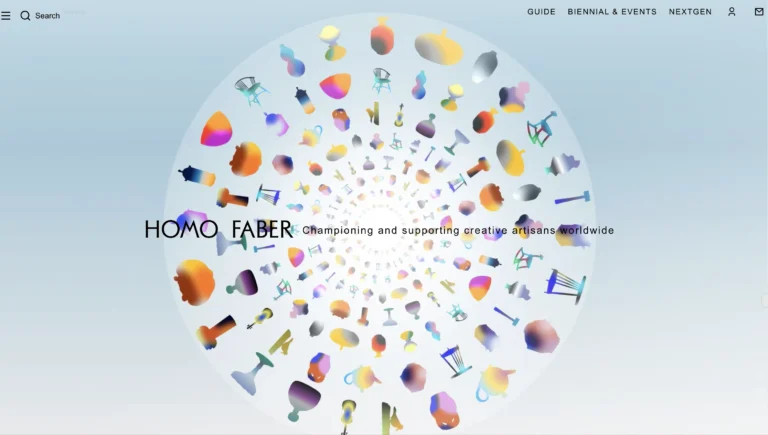
In September 2026, Venice hosts Homo Faber 2026, an international celebration of craft. This edition’s theme is “An Island of Light.”
Why would a biennial that gathers more than 700 works of craft from around the world place light at the centre of how it shows them?
To put it plainly: at Homo Faber 2026, light is not staging meant only to make the work look striking. It is designed as an instrument of perception—a way to make material texture, technique, the maker’s hand and the working environment easier to see.
According to the official announcement, light is handled through water, mirrors and movement, and fifteen immersive installations present a single story that runs from the maker to the workshop, the tools, the materials and the finished work. At the heart of the theme is not light alone but the relationship between light, materials and the human hand.
(Source: Homo Faber 2026: An Island of Light|Homo Faber)
This article first sets out the practical details, then reads the exhibition through one question: how does light show the world’s craft? From there it connects to the relationship with light already present in Japanese craft—urushi lacquer, kiriko cut glass, raden (mother-of-pearl inlay) and kinko metalwork among them.
Table of Contents
What Is Homo Faber 2026? The Basics of “An Island of Light”

Homo Faber 2026 is the fourth Homo Faber Biennial, exploring the relationship between light, materials and the human hand across fifteen immersive installations.
Dates, Venue and Artistic Director
Homo Faber 2026 runs from 1 to 30 September 2026 at Fondazione Giorgio Cini, on the island of San Giorgio Maggiore in Venice, Italy.
The Artistic Director is Es Devlin, the British artist and designer. The official site states that the biennial is curated by the Michelangelo Foundation, in partnership with Fondazione Cologni dei Mestieri d’Arte and Fondazione Giorgio Cini.
(Source: Homo Faber 2026: An Island of Light|Homo Faber)
As of August 2026, official information states that more than 500 makers take part, with over 700 works drawn from more than 70 countries and regions.
Es Devlin has worked across stage and space—theatre, opera, museums, large-scale installations and Olympic settings. According to the official announcement, “Library of Light,” which she presented at the Pinacoteca di Brera in Milan in spring 2025, drew around 200,000 visitors.
(Source: Homo Faber 2026: An Island of Light|Homo Faber)
What is worth attention here, though, is not simply that a well-known spatial designer is staging craft.
Rather than how to arrange more than 700 works, the show is rebuilt around a different question: what needs to be visible for the handwork to register? That is the important feature of Homo Faber 2026.
What Does “An Island of Light” Mean?
Taken literally, the title describes exactly that: an island of light.
The official description explains that Es Devlin drew on the archipelago of the Venetian lagoon, treating each craft artist around the world as an “island” with its own talent and skill. The story is one of those islands connecting within a wider sea of craftsmanship.
(Source: Homo Faber 2026: An Island of Light|Homo Faber)
Light, then, functions less as the main subject than as a shared language that links maker, material, tool and work.
Editor’s Note
At craft exhibitions, it is easy to think of lighting as equipment for making work look attractive. Homo Faber 2026 points to something one step deeper. Change the light, and the same material shows different thickness, surface, tool marks and reflection. In other words, it is trying to move from a display that arranges objects to a display that designs how those objects are seen. That is where reading this exhibition becomes especially interesting.
Why Show the World’s Craft Through Light?
Change the light and the same object yields different information. In craft, light is not a backdrop; it can be a tool of perception for reading differences in material and workmanship.
Light Changes the Conditions Under Which We See
Metal polished to a mirror finish returns light differently from metal left with fine tsuchime, the marks of the hammer. In clear glass, light enters the interior and refracts rather than stopping at the surface; in thin paper, fibre and thickness govern how it lets light through.
Seen only once, head-on, an object does not reveal everything its material holds.
The official Homo Faber announcement is explicit about handling light through water, mirrors and movement. What these share is that they do not fix a single appearance: it shifts as the viewer moves and as time passes.
(Source: Homo Faber 2026: An Island of Light|Homo Faber)
It reframes craft not as a single still image but as something that changes with viewing position and light. That way of thinking aligns closely with how craft is actually seen.
Showing Not Just Material but the Human Hand
What is interesting is that Homo Faber 2026 does not treat finished work as the only thing on display.
“A Language of Hands” opens in a space that evokes the working environment of a workshop, leading visitors into the world of making through image and sound. “An Index of Artisans” shows portraits of the makers behind the works on display.
Beyond that, “An Alphabet of Objects” projects the outlines of more than 100 works into the space using a moving cylindrical structure and light.
(Source: Homo Faber 2026 Creative Vision Press Release|Fondazione Giorgio Cini)
Read as a sequence, this shows an intent to present craft as more than finished, “beautiful” objects—to include the whole relationship: a maker, a workplace, tools and materials, and only then the work.
The value of craft does not sit in the appearance of the finished piece alone. Why this material was chosen, how far it was pared back, how much it was polished, where the maker chose to stop: behind the final form lie countless decisions.
Do Immersive Displays Work for Craft?
At the same time, it would be too simple to say that immersive automatically means craft comes across well.
Mirrored surfaces, water, vast structures, sound and light are themselves very strong visual experiences. If visitors remember only the setting and cannot recall the works and techniques they saw there, questions remain for a craft exhibition.
As far as the official materials indicate, Homo Faber 2026 in fact turns its light toward makers, workshops, tools, materials and live demonstration.
The Kogei Japonica View
Exhibition design does not “add” new value to a piece of craft. It is editing that helps the viewer discover what is already there: the material, the technique, the form, the maker’s decisions. A good exhibition is not one that stands out more than the work, but one that makes the previously unseen labour visible.
How Do the Fifteen Displays Use Light Differently?
At Homo Faber 2026, shadow, water surfaces, mirrors, translucency, white light, colour and movement are each used in different ways. A “light exhibition” does not mean a single method.
Shadow and Movement—An Alphabet of Objects
“An Alphabet of Objects” projects the silhouettes of more than 100 works onto the wall using a moving cylindrical structure and light.
By stripping back, for a moment, the information of colour and fine surface decoration, it brings the outline forward. The mouth of a vessel, the swell of its body, the slenderness of a foot, the profile of a carving—the form itself becomes easier to read.
(Source: Homo Faber 2026 Creative Vision Press Release|Fondazione Giorgio Cini)
When looking at craft, asking “what shape would this be if it were only a black shadow?” makes the form beneath the decoration easier to see.
Water and Reflection—A Full Moon Rising / A Great Turning
“A Full Moon Rising” is an installation staged in the former Piscina Gandini. The point to note is that Piscina Gandini is not itself the name of a display; “A Full Moon Rising” is what is installed in the former swimming-pool space.
Its subject is vessels that have held and carried water; Korean moon jars, and works inspired by them, are placed in a space that combines water and light. As light reflects off the water’s surface, not only the vessels but the relationship between vessel and water becomes part of the display.
In “A Great Turning,” an architectural colonnade is mirrored on the water, and a large kinetic mirror at the centre shifts how the space looks in relation to the changing light of the day.
(Source: Homo Faber 2026 Creative Vision Press Release|Fondazione Giorgio Cini)
Here reflection is not decoration for simply doubling the image of a work. It unsettles the boundary between work and architecture, work and setting, drawing attention to how a piece of craft exists within a space.
Translucency—A Luminous Ark
In “A Luminous Ark,” paper sculptures by the Chinese maker Wen Qiuwen are lit like lanterns. Taking motifs such as the birds that live in Venice, the display works with the delicate translucency of paper itself.
(Source: Homo Faber 2026 Creative Vision Press Release|Fondazione Giorgio Cini)
Without touching it, you can sense the thinness and material quality of paper from how it looks when light passes through. It is a way of seeing that carries over to looking at washi and other papers.
White and Colour—A Feast of Light / A Rainbow of Forms
In “A Feast of Light,” white works made of different materials—porcelain, glass, fibre, paper—are arranged on a reflective surface. Because everything is white, the differences in texture and shadow under light stand out.
In “A Rainbow of Forms,” by contrast, colourful works in plastic, enamel, resin and glass are combined with reflective shelves, rotating supports and a mirrored ceiling.
(Source: Homo Faber 2026 Creative Vision Press Release|Fondazione Giorgio Cini)
The same light plays a different role when you are looking at white material than when you are looking at material with colour. Light is not there to brighten a work evenly; it is used in different ways to bring out the differences between materials.
Material and the Act of Making—An Atelier Alive
“An Atelier Alive” is a space where makers in ceramics, glass, metal and textiles show the act of making to visitors. It does not separate finished object from process; it makes the movement of hand and tool part of the display itself.
(Source: Homo Faber 2026 Creative Vision Press Release|Fondazione Giorgio Cini)
The official programme also includes guidance from 90 Young Ambassadors and live demonstrations.
| Lighting / display method | Example at Homo Faber 2026 | What it mainly makes easier to see | Possible parallels in Japanese craft |
|---|---|---|---|
| Shadow / silhouette | An Alphabet of Objects | Outline, form, modelling | Vessel forms, woodwork, metalwork |
| Reflection on water | A Full Moon Rising | The relationship between work and setting | Ceramics, lacquerware |
| Mirror / movement | A Great Turning | How appearance changes over time | Spatial display in general |
| Translucency | A Luminous Ark | Thinness, translucency, material quality | Washi paper, glass |
| White surfaces and reflection | A Feast of Light | Differences in surface and texture | Lacquer, porcelain, metalwork |
| Colour and mirrors | A Rainbow of Forms | Colour, reflection, material quality | Kiriko cut glass, glass |
| Live making | An Atelier Alive | Hand, tools, process | Open studios, live demonstrations |
Japanese Craft, Too, Looks Different Under Light
In Japanese craft too—urushi lacquer, kiriko cut glass, raden mother-of-pearl inlay, kinko metalwork—there are pieces whose materials and workmanship can look markedly different depending on how the light falls and the angle from which you view them.
That said, one cannot flatly claim that Japanese craft developed with optical effects in mind. Rather than guessing at historical intent, here we consider, from the standpoint of viewing today, what light lets us see.
Urushi—Look at the Surface, Not Just the Shine
Lacquer art, shitsugei, is often described in terms of beautiful gloss, but simple sheen is not the only thing to look at.
How smooth the lacquer surface is, what shape the light source takes as it reflects, how the return of light differs between decorated areas such as maki-e and the plain ground: reading how the surface was worked through the way it reflects light sharpens your perception of the piece.
At the same time, one should not think that stronger light makes lacquer more appealing. Real exhibitions require conservation lighting that takes account of a work’s material, condition, sensitivity to light and length of display. The effect on viewing and the protection of the work must always be held together.


Kiriko—Light Reads into the Glass Itself
In kiriko, cut glass, the reflection and refraction of light change with each cut facet.
The important thing is not to see kiriko merely as patterned glass. A cut is decoration, and at the same time it shapes how light travels through the glass and how the piece is seen.
Shift your viewpoint a little in front of a piece and the depth of the cuts, and the overlap of coloured and clear glass that you could not read head-on, become visible.


Raden—Move, and the Colour Moves With You
Raden is a decorative technique in which shells such as green turban and abalone are worked thin and set into a lacquer ground or similar surface.
Its defining quality is that the colour and shine of the shell change with viewing position and light source. For that reason, raden is also a craft that a single still photograph struggles to convey.
When looking, don’t only stand still in front; move slightly to the left and right. Colours that were not there a moment before can appear.

Kinko—Polishing, Hammer Marks and Colouring Change the Light
In kinko metalwork, light too makes differences in surface treatment easier to see.
Areas polished close to a mirror finish, areas left with hammer marks, surfaces given chokin engraving, and coloured surfaces each return light differently.
Beyond whether something simply shines, looking at whether it reflects to a single point or scatters finely, and what shading its unevenness produces, makes it easier to understand how the maker worked the surface.

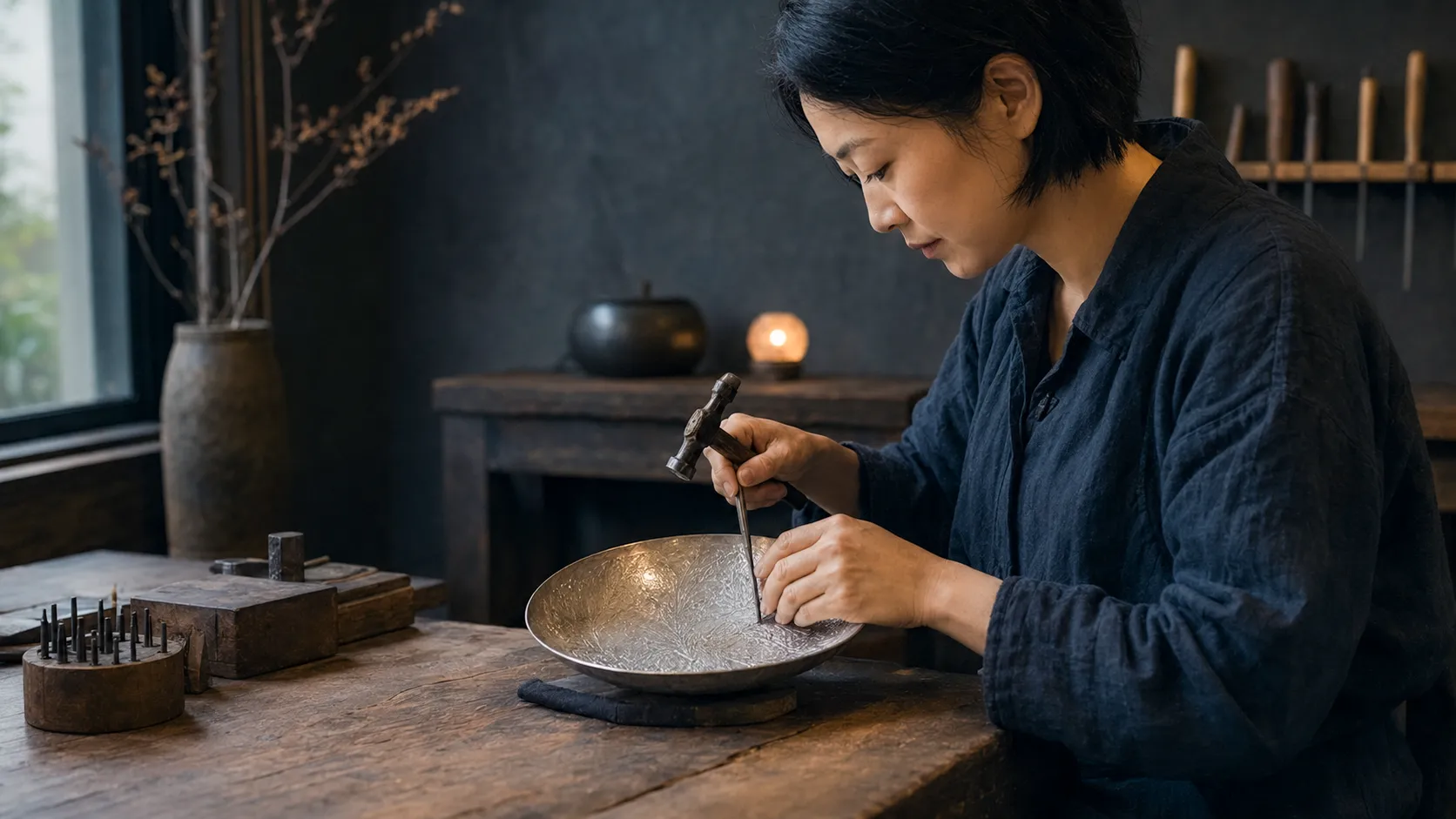
To set out the difference with Homo Faber 2026: the exhibition actively edits the relationship between light and material through exhibition design. Japanese craft, by contrast, has many techniques in which the material and surface treatment themselves change how a piece responds to light.
The direction is not the same. But they connect on one point: looking at light lets you understand material and handwork more deeply.
The official Homo Faber 2026 programme also includes specific events connected to Japanese craft. Alongside a kintsugi workshop—repairing ceramics with lacquer and gold—a hanko workshop is planned, in which participants carve into a wooden cube one of the kanji for “light,” “shadow” or ma (間), the sense of interval or space.
(Source: Discover Homo Faber 2026’s programme|Homo Faber)
The official e-catalogue, moreover, lists Junpei Kawaguchi (川口淳平), who works in rattan craft from Japan, as an exhibitor in “A Rooted Ascent.” Japanese participation is not at some “unconfirmed” stage: it is already confirmed in the official materials.
(Source: A Rooted Ascent Exhibitors|Homo Faber 2026 E-Catalogue)
Should a Good Craft Exhibition Show Only the Work?
The question Homo Faber 2026 raises is whether displaying only finished pieces is enough to convey the value of craft.
Not a Choice Between “Work-Centred” and “Experience-Centred”
Craft exhibitions tend to fall into an either/or: should the work be shown quietly, or should the display be made experiential?
But the real question is not which to choose.
It is to design what you want the viewer to discover, while respecting the work.
If you want people to see surface treatment, the direction of light matters. If you want to convey process, tools and demonstration help. If you want them to understand a material’s translucency, transmitted light can be effective.
Adding experience is not itself the aim. What matters is designing only the experience needed to understand the work.
What Is Lost When the Exhibition Design Is Too Strong?
Even with Homo Faber 2026, there are things to check once it has actually opened.
Vast mirrors, water, moving structures and light produce a strong visual experience. But if visitors remember that “the space was impressive” yet cannot recall what materials or works were in it, that leaves something to reconsider as a craft exhibition.
As far as current official information goes, sections such as “A Language of Hands,” “An Index of Artisans” and “An Atelier Alive” show a structure that tries to return makers and the act of making to the centre of the display.
Editor’s Note
In conveying craft, we may have leaned too heavily on the finished piece and shown too little of how it was made. Isolate the finished object from its process, and many of those decisions disappear from view—choosing a material, handling a tool, correcting a mistake, knowing when to stop. In judging what Homo Faber 2026 is worth, too, I would rather look not at whether the space is beautiful but at whether the display has made the maker’s decisions visible.
What Makers, Workshops and Brands Can Take From This
This view is not only about an international biennial. It applies to solo shows, department stores, hotels, ryokan inns, shops and showrooms.
When displaying craft, it is worth checking the following.
- Where the light source is, and which face of the work it lights
- Whether the work’s expression changes when seen from other than head-on
- Where it reflects and where it absorbs light
- Whether shadow makes the form easier to read
- For clear or translucent materials, how light enters the interior
- Whether colour and reflection change as the viewer moves
- Whether you can still describe the work’s qualities with the staging removed
- Whether you have considered not only the viewing effect but the conservation conditions of the material
The last two points matter especially. If the value of the work cannot be explained once the staging is removed, the display may not be helping the work but standing in for it.
Because tolerance to light and appropriate display conditions differ by material, it is better not to fix a single rule—this lighting for lacquer, that lighting for glass—but to judge piece by piece, including condition and length of display.
When introducing craft into hotels, shops, offices or trade shows, too, how the work comes across changes if you think of material, light, background, visitor flow and cultural context together, rather than simply placing the piece.
Kogei Japonica welcomes enquiries on introducing craft works, collaborating with makers and workshops, exhibition and spatial design, communicating to audiences abroad, and regional and production-area projects.


If You Visit Homo Faber 2026, Watch the Relationship Between Work and Light
If you go in person, how you read the exhibition changes a great deal when you focus not on how many pieces you saw, but on where you looked from, in what light, and how the material appeared to change.
Five Things to Check on Site
The first thing to check is where the light source is. From above, from the side, or within the work? Note whether it is natural or artificial light.
Next, shift your position slightly in front of the work. For pieces whose reflection, colour or transparency changes, looking only from the front is not enough.
Third is shadow. Sometimes the shadow cast on wall or floor makes the form easier to grasp than the work itself.
Fourth is the relationship between materials. Paper and light, glass and mirror, vessel and water—look at why each pairing was chosen.
And fifth is to ask, “how would this work look if this staging were not here?”
Why this light for this work? Simply holding that question makes it harder to reduce the exhibition design to a photogenic backdrop.
See Homo Faber in Città As Well
Homo Faber 2026 is not a project that begins and ends at Fondazione Giorgio Cini.
Official information describes Homo Faber in Città: an exhibition at Casa Sanlorenzo, visits to workshops across Venice, and related cultural events.
(Source: Homo Faber 2026: An Island of Light|Homo Faber)
Seeing a highly edited craft display at the main venue, then going to an actual workshop—that contrast matters, too.
In a workshop you begin to see what the exhibition hall does not show: different natural light, the arrangement of tools, how materials are stored, the height of the workbench. The working environment itself, which finished pieces alone do not reveal, is information for understanding craft.
Visitor Information
As of the official guidance on 18 August 2026, the details are as follows.
| Detail | Information |
|---|---|
| Event | Homo Faber 2026: An Island of Light |
| Dates | 1–30 September 2026 |
| Opening hours | 10:00–19:00 |
| Last entry | 17:00 |
| Venue | Fondazione Giorgio Cini, San Giorgio Maggiore, Venice |
| Standard ticket | €16 |
| Reduced ticket | €10 (eligibility conditions apply) |
| Artistic Director | Es Devlin |
| Suggested visit length | 2 hours or more |
| Admission | Paid, timed-entry ticketing |
For visitors who buy tickets online, a free shuttle is offered on the day of the booking, running from Pier B1 at San Marco–San Zaccaria to the island of San Giorgio Maggiore. Outbound departures run at 30-minute intervals from 9:30, and the return from the island runs every 30 minutes from 10:15 to 19:15.
Prices, times, transport and admission conditions may change, so always check the official information before visiting.
(Source: Homo Faber 2026 Practical Information|Homo Faber)
FAQ|Homo Faber 2026 and Light in Craft Exhibitions
A concise summary of the main questions about Homo Faber 2026’s key details and this edition’s theme of light.
- Q. What is Homo Faber 2026?
- It is an international craft biennial curated by the Michelangelo Foundation. 2026 marks the fourth edition, exploring the relationship between light, materials and the human hand across fifteen immersive installations.
- Q. When and where is Homo Faber 2026 held?
- From 1 to 30 September 2026 at Fondazione Giorgio Cini, on the island of San Giorgio Maggiore in Venice, Italy.
- Q. What is Es Devlin’s role?
- She is the Artistic Director of Homo Faber 2026. Using water, mirrors and movement, she has designed a story that runs across the fifteen exhibition spaces.
- Q. Why is light important at Homo Faber 2026?
- Because the official theme rests on the fundamental relationship between light, materials and the human hand. Light is used not merely to present the work attractively but as a medium for showing material, workshop, tools and the act of making.
- Q. What can you see in the fifteen installations?
- Displays that show craft in different ways are planned, among them “A Language of Hands,” which evokes a workshop; “An Alphabet of Objects,” which uses light to project the silhouettes of more than 100 works; “A Full Moon Rising,” which combines water and vessels; and “An Atelier Alive,” which shows makers at work.
- Q. Is there Japanese craft that is closely tied to light?
- Yes. The surface of urushi lacquer, the reflection and refraction of kiriko, the way raden changes with angle, and the polishing and hammer marks of kinko all reveal their material and working more clearly when the light is changed.
- Q. Are Japanese makers taking part in Homo Faber 2026?
- Yes. The official e-catalogue lists, for example, the Japanese basket-maker Junpei Kawaguchi as an exhibitor in “A Rooted Ascent.” Participant information may be updated, so check the latest official e-catalogue as well.
- Q. Are there programmes for experiencing Japanese craft?
- Yes. The official programme includes a kintsugi workshop and a hanko workshop in which participants carve into a wooden cube the kanji for “light,” “shadow” or “interval” (ma).
- Q. What is Homo Faber in Città?
- It is a programme that extends the experience beyond the main venue to exhibitions, workshops and cultural events across the city of Venice.
Take Homo Faber 2026 only as an exhibition where the world’s craft is beautifully staged by light, and you miss the important part.
More interesting is that changing the light brings into view the material, form, technique and the maker’s decisions you had been overlooking.
Look not only at the finished work but at the person, the hand, the tools, the material, the process, and the environment in which the work is placed.
This is not a theory of display that works only in Venice. It serves when you look at a single lacquer piece or a single kiriko glass. It applies when a maker builds a solo show, and when a hotel or brand brings craft into a space.
What it takes to convey the value of craft is not making it look grand through words or staging.
It is creating the conditions in which the work can properly be seen.
Homo Faber 2026, “An Island of Light,” looks set to be a fitting occasion to consider how craft exhibition is moving from arranging objects to designing how objects are seen.


