




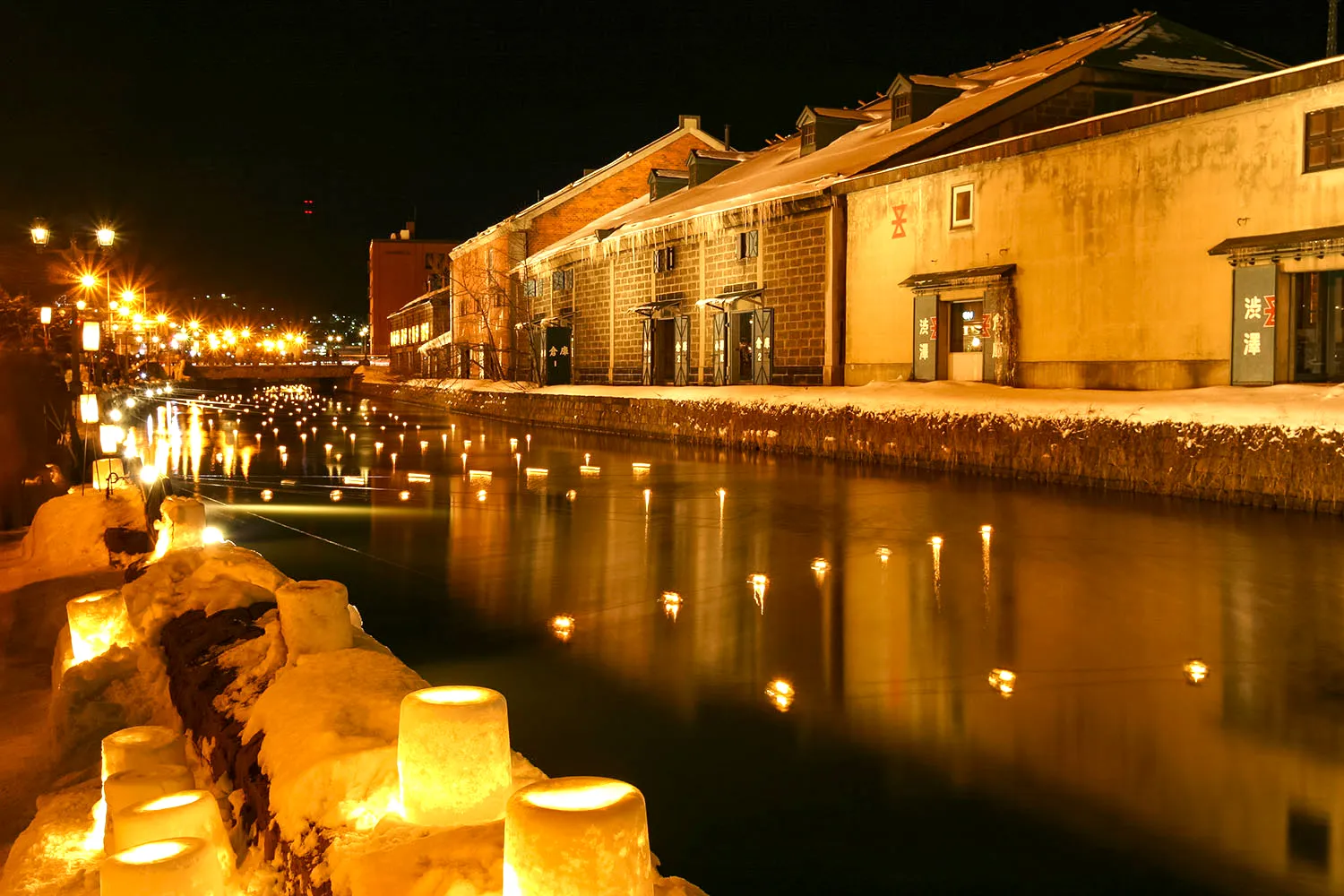
The Otaru Snow Light Path is a quintessential winter event in Otaru, Hokkaido, where visitors can experience ephemeral art created by snow and fire amid the winter landscape. Along the city’s canal, alleyways, and historic buildings, snow sculptures and candles are quietly lit, creating an urban space with a completely different character from daytime.
Here exists an “ephemeral sculptural culture” not of permanent works, but premised on melting and disappearing. This article explores the origins and characteristics of the Otaru Snow Light Path, explaining from the perspective of walking through and savoring the charm of these creations made from snow and light.
Table of Contents
What is the Otaru Snow Light Path? Winter’s Ephemeral Sculptural Culture Created with Snow and Fire

The Otaru Snow Light Path is a citizen-participation event representing Otaru’s winter in Hokkaido. Snow sculptures and streetscapes are illuminated by the soft glow of candles, enveloping the entire city in quiet light.
Unlike events centered on flashy productions or large-scale displays, this event’s appeal lies in its “handmade” and “ephemeral” nature. Using familiar yet fleeting materials like snow and fire, the scenery that emerges only during the short winter period has brought gentle wonder to many visitors. The fact that local residents, not just tourists, play leading roles in creating this event is another distinctive feature.
Event Origins: A Winter Tourism Revitalization Project Born from Citizens’ Voices
The Otaru Snow Light Path did not begin as a large-scale tourism event. To improve the situation where Otaru’s winter was the off-season with virtually no tourists, winter visitor attraction was identified as the top priority at the 1997 Otaru Tourism Promotion Council.
With the National Winter Sports Festival scheduled in Otaru in February 1999, voices from citizens and business operators emerged stating “creating a new event to promote winter tourism is urgent.” In response to these voices, lighting up the canal and town with candlelight was planned to renew the “lonely, dark” image. A key characteristic is that this was an event born from citizens’ voices, not imposed by government agencies.
The effort by citizens to restore warmth to the city by lighting candles gradually spread and eventually grew into an event involving the entire city. The essence of this event lies in how it reached its current form through the accumulation of citizens’ handiwork.
Why “Snow” and “Candles”? The Meaning Behind Material Selection
The main materials used in this event are snow and candles. Both are familiar presences that anyone can handle without special tools or techniques. Snow can be freely reshaped, and candles convey human presence and warmth through fire.
Unlike electric lights, candlelight comes with flickering, creating a quiet rhythm in the space. The small lights that stand out especially in the cold naturally direct viewers’ senses inward. The material selection itself shapes the event’s gentleness and accessibility.
Value Born Precisely Because They’re Not Permanent Crafts
All works created at the Otaru Snow Light Path disappear when the event ends. The snow melts, and the candle flames extinguish. However, this very transience constitutes the event’s value.
Unlike permanent craft objects, the scenery that can only be experienced by being present in that moment becomes deeply etched in memory. Even when held in the same location every year, the same scenery never appears twice.
This is why many people visit repeatedly, making their way to winter Otaru. The special experience born precisely because of the ephemeral nature of these creations is what makes the Otaru Snow Light Path a long-beloved event.
Otaru Snow Light Path Event Overview: Schedule and Access Information
The Otaru Snow Light Path is held annually from early to mid-February.
- Event Period: In 2026, scheduled for 8 days from Saturday, February 7 to Saturday, February 14
- Lighting Hours: Daily from 5:00 PM to 9:00 PM
- Admission: Free
- Location: Otaru Canal (Minatomachi, Otaru City, Hokkaido), Former JNR Temiya Line, Asarigawa Onsen, and approximately 30 locations throughout the city
- Official Website: http://yukiakarinomichi.org/
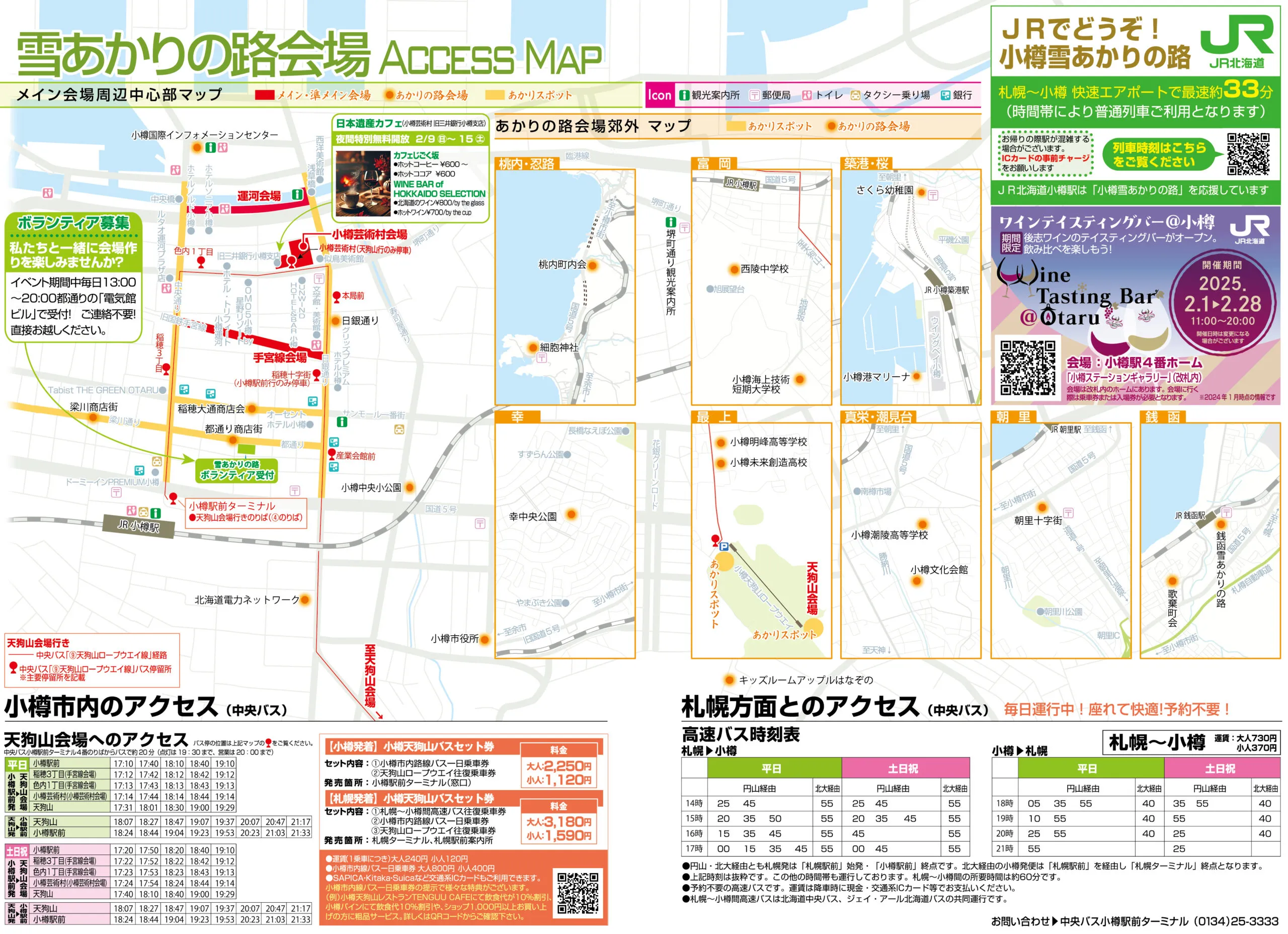
Venues are set up in order of candle quantity at the Canal venue (Asakusa Bridge to Chuo Bridge section), Former JNR Temiya Line venue, Otaru Art Village venue, as well as Tengu Mountain venue and neighborhood associations at approximately 30 locations throughout the city. Annual visitor numbers reach about 240,000, making this a representative winter tourism event in Hokkaido.

Access by Train
From Sapporo, you can use the express bus “Kosoku Otaru-go” or the JR Hakodate Main Line. JR Otaru Station is the nearest station, and it takes 5-8 minutes on foot from the station to the Canal venue. During the event period, some express buses extend their routes to the Canal Terminal, making access to the Canal and Temiya Line venues more convenient. There is a tourist information center around Otaru Station where you can obtain detailed event information and maps.
Parking and Car Access
The Otaru Snow Light Path does not provide official parking, so using public transportation is recommended. If you must visit by car, consider using private parking lots around Otaru Station. Parking fees vary by facility, and parking congestion is expected during the event period due to visitor concentration. We strongly recommend using public transportation whenever possible.
Viewing Snow Light as “Craft”
The Otaru Snow Light Path is known as a tourism event, but viewed from another angle, it can also be understood as “craft expression.” Within it exists thinking and processes common to craft: confronting materials, working with hands, and adjusting form and light.
Though it differs from typical craft objects in using snow as a natural material and completing works within a limited time, the essence of creating space through handiwork is shared. This chapter interprets snow light from a craft perspective, examining the sculptural process, light design, and the meaning of expression premised on “disappearance.”
Carving, Shaving, Lighting: Handwork Processes Common to Snow Sculpture
Snow light creation involves clear handwork processes: “carving,” “shaving,” and “lighting.” The work of piling up snow and shaping it by removing unnecessary parts closely resembles the process of carving wood or stone.
How far to shave the surface and how much thickness to leave affects the completed work’s strength and light transparency. Furthermore, the sculpture is completed for the first time by placing candles inside. The expression visible from outside changes greatly depending on lighting position and height.
This series of steps is not play left to chance, but an accumulation of judgments based on experience and intuition. While anyone can participate, each creator’s ingenuity and habits naturally emerge, and no two creations are identical. This accumulation of processes overlaps with the essence of handwork in craft, despite different materials.
Light and Shadow Design: Completeness as Three-Dimensional Objects
Snow lights are not evaluated solely by their daytime appearance. They reveal their true nature when night falls and candlelight enters.
The thickness of snow and depth of carving create areas that transmit light uniformly and areas that cast shadows, accentuating the three-dimensional expression. This is not coincidental but results from conscious “light and shadow design.” Thinly shaved areas glow softly, while areas retaining thickness create shadows as contours.
As a result, snow lights are established not merely as illumination but as three-dimensional sculptures containing light. Viewers experience the work including not only the form itself but also the shadows and flickering created by light. This high level of completeness is what makes snow lights viable as sculptural expression rather than temporary decoration.
Expression Premised on Disappearance and Its Connection to Japanese Craft Philosophy
Snow lights inevitably disappear when the event ends. This “expression premised on disappearance” may seem diametrically opposed to craft at first glance. However, examining Japanese craft philosophy reveals commonalities.
Japanese craft embodies a sensibility that honors “what is not eternal,” such as the once-in-a-lifetime spirit of tea ceremony and the acceptance of material aging as beauty. Snow lights likewise value beauty that exists only in the moment.
The value lies not in possessing finished products but in retaining experiences in memory. Precisely because they disappear, people stop, gaze at the light, and spend time quietly. This attitude overlaps with the aesthetic sensibility cultivated by Japanese craft, elevating snow lights from mere events to cultural expression.
Sculpture and Spatial Direction by Venue

The appeal of the Otaru Snow Light Path lies not only in the works themselves but in the spatial direction of “where and how they are placed.” Even the same snow lights appear and feel significantly different when venues change.
Location-specific characteristics unique to Otaru—waterside, former rail tracks, downtown areas—bring out the expressions of snow and light. This chapter focuses on three representative venues, introducing from a general visitor’s perspective how each venue’s spatial characteristics relate to snow light sculptures.
Otaru Canal Venue: Reflection and Depth Created by Waterside × Snow × Light

The Otaru Canal venue is beloved by many as the iconic scenery of the Snow Light Path. While snow objects and ice candles are installed along the promenade, “floating ball candles”—candles lit inside glass fishing floats used in herring fishing—float on the canal’s water surface, with their light reflecting on the water, creating greater depth than actually exists.
The whiteness of snow, the warm colors of candles, and water reflections overlap, forming a visually rich space. Especially at night, light seems to spread vertically, with expressions changing with each step.
Even with relatively simple sculptures, the canal as a stage device creates highly complete direction. While popular as a photogenic location, the quietness and flow of time that can only be understood by actually walking are also unique charms of this venue.
Former JNR Temiya Line Venue: Sculptural Rhythm Through Linear Structure and Repetitive Placement

The Former JNR Temiya Line venue features direction utilizing the site of Hokkaido’s first railway that opened in 1880. Taking advantage of the linear space where tracks once ran, snow lights are repetitively placed at regular intervals, creating rhythmic scenery.
By emphasizing the linear structure, visitors’ gazes are naturally guided into the distance, making the act of walking itself a viewing experience. Even if individual sculptures are modest, gathering in numbers leaves a strong overall impression.
Additionally, the historical background as a former rail line overlaps with the transience of snow lights, creating a sensation where past and present quietly intersect. This space, which ceased passenger operations in 1962 and was completely abandoned in 1985 before being developed into a 1.6km promenade, has become a place where modern citizen-participation events unfold atop industrial heritage that supported Japan’s modernization. While not flashy, it offers structural and calm beauty.
Downtown Venues: Small Handwork Intervening in Everyday Space


At downtown venues, snow lights are scattered in everyday spaces: residential eaves, storefronts, slopes, and alleyways. This venue’s characteristic is that sculptures appear not in special exhibition spaces but as extensions of ordinary life.
Small snow lights illuminate the ground, temporarily transforming casual paths into special places. While not featuring flashy direction, approaching closely reveals traces of handwork and ingenuity, allowing visitors to feel the creators’ presence intimately.
As residents and shops participate, the entire city becomes part of the event, and visitors naturally join the circle. Downtown venues can be said to be spaces where one most strongly feels that the Otaru Snow Light Path is a “citizens’ event.”
The Production Site: How Snow Lights Are Created

The fantastical scenery of the Otaru Snow Light Path is not born by chance. Behind it lies a production site where creators carefully craft each piece while confronting the unstable material of snow.
Though the appearance is gentle and quiet scenery, actual production is also a race against weather conditions and time. This chapter introduces the basic structure and tools of snow candles, the approach to material management reading temperature and snow quality, and the production system involving people from diverse backgrounds, explaining from a general visitor’s perspective how snow lights are created.
Basic Structure and Tools for Snow Candle Production
Snow candles, the central presence of snow lights, have a more rational structure than their appearance suggests. The basics involve packing snow into cylindrical or cubic shapes, hollowing out the interior to create a cavity, and placing candles—a simple mechanism.
However, this “hollowing method” and “wall thickness” greatly change light transparency and strength. Walls that are too thin collapse easily, while those too thick weaken the light. Tools used are not special—common items like shovels, shovel-shaped molds, spoons, and spatulas form the core.
Precisely because of this, creators’ experience shows in tool usage and force application. The interesting aspect of snow lights as craft lies in their design including not only completed forms but internal structures. Lighting position and height significantly change the expression visible from outside.
This entire flow is not play left to chance but an accumulation of judgments based on experience and intuition. While anyone can participate, each creator’s ingenuity and habits naturally emerge, and nothing is created identically twice. This accumulation of processes overlaps with the essence of handwork in craft, despite different materials.
The Concept of “Material Management” Reading Temperature, Snow Quality, and Wind
Essential to snow light production is the “material management” perspective of reading natural conditions like temperature, snow quality, and wind. When temperature is high, snow melts easily; when too low, it doesn’t compact properly. Additionally, freshly fallen snow is light and crumbly, while aged snow compacts more easily.
At production sites, creators assess that day’s snow condition and adjust compacting methods and size. Furthermore, in windy locations, candle flames extinguish easily, so opening direction and depth require ingenuity.
These are continuous judgments that don’t follow manuals, a sensibility shared with crafts and architecture handling natural materials. Snow lights can be said to be expressions established not by controlling but by reading and accepting natural conditions.
Production System Mixing Citizens, Students, and Experienced Craftspeople
A major characteristic of the Otaru Snow Light Path’s production system is that people with diverse backgrounds stand at the same site. Local citizens, students from the area and nearby regions, and experienced individuals with backgrounds in architecture, craft, or making participate from their respective positions.
Rather than clear hierarchies or role divisions, the site functions through experience sharing and mutual support. Beginners learn while creating, and experienced individuals support while overseeing—this circulation arises naturally.
This mixed production system is what brings diverse expressions to snow lights. Rather than aiming for a unified finished form, individual handwork gathers to create a single scenery. This approach has been the driving force that has long sustained the Otaru Snow Light Path as a citizen-participation event.
Comparison with Other Traditional Crafts and Sculptural Cultures
To understand the Otaru Snow Light Path as “sculptural culture,” comparing it with other traditional crafts and winter sculptural events clarifies its contours. While sharing commonalities with “display sculptures” like ice carvings, snow sculptures, and lanterns, it occupies a unique position through its choice of snow and candles as materials, citizen participation in handwork, and premise of disappearance.
Here we examine differences from related cultures, commonalities with craft tactility, and perspectives as an intermediate domain between installation and craft. Comparison is not to determine superiority but a tool to interpret what values snow lights prioritize. For general visitors too, gaining perspectives for viewing works at venues enriches the experience.
Differences from Ice Carving, Snow Sculpture, and Lantern Culture
Snow lights use winter natural materials like ice carvings and snow sculptures, but aim in different directions. Ice carving leverages transparency and hardness, easily making sharpness of contours and light refraction subjects, while snow sculptures have strong “display” power through volume and narrative.
Lantern culture centers fire, with forms designed as vessels containing light. Snow lights lie in between, completed for the first time when snow’s softness creates ambiguous contours combined with candle flickering. Rather than placing one large work, the core design scatters small lights to change the entire city’s atmosphere.
This “dispersion” and “participation” can be said to be decisive differences from other winter sculptural cultures. Also, while ice carvings and snow sculptures tend toward viewing completed forms, snow lights include the act of “protecting fire” after installation in maintaining the work.
When wind extinguishes fire, it’s relit; when snow collapses, it’s repaired. This repetition of maintenance makes the entire event a living landscape. Compared with lanterns too, snow is a material embracing both transparency and collapse, with thickness adjustment and opening direction affecting how light appears. As a result, snow lights are experienced not as sculptural objects but as “spatial direction” arising together with environment. The changing impressions at walking speed are also characteristic.
The Sense of “Shaving” and “Refining” Common to Woodwork, Stonework, and Lacquerwork
Snow light production may appear simple at first glance, but actually the sensibility of “shaving” and “refining” is important, with elements common to woodwork, stonework, and lacquerwork. For example, in woodwork, planes flatten surfaces; in stonework, chisels chase forms; in lacquerwork, polishing refines texture.
Snow lights similarly increase completeness by removing excess to even thickness and creating surfaces where light circulates. Leaving rough surfaces creates strong shadows for rustic expressions, while smoothing allows light to spread softly. Though the material is snow, reading surfaces and ridges with hand sensation and approaching intended expressions is craft-like.
Furthermore, tool application is important—forming shapes with shovels, then detailing with corners, spatulas, and spoons stabilizes wall thickness. Snow involves not only shaving but pressing to increase density, and allowing time after production for snow to compact prevents collapse.
Also, micro-adjustments matching environmental conditions are essential, like thickening windward sides or deepening openings to protect fire. Like lacquer undercoating, unseen design supports finishing. Participant repairs and lighting are also part of maintaining finish. The experience includes not just making but “nurturing” works through maintenance.
Positioning as an Intermediate Domain Between Installation Art and Craft

Snow lights also have aspects close to contemporary installation art. Works acquire meaning not by existing independently but by connecting with places like canals, former rail tracks, and streets, with experiences changing according to viewers’ movement and duration. On the other hand, the center of production being citizens’ handwork, with material understanding and technique required in form-making processes, is craft-like.
In other words, snow lights are positioned in an intermediate domain simultaneously containing art’s “spatial design” and craft’s “hand technique.” While craft objects perform finishing and management premised on long-term preservation, snow lights accept disappearance, with that brevity generating concentration.
Precisely because of this, placement planning and circulation become important, establishing nighttime scenery as a single environmental work. Furthermore, evaluation axes are also intermediate, with considerations like whether fire burns stably and pedestrian safety is ensured becoming part of the work.
As participants continue repairs and lighting, scenery is maintained, and visitors witness not finished products but a place continuing to arise. Because it cannot be owned, scenery remains in memory and becomes motivation to visit again. This circulation establishes snow lights as regional culture. It’s also appealing as an entry point gently crossing boundaries between craft and art.
The Value of Otaru Snow Light Path for Craft and Making Enthusiasts
The Otaru Snow Light Path is an event for viewing high-quality sculpture while simultaneously being a place to experience the very thinking of making. The attitude of testing, adjusting, and continuously working with snow—a difficult-to-handle material—is common to many crafts and handwork.
Below, we examine the unique values the Otaru Snow Light Path holds through three perspectives: process, materials, and experience. There is richness as experience here, different from the joy of owning finished products.
Being an Event That Savors Process Over Finished Products
A major characteristic of the Otaru Snow Light Path is that the production processes behind it can be sensed more than completed sculptures. Snow lights are not completed once and finished, but are established by continuously reworking according to temperature and wind changes and protecting fire.
This closely resembles craft processes of repeatedly shaving and polishing toward finishing. Walking through venues, slight repair traces and evidence of light adjustment catch the eye, naturally conveying creators’ accumulated judgments.
The “intermediate thinking” difficult to see in exhibitions showing only finished products is visualized—a great appeal for making enthusiasts. The attitude of finding value in process over results permeates this entire event.
A Place to Consider Possibilities of Expression Using Regional Materials
The Snow Light Path is also a practical site for expression using materials present in the region as-is. Snow is an unavoidable presence in Otaru’s winter, not specially prepared material.
The point of transforming that familiar material into valuable scenery through sculptural and lighting ingenuity is suggestive for considering regional craft and local making. Expression is established without expensive materials or advanced facilities by reading environment and working with hands.
That fact connects deeply with crafts handling regional materials like wood, earth, and stone. Snow lights quietly present to visitors the perspective of treating local conditions not as constraints but as possibilities.
“Craft as Experience” Different from Permanent Works
Craft objects often presume long use and preservation after completion, but snow lights inevitably disappear. However, this very transience heightens value as experience.
The time itself of walking on-site, stopping, and feeling light’s changes becomes the “work,” remaining as memory. This can be called a way of being different from owned craft—”experienced craft.” Both creators and viewers share the same time and environment, with value arising from witnessing that place.
For those wanting to grasp making including not only form but time and action, the Otaru Snow Light Path can be said to be a precious place that expands craft’s possibilities.
Conclusion
The Otaru Snow Light Path is a winter event created through citizens’ handwork using familiar yet fleeting materials of snow and candles. Rather than merely viewing completed works, the processes themselves of carving, shaving, lighting, and protecting appear in the scenery.
Spatial direction differing by venue and production ingenuity confronting natural conditions connect deeply with craft and making thinking. Precisely because they don’t remain permanently, the experience of witnessing that place strongly remains in memory, showing different expressions every year.
The Otaru Snow Light Path, enjoyable both as tourism and as making culture, is an event providing special time for quietly savoring winter Otaru.


