




Many people feel drawn to Japanese tea ceremony, yet unsure where to begin. The different schools, the etiquette, the equipment — the more you research, the harder the entry point seems to find.
And if we’re being honest, the real obstacle for most beginners isn’t a lack of information — it’s that so much of what’s out there misses the point entirely. “Tea ceremony is too formal.” “Sitting seiza is painful.” “I have no idea what it costs.” This guide addresses those concerns directly, with attention to how tea ceremony is actually practiced and experienced.
This is not a comprehensive manual of etiquette. It’s a map for understanding tea ceremony as a living culture — and a practical starting point for anyone ready to engage with it.
What you’ll find in this guide
- Why tea ceremony is fundamentally about cherishing a once-in-a-lifetime encounter — not memorizing a sequence of rules
- How the three main schools — Omotesenke, Urasenke, and Mushanokoji Senke — differ in aesthetic sensibility, atmosphere, and who they suit
- Why knowing nothing before your first experience is perfectly fine, and what basic preparation actually helps
- Practical answers to the concerns beginners rarely voice out loud: cost, seiza, English-language access
Table of Contents
What Is Japanese Tea Ceremony? | What Every Beginner Should Know First

At its center is the preparation and drinking of matcha — powdered green tea — through a prescribed sequence of gestures shared between host and guest. But chanoyu is not simply a way of serving tea. It is a complete cultural practice in which space, objects, movement, and seasonal awareness converge. It is also one of the few contexts in which the full range of Japanese craft — ceramics, lacquerwork, architecture, garden design — gathers in a single room.
The most important thing a beginner can hold onto is this: chanoyu is not meant to be an intimidating practice. At its core, it is a culture of considered hospitality. Mastering every prescribed gesture matters far less than showing up with genuine attention — that is closer to the spirit of the practice than technical perfection.
Chado, Sado, Chanoyu — What the Different Terms Mean
Tea ceremony is most commonly translated into English as “tea ceremony,” but the Japanese language offers several distinct terms, each with a different emphasis.
- Chado / Sado (茶道): Literally “the way of tea” — a term that foregrounds the practice as a path of personal cultivation
- Chanoyu (茶の湯): Literally “hot water for tea” — the older, more traditional term referring to the practice itself
- Otemae (お点前): The complete sequence of gestures involved in preparing and serving tea
These distinctions are preserved even in official English-language materials for international visitors. The Japan National Tourism Organization (JNTO) explains each term separately in its official guide.
(参照:Japanese Tea Ceremony | JNTO Official)
Ichigo Ichie and Wa-Kei-Sei-Jaku
Two phrases form the philosophical backbone of tea ceremony, and they are worth understanding before your first experience.
Ichigo ichie (一期一会) means, roughly, “this encounter will never happen again.” Every tea gathering is shaped by a specific season, a specific set of objects, a specific gathering of people — none of which will align in exactly the same way twice. Because of this, the host prepares with full care, and the guest engages with full presence. This idea underpins every gesture in the tea room.
Many first-time participants describe the experience in similar terms: a kind of quiet concentration they hadn’t felt in a long time. That quality of stillness is precisely what ichigo ichie, as a lived philosophy, makes possible.
Wa-Kei-Sei-Jaku (和敬清寂) — harmony, respect, purity, and tranquility — is the foundational principle attributed to Sen no Rikyu, the 16th-century tea master credited with bringing tea ceremony to its mature form. Urasenke describes it as the spiritual basis of the practice on its official English-language website.
(参照:Greetings from Iemoto | Urasenke Official)
These may sound abstract at first. But once you’re seated in a tea room, the reason each gesture exists tends to make itself clear.
How Tea Ceremony Differs from the Matcha Trend
Matcha lattes and matcha-flavored sweets have found a global audience in recent years, and it’s natural for that interest to lead toward tea ceremony. But the two are different in kind, not just in degree.
The matcha trend is centered on flavor and visual appeal — matcha as an ingredient. Tea ceremony is centered on the relationship between people, and the quality of the space they create together. Matcha is the medium; chanoyu is the practice built around it.
Holding that distinction in mind before your first experience will make the difference between watching a performance and actually being present in it.
The Three Schools of Japanese Tea Ceremony | Understanding the Differences
There is no need to evaluate which school is superior. Because Omotesenke, Urasenke, and Mushanokoji Senke each have a distinct aesthetic sensibility and atmosphere, the most useful question is which kind of environment you want to learn in.
Trying to map out every difference between the schools before you begin is a fast way to get stuck at the entrance. But treating them as interchangeable would also be a mistake. Each school has a clear character, and understanding those differences gives you a practical basis for choosing where to start.
The Three Sen Schools (Sansenke)

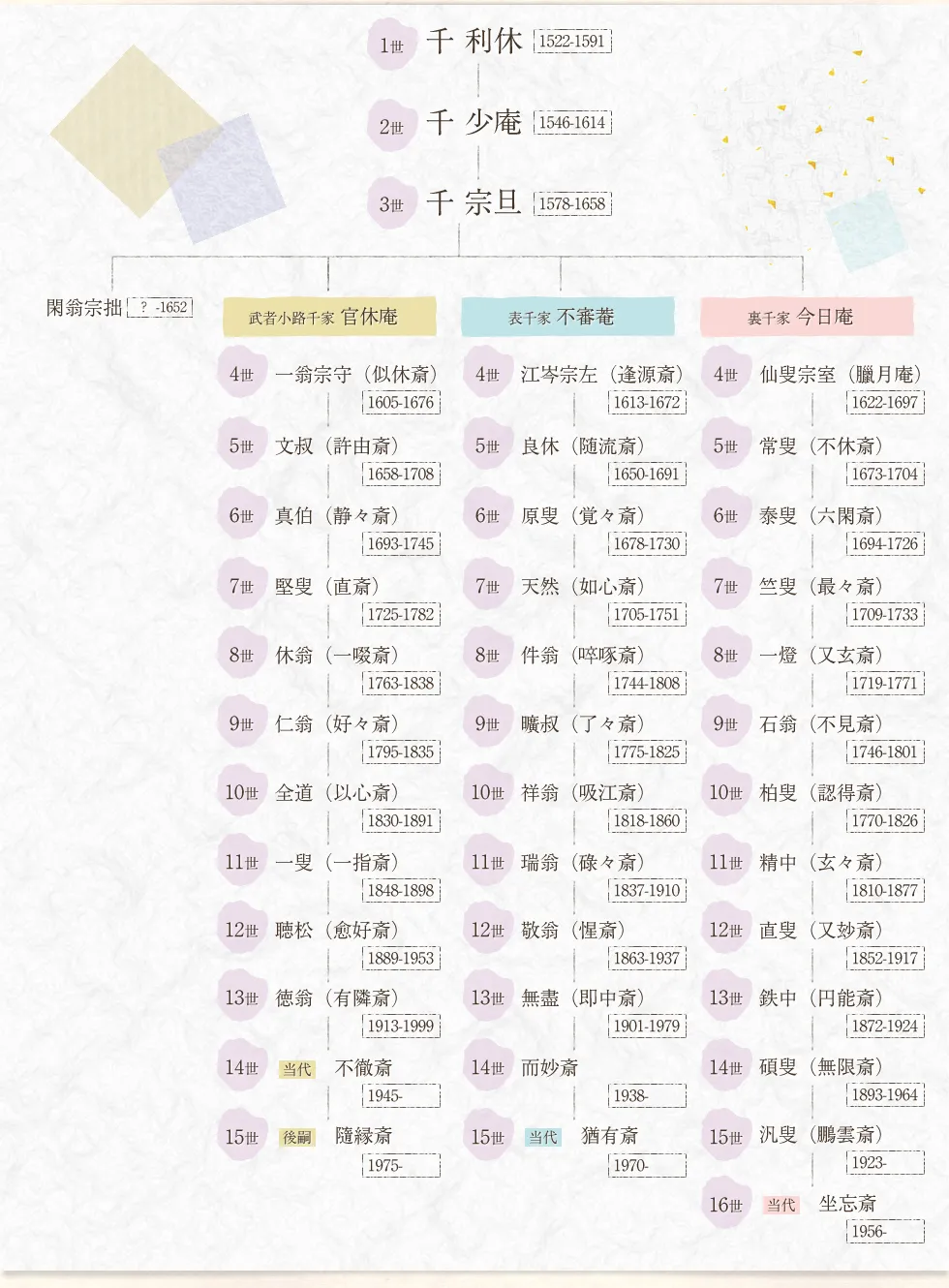
The Sansenke — Omotesenke, Urasenke, and Mushanokoji Senke — are the three main lineages of Japanese tea ceremony. Each is headed by an iemoto, the hereditary head of the school’s lineage, and each traces its descent directly from Sen no Rikyu (1522–1591), the figure most responsible for shaping tea ceremony into its classical form. Together, they represent the core of the tradition in Japan.
The three schools each maintain their own prescribed forms, gestures, and aesthetic values, but they share the same philosophical foundation: ichigo ichie, and the principles of wa-kei-sei-jaku. Omotesenke’s official website describes how Rikyu’s tea was passed down through all three schools.
(参照:The Tradition of Chanoyu: The Emergence of Wabi-cha | Omotesenke Official)
Comparing Omotesenke, Urasenke, and Mushanokoji Senke
The differences between the three schools go beyond the details of their prescribed forms. Their aesthetic values, teaching cultures, and accessibility each have a distinct character.
| School | Aesthetic & Atmosphere | How They Teach | Best Suited For |
|---|---|---|---|
| Omotesenke | Grounded in the wabi aesthetic — quiet, restrained, and reductive. The tendency is toward essence over ornamentation. | The forms passed down since Rikyu are preserved with precision. Study emphasizes technical integrity and a close relationship with the tradition. | Those who want to study tea ceremony in its most historically grounded form. Those drawn to the beauty of understatement. |
| Urasenke | Actively engaged in contemporary settings and international outreach. An accessible entry point for beginners and overseas visitors. | An extensive network in Japan and abroad, including well-developed English-language programs. Classes are commonly available at cultural centers. | Those who want to learn in English. Overseas visitors and international students. Those who want to try tea ceremony before committing to regular study. |
| Mushanokoji Senke | Generally understood as the most compact of the three major Sen lineages, with a particularly close association with Kyoto. Known for refined, precise forms. | Fewer practice spaces than the other two schools, but a tradition of small-group, intensive study that has been maintained over generations. | Those with a connection to Kyoto. Those who want to study in depth with a small group. Those drawn to a more immersive approach to the tradition. |
Omotesenke

Omotesenke is often associated with a restrained expression of wabi-cha, the austere tea aesthetic brought to maturity by Sen no Rikyu. The prescribed forms are quiet and reductive in character, and the sensibility that runs through the choice of objects and the design of the tea room reflects Rikyu’s aesthetic consistently.
Omotesenke’s official website describes the school’s tea as rooted in “the wabi-cha that Sen no Rikyu brought to completion.” That quality — favoring restraint over embellishment — carries through into every aspect of how the school teaches and practices.
A note for beginners: Omotesenke classes tend to be based in private teaching studios rather than cultural centers. In most cases, the path in is through direct contact with a teacher.
(参照:About Omotesenke | Omotesenke Official)
Urasenke

Urasenke has the broadest reach of the three schools, both within Japan and internationally, and has made international outreach a central part of its mission. English-language programs and materials are well developed, and Urasenke-affiliated spaces are often the most accessible starting point for overseas visitors seeking structured English-language guidance.
When people search for tea ceremony classes in Japan through cultural centers or community spaces, they most often find Urasenke-affiliated studios. In terms of sheer accessibility — number of teaching spaces, English-language provision, and the breadth of the entry point — Urasenke is often the most accessible starting point for international visitors and English-speaking beginners.
(参照:Urasenke Official)
A note for beginners: If English-language explanation is a priority, starting with Urasenke-affiliated facilities is the most efficient approach.
Mushanokoji Senke

Mushanokoji Senke is one of the three schools descending from Sen no Rikyu, centered on the Kankyuan tea house in Kyoto. It is generally understood as the most compact of the three major Sen lineages, with a particularly close association with Kyoto, and that relative compactness has helped preserve a tradition of close, small-group study and a careful teacher-student relationship.
The school’s prescribed forms are characterized by compact, functional movement — an aesthetic that resists unnecessary gesture. Those drawn to refined economy of form tend to find Mushanokoji Senke a natural fit.
(参照:Mushakoji Senke Kankyuan | Mushanokoji Senke Official)
A note for beginners: Teaching spaces are limited outside Kyoto, and finding a teacher elsewhere can take time. If your goal at this stage is simply to experience tea ceremony, starting with a program from one of the other two schools is a practical option.
Which School Should a Beginner Start With?
The honest answer is that asking “which school is best?” is less useful than asking “is there a teaching space I can get to easily? Does the atmosphere feel right? Do I connect with the teacher?” Those are the criteria that actually matter for making a start.
The prescribed forms differ in their details, but the substance of the tradition is shared across all three schools. The most natural way in is to find a nearby experience, and let that be your point of entry. If English-language instruction is important to you, looking at schools with established international programs is a reasonable first filter.
What to Expect at a Tea Ceremony Experience | What to Know Before You Go
Most of the anxiety that comes before a first tea ceremony experience comes from the same fear: arriving without knowing anything, and doing something that marks you as out of place. In practice, the hosts of beginner-oriented experiences are there to guide you through every step. Not knowing is not a problem. The only thing that tends to create difficulty is disregarding the atmosphere of the room.
Chakai and Chaji — The Two Main Formats

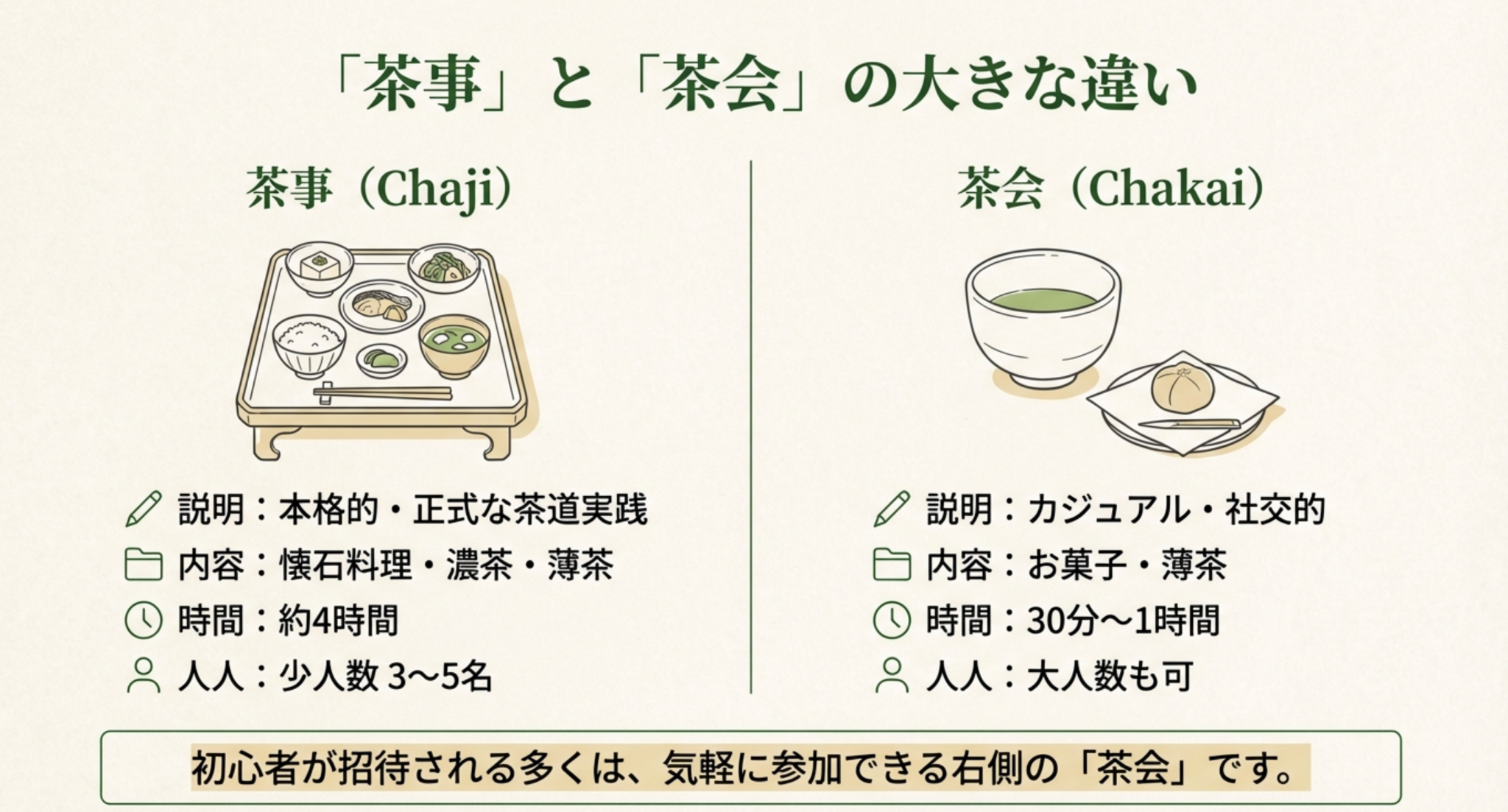
Tea gatherings fall into two broad categories: the chakai and the chaji.
| Format | What It Involves | Relevance for Beginners |
|---|---|---|
| Chakai | A shorter gathering centered on matcha and wagashi sweets, using a somewhat abbreviated form. | Most beginner-oriented experiences and tourist facilities use this format |
| Chaji | A full, formal gathering that includes a kaiseki meal, charcoal preparation, thick tea (koicha), and thin tea (usucha). Can last several hours. | Rarely the format for a first experience |
(参照:Japanese Tea Ceremony | JNTO Official)
How a Typical Experience Unfolds
While every venue handles the experience differently, most beginner sessions follow a fairly simple rhythm.
- Check in and settle in the waiting area (machiai)
- Follow the guide into the tea room and take your assigned seat
- When the wagashi sweet is presented, eat it before the tea arrives
- The host (or guide) prepares the matcha and brings the bowl to you
- Receive the bowl and drink the tea
- Offer a brief word of thanks as you leave
Some programs include time for you to prepare matcha yourself. Knowing this sequence beforehand takes most of the tension out of the experience.
Basic Etiquette to Know | Seiza, Bowing, and the Tea Bowl
Three points of etiquette are worth having in mind before you arrive.
Seiza: Formal kneeling — sitting on your heels with legs folded beneath you — is the standard seated posture in a tea room. That said, shorter experiences and standing-height (ryurei) formats often provide chairs.
Bowing: A respectful bow when receiving the bowl, and again after drinking, is the expected gesture at these transitions. The precise angle and form vary by school, but the intention — a sincere acknowledgment — is consistent.
Handling the bowl: Receive the chawan with both hands. Before drinking, rotate the bowl slightly so that you are not drinking from its front face (shomen). The exact number of rotations differs by school and context, so follow the guidance given on the day.
(参照:Japanese Tea Ceremony | JNTO Official)
Common Missteps and How to Avoid Them
What beginners often get wrong — and what to do instead
- Saving the sweet for after the tea → The wagashi is meant to be eaten before the matcha, not alongside it. When invited to take the sweet, do so without hesitation.
- Holding the bowl in one hand → Always use both hands, especially when first receiving the bowl from the host.
- Reaching for your phone immediately → Photography policies vary by venue. Keep your phone away until guidance is given.
- Wearing rings or a watch → Hard accessories can scratch the bowl. It’s worth removing them before the experience begins.
- Underestimating how long seiza takes → If you’re not used to formal kneeling, let the host know in advance, or look for a ryurei (chair-based) format.
For Those Concerned About Seiza | Ryurei as an Alternative
Ryurei (立礼) is a format in which tea is prepared and served at a standing-height table, with guests and host seated in chairs. It was developed as a way to make tea ceremony accessible to those for whom formal kneeling on the floor is difficult — including people with knee or hip concerns, and visitors from abroad who are unfamiliar with seiza.
Public events such as the Tokyo Grand Tea Ceremony include provisions specifically designed to welcome first-time participants. When booking an experience, it’s worth asking directly: “Is a ryurei option available?”
(参照:How to Enjoy the Tea Ceremony | Tokyo Grand Tea Ceremony Official)
What to Wear, What to Bring, and a Note on Photography
Kimono is not required. The majority of experience venues welcome participants in ordinary clothing. Since you’ll be seated on tatami matting, comfortable clothes that allow you to sit easily are a sensible choice.
You may be asked to remove rings and watches to protect the bowl. White socks or tabi (the split-toe socks traditionally worn with kimono) are the expected foot covering in most tea rooms.
Photography policies are set by the individual venue or host. If no guidance is given at the start, hold off on taking out your phone until you receive it.
(参照:How to Enjoy the Tea Ceremony | Tokyo Grand Tea Ceremony Official)
Tea Ceremony Tools | Understanding the Chawan, Chasen, and Kama
The tools of tea ceremony are not merely functional objects — they embody the aesthetic values the practice is built on. At this stage, the priority is not acquiring them but understanding what each one is and why it matters. Knowing something about the tools changes what you notice during an experience.
Chawan, Chasen, and Chashaku
Chawan (茶碗), the tea bowl, is used to prepare and drink the matcha. Shape, size, origin, and maker all contribute to its individual character, and the chawan is typically the most closely observed object in the tea room. Regional ceramic traditions — Raku ware from Kyoto, Hagi ware from Yamaguchi, Karatsu ware from Saga — each bring their own approach to what a tea bowl can be. For a detailed look at how to choose a chawan, see Kogei Japonica’s introductory guide.


Chasen (茶筅) is the bamboo whisk used to prepare the matcha. The fine tines at the tip create the foam. It is a consumable tool — once the tines begin to wear, the chasen is replaced.
Chashaku (茶杓) is a small bamboo scoop used to transfer matcha from its container into the bowl. Simple in appearance, it is nevertheless an object that tea practitioners study closely: the way the scoop has been carved carries the individual character of its maker.
Kama, Natsume, and Hishaku
Kama (釜) is the iron kettle in which water is heated. It sits over a sunken hearth (ro) or a portable brazier (furo), and the water it produces is used to prepare the tea. The sound of water simmering in the kama is traditionally described as matsukaze — “the wind in the pines” — and is considered part of the atmosphere of the tea room. The kama used changes with the season: the ro is used from November through April, the furo from May through October.
(参照:Words of Tea Practitioners | Omotesenke Official)
Natsume (棗) is the lacquered container used to hold the matcha for thin tea (usucha). Its name comes from the jujube fruit, whose shape it resembles.
Hishaku (柄杓) is the long-handled bamboo ladle used to transfer hot water from the kama to the tea bowl or water jar. Its proportions differ slightly depending on whether it is used with the ro or the furo.
Why Tea Ceremony Is an Entry Point into Japanese Craft
Look at the full set of tools required to prepare a single bowl of tea and you find ceramics, lacquerwork, bamboo craft, metalwork, and architecture gathered in one room.
The chawan is made by a ceramicist. The natsume is finished by a lacquer craftsperson. The chasen, chashaku, and hishaku are shaped by someone who works bamboo. The kama is cast by a metalworker. And the tea room itself — with its architecture, garden, shoji screens, tatami, and tokonoma alcove — is a work of spatial craft in its own right.
Engaging with chanoyu means encountering a significant part of Japanese craft all at once. Kogei Japonica covers each of these fields in depth — from the ceramic traditions behind the chawan to the history of lacquerwork and the craft of iron casting. Tea ceremony is a natural starting point for that wider exploration.
How to Choose a Tea Ceremony Experience | For First-Timers in Japan and Abroad
Once the interest is there, the next step is finding the right setting. The range of available experiences is wider than most people expect, and choosing with your actual goal in mind makes a real difference in what you come away with.
Tourist Experiences, One-Day Workshops, and Regular Classes
Tea ceremony experiences fall into three broad types.
Tourist experiences are short, self-contained programs designed for visitors to Japan. Facilities in Kyoto and Tokyo — many with English-language guidance — offer these regularly, sometimes combined with kimono rental or photography. The primary purpose is to encounter the culture directly during a trip.
One-day workshops go a step further and include hands-on time preparing matcha yourself. These are suited to people with a genuine interest in the practice — cultural enthusiasts and Japan-based international visitors who want more than observation.
Introductory classes and observation visits are aimed at those considering regular study. These are typically offered through school-affiliated teaching studios and cultural centers, and are the natural entry point for anyone who wants to pursue chanoyu as a long-term practice.
What to Look For When Choosing a Beginner Experience
- English-language guidance: Essential for overseas visitors or those who want explanation in English
- Duration: Choose based on your schedule and stamina
- Ryurei option: Confirm in advance if formal kneeling is a concern
- Group size: Smaller groups allow for more individual attention
- Hands-on preparation: Some programs include time to whisk your own matcha; others do not
- Wagashi included: Experiences that include the traditional sweet offer a closer approximation of a genuine tea gathering
- Location: If you’re traveling, proximity to your itinerary is a practical consideration
A Practical Example | The Tokyo Grand Tea Ceremony

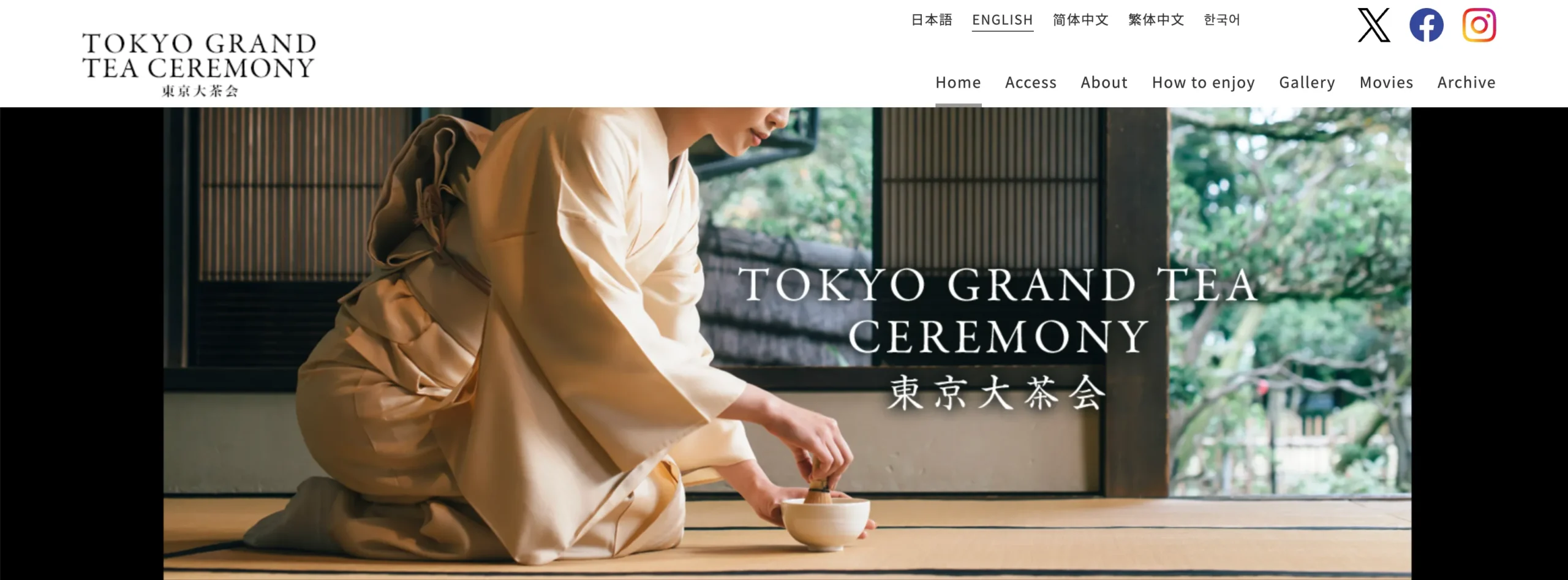
The Tokyo Grand Tea Ceremony is a large-scale public event organized by the Tokyo Metropolitan Government and related cultural institutions. The official English-language site confirms that first-time participants are welcome, that English-language programs are available, and that no special clothing or equipment is needed. It functions as an accessible first exposure to chanoyu for a wide range of participants.
(参照:TOKYO GRAND TEA CEREMONY | Official)
Events of this kind are easy to enter, but they do tend to attract large numbers of visitors. If you prefer a quieter, more focused introduction, a smaller program run by a teaching studio will likely be a better fit.
For International Visitors | Finding English-Friendly Experiences

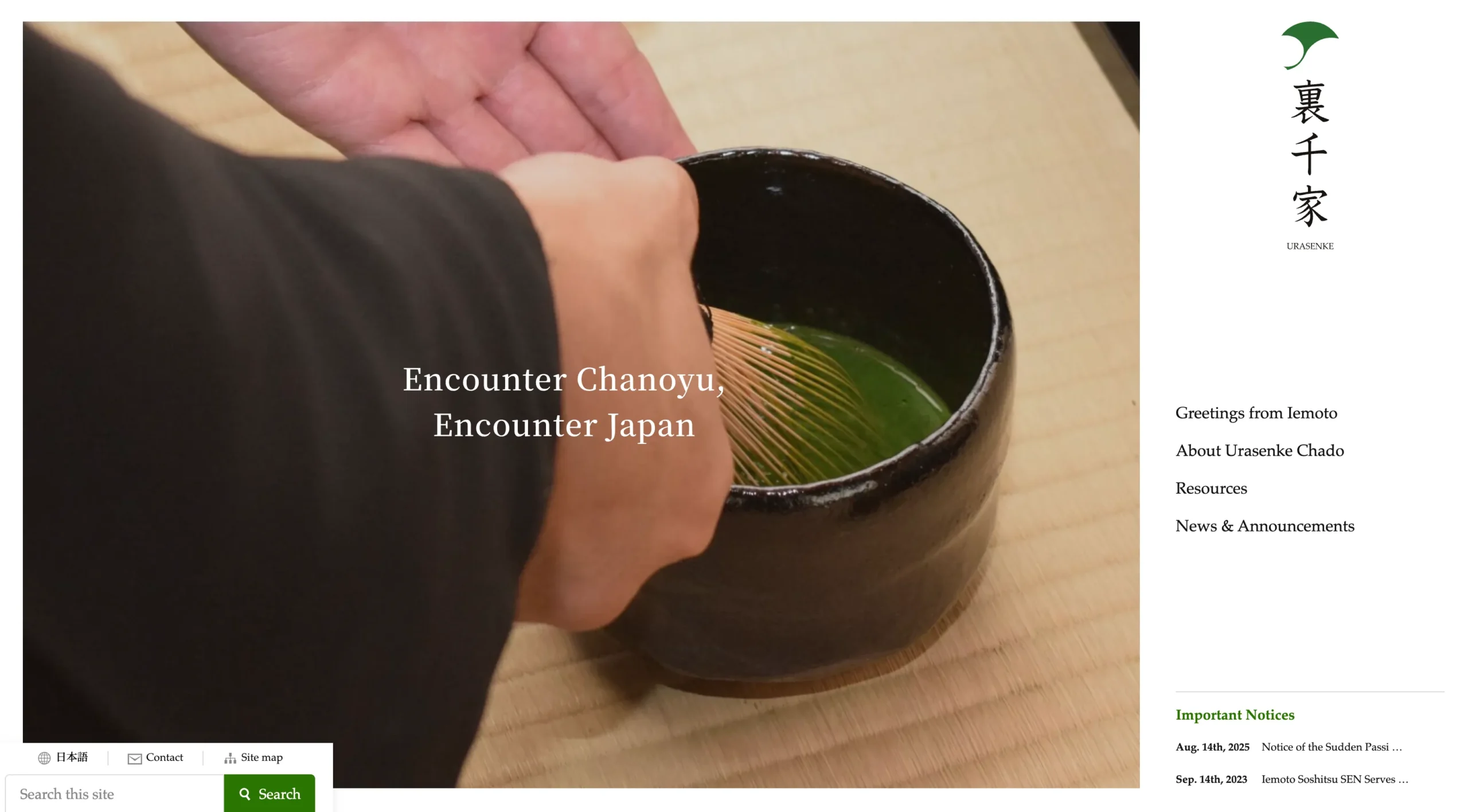
When searching for an English-language experience, two things are worth verifying: whether English commentary is available, and whether advance booking is possible online. Most major facilities in Kyoto and Tokyo offer online reservations, but the depth of English support varies considerably — some venues provide full narration; others offer a printed sheet or brief introduction.
Urasenke, which has maintained international outreach as an institutional priority, is explicit about its English-language access on its official website.
(参照:Urasenke Official)
Taking It Further | Next Steps After Your First Experience
A first experience sometimes leaves people wanting more. If you find yourself thinking about beginning regular study, here is how to approach that transition.
How to Find a Tea Ceremony Class
The most reliable route is to search for teaching spaces directly through the official websites of the three schools. Both Omotesenke and Urasenke list affiliated studios and facilities across Japan through their official sites. Mushanokoji Senke’s website also provides information on classes and related resources.
Local community centers and cultural facilities that run tea ceremony classes are another accessible entry point, particularly for those just starting out. And if you enjoyed a particular experience, many of the venues that offer introductory programs also welcome participants into ongoing classes.
In any case, it’s worth observing a class or attending a single session before committing. Whether the teacher’s approach and the atmosphere of the space feel right is something you can only assess in person.
What to Know Before You Begin Regular Study
Committing to regular practice means ongoing costs: monthly tuition, equipment, and the wagashi that is part of each session. The specifics vary considerably by school, location, and individual teacher, so asking directly before you enroll is the right approach.
You do not need to acquire a full set of tools at the outset. Most teachers recommend beginning with just three items: a fukusa (a folded silk cloth used in handling utensils), a sensu (a folding fan), and kaishi (small sheets of paper used in place of a plate for sweets). These are relatively straightforward to obtain and serve as a sufficient starting kit.
Some schools operate a formal certification system in which students receive a kyojo — a document acknowledging their progression to a new stage of study — at various points in their training. Each stage involves an associated fee. The structure and cost vary between schools, so clarifying this before you begin will help you plan your practice over the longer term.
Further Reading | Chawan, Lacquerware, Kama, and the Tea Room
For those whose interest in the practice has extended to the objects themselves, Kogei Japonica covers the individual craft fields connected to tea ceremony in depth.
On the chawan, the introductory guide “How to Choose Your First Matcha Bowl” goes into detail on regional traditions, form, and how to approach a purchase.
Coverage of lacquerware, iron casting, and tea room architecture — all craft fields deeply interwoven with tea ceremony — is planned for upcoming issues. The bowl in your hands, the kettle on the hearth, the room around you: each has its own history and its own practitioners. We’ll be following those threads here.
Summary
Tea ceremony is not a difficult culture to enter. At its foundation is a straightforward idea: that this particular encounter, between these particular people, in this particular moment, will not occur again — and that it is worth meeting with full attention. Every gesture, every object, every choice of space is in service of that idea.
Key points from this guide
- Tea ceremony is about creating a shared, unrepeatable encounter — not performing a sequence of rules correctly
- The three schools differ in aesthetic sensibility, atmosphere, and accessibility. Knowing the differences helps you choose where to start
- There is no need to be anxious about your first experience. Eat the sweet before the tea, hold the bowl with both hands — that is enough to begin with
- If seiza is a concern, ask about ryurei in advance. Kimono is not required
- Understanding the tools changes what you notice during the experience
- Before committing to regular study, clarify costs and the certification structure
The best starting point is simply to go — to sit in a tea room, drink a bowl of matcha, and let the experience tell you what it is. For those looking for a place to begin, public events open to first-timers and facilities with structured English-language guidance are a practical first step.
Kogei Japonica covers Japanese craft — ceramics, lacquerwork, metalwork, textiles, and the spaces they inhabit — from the perspective of people who engage with these things directly: as makers, users, and close observers. The texture of a tea bowl, the sound of water in the kettle, the depth of a lacquered surface — we’ll keep following those details, and we hope you’ll follow along.


