



Collaborations between overseas brands and Japan’s craft regions can open new markets and new forms of expression. Yet the finished product — and the brand name on it — reveals little about the profit or rights that remained with the makers and workshops involved.
Assessing a collaboration takes more than a story of international recognition. It means looking at prototyping cost, pricing, intellectual property, mass-production responsibility, credit and repeat orders.
For a partnership between a region and a brand to benefit both, prototyping cost, intellectual property, mass-production responsibility, credit and the handling of matters after the contract ends must be agreed before development begins.
Drawing on published material from Japan’s Ministry of Economy, Trade and Industry (METI) and others, together with specific cases, this article sets out the points that regions, brands and intermediaries should check. Because the contract terms of individual deals are often undisclosed, it separates confirmable facts from editorial analysis.
Table of Contents
Why should a craft–brand partnership be more than a feel-good story?
The value of a collaboration cannot be measured by a partner brand’s profile alone. Only by looking at price, rights, repeat orders and reinvestment in technique can you judge its real effect on a region.
According to METI material published in March 2026, there were 244 Traditional Crafts designated by the Minister of Economy, Trade and Industry as of October 2025. The same material reports that production value has trended gradually downward since falling below 100 billion yen in fiscal 2016, and that the workforce stood at roughly 48,000 in fiscal 2022.

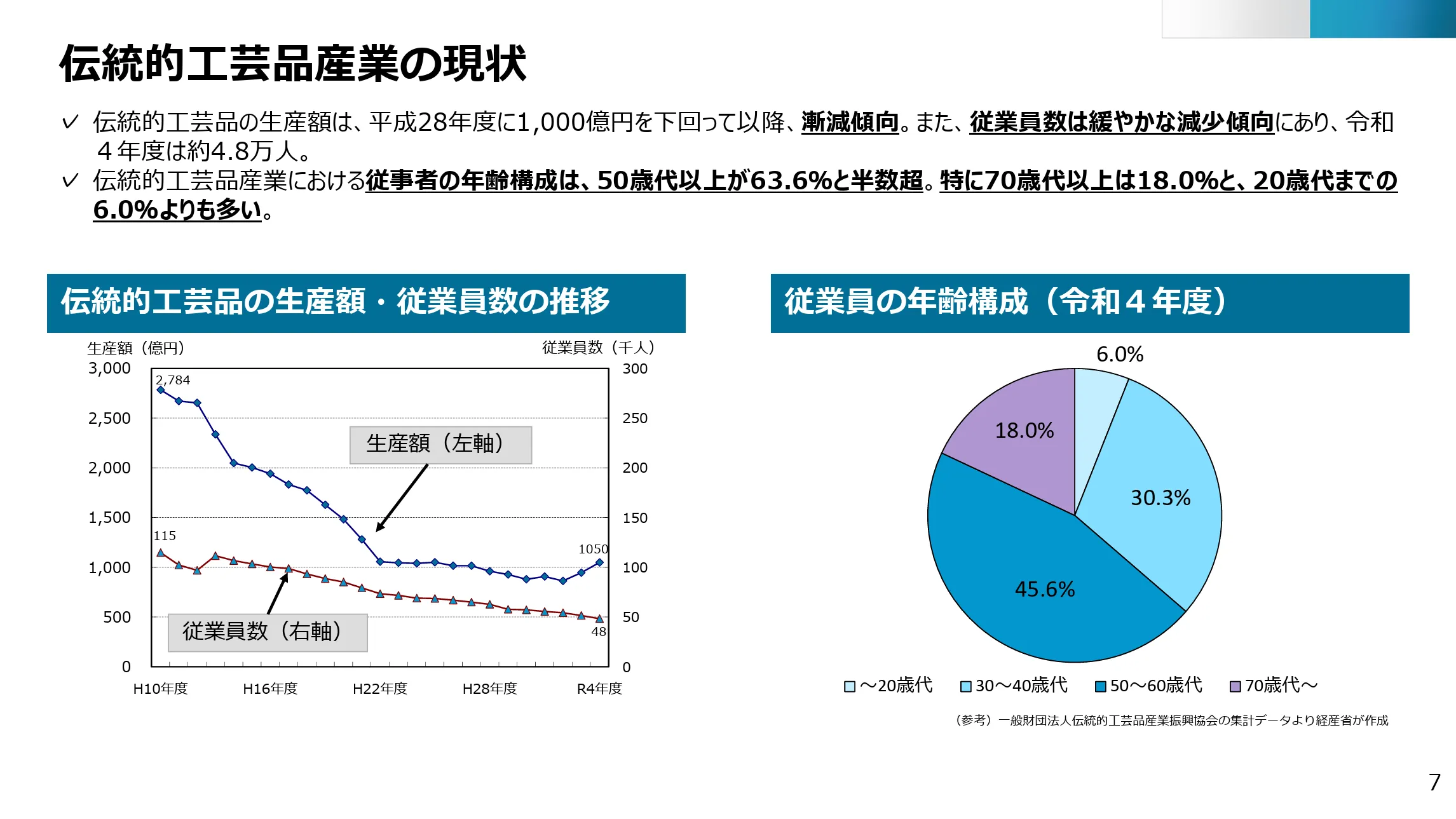
By age, workers in their 50s and 60s make up 45.6% and those aged 70 and over 18.0%, so those aged 50 and above total 63.6%. Workers up to their 20s, by contrast, account for 6.0%. Beyond the overall contraction of the industry, this points to limited time in which to pass technique to the next generation.
(Source: 15th Entertainment and Creative Policy Study Group, Secretariat Material | METI)
The same material puts the average number of employees per company in the Traditional Craft industry at 5.2. Businesses in the regions are mainly small and medium-sized or micro enterprises, and it is not unusual for a small team to handle not only manufacturing but sales, public relations, inventory, contracts and overseas dealings.
METI frames the shortage of people to lead marketing and management, together with pricing that does not adequately reflect materials, labour, time and technique, as a cause of the falling bargaining power and profitability of manufacturers.
(Source: The State and Challenges of the Traditional Craft Industry | METI)
A useful reference for thinking about this structure is Arita Porcelain Lab in Arita, Saga Prefecture. According to METI material, the company shifted from a wholesale-centred structure that went through trading houses to direct sales, revising a structure in which the wholesale price had been around 25% of the retail price.

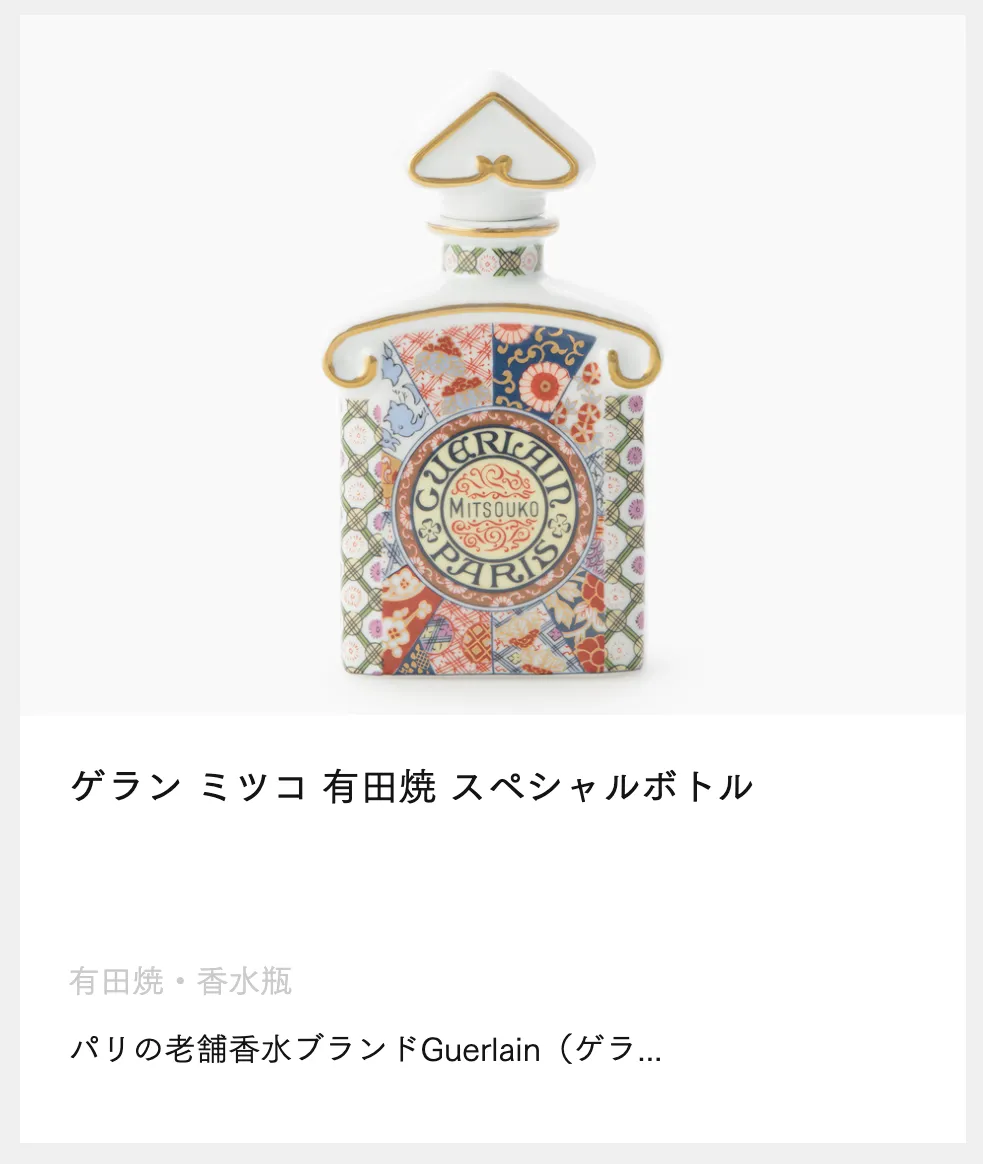
It later collaborated with the French luxury house Guerlain, producing a special Arita ware bottle for the perfume “Mitsouko.” METI material reports that an exhibition at the Champs-Élysées flagship store drew 45,500 visitors and that the limited product sold out in under a month.
(Source: The Guerlain × Arita Ware Case | METI)
The point that matters from this case is not the simple conclusion that “pairing with a famous brand sells at a high price.” It is that, ahead of the collaboration, the company had reviewed its own sales structure and put in place the means to design quality, story and customer contact worthy of the price itself.
METI also notes that while tie-ups with creative industries can be a spur to recognition, the partner brand’s image can sometimes run ahead on its own. Conveying the appeal of the Traditional Craft itself, it concludes, calls for careful dialogue with the brand side.
Editor’s note
What I watch in a craft collaboration is not only the beauty of the finished work. Did a next order follow? Did the workshop’s or region’s name remain? Can the technique developed be used in other work? Was profit reinvested in people and equipment? The real result of a collaboration shows in whether the options that come after it have grown.



Who initiates a collaboration, and why? (region, brand and intermediary)
Regions, brands and intermediaries may take part in the same project, but each brings different value and takes on different risk. It helps to consider each party’s position separately first.
The region’s and maker’s motives and risks
For a region or maker, the aim of a collaboration is not only sales. Developing new uses, renewed recognition for a technique, reaching overseas customers, appealing to younger people, and building the credibility of a workshop or region are all possible outcomes.
At the same time, there is a risk of bearing the time and materials for prototyping up front and being unable to recover the cost if the product is cancelled. There is also a risk that a workshop’s processing conditions, formulas, drawings, moulds and hard-won production knowledge are transferred to the partner without compensation.
Hosoo, a Nishijin textile company in Kyoto, is a leading example of a craft business expanding the uses and markets for a regional technique. According to LVMH Métiers d’Art’s official announcement, in 2010 Hosoo independently developed a Nishijin-ori (Nishijin textile) loom able to handle the 150-centimetre width widely used in textiles worldwide. Beyond obi and kimono, it has extended into interiors, fashion, art, science and technology, and supplied textiles to overseas markets.

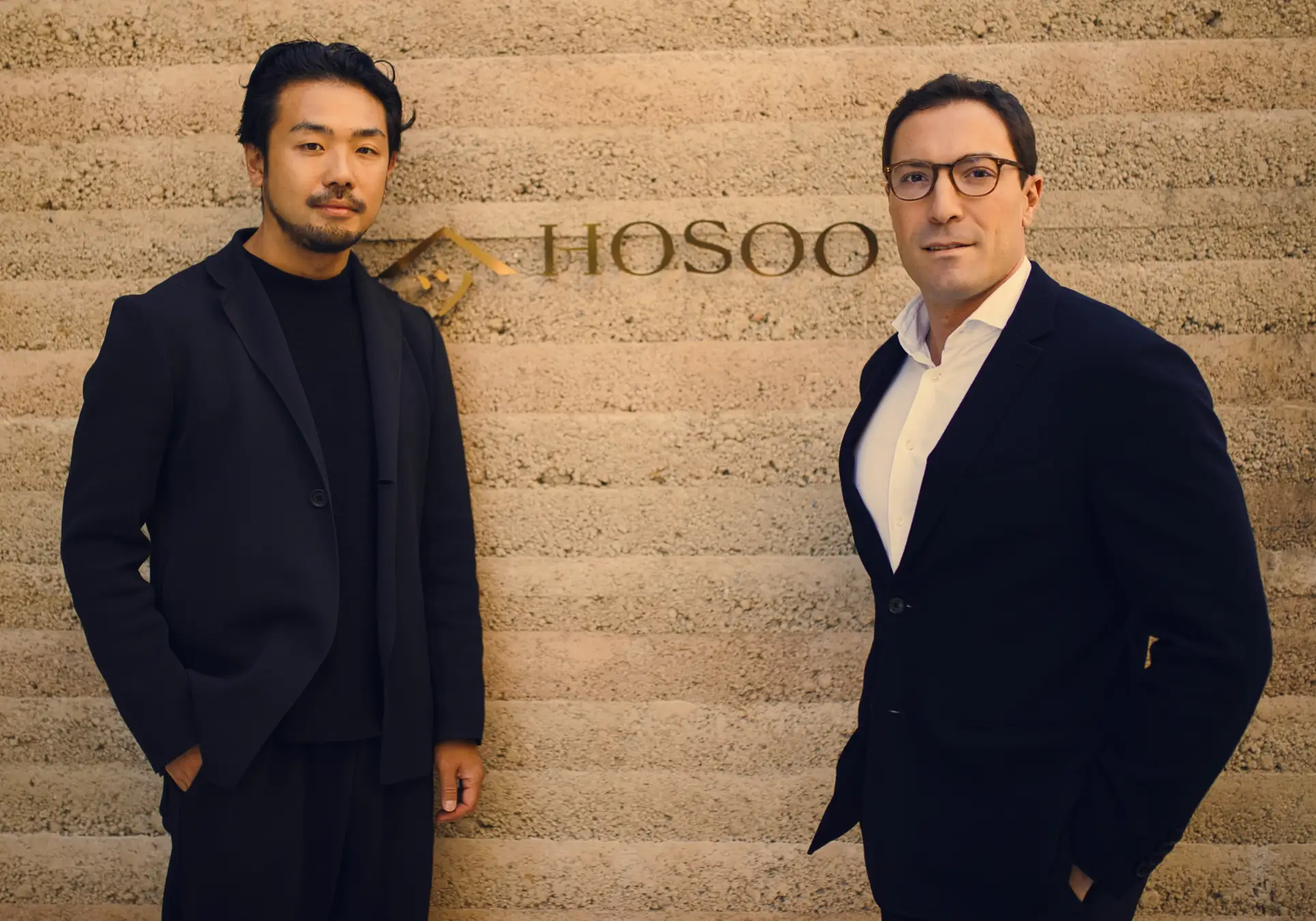
In November 2023, a partnership with LVMH Métiers d’Art was announced. The official announcement sets out its aim not as a partnership to sell individual products but as technical exchange between the silk industries of Japan and Europe, innovation across the whole manufacturing process, and the renewal and development of the silk industry.
(Source: LVMH Métiers d’Art Enters a Partnership with Hosoo | LVMH Moët Hennessy Louis Vuitton Japan)
That Hosoo has built up overseas textile development and collaborations across several fields is important background for thinking about this partnership. The specific fees, the ownership of intellectual property, and any exclusivity terms, however, are undisclosed. Confirmable business achievements and non-public contract terms need to be assessed separately.
The brand’s motives and risks
A brand’s reasons for collaborating with a craft region include access to distinctive materials or processing techniques, developing new products, expression with a cultural background, and strengthening the customer experience. In the luxury field in particular, not only quality but provenance — who made it, where and how — bears on a product’s value.
LVMH Métiers d’Art was established in 2015 and has built a network of manufactures and artisans around the world in fields such as leather, metal, fibre and fabric. In December 2022 it set up a base of operations in Japan, and in April 2023 it entered its first partnership in Japan, with the Okayama denim-fabric maker Kuroki.
(Source: About LVMH Métiers d’Art | LVMH Moët Hennessy Louis Vuitton Japan)
LVMH Métiers d’Art, though, is not positioned in the same way as a single brand selling individual bags or garments to consumers. It is a business organisation for carrying on and developing materials, manufacturing techniques and artisan expertise within the luxury industry. The relationship with Hosoo, too, is more accurately understood as a strategic partnership focused on technical exchange and material development than as a one-off product collaboration.
The brand side carries risks of its own around supply volume, quality, delivery time, variation between individual pieces and the continuity of raw materials. How far variation from handwork will be tolerated, and how inspection standards are set for mass production, must be shared with the workshop before a product is made.
The stronger a brand’s reach, moreover, the more a workshop or region can recede into the background. Explaining cultural background and setting out credit are matters the brand and region should design together, not leave to the region alone.
The role of intermediaries (local governments, regional trading companies, support bodies)
Between a region and a brand there may be local governments, regional trading companies, craft cooperatives, designers, producers, financial institutions and galleries. The main role of an intermediary is not simply to introduce the two parties but to translate each side’s aims, budgets, production conditions, communication and scope of responsibility into terms the other can act on, so that both sides can make informed decisions.

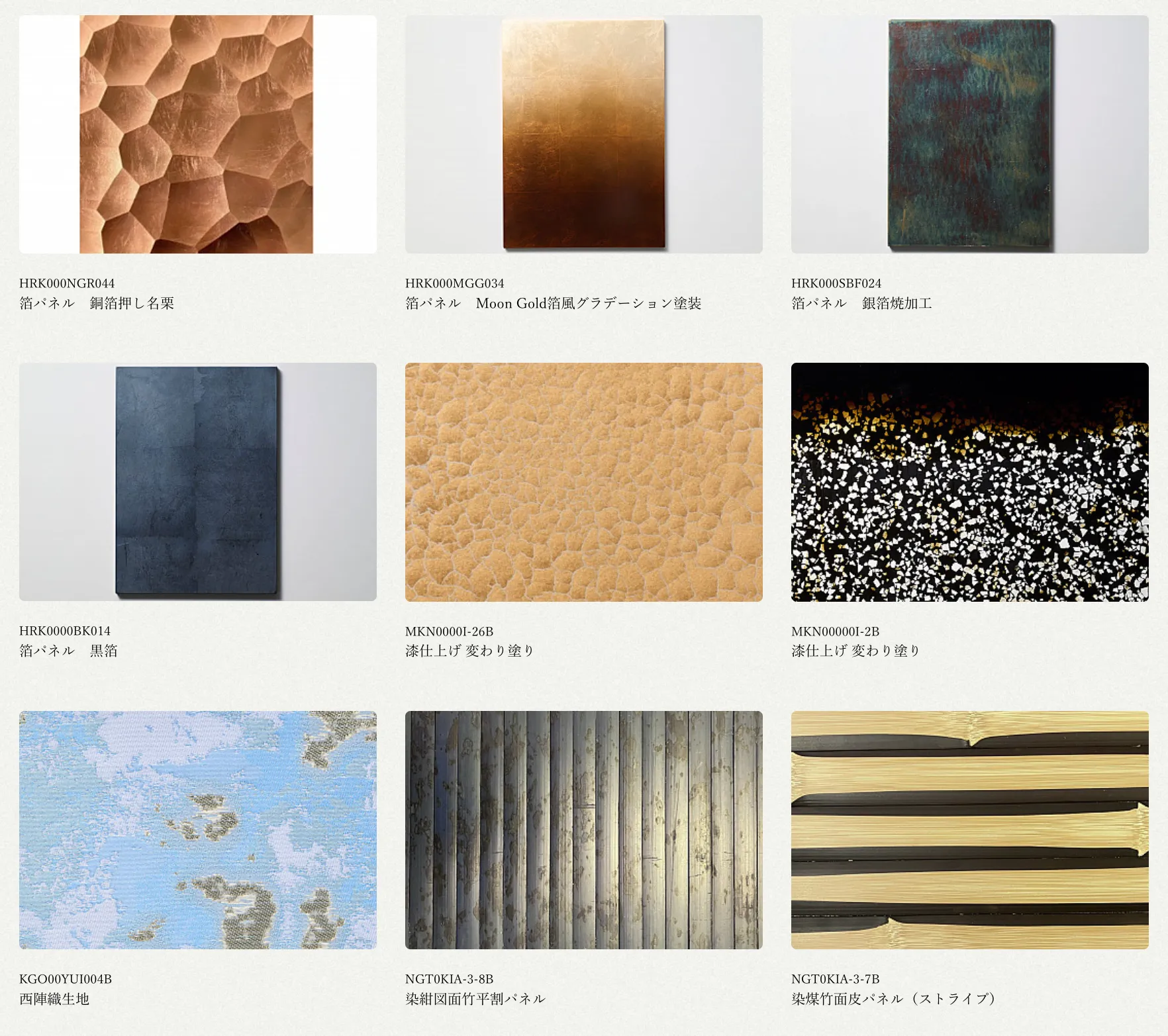
Kyoto Amplitude, a regional trading company established by Kyoto Chuo Shinkin Bank, turns traditional techniques and designs in bamboo, ceramics, lacquer, washi paper and weaving and dyeing into material samples under the name “WAZAI.” Its showroom has a gallery function that displays products and a library function for comparing materials for architecture and interiors, leading to business discussions about specifying these materials for hotels, shops and homes.
This is a case of converting technique and materials into a form architects and designers can select, rather than a workshop only selling finished pieces on its own. The intermediary fills the information gap between a region and another field — “we don’t know how to place an order,” “we don’t know what can be made.”
(Source: The Kyoto Amplitude Case | METI)
Unagi no Nedoko, in Yame, Fukuoka Prefecture, is a “regional culture trading company” that connects local culture and the economy through product development, retail and tourism built on “contemporary monpe” — work trousers made with Kurume-gasuri, a Kurume kasuri ikat. METI material presents it as a case that returns profit to makers while pursuing a mechanism to circulate historical and cultural resources economically and socially.
Waza no Wa, a general incorporated association in Gifu Prefecture, was established in February 2024 and handles enquiries on training successors, securing raw materials and sourcing tools. It is an intermediary support body that connects government, artisans, companies and educational institutions, and takes on regional issues hard to solve by an individual workshop alone.
(Source: The Unagi no Nedoko and Waza no Wa Cases | METI)
An intermediary in the middle does not, however, guarantee an equal collaboration. Who pays the intermediary, how far they take part in decisions, and what they bear when trouble arises all need to be made clear. Where an intermediary holds no legal qualification, the appropriate position is to treat them as organising the points to check with a lawyer or patent attorney, rather than leaving legal judgements on contract clauses to them.
Pricing, intellectual property and mass production — what should a collaboration agreement cover?
In a collaboration agreement, it is important to decide not only the unit manufacturing cost of the finished product but, separately, prototyping, existing know-how, new results, mass production, communications and the handling of matters after the contract ends.
| Point | For the region / maker to check | For the brand to check | What the intermediary can organise |
|---|---|---|---|
| Pricing | Are the fees for prototyping, manufacturing, supervision and licensing itemised separately? | Are the budget, retail price and minimum order commercially viable? | Can cost items and payment terms be made visible? |
| Existing technique / know-how | Are techniques, drawings, moulds and processing conditions held before the collaboration clearly identified? | Is information needed for manufacturing separated from confidential information that need not be disclosed? | Can the information to disclose before signing an NDA be clearly defined? |
| New results | Are ownership and terms of use for new shapes, patterns and improved techniques clear? | Can they be used for the products, regions, periods and media required? | Can the rights issues needing specialist advice be identified? |
| Prototyping | Are material costs, labour costs, number of revisions and settlement terms on cancellation clear? | Are the purpose of prototyping, evaluation criteria and approver decided? | Can the conditions for moving from prototype to mass production be documented? |
| Mass production / inspection | Do the quantity and delivery time exceed production capacity? | Are variation, tolerance, defect handling and delivery time clear? | Can quality standards and lines of contact be defined? |
| Credit | Are the place and manner of showing workshop, maker and region names decided? | Have credit requirements been agreed for the product, store, website and advertising? | Can display rules by medium be put into an agreement? |
| Contract end | Will moulds, drawings, data and prototypes be returned or disposed of? | Can sales of existing stock and repair support continue? | Can the tasks and deadlines at termination be defined? |
The Small and Medium Enterprise Agency’s guidelines on intellectual property transactions set out that free technical guidance or prototype manufacturing should not be forced, that intellectual property or know-how should not be used without the other party’s consent, and that results of joint development should be handled with regard to each side’s contribution of technique and ideas.
In craft collaborations too, a prototype is not a “product that never made it to market.” It is research and development that draws on materials, working time, equipment, technical judgement and the knowledge built up to avoid failure. Including the case where a product does not go to market, it is necessary to decide in advance up to which stage the work is paid.
(Source: Guidelines and Model Contracts for Intellectual Property Transactions | SME Agency)
The Japan Fair Trade Commission likewise sets out that intellectual property created on the contractor’s side should not be forcibly assigned or licensed without commensurate payment, and that its value should be assessed with the cost of creation and future profit in mind. It also raises, alongside assignment of rights, a licence limited in purpose and scope as a way to leave future revenue opportunities with the contractor.
(Source: Approach to Appropriate Transactions of Intellectual Property, Know-how and Data | Japan Fair Trade Commission)
That said, a traditional technique or expression does not automatically become the exclusive intellectual property right of a single workshop. Secret know-how a workshop held before the collaboration, newly created designs, the shape of an object, a brand name, photographs, video and text — the rights that can arise and their terms of use need to be considered separately for each.
In licensing a copyrighted work, it is important to make clear the medium, region, period, whether alteration is allowed, and exclusivity. The Agency for Cultural Affairs’ copyright contract manual likewise advises that, where a work is licensed rather than the copyright assigned, the permitted uses be specified concretely.
(Source: Copyright Contract Manual Anyone Can Use | Agency for Cultural Affairs)
On joint development, splitting rights automatically down the middle is not necessarily fair. Appropriate ownership and terms of use differ according to who brought what, who produced the new result, and who bore the cost of commercialisation and IP filing. The Japan Patent Office’s model contracts for promoting open innovation are a useful reference, but as they are not craft-specific contracts, the appropriate use is to organise points for discussion with an expert rather than to transfer them directly to an individual deal.
(Source: Open Innovation Portal | Japan Patent Office)
Terms explained
Collaboration is a general term for a brand and a region jointly planning and presenting products, works, spaces or experiences. It does not denote a legal contract type.
OEM is a production method in which the contractor manufactures and the client sells under its own brand name. The workshop or region name is not necessarily shown to consumers.
Licensing is a contract that grants use of copyright, design rights, trademarks, patents, or know-how managed under contract, defining the products, region, period, media and exclusivity for which it may be used.
Joint development is work in which several parties bring together planning, technique, design and funding to develop a new product or technology. Being joint development does not automatically make the results shared.
Design rights are a registered industrial property right, protecting the design of objects, images, buildings and interiors. Not every shape or pattern of a craft can be registered; there are requirements such as novelty.
Common misunderstandings, and the “light and shadow” seen in practice
The misunderstanding most to be avoided is treating “having paired with a famous brand” as success in itself. Recognition and revenue, buzz and rights, exhibition and repeat orders each need to be verified separately.
The same pattern appears not only in collaborations with luxury brands but in those with content IP such as anime and games.

On “Pokémon × Kōgei: A Bountiful Discovery of Beauty and Craft,” held at the National Crafts Museum in Kanazawa, METI material reports that it drew around 95,000 visitors, a record for a special exhibition at the museum. It was later shown at venues including JAPAN HOUSE Los Angeles, widening recognition among audiences at home and abroad who had had little contact with craft.
(Source: Pokémon × Kōgei: A Bountiful Discovery of Beauty and Craft | Official Exhibition Site)
METI notes, on the other hand, that in IP tie-ups it is important to design the arrangement so that the image of the partnered IP does not run ahead on its own, and so that it leads to communicating the appeal of the Traditional Craft itself.
That many people encounter craft through the profile of a character or brand is clearly the bright side. But whether visitors came to understand a work’s technique, material, maker’s name and region, whether the exhibition led to purchases of craft or visits to regions afterwards, and whether appropriate payment returned to makers and workshops — none of this is shown by visitor numbers alone.
Another thing to read with care is the gap in attitudes at home and abroad. In a survey of around 1,000 people cited in METI materials, the share choosing the impression that Japanese Traditional Crafts are “expensive, out of reach” was 52.9% in Japan, 18.1% in Europe and the United States, and 29.3% in East Asia. The respondents were 310 in Japan, 270 in Europe and the US, 270 in East Asia and 150 elsewhere.
This is a result showing that Japanese respondents tended, more than overseas respondents, to see Traditional Crafts as hard to reach. It is not, however, a statistic that directly shows actual spending or demand in the luxury market. Impression surveys and sales records need to be read without conflating them.
(Source: Attitudes Toward Japan’s Traditional Crafts | METI)
When entering overseas markets becomes an end in itself, the price band, delivery times and worldview of the overseas side can take priority over a region’s production capacity and cultural background. Look only at the domestic market, on the other hand, and a region can be unable to break out of existing uses and price structures.
The question is not which is right, overseas or domestic. For each collaboration, the task is to design in which market, to whom, what value is delivered, and how the payment for it is returned to the region.
What should you check before considering a collaboration? (free download)
When an approach is first made, check the aim, cost, rights, manufacturing, communications and exit terms. Before disclosing detailed techniques or drawings, also define the scope of confidentiality.
- Are the aim of the collaboration and the measure of its success decided?
- Are the contractual positions of region, workshop, maker, brand, designer and intermediary clear?
- Are cost items such as planning, prototyping, supervision, mass production, photography and PR itemised separately?
- Is it clear who bears the prototyping costs, how many revisions are included, and how settlement is handled if the project is cancelled?
- Are techniques, drawings, moulds, processing conditions and names held before the collaboration clearly identified?
- Is the handling of shapes, patterns, improved techniques, photographs, video and text produced in joint development clear?
- Is it stated whether rights are assigned or licensed?
- Does the licence clearly define the permitted products, region, period, media, alteration, sub-licensing and exclusivity?
- Are minimum order, delivery time, production capacity and continuity of raw materials confirmed?
- Is the handling of variation between individual handmade pieces, inspection standards, defects, repair and returns agreed?
- Are retail price, wholesale price, royalties, minimum guarantee and payment timing clear?
- Have the placement, size and format of credits for the workshop, maker and region been agreed?
- Has it been confirmed that the workshop or maker may publish the work on its own site or social media?
- Is it decided who owns and stores moulds, drawings, data, prototypes and surplus material?
- Are the time limits for stock sales, remanufacturing, repair and use of PR material after the contract ends clear?
- For an overseas contract, are contract language, governing law, jurisdiction, currency, tax, transport and insurance defined?
- Can you check with experts — lawyers, patent attorneys, tax accountants — according to the point at issue?
This checklist is not a substitute for a contract. It is for a workshop or company to set out its business wishes and non-negotiable conditions before consulting an expert.
A good collaboration does not require every term to favour the region. The allocation of rights and profit should correspond to the risks each party takes on, including development cost, stock, distribution, advertising and quality assurance.


FAQ for regions, brands and intermediaries
Basic practical thinking on the frequent questions in craft collaborations — cost, IP, credit and overseas contracts.
- Q1. How should profits be divided in a regional collaboration?
- There is no uniform standard. Unit manufacturing cost, prototyping fees, supervision fees, minimum guarantee, and royalties on sales are combined and set by contract according to each party’s contribution and risk.
- Q2. Who owns the intellectual property in a design or technical improvement produced in a collaboration?
- Being joint development does not automatically make it shared. Existing technique and new results are separated, and ownership and terms of use are set by contract with regard to involvement in the creation or invention, filing costs and purpose of use.
- Q3. Who bears the prototyping cost, the region or the brand?
- It varies by deal. But even where commercialisation is undecided, a prototype that draws on materials, working time and processing judgement has value. Rather than assuming it is free, confirm cost, cancellation terms and number of revisions before starting.
- Q4. Can the workshop or maker negotiate how they are credited?
- It is a negotiable item. Credit should be agreed separately for the product itself, packaging, stores, press releases, websites and social media.
- Q5. What should you check to avoid a one-sided collaboration?
- Check price, prototyping cost, existing know-how, new results, scope of use, minimum order, credit and exit terms. It is especially important not to treat free prototyping or comprehensive assignment of rights as a given on the grounds of future orders or exposure.
- Q6. What do intermediaries such as local governments or agents take on?
- Selecting candidates, organising aims and budget, translating manufacturing conditions, managing progress, and communications. For legal judgements, though, check the intermediary’s qualifications and scope of work, and consult a lawyer or patent attorney as needed.
- Q7. What is especially different about collaborating with an overseas brand compared with a domestic deal?
- Contract language, governing law, currency, tax, transport, insurance, inspection, region of use and the explanation of cultural background are added. Which language version of the contract takes precedence also needs confirming.
How Kogei Japonica sees the future of regional collaborations
Future craft collaborations should be designed not only to present a finished product but as a mechanism that increases a region’s bargaining power and its future options.
Arita Porcelain Lab reviewed its sales structure before moving on to the collaboration with Guerlain. Hosoo independently developed a 150-centimetre-width loom and extended Nishijin textile into uses beyond obi and kimono before building overseas relationships.
What the two share is that, rather than waiting for an outside brand to grant value, the region and business reinterpreted their own technique and thought through price, use and market themselves.
It is not right, however, to assume that strengthening the region alone will solve every problem. There are limits to a small workshop handling overseas sales, contracts, IP, logistics, quality assurance and PR on its own. Brands, designers, intermediaries and experts need to support it, each with their responsibility made clear.
Kogei Japonica’s view
A good collaboration neither freezes a region’s culture in its current form nor gives form to every one of a brand’s wishes. It begins with openness about each side’s constraints and aims, and turns respect for technique into concrete terms — payment, rights, credit and a continuing relationship. More than the glamour of the finished work, we want to value what is left, and in whose hands, once the collaboration ends.
Kogei Japonica is available to consult on organising collaboration aims, selecting workshops and makers, planning and design, product development, spatial presentation, corporate gifts, and communications. Where specialist judgement on intellectual property or contract clauses is needed, we set out the business points to raise, on the premise of checking with a lawyer, patent attorney or similar.