

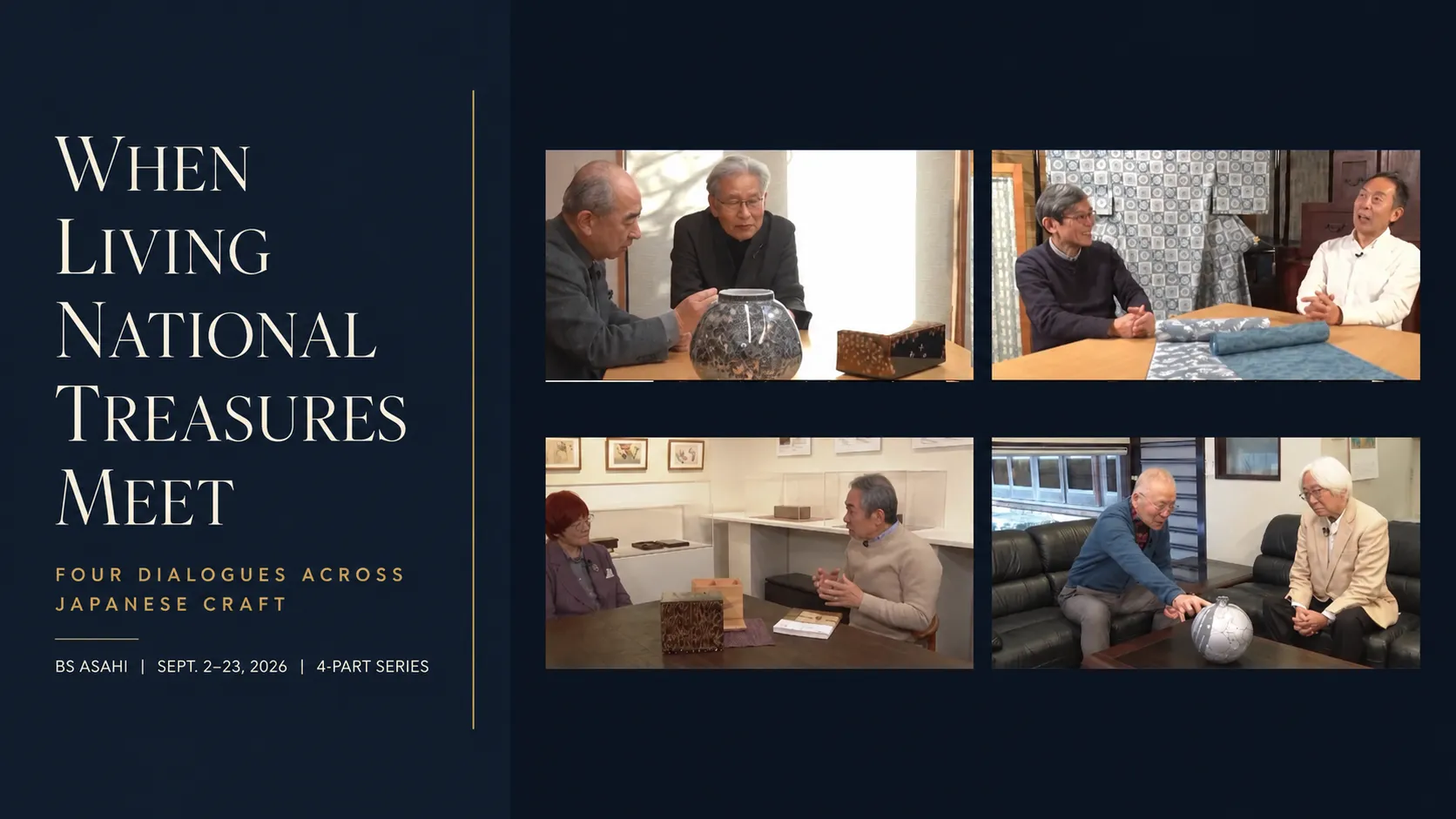
Works by Living National Treasures can be seen in museums and exhibitions. Opportunities to hear these artists speak directly with one another about their practice, however, are far less common.
Beginning Wednesday, September 2, 2026, BS Asahi will broadcast the four-part documentary series Ningen Kokuhō × Ningen Kokuhō—translated here as “Living National Treasure × Living National Treasure”—on four consecutive Wednesdays. Each 30-minute episode airs from 11:30 p.m. to midnight JST.
The series brings together eight individually recognized holders of Important Intangible Cultural Properties in four pairings. Their fields span maki-e lacquer decoration, overglaze-enamel porcelain, indigo stencil dyeing, woodwork, metal hammering, lacquer coating and underglaze decoration.
ARTerrace states that it provided comprehensive support for the program’s planning, production and filming. Its initiatives in the field of traditional craft are also scheduled to be featured in each episode.
This guide covers the broadcast schedule and featured artists, while also considering a broader question: what becomes visible when masters of different materials and techniques enter into conversation?
(Reference: Ningen Kokuhō × Ningen Kokuhō|BS Asahi)
(Reference: BS Asahi Documentary Ningen Kokuhō × Ningen Kokuhō|ARTerrace)
Disclosure: This article was independently structured and written by the Kogei Japonica editorial team based on information provided by ARTerrace.
Table of Contents
Why Pair Living National Treasures Across Disciplines?
The significance of this series lies not simply in its celebrated participants, but in its decision to bring masters of different materials and techniques face to face.
A documentary devoted to one artist can explore that person’s career, techniques and major works in depth. A dialogue operates differently. It creates space for ideas that emerge only in response to another maker’s words—and for reactions prompted by encountering a practice unlike one’s own.
Lacquer, clay, cloth, wood and metal behave in fundamentally different ways. One process depends on drying; another on firing. Some materials are hammered, others carved, dyed or coated. The point at which an error can still be corrected varies, as does the judgment that a work is complete.
Yet when artists speak across disciplines, they often arrive at questions that transcend technique. How should a maker respond to the material? How far can an inherited practice be changed? How can technical knowledge be passed to the next generation without reducing tradition to repetition? This is where the dialogue format becomes especially revealing.
Editor’s Note
The longer one follows craft, the more compelling the decisions behind a finished work become: what the maker preserved, what they transformed and where they recognized the work as complete. Individuality resides not only in visible form and pattern, but also in the many judgments accumulated throughout the making process. By responding to another master’s work, each artist is prompted to reconsider—and articulate—the principles behind their own practice. That exchange is a central reason to watch this series.
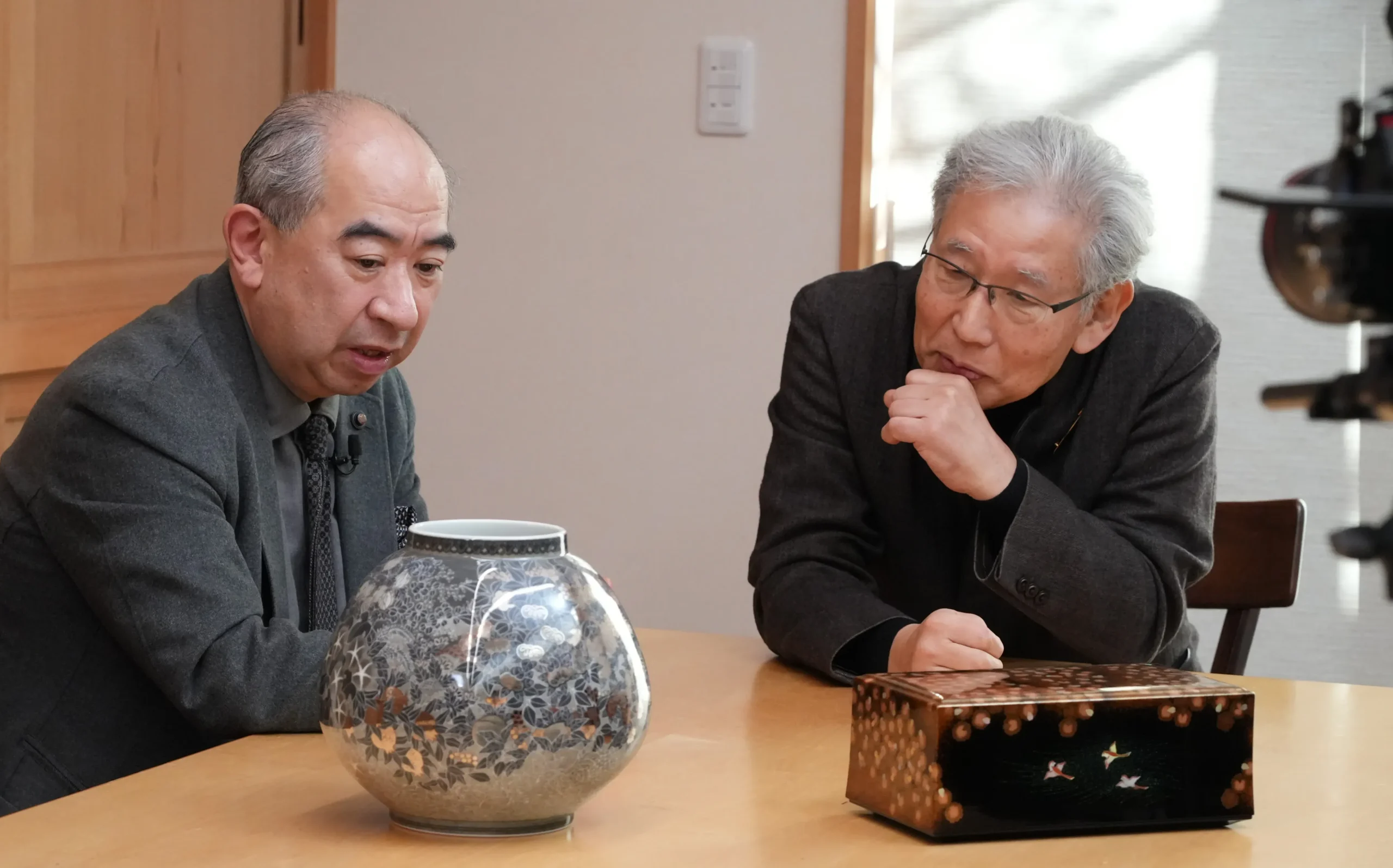
According to BS Asahi, the first episode brings together Murose Kazumi and Imaizumi Imaemon XIV to discuss the meaning of tradition and creative practice through their experience of working with different materials and techniques.
Listening for what each artist seeks to preserve—and what each is willing to renew—offers a richer way to approach the program than simply observing an encounter between two Living National Treasures.
(Reference: Ningen Kokuhō × Ningen Kokuhō|BS Asahi)
Four Episodes, Four Cross-Disciplinary Pairings
The four pairings offer a way to consider what different forms of Japanese craft share precisely because their materials and processes are so different.
The editorial perspectives in the final column below are based on the announced participants and their recognized fields. They are intended as viewing prompts and do not claim to predict what will be discussed in each episode.
| Broadcast date | Participants | Recognized fields | A perspective to consider |
|---|---|---|---|
| Sep. 2 (Wed.) | Murose Kazumi × Imaizumi Imaemon XIV |
Maki-e × Iroe jiki (overglaze-enamel porcelain) |
How light and color are embedded in the surfaces of lacquer and porcelain |
| Sep. 9 (Wed.) | Matsubara Nobuo × Watanabe Akio |
Nagaita chūgata (indigo stencil dyeing) × Woodwork |
How makers negotiate precision, pattern and the individual character of natural materials |
| Sep. 16 (Wed.) | Ōsumi Yukie × Suda Kenji |
Tankin (metal hammering) × Woodwork |
The decisions involved in shaping metal and wood through tools and controlled force |
| Sep. 23 (Wed.) | Komori Kunie × Nakada Kazuo |
Kyūshitsu (lacquer coating) × Yūkasai (underglaze decoration) |
How unseen layers and processes create visible depth, color and sheen |
Each episode airs from 11:30 p.m. to midnight JST. Broadcast dates and content are subject to change, so viewers should check the official program page for the latest information.
(Reference: BS Asahi Documentary Ningen Kokuhō × Ningen Kokuhō|ARTerrace)
Episode 1: Maki-e × Iroe Jiki (Murose Kazumi / Imaizumi Imaemon XIV)
The first episode considers how an inherited technique can remain intact while continuing to produce expression that belongs to the present.
Appearing on September 2 are Murose Kazumi, an individually recognized holder of the Important Intangible Cultural Property “maki-e,” and Imaizumi Imaemon XIV, an individually recognized holder in “iroe jiki,” or overglaze-enamel porcelain.
Maki-e is a decorative lacquer technique in which gold, silver or other fine powders are sprinkled onto designs drawn in wet lacquer. Its principal forms include togidashi maki-e, hira maki-e and taka maki-e. Variations in the way powder is applied, lacquer is layered and the surface is finished produce an extensive range of visual effects.
Iroe jiki involves applying colored overglaze enamels to glazed and previously fired porcelain, followed by a further firing that fixes the decoration. Reds, yellows, greens, purples and other colors can be combined to create intricate pictorial and abstract designs.
One practice sets metallic powder into lacquer; the other fixes colored enamel onto porcelain through heat. Their materials and processes differ, yet both ask how the surface of an object can carry light, color and the maker’s aesthetic judgment.
BS Asahi describes the episode as a discussion of tradition and creation grounded in the artists’ respective experiences. Its central question is not simply how a technique is preserved, but how it can be inherited without allowing contemporary expression to become imitation.
(Reference: Important Intangible Cultural Property “Maki-e”|Database of National Cultural Properties)
(Reference: Important Intangible Cultural Property “Iroe Jiki”|Database of National Cultural Properties)


Episode 2: Nagaita Chūgata × Woodwork (Matsubara Nobuo / Watanabe Akio)
The second episode brings together a textile practice defined by exact alignment and repeated pattern with a woodworker’s response to the unique character of each piece of timber.
Appearing on September 9 are Matsubara Nobuo, an individually recognized holder of the Important Intangible Cultural Property of nagaita chūgata, and Watanabe Akio, an individually recognized holder of woodwork, or mokkōgei.
Nagaita chūgata is an indigo-dyeing technique in which cloth is stretched across a long board and resist paste is applied through a stencil. The pattern must be carefully aligned on both sides of the fabric before it is dyed, demanding exceptional precision from the maker.
Japanese woodwork encompasses techniques including sashimono joinery, kurimono carving, hikimono turning and magemono bentwood work. The maker selects, cuts, shapes and assembles the material while accounting for the species, grain, moisture and movement of the wood.
One practice establishes pattern through the controlled repetition of stencil and resist paste; the other responds to a material whose grain and behavior vary from one piece to the next. They may initially appear opposed, but neither relies on imposing form without negotiation. In both, the process must be adapted to the conditions of the material.
Where does the maker’s intention enter that negotiation? The episode offers an opportunity to listen for how the two artists describe the boundary between technical control and responsiveness to material.
(Reference: Important Intangible Cultural Property “Nagaita Chūgata”|Database of National Cultural Properties)
(Reference: Important Intangible Cultural Property “Woodwork”|Database of National Cultural Properties)
Episode 3: Tankin × Woodwork (Ōsumi Yukie / Suda Kenji)
The third episode focuses on two very different materials—metal and wood—and the judgment required to shape each without working against its nature.
Appearing on September 16 are Ōsumi Yukie, an individually recognized holder of the Important Intangible Cultural Property of tankin, or metal hammering, and Suda Kenji, an individually recognized holder of woodwork.
Tankin is a metalworking technique in which sheet metal is repeatedly hammered into vessels and three-dimensional forms. Metal hammers and wooden mallets are used in combination with annealing and other heat treatments, allowing the material to be shaped without cracking or becoming excessively brittle.
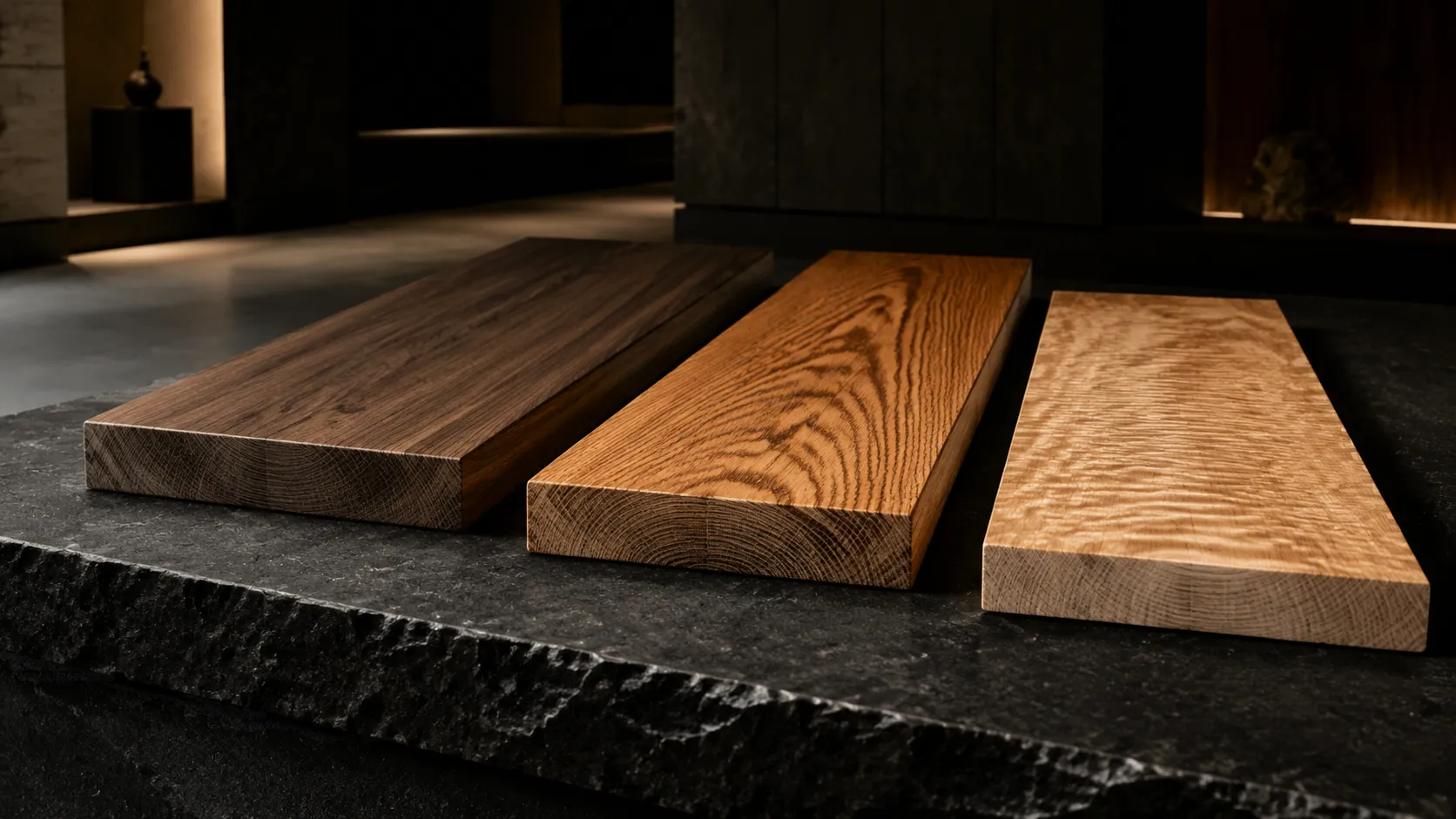
In woodwork, shaping begins long before the first cut. The maker considers the species, grain, moisture and future movement of the timber, determines how each component should be taken from the larger piece and then joins multiple elements into a coherent form.
Metal and wood respond differently to pressure, heat and tools. What the two practices share is the need to judge whether to make one more intervention or to stop. The finished object conceals that sequence of decisions, but the dialogue may reveal how each maker balances the limits of the material with artistic intention.
(Reference: Important Intangible Cultural Property “Tankin”|Database of National Cultural Properties)
(Reference: Important Intangible Cultural Property “Woodwork”|Database of National Cultural Properties)

Episode 4: Kyūshitsu × Yūkasai (Komori Kunie / Nakada Kazuo)
The final episode draws attention to the layers and processes that remain largely invisible beneath a finished surface.
Appearing on September 23 are Komori Kunie, an individually recognized holder of the Important Intangible Cultural Property of kyūshitsu, and Nakada Kazuo, an individually recognized holder of yūkasai.
Kyūshitsu centers on the application and finishing of lacquer. It encompasses the selection and preparation of the substrate, the building of foundation layers, successive coats of lacquer and the final treatment of the surface. Much of what gives the finished work its depth lies beneath what the viewer can see.
Yūkasai is a form of underglaze decoration in which color is applied to the ceramic or porcelain body before it is covered with glaze and fired. The relationship between the decoration and the translucent glaze above it gives the color a distinctive sense of depth.
One practice builds a surface through successive layers of lacquer; the other preserves color beneath a glasslike layer of glaze. In both, an accumulation of largely unseen processes determines what ultimately becomes visible.
The final episode invites viewers to listen for how the two artists articulate the time and labor embedded beneath color, depth and sheen.
(Reference: Important Intangible Cultural Property “Kyūshitsu”|Database of National Cultural Properties)
(Reference: Important Intangible Cultural Property “Yūkasai”|Database of National Cultural Properties)

Behind the Scenes: The Stillness of Maki-e
An account from the filming of the first episode illustrates that maki-e depends not only on the movement of the artist’s hands, but also on the careful control of the surrounding environment.
According to ARTerrace, staff members filming in Murose Kazumi’s studio described the workspace as “as immaculate as a dōjō.” They were instructed not to stir the air while he worked. In the resulting silence, the only sound was the steady tapping of the powder tube, or funzutsu, as fine gold powder was scattered across the lacquer.
The point is not simply to romanticize the stillness of the workshop. The stillness is itself a technical requirement. Fine powders used in maki-e can be disturbed by unintended air movement, meaning that the cleanliness of the room, the movement of people and even their physical presence become part of the conditions of making.
Editor’s Note
When viewing a finished work, the eye is naturally drawn to the glow of the metal powder and the intricacy of the design. Yet that radiance also emerges from the attention devoted to keeping the environment still. One of the strengths of seeing craft on film is that it can reveal this relationship between the maker’s body, the material and the surrounding space—something a frontal photograph of the finished object cannot fully convey.
One ARTerrace staff member recalled feeling as though the gold powder itself were shimmering audibly as it was scattered. The quiet of the room brought forward a rhythm that would otherwise be almost impossible to notice.
(Reference: BS Asahi Documentary Ningen Kokuhō × Ningen Kokuhō|ARTerrace)
What Is a Living National Treasure?
“Living National Treasure” is the commonly used term for a person individually recognized by the Japanese government as a holder of an Important Intangible Cultural Property.
Japan’s Agency for Cultural Affairs defines Intangible Cultural Properties as performing arts, music, craft techniques and other forms of human technical artistry that possess significant historical or artistic value. Particularly important examples are designated as Important Intangible Cultural Properties, while the individuals or groups who have achieved advanced mastery are recognized as their holders.
Recognition takes three forms: individual recognition, collective recognition and group recognition. “Living National Treasure” refers specifically to an individual who has received individual recognition.
The system therefore does not simply declare a celebrated person to be a national “treasure.” The skill comes first: a particular form of technical artistry is identified as worthy of protection and transmission, and a person who embodies that skill at the highest level is recognized as its holder.
The eight artists in this series were not selected merely because they are prominent makers. Each is the recognized holder of a specific craft technique: maki-e, iroe jiki, nagaita chūgata, woodwork, tankin, kyūshitsu or yūkasai.
The designation does not mean that a holder’s task is to reproduce an unchanging form. Holders continue to make new work, refine their practice and contribute to the transmission of technical knowledge. This is why their thoughts on inheritance and creation matter: they reveal how tradition is maintained through active judgment rather than passive repetition.
(Reference: Intangible Cultural Properties|Agency for Cultural Affairs)
Broadcast Information
BS Asahi’s Ningen Kokuhō × Ningen Kokuhō is scheduled to air in four 30-minute episodes on consecutive Wednesdays from September 2 to September 23, 2026.
Ningen Kokuhō × Ningen Kokuhō: Program Overview
- Broadcaster: BS Asahi
- Broadcast dates: September 2, 9, 16 and 23, 2026
- Broadcast time: 11:30 p.m.–midnight JST
- Episodes: 4
- Participants: 8 individually recognized holders of Important Intangible Cultural Properties
- Production support: ARTerrace

Broadcast dates and content are subject to change. Please consult the official BS Asahi program page for the latest information before watching.
(Reference: Ningen Kokuhō × Ningen Kokuhō|BS Asahi)
(Reference: BS Asahi Documentary Ningen Kokuhō × Ningen Kokuhō|ARTerrace)
Where to Experience the Works in Person
If the program sparks an interest in the works themselves, the next step is to encounter them through exhibitions, museum collections and carefully documented artist profiles.
ARTerrace provides online introductions to Murose Kazumi, Imaizumi Imaemon XIV, Ōsumi Yukie and Komori Kunie, offering one route from the conversations presented on screen to the forms and surfaces of the artists’ work.
ARTerrace describes itself as the cultural-promotion initiative of a corporate group that has entered into a partnership agreement with the Japan Kōgei Association. Its activities include circulating works and sharing information about traditional-craft artists, including Living National Treasures.
(Reference: Artists|ARTerrace)
The four episodes bring together lacquer and porcelain, cloth and wood, metal and wood, and lacquer and ceramics. Simply cataloguing those differences, however, does not fully explain the value of the conversations.
Tradition in craft is not the passive preservation of past forms. It involves observing the material, understanding the logic of an inherited technique and deciding what form that knowledge should take in the present.
What is most worth hearing in these dialogues is not a set of definitive answers, but the judgment of artists who have continued asking difficult questions throughout long careers. In responding to another master’s work, each artist is invited to reconsider and articulate their own practice. The opportunity to witness that process is what makes BS Asahi’s four-part series especially valuable.
