
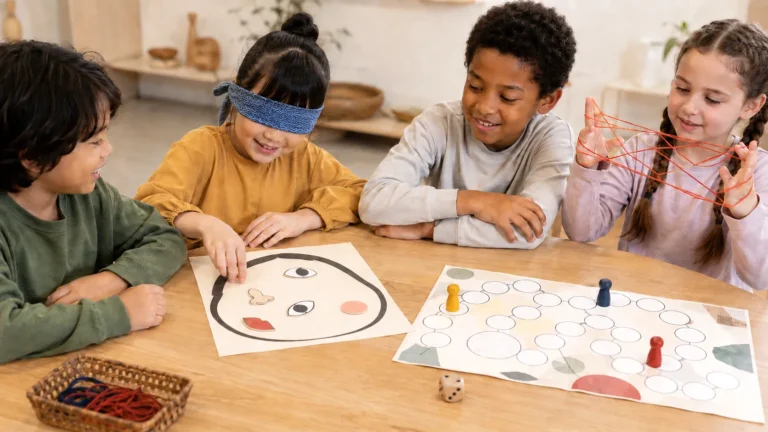
Fukuwarai (a blindfold face-assembly game), sugoroku and ayatori are Japanese traditional games that are easy to try with a few household items and a printed sheet. Even without knowing any Japanese, they’re easy to join in with a quick demonstration or a simple diagram, and they work not only at home but also in Japanese-language teaching and in lessons that introduce Japanese culture.
This article compares fukuwarai, sugoroku and ayatori, and sets out the basic rules, how to use printable materials, the historical background, and the points worth keeping in mind when using them in a teaching setting.
Japanese traditional games are also a form of culture—one you come to understand not by reading an explanation, but by using your hands and playing with someone. When you introduce them in a home or classroom abroad, rather than playing up a sense of “Japanese-ness,” start simply by experiencing the game itself.
Table of Contents
Why do Japanese traditional games still work so well at home and in the classroom?
Fukuwarai, sugoroku and ayatori share one thing: they need no special equipment, and you can start from everyday materials such as paper and string. Another reason they fit easily into a home or classroom is that, rather than having to grasp a complicated explanation before you begin, you can convey the rules by showing them in action.
Sugoroku in particular is interesting for thinking about the relationship between play and paper culture. Historically, there have been two different games called sugoroku: ban-sugoroku, a backgammon-type board game, and e-sugoroku, a picture race game. The e-sugoroku, closest to what people generally picture as sugoroku today, spread mainly in the Edo period as an entertainment for ordinary people.
The Edo-period e-sugoroku introduced by the National Diet Library depict a wide range of subjects: travel, famous places, people, kabuki, stories, and the customs of the day. They were not simply game boards but a visual medium through which, while playing, you could encounter the society and interests of the period.
(Source: Travel, People and Everyday Life on Paper: Edo Sugoroku | National Diet Library)
In the late Edo period, there were also e-sugoroku whose designs were created by popular print artists and produced using multicolour woodblock printing (mokuhan tashoku-zuri). Edo-period sugoroku made with multicolour woodblock printing can also be found in the holdings of the National Museum of Japanese History.
(Source: New Year Detailed-View Sugoroku | National Museum of Japanese History)
Editor’s Note
At Kogei Japonica we usually deal with culture that survives as “things”—vessels, textiles, woodwork, lacquerware. But something like sugoroku, printed on paper, cut by hand, spread open, and folded away once the game is over, is also a form of culture in which object and action are bound together.
There’s no need to think of today’s free printables as direct successors to Edo-period e-sugoroku. Still, the idea of laying out information on a single sheet of paper and passing it on to someone through play does have something in common. Culture begins to move not when you look at a finished object, but when it is actually used. This view matters when thinking about traditional crafts, too.
From what age can you play fukuwarai, sugoroku and ayatori? [Comparison table]
Fukuwarai, sugoroku and ayatori each call for different movements and different rules to understand. There is no officially fixed target age for these games, so rather than deciding uniformly on “from age 3” or “from age 4,” it is important to choose according to a child’s stage of development and the difficulty of the material.
When choosing a game, it is easier to decide if you use not only age but also the tools required, the number of players, how much it depends on Japanese, and the kind of activity it suits.
Comparison table
| Game | Who it may suit | Players | Main items needed | Japanese needed | Printable components | Features |
|---|---|---|---|---|---|---|
| Fukuwarai | From the stage where a child can handle facial parts; younger children with an adult’s help | Easy to enjoy with two or more | Face base sheet, facial parts, blindfold | Not required | Face base sheet, facial parts | Extends easily into vocabulary for the face and words for position |
| Sugoroku | From the stage where a child understands turns and the numbers on a die | Easy to enjoy with two or more | Board, pieces, die | Not required for the basic rules; depends on the square content | Board, pieces, paper die | Can be set to a theme and extended to cultural or language learning |
| Ayatori | From the stage where a child can manipulate string with the fingers; difficulty varies by the figure | Possible from one player | A loop of string | Not required | Step cards, diagrams | Not the paper itself but a step sheet is used as a supporting material |
Definition box
What is fukuwarai?
A game in which, while blindfolded, you feel your way to place parts such as the eyebrows, eyes, nose and mouth onto a face outline, and enjoy the finished expression.
What is sugoroku?
In the form widely known today, you roll a die, move your piece, and aim for the “goal” (agari). Historically, however, two different games—ban-sugoroku and e-sugoroku—have been called sugoroku.
What is ayatori?
A game in which you hook a single loop of string over your fingers and hands and, by changing how you move your fingers, make various figures. Similar string games known as string figures exist all over the world, so it is important not to position it as a game found only in Japan.
With ayatori, it is worth being careful not to assert that it is “a traditional game unique to Japan.” The International String Figure Association has built up materials and research on string figures from around the world, and Japanese ayatori is recorded among them as well.
(Source: Bulletin of the International String Figure Association | International String Figure Association)


How to play fukuwarai and how to use the printable template
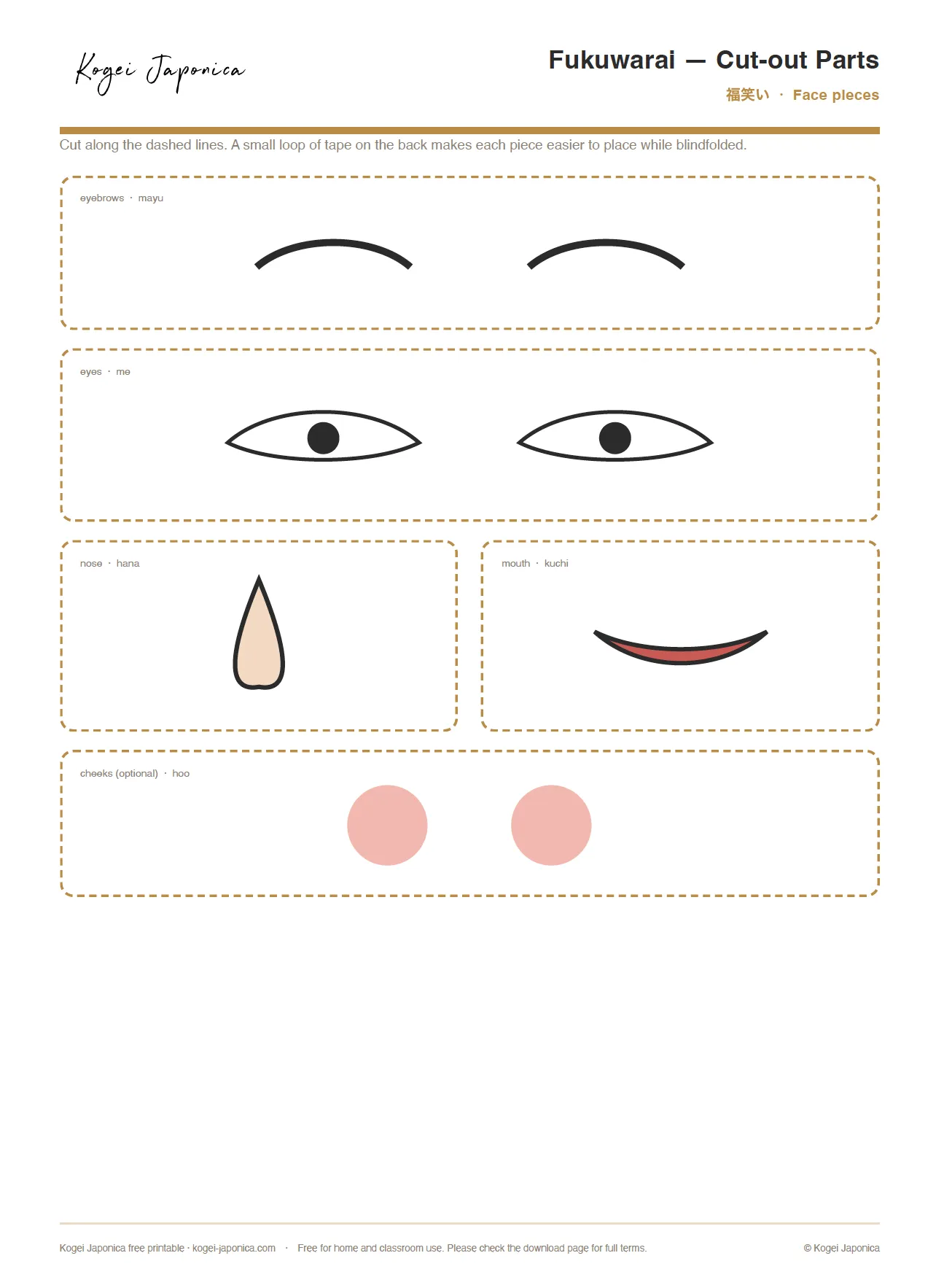
Fukuwarai has straightforward rules: you can start once you have a face outline and parts such as the eyes, nose and mouth. When using printable materials, the activity is easier to manage if you print the face base sheet and the facial parts separately.
The basic steps are as follows.
- Place the base sheet with the face outline drawn on it
- Cut apart the parts—eyes, nose, mouth, eyebrows, and so on
- The player puts on a blindfold
- Place the facial parts one by one by feel
- Once everything is placed, take off the blindfold and look at the finished expression
Rather than being mainly about winning or losing, the point of the game lies in enjoying, together with those around you, the unexpected expressions that arise from eyes and a mouth set off from their proper positions.
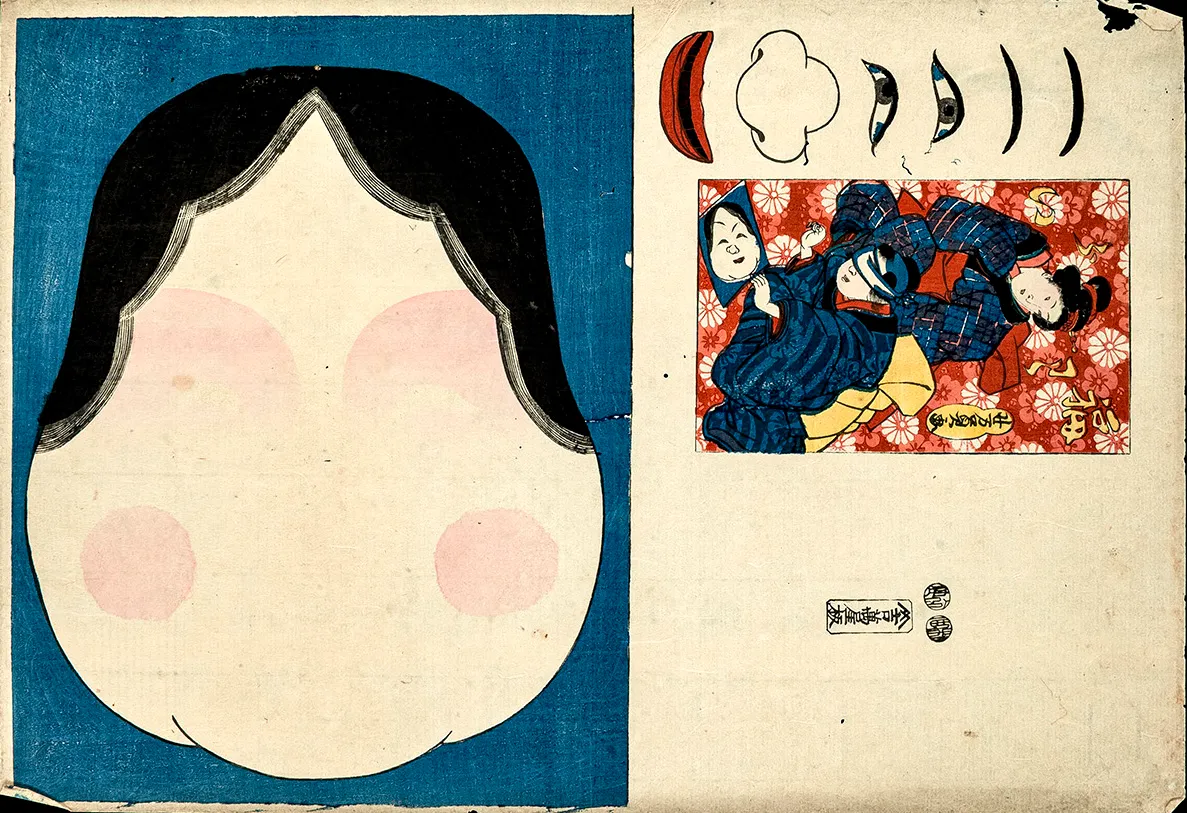
The origins of fukuwarai should be described with some caution. The National Diet Library’s Collaborative Reference Database notes that, although its exact year of origin is unknown, reference materials suggest something thought to be its prototype around the mid-to-late Edo period, and that it became popular as a New Year game from around the mid-Meiji period onwards.
(Source: When did the game of fukuwarai begin? | National Diet Library, Collaborative Reference Database)
When using it in Japanese-language learning abroad, you can also add vocabulary like the following as you play.
- 目:me / eye
- 鼻:hana / nose
- 口:kuchi / mouth
- 右:migi / right
- 左:hidari / left
- 上:ue / up
- 下:shita / down
That said, there’s no need to turn every cultural game into a learning task. It works just as well to play first, laugh or be surprised, and only then explain the name and cultural background: “this game is called fukuwarai.”
If you use a blindfold, take care with safety—for example, staying seated rather than walking around. When small facial parts or scissors are involved, a parent or teacher watches over the activity according to the age and developmental stage of those taking part.

How to play sugoroku and how to use the printable template
Sugoroku is a game in which you prepare a board, pieces and a die, and take turns rolling the die and moving your piece by the number that comes up. In the form widely known today, you set off from the “start” (furidashi) and aim for the “goal” (agari).
The basic flow is as follows.
- Place everyone’s pieces at the start
- Take turns rolling the die
- Move your piece by the number rolled
- Follow any instructions on the square
- Aim for the goal
With printable materials, you can include not only a shop-bought die but also a build-it-yourself paper die as a set. For pieces, you can print dedicated parts, or use small objects you have to hand.
One of sugoroku’s strengths is that you can freely change the game’s theme by what you write on the squares. For language learning you might use simple questions; for a lesson on Japanese culture you can set a particular theme such as the seasons, food culture, or a region.
At the same time, in trying to express “Japanese culture” there’s no need to line up easy signifiers—Mount Fuji, cherry blossoms, kimono, ninja—at random. Deciding on one thing you want people to learn about, and choosing only the elements that theme needs, makes it clearer both as teaching material and as a cultural introduction.
According to the National Diet Library, Edo-period e-sugoroku used a variety of subjects: journeys and famous places, people, stories, and everyday customs. Looking at what was drawn on the squares is itself a clue to the interests and society of people at the time.
(Source: Sugoroku Depicting Everyday Life | National Diet Library)
The National Diet Library also notes that, after the education system was established in 1872, “educational sugoroku” made for teaching purposes appeared as well.
(Source: Edo Sugoroku: Goal and References | National Diet Library)
Even now, the National Museum of Japanese History introduces Meiji- and Taishō-period sugoroku as materials that can be used in school education. In other words, sugoroku is not just something you play after a history lesson: the play material itself can serve as a way in to thinking about a period and its society.
(Source: Materials for the Classroom | National Museum of Japanese History)
Editor’s Note
Looking at e-sugoroku, sugoroku starts to seem less like a mere game board and more like a device for editing a world onto a single sheet of paper. Make travel the theme and it becomes a map of a region; make crafts the theme and it becomes teaching material that moves through materials and production areas.
Reproducing old sugoroku exactly is not the only way to carry a culture forward. Understanding the way of thinking—”what to place on each square, and in what order players encounter it”—and applying it to learning today is also one way of engaging with culture.
A checklist for running these games smoothly in class or at home
When running traditional games at home or in class, it is more important to plan around the actual participants and materials you’ll use than to set a single age. Printable materials should always be test-printed before publication or classroom use.
- Have you printed the materials you’ll use once beforehand to check them?
- Have you prepared enough sets for the number of players?
- Have you prepared anything that needs cutting out, such as fukuwarai’s facial parts?
- Have you set safety rules for when children use scissors?
- Have you prepared a clean blindfold for fukuwarai?
- Have you prepared the pieces and die for sugoroku?
- Have you checked that the ayatori string is an easy length for participants to handle?
- Have you explained not to wind a long string around the neck or body?
- In a multilingual class, have you made sure the rules can also be conveyed by diagrams and demonstration?
- Have you kept the cultural explanation brief enough to leave time to play first?
- Have you checked the terms of use for any PDF or image you’re using?
Ayatori is not a game played with paper itself. So for free printables, rather than making a printout to stand in for the string, it is better to design a step card that shows the positions of the fingers and string.
Kōka City describes ayatori as “a game in which you hook a loop of string over your fingers and wrists and change it into all sorts of shapes,” and sets out both ways to make figures on your own and ways for two people to take the string from each other.
(Source: Ayatori | Kōka City)
Note, too, that being able to view images released by government bodies, museums or libraries is not the same as being free to reproduce or redistribute those images in your own materials. When making free materials, it is best to check each institution’s terms of use and, as a rule, to produce your own illustrations.
Frequently asked questions (FAQ)
Here are the points that tend to cause hesitation when using fukuwarai, sugoroku and ayatori at home or at school.
- Q. From what age can you play fukuwarai?
- There is no officially fixed target age. Check whether the child can handle the facial parts and use a blindfold safely, and adjust to their stage of development. With very young children, one option is to start with a version that lays out the face without a blindfold.
- Q. How can I explain the rules of sugoroku simply for children?
- Start from the basics: “roll the die,” “move by the number rolled,” “aim for the goal.” Additional rules for each square are easier to understand if you explain them when a player actually lands there.
- Q. Is ayatori a traditional game found only in Japan?
- It is not a game found only in Japan. String figures, made by forming shapes with string, exist all over the world, and the ones handed down in Japan are called ayatori.
- Q. Can children who can’t read Japanese still play?
- Yes. If you teach fukuwarai and ayatori mainly through demonstration and diagrams, children can take part without reading Japanese. Sugoroku, too, is easy to join in if you use squares that don’t depend on text, or materials with English alongside.
- Q. Are there traditional games you can play alone?
- Ayatori can be enjoyed on your own, making figures. You can try fukuwarai and sugoroku alone as well, but they tend to be more enjoyable when played with others.
- Q. Can the free printables be used in schools and cultural institutions?
- The actual scope of use follows the terms of the download page where they are released. The terms should clearly state whether classroom use, copying, redistribution, modification, and use at commercial events are permitted.
- Q. What paper size is suitable for printing?
- Check the size given in the actual distribution file you’re using. If use abroad is expected, it is easier to use if US Letter is supported as well as A4. Always run a full-size test print before publishing.
Learn more about related Japanese traditional games
Fukuwarai, sugoroku and ayatori each involve the hands in a different way—laying out a face, moving across a board, or forming shapes with string.
At Kogei Japonica, we introduce the history and rules of each in more detail in separate articles. If a free printable sparks your interest in a game, we’d encourage you to explore its cultural background as well.
The point of a free printable is not to download a sheet and be done. It is that, from a single sheet of paper or a single loop of string, play actually begins somewhere in a home or classroom, creating an opportunity to talk about culture—”why is this the way it is?”
Editor’s Note
Using your hands, remembering the order of turns, laughing when things don’t go as planned, and having someone who knows the game teach someone who doesn’t. In both crafts and traditional games, a culture that a finished object alone cannot show lies within those actions.
At Kogei Japonica, we believe that, rather than preserving old forms unconditionally, checking the historical background while finding ways to actually engage with them in daily life today is one way of placing culture in the hands of the next generation.
Kogei Japonica also welcomes enquiries about the planning, production and supervision of Japanese cultural teaching materials for use by schools, local authorities, cultural institutions, international-exchange programmes and others. Rather than simply lining up “Japanese-looking” motifs, we place importance on designing content grounded in its history and cultural background.