




You may have come across the word “chinkin” on a museum label or in the description of a lacquerware piece — and found yourself uncertain what it actually meant. “How is it different from maki-e?” “I know it has something to do with Wajima lacquerware, but what makes it distinct?” These are reasonable questions to carry around half-answered.
This article draws on primary sources to explain what chinkin is, how it compares with maki-e and kinma, how it relates to Wajima lacquerware, and what the designation of Mae Fumio as a holder of Important Intangible Cultural Property tells us about where this technique stands today.
It also addresses where Wajima — and the transmission of its craft — currently sits.
Understanding chinkin is one way into the broader world of urushi. And knowing something about the people and places sustaining it tends to change how you look at the objects themselves.
Table of Contents
What Is Chinkin? — Carving the Lacquer Surface, Sinking the Gold

Chinkin is a decorative urushi technique in which patterns are carved into a cured lacquer surface using specialized engraving chisels, lacquer is then rubbed into the carved lines, and gold powder or gold leaf is pressed in to complete the design.
The defining characteristic is that the gold is not applied on top of the surface but settled into it — “sunk,” as the name suggests. Ishikawa Prefecture’s cultural property documentation describes chinkin as a technique that “developed to a particularly high level in Wajima, Ishikawa Prefecture, from the early modern period onward.”
(Source: Chinkin (Mae Fumio) | Ishikawa Prefecture)
Chinkin: key facts
- Technique name: Chinkin / 沈金
- English description: Engraved-gold lacquer technique — designs are carved into cured lacquer, then filled with gold powder or gold leaf
- Category: Decorative urushi technique
- Primary associated region and craft: Wajima, Ishikawa Prefecture (Wajima lacquerware)
- Characteristics: The depth of the carving and the choice of fill material — gold, silver, platinum — allow for variations in tone, shadow, and a sense of relief
- Holder of Important Intangible Cultural Property (chinkin): Mae Fumio (designated 1999)
- Video documentation: “Chinkin — The Techniques of Mae Fumio,” Cultural Heritage Online (Agency for Cultural Affairs)
The Three Stages of Chinkin — Carve, Rub, Fill
The chinkin process can be broken into three broad stages.
Carving
The first step is incising the pattern into the cured lacquer surface using a chinkin chisel. There is more than one carving method: sen-bori (line carving), in which fine lines are cut; ten-bori (dot carving), in which repeated points are struck; a scraping technique that removes material across a broader area; and itto-bori (single-stroke carving), associated with Mae Fumio’s practice. The choice of method determines much of the finished character of the work.
Rubbing in the lacquer
A thin layer of lacquer is then worked into the carved grooves. The quantity applied and the manner of application directly affect how well the fill material adheres.
Filling with gold
Gold powder or gold leaf is pressed into the carved lines, and any excess is removed to finish the surface. The choice of fill material — gold, silver, platinum, or other metallic powders — affects how the finished work catches and reflects light.
Every carved line requires a judgment about pressure and angle. On a large piece, hundreds or thousands of individual marks accumulate. That is worth keeping in mind when handling a finished work.
Why “Chinkin”?
The characters 沈金 can be read as “sunken gold,” reflecting the idea of gold set into the carved surface rather than laid on top of it.
In maki-e, a design is drawn in lacquer and metallic powder is dusted over the wet surface. In chinkin, the surface is carved first and the gold is contained within the resulting grooves. When light strikes a maki-e surface, the gold sits at the top of the lacquer and reflects directly outward. In chinkin, the gold is set slightly below the surface, and the light it returns comes from a marginally deeper plane. The difference reads as a quality of restraint rather than brilliance — though placing the two side by side makes the distinction easier to grasp than written descriptions suggest.
Chinkin vs. Maki-e vs. Kinma — Comparing Three Decorative Urushi Techniques
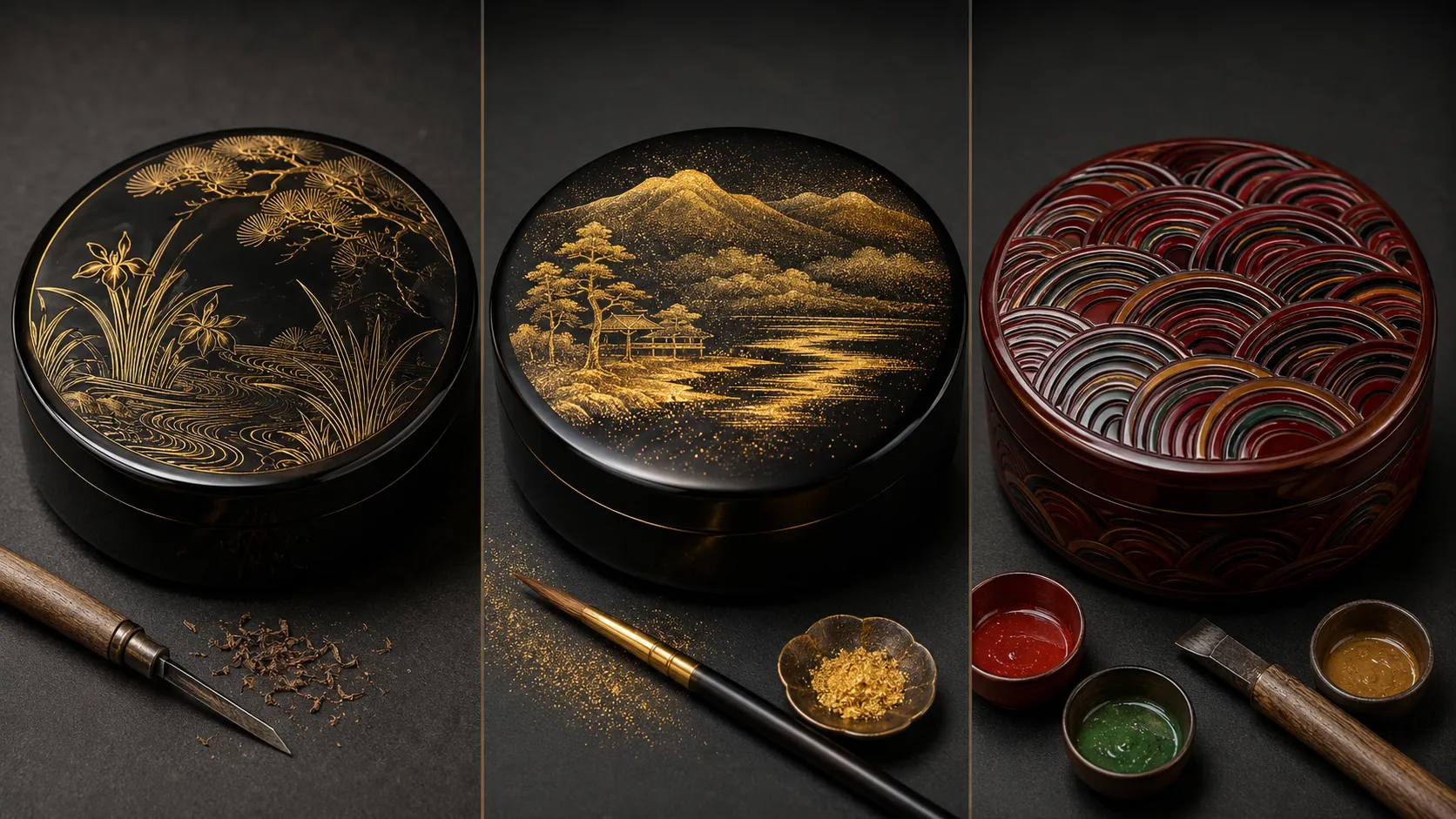

Chinkin carves and fills with gold. Maki-e draws with lacquer and dusts with metallic powder. Kinma carves and fills with colored lacquer, then polishes the surface back. All three are decorative urushi techniques, but their starting points, working sequences, and visual results are each different.
Comparison Table: Chinkin, Maki-e, and Kinma
| Criteria | Chinkin | Maki-e | Kinma |
|---|---|---|---|
| Core action | Carve, then fill with gold | Draw with lacquer, then dust with metallic powder | Carve, fill with colored lacquer, then polish back |
| Visual character | Linear tension, restrained light, carved shadow | Painterly, luminous, expansive surface coverage | Layered color, repeating pattern, carved and lacquered texture |
| Key things to look at | Precision of carving, quality of gold fill, relationship to the lacquer ground | Powder grain, compositional structure, finish type (togidashi, hira, taka) | Color lacquer strata, rhythm of the pattern |
| Primary associated region | Wajima, Ishikawa Prefecture | Kyoto, Wajima, and other regions | Takamatsu and the broader Kagawa lacquer tradition |
| Common point of confusion | Gold decoration leads to confusion with maki-e | Can look similar to chinkin at a distance | Shares the carving process with chinkin |


Placing all three together reveals something useful. Chinkin and kinma both begin with carving, but filling the grooves with gold versus with colored lacquer produces entirely different results. Chinkin and maki-e both use gold, but their working sequences run in opposite directions — maki-e applies decoration to the surface, chinkin removes material from it first. Organizing these three by “does it involve carving?” and “is the fill gold or colored lacquer?” is more clarifying than grouping by whether gold appears in the finished piece.
How to Tell the Difference in Front of an Actual Work
When looking at a piece directly, the first thing to check is whether the gold sits on the lacquer surface or slightly within it.
In maki-e, the metallic powder rests on top of the lacquer, and there is sometimes a barely perceptible raised quality to the decorated areas. In chinkin, the gold is contained within carved grooves, and if you look across the surface at an angle, the gold appears set just below the plane of the surrounding lacquer.
This distinction rarely comes through in photographs. The most direct way to understand it is to look at actual objects in a museum, workshop, or shop — ideally alongside any available technical descriptions — and to vary the angle of viewing.
Chinkin in Wajima Lacquerware — Surface Decoration Built on Accumulated Ground
In Wajima lacquerware, the combination of a highly durable ground preparation and high-level surface decoration has allowed chinkin and maki-e to develop considerable expressive depth. When chinkin is described as representative of Wajima lacquerware, the claim rests not simply on the presence of skilled individual practitioners but on the sustained technical standard the production region has maintained across the full sequence from ground preparation to finished decoration.
The Relationship Between Wajima Lacquerware and Chinkin

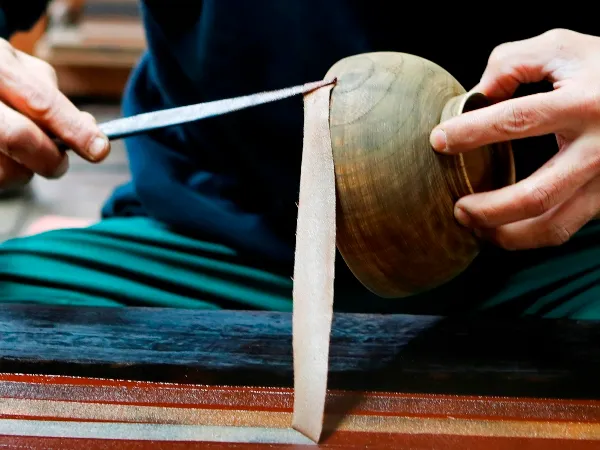
One of the most widely recognized features of Wajima lacquerware is its ground preparation, which incorporates ji-no-ko — a powdered material produced by firing the diatomite found in the Wajima region. This produces a ground of exceptional hardness, which in turn provides the foundation that fine surface decoration requires.
That hardness matters directly for chinkin. Carving fine lines into a lacquer surface that is too soft risks collapsing the edges of the carved lines or causing the surrounding lacquer to lift. The ground preparation and the decorative technique are not separable: to discuss chinkin at the level it reaches in Wajima, the ground beneath it has to be part of the account.
(Source: About Wajima Lacquerware | Wajima Lacquerware Cooperative)
Why Wajima Is the Region Associated with Chinkin
The ground preparation is part of the answer, but not all of it. The technical standard that Wajima has maintained over time also reflects how the region has structured the transmission of its craft.
The Wajima Urushi Art Training Institute is a public institution offering systematic training in urushi techniques, and chinkin is part of its curriculum. The existence of a training institution within the production region means that technical continuity does not depend entirely on the individual master-apprentice relationship. There is an institutional structure behind the effort to sustain the craft — and that structure is part of what makes Wajima the region it is for this technique.
Wajima Lacquerware Beyond the “Premium Lacquerware” Label
Wajima lacquerware is often framed primarily in terms of price — and the reputation is not without basis. But the substance of Wajima lacquerware lies not in its price category but in its division of labor, in which materials, ground preparation, surface decoration, and repair are each handled by specialists, and in the regional capacity that has supported that structure over time.
A culture of accepting repair work. Materials sourced through established regional relationships. An institution for training practitioners. These are what have allowed a technique as demanding as chinkin to remain a living part of a production region. That context changes how Wajima lacquerware reads.
What Mae Fumio’s Practice Tells Us About the Depth of Chinkin

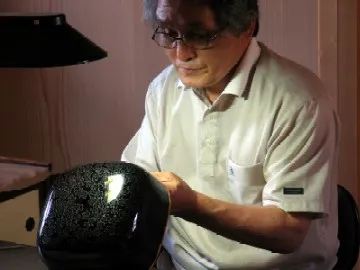
Mae Fumio is a urushi artist designated in 1999 as a holder of Important Intangible Cultural Property in chinkin. His working process is documented in the film “Chinkin — The Techniques of Mae Fumio,” available through Cultural Heritage Online.
“Chinkin — The Techniques of Mae Fumio” on Cultural Heritage Online
Cultural Heritage Online, operated by Japan’s Agency for Cultural Affairs, hosts a filmed record of Mae Fumio’s chinkin process.
The film runs approximately nine minutes and fifty seconds and documents the making of a chinkin box titled “Yugen.” It captures the angle at which the chisel enters the lacquer, the movement of the hands, and the rhythm of the carving — aspects of the technique that written description cannot fully convey.
As a means of understanding craft, filmed records of this kind serve a function that text cannot replace. A written explanation of a technique and footage of a practitioner’s hands at work together bring you closer to a three-dimensional understanding than either does alone.
(Source: Chinkin — The Techniques of Mae Fumio | Cultural Heritage Online)
Mae Fumio as a Holder of Important Intangible Cultural Property
Mae Fumio has worked as a chinkin artist in Wajima over many decades. His designation in 1999 as a holder of Important Intangible Cultural Property — colloquially known in Japan as a Living National Treasure — followed a long career in practice. According to records held by the Japan Crafts Association, he was appointed vice director and lecturer at the Wajima Urushi Art Training Institute in 1989, became chief lecturer in 2001, and served as director and chief lecturer from 2006.
In Japan, designation as a holder of Important Intangible Cultural Property is not an honorary title in the conventional sense. It is a government decision by the Agency for Cultural Affairs to identify a specific individual as someone who embodies a technique at a high level, and to support both the preservation of that technique and the training of successors as a matter of national cultural policy.
Mae Fumio’s designation is, in that sense, also a statement that chinkin itself has been recognized by the state as a form of cultural practice worth maintaining through institutional means.
On Recording and Transmitting a Technique
Editor’s note
Filmed records are an important entry point for understanding a technique. But the transmission of chinkin cannot be completed through film alone. The physical sensation of the chisel entering the lacquer surface, the judgment required to read the material in front of you, the bodily knowledge that accumulates over years of practice — these are what allow a technique to pass to the next generation. The fact that the Important Intangible Cultural Property system places emphasis not only on the technique itself but on the individual who continues to embody it reflects that understanding. Recording and practice are both necessary. Keeping both in view is, I think, the right way to approach chinkin.
Wajima Now — Reading the Recovery Through the Lens of Craft Transmission
Understanding chinkin today also means looking at the region that has sustained it — especially Wajima, where the conditions for transmission have changed dramatically since 2024.
When thinking about Wajima lacquerware after the Noto Peninsula earthquake, two questions need to be held alongside each other: “Is the production region recovering?” and “Is the technique being transmitted?” These are related but not identical. A region’s buildings and distribution networks can return to function while its practitioners have not. That gap should not be overlooked.
Primary Sources for the Current State of the Wajima Production Region
For the current state of the region as of any given time, refer to primary sources: the official Wajima city website, Ishikawa Prefecture’s official earthquake-related information, the Wajima Museum of Urushi Art, and the Association for the Promotion of Traditional Craft Industries. The situation in the production region continues to evolve, and the information in this article should be read alongside the most current official sources.
The Wajima Urushi Art Training Institute and Craft Transmission

The Wajima Urushi Art Training Institute has played a central role in the systematic transmission of urushi techniques within the production region.
Following the January 2024 Noto Peninsula earthquake and the flooding that hit the Noto region in September of the same year, the institute suspended classes for approximately nine months. According to Ishikawa Prefecture documents, classes resumed on October 7, 2024. The fact that the institution responsible for technical transmission has returned to operation is a significant piece of primary information about where the production region currently stands. For detailed information about the institute’s current activities, refer to the institute’s own communications and to Ishikawa Prefecture’s latest official publications.
(Source: Key Events Related to the Earthquake and Flooding | Ishikawa Prefecture)
On Supporting a Production Region Beyond the Immediate Response
An impulse to support Wajima lacquerware is a serious one, and worth taking seriously. But supporting a craft production region does not begin and end with purchasing. Understanding the techniques, knowing the practitioners, learning how the regional structure works — these forms of engagement change the relationship between a person and a craft object. The aim is not a short-lived response to a crisis but a long-term orientation toward the culture a region carries. That is the intention behind this article.
Selecting Chinkin Work — Carving, Light, and Provenance
When choosing a chinkin piece, looking beyond the surface appeal of the gold to the precision of the carving, the quality of the fill, the relationship between decoration and lacquer ground, and the availability of information about the maker, workshop, and production region will deepen the process of selection. Trusting an instinctive response to an object is valuable — being able to articulate something about the basis for that response adds another dimension.
A Checklist for Looking at Chinkin Work
- Does the carving have both rhythm and precision? — Are the lines consistent without being mechanical, and free of unintended irregularity?
- Is the gold fill well-judged? — Neither overloaded nor thin enough to read as sparse?
- Do the decoration and the lacquer ground work together? — Does the pattern read as integral to the surface, or does it sit on top of it?
- Does the composition respond to the form of the object? — Has the arrangement of the design taken the three-dimensional surface into account?
- Does the piece hold up both close and at a distance? — Does it reward examination at close range and retain presence when viewed from further away?
- Is information about the maker, workshop, production region, and technique available? — Is the provenance clearly stated?
- Is guidance on care and repair available? — Is there a point of contact for maintenance questions over the long term?
What to Confirm Before Purchasing or Commissioning
Pricing varies considerably depending on the maker, the work itself, and the distribution channel. For purchases or commissions, going directly to the artist, workshop, or gallery is the most reliable approach.
Size, lead time, installation environment, storage conditions, certificates of authenticity, and repair arrangements are all worth confirming in advance. For larger panel works or pieces intended for spatial installation, the angle and intensity of lighting, humidity levels, and the risk of contact should all be discussed before a decision is made.
Chinkin for Hotels, Retail Spaces, and Corporate Gifting
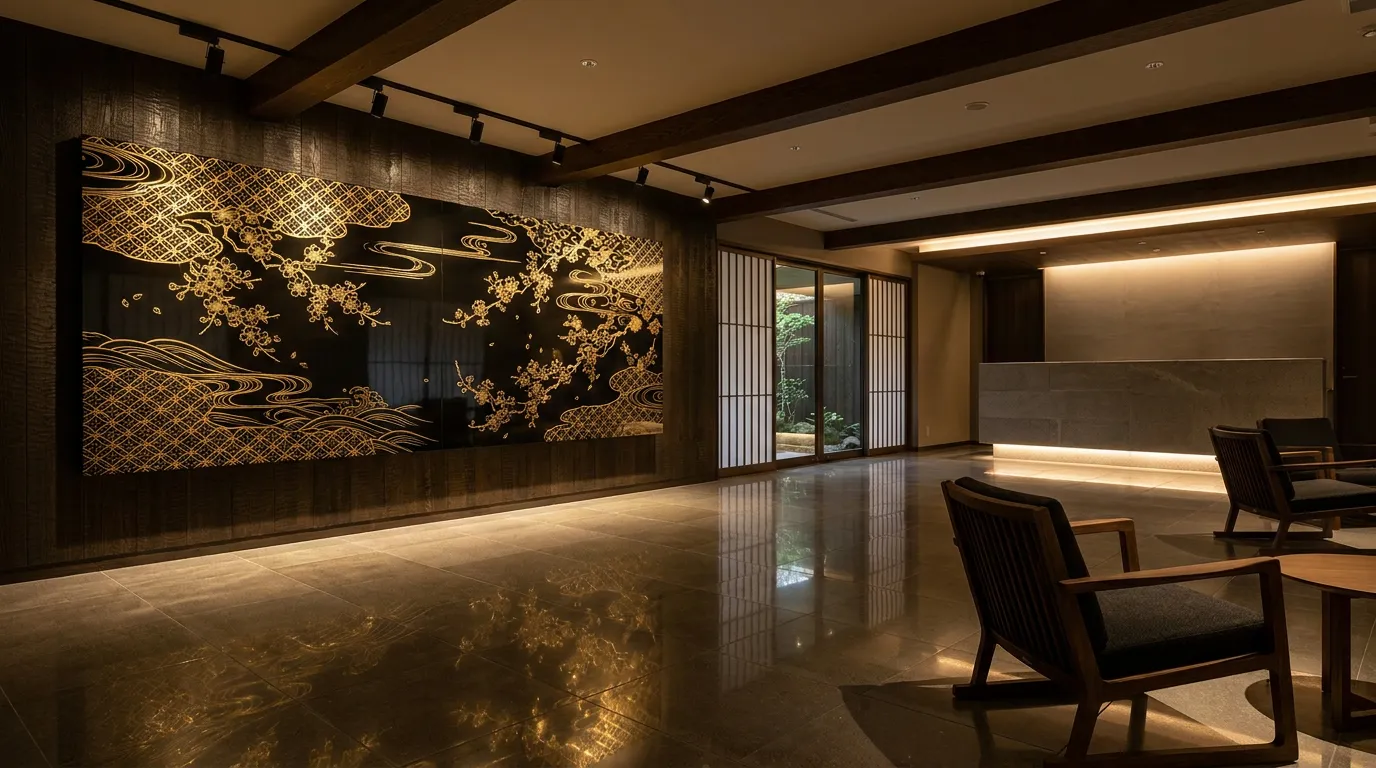

Beyond vessels and decorative boxes, chinkin work is sometimes considered for urushi panels, commemorative pieces, and objects intended for spatial installation. For any such application, the type of work, the installation environment, and the capacity of the relevant artist or workshop to take on the commission all need to be confirmed individually.
What to Establish Before Installing Urushi Work in a Commercial Space
For hotels, ryokan, retail environments, offices, or showrooms considering urushi work, clarifying the following points in advance will make conversations with artists and workshops more productive.
- Installation location and lighting (direct sunlight, spotlight angle)
- Humidity and climate control in the space
- Contact risk (whether visitors or customers are likely to touch the work)
- Required dimensions and installation method
- Whether explanatory material about the technique and its background will be displayed
- Whether an ongoing relationship with the artist or workshop is desired
The way chinkin gold reads is highly sensitive to the angle of the light source. Where possible, testing the work under the actual lighting conditions of the space before finalizing a commission will help avoid a significant gap between expectation and result.
On Corporate Gifting and Commemorative Pieces
When selecting chinkin work for corporate gifts or commemorative purposes, the value lies less in the price of the object than in being able to convey something about the technique and its regional background to the recipient. Including a brief explanation of the craft — a technical note or a description of the production region — alongside the piece gives it a context that would otherwise be lost. Size, lead time, budget, and intended use should all be discussed with the relevant artist, workshop, or gallery before any commitment is made.
Inquiries and Consultation with Kogei Japonica
For those considering chinkin or Wajima lacquerware for hotel or retail installation, corporate gifting, or commemorative purposes, we can assist with selection according to use, space, and budget, and with facilitating introductions to relevant artists and workshops.
If you are at an early stage and unsure where to direct an inquiry, that is a reasonable place to start a conversation.


Frequently Asked Questions about Chinkin
Questions about what chinkin is, how it differs from maki-e, its relationship to Wajima lacquerware, how to look at it, and how to describe it in English.
- What is chinkin?
- Chinkin is a decorative urushi technique in which patterns are carved into a cured lacquer surface using engraving chisels, lacquer is rubbed into the carved lines, and gold powder or gold leaf is pressed in to complete the design. The defining characteristic is that the gold is settled into the carved surface rather than applied on top of it.
- How do you read “chinkin” in Japanese?
- It is read “ちんきん” (chinkin). In English it is written as “chinkin” in romanization, or described as “engraved-gold lacquer technique.”
- What is the difference between chinkin and maki-e?
- Chinkin carves into the lacquer surface first and then fills the carved lines with gold. Maki-e draws a design in lacquer and dusts metallic powder over the wet surface. Both techniques use gold, but the working sequences are opposite in direction.
- Is chinkin exclusive to Wajima lacquerware?
- Chinkin is strongly associated with Wajima lacquerware and is widely regarded as one of its signature decorative techniques, but it is not a technique exclusive to Wajima. That said, the hardness of Wajima’s ground preparation and the region’s structures for transmitting craft skills have supported the technique’s development over a long period.
- What should I look for when examining a chinkin piece?
- The precision of the carved lines, the quality and consistency of the gold fill, the relationship between the decoration and the lacquer ground, and the correspondence between the composition and the form of the object are all worth attention. Being able to confirm information about the maker, workshop, production region, and technique adds another dimension to the experience.
- Can chinkin work be used in hotel or retail spaces?
- Urushi panels and other works can be suitable for spatial installation, depending on the specific piece and context. Before proceeding, it is advisable to clarify the lighting, humidity, contact risk, and maintenance arrangements for the intended location, and to discuss these directly with the artist or workshop.
- How do you describe chinkin in English?
- “Chinkin is an engraved-gold lacquer technique in which designs are carved into the cured lacquer surface and filled with gold powder or gold leaf.” To distinguish it from maki-e: “Unlike maki-e, which involves drawing with lacquer and dusting with gold powder, chinkin carves into the surface first and then inlays the gold.”
Summary
Chinkin is not a technique in which gold is dusted over lacquer. It is one in which the lacquer surface is carved and the gold is sunk into it. That distinction, in a single sentence, is what separates it from maki-e.
This article has tried to connect several things: a definition of the technique, a comparison with maki-e and kinma, the regional context of Wajima lacquerware, the figure of Mae Fumio and the filmed record of his practice, and the current state of the training institution that has carried technical transmission in that region.
Knowing what chinkin is does not mean memorizing the name.
It means building a picture — gradually — of who carves it, where it is learned, what supports its continuation, and where it stands now. That kind of accumulated knowledge is what allows a sustained engagement with craft objects over time.
The Wajima Urushi Art Training Institute has resumed classes. Practitioners are continuing to work with the question of technical transmission. We hope that sharing these facts with readers who care about craft has been a useful part of what this article does.


