

If you’ve ever wanted to try pottery but weren’t sure where to begin, you’re not alone. What tools do you need? How does a one-day experience class differ from enrolling in a regular course? And what exactly are all those different types of Japanese ceramics? The moment you start researching, the volume of information can make the entry point feel harder to find, not easier.
This guide is written for people who are just starting out — or simply considering their first experience — and brings together the essentials on how to get started, core forming techniques, tools, and the basics of Japanese ceramics in one place. Rather than going deep on specialist technique or individual artists, it focuses on what helps beginners orient themselves without getting lost.
For international visitors to Japan, there’s also a section on finding English-language experience classes. If you’re taking your first step into pottery, a single-session experience class is the most practical and accessible place to start. Read through, and find the entry point that suits you.
What you’ll find in this guide
- How to get started with pottery (experience classes, regular courses, and home practice)
- The three core forming techniques every beginner should know — and how they differ
- Why you don’t need to buy tools for an experience class, and what to check beforehand
- The difference between earthenware and porcelain, and a primer on Japan’s Six Ancient Kilns
- Where to take your interest after your first pottery experience
Table of Contents
1. What Is Pottery? | The Big Picture for Beginners
Pottery is one part of the broader world of ceramics: it involves shaping clay, then drying and firing it to produce vessels and objects. In Japan, the craft has a history going back to the Jōmon period, making it one of the oldest continuous forms of making in the country. Today it remains widely practiced as a hobby, a cultural activity, and a popular hands-on experience for travelers.
It can look intimidating from the outside, but the entry point is more approachable than it seems. There isn’t much you need to know before your first session — the fastest way to understand pottery is simply to try it.
Ways to Engage with Pottery
There are three broad ways people engage with the craft:
As an ongoing hobby
Making vessels at a studio or at home, and using the finished pieces in everyday life. There is a particular satisfaction in using a cup, bowl, or plate you made yourself — an everyday object that carries the imprint of your own hands.
As a travel experience
Single-session experience classes, typically one to three hours long, are available throughout Japan — in ceramics-producing regions and major cities alike. Making a one-of-a-kind piece as a travel memento is a popular draw, and these classes are increasingly sought out by international visitors as well.
As a way into Japanese craft culture
Each ceramics-producing region in Japan has its own history, technique, and clay character. Visiting those regions, or looking closely at the work of individual makers, opens up a dimension of the craft that goes well beyond the studio.
None of these is the “right” entry point. Getting your hands on clay is where understanding begins.


Where Should a Beginner Start? | The Short Answer
The short answer is: start with an experience class, and decide what comes next from there.
Setting up at home from scratch means sourcing clay, tools, a drying space, and access to a kiln — the upfront investment in both cost and logistics is considerable. An experience class removes all of that. Materials and tools are provided, and you can focus entirely on the process itself.
Whether pottery suits you — and which technique appeals to you most — isn’t something you can work out in advance. One session gives you enough to go on. The first step doesn’t need to be a big one.
2. How to Get Started | Three Entry Points
There are three main ways to begin. The right one depends on whether you want to try pottery once, build it into a regular practice, or work independently.
Single-Session Experience Classes (One-Day Pottery Experiences)
For most beginners, this is the natural starting point.
Sessions typically run one to three hours, with fees generally ranging from around ¥2,000 to ¥6,000. Clay and tools are usually included, though some studios ask participants to bring their own apron — worth confirming before you go. Wear clothes you don’t mind getting clay on.
Before booking, it’s useful to check three things:
- Which technique is on offer (hand-building, the potter’s wheel, or both)
- Whether the studio fires your piece (unfired clay is not a finished work)
- When and how you receive the finished piece (firing typically takes several weeks to a month and a half)
The last point matters most if you’re visiting from out of town or from abroad. Many studios offer postal delivery, so it’s worth confirming before you book.

Enrolling in a Regular Pottery Course
If a single session leaves you wanting more, a regular course is the next step.
Monthly fees typically run from around ¥5,000 to ¥15,000. Tools and kiln use are generally covered by the studio, and most courses run on a schedule of once a week to twice a month — flexible enough to fit around other commitments.
The meaningful difference from a one-off experience is that technique develops through repetition. Skills that are hard to get a feel for in a single session begin to settle into muscle memory over several visits.
Working at Home | Is It Realistic for Beginners?
Home pottery is possible, but the barriers are real.
Even a compact electric kiln runs to several hundred thousand yen, requires dedicated space, and may require electrical upgrades. Clay storage and drying space add to the logistics. There are oven-cure clays available for home use that don’t require a kiln, but the results are quite different from traditionally fired ceramics.
A more practical route is to build a foundation at a studio first, get a clear sense of what you want to make, and set up a home practice once you know what kind of environment that requires.
For International Visitors | Finding English-Language Experiences
If you’re visiting Japan and want to join a pottery class, check whether the studio offers instruction in English before booking.
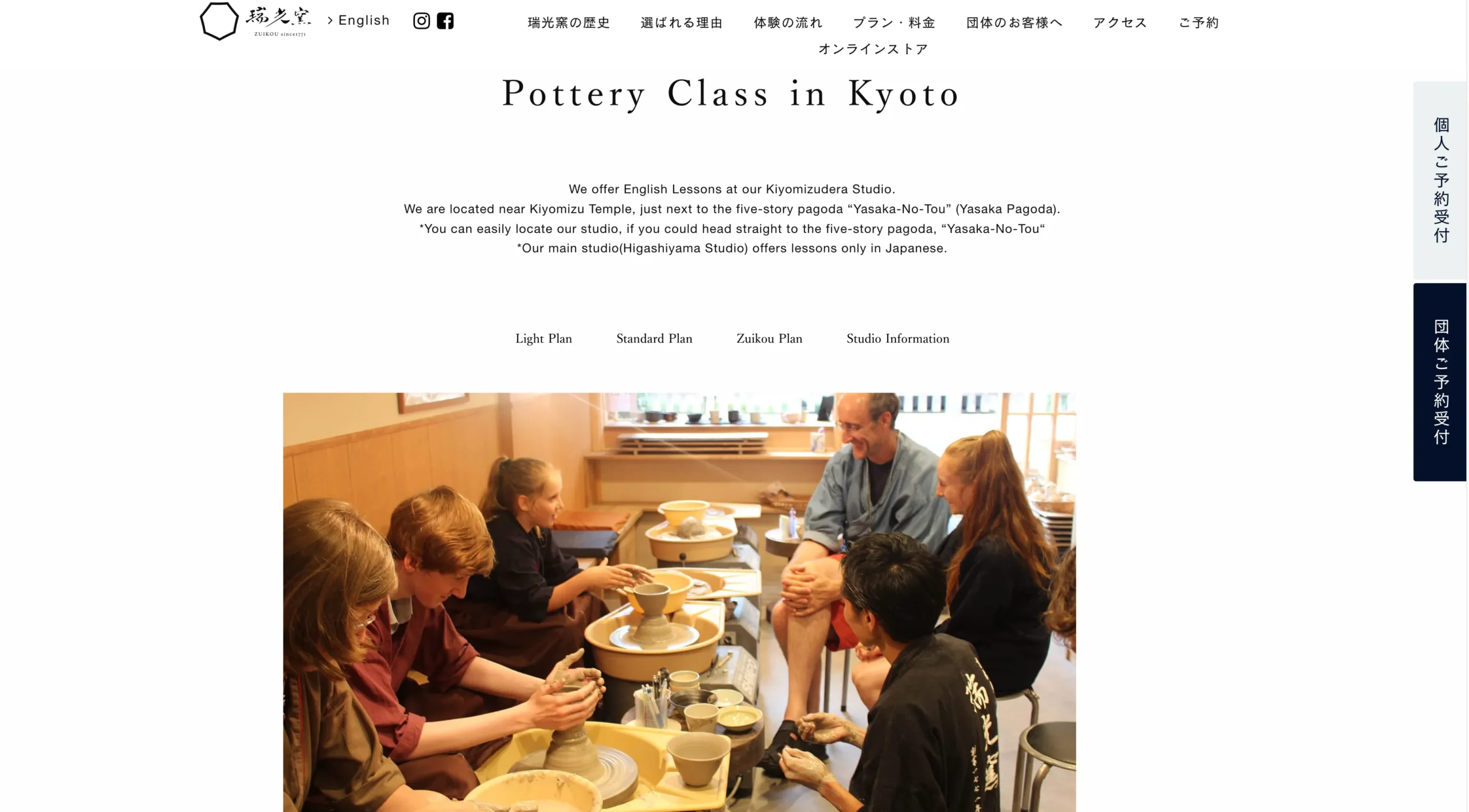
Zuikou Pottery Studio’s Kyoto Kiyomizu location offers English-language sessions, with instruction that covers both technique and the cultural context behind it. International shipping is available for finished pieces, which matters if your travel schedule doesn’t allow for a return visit.
(See: Zuikou Pottery Studio — English Experience Page)
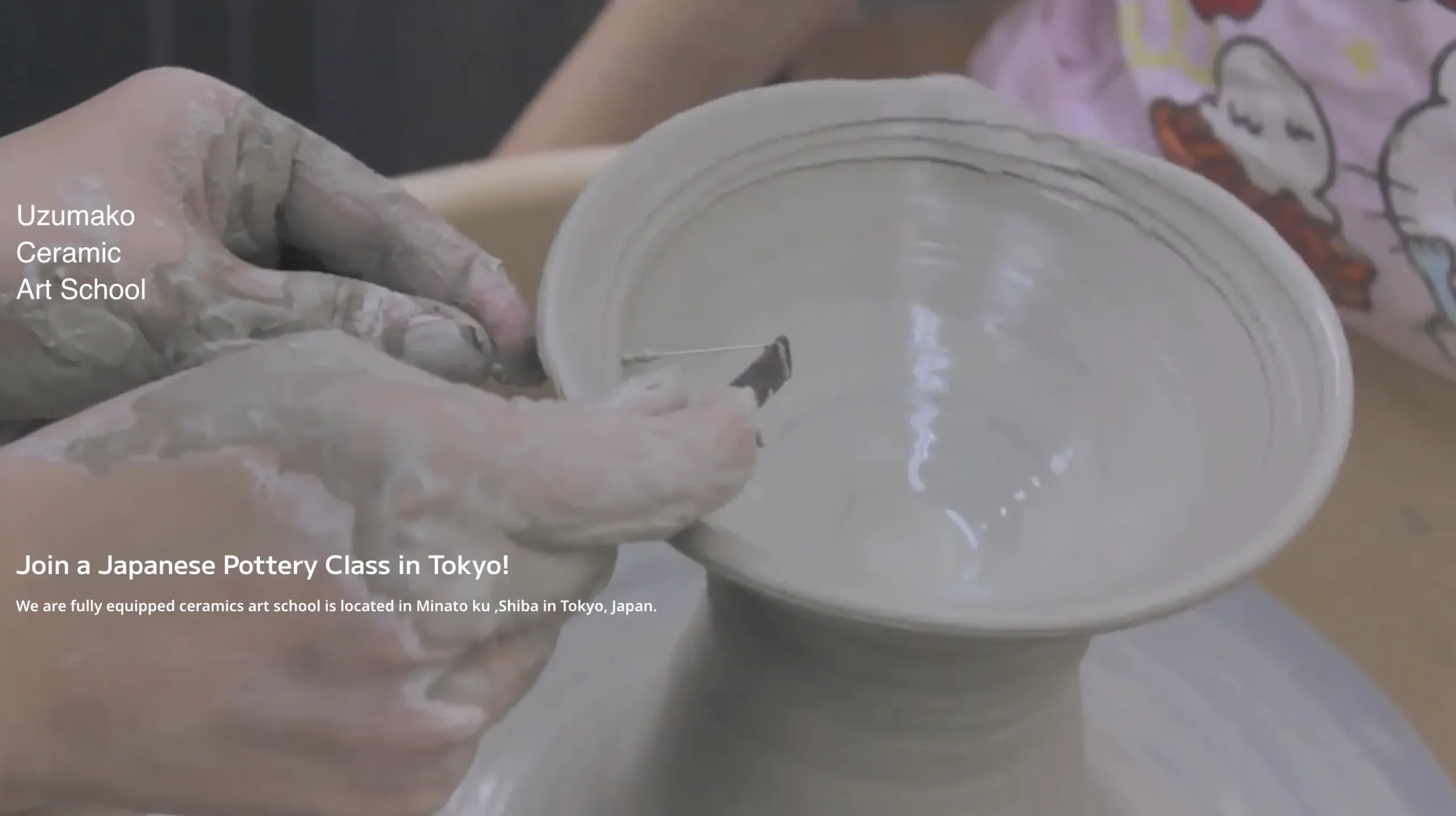
Uzumako Ceramic Art School in Minato, Tokyo offers dedicated English classes and sits close to Tokyo Tower, making it easy to reach from most central neighborhoods. Tools and aprons are provided; no prior experience or equipment is needed.
(See: English Pottery Classes | Uzumako Ceramic Art School)
Booking through a studio’s official website or an online travel platform is the most reliable approach. If you’re traveling and won’t be able to return for your finished piece, confirm international shipping availability before you book.
3. Core Forming Techniques | Hand-Building, the Potter’s Wheel, and Slab Building
Pottery uses several distinct methods for shaping clay. You don’t need to learn them all at once — but understanding hand-building, the potter’s wheel, and slab building will make an experience class much easier to follow, and give you a better sense of what you’re looking at when visiting a ceramics region.
Hand-Building (Te-biineri)
Hand-building — te-biineri in Japanese — is the most fundamental forming method: shaping clay directly with your hands, without a wheel or mechanical assist. For that reason, it’s well-suited to beginners.
Simple forms — small plates, yunomi tea cups, bowls — are relatively forgiving, and most people can bring a piece close to finished in a one- to two-hour session.
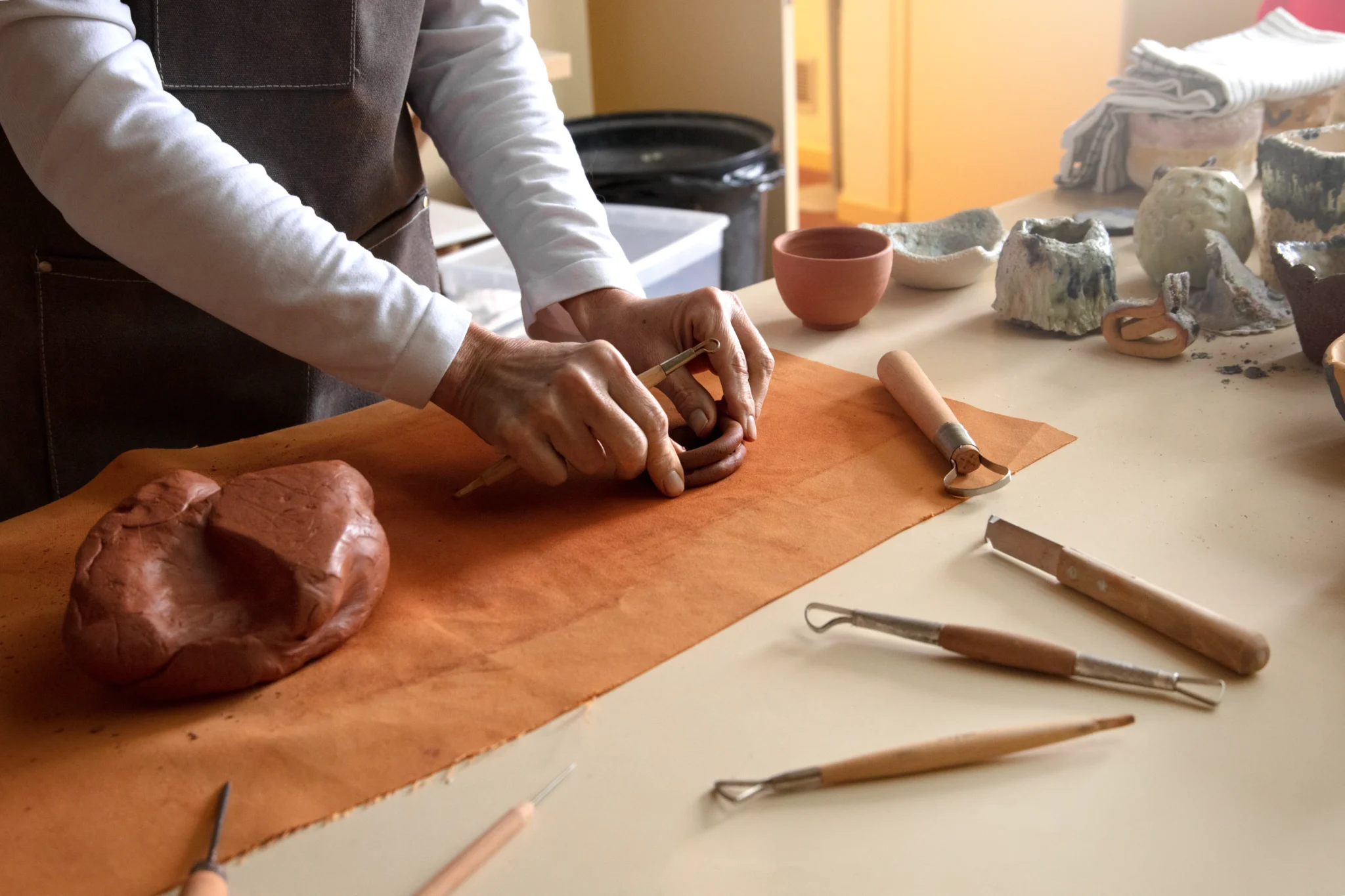
Hand-building encompasses several approaches: pinching from a ball of clay to open up a form; coil building (himo-zukuri), where ropes of clay are stacked and blended; and slab building (tatara seikei), where flat sheets of clay are cut and assembled. Most experience classes focus on pinching and coil-building methods.
The Potter’s Wheel (Rokuro)
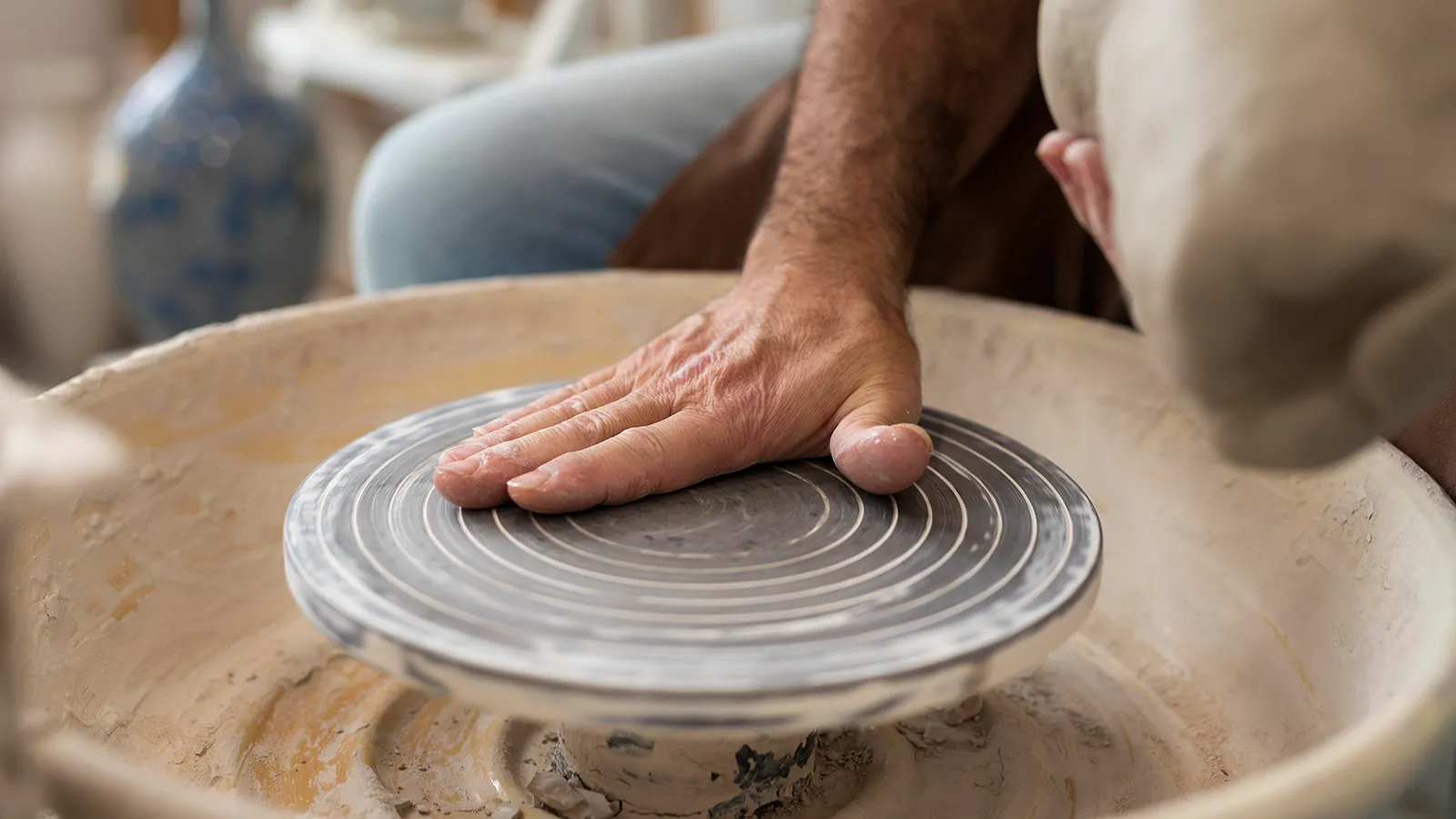
The potter’s wheel uses a spinning platform — driven electrically in most studio settings — and the combination of centrifugal force and hand pressure to raise and shape clay. It produces the smooth, symmetrical forms most people associate with wheel-thrown ceramics.
The first real challenge is centering: getting the clay to rotate perfectly true on the spinning wheel. Until that’s stable, the form won’t hold. Instructors at experience classes will help with this, but it takes practice to manage independently.
The potter’s wheel is what many people picture when they think of pottery — but for a first session, producing a controlled, intentional shape is harder than it looks. Starting with hand-building to get a feel for clay, then moving to the wheel, tends to work better for most people.
Slab Building (Tatara Seikei)
Slab building — tatara seikei — involves rolling clay into flat sheets of even thickness, then cutting and joining those sheets to construct a form.
It’s particularly suited to flat or angular shapes — dinner plates, square dishes, box forms — that would be difficult to produce on the wheel. Because the clay is worked in sheets rather than thrown or pinched freehand, the results tend to be consistent and structurally stable, which makes it a manageable technique for beginners.
Which Technique Is Right for Beginners? | A Comparison
Here’s how the three techniques compare from a beginner’s standpoint:
| Technique | Difficulty | Forms It Suits | Availability in Experience Classes |
|---|---|---|---|
| Hand-building (Te-biineri) | ★☆☆ Accessible | Small plates, yunomi cups, bowls, mugs | ◎ Available at most studios |
| Slab Building (Tatara Seikei) | ★☆☆ Accessible to moderate | Flat plates, square dishes, box forms | △ Available at fewer studios |
| Potter’s Wheel (Rokuro) | ★★★ Requires practice | Tea bowls, yunomi cups, vases | ○ Experience sessions available; instructor guidance needed |
For a first experience class, hand-building or slab building are the more practical choices. The wheel is worth trying if the experience itself is the goal, but getting a controlled result takes more than one session.
4. Tools for Beginner Potters | You Don’t Need to Buy Anything Yet
“What tools do I need to get started?” is one of the most common questions beginners ask. The honest answer is: at the experience class stage, essentially none. What you need changes as you progress, so it’s worth thinking in terms of where you currently are.
For an Experience Class, Tools Are Provided
Clay, tools, and firing are almost always included in the experience fee. That said, some studios ask participants to bring their own apron, so confirm this in advance. Wear clothes you don’t mind getting dirty. If your nails are on the longer side, trimming them beforehand makes working with clay considerably easier.
The Basic Tools — When You Do Need Them
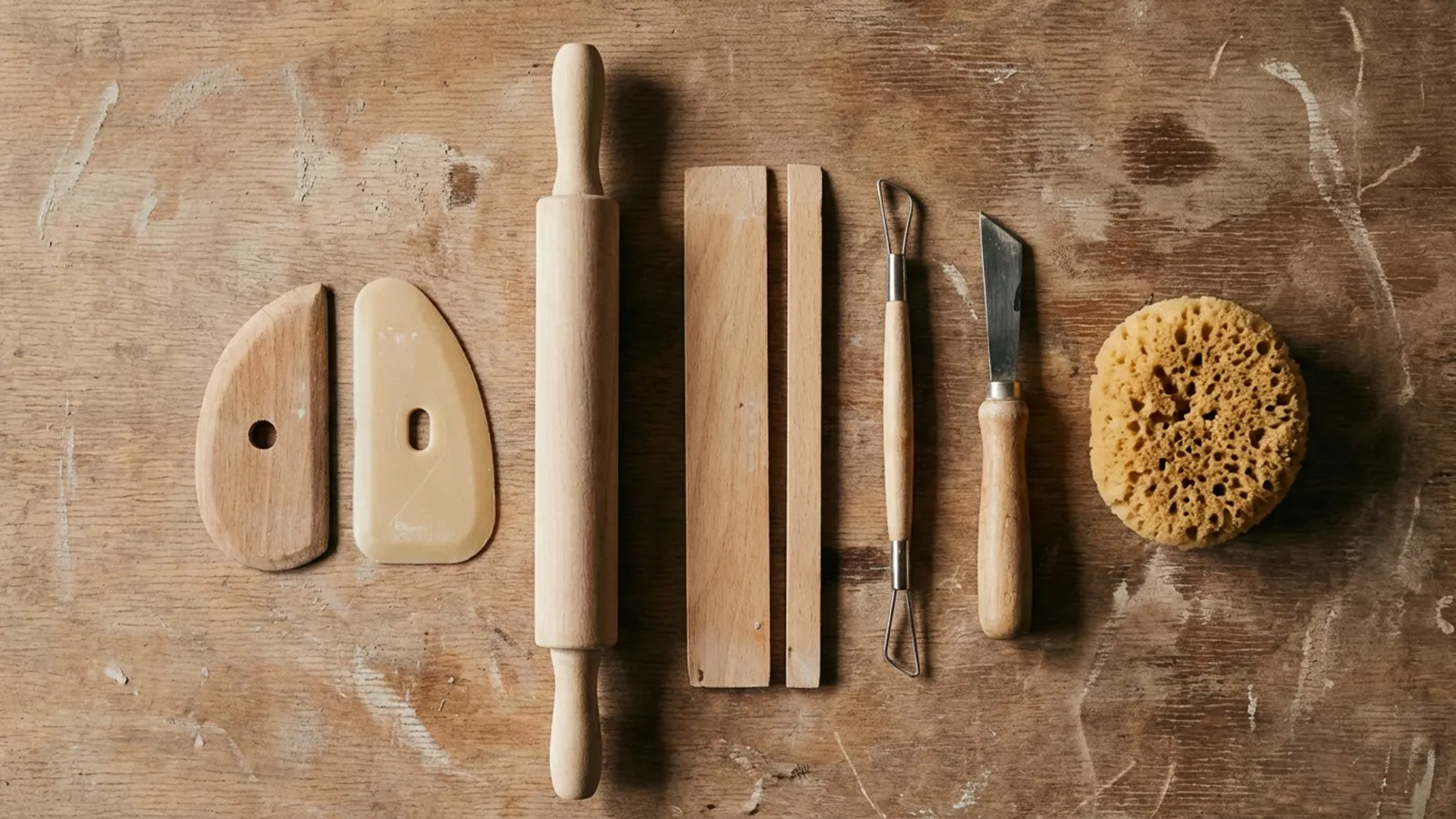
Once you start attending a regular course or practicing at home, you’ll gradually begin to accumulate tools. Here are the ones that come up most often at the beginning:
- Rib (Kaki-ita): A flat, paddle-shaped tool used to smooth and refine clay surfaces. Available in wood and plastic.
- Rolling Pin (Nobe-bō): Used to roll clay into even sheets for slab building.
- Slab guides (Tatara-ita): Flat boards placed on either side of the clay while rolling to maintain consistent thickness.
- Trimming tool (Kanna): Used to trim and refine the foot of a piece before bisque firing.
- Sponge: Held damp, used to smooth the clay surface and control moisture while working.
All of these are available at hardware stores and ceramics suppliers, but buying as you go — learning which tools you actually reach for at your studio — avoids accumulating things you don’t need.
A Brief Note on Clay and Glaze
Clay types fall into three broad categories: earthenware clay (tōdo), porcelain clay (jikido), and stoneware clay (sekkido). Each has different working properties, firing temperatures, and surface qualities. In an experience class, the instructor will select the clay — it’s not something you need to think about at first.
Glaze (uwagusuri, or yūyaku) is the coating applied to bisque-fired work before the final firing. It determines the color, surface texture, and sheen of the finished piece. Transparent glaze, white slip glaze (kohiki), iron glaze (tetsuyū) — the options vary considerably, and the same form can look entirely different depending on the glaze applied. In most experience classes, you’ll choose from a small selection, which is one of the more enjoyable decisions in the whole process.
5. Japanese Ceramics Basics | Earthenware, Porcelain, and the Producing Regions
Japan has a large number of ceramics-producing regions, each with its own history and character. The terminology can be hard to navigate at first. This section covers only what’s useful to know before visiting a studio or an experience class.
Earthenware vs. Porcelain — The Fundamental Distinction
There are several categories of fired ceramics, but the one distinction worth fixing in mind first is the difference between earthenware and porcelain.
Earthenware (Tōki)
In Japan, tōki broadly refers to clay-based ceramics fired at lower temperatures than porcelain — a category that in Western classification would span earthenware and parts of stoneware. These pieces tend to retain more of the clay’s texture and warmth, and are often heavier-walled. Shigaraki ware and Mashiko ware are typical examples — robust, tactile, with a certain informality that makes them feel comfortable to hold.
Porcelain (Jiki)
Made from clay containing silica and other mineral components, fired at higher temperatures. Porcelain is white, smooth-surfaced, and translucent in thin sections. Arita ware is among the best-known Japanese porcelain traditions.
Between these two sits a third category — stoneware (sekki) — which combines properties of both and is widely used in contemporary functional ceramics. For now, understanding the earthenware-porcelain distinction as a felt difference is enough.

(Reference: Introduction to Ceramics | Museum of Oriental Ceramics, Osaka)
“Yakimono,” “Tōgei,” “Tōjiki” — What’s the Difference?
A few overlapping terms tend to appear together and can cause confusion. A quick clarification:
- Tōgei: The activity and craft of making ceramics — the practice itself.
- Yakimono: A broad, informal term for fired ceramic objects — what tōgei produces.
- Tōjiki: A classificatory term encompassing both earthenware (tōki) and porcelain (jiki).
In everyday conversation, yakimono is the most general term — it covers everything from pieces made in an experience class to antique wares found at a market stall.
Japan’s Six Ancient Kilns — A Foundation for Understanding Japanese Ceramics
Japan’s Six Ancient Kilns (Nihon Rokkoyo) are six ceramics-producing regions with unbroken production histories from the medieval period to the present: Echizen, Seto, Tokoname, Shigaraki, Tamba, and Bizen. These six kiln regions are recognized as part of Japan Heritage, a cultural heritage initiative led by Japan’s Agency for Cultural Affairs.
Each region works with distinct local clay, fires at different temperatures, and has developed its own aesthetic over centuries. Knowing these six names before visiting any of them changes what you notice — the clay colors, the surface textures, the weight and feel of a finished piece.
(Reference: Traveling a Thousand Years — Japan’s Six Ancient Kilns | Official Website (Japan Heritage))
For a closer look at one of the six, see our feature on Tokoname ware below.

How to Choose an Experience Class or Producing Region
A famous producing region isn’t automatically the right choice for a first experience. When selecting a studio or class, these are the practical things to check:
- Getting there: If you’re traveling, ease of access matters as much as the destination itself.
- Technique options: Decide in advance whether you want to try hand-building or the wheel — not all studios offer both.
- English instruction (for international visitors): Whether instruction is available in English makes a significant difference to how much you take away from the session.
- Receiving your finished piece: Check whether the studio offers postal delivery, and for international visitors, whether overseas shipping is an option.
If you’re visiting as a traveler, prioritize access and language support. If you’re looking for a studio to attend regularly, look for one that offers a range of techniques and enough flexibility in scheduling to fit your life.
6. Where to Take Your Interest Next | Looking, Learning, Collecting
After making something for the first time, it’s common to find that curiosity opens in several directions at once — wanting to improve, wanting to see the work of experienced makers, wanting to visit the regions where particular styles developed. The craft has depth in every direction.
See the Work | Museums and Craft Institutions
Looking carefully at finished work is one of the most useful things you can do to develop your understanding of ceramics.
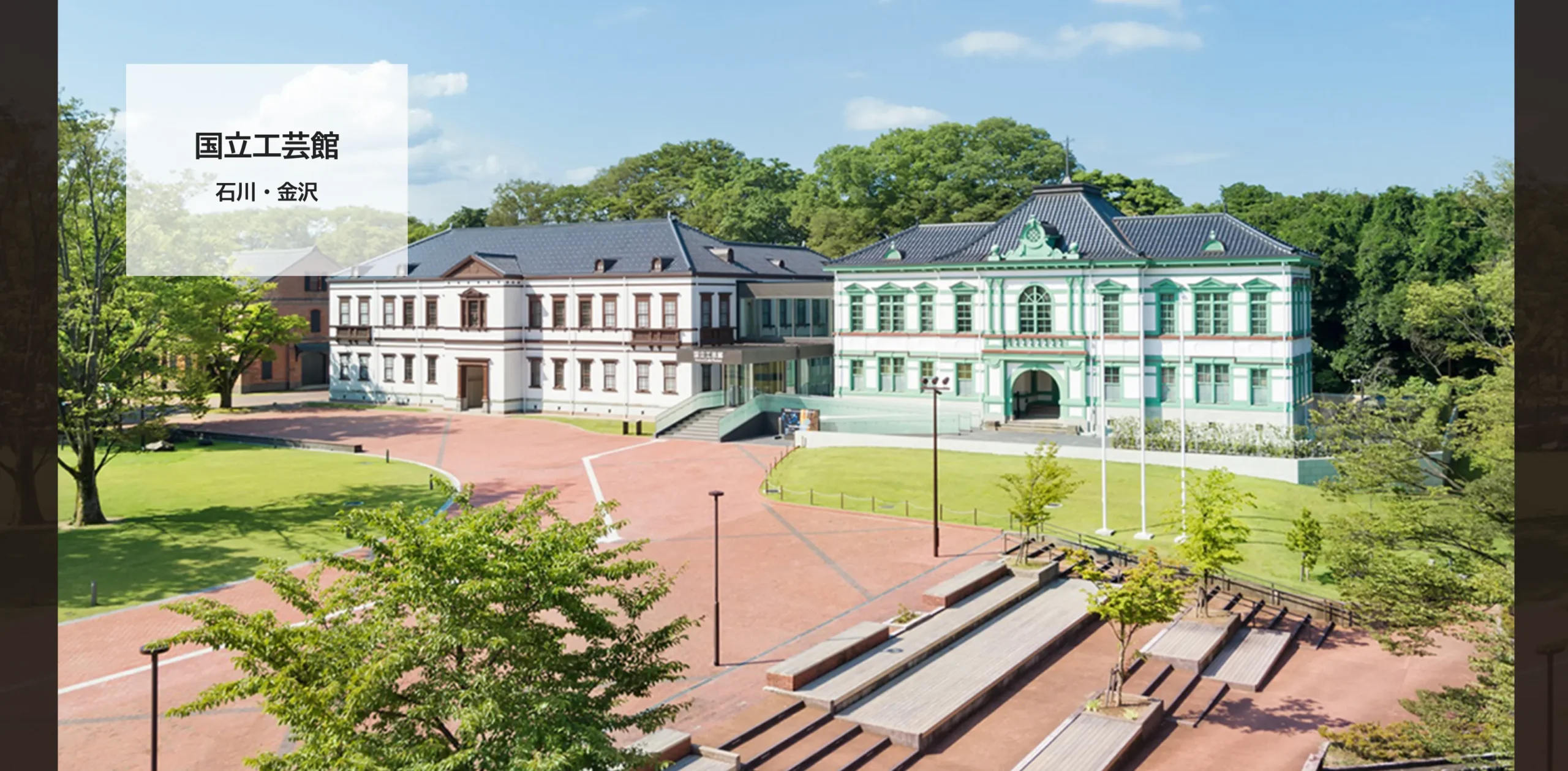
The National Crafts Museum in Kanazawa holds a substantial collection of modern and contemporary Japanese craft, including ceramics, lacquerwork, and textiles. Seeing the work of Living National Treasures — potters recognized by the Japanese government for their mastery — connects the clay you handled in the studio to a much longer line of technical and material knowledge.
(Reference: National Crafts Museum | National Museum of Art)
Ceramics museums within producing regions, and open kiln visits where they’re available, add another layer. Pairing a hands-on session with time spent looking at historical and contemporary work is a natural way to deepen engagement with the craft.
Use Your Eyes on Everyday Ceramics
Once you’ve worked with clay, looking at the vessels you use daily becomes a different experience. You start to read the marks of how something was made — a trimming line on the foot, the slight irregularity of a hand-built wall, the way a glaze has pooled in a depression. Developing that kind of attention changes how you approach making your own work.
For a closer look at how clay type, glaze, and forming technique interact to produce different surface qualities, see our guide to Japanese ceramics here.
Know the Regions and the Makers
Coming to an experience class with some background on the region — its clay, its history, what it’s known for — gives the session a different quality. Noticing that the clay is from Shigaraki, or that the instructor is working in a hand-building tradition rather than off the wheel, becomes part of what you bring home from the day.
Kogei Japonica covers individual producing regions, the work of Living National Treasures, and ceramics events throughout the year. For one example of what a regional pottery market looks like, see our guide to the Mashiko Pottery Fair below.

Pottery as a Practice of Attention
One reason people stay with pottery as a hobby is the quality of focus it requires.
When you’re at the wheel or working a piece by hand, your attention narrows to the clay — its resistance, its response, the way the form is changing. Time passes differently. It’s a mode of concentration that sits at some distance from screen-based work, and people who come to pottery for a single experience sometimes find they want to return for exactly that reason. Getting better matters, but it’s not the only thing on offer. The act of working with clay directly has its own value.
Summary
You don’t need to know everything before you start.
The most natural route in is: try an experience class, get a feel for clay and forming, and build from there — learning more about technique, materials, and regional traditions as curiosity leads you.
At Kogei Japonica, we’re interested in connecting that kind of entry point — a single session, a first-time visitor, an afternoon in a studio — with the broader world of Japanese craft. However you come to ceramics, the time spent working with clay tends to be its own reward. The first step is the only one that needs to be small.
FAQ
How much does a pottery experience class in Japan typically cost?
Most single-session experience classes run from around ¥2,000 to ¥6,000. The exact fee depends on the technique (hand-building or the potter’s wheel) and the studio. Some studios charge separately for firing, so it’s worth confirming what’s included when you book.
Is hand-building or the potter’s wheel better for a first session?
Hand-building is generally the more accessible starting point. Because you’re shaping clay directly with your hands, there’s no specialized technique to get past before you can start forming something. The potter’s wheel requires a process called centering — stabilizing the clay on the spinning wheel — which takes time and practice to feel natural, and is difficult to manage in a single session without instructor support.
Do I need to bring anything to a pottery experience class?
Clay and tools are provided at most studios. Some ask participants to bring their own apron, so check before you go. Regardless, wear clothes you don’t mind getting dirty — clay has a way of getting on everything. If your nails are long, trimming them beforehand will make working with clay more comfortable.
Can I take my piece home the same day?
In most cases, no. The shaped piece needs to dry, then go through bisque firing and glaze firing before it’s finished — a process that typically takes several weeks to a month and a half. Many studios offer postal delivery, and some can ship internationally. Confirm the arrangement before booking if collection will be an issue.
What should international visitors look for in an English-language pottery experience?
Look for clear English-language instruction, transparent information about firing timelines and delivery, and overseas shipping if you will leave Japan before the piece is ready. Studios in Kyoto’s Kiyomizu area and central Tokyo are among the more accessible options for international visitors. Booking in advance through the studio’s official website or an online travel platform is the most reliable approach.