

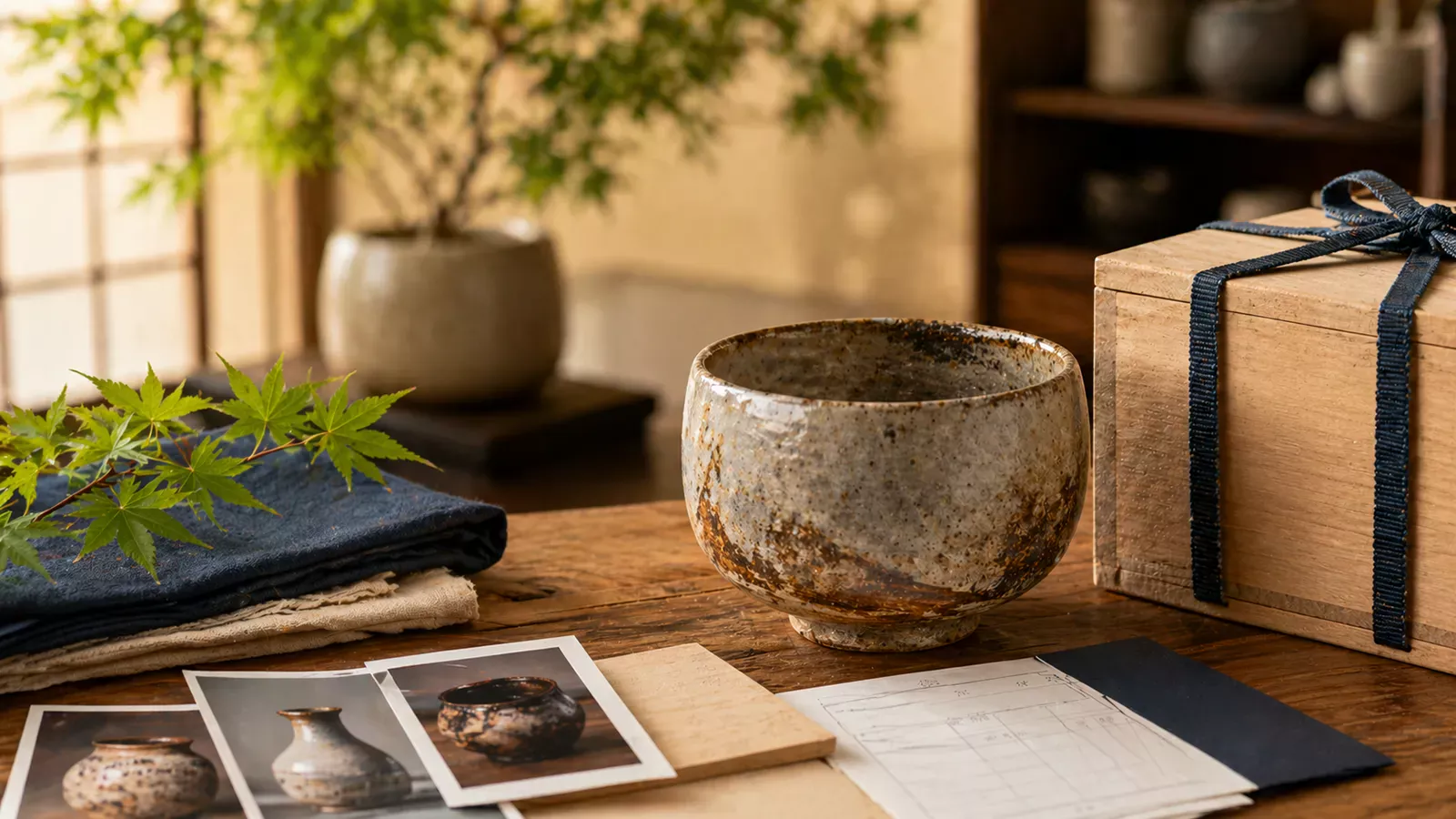
You find a bowl that stops you mid-step. You pick it up, turn it over, and know you want to bring it home. Or perhaps you’ve been following the work of a local maker and want to support what they’re doing — to own something of theirs and watch where their practice goes. The encounter with a craft object rarely begins with a checklist.
That impulse — the pull of beauty, the desire to support a maker’s work — is a legitimate and important reason to buy. It’s what keeps craft in circulation and keeps makers making.
At the same time, depending on what you’re spending and why, it can be worth pausing to consider the background of a piece: where it came from, what condition it’s in, and who you’re buying it from. In this guide, we use “kogei” to refer to Japanese craft works shaped by material knowledge, technique, and individual artistic practice. The guide organises five areas of consideration for anyone buying Japanese artisan craft — the work itself, the tomobako and hakogaki, provenance, condition, and the seller’s accountability — in terms a first-time buyer can act on. From practical authentication steps to evaluating purchase channels, and from post-purchase storage to keeping records, treat this as a working reference you can return to.
Table of Contents
The Guiding Principle: Honour What Moved You, Then Give Yourself the Evidence to Feel Certain
Buying kogei does not require encyclopaedic knowledge before you begin. Being drawn to something beautiful, moved by the skill behind it, wanting to live with it or support the person who made it — these are natural and entirely sufficient starting points.
What makes a purchase feel solid over time is holding both things together: the work itself, and the supporting information that lets you explain your choice — provenance, documentation, and a seller who can answer your questions.
There’s no need to override your instincts. The more useful approach is to keep them while adjusting how deeply you verify, depending on what you’re buying and why.
Five Questions Worth Asking Before Any Purchase
The following five points are worth keeping in mind when buying Japanese artisan craft, regardless of price. They’re not a pass/fail test — they’re a framework for deciding how much verification your particular purchase warrants.
Maker, Title, Technique, and Date
Knowing who made a work, when, and by what method is the baseline for understanding it. This information also deepens your relationship with the work over time — especially if you want to follow the maker’s practice or build a collection.
Tomobako, Hakogaki, and Supporting Documents
A tomobako is the original storage box accompanying a work, usually bearing an inscription written by the artist — the hakogaki — which often identifies the work’s title, technique, or date. Supplementary materials — exhibition catalogues, receipts, signed documents from the maker — add further context for understanding where a piece sits within an artist’s body of work.
Provenance
Where was it made, and whose hands has it passed through to reach you? A clear ownership history makes a piece easier to stand behind — and easier to explain later, whether you’re reselling, passing it on, or lending it for exhibition.
Condition
Visible wear, repairs, and signs of use are all worth noting — but so is the explanation for them. Whether you’re buying something to use daily or to preserve long-term will change what you need to know.
The Seller’s Accountability and the Paper Trail
How much can the seller actually explain about provenance and condition? And will the transaction leave a paper record — a receipt, a certificate, written documentation — rather than relying on memory? These questions matter most for high-value or secondary-market purchases, though for a more modest work bought directly from a young maker at an open studio, you can decide for yourself how much documentation you need.
Understanding What You’re Buying: Kogei Is a Different Purchase from Tableware
Buying Japanese artisan craft is not entirely separate from buying regional ceramics or studio pottery — but the things worth paying attention to are different. Knowing the distinction helps you clarify what kind of purchase you’re actually making.
Mass Production, Regional Brand, and Artist Work: What Sets Them Apart
Mass-produced wares are valued for consistency. Regional craft brands — Arita ware, Mino ware, and the like — draw their value from the accumulated techniques and history of a place. Artisan kogei derives its value from something more individual: a specific maker’s expression, career, exhibition record, and critical recognition.
These categories don’t always sit neatly apart. Many ceramicists work within an established kiln tradition while also being recognised as independent artists in their own right. Japan’s Act for the Promotion of Traditional Craft Industries designates certain crafts as “Traditional Crafts” based on regional and technical criteria — but that designation and the standing of an individual artist within it don’t always align.
Japan’s Living National Treasure designation — formally, the holder of an Important Intangible Cultural Property — is conferred on individuals who embody a high level of mastery in craft, performing arts, or traditional technique. It represents recognition earned through sustained practice and carries significant cultural weight as a marker of technical and artistic achievement.
That said, what the designation confirms is the holder’s mastery of a technique — not the condition, provenance, or authenticity of every individual work in circulation bearing their name. Even with a Living National Treasure’s work, the same practical checks apply: tomobako, provenance, condition, and a seller who can explain what they’re selling.
(Reference: Important Intangible Cultural Properties | Agency for Cultural Affairs, Japan)
Instinct and Verification Are Not in Competition
An encounter with craft can begin with aesthetics — it probably should. Beautiful, compelling, something you want to live with or give to someone you care about: these are real reasons to buy.
When the price is significant, or when future resale, inheritance, insurance, or loan to an institution is in the picture, it also becomes useful to be able to explain your choice in terms that go beyond personal response. Think of instinct as the starting point and documentation as the means of being certain.
Reading Provenance: Before the Price Tag, Ask Where It Came From
Provenance — in Japanese, raireki — refers to the documented history of a work: who made it, when, and the chain of ownership from that point to the present. In many international art markets, provenance is treated as a standard part of serious transactions. In Japanese craft, documentation practices can vary more widely, especially between primary sales, galleries, department stores, and the secondary market — though expectations are rising across all of these channels.
Provenance is a work’s ownership biography. Think of it less as a price justification and more as the evidence base for explaining a work’s value — now and in the future.
That said, no piece needs a perfect paper trail to be worth buying. When you purchase directly from a young maker at an exhibition or open studio, the record of that encounter — who you bought it from, why, what they said about it — becomes the first entry in the work’s provenance. What matters is knowing how much documentation is enough for what you’re doing.
Provenance Documents, Ranked by Weight
Not all provenance materials carry equal force. A single certificate is a different situation from a coherent set of documents that have stayed with a work over time. For high-value or secondary-market pieces in particular, it’s worth checking whether multiple sources corroborate one another.
| Priority | Document Type | Notes |
|---|---|---|
| High | Tomobako and hakogaki | Confirmed as originating from the artist themselves |
| High | Purchase receipt / gallery certificate | Issuer clearly identified |
| Medium | Exhibition catalogue / department store solo show catalogue | Work photographed and identified within |
| Medium | Museum acquisition record / publication history | Evidence of formal institutional recognition |
| Supporting | Statement from the artist or studio | Carries significant weight when in written form |
Tomobako and Hakogaki
A tomobako is an accompanying box bearing a handwritten inscription — the hakogaki — by the artist, typically identifying the work’s title, technique, or date of production. In the Japanese craft market, it functions as one of the primary anchors of provenance.
Purchase Receipts, Delivery Notes, and Gallery Documents
A document with a clearly identified issuer establishes the first-hand record of a transaction: who bought the work, when, and from whom. Purchases made through personal networks or certain resale platforms often lack this, which is their principal weakness as provenance sources.
Exhibition Catalogues and Department Store Records
The Japan Kogei Association’s annual Japan Traditional Kogei Exhibition publishes a catalogue documenting submitted works. Gallery and museum exhibition catalogues serve the same function as supporting provenance.
(Reference: Japan Kogei Association)
Museum Acquisition and Publication History
A record of acquisition by a public museum — the National Crafts Museum in Kanazawa, for instance, which operates as part of the National Museum of Modern Art, Tokyo — is evidence of formal institutional recognition. It doesn’t, on its own, confirm a work’s authenticity, but it adds meaningful weight to a provenance record.
(Reference: National Crafts Museum | The National Museum of Modern Art, Tokyo)
Statements from the Artist or Studio
A direct purchase from an artist, or an official document issued by their studio, carries strong provenance weight — provided it exists in writing. Verbal confirmation alone, however sincere, is difficult to pass on.
Tomobako and Aibako: A Distinction Worth Knowing
One of the most common points of confusion for new buyers is the difference between a tomobako and an aibako.
A tomobako is a box inscribed by the artist who made the work. An aibako is a substitute box prepared at a later date and inscribed by someone else — an appraiser, a later owner, or a dealer.
An aibako is not automatically without value. A box inscribed by a well-regarded critic or appraiser can itself become part of a work’s provenance history. But the absence of a tomobako means the primary documentary anchor is missing. For high-value or secondary-market purchases, it’s worth checking whether other materials compensate for that gap.
How to Look at a Box Inscription
You don’t need specialist training to notice things worth asking about. The following are points a buyer can reasonably consider — not as grounds for a firm judgment, but as prompts for a conversation with the seller.
Start with internal consistency: does the technique named in the inscription match the materials of the work itself? Any obvious discrepancy is a reasonable basis for asking questions. Then consider the seal, kaō (the artist’s personal cipher or seal-signature), and brushwork: if you have access to other inscriptions by the same artist, do these elements look consistent? Significant differences in seal shape or brushwork character are worth raising.
Definitive authentication is a specialist’s domain. But asking a seller to explain an inscription that gives you pause is entirely within your rights as a buyer.
What a Museum Acquisition Record Actually Tells You
A museum acquisition or exhibition history does not confirm that a work is genuine. It records the fact that, at a specific point in time, a specific institution recognised and documented the work.
What that record adds to a provenance file is the ability to say: this piece has a formal recognition history. That is useful when explaining value in the context of a future sale, estate transfer, or insurance appraisal — but it is supporting evidence, not proof of authenticity.
Authentication in Practice: A Certificate Alone Is Not Enough
The most common mistake in thinking about authentication is treating any certificate as sufficient reassurance. A certificate tells you that someone made a claim — its value depends entirely on who that person is and what evidence they based their assessment on.
Knowing the difference between what you can assess yourself and what requires a specialist is the first practical step in managing authentication risk.
Authentication also doesn’t carry the same weight across every transaction. Buying a modestly priced piece from a young maker at an open studio is a different situation from acquiring an expensive secondary-market work. The depth of verification you need should match what you’re spending and what you plan to do with the piece.
Five Authentication Checks You Can Do Yourself
Check the Inscription Against the Work
Confirm that the technique and materials named in the hakogaki match the work itself. Any significant discrepancy is worth raising directly with the seller.
Look at the Seal, Signature, and Their Placement
Check whether seals and signatures appear to sit naturally within the work, or seem added after the fact. A seal impression that looks pressed or blurred in an unusual way, or brushwork that seems visually inconsistent with the rest of the surface, is worth asking about.
Ask the Seller for Provenance Documents
Asking directly — “Is there a tomobako? Are there purchase documents or other records?” — is entirely normal. A seller who has documentation will show it. A seller who doesn’t will, if trustworthy, explain why.
Cross-Reference Exhibition and Museum Records
Using the artist’s name alongside a title, technique, or production year, you can cross-check against exhibition catalogues, museum databases, and the Japan Kogei Association’s published records.
For High-Value Pieces, Seek a Second Opinion
If your own assessment isn’t sufficient for what you’re spending, consulting a specialist — a gallerist, established dealer, or appraiser with relevant expertise — is a step you can take before committing to a purchase.
Common Misunderstandings About Authentication
A few patterns recur frequently enough to be worth naming.
- “The tomobako confirms it’s genuine.” — The box itself can be fabricated or transferred from another work. A tomobako is strong supporting evidence, not proof.
- “There’s a certificate, so it must be fine.” — A certificate from an unidentified issuer, or one that provides no basis for its assessment, forms weak provenance on its own.
- “It came from a major department store, so no further checking is needed.” — For secondary-market pieces in particular, this logic doesn’t hold. The chain of ownership after the original sale matters.
- “The artist’s social media presence looks legitimate.” — Cross-check against the artist’s official website or their affiliated gallery before assuming an account is genuine.
When to Consider Bringing in a Specialist
The right threshold varies by situation, but the following are cases where a third-party opinion is worth arranging.
- Works acquired outside Japan, or works that have re-entered the Japanese market after a period abroad
- Secondary-market pieces where part of the provenance record is missing
- Any purchase where future resale, inheritance, or insurance appraisal is anticipated
- Works where condition questions remain unresolved
The more of these factors apply simultaneously, the stronger the case for independent verification.
Choosing Where to Buy: It’s Less About the Venue and More About How You Want to Meet the Work
Every channel through which Japanese artisan craft changes hands has its own character. Some offer the closest possible connection to the maker; others offer better documentation or more formal accountability. What matters is matching where you buy to what you’re looking for — not identifying a single correct source.
For high-value or secondary-market purchases, the three things to prioritise are: can the seller produce provenance documents, can they describe the work’s condition, and can you reach them after the sale if you have questions.
Established Department Store Art Galleries
The art galleries of Japan’s established department stores — Mitsukoshi, Takashimaya, Isetan and others — offer attentive in-person guidance, reliable receipts, and a degree of vetting in how artists are selected. Their long-standing relationships with makers tend to produce relatively clear provenance records, which can be reassuring for a first major purchase.
The tradeoff is that the gallery’s margin structure is reflected in pricing, so the same work may cost more here than through a primary-market channel. Rather than judging on price alone, it’s worth factoring in the quality of guidance offered and what support is available after the sale.
Specialist Galleries
A specialist gallery’s reliability depends on the expertise and relationships of the people running it. Galleries with a strong focus in a particular area of kogei can offer context you won’t find in a department store setting — the arc of a maker’s career, where a given work sits in their development, what to look for. That kind of conversation is worth something beyond the transaction itself.
- Direct or exclusive working relationships with the artists they represent
- Tomobako, receipts, and provenance documents provided as standard
- Willingness to answer questions about condition and history after the sale
- A clear returns and dispute policy
- Staff with genuine subject expertise in the relevant field
Auction Houses
Auction houses have their own documentation conventions and terms, and buying through them requires some preparation. The pricing transparency is a genuine advantage, but so is the need to read the catalogue carefully before bidding.
- Condition Report: The seller’s written description of a work’s physical state — damage, repairs, storage history. Always request it.
- Conditions of Sale: The binding terms covering returns, warranties, and buyer’s premiums. Read these before bidding.
- Provenance language in the catalogue: Phrases like “said to be” or “attributed to” are reservations, not confirmations. Note them.
Terms, catalogue conventions, and condition reporting vary between houses, so individual verification is always necessary. SBI Art Auction publishes its conditions of sale and ownership verification procedures on its website.
(Reference: SBI Art Auction)
Direct from the Artist’s Studio
Buying directly from a maker’s studio or workshop gives you the clearest possible first-hand provenance: who made the work, when, how, and what they intended. You can ask questions that no dealer can answer as completely. And if your reason for buying is simply that you want to support a maker whose work you believe in, this is the most direct way to do it.
Even a modest, impulsive purchase at an open studio can become one of the most personally meaningful things in a collection — because the encounter itself is part of what you’re keeping.
That said: return policies, shipping guarantees, and the artist’s continued availability for future enquiries are all worth confirming before you finalise a purchase. Circumstances change, studios close, and the ability to follow up matters more than it might seem at the time.
Art Fairs, Craft Fairs, and Exhibitions
Events like Tokyo Art Antiques, regional craft fairs, and the Japan Traditional Kogei Exhibition are among the best places to develop your eye — to see a wide range of work, understand what draws you and why, and get a sense of how the market is moving. Many offer the chance to speak directly with makers or their representatives.
They are also environments where the energy of the room can accelerate a decision. If you’re spending seriously, make sure you leave with a receipt, any accompanying materials, and a way to contact the artist or exhibitor afterwards. For higher-value purchases particularly, having a clear point of contact for follow-up questions is not optional.
Online Retail and Social Media Purchases
The gap between photograph and object, condensed descriptions, and the risk of imitations are persistent issues with online craft purchases. At the same time, online channels provide access to makers in regions and at scales that physical distribution rarely reaches.
For lower-priced pieces bought because you simply want them, that’s a reasonable trade-off. To reduce the chance of later regret at any price point, at minimum check the return policy, confirm the seller’s identity, and ask whether any documentation accompanies the work.
A Template for Assessing Any Seller
Before completing a purchase, these are worth raising — in conversation, in writing, or both. You don’t need to interrogate anyone; putting a direct question into words is itself a useful clarifying act.
What Documentation Comes with the Work?
“Is there a tomobako? Is the hakogaki by the artist themselves? Are there any purchase documents or records?”
How Much of the Ownership History Can Be Explained?
“How did this piece come to you? Do you know anything about its previous owners?” Vague or reluctant answers often reflect gaps in the provenance.
Are There Any Repairs, Damage, or Signs of Use?
“Are there any visible repairs or damage? Has the piece been used?” If a seller cannot answer this clearly, it may be a sign that they do not know the work well enough for a higher-value transaction.
What Are the Return and Shipping Terms?
“If the work doesn’t match the description when it arrives, can I return it? Who is responsible if there’s damage in transit?” Clear answers here indicate a seller who has thought through their obligations.
After the Purchase: Protecting What You’ve Acquired
The relationship with a craft work doesn’t end when you carry it home. Proper storage and consistent record-keeping are what allow that relationship to deepen over time — and to survive a change of hands, if it comes to that.
Basic Storage by Material
Kogei spans a wide range of materials, each with its own vulnerabilities.
Ceramics: Keep away from direct sunlight and sudden temperature changes. Glazed works are particularly susceptible to crazing — a network of fine cracks caused by differential thermal expansion. Avoid stacking; if pieces must be stored together, use cloth or buffering material between them.
Lacquerware: Humidity management is the primary concern. Both extreme dryness and sustained heat and moisture damage lacquer surfaces. Direct sunlight causes discolouration and cracking.
Textiles: The three main risks are insect damage, light exposure, and fold lines. If stored folded, rotate the fold lines regularly.
Metalwork: Moisture and oxidation are the principal causes of deterioration. Handle with cotton gloves — skin oils accelerate oxidation.
Keep the Documentation with the Work
One of the most common ways a collection loses value over time is through paperwork becoming separated from the objects it belongs to. A tomobako stored in a different location, a receipt misfiled and forgotten, an exhibition catalogue that turns up years later without a clear connection to anything — each of these erodes provenance permanently.
Treat the work and its documentation — tomobako, hakogaki, receipt, exhibition catalogue, condition report — as a unit. If physical storage constraints require separating them, maintain the connection through an indexed record or photographs.
Keeping a Collection Record
Recording the following for each work — in a spreadsheet, a notebook, or whatever format you’ll actually use consistently — pays dividends if you ever need to sell, pass on, insure, or simply explain what you own.
- Date of purchase, seller, price paid
- Artist name, work title, materials, technique, year made
- Dimensions (height × width × depth)
- Condition notes at time of purchase (any damage, repairs)
- List of accompanying materials (tomobako, receipt, catalogue, etc.)
- Photographs (the work itself, the tomobako, the hakogaki, any seals, the base or reverse)
- Provenance notes (how the work came to you, and from whom)
Format matters less than consistency. Even for a piece bought on instinct at an exhibition because it moved you — noting the show’s name, the date, the seller, and what you felt at the time creates a provenance entry that is entirely your own.
For Those Thinking About Insurance, Inheritance, or Resale
If you’re building a collection of significant scale or value, specialist fine art insurance — sometimes called fine art or moveable property insurance — is worth looking into. It isn’t necessary for every buyer, but once the combined value of a collection reaches a meaningful level, the cost of not being insured can outweigh the cost of cover.
Insurance appraisal, estate valuation, and resale all require a collection record and provenance documentation. Building the habit of recording early, rather than reconstructing it later, is simply easier.
For International Collectors and Gallerists: What to Confirm Before Buying in Japan
For collectors and gallerists entering the Japanese craft market for the first time, three practical barriers — language, commercial conventions, and export regulation — are worth preparing for specifically.
Three Barriers to Prepare For
Language: Transaction documents, box inscriptions, and exhibition catalogues are almost entirely in Japanese. The risk of missing or misreading critical information is real. For higher-value purchases, engaging a trusted interpreter or a Japan-based agent who can handle communication in Japanese can be highly helpful.
Commercial conventions: The Japanese art and craft market operates on relationships built over time. Pushing hard for price reductions in an initial exchange, or applying pressure to accelerate a decision, tends to damage the relationship with a seller rather than advance it.
Legal restrictions: Japan’s Law for the Protection of Cultural Properties governs the export of certain categories of objects. The details are in the following section.
Export: What to Check
Under Japan’s cultural property protection legislation, works designated as National Treasures or Important Cultural Properties, and works recognised as Important Art Objects, are in principle prohibited from export. Contemporary kogei generally falls outside these designations.
That said, a work’s age, maker, and designation status all affect how it is treated. Before arranging export, confirm whether the work carries any cultural property designation or Important Art Object recognition. For individual cases, consult a specialist customs broker or the relevant authority directly. Piece-by-piece verification is the standard approach.
(Reference: Certification for Export of Old Art Objects: Preventing the Outflow of Cultural Properties | Agency for Cultural Affairs, Japan)
Practical Notes for Working with Japanese Galleries and Artists
Estimates and reservations: Verbal agreements often precede written confirmation in Japan. Always follow up to get price and terms in writing before proceeding.
Payment: International wire transfer and credit card acceptance vary widely between galleries. Confirm options in advance.
Packing and shipping: Clarify whether a specialist fine art shipper will be used, and what the insurance terms and liability coverage are for transit.
English language capability: Not all galleries and artists work in English. Check before your first contact, and arrange an interpreter if needed.
Pre-Purchase Checklist for International Buyers
- Confirm whether the work carries any cultural property or Important Art Object designation
- Confirm export and import requirements in advance (consult a specialist customs broker)
- Obtain and review provenance documents (tomobako, receipt, condition report)
- Confirm whether documentation and seller explanations are available in English or your working language
- Get packing, shipping, and insurance terms in writing
- Clarify the process for raising a dispute if the work arrives in a condition inconsistent with the description
Pre-Purchase Checklist
A summary checklist for use before any purchase, followed by a closing note from Kogei Japonica.
Seven Points to Check Before Buying
| No. | Check | What to Look For |
|---|---|---|
| 1 | Artist information | Is the artist’s name, technique, and year of production clearly stated? |
| 2 | Tomobako / hakogaki | Is there a tomobako? Does the inscription’s content align with the work? |
| 3 | Provenance | Are there documents that trace the ownership history? |
| 4 | Condition | Has the seller explained any damage or repairs? |
| 5 | Seller’s accountability | Are the seller’s answers direct and supported by evidence? |
| 6 | Returns and compensation | Are the return policy and shipping liability terms clearly stated? |
| 7 | Storage readiness | Do you have an appropriate environment to care for the work? |
None of these seven points is a condition of purchase. Bringing home something that caught you off guard, or buying a piece to support a maker you’ve been watching, are both legitimate ways to build a relationship with craft. The checklist is a tool for deciding how much verification any particular purchase calls for — not a threshold that has to be cleared before anything can change hands.
A Closing Note from Kogei Japonica
What matters when buying Japanese artisan craft is holding two things at once: the feeling that made you stop — and the means to feel certain about your choice.
Trust what moved you. Then give yourself the evidence to stand behind it.
An unheralded maker’s work bought on impulse for a modest price can become one of the objects you’re most glad to own. A piece bought to support a local craftsperson, with no particular plan behind it, can turn into something you keep for the rest of your life. These are serious ways of collecting, not lesser ones.
For high-value purchases, secondary-market works, or pieces you intend to pass on — taking the time to verify the tomobako, the provenance, the condition, and what the seller can tell you will give you a cleaner, more confident relationship with the work. Buying kogei is not just a matter of possession. It’s a way of carrying something made by hand forward — into your daily life, and further.
