

Table of Contents
61st Venice Biennale — Japan Pavilion: Key Facts
| Exhibition | 61st International Art Exhibition — La Biennale di Venezia |
|---|---|
| Dates | Saturday, May 9 – Sunday, November 22, 2026 |
| Pre-opening | Wednesday, May 6 / Thursday, May 7 / Friday, May 8, 2026 |
| Venues | Giardini, Arsenale, and various locations across Venice |
| Overarching Theme | In Minor Keys |
| Artistic Director | Koyo Kouoh — passed away May 2025; exhibition proceeds in accordance with her vision |
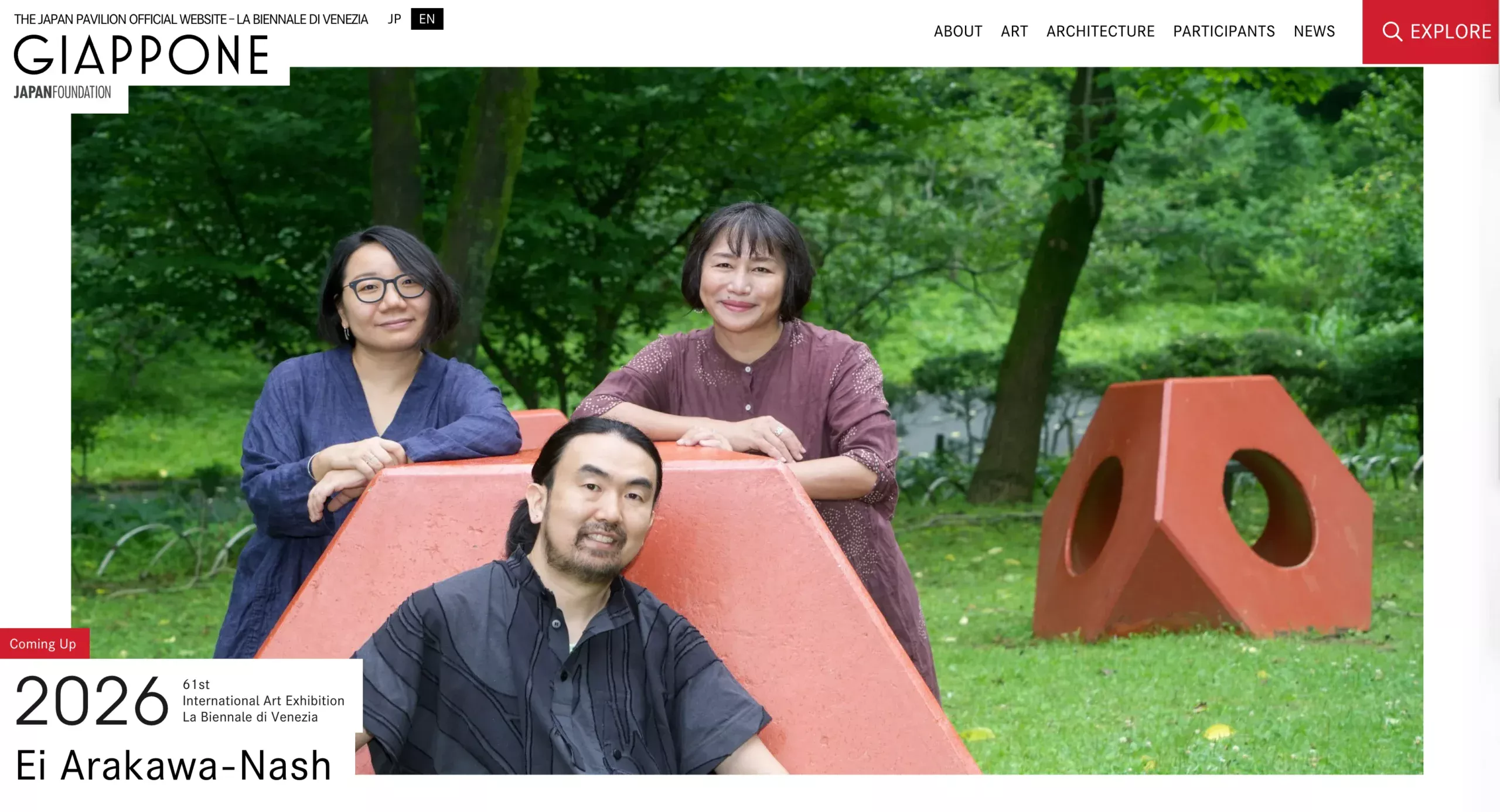
| Japan Pavilion Artist | Ei Arakawa-Nash |
| Exhibition Title | Grass Babies, Moon Babies |
| Co-Curators | Mizuki Takahashi, Lisa Horikawa |
| Commissioner | The Japan Foundation |
(Sources: The Japan Pavilion Official Website | La Biennale di Venezia)
Venice Biennale 2026 Japan Pavilion — What Matters and Why
The 2026 Venice Biennale Japan Pavilion is, in at least three distinct ways, a departure from what has come before. The selected artist is Ei Arakawa-Nash, a performance artist born in Fukushima and based in Los Angeles. The exhibition title is Grass Babies, Moon Babies. And this year marks the seventieth anniversary of the Japan Pavilion’s founding.
Three Ways to Read the Japan Pavilion 2026
① A Japan Pavilion with a team working entirely outside Japan
Arakawa-Nash lives and works in Los Angeles. Co-curator Mizuki Takahashi serves as Executive Director and Chief Curator of CHAT (Centre for Heritage, Arts and Textile) in Hong Kong; co-curator Lisa Horikawa is Senior Curator at the National Gallery Singapore. At the pavilion’s seventieth anniversary, the team brings a perspective formed through sustained engagement with Japan from outside its borders.
(Source: Japan Pavilion at the 61st International Art Exhibition | The Japan Foundation)
② A resonance between the overarching theme and the pavilion’s own logic
The Biennale’s theme — attentiveness to what is quiet, minor, understated — finds a natural counterpart in an exhibition whose starting point is baby dolls and the birth of twin children. Based on the announced concept, the Japan Pavilion appears less interested in grand declarations than in acts of care and quiet circulation, and that is precisely what makes it worth close attention.
③ Why this pavilion speaks directly to craft
The exhibition is structured not around making objects but around tending, caring, and passing on — actions that carry the same embodied logic as the repetitive turning of a rokuro (potter’s wheel), or the unhurried rinsing of dyed cloth through water. The craft reading is developed in the section below.
What Is “In Minor Keys”?
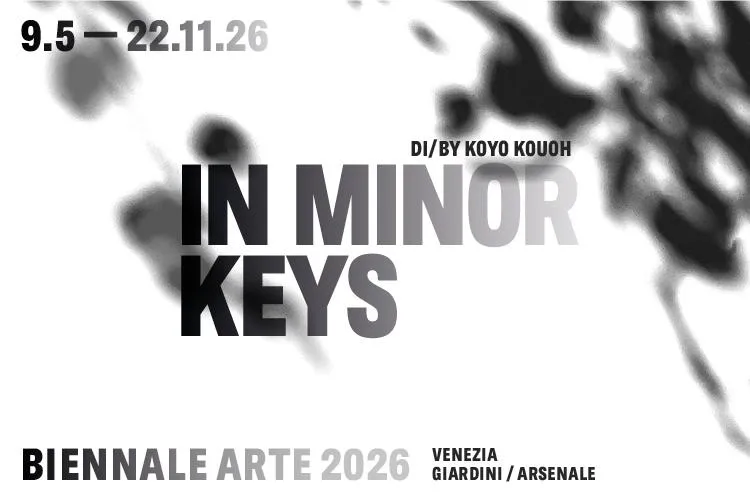
“In Minor Keys” takes its name from the minor key in music — a tonal register that carries shadow, resonance, and a quality of holding something inward, as opposed to the forward momentum of a major key. This phrase was chosen as the theme for the 2026 Biennale by artistic director Koyo Kouoh.
The background is worth knowing. Kouoh was named artistic director in November 2024, with her appointment officially announced on December 3 of that year. She submitted her curatorial text to the Biennale president on April 8, 2025, and died on May 10, 2025, at the age of fifty-seven. With the agreement of her family, the Biennale is proceeding with the exhibition exactly as she conceived it.
(Source: Biennale Arte 2026: In Minor Keys | La Biennale di Venezia)
The Perspective Koyo Kouoh Brought to This Theme
Kouoh was born in Cameroon and raised in Switzerland. She co-founded RAW Material Company in Dakar, Senegal, and later served as Executive Director and Chief Curator of the Zeitz Museum of Contemporary Art Africa (Zeitz MOCAA) in Cape Town.
Her curatorial text draws on the improvisational logic of jazz, Caribbean intellectual traditions, and the Creole garden — a space where many different plants coexist. “In Minor Keys” is conceived as an exhibition that listens carefully to voices long excluded from the main melody: work that has existed in the margins, that holds grief and joy at once, and that can sustain contradiction without resolving it into something easier.
(Source: Curatorial Text by Koyo Kouoh | La Biennale di Venezia)
A Kogei Japonica Reading: Why This Theme Matters to Craft
Translated into the language of craft, the idea of a “minor key” opens onto a wide field of meaning.
Kogei (craft) has long operated in a quieter register of attention. The texture of a clay bowl in the hand, the time it takes for dyed cloth to dry, the weight distribution of a chopstick rest — none of these things exist within the register of speed or efficiency. They exist at a different frequency entirely. Kouoh’s theme, though framed in the vocabulary of contemporary art, seems to be reaching toward something close to the philosophy of making that craft has developed over a long period of practice.
Kouoh’s own text touches on the way certain artists treat daily life as part of the work itself — living within an aesthetically coherent relationship between part and whole. Anyone familiar with the relationship a craft practitioner develops with clay, wood, or thread will recognize that quality immediately.
Who Is Ei Arakawa-Nash?
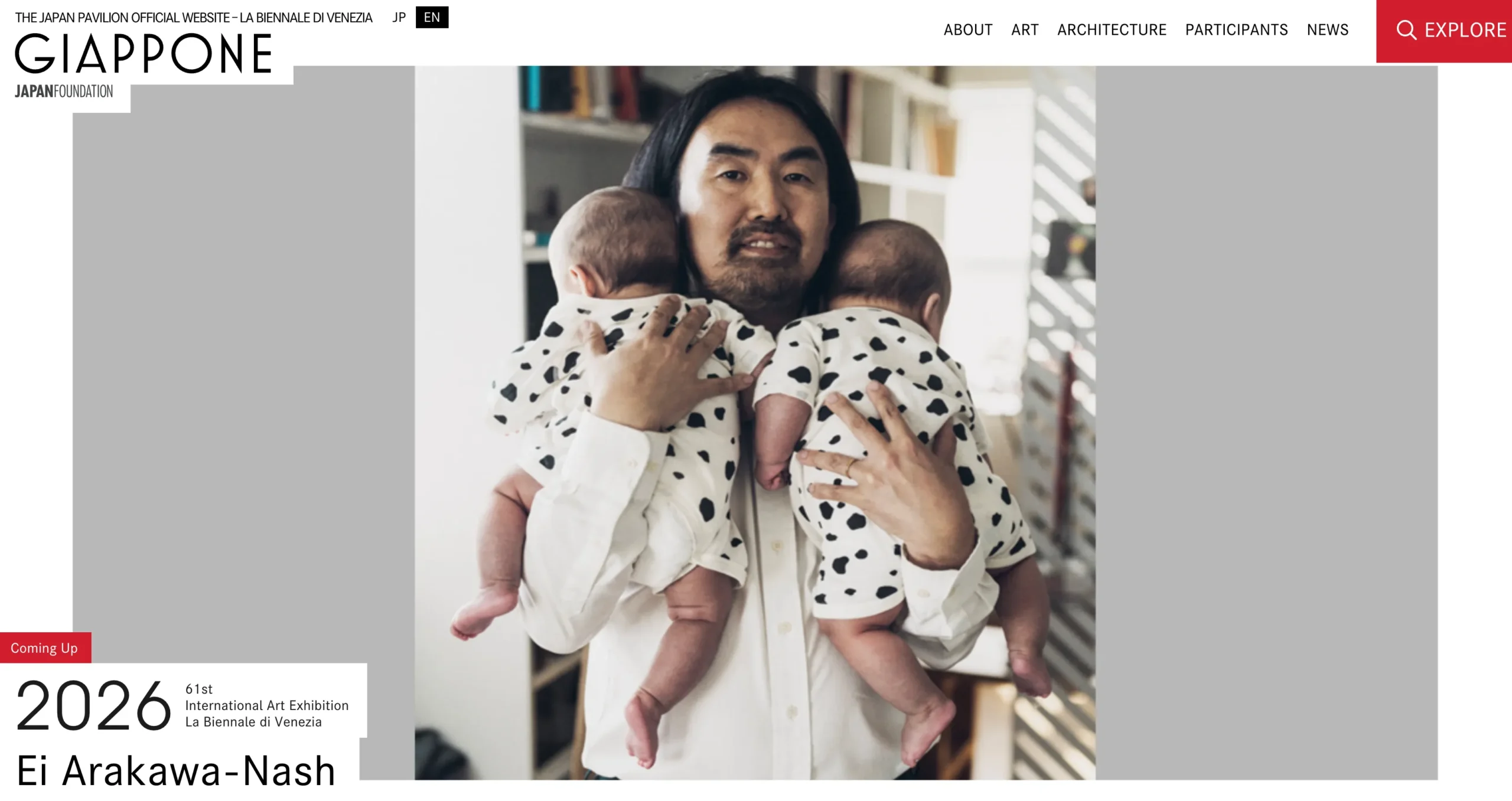
At this stage of coverage, the essential question is straightforward: who is Ei Arakawa-Nash? In short, Arakawa-Nash is an artist who has spent their career dismantling the assumption that performance is something an audience watches from a seat — building instead a practice in which audience members, collaborators, space, and history fold into one another and cannot be separated from the work itself.
Background: Born in Fukushima, Working Across Borders
Born in Fukushima in 1977. Moved to New York in 1998, then relocated to Los Angeles in 2019. Currently a professor in the graduate fine art program at ArtCenter College of Design in Pasadena. Arakawa-Nash has spoken publicly about giving up Japanese nationality some years ago, and has reflected on the unexpected nature of being asked to represent Japan in Venice — a possibility they had not anticipated.
That statement signals clearly that questions of nationhood, representation, and identity are not incidental to this exhibition — they are part of its foundation.
(Source: Ei Arakawa-Nash to represent Japan at the 2026 Venice Biennale | e-flux)
Performance, Collectivity, and Participation as Core Practice
Arakawa-Nash’s work does not present finished objects for contemplation. It requires people to gather before it can exist at all. Action, sound, relationship, and improvisation are the materials.
The practice draws on postwar avant-garde lineages — Gutai, Tokyo Fluxus, Happenings, the Judson Dance Theater, Viennese Actionism — while working consistently to dissolve the boundary between performer and spectator. The 2021 participatory installation Mega Please Draw Freely at Tate Modern’s Turbine Hall is among the most direct demonstrations of this approach.
What to Know About This Artist Before Opening Day
- It is a solo exhibition: The Japan Pavilion takes the form of a single-artist show.
- It is co-curated: Both Mizuki Takahashi and Lisa Horikawa were personally invited by Arakawa-Nash, and the exhibition has developed out of a three-way dialogue.
- It is a project with multiple institutional partners: Collaborations have been announced with the J. Paul Getty Museum (Los Angeles), The Isamu Noguchi Foundation and Garden Museum (New York), and Kestner Gesellschaft (Hanover). This is not a standalone pavilion presentation but a project unfolding across several institutions.
Inside “Grass Babies, Moon Babies”: What to Expect
The title offers several clues worth considering before entering the pavilion. Grass and moon. Babies, plural. The combination is quiet and deliberate.
Reading the Title: Grass, Moon, and Babies
At the center of the exhibition are approximately two hundred baby dolls. Visitors select a doll and perform an act of care. A QR code then activates, generating a poem tied to that doll’s assigned birthdate — a date connected both to the artist’s personal history and to historical events that have shaped Japanese and diasporic communities.
(Source: Grass Babies, Moon Babies exhibition announcement | Japan Pavilion Official Website)
Editor’s note
A personal reading of the imagery: grass is rooted in the ground, returns after being cut, and follows the seasons into dormancy and renewal. The moon is distant but marks time with a quiet consistency. Placing “babies” between these two images suggests a cycle of life, time, and memory. Read alongside craft’s own material sensibility — soil as the ground where grass takes root, the moon still present in the sky during a long kiln firing — and another layer of meaning opens up.
The Pavilion Building and Its Relationship to the Exhibition
The Japan Pavilion was completed in 1958 and designed by Ryūsei Yoshizaka, an architect who trained under Le Corbusier. The key point here is that Yoshizaka placed the concept of mobility at the structural core of the building’s design.
In a talk at Mori Art Museum, Arakawa-Nash stated that the exhibition’s concept centers on this very idea — the mobility that Yoshizaka embedded in the design of the pavilion’s garden and building. The garden and building are not separate; they form a circulation. Visitors carrying baby dolls, moving between interior and exterior space, entering and leaving — this experiential structure appears to be in direct dialogue with the building’s own founding logic.
(Source: Urgent Talk 052: Ei Arakawa-Nash | Mori Art Museum)
What “A Constellation of Voices and Practices” Means
The exhibition’s official text describes the work as “a constellation of voices and practices” that will “permeate the peripheries of the Japan Pavilion.” This is not the language of a single-artist showcase. It describes a structure in which the contributions of collaborators, partners, and visitors are constitutive of the work — not supporting material around a central object, but part of the fabric itself.
What is confirmed at this stage: a collaboration with the Asian American artist collective FAC XTRA RETREAT; a preview performance titled 24 HOUR CARE at the Getty; a partnership with The Isamu Noguchi Foundation and Garden Museum; a subsequent presentation at Kestner Gesellschaft; and the Korean Pavilion 2026, which has been publicly named as a collaborator. Further details will be added here as they become available during the run.
Further Points to Track Before Opening
- Three-institution program: Joint production initiatives with the J. Paul Getty Museum, The Isamu Noguchi Foundation and Garden Museum, and Kestner Gesellschaft.
- Korean Pavilion 2026: Named as a collaborator in The Japan Foundation’s announcement dated March 19, 2026.
- Crowdfunding: An artist-led crowdfunding campaign has been conducted, as noted on the Japan Pavilion’s official news page.
- Pre-opening: Press and professional previews are scheduled for May 6, 7, and 8. The opening ceremony and awards take place on Saturday, May 9.
Reading Through a Craft Lens — What This Pavilion Asks of Us
From here, the article shifts into editorial territory. The factual groundwork has been laid in the preceding sections. What follows is this editor’s own reading — an attempt to articulate why, for anyone who follows kogei, this pavilion is not a peripheral concern.
Care as Embodied Practice, and What Craft Recognizes in It
The exhibition places care at its center. Visitors pick up a baby doll, hold it, tend to it. The physical actions involved — cradling, carrying, arranging, watching — can be read alongside the embodied attention that craft practice requires.
A ceramicist wedging clay, a lacquerware artisan drawing a spatula through urushi (lacquer) in thin, deliberate layers, a dyer pulling cloth through water in a slow rinse — none of these actions are about controlling a material. They are about being in relationship with it, reading it, responding to what it offers and resists. The question the exhibition appears to pose — what quality of bodily attention can you bring to this small thing? — is not far from the question craft asks every time a maker sits down to work.
Material, Garden, Architecture, Body: A Circulation
The garden of Ryūsei Yoshizaka’s pavilion does not function as an exterior to the building. It is part of the building’s internal logic — a space where grass grows, light moves, and visitors pass through. The exhibition is situated within that circulation.
Read alongside craft’s sense of place, this design carries something of the philosophy embedded in the roji — the garden approach in tea ceremony architecture, a transitional space that is not merely a path to the tearoom but the beginning of the experience itself. This is an editorial analogy, not an architectural-historical claim, and the distinction matters. Whether and how the exhibition actually uses this spatial circulation is something a visit will answer far better than any preview can.
Questions to Return to After Opening
This article is written as a pre-opening preview, with the intention of adding to it during the run. The questions worth returning to are these:
- The quality of participation: What depth does the experience of tending a baby doll actually hold for visitors moving through the pavilion?
- The “constellation” structure: Does a framework of multiple voices and practices genuinely dissolve the center-periphery hierarchy, or does it redistribute it?
- The Noguchi connection: How does the partnership with The Isamu Noguchi Foundation and Garden Museum engage with questions about the boundaries between craft, sculpture, and material knowledge?
- Representation, again: A team based entirely outside Japan representing Japan at the Biennale — how does that condition speak to questions of provenance, inheritance, and belonging that run through craft discourse as well?
Practical Information and Update Policy
Dates, Pre-opening, and Where to Find Official Information
| Pre-opening | Wednesday, May 6 / Thursday, May 7 / Friday, May 8, 2026 |
|---|---|
| Opening / Awards | Saturday, May 9, 2026 |
| Closing | Sunday, November 22, 2026 |
| Japan Pavilion Official Site | venezia-biennale-japan.jpf.go.jp |
| La Biennale di Venezia Official | labiennale.org |
| The Japan Foundation (English) | jpf.go.jp |
| Press Inquiries | venezia_press2026@jpf.go.jp |
What Will Be Added During the Run
This article is designed as a pre-opening preview that will be updated throughout the exhibition period. Planned additions include:
- On-site photography and a report on the spatial experience
- A firsthand account of the baby doll and poem-generation installation
- International critical responses
- Performance dates and program details as confirmed
- Details of the Korean Pavilion 2026 collaboration
- Awards results
This page will be updated as information becomes available.
An Honest Note on Coverage of This Kind
The most common failure in preview coverage is circling a theme without landing anywhere — or stopping at an artist introduction and calling it done. A subtler failure is letting interpretation and confirmed fact bleed into each other without signaling the difference. This article has tried to keep those two registers distinct: verified facts and primary sources in the first half, editorial reading in the second. If you find the line blurring, that is worth flagging.
In Place of a Conclusion — “Permeate the Peripheries”
The official text for Grass Babies, Moon Babies says the exhibition will “permeate the peripheries” of the Japan Pavilion. Not occupy the center. Not make a commanding statement. Seep in from the edges.
Having laid out the facts, what remains is to go and see whether the space delivers on that. Kogei has long worked this way — not from the center of the gallery but from the periphery of daily life, the table, the shelf, the hand. That the Japan Pavilion’s title and structure appear to be reaching toward a similar position may be intentional, or it may be convergence. Either way, it is worth paying attention to. The exhibition opens May 9.
