

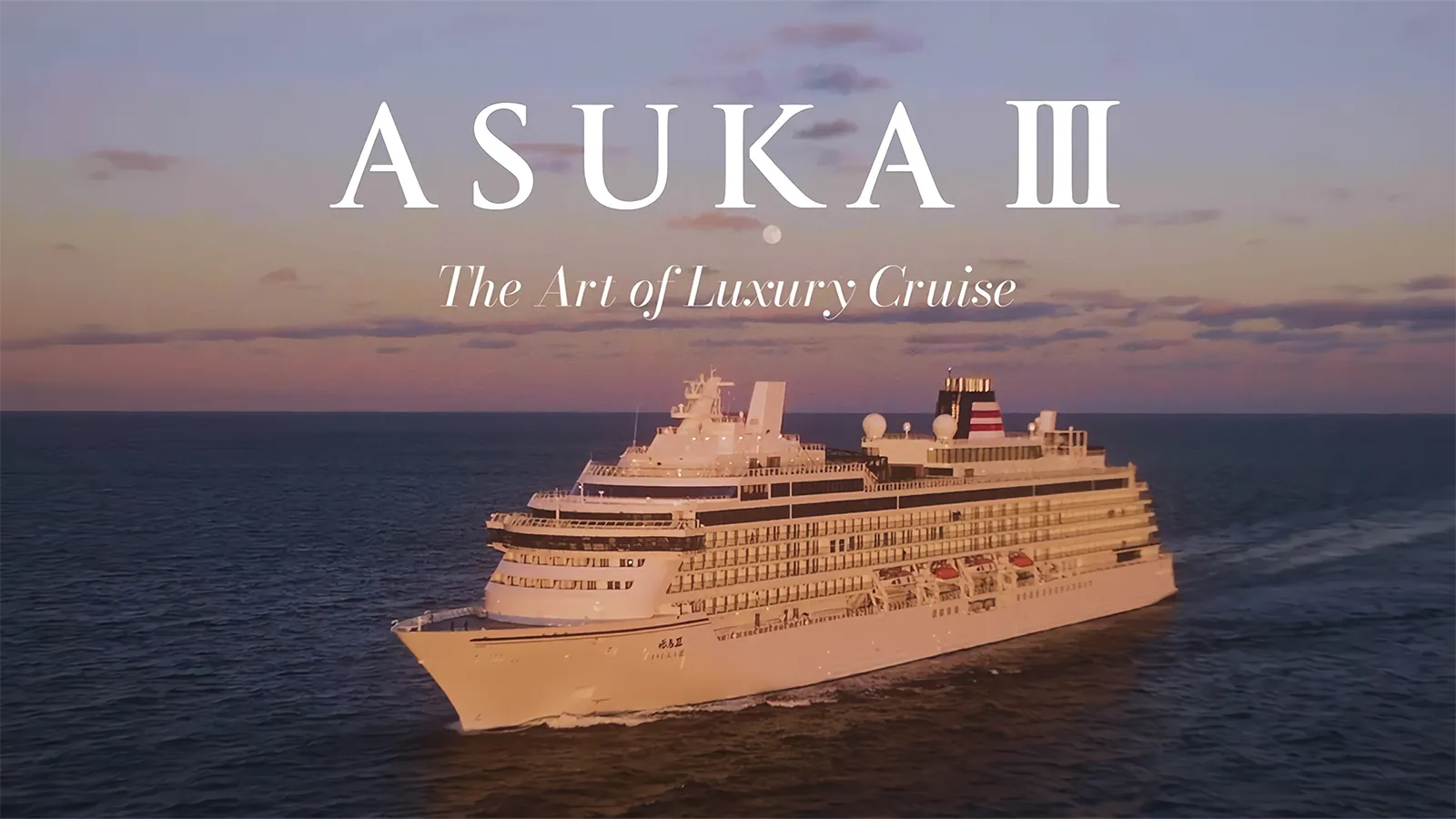
There is a place where Japanese traditional craft is not something you visit — it is something you live inside, for the duration of a journey.
Homeported in Yokohama, the cruise ship Asuka III travels the length of Japan, from Hokkaido in the north to Okinawa in the south. Launched in 2025 by Yusen Cruises — the company’s first newly built vessel in thirty-four years — the ship is one that Kogei Japonica has chosen to cover for a specific reason: traditional craft and fine art are not decorative additions here. They are embedded in the spatial logic of the ship itself.
This article is for travelers, in Japan and overseas, who have a serious interest in Japanese craft. It covers the ship’s onboard art and Kogei collection, its formal collaboration with the Japan Kogei Association, and the practical information needed to plan a voyage.
Table of Contents
What Is Asuka III? A Luxury Cruise Designed Around Japanese Culture
Asuka III is not a ship designed for transit. It is a ship designed for inhabitation. Your day begins in spaces where works supervised by Living National Treasures are on display. You pass through Asuka Plaza — the main atrium anchored by a monumental lacquer installation — and end the evening watching the ship’s wake dissolve into open water. That is the experience this vessel is built to deliver.
When we visit a museum, we arrive as viewers: we stand before objects, read the wall text, and move on. On Asuka III, that relationship is reversed. The works settle into your daily rhythm. They are there at breakfast and at midnight. This is what it means to live with craft rather than look at it.
Ship Specifications
Asuka III is operated by Yusen Cruises Co., Ltd. (est. 1989). The ship was completed at Meyer Werft in Germany in April 2025 and entered service from Yokohama in July of that year — Yusen Cruises’ first newly built vessel in thirty-four years.
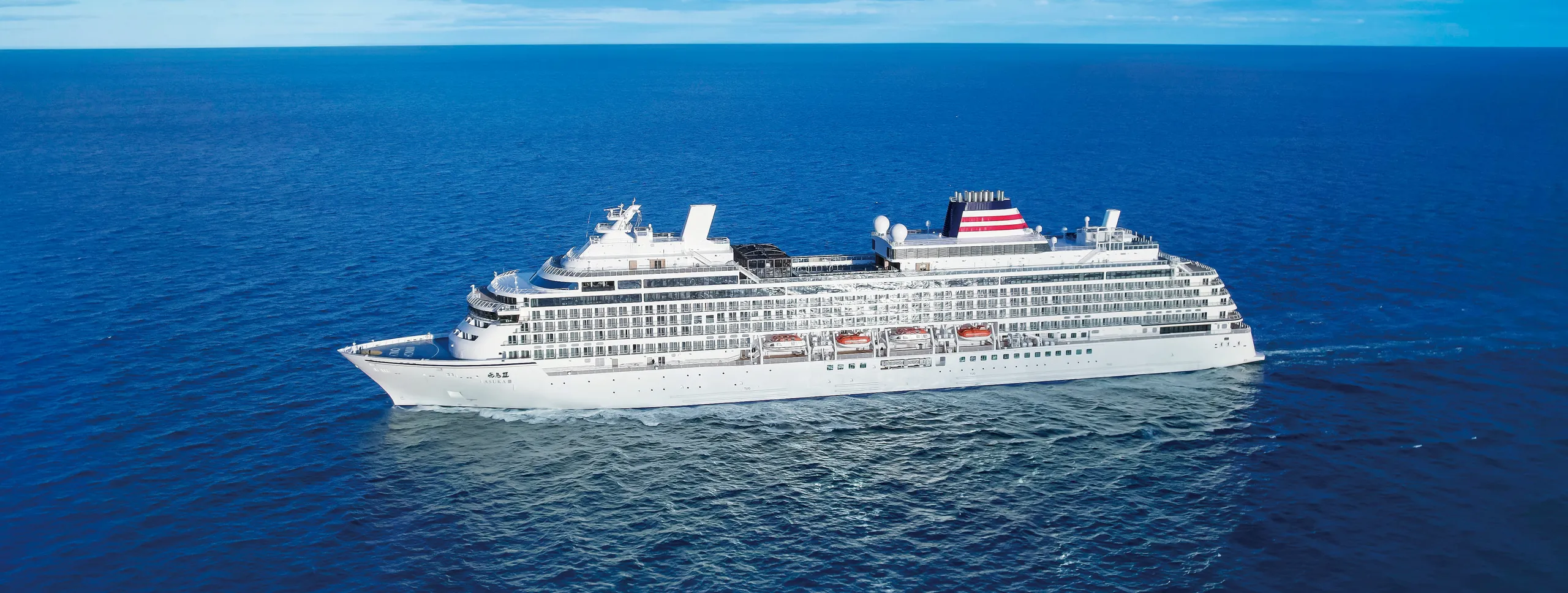
According to official Asuka Cruise figures, Asuka III has a gross tonnage of 52,265 GT, an overall length of 230 meters, a guest capacity of 740, a crew of approximately 470, and 381 staterooms. Every stateroom has an ocean-facing private balcony. The ship’s public spaces include six restaurants, multiple lounges, and a Gallery Café.
With 740 guests served by a crew of approximately 470, the ratio reflects a deliberate commitment to attentive, personal service — the kind of hospitality, rooted in the Japanese principle of omotenashi, that cannot be retrofitted onto a larger vessel.
Beyond “Luxury”: Reading the Ship as a Cultural Space
When speaking about the appeal of Asuka III, I feel that the word “luxurious” alone only captures a fraction of what makes the ship truly compelling.
The more precise description is this: it is a ship that has made deliberate decisions, at every level of design, to be Japanese. The spatial philosophy, the sourcing of ingredients, the selection of artists and craftspeople — these choices accumulate into something that cannot be reduced to an amenity list. The result is an environment in which Japanese aesthetic thinking is not a theme applied to surfaces, but a principle running through the whole.
This is why Kogei Japonica is covering this ship in depth. The question is not whether it is luxurious. The question is whether it represents a serious engagement with Japanese craft as a living practice — and on that measure, the case is worth examining carefully.
Asuka III as a Floating Art Museum: The Onboard Collection
The ship’s interior holds over 130 commissioned original works: Japanese paintings, lacquerware, calligraphy, photography, and works in acrylic. What unites them is that each was made specifically for this vessel, by Japanese craft artists (Kogei) working at the top of their respective fields.
Anchor Infinite Co., Ltd., which operates the international booking site Voyage Japan with AsukaIII, describes the ship as “A Floating Art Museum,” noting that the collection includes works connected to two Living National Treasures.
(Reference: Art & Kogei | Voyage Japan with AsukaIII)
The difference from a museum is structural. A museum requires you to allocate time and attention. On Asuka III, the works are woven into the routes you already take — to a meal, to the deck, to your stateroom. The encounters build naturally, and they deepen over time. This is the editorial logic of the ship’s art program — what we would call its art circulation — and it is not something a shore-based institution can replicate.
Kazumi Murose: “Yōkō Yōei” — A Lacquer Wall Work at the Heart of Asuka Plaza
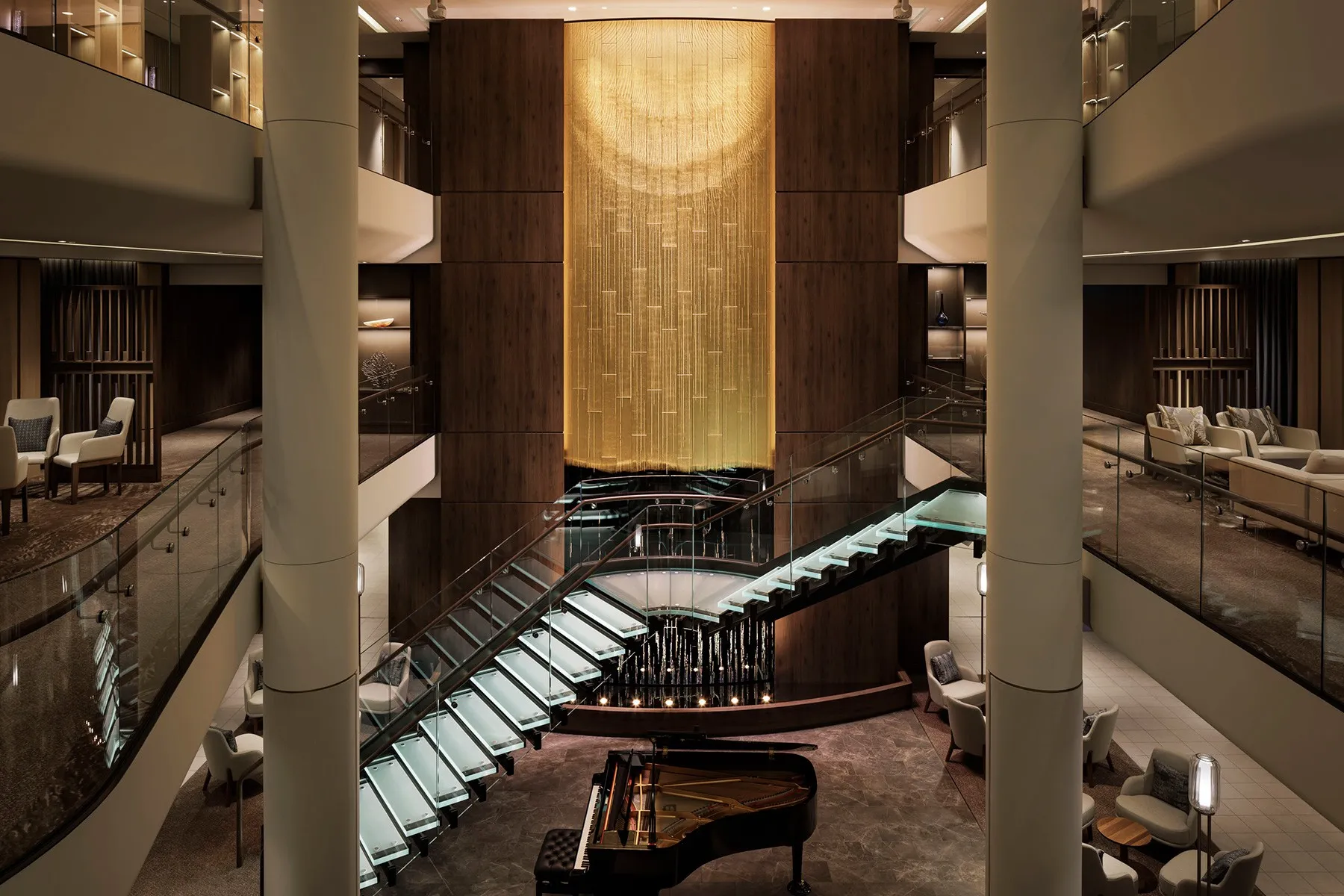
The centerpiece of the Asuka III collection is “Yōkō Yōei” (“Radiant Light, Radiant Brilliance”), a lacquer wall installation by Kazumi Murose, a Living National Treasure designated for Maki-e lacquer — the government’s highest recognition for mastery of intangible cultural heritage.
The work is displayed in Asuka Plaza, the ship’s three-story main atrium. At 8.8 meters tall and 3 meters wide, it depicts the play of light falling from above and reflected off the surface of the sea, rendered in Maki-e gold-powder technique and Raden mother-of-pearl inlay. It is the first work every passenger passes through on the ship’s main circulation route, and it functions as the collection’s visual anchor.
(Reference: Asuka III Art Collection)
As someone who follows lacquer craft closely, what strikes me most about this work is not its scale but its placement. It is not in a gallery. It stands in a thoroughfare — a space of movement and transition. The work does not wait to be visited. It meets people in motion, which is precisely how the finest lacquer objects have always functioned: as part of a lived environment, not an isolated spectacle.
Maki-e and Raden: A Brief Technical Note
Maki-e is a lacquer decoration technique in which gold or silver powder is dusted onto a wet lacquer surface to form patterns. Developed in Japan from at least the Heian period (794–1185), it is applied in multiple stages of layering and polishing. The process demands a physical sensitivity that only develops over years of practice — the powder must be set at precisely the right moment in the lacquer’s cure. The depth of its surface and the softness of its reflected light are particular to lacquer.


Raden is the practice of cutting thin sections from the shells of abalone or turban snail, then inlaying them into a lacquer or wood ground. The shells produce a shifting iridescence — the perceived color changes with the angle of incident light. On a ship, where light moves constantly as the vessel turns and the sun tracks across the sky, Raden behaves differently than it does in a fixed interior. The material is responsive to its environment in a way that conventional pigment is not.

“Kaiyu”: A Collaborative Work by Two Living National Treasures and Members of the Japan Kogei Association
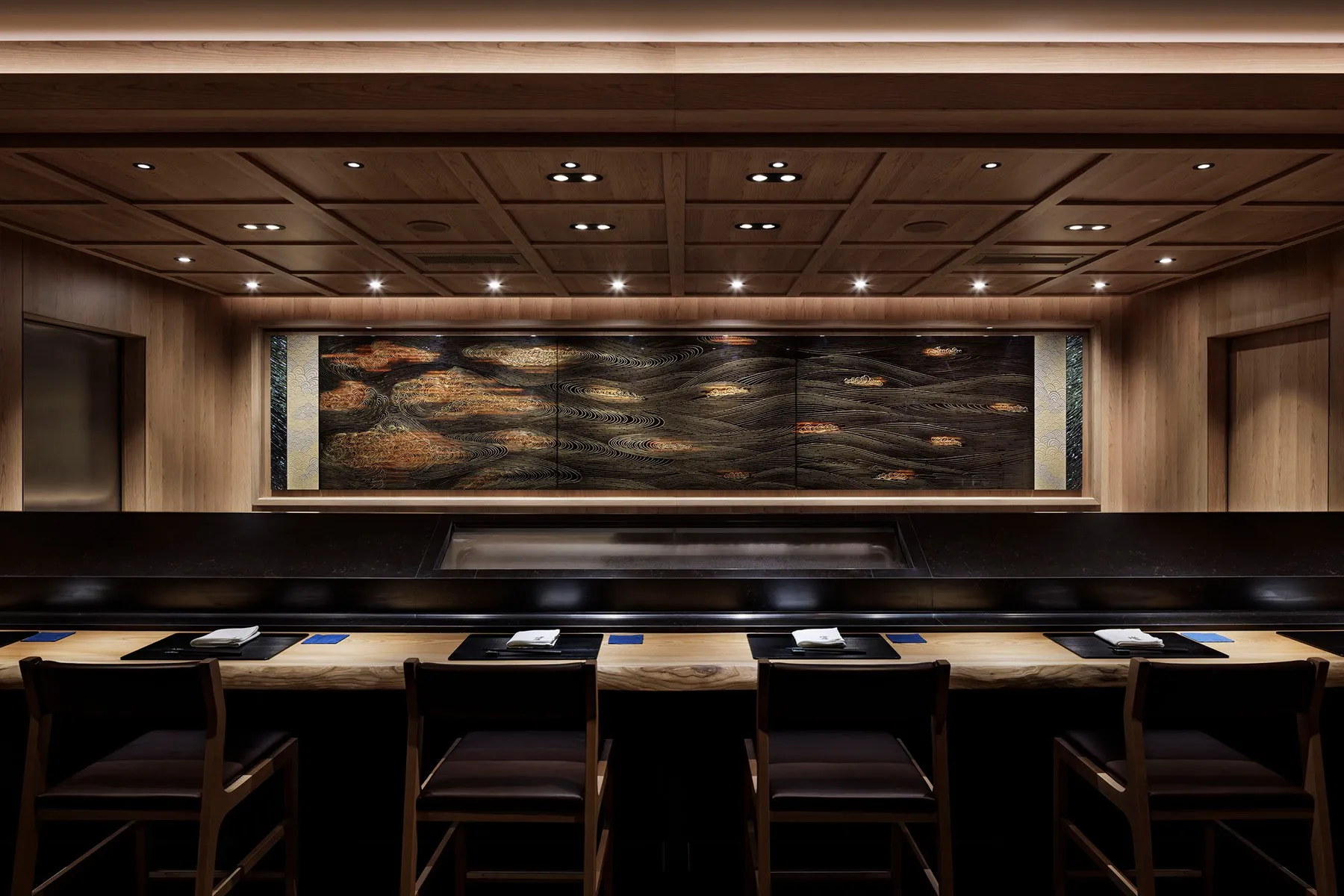
Among the works in the Asuka III collection, “Kaiyu” (“Drifting at Sea”) makes the most direct statement about craft transmission — the passing of technical knowledge between generations.
The work is displayed in Umihiko, the ship’s kaiseki restaurant. According to the Asuka III Art Collection website, the composition and concept were developed by Living National Treasure Kazumi Murose, with technical direction for the Chinkin (incised gold) passages provided by Kazuo Yamagishi, Living National Treasure in Chinkin lacquer. The execution of the decorative surfaces was carried out by junior regular members of the Japan Kogei Association, each contributing techniques from their own regional practice.
(Reference: Kaiyu — Kazuo Yamagishi | Asuka III Art Collection)
The subject is a seascape in transition: a large swell in the left field gradually giving way, as the eye travels right, to calm water at harbor’s edge. It is a description of a voyage reaching its end — and a fitting subject for a work that is itself the product of a long collaborative process.
Kazuo Yamagishi was designated a Living National Treasure in Chinkin in 2018 and received the Order of the Rising Sun, Gold and Silver Rays for contributions to cultural heritage preservation in spring 2025. He is based in Wajima, Ishikawa Prefecture, where the Wajima lacquer tradition has been centered for centuries.
A work of this kind — two Living National Treasures directing a team of specialized craftspeople, each contributing a distinct technique within a single unified composition — has no obvious precedent in standard exhibition practice. It required the kind of extended institutional commitment that the Asuka III project was structured to provide.
The Four Lacquer Techniques in “Kaiyu”: Raden, Kinma, Maki-e, and Chinkin
A brief account of each technique used in “Kaiyu” is useful here.
Raden (mother-of-pearl inlay): as described above — shell sections set into lacquer ground for iridescent effect.
Kinma is a carved lacquer technique in which a design is incised into the lacquer surface and the recesses are filled with colored lacquer, then polished level. The technique has roots in mainland Southeast Asia — Thailand and Myanmar — and was absorbed into Japanese lacquer practice, where it developed its own formal vocabulary. It is entirely distinct from Kirikane, a technique used in Buddhist painting and some decorative crafts, in which gold leaf is cut into strips and applied to a surface. The two are sometimes confused in general writing on Japanese craft; the distinction matters both technically and historically.
Maki-e (gold-powder lacquer): as described above.
Chinkin is a technique in which a fine design is carved or scratched into a cured lacquer surface using a specialized needle tool, and gold leaf or gold powder is then pressed into the incised lines. It is the dominant decorative technique of the Wajima lacquer tradition, and Kazuo Yamagishi is among the foremost living practitioners of the technique.
That a single work brings together four lacquer specialists — each trained within a different regional or technical tradition — is, from a craft perspective, structurally unusual. Lacquer practitioners typically develop deep expertise within one technique over the course of a career. The production of “Kaiyu” required a level of inter-specialist coordination that is only possible through formal institutional structure. That structure, in this case, is the Japan Kogei Association.
Hiroshi Senju, Reiji Hiramatsu, Noriko Tamura: Further Works in the Collection
The Asuka III collection extends well beyond lacquer.
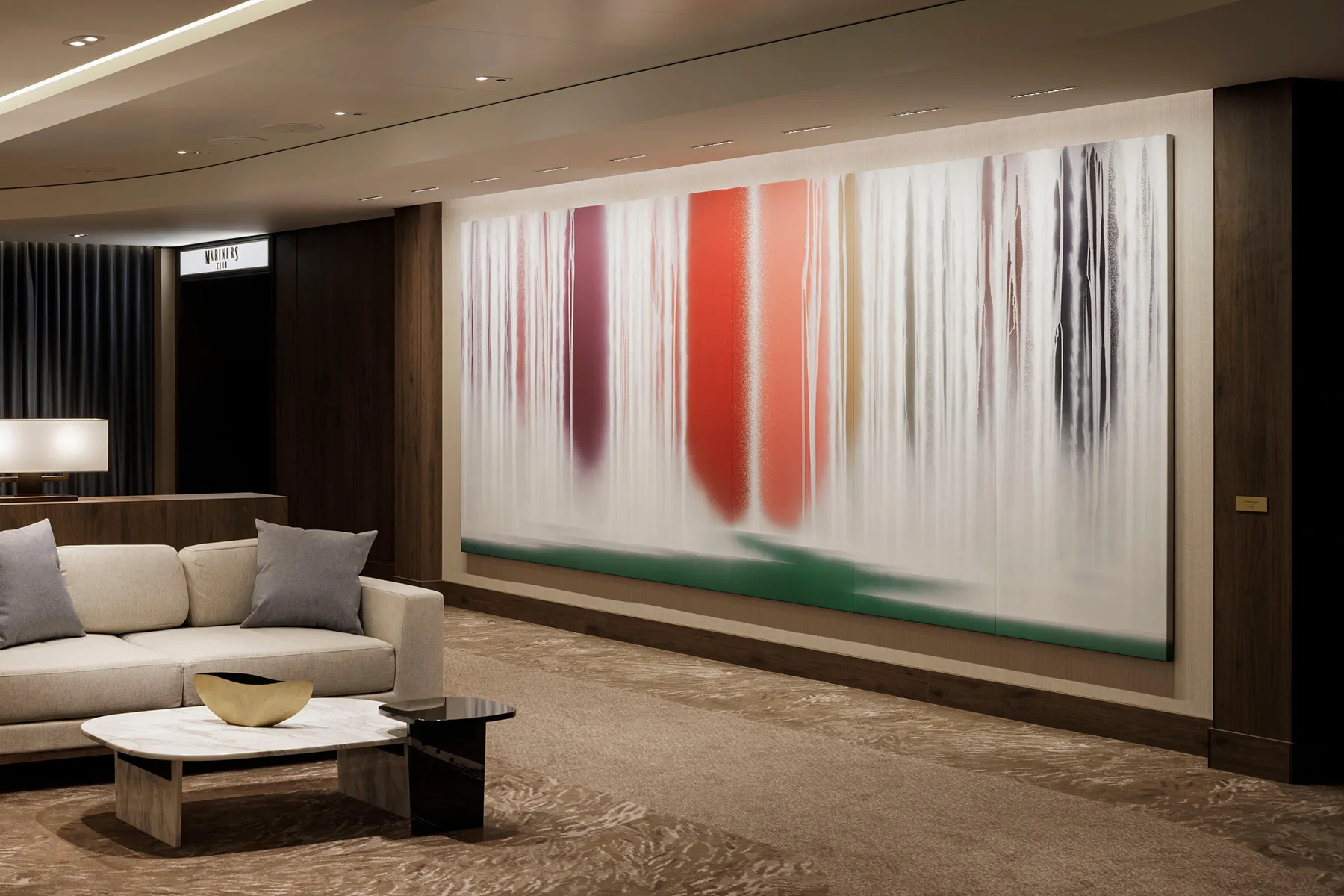
In the Gallery Café, Hiroshi Senju — a member of the Japan Art Academy — has installed “Waterfall on Colors.” Known internationally for his Waterfall series, Senju shifts perspective here: rather than depicting a waterfall head-on, the work places the viewer behind the falling water, looking outward. The diversity of the visible world is rendered in saturated, layered color.
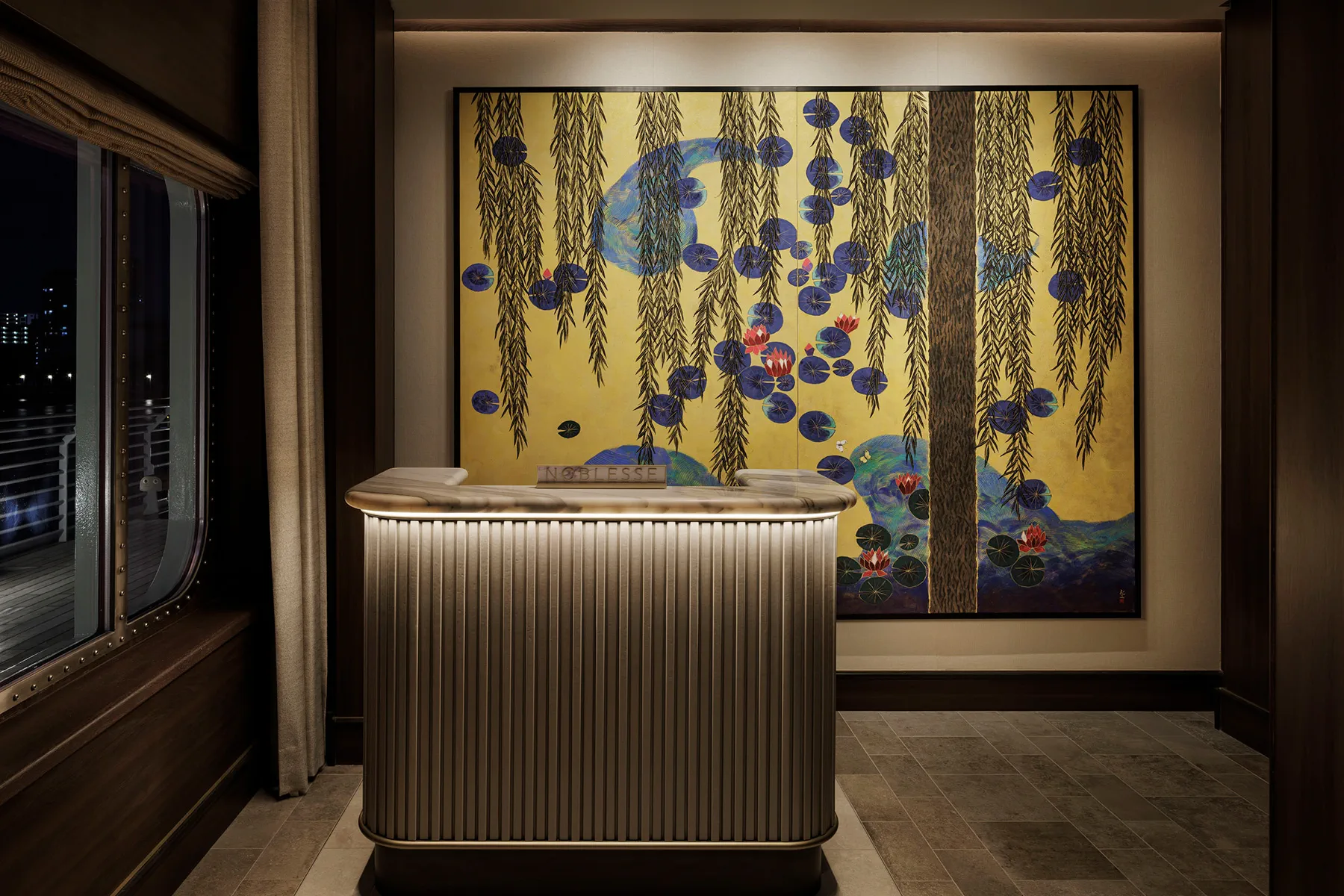
The Noblesse restaurant and adjacent spaces hold a group of works by Reiji Hiramatsu — Chevalier of the Ordre des Arts et des Lettres (France) — including “Monet’s Pond: Butterflies.” Hiramatsu’s practice consistently positions Japanese painting technique in dialogue with Western Impressionist tradition; the work here continues that conversation in a setting designed around French cuisine.
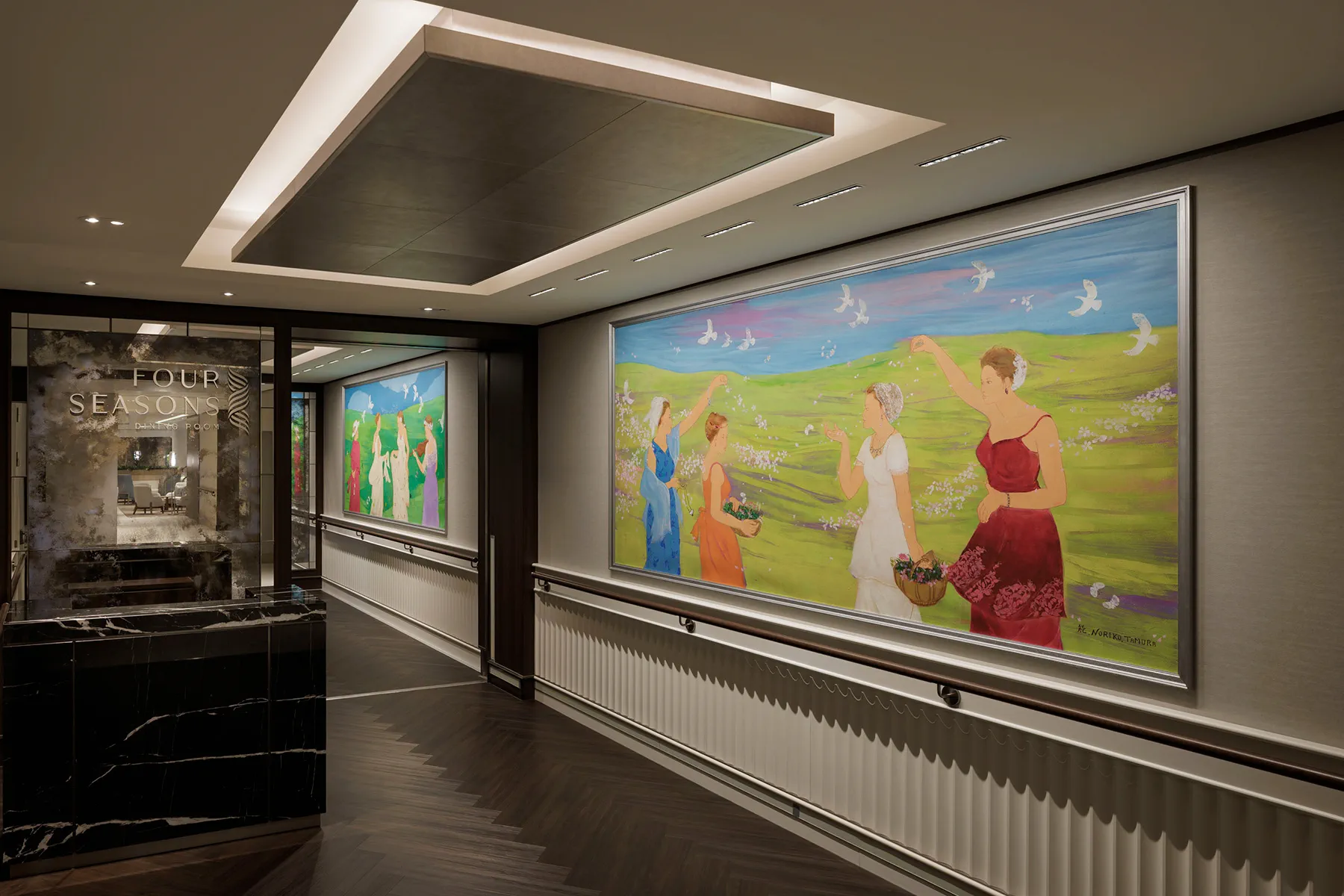
The Four Seasons Dining Room features four panels by Noriko Tamura — “Four Seasons Muses” — one for each season. Tamura has contributed work to every generation of the Asuka fleet. Here, the works become part of the dining experience itself: the paintings are not in an adjacent gallery but on the walls of the room where passengers eat, across multiple meals and multiple days.
The Japan Kogei Association and Asuka Cruise: A Formal Cultural Partnership
The relationship between Asuka III and traditional craft is not a matter of interior styling. Yusen Cruises and the Japan Kogei Association — the country’s principal organization for traditional craft arts, whose membership is anchored by Living National Treasures — have a formal collaborative relationship.
As documented on the Kogei Japonica profile of Asuka Cruise, the Japan Kogei Association and Asuka Cruise work together to present craft works aboard ship and to connect passengers with craft culture at ports of call through organized programs.
(Reference: Asuka Cruise | Kogei Japonica)
Living National Treasure Works Displayed Onboard
The realistic opportunity to stand in front of work by a Living National Treasure — not in a temporary exhibition, at a specific venue, during limited hours — is genuinely rare. For most people, regardless of where they live, it simply does not present itself.
On Asuka III, Murose’s “Yōkō Yōei” and the collaborative “Kaiyu” — supervised and technically directed by two Living National Treasures — are displayed in the ship’s public spaces. They are accessible at any hour of the day or night, for the full duration of the voyage.
The value here is not primarily one of prestige. It is one of access — sustained, unhurried access to work of high technical complexity, in an environment where you have time to return to it, and where the quality of your attention is not managed by museum protocol.
Craft Encounters at Ports of Call
The voyage extends beyond the ship’s interior. Asuka Cruise arranges programs connected to the craft culture of its ports of call — opportunities for passengers to engage with local craft traditions alongside the onboard collection.
(Reference: Asuka Cruise | Kogei Japonica)
The specific content of shore excursions varies by itinerary. We recommend confirming current program offerings with the official site or your booking contact before travel. What can be said with confidence is that many of Asuka III’s ports of call are adjacent to significant craft-producing regions — and that the itinerary design takes this seriously.
Most traditional craft production centers in Japan are not straightforwardly accessible from major urban hubs. The Asuka III routing, designed around Japan’s coastline, reaches a number of these regions as a matter of course — which represents a different kind of access than the Tokyo–Kyoto–Osaka circuit typically available to international visitors.
Living with Craft: Staterooms, Lounges, and Dining Spaces
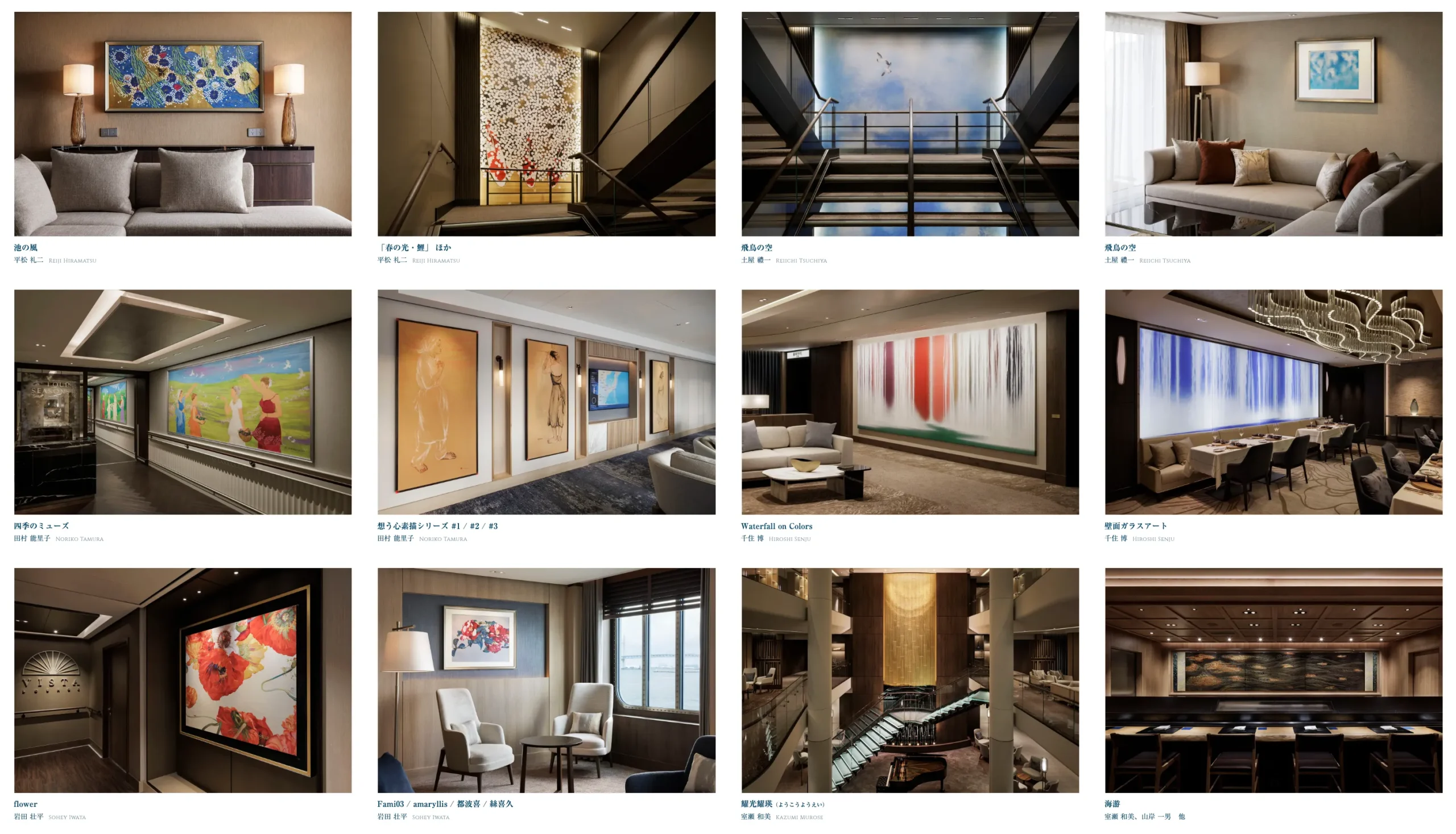
What makes Asuka III’s spatial approach distinctive is that it does not require you to stop. There is no “art section” of the ship that you visit and leave. The works are placed along routes you already take — to your table, to the deck, to your stateroom — and the encounters build over time.
By the end of a voyage, the experience of craft shifts register. Works that initially registered as impressive become familiar. Familiar things become available for closer attention. This is a different cognitive relationship with craft objects than a single museum visit produces — and it is not one that can be manufactured on shore.
Encounter Without Effort: The Spatial Logic of the Collection
The fundamental difference between a museum visit and time spent on Asuka III is one of mode.
In a museum, we adopt a viewing posture: we read labels, stand at prescribed distances, allocate time proportionally to importance. It is a rich experience, but a directed one. There is low-level cognitive effort involved in sustaining the attention it requires.
On Asuka III, no such effort is asked of you. You are eating, or in conversation, or looking out at the water, and a work enters your field of vision. The following day, it is there again. Over seven days — or twenty-three — that accumulates into something. Details that were invisible on first viewing become apparent on the fourth or fifth encounter. This is how craft objects were historically meant to be seen: as part of a sustained domestic environment, not as items on a viewing itinerary.
Light, Motion, and the Changing Face of the Works
A ship is a specific optical environment, and the collection has been chosen with this in mind.
The quality of light aboard changes continuously: the sun’s angle shifts as the vessel moves, the color of the sea varies by latitude and time of day, interior lighting plays differently as natural light waxes and wanes. For materials like Raden — mother-of-pearl inlay, whose perceived color depends entirely on the angle at which light strikes it — this variability is not incidental. It is part of the work’s behavior.
The Asuka III Art Collection site describes this directly: the works “resonate with the shimmering wake and the ever-changing sky, their expressions shifting moment by moment.”
(Reference: Art Concept | Asuka III Art Collection)
Conventional exhibition design treats environmental variability as a problem to be controlled: fixed lighting, climate management, UV-filtered glass. Asuka III treats it as a condition to work with. Craft materials — lacquer, mother-of-pearl, gold leaf — were developed in domestic environments where light moved and changed across the day. This ship returns them to something closer to that context.
On Luxury: A Reading from a Craft Publication
The form of luxury Asuka III represents is not defined by equipment specifications.
Commissioning work from Living National Treasures, maintaining a formal relationship with the Japan Kogei Association, building a ship in Germany while insisting on materials and surfaces that carry the sensory qualities of Japanese interiors — these are not decisions that follow automatically from a high capital budget. They are decisions that reflect a specific set of values about what a voyage should be.
The phrase “Quiet Luxury” has gained currency in international discourse around high-end goods and experiences. It describes a sensibility organized around material quality, workmanship, and provenance rather than brand visibility. It is, in many respects, the commercial culture catching up with what Japanese craft has always argued: that the most demanding standard is the one you impose on yourself, in the absence of any audience. Asuka III applies that standard to a ship.
Planning a Voyage: What International Travelers Need to Know
For international travelers seeking a Japan luxury cruise with a deeper cultural focus, Asuka III offers a rare way to encounter Japanese traditional craft, contemporary art, regional culture, and hospitality within a single journey. For those whose interest in Japan extends to its craft traditions, the ship addresses a question that is otherwise difficult to answer: where can you spend extended time in the presence of significant work, across multiple formats and traditions, in a setting that supports sustained attention rather than efficient throughput?
Japan in One Continuous Experience
Planning independent travel in Japan involves a familiar set of logistical demands: coordinating city-to-city transfers, managing accommodation changes, building an itinerary that connects cultural sites across a dispersed geography. For many visitors — particularly those on a second or third trip, moving past the major urban circuits — this complexity becomes the dominant experience of the journey.
On Asuka III, transport, accommodation, meals, and cultural programming operate as a single continuous experience. The cognitive load of itinerary management is removed. The geography of Japan unfolds from the water — a perspective that is simply not available by any other means.
This format is particularly well-suited to repeat visitors who have covered the Tokyo–Kyoto–Osaka circuit and are ready to engage with a different register of Japanese cultural experience.
Who This Voyage Is For
A straightforward account of who finds the most value in this kind of travel.
Repeat visitors to Japan and travelers with a specific interest in Japanese culture: those with a background in craft, art, architecture, or cuisine will find the onboard collection and the port itinerary substantively rewarding, not merely scenic.
Milestone journeys: wedding anniversaries, retirement, significant personal transitions. The format — continuous, unhurried, self-contained — suits occasions that call for a particular quality of time.
Travelers who prefer depth over density: Asuka III is not designed around maximizing activity. It is designed for people who want reading time, sustained conversation, and the particular kind of attention that slow travel makes possible.
Before You Book: Key Points to Confirm
| Item | Notes |
|---|---|
| Home port and itineraries | Homeported in Yokohama; voyages also depart from Kobe, Hakata, and other ports depending on the itinerary. |
| Duration and pricing | Itineraries range from short cruises to extended voyages. Fares and schedules vary by program; check the official site for current offerings. |
| Dress code | Relaxed during the day; Elegant Casual from approximately 17:00. Specific guidelines vary by itinerary — confirm in your booking documentation. |
| Restaurants and shore excursions | Reservations are required for some restaurants and shore excursion programs. Arrange these in advance through the official site or your booking contact. |
(Reference: Cruises | Voyage Japan with AsukaIII / Asuka III Boarding Information | Official Asuka Cruise Website)
How to Inquire and Book Through Voyage Japan with AsukaIII
For international travelers, a dedicated English-language booking and inquiry channel is in place.
The Role of the International Booking Site
Voyage Japan with AsukaIII (voyagejapanwitha3.com) is operated by Anchor Infinite Co., Ltd., an authorized sub-agent of Yusen Cruises Co., Ltd. The site provides full English-language access to the Asuka III Art Collection, current itineraries, stateroom information, and a direct inquiry form.
International booking and inquiry site: Voyage Japan with AsukaIII
Information to Have Ready Before You Inquire
Having the following details prepared will help your inquiry move efficiently.
- Preferred travel dates or seasonal window
- Number of travelers and travel configuration (solo, couple, family)
- Approximate budget and preferred stateroom category
- Areas of interest: craft, art, natural scenery, gastronomy, wellness, or combinations
- Any preferred regions or ports of call
If you have further questions, please feel free to use the Kogei Japonica inquiry form below.

Conclusion
The clearest way to describe Asuka III is this: it is a place where the Japanese aesthetic sensibility has been given the form of a living space — one that moves through the water and through the seasons.
In a museum, you stand before the work. On Asuka III, you share space with works supervised by Living National Treasures over the course of days, encountering them at the pace your own attention sets. Craft has always been argued, by the people who make it, to belong in use — in rooms where light changes and time passes. This ship makes that argument in physical form.
For travelers looking to encounter Japanese traditional craft outside a display case — and for those weighing a Japan luxury cruise that goes deeper than the itinerary — Asuka III is currently one of the more considered answers to that question.
This article is published by Kogei Japonica in connection with a project by Anchor Infinite Co., Ltd. Artwork details, ship specifications, and pricing information are drawn from official Asuka Cruise sources and affiliated sites. Cruise fares, itineraries, and schedules are subject to change without notice. Please verify current information directly with the relevant official sites before making travel plans.
