

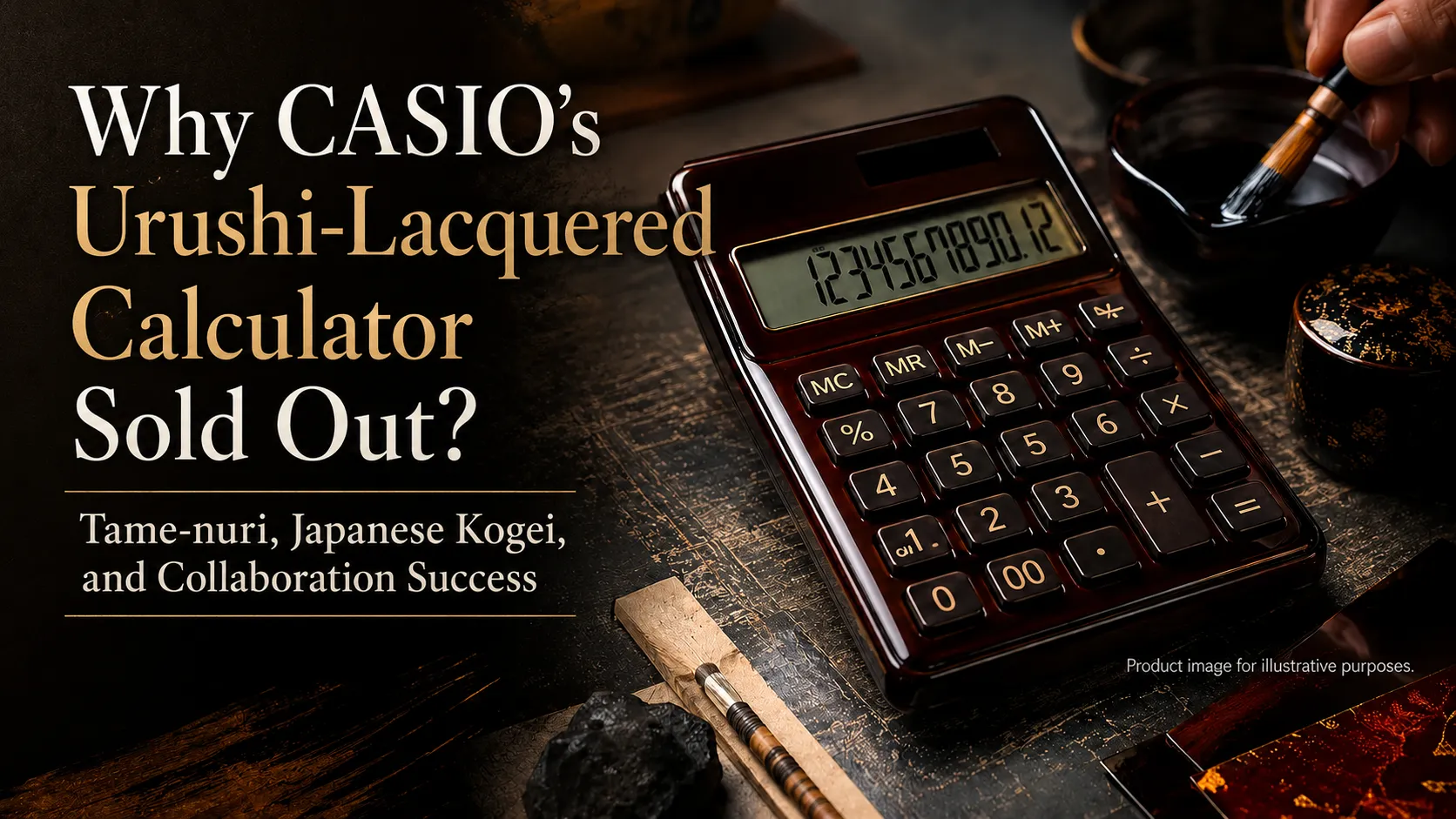
The urushi-lacquered CASIO calculator “S100X-JC1-U” attracted attention because three things aligned: the tamenuri lacquer technique, a worldwide edition of 650 units, and a level of finish that gave the ¥99,000 price tag a coherent rationale.
Released by Casio on April 9, 2026, the S100X-JC1-U is a special edition that brings together Japanese urushi lacquer craftsmanship and the S100 series — Casio’s flagship calculator line. According to official product information, each unit was finished by hand with urushi lacquer by skilled artisans at Yamakyu Shikko, an Echizen lacquerware workshop founded in 1930 in Sabae, Fukui Prefecture, with roughly 95 years of production history. The worldwide edition was limited to 650 units.
A calculator priced at ¥99,000 naturally invites a question: what, exactly, makes that price credible? But to read this product simply as a “luxury calculator” or a limited-edition conversation piece is to miss what it demonstrates about the intersection of craft and product development.
This article examines why the urushi CASIO attracted the attention it did, looking at the tamenuri technique, the pricing logic, the role of limited production, the Quiet Luxury context, and the structural conditions for craft-product collaboration. It is intended to be useful not only for craft enthusiasts but for those in product development, corporate gifting, spatial design, and international brand communication.
(Source: Calculator finished with traditional Japanese urushi lacquer | Casio Computer Co., Ltd.)
Table of Contents
Why Did the Urushi CASIO Calculator Sell Out?
The attention the urushi CASIO attracted was not simply a viral moment. It appears to have been the result of a craft technique, a production limit, and a pricing structure that reinforced one another.
Because purchase motivations cannot be verified directly from sales data alone, this article does not claim a single cause for the sell-out. Instead, it examines the product conditions that made the purchase credible: technique, material, production limit, pricing, and communication.
The S100X-JC1-U: Basic Product Facts
To understand this product clearly, it helps to start with the specifics.
| Item | Details |
|---|---|
| Product name | S100X-JC1-U |
| Release date | April 9, 2026 |
| Manufacturer’s suggested retail price | ¥99,000 (tax included) |
| Production quantity | Worldwide limited edition of 650 units |
| Base model | Casio S100 series (flagship calculator line) |
| Domestic production | Based on the S100 series, the only Casio calculator line manufactured domestically, at Yamagata Casio |
| Urushi finishing | Yamakyu Shikko (Sabae, Fukui Prefecture; founded 1930; approximately 95 years of history as an Echizen lacquerware workshop) |
| Lacquer technique | Tamenuri |
| Materials and finish | Precision-machined aluminum alloy body finished with 100% natural urushi lacquer |
| Production time | Over one month per unit, including urushi application, drying, and final assembly at Yamagata Casio |
The Nikkei reported that the product sold out at major electronics retailers’ online shops shortly after launch. For current availability and any restock announcements, refer to Casio’s official website and individual retailers directly.
(Source: S100X Urushi Edition | CASIO)
(Source: Casio’s ¥100,000 urushi calculator sells out across retailers | Nikkei)
Why “Calculator Meets Urushi” Generated Interest
The combination of urushi and a calculator attracted attention for reasons beyond the unexpected pairing. A calculator is an object handled repeatedly on a desk, day after day — which makes it, in practical terms, a reasonable vehicle for experiencing the texture of urushi in daily life.
In the same way that lacquered bowls and trays are used at the table, a calculator is a tool that comes into contact with hands repeatedly, over time. What this product brought together was a functional object — a working calculator — with the depth of urushi’s surface, the evidence of hand finishing, limited availability, and the particular satisfaction of ownership.
From a craft media perspective, the interest in this collaboration lies not in the fact that a calculator was given a Japanese aesthetic. It lies in the layering of urushi’s material character and the time it takes to apply onto an object of daily use.
Three Angles This Article Takes
This article examines the urushi CASIO through three lenses.
- Why the tamenuri technique is directly connected to this product’s value
- Why ¥99,000 carried a coherent rationale for a significant number of buyers
- What craft collaboration as a practice means — and what companies can learn from this case
What Is Tamenuri? — How a Lacquer Technique Gave an Industrial Product Depth
Tamenuri is a lacquer technique whose layered depth of surface — the sense of color existing below as well as on the finish — gives industrial objects a richness that uniform coating cannot replicate.
Tamenuri Is Not Simply a Dark Gloss
In Casio’s official release, the S100X-JC1-U is described as achieving a deep reddish-brown or dark crimson through the layering of translucent amber-toned urushi over a red ground.
What distinguishes tamenuri is the visual depth that this layering creates. The effect is not a uniform black or red but a surface where the color beneath the lacquer registers through the layers above it. Depending on the light and the angle of observation, the surface shifts between reddish-brown, dark crimson, and something close to deep black. This is tamenuri’s defining characteristic.
Casio’s official materials describe the technique as one in which the lacquer film is thinner at the edges, allowing those areas to show through. Rather than asserting that use will inevitably change the color, it is more accurate to describe this as the visual depth that the lacquer’s layered structure creates — a quality that is present from the moment the object is finished.
(Source: How the S100X Urushi Edition was made: where traditional Japanese lacquer meets calculator design | Casio Computer Co., Ltd.)
Urushi Is Not a Coating — The Material Itself Carries the Value
From a craft media standpoint, the fact that this product specifies 100% natural urushi is not a detail to pass over.
Urushi is a natural resin derived from the sap of the urushi tree, filtered and refined before use. It differs from synthetic lacquer in both origin and curing mechanism, producing a film of considerable durability and water resistance once hardened. This article does not make claims about properties such as antibacterial qualities that cannot be confirmed through primary sources, and limits its description to the material and process differences that are documented.
There is a meaningful distinction between a finish that resembles urushi and a finish applied with 100% natural urushi. The S100X-JC1-U is documented as the latter — hand-finished at a workshop in Sabae, Fukui Prefecture. That transparency is one of the reasons the price found a rationale with buyers.
(Source: Calculator finished with traditional Japanese urushi lacquer | Casio Computer Co., Ltd.)
(Source: How the S100X Urushi Edition was made | CASIO)
Glossary: Key Terms for Understanding the Urushi CASIO
| Term | Reading | English | Explanation |
|---|---|---|---|
| 漆 | Urushi | Urushi / Japanese lacquer | A natural coating material derived from the sap of the urushi tree. Distinct from synthetic lacquer in both origin and curing process, and requires clarification when described in English. |
| 溜塗 | Tamenuri | Tamenuri | A lacquer technique in which translucent amber-toned urushi is layered over a red ground, producing a deep reddish-brown or dark crimson with visual depth. |
| 生漆 | Ki-urushi | Ki-urushi / Raw urushi | Urushi sap that has been filtered to remove impurities. The S100X-JC1-U uses ki-urushi as its source material. |
| 越前漆器 | Echizen shikki | Echizen lacquerware | A lacquerware tradition centered on the Kawada district of Sabae, Fukui Prefecture. The Echizen Lacquerware Cooperative documents the history and current activity of this production region. |
| 塗師 | Nushi | Lacquer artisan | A craftsperson specializing in urushi application. Each unit of the S100X-JC1-U was finished by hand by skilled lacquer artisans at Yamakyu Shikko. |
Why the ¥99,000 Price Was Credible
A craft product that commands a high price needs to be able to articulate why — in terms of material, process, production limits, and the experience of ownership. “Luxury feel” alone is not enough.
Price Credibility Cannot Rest on Prestige Alone
A calculator approaching ¥100,000 will stop most people in their tracks. But whether a high-priced craft product finds buyers depends less on the number itself than on how clearly the reasoning behind it can be explained.
In the case of the S100X-JC1-U, the elements that support the price can be laid out as follows.
- Materials: 100% natural urushi used throughout
- Process: Each unit hand-finished by skilled lacquer artisans at Yamakyu Shikko
- Production time: Over one month per unit, including urushi application, drying, and assembly
- Production quantity: Worldwide limited edition of 650 units
- Base product: Built on Casio’s S100 series flagship calculator line
- Domestic manufacture: The S100 series is the only Casio calculator line produced domestically, at Yamagata Casio
- Ownership experience: Casio describes the product as intended to be “a piece that brings the pleasure of ownership and can be used for a long time”
Taken together, these elements position the ¥99,000 price not as an expression of luxury status but as a figure that can be read through materials, process, production limits, and the quality of the underlying product.
650 Units: Production Limits That Match the Process
A worldwide edition of 650 units creates scarcity — but in this case the number also aligns with the production reality: each unit finished by hand, requiring over a month of work including urushi application, drying, and assembly.
How the figure of 650 was arrived at is not specified in official materials. This article does not claim it was determined by the maximum capacity of the artisans involved. What can be said is that the limit reads as consistent with the production process described — which is itself part of what gives the number coherence rather than feeling like a marketing construct.
The Conditions Under Which a High-Priced Craft Product Is Accepted
For a craft collaboration to carry a high price credibly, the reasoning needs to be articulable. For companies considering similar projects, the following are the minimum points worth working through.
Checklist: conditions for a high-priced craft product to be credible
- The technique name can be explained accurately
- The involvement of a named workshop and artisan is documented
- The authenticity of the material is stated
- An overview of the production process and the time it requires is communicated
- The production quantity has a coherent rationale in terms of the production structure or the project design
- The use context and the experience of ownership can be imagined concretely
- The material, technique, and background can be explained to an international audience
Why Quiet Luxury and Craft Work Well Together
Quiet Luxury — a value orientation that prioritizes material quality, process, and understated refinement over branded display — has a natural alignment with craft products.
What Quiet Luxury Actually Means
Quiet Luxury is generally described as a sensibility that signals value through material quality, construction, and context rather than through visible logos or conspicuous decoration. It originated as a fashion term but has moved into discussions of interiors, product design, stationery, and everyday objects.
The term does not simply mean “subdued and expensive.” At its center is the idea that the person using the object understands its material and process — and finds value in it quietly, within their own life. That understanding, rather than external display, is the point.
Why the Urushi Calculator Reads as Quiet Luxury
Several elements of the S100X-JC1-U align with this framing.
- The depth of the tamenuri surface is more prominent than any logo or decorative element
- The layered color of tamenuri carries a strong presence that is restrained rather than assertive
- A functional object of daily life — the calculator — is reframed as a quiet ownership experience
- The value deepens with understanding of the material, process, and production region
- The premise is a limited edition meant to be used over a long time, rather than mass-consumed
That said, a craft media perspective requires some caution about over-relying on the Quiet Luxury frame to account for craft value. The quality of tamenuri’s surface and the material character of urushi exist independently of any consumption trend. The right sequence is: the technique and material have their own substance first, and the connection to contemporary consumer contexts is secondary.


How to Communicate This to an International Audience
When writing about a craft product like this one in English, there is no need to reach for framings like “the mystical soul of Japan” or “ancient wisdom.” Describing the material, the process, and the experience of use in concrete terms is both more accurate and more effective with international readers and buyers.
| Framings that work | Framings to avoid |
|---|---|
| contemporary craft | mysterious Japan |
| material culture | ancient soul |
| collectible design | exotic beauty |
| quiet luxury | magical craftsmanship |
| product storytelling | Japanese-style decoration only |
| urushi / Japanese lacquer | vague oriental mood |
| tamenuri lacquer | unexplained traditional aura |
What an international audience needs is a material and structural explanation: what makes this surface work the way it does, and why the process behind it connects to the product’s value. Over-mystifying craft makes its actual qualities harder to see.
Why This Collaboration Did Not End Up as “Craft-Inspired”
The craft collaborations that work are not ones where a traditional pattern is applied to a surface. They are ones where the technique, material, and process are built into the product’s value from the start.
The Difference Between Craft Collaboration and Craft-Inspired Products
There are many products described as craft collaborations. Not all of them manage to incorporate craft value into the product itself. The distinction can be laid out as follows.
| Criteria | Craft collaboration that works | Craft-inspired product that tends not to |
|---|---|---|
| Role of the technique | Central to the product’s value | Applied as surface decoration |
| Workshop and artisan | Named, with process and involvement documented | Unnamed, or involvement unclear |
| Material authenticity | Material and process are explained | Distinction from print, sticker, or synthetic coating is not addressed |
| Price rationale | Can be explained through process, material, and production limits | Explained only through a general sense of luxury |
| Production quantity | Limit is consistent with the production structure and the project concept | The word “limited” does the work without further explanation |
| Ownership experience | The experience of use and material contact is designed into the product’s value | The visual appearance is the whole point |
| International communication | Material and technique can be explained concretely | Handled as “Japanese-style” without further elaboration |
The Casio collaboration appears to meet many of the conditions in the left column. What ties the product together is the combination of 100% natural urushi, hand finishing by Yamakyu Shikko’s lacquer artisans, the underlying quality of the S100 series, and a worldwide edition of 650 units — all of which form a coherent product design rather than a set of disconnected selling points.
Six Success Factors in the CASIO Case
The factors that appear to have made this a functional craft collaboration can be organized under six headings.
- A strong base product: The S100 series is Casio’s flagship calculator line and the only one manufactured domestically, at Yamagata Casio.
- Technique selection: Tamenuri’s depth of surface and layered color connect to the experience of handling a calculator at a desk every day.
- Workshop involvement: Yamakyu Shikko in Sabae, Fukui Prefecture handled the urushi finishing, with each unit completed by hand by skilled lacquer artisans.
- Limited production: A worldwide edition of 650 units generated both scarcity and attention.
- Articulable pricing: The material, process, production time, domestic manufacture, and production limits are all documented as background to the price.
- Internationally communicable material value: The product can be described in English through urushi, Japanese lacquer, and tamenuri — giving the material and technique a basis for explanation beyond Japan.
Editor’s Note
As a craft media editor, what I found most worth paying attention to in this case was not that a calculator was given a Japanese aesthetic — it was that a material with its own processing time, its own layered structure, and its own relationship to the hand was placed onto an object of daily use.
Craft collaboration is not about decorating tradition. The technique, material, workshop, and use context have to connect before a product can carry its value to a different depth. The S100X-JC1-U appears to have met that condition with considerable consistency.
In its official release, Casio described the product as “a piece that brings the pleasure of ownership and can be used for a long time.” That is not simply advertising copy — it is a description that aligns with what it means to apply a technique like tamenuri urushi to a calculator.
If a Company Is Planning a Craft Collaboration — What Needs to Be Designed?
A craft collaboration requires technique selection, workshop relationship, production quantity, pricing, and communication approach to be designed as a single integrated structure — not assembled after the fact.
Six Design Questions to Start With
When a company is considering a craft collaboration, these are the questions worth working through at the beginning.
- Why this technique? Can you explain how the specific properties of the technique connect to the product’s value — rather than “we wanted a Japanese aesthetic”?
- Which workshop or artist? Can the workshop’s background, skill, and production region be introduced honestly as part of the product’s description?
- What quantity is realistic? Does the production limit align with what the workshop can actually produce, and with the concept of the collaboration?
- How will you explain the price? Can the price be justified through process, material, and production time — without relying on luxury positioning alone?
- How is the use experience designed? Is the product structured so that the owner can experience the value of the craft in daily use?
- How will you communicate internationally? Can the material and technique be explained in English without defaulting to “Japanese style”?
A craft collaboration cannot be assembled by adding a traditional appearance to a finished product. The technique, workshop relationship, quantity, price, and communication approach need to be built together from the start.
Checklist for Company Teams
The following checklist can serve as a quick reference when planning a craft collaboration product or a corporate craft commission.
Craft Collaboration Planning Checklist
Technique and material
- The technique name can be explained accurately
- Whether the material is natural or synthetic is clearly stated
- The reason this specific technique is used — rather than any other — can be explained
Workshop and artisan relationship
- The workshop and artisan’s name, history, and production region can be introduced
- The artisan’s role and the extent of their involvement can be described
- Appropriate compensation and respect for the workshop are reflected in the project design
Quantity and pricing
- The production limit has a rationale in terms of the production structure or the project concept
- The price can be explained through process, material, and production time
Communication and PR
- The material and technique can be explained in both Japanese and English
- There is a context for communicating the ownership experience, the feel of use, and the material’s qualities
FAQ: The Urushi CASIO and Craft Collaboration
Pricing, technique, availability, international communication, and key considerations for corporate craft collaboration — addressed here.
- Q1. Is the urushi CASIO calculator S100X-JC1-U still available to buy?
- Reports indicated that the product sold out at major electronics retailers’ online shops shortly after launch. For current availability, check Casio’s official website and individual retailers. For restock information, refer to official announcements.
- Q2. What is tamenuri?
- Tamenuri is a urushi technique in which translucent amber-toned lacquer is layered over a red ground, producing a deep reddish-brown or dark crimson with visual depth. In the S100X-JC1-U, this technique is what gives the surface its layered, dimensional quality.
- Q3. Why did a ¥99,000 calculator attract serious interest?
- The combination of 100% natural urushi, hand finishing by skilled lacquer artisans, a production time of over one month per unit, a worldwide edition of 650 units, and the quality of the S100 series as a base product gave buyers a concrete basis for understanding the price — rather than asking them to take the cost on trust.
- Q4. Can urushi lacquer be applied to industrial products like calculators?
- This product applies urushi to a precision-machined aluminum alloy body. That said, material compatibility, durability, and quality management vary by product. For specifications of any particular product, refer to official manufacturer information.
- Q5. Is urushi the same as lacquer?
- Both are sometimes translated as “lacquer” in English, but urushi is a natural resin derived from the sap of the urushi tree. It differs from petroleum-based synthetic lacquer in both origin and curing mechanism. When describing urushi in English, it helps to specify that it is a natural material — “Japanese lacquer” or “natural urushi” — rather than leaving the distinction implicit.
- Q6. What should companies watch out for when planning a craft collaboration?
- The key considerations are: a clear rationale for the technique chosen, genuine respect for the workshop’s contribution, a price that can be explained through process and material rather than through luxury positioning alone, a production quantity that is consistent with the production structure, thorough material documentation, and a communication approach that works in international contexts. A craft collaboration that exists only to apply a traditional appearance to a product risks consuming craft value without contributing to it.
What the Urushi CASIO Reveals About Craft Collaboration Today
Contemporary craft collaboration is not about decorating a product with tradition. It is about redesigning a product’s value through material and technique.
Five Conclusions
The points this article has worked through can be summarized under five headings.
- The attention the urushi CASIO attracted was not simply the result of novelty. It appears to have been produced by the alignment of the tamenuri technique, the production limit, and a price that could be explained.
- Tamenuri’s depth of surface gave a daily-use object — the calculator — a quality of ownership that goes beyond function.
- Being accepted at a high price requires a rationale that can be articulated through process, material, and production structure — not through a general appeal to luxury.
- The Quiet Luxury frame is useful as a communication context for craft products, but craft’s value is not dependent on it.
- The success of a craft collaboration depends on technique selection, workshop relationship, quantity, pricing, and communication being designed together as an integrated whole.
For companies and teams considering craft in product development, corporate gifting, spatial design, or international communication.
Kogei Japonica can assist at each stage — from introductions to appropriate craft artists and workshops, through to product development, PR, and international communication design.
If this is your first craft collaboration, we are open to conversations from the early planning stage onward.

