

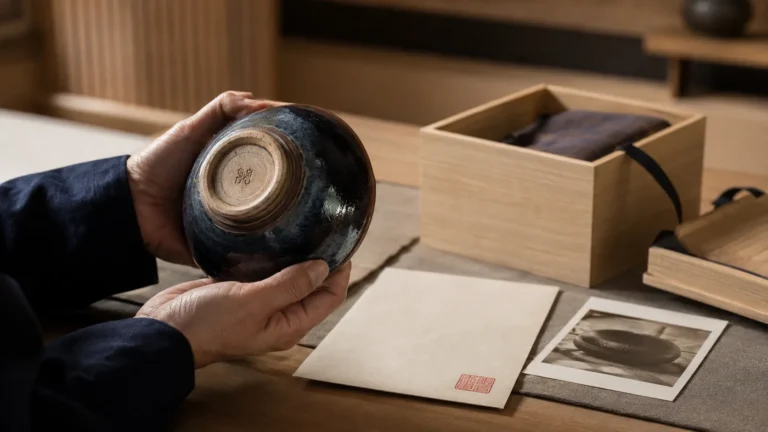
When choosing a piece of craft, it is tempting to reason “it carries the traditional mark, so it must be genuine” or “it comes with a tomobako, the maker’s own signed box, so I can trust it.” But the traditional mark, the traditional certification seal, an artist’s mark, a tomobako and its box inscription (hakogaki), and a certificate or letter of authentication each play a different role.
To put it plainly: no single mark or document can establish a piece of craft as “genuine” on its own. What matters is to distinguish who is providing the information, what exactly it refers to, and what standard it is based on.
Drawing on material from the Ministry of Economy, Trade and Industry (METI), the Association for the Promotion of Traditional Craft Industries, and the collection records of Japan’s national art museums, this article sorts out what each mark or document does show, and what it does not. The checks it describes are useful for first-time buyers of craft, for anyone choosing a gift or an artist’s piece, and for those buying Japanese craft from abroad.
Table of Contents
Does the Traditional Mark Make a Piece “Genuine”?
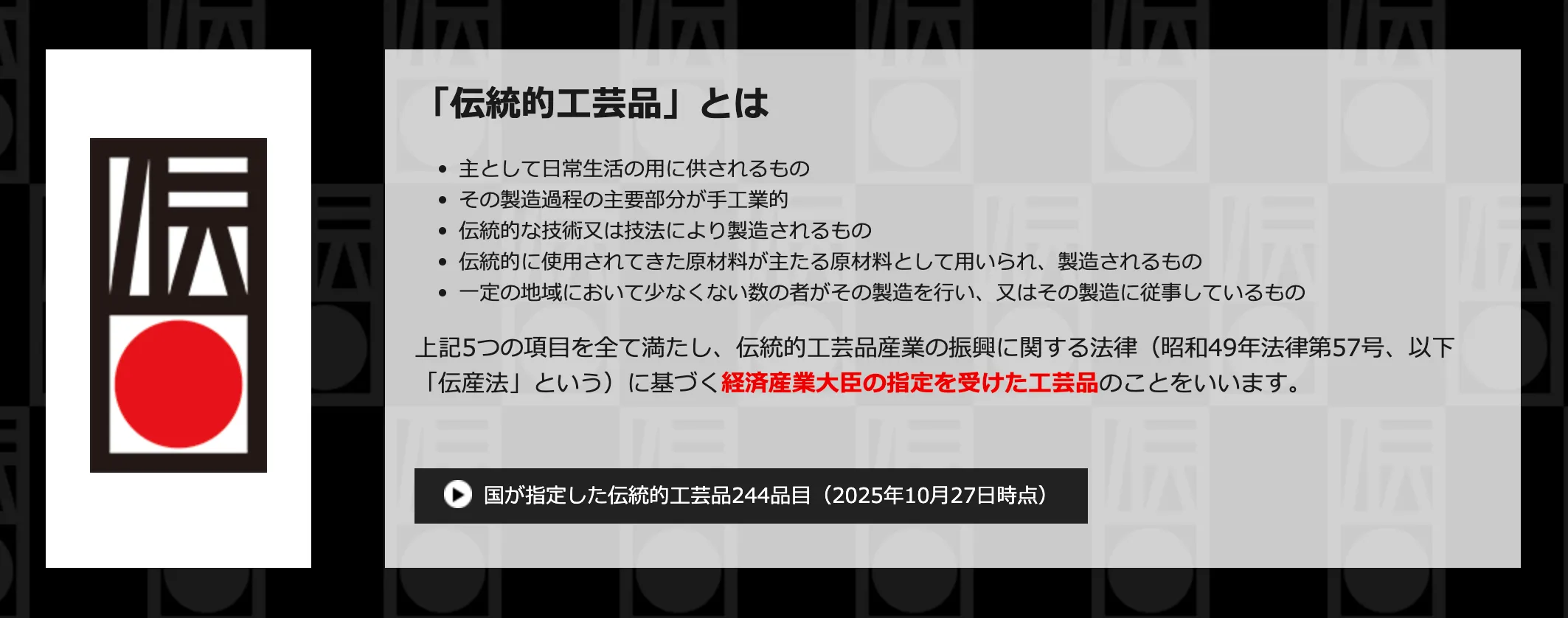
The traditional mark is not a certification mark for classifying every Japanese craft as either genuine or fake. The first thing to understand is the difference between Japan’s official Traditional Craft Mark itself and the “traditional certification seal” that uses its design.
What the Traditional Mark Certifies
The “traditional mark” is the symbol mark of the traditional crafts designated by the Minister of Economy, Trade and Industry. According to the Association for the Promotion of Traditional Craft Industries, products made with the techniques, methods and raw materials designated by the Minister, and that pass inspection in their production area, receive a “traditional certification seal” using the traditional mark’s design.
So at the point of purchase, rather than simply checking whether the mark’s design is present, what matters is which designated craft the seal applies to and which production-area certification system issued it.
(参照:伝統的工芸品のシンボルマークについて|一般財団法人 伝統的工芸品産業振興協会)
On the certification seal, the Association describes a system in which specified manufacturing cooperatives and the like inspect the traditional crafts concerned and affix the seal to those that pass the inspection standards. The certification seal is therefore an important way for consumers to identify products certified under the designated traditional craft system.
At the same time, the certification seal is not a system for authenticating an artist’s work on the antiques market, nor for guaranteeing an individual maker’s artistic standing or a work’s rarity.
(参照:法律(伝産法)|一般財団法人 伝統的工芸品産業振興協会)
The term “designated traditional craft” is, in the first place, an institutional name under the Act on the Promotion of Traditional Craft Industries (the Densan Law), promulgated in 1974. METI sets out requirements including that a craft be used mainly in daily life, that the main part of its manufacturing process be by hand, that traditional techniques, methods and raw materials be used, and that a production base be formed as a recognised area.
With the addition of “Tokyo hand-carved seals” on 27 October 2025, the traditional crafts designated by the Minister came to 244 nationwide. METI’s information available at the time of writing likewise gives the figure as 244.
(参照:伝統的工芸品|経済産業省)
The category of “designated traditional crafts” is narrower than Japanese craft as a whole.
There are many excellent crafts among the work of contemporary makers who have not received the Minister’s designation, among regional crafts outside the system, and among pieces that incorporate new materials and techniques. Being inside the designation system, and the value or appeal of a work itself, are not measured by the same yardstick.
This difference matters a great deal in understanding the traditional mark. The system is a strong clue for understanding craft, but it is not a means of judging the craft outside it to be “not genuine.”
What Is the Difference Between the Seal, the Artist’s Mark, the Tomobako, the Box Inscription and a Certificate?
The certification seal, the artist’s mark, the tomobako, the box inscription and a certificate or letter of authentication differ both in who issues them and in what they show. Don’t treat “something is attached” as the same kind of proof in every case; check each one’s role separately.
| What to check | What it indicates | Main issuer | What to confirm at purchase | Can it settle authenticity alone? |
|---|---|---|---|---|
| Traditional certification seal | The relation between designated techniques, methods and raw materials and production-area inspection | Specified manufacturing cooperatives etc.; the Association’s certification system | Whether it is a formal seal, and which designated craft it corresponds to | No — it does not authenticate craft in general |
| A production area’s own seal or mark | Information on standards set by the area or cooperative | Individual areas, cooperatives etc. | The issuer, and the standard the seal represents | Varies by system |
| Artist’s mark, seal or signature | Evidence that may support attribution to a maker or workshop | Makers, workshops etc. | Whether the piece and the box or documents agree | Don’t conclude from the mark alone |
| Tomobako and box inscription | Work information such as title, maker’s name, signature and seal | The maker etc. | Whether piece and box correspond, and what is recorded | Don’t conclude from the box alone |
| Certificate or letter of authentication | What the issuer has confirmed or certified | Makers, workshops, galleries, authenticating bodies etc. | Who issued it and what it certifies | Depends on the issuer and content |
What the comparison shows is that these cannot be lumped together as “documents that prove a piece is genuine.”
The traditional certification seal is a mark relating to the national designation system and production-area inspection. An artist’s mark is material for considering attribution to a maker, and a tomobako is information that accompanies a work. A certificate or letter of authentication, too, changes in meaning with its issuer and what it certifies.
What a Production-Area Seal Does and Does Not Prove
Separately from the “traditional certification seal” used on the traditional crafts designated by the Minister, an area or cooperative may set up its own seal, brand mark or quality label.
What to note here is that there is no single nationwide system called the “production-area seal.”
What a seal shows differs by area and by system, and what it confirms—production in the area, raw materials, method of manufacture, membership of a cooperative, inspection standards—is not uniform.
So if you find an area’s own seal, rather than thinking “there’s a seal, so it must be authentic,” check the organisation issuing it and the standard the seal is based on.
The name of a production area is important information for understanding a work, but indicating a production area and evaluating the quality or artistic merit of an individual work are separate things.
What an Artist’s Mark (Signature, Rakkan) Does and Does Not Prove
Craft works may bear various forms of maker identification, depending on genre and artist—the mei (mark), a seal, a tōin (ceramic seal-stamp), a rakkan (artist’s seal or signature), an incised mark, a signature.
In ceramics, a mark or seal may be placed on the base or around the foot ring (kōdai), but the position and form differ by artist. Maker information may be recorded not only on the piece itself but on the box, an accompanying leaflet (shiori) or work documents.
An artist’s mark is an important clue for considering attribution, but concluding it is a genuine work by that artist from the mark alone is best avoided.
Even for the same artist, the mark or seal used may differ by the period of making and the type of work. And judging authenticity from the shape of the mark alone is difficult, especially for a beginner.
When confirming a particular artist’s work, the basic approach is to cross-check it against reliable sources clearly connected to the work—official information from the artist or workshop, museums that hold the artist’s work, exhibition catalogues, authorised dealer galleries.
For higher-value works by named artists, and for pieces in the secondary market, a separate article explains in detail how to confirm not only the mark but the box inscription, provenance and point of purchase.


What a Tomobako and Box Inscription Do and Do Not Prove
A tomobako generally refers to a box corresponding to a work, accompanied by a box inscription, signature or seal by the maker themselves.
The work title, maker’s name, signature and seal recorded on the box can provide important evidence for assessing a work’s attribution and provenance. For that reason, rather than treating a tomobako as mere packaging, we recommend keeping it together with the work itself.
In fact, in the collection search of the National Museum of Art, the record for Tomimoto Kenkichi’s large decorative jar with an overglaze gold-enamel fern design, held by the National Museum of Modern Art, Kyoto, lists the work title, a seal, and the inscription “made by Tomimoto Kenkichi” together with the “tomobako.” The English information records it as “Case with title, sign and seal,” so the box itself is recorded as part of the work’s information.
(参照:富本憲吉《色絵金彩羊歯模様大飾壺》|独立行政法人国立美術館・所蔵作品検索)
That said, the existence of a tomobako and the unconditional confirmation of a work’s authenticity are not the same thing.
Over long circulation and ownership, the pairing of work and box may have changed. So check together whether the work title, dimensions, maker’s name, signature and seal are consistent with the piece itself.
In tea utensils and antiques, an inscription or appraisal by someone other than the maker may remain on the box, but its meaning and evaluation differ according to who recorded what, and about what. Rather than a beginner judging value from a name alone, it is safer to check with a specialist or a trusted seller as needed.
A Certificate Is Not Conclusive Proof
With a certificate or letter of authentication too, it matters to look at “who is certifying what,” rather than “whether there is a document.”
A certificate of the work issued by the artist or workshop, a proof of sale issued by a gallery or shop, and a letter of authentication by a body recognised in a particular field each serve different purposes.
So when checking a certificate or letter of authentication, look at least at the following.
- Who issued the document
- What the document certifies
- Whether the work title, maker’s name, dimensions and so on match the actual piece
- Whether there is verifiable information such as an issue date or reference number
- Whether you can enquire with the issuer if needed
The phrase “with certificate” should not be treated as conclusive on its own. For high-value works especially, verify the issuer, the document itself and the work’s provenance.
Is a Craft Without a Mark or Seal a Fake?
No. The absence of a mark or traditional certification seal does not mean a craft is a fake.
The traditional certification seal is a system concerning the traditional crafts designated by the Minister. It is therefore not something affixed uniformly to craft works outside that system.
There are many excellent crafts among one-of-a-kind works by contemporary makers, regional crafts in areas without designation, and pieces combining new materials and techniques.
As of 27 October 2025, the traditional crafts designated by the Minister number 244. Whether or not a piece falls within these 244 designated crafts is an institutional category; it is not a line dividing all of Japan’s craft works into higher or lower value, or genuine and fake.
(参照:「東京手彫り印章」を伝統的工芸品として指定しました|経済産業省)
Editor’s Note
When choosing a piece of craft, there is no need to think “the more proofs a work has, the more valuable it is.” What we would rather look at is whether the information given about a work—the maker, material, technique, production area and making background—is consistent with the actual piece.
A mark from the system, an artist’s mark, information left on a box, a sales record—each is a clue for understanding a work from a different angle. Rather than entrusting the judgement to one impressive-looking “proof,” seeing the connections between several pieces of information is, we think, what matters in understanding craft.
A tomobako or a certificate of authentication, too, does not accompany every craft. The degree of checking called for differs between an everyday vessel bought directly from a young maker and a high-value work bought on the secondary market.
Rather than looking only at the “presence or absence” of documents, it is more practical to consider what information you can actually confirm for that particular work.

What Can You Check for Yourself Before Buying?
At purchase, don’t reach a conclusion from a single mark or document; check the information on the maker, the work, the accompanying material and the seller in turn. Even without being a specialist, there are still many things you can check for yourself.
Pre-purchase checklist
- Whether the maker or workshop name is clear
- Whether the work or product title can be confirmed
- Whether there is an explanation of material and technique
- If a production area is stated, whether its basis is clear
- Where there is a seal or mark, whether you have checked the issuer and meaning
- Where there is an artist’s mark, seal or signature, whether it is consistent with the box and accompanying documents
- Where there is a tomobako, whether the work title, dimensions and maker information correspond to the contents
- Where there is a certificate or letter of authentication, whether you have checked the issuer and what it certifies
- Whether there is verifiable information about the seller or point of purchase
- Whether you can keep the delivery note, receipt and work documents after purchase
Not every work has to have every item in place.
For instance, buying an everyday vessel of a few thousand to a few tens of thousands of yen at an artist’s own exhibition, and buying a well-known artist’s work on the secondary market, naturally require different levels of verification.
What matters is keeping track of what you checked in choosing that work.
If there is something you do not understand, it is fine to ask the shop or gallery questions like the following.
- “Who made this piece?”
- “Could you tell me about the material and technique?”
- “Which organisation issued this seal?”
- “Is this box a tomobako corresponding to the work?”
- “Is there any material I can check about the artist or the work?”
What matters more than receiving a polished answer to every question is whether the seller clearly distinguishes what can and cannot be verified—one measure for judging a seller.
When buying second-hand or on the secondary market especially, be conscious not only of the piece itself but of its provenance, the presence of repair or loss, the correspondence with the box and accompanying material, and information you can confirm about the source.
Frequently Asked Questions (FAQ)
Finally, we sort out, concisely, the points that most often raise questions at purchase—about the traditional mark, the seal, an artist’s mark and the tomobako.
- Q. If a piece has the traditional mark, does that prove it is genuine?
- The traditional mark itself is the symbol mark of the traditional crafts designated by the Minister of Economy, Trade and Industry. The traditional certification seal using its design is affixed to products made with the designated techniques, methods and raw materials that pass production-area inspection. It is not, however, a system for authenticating the genuineness of crafts in general.
- Q. Is a craft without the traditional mark a fake?
- No. The traditional certification seal is a system concerning traditional crafts designated by the Minister. There are many excellent works among contemporary makers’ pieces and regional crafts outside the system.
- Q. Are “traditional crafts” and “designated traditional crafts” the same?
- In everyday use they are sometimes used almost interchangeably, but “designated traditional craft” is an institutional name designated by the Minister of Economy, Trade and Industry under the Densan Law.
- Q. Can I judge a piece to be a genuine work by the artist from the mark or signature alone?
- The mark is an important clue, but avoid concluding from it alone. Check it together with the box, work documents, provenance, and official information from the artist or workshop.
- Q. What is the difference between a tomobako and a box inscription?
- A tomobako refers to a box corresponding to a work, and may be accompanied by a signature or seal by the maker themselves. A box inscription refers to the written information recorded on that box—the work title, maker’s name, signature and so on.
- Q. If there is a tomobako, can I take it as a genuine work by the artist?
- The box is important material, but avoid concluding authenticity from the box alone. Check whether the piece itself, the box inscription, the dimensions and the maker information correspond.
- Q. What should I check on a certificate or letter of authentication?
- Beyond the name of the document, check who issued it, what it certifies, and whether it matches the information on the actual piece.
- Q. Is it better not to buy a work without a certificate?
- Not necessarily. Accompanying material differs by the type of work, its price and its sales route. Judge by weighing the information you can confirm—maker, material, technique, point of purchase and so on.
- Q. What should I check when buying Japanese craft from abroad?
- Rather than judging from wording such as “authentic” alone, we recommend checking separately the maker, material, technique, maker’s mark, tomobako, documentation, provenance and seller information.
Looking Beyond “Genuine or Fake”
A seal or a box inscription is not the “answer” to understanding a work, but a clue that helps your judgement.
Editor’s Note
Researching and organising information on many makers, production areas, techniques and craft works for Kogei Japonica, you quickly see how much the word “genuine” fails to capture on its own.
Meeting the standards as a traditional craft designated by the Minister, being able to confirm attribution to an individual maker, and the work itself being excellent are each separate matters.
A traditional certification seal does not remove the need to look at the work. Conversely, the absence of a certification seal or tomobako does not remove a work’s value.
What matters, we think, is to move beyond asking “what comes with the work?” and ask instead “what does that information actually mean?”
Choosing a piece of craft is not an exercise in checking only the correctness of documents.
Who made it. What materials they chose. Which techniques were used. Where it was made, and in what production context. And how far the seller takes responsibility in explaining the work.
Reading such information one piece at a time, the seal, the mark and the tomobako come into view not as mere “marks of authority” but as information for understanding the work and its maker.
Rather than deciding whether something is “genuine” from a single mark, carefully read the work itself and the information that accompanies it. That, surely, is the most practical way to welcome a single piece with confidence, without spoiling the pleasure of choosing craft.
