




On 22 October 2026, Hakone-Odawara karakuri woodcraft, Kyoto bamboo craft and Kyoto cloisonné were added to Japan’s nationally designated traditional crafts. Mechanisms built from wood, forms shaped from bamboo, and enamel fused onto metal: understanding how each craft works its material is the best way in.
(Sources: Hakone-Odawara Karakuri Woodcraft Newly Designated as a Traditional Craft | Kanagawa Prefectural Government, Kyoto Bamboo Craft and Kyoto Cloisonné Designated as Traditional Crafts | Kyoto Prefectural Government)
Is karakuri woodcraft the same thing as yosegi marquetry? Is Kyoto cloisonné a kind of pottery? Even after reading the names in the news, it may not be obvious what kind of work produces these crafts.
Once you understand the materials and how a piece is made, you begin to notice different details in the finished work. This guide compares the techniques behind the three crafts, explains what the designation means, and sets out what to check when viewing, buying or commissioning work.
Table of Contents
How Do the Three Newly Designated Crafts Differ?
The key differences lie in how each craft works its materials: mechanisms in wood, shaping in bamboo, and enamel fused onto metal. Separating material, technique and use reveals distinctions that the names alone do not show.
Comparing Materials, Techniques and Uses
Hakone-Odawara karakuri woodcraft, from Kanagawa Prefecture south-west of Tokyo, uses carefully fitted moving parts to create a mechanism. Kyoto bamboo craft (Kyō take kōgei) is best understood through two kinds of work: splitting bamboo into fine strips and weaving them, and shaping sections of bamboo stem while keeping their natural form. Kyoto cloisonné (Kyō shippō) creates colour and pattern by fusing vitreous enamel, a glass-based material, onto a metal base in the kiln.
| Craft | Main materials | Core technique | Typical products | Where to start looking |
|---|---|---|---|---|
| Hakone-Odawara karakuri woodcraft | Wood | Mechanisms built from moving, interlinked parts | Secret boxes, karakuri boxes and similar pieces | How a sequence of movements operates the mechanism, such as opening the box |
| Kyoto bamboo craft | Bamboo | Preparing and weaving bamboo strips; shaping sections of bamboo stem | Bamboo flower baskets (hanakago), bamboo flower vases | How the strips, or the shape of the stem itself, support the overall form |
| Kyoto cloisonné | Metal, vitreous enamel | Applying enamel to metal and firing | Vases, jewellery, decorative metal fittings | How colour and pattern work with the shape of the metal |
The products listed are representative examples. The “Where to start looking” column is the editorial team’s suggestion based on the technical documentation; it is not a standard for ranking individual works.
(Sources: Hakone-Odawara Karakuri Woodcraft | Japan Traditional Crafts Aoyama Square, Kyoto Bamboo Craft | Japan Traditional Crafts Aoyama Square, Kyoto Cloisonné | Japan Traditional Crafts Aoyama Square)
The action of a karakuri mechanism and the colours of cloisonné cannot be measured on the same scale. Knowing what each technique achieves lets you move beyond “intricate” or “beautiful” and engage with the work more closely.
Keep craft names, technique names and product names separate
In this article, “Kyoto cloisonné” refers to Kyō shippō, Kyoto’s enamelwork tradition and the newly designated craft. It should be distinguished from cloisonné as a specific technique, in which metal wires define areas of coloured enamel; in Japanese this is called yūsen shippō, or wired cloisonné. “Vase” and “jewellery”, meanwhile, are types of product. In the same way, making yosegi patterns and building karakuri mechanisms need to be described as different kinds of work.
To look up terms for materials and techniques, our glossary of traditional craft terms (in Japanese) is a useful reference.


What Does This “Designation” Mean?
The designation is made by the Minister of Economy, Trade and Industry under the Act on the Promotion of Traditional Craft Industries. With these three additions, the number of designated crafts nationwide has reached 247.
(Source: Hakone-Odawara Karakuri Woodcraft Designated as a Traditional Craft | Odawara City)
To be designated, a craft must meet several requirements: it is used mainly in daily life, the principal stages of production are done by hand, it uses traditional techniques and materials, and it is produced within a defined region. The system also supports work such as training successors and developing demand, carried out by production areas that draw up a promotion plan and have it approved.
(Sources: On the Designation of Traditional Crafts | Kyoto Prefectural Government, The Act on the Promotion of Traditional Craft Industries | The Association for the Promotion of Traditional Craft Industries)
A new designation does not mean that a technique was born on that day, or that its value has been recognised for the first time. Before the national designation, Kyoto bamboo craft and Kyoto cloisonné were already included in Kyoto Prefecture’s designated “Kyōmono” crafts and in Kyoto City’s list of traditional industries.
| Authority | System or category | Status of Kyoto bamboo craft and Kyoto cloisonné |
|---|---|---|
| National government (Minister of Economy, Trade and Industry) | Traditional Craft Products | Newly designated on 22 October 2026 |
| Kyoto Prefecture | Designated Kyōmono crafts | Both listed before the new national designation |
| Kyoto City | Traditional industrial products designated by Kyoto City | Both included in the list of 74 items |
Each is a separate system run by a different authority; the same designation is not being counted more than once.
(Sources: Traditional Crafts of Kyoto Prefecture | Kyoto Prefectural Government, Traditional Industrial Products Designated by Kyoto City | Kyoto City)
This designation is also separate from the designation of Important Intangible Cultural Properties and the recognition of their holders. As the Agency for Cultural Affairs explains, Important Intangible Cultural Properties are skills of high historical or artistic value, and the individuals or groups who embody them at the highest level are recognised as holders. Designation as a traditional craft is not the same as recognition as a Living National Treasure.
(Source: Intangible Cultural Properties | Agency for Cultural Affairs)
Hakone-Odawara Karakuri: Understanding the Mechanism

The key to Hakone-Odawara karakuri woodcraft is how the parts move and how they make the mechanism work. Considering it separately from the yosegi pattern reveals the different kinds of work layered into a single piece.
Karakuri Mechanisms and Yosegi Decoration Are Not the Same Thing
Yosegi-zaiku, or wood marquetry, creates patterns by combining woods of different colours and grain. Besides shaving the patterned blocks into thin sheets and applying them to a surface, makers also work the assembled wood itself into objects such as bowls.
(Source: Yosegi Marquetry, the Hatajuku Settlement and the Ichirizuka Milestones | Japan Tourism Agency Multilingual Commentary Database)
In karakuri woodcraft, what counts is the mechanism set in motion by handling the piece. A secret box decorated with yosegi therefore brings together two kinds of work in one object: making the pattern and building the opening mechanism.
The scope of Hakone-Odawara karakuri woodcraft, however, cannot be limited to square secret boxes with yosegi patterns. Odawara City describes it as sashimono, or joinery-based woodwork, comprising a wide range of products, including various karakuri boxes, kumiki interlocking puzzles and trick objects.
(Source: Overview of Hakone-Odawara Karakuri Woodcraft | Odawara City)
The official website of the Karakuri Creation Group also shows a variety of works that look like wooden ornaments. Not being able to tell from the outside how a piece opens is part of the pleasure of getting to know this craft.
(Source: Karakuri Boxes | Karakuri Creation Group)
Editor’s Note: What Recognition Brings into Focus
A yosegi-decorated puzzle box invites us to admire its pattern. Karakuri invites a different question: how does it open? In my view, the work on the mechanism has tended to sit in the shadow of the pattern’s first impression, and the value of this designation lies in the attention it can bring to the fitting, movement and material choices behind it. It gives us another way to appreciate the same object.
Sato Seiichi, Editor-in-Chief, Kogei Japonica
Our guide to the making methods and patterns of yosegi (in Japanese) covers the craft in more detail.

Grain, Drying and Movement: What Keeps the Mechanism Working
The published technical requirements include adjusting the direction of the grain to suit the structure of each product, drying materials thoroughly, and fine-tuning the resistance of the moving parts. The idea behind a mechanism matters, but so does working with the wood’s grain and moisture content to make it function.
Techniques are specified for two types: “aruki-structure products”, which use the sliding movement of parts, and “drawer-structure products”, in which the outer and inner boxes physically lock together.
(Source: Hakone-Odawara Karakuri Woodcraft: Techniques | Japan Traditional Crafts Aoyama Square)
What is aruki?
Aruki is the term for the sliding components used in karakuri. The way these parts slide, and the way they work together, drives the mechanism.
(Source: Overview of Hakone-Odawara Karakuri Woodcraft | Odawara City)
When viewing a piece, avoid treating invisible joins or a large number of moves as the only measures of quality. Each work has its own intentions for mechanism and form. Comparing the movement you expected from the shape with the movement that actually happens will tell you more about the work.
When handling a piece, follow the guidance of the maker or the exhibition staff. Never force anything, and ask which parts may be moved and what to be careful of; this is part of engaging with the work.
Kyoto Bamboo Craft: From Bamboo Strip to Finished Form

Kyoto bamboo craft is best understood through both of its techniques: weaving baskets and shaping sections of bamboo stem. Look at the finished form, then consider how the bamboo was prepared to make it.
Distinguishing Weaving from Shaping the Stem
The technical requirements for Kyoto bamboo craft set out separate making methods for flower baskets and bamboo flower vases.
For flower baskets, bamboo is split, the strips (take-higo) are adjusted in width and thickness, and they are woven and finished at the rim. For bamboo flower vases, the listed work includes cutting the bamboo, deciding where to place the opening and finishing the cut surfaces. With the same material, assembling fine strips and making use of the stem’s tubular form and nodes lead to quite different approaches to shape.
(Source: Kyoto Bamboo Craft: Techniques | Japan Traditional Crafts Aoyama Square)
One point that is easily confused is the relationship between Kyoto bamboo craft and Kyō-meichiku. Kyō-meichiku does not simply mean untreated bamboo. Kyoto Prefecture describes it as the collective name for four types of finished bamboo: shiratake, zumen-kakuchiku, kikkōchiku and gomadake. Growing the bamboo and finishing its shape and surface character involve skills of their own, and the material is used in architecture, decoration and bamboo craft, among other things.
(Source: Kyō-meichiku | Kyoto Prefectural Government)
Bamboo has already passed through skilled hands before it becomes a finished piece. When looking at Kyoto bamboo craft, asking which bamboo was chosen and how it was worked reveals labour that the weave alone cannot show.
How Much of the Process Can You Read in a Finished Weave?
When looking at a flower basket, try following a single strip with your eyes before learning the names of weaves. Where does it overlap, where does it change direction, and how does it reach the rim? Moving from part to whole makes it easier to see pattern and structure together.
What are take-higo?
Take-higo are bamboo strips: bamboo split finely and adjusted in width, thickness and other dimensions. Before a piece takes its woven form, the strips to weave it with must first be made.
Uniform strip widths and spacing are not universal measures of quality. What deserves attention depends on the weave and the form it creates. Look not only at the fineness of the weave but also at larger open spaces, the overall outline and the way the rim is resolved.
With a vase made from a section of stem, the position of the nodes, the shape of the opening, and the relationship between the bamboo’s surface and the overall proportions are all clues worth observing. Even so, not every stage of making can be read from the exterior alone. Asking “How did you decide on this form?” brings you closer to the maker’s judgement.
If you plan to arrange flowers in a piece, check whether it has a water container and how it should be used. Rather than assuming care methods from the general properties of bamboo, ask how to care for the piece’s particular construction and finish.
Kyoto Cloisonné: How Metal and Enamel Work Together

Kyoto cloisonné creates colour and pattern by fusing vitreous enamel onto metal. Understanding how the underlying metal relates to the surface decoration, not just the colour, is where viewing begins.
How Does It Differ from Ceramics or Glass?
To understand Kyoto cloisonné, it helps to start by asking what it is built on. Even when the surface has lustre and colour, its structure is not the same as that of ceramics, or of works formed from glass itself.
The designated specifications for Kyoto cloisonné set out a process in which sheet metal is formed into a body, a ground coat of enamel is applied and fired, and the work then proceeds to decoration, further firing and polishing. Gold, silver and copper are listed as the metals used for the body.
(Source: Kyoto Cloisonné: Techniques and Materials | Japan Traditional Crafts Aoyama Square)
The metal body and the enamel
The metal body gives the piece its shape; in shippō it is also called the tai. Vitreous enamel forms the coloured, glassy surface fused onto it. The enamel is applied, then fired in a kiln to bond it to the metal.
When viewing a piece, first take in the colours and patterns, then look at the outline of the vessel or jewellery, and finally notice how the design follows the contours of the piece. This is a way of seeing the work not only as a flat pattern but as decoration applied to a three-dimensional surface.
How Does Wired Cloisonné Relate to the Wider Kyō Shippō Tradition?
Wired cloisonné is a technique in which patterns are formed with metal wire. The technical requirements for Kyoto cloisonné describe a process of selecting the height and thickness of the wire, shaping the pattern with it, placing it on the body and firing.
That description, however, is conditional: it applies “in the case of wired cloisonné”. The craft name Kyō shippō and the technique of wired cloisonné are not interchangeable. The technique used in any given piece needs to be confirmed.
(Source: Kyoto Cloisonné: Techniques | Japan Traditional Crafts Aoyama Square)
When looking at wired cloisonné, rather than judging whether every wire is the same thickness, consider how the placement and thickness of the wires shape the colours and patterns. Following the boundaries between colours makes the composition of the design easier to see.
Kyoto Prefecture’s designation announcement also refers to the improvement of enamels by Gottfried Wagener in the Meiji era and the development of wired cloisonné by Namikawa Yasuyuki. Tracing this history shows how the craft refined its expression by taking in knowledge from outside.
(Source: Overview of Kyoto Cloisonné | Kyoto Prefectural Government)
When explaining the craft to international audiences, using “enamelwork” as the broad term for shippō and “cloisonné enamel” for wired cloisonné helps avoid confusion about technique. Beyond translating the name, it is important to convey the making method itself, which brings together metal and vitreous enamel.
What Should You Check When Viewing, Buying or Commissioning?
When choosing a piece, check its intended use, handling, repairs and production conditions as well as your own taste. Turn what you have learned from the comparison table into specific questions for the maker.
Start with One Piece and One Question
There is no need to learn all three crafts in detail from the start. “I’m curious about the opening mechanism.” “I’m drawn to the outline of the bamboo.” “I want to see cloisonné colours in person.” Choosing just one of these interests is enough.
If you are thinking of buying, decide whether you want to display the piece, use it every day or give it as a gift. Once the purpose is clear, the list of things to check becomes shorter.
| What to check | Example questions for makers and sellers |
|---|---|
| Use | How is this piece intended to be used? |
| Operation and handling | Which parts can be moved, and is there any handling I should avoid? |
| Use with water | If I arrange flowers in it, how should I add water? |
| Care and storage | Is there anything to be careful of in everyday care and storage? |
| Repairs and adjustments | If there is a fault or damage, whom can I contact? |
| Labelling | Can I confirm who made it and the basis for labelling it as a traditional craft? |
Labelling as a nationally designated traditional craft and the attachment of a traditional craft certification label (dentō shōshi) to an individual product should also be checked separately. The Association explains that products must meet the conditions of the designated techniques, materials and production region, and that the certification label is attached to products that pass the production area’s inspection standards.
(Source: The Act on the Promotion of Traditional Craft Industries | The Association for the Promotion of Traditional Craft Industries)
News of the designation alone does not tell you the specifications of an individual piece or whether it suits your purpose. You need both to confirm the labelling and to discuss how the piece will be used.
For Corporate Use, Define the Purpose and Care Conditions First
For corporate gifts or for use in hotels and shops, describing the setting where the piece will be used, as well as your interest in the craft, makes the conversation more concrete.
A piece that visitors will pick up and one displayed in a case call for different handling and care. With gifts, too, considering whether recipients will understand how to use the piece, and whether instructions can be included, makes selection more precise.
- Use: who will use it, where and how.
- Production conditions: quantity, dimensions, target delivery date and any custom requests.
- Budget: what the budget covers, including the work itself and costs such as delivery and installation.
- Care conditions: installation environment, how often it will be touched and who is responsible for day-to-day care.
- After purchase: what you want to confirm about repairs, adjustments and replacements.
- Communications and international needs: permission to use photographs, English descriptions and the need for overseas shipping.
As a guide to the scale of each production area, materials published in October 2026 list 12 businesses with a combined workforce of 31 for Hakone-Odawara karakuri woodcraft, 26 companies with 127 for Kyoto bamboo craft, and 14 companies with 44 for Kyoto cloisonné. These figures, however, cannot be used to judge the capacity or lead times of individual workshops. Share the conditions of your project and confirm what can be accommodated.
(Sources: Number of Businesses and Workers in Hakone-Odawara Karakuri Woodcraft | Odawara City, Overview of Newly Designated Crafts | Kyoto Prefectural Government)
Editor’s Note: Carrying the Maker’s Guidance Beyond the Purchase
When bringing craft into a project, it is worth thinking not only about choosing the piece but also about what to tell the people who will use and look after it. For a karakuri box, notes on operating it; for a flower vase, how to handle water; for cloisonné, care suited to the piece. When the maker’s guidance reaches people after the purchase, an understanding of the technique carries through into how the piece is actually used.
Sato Seiichi, Editor-in-Chief, Kogei Japonica
If you are considering product development or craft commissions for interiors with artists and workshops, clarify your intended use and requirements, then see our services for businesses.


How Kyoto Crafts Appear in Contemporary Spaces
Connections between craft and contemporary spaces are already taking concrete form.
The Kyoto City Transportation Bureau has created display spaces introducing materials from traditional industries in the “Omoiyari Area” of its new Series 20 trains on the Karasuma subway line. According to a 2023 notice, the fifth trainset displays actual pieces of Kyō-meichiku, Kyoto bamboo craft and Kyoto cloisonné, presenting bamboo weaves and cloisonné works connected with everyday life.
(Source: Traditional Industry Material Displays in the “Omoiyari Area” (Fifth Trainset) | Kyoto City Transportation Bureau)
This example predates the new designation. It is also a presentation within a protected display space and does not show that the same works can be used directly as interior finishes.
Even so, creating a place to present craft on public transport offers a useful reference for planning. Beyond deciding where to place a piece, consider what you want viewers to know. A short explanation of materials and making methods can turn a work that catches someone’s eye into a starting point for interest in the technique.
Common Questions About the Three Newly Designated Crafts
The designation system, differences in technique, and the conditions for buying or commissioning are best checked separately. Below, we set out what can be answered in general and what needs to be confirmed for individual pieces.
FAQ: Designation, Techniques and Choosing a Piece
- Q1. When were they designated, and under what system?
- They were designated by the Minister of Economy, Trade and Industry on 22 October 2026, under the Act on the Promotion of Traditional Craft Industries. The three crafts are Hakone-Odawara karakuri woodcraft, Kyoto bamboo craft and Kyoto cloisonné.
(Sources: Announcement of New Designation | Kanagawa Prefectural Government, Designation of Kyoto Bamboo Craft and Kyoto Cloisonné | Kyoto Prefectural Government) - Q2. Are Hakone-Odawara karakuri woodcraft and Hakone yosegi marquetry the same?
- The two names point to different techniques. Karakuri woodcraft centres on mechanisms, while yosegi marquetry centres on making patterns by combining woods. In some products, such as a secret box decorated with yosegi, both techniques are used in a single piece.
- Q3. Does Kyoto bamboo craft refer only to bamboo baskets?
- Not only baskets. The technical requirements cover the shaping of bamboo flower vases as well as flower baskets. Looking at both the weaving of strips and the shaping of the stem makes the craft easier to understand.
(Source: Kyoto Bamboo Craft | Japan Traditional Crafts Aoyama Square) - Q4. Is Kyoto cloisonné a type of ceramics?
- No. Unlike ceramics, it is a craft in which vitreous enamel is fused onto a metal body. Looking at the underlying material, not just the surface colour, makes the difference easier to see.
- Q5. Does every Kyō shippō piece use metal wires?
- Do not assume so from the craft name alone. The technical requirements describe the wired process conditionally, so ask the maker which technique a particular piece uses.
(Source: Kyoto Cloisonné | Japan Traditional Crafts Aoyama Square) - Q6. Can the new designation be taken as a guarantee of a piece’s price or quality?
- News of the designation alone is not enough to judge an individual piece. Check who made it, its materials and specifications, the basis for its labelling and the repair arrangements, then decide whether it suits your purpose.
- Q7. Can I commission corporate gifts, product development or work for interiors?
- That depends on the workshop, the piece and the conditions of the project. Clarify the use, quantity, target delivery date, budget and environment, then contact the maker or seller.
Official Information and Related Articles to Read Next
For more detail on making methods and production areas, the pages for each craft on Japan Traditional Crafts Aoyama Square set out their techniques, materials and principal production regions.
(Sources: Hakone-Odawara Karakuri Woodcraft | Japan Traditional Crafts Aoyama Square, Kyoto Bamboo Craft | Japan Traditional Crafts Aoyama Square, Kyoto Cloisonné | Japan Traditional Crafts Aoyama Square)
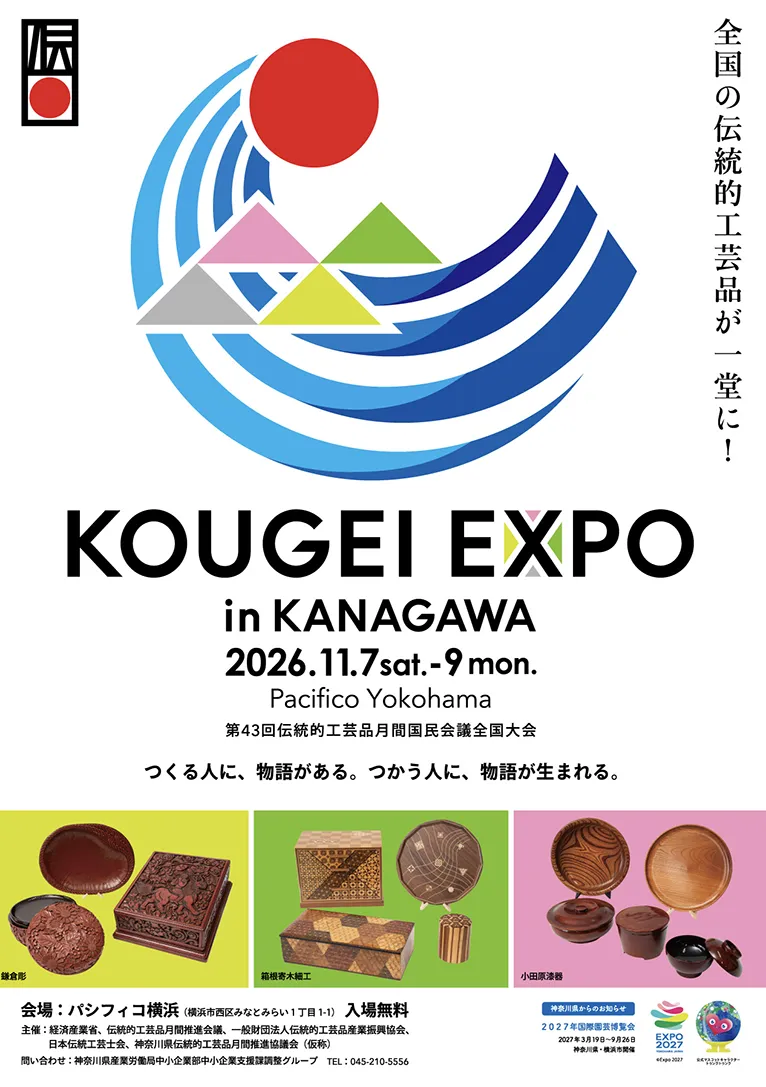
For a hands-on encounter with karakuri woodcraft, Kanagawa Prefecture announces that visitors to KOUGEI EXPO in KANAGAWA, held at PACIFICO Yokohama from 7 to 9 November 2026, will be able to try opening karakuri boxes. Please check the latest programme details before your visit.
(Source: New Designation Announcement and Karakuri Box Experience | Kanagawa Prefectural Government)

To see historical works of Kyoto cloisonné, the Namikawa Yasuyuki Cloisonné Museum is one option. Its autumn special exhibition explores the techniques of Namikawa cloisonné and runs from 15 September to 20 December 2026. Please check the official information for closing days and admission conditions before visiting.
(Source: Events and Schedule | Namikawa Yasuyuki Cloisonné Museum)
Craft artists and makers interested in having their work featured or promoted can find our support services here (in Japanese).

The designation of Hakone-Odawara karakuri woodcraft, Kyoto bamboo craft and Kyoto cloisonné offers new ways into these works. Rather than choosing by name or designation alone, ask: How does it move? How was it given its form? What lies beneath the colour? Those questions lead to work that the finished exterior does not reveal on its own.
Our aim at Kogei Japonica is to help readers move from learning a name to understanding the decisions behind a piece. Choose one that interests you, and start with a single, specific question.


