




Shokunin is the Japanese word for a skilled craftsperson. In the AI age, understanding this work means looking beyond individual mastery to the division of labour that supports quality, the tools and materials involved, and the opportunities to learn the skills.
Some readers will have come across the word shokunin in English-language media and wondered how Japanese craftsmanship is being represented abroad. For companies hoping to bring craft techniques into product development, how they understand a craftsperson’s work also shapes how a collaboration unfolds.
The starting point is a business essay published in Fortune in October 2026. Taking that argument as a way in, we look at the production conditions that sustain Japanese craft, and at concrete examples of skill transfer through AI and digital technology. Rather than simply reporting how Japan is praised abroad, we ask what makers need for their work to continue.
Table of Contents
How Did the Fortune Essay Portray “Shokunin”?
The Fortune essay maps the craftsperson’s work onto business management. The first thing to note is that it is not an investigative report on the craft industries but a commentary in which the authors draw lessons for business.
Published on 18 October 2026, the essay is by Matt Alt and David Schonthal. It uses the Japanese idea of the craftsperson as a lens for thinking about how companies work. Below, we separate those business proposals from what can be verified about production in Japan.
(Source: Move slow and make things | Fortune)
Four Principles, Illustrated Through Business Examples

The film above, about the denim maker Japan Blue Jeans, is included as separate context; it is not one of the companies discussed in the Fortune essay. The essay itself discusses deepening expertise, refining taste, working over the long term and taking responsibility for one’s work, illustrating each with a company example. The examples range widely, from Shimano’s bicycle components and denim production to YKK’s zips and Zildjian’s cymbals.
The value of this framing is that it does not confine the craftsperson’s work to a specialised world, but opens it up as a question that a wide range of organisations can ask. At the same time, the same idea will be put into practice differently depending on an organisation’s scale, equipment, funding and business relationships.
To apply it to collaboration with a workshop, the conclusion that expertise should be deepened is not enough. One also has to consider how to ensure a steady volume of work and enough time to learn, since these are what build that expertise.
The Question at the Heart of the Essay
When considering automation, is an organisation giving up capabilities it has always valued? This question can also be brought to bear on Japanese craft.
That said, there is no need to decide from the outset that a task will never be automated. A more practical approach is first to establish what quality a process produces, who assesses it and what they look for. The tasks that can be assisted can then be separated from the judgements that still need a person to check them.
What matters in craft is not only the number of processes done by hand, but the ability to judge quality, and the chance for the next generation of makers to acquire that ability.
How Does the Essay’s View of Shokunin Compare with Work in Japan’s Craft Workshops?
To apply business thinking to craft, the division of labour in production regions and the supply of materials and tools need to be added to the picture. The attitude of an individual or a company and the production conditions that make the work possible should be considered together.
It is important not to read the absence of detailed explanation in the essay as neglect or misunderstanding on the authors’ part. The discussion becomes richer if we separate the essay’s purpose from the information a specialist craft publication should supply.
From Business Principles to Workshop Practice: A Comparison
The table below is a framework for carrying business thinking over into work with workshops and production regions. The conditions to check and the commentary in the right-hand columns are the editors’ own proposals.
| Theme | Business focus | Conditions to check in production | Editorial commentary |
|---|---|---|---|
| Expertise | Building experience in an area of strength | Who handles each process, a steady volume of work, opportunities for instruction and practice | View expertise not only as individual ability but through the conditions that allow the work to continue |
| Taste | Refining the sense of what counts as good | Material characteristics, equipment maintenance, physical samples, requirements in use | Connect the eye for what is appealing with the conditions for reproducing it as a physical object |
| Long-term commitment | Not judging by short-term results alone | Prototyping costs, materials procurement, equipment renewal, time available for training | A decision to take time also requires someone to bear the costs in the meantime |
| Responsibility for the work | Making responsibility for quality clear | Inspection between processes, who approves the work, communication when corrections are needed, labelling of the finished product | Look beyond how names are credited to the quality checks actually in place |
In-house production and division of labour are not a choice between taking responsibility and avoiding it. Whether a company handles a process itself or works with outside specialists, quality standards and coordination are needed.
Public explanations of Wajima-nuri, the lacquerware of Wajima in Ishikawa Prefecture, for example, describe specialist stages such as making the kiji, or wooden base, lacquering and kashoku, or decoration. They also describe the role of the nushiya, the lacquer house that oversees production as a whole. It is a system that divides expertise while bringing it together into a single product.
(Source: The Division of Labour Behind High Quality | Wajima-nuri Online Shop (in Japanese))
For a closer look at Wajima-nuri decoration, the difference between chinkin, in which gold is laid into lines incised in the lacquer, and maki-e, in which designs are made with metal powder sprinkled onto wet lacquer, is a useful next step.


Applying Corporate Lessons to Craft Regions and Workshops
When applying corporate examples to small workshops, the idea and the conditions for carrying it out have to be considered together. The scale at which an organisation can invest in equipment, and how long it can sustain prototyping, differ from one organisation to the next.
A specification change that seems minor to the client may mean the maker has to re-order materials or start again from an earlier stage. Expecting that a craftsperson will simply find a way does not solve the problems of time and cost.
When explaining to audiences outside Japan, too, it is better not to rely on the word shokunin alone to convey value, but to show concretely the processes a maker handles, their judgements about materials and the people they work with. Not overstating a uniquely Japanese spirit makes it easier to share the substance of the work with makers and designers in other countries.
Definitions: Shokunin, Craftsperson and Designated Traditional Craft Products
shokunin / 職人
Shokunin is the romanised form of the Japanese word 職人. Here it refers to a maker with specialised skills and practical judgement relating to production processes. Craftsperson and skilled artisan are possible English equivalents, but it helps to add a concrete description of the work.
Designated traditional craft products
Craft products designated by Japan’s Minister of Economy, Trade and Industry under the Act on the Promotion of Traditional Craft Industries. The requirements include being used in everyday life, having the main parts of the production process carried out by hand, using traditional techniques and materials, and being produced within a particular region. The figure of “100 years or more” given for techniques and materials does not refer to the age of individual products or the founding date of a workshop.
(Source: About the Act on Traditional Craft Products | Ministry of Economy, Trade and Industry (in Japanese))
Production region (sanchi)
Here, a region in which the specialists and businesses that support production are connected. Explanations of the designation system give a guideline of, in principle, 10 or more businesses or 30 or more workers, but this figure does not define every production region in the general sense.
(Source: What Are Traditional Craft Products? | Niigata Prefecture (in Japanese))
Official designation, the appeal of individual works, a maker’s ability and suitability as a collaboration partner are related but separate judgements. Whether or not something is designated cannot decide the full value of a craft.
What Production Conditions Determine the Future of Japanese Craft?
Exercising skill depends on access to materials and tools, and on time for both production and training. Alongside the maker’s attitude, attention needs to go to these underlying conditions.
Photographs of finished objects rarely show the effort of sourcing materials or the work of maintaining equipment. But anyone considering whether a commissioned piece can continue to be made needs to look at that less visible work as well.
Japan’s Traditional Craft Industries in Figures

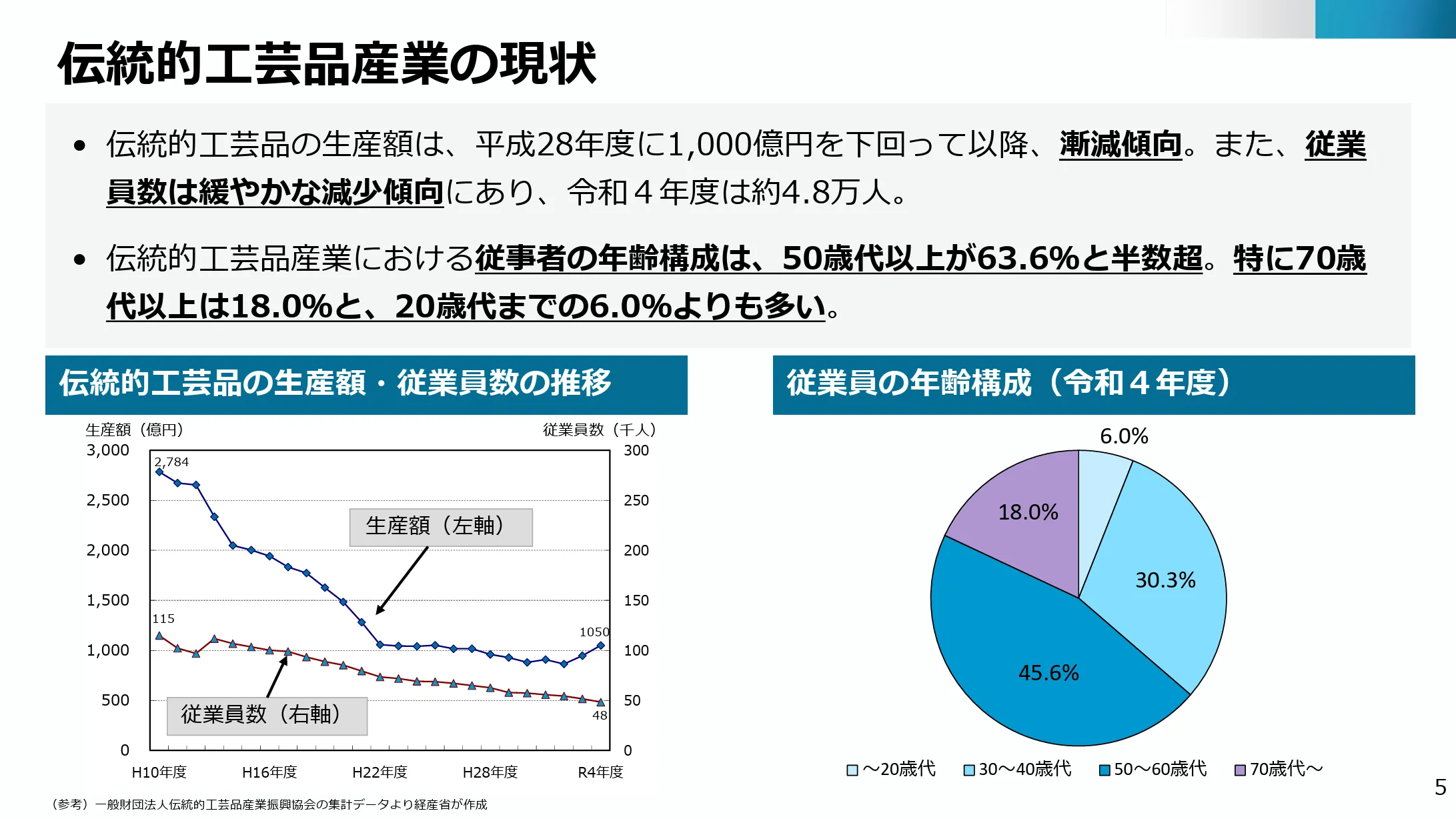
According to materials from the Ministry of Economy, Trade and Industry (METI) dated July 2026, the traditional craft industries they cover employed around 48,000 workers in fiscal 2022 (Japan’s fiscal year runs from April to March). In the same year, people aged 50 or over made up 63.6% of that workforce. Production value is described as having fallen below ¥100 billion in fiscal 2016 and as declining since. These figures apply to the scope of the materials and do not cover craft or contemporary studio practice as a whole.
(Source: METI briefing materials, July 2026, p. 5 | Ministry of Economy, Trade and Industry, published by the Agency for Cultural Affairs (in Japanese))
The figures show that securing people to make the work and carry it on is a major challenge. National totals alone, however, cannot tell us the situation of an individual region or workshop. A business with growing orders may still face constraints on people or materials, and the reverse is also possible.
When considering a collaboration, a company needs not only information on the craft industries as a whole but also to ask about the conditions under which the partner workshop is currently working.
Without Tools and Materials, Skill Alone Cannot Make the Work

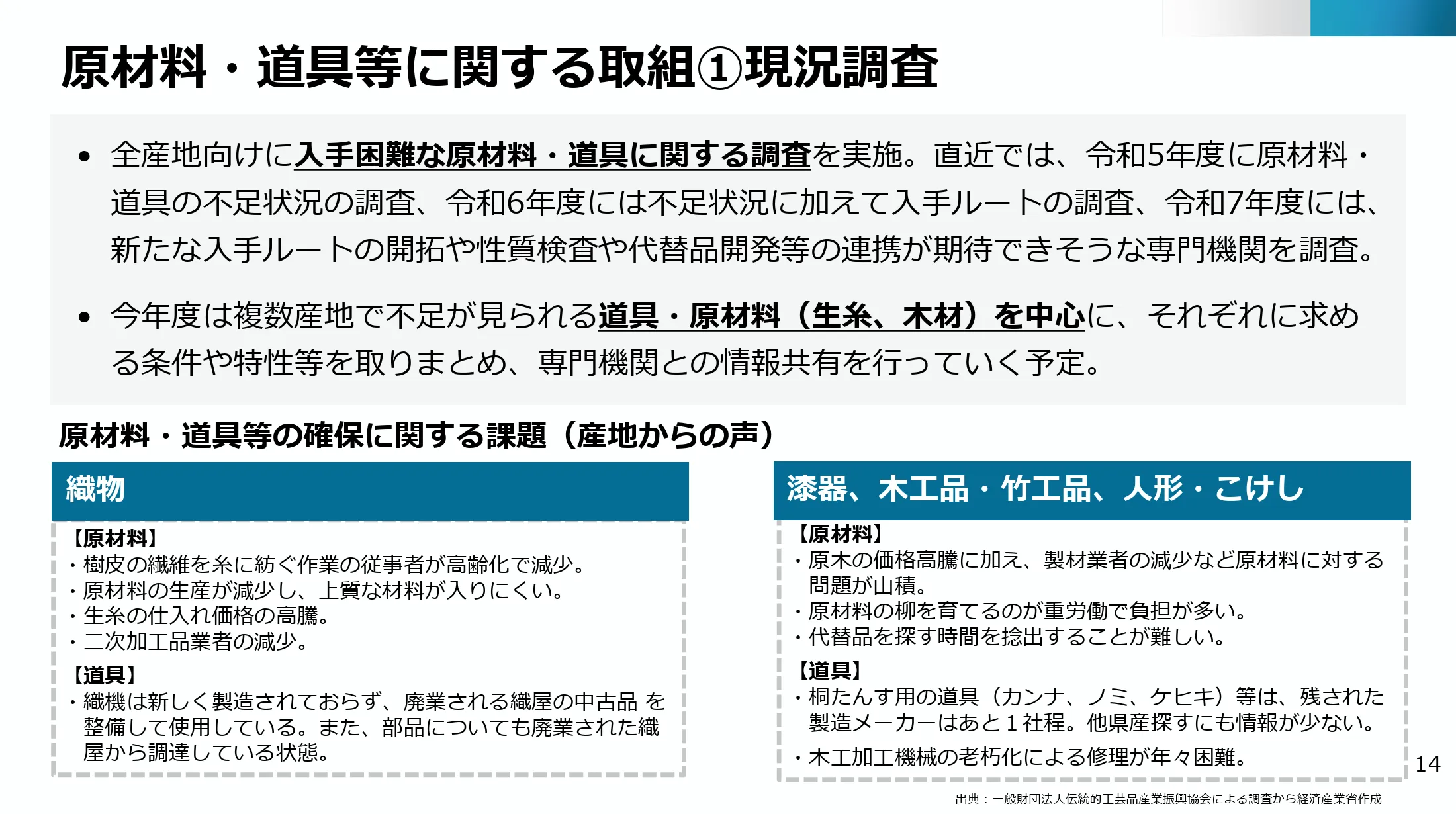
The same materials also include comments from production regions, among them a decline in toolmakers, growing difficulty repairing equipment and rising material prices. One response describes maintaining second-hand looms and securing parts to keep them in use. These are individual circumstances reported in a survey; they do not mean that no new looms of any kind are being made.
(Source: METI briefing materials, July 2026, p. 14 | Ministry of Economy, Trade and Industry, published by the Agency for Cultural Affairs (in Japanese))
If we value the use of old equipment and tools, our view has to extend to the people who can repair that equipment and to the supply of parts. Respect for craft skill that is directed only at the people who make finished objects cannot take in the whole of the work.
Division of Labour Is Not a Weakness but a Sharing of Expertise
Division of labour makes it possible to combine the work of people with specialist skills. On the other hand, depending on a process for which there is no substitute means that if that process stops, production as a whole may be affected.
That does not mean everything should be concentrated in a single workshop. What is needed are ways of sustaining the network: sharing information with partners, keeping work flowing, knowing where repairs can be done and handing over to the next generation.
“Whose absence would bring this work to a standstill?” The question is useful not for identifying a master, but for understanding the relationships that support production, including people whose names never appear on the finished object.
How Can We Sustain the Systems That Support Skill, Not Just a Single Master?
Sustaining skill requires not only training makers but conditions that allow material suppliers, toolmakers and repair specialists to continue their work. It is important to distinguish the names that appear on finished objects from the roles behind them.
Makers’ Signatures and the Work Behind Them

A maker’s signature or mark, known as mei, together with the inscription on a tomobako, a wooden storage box bearing the maker’s inscription or signature, can help identify the maker and the work. Yet people whose names do not appear on a finished object may also support its production.
Division of labour, however, does not prevent a work from being attributed to a named artist. Who shaped the form and who handled each process needs to be established for each work and each production set-up.
The Traditional Craft certification label, which carries the official Traditional Craft mark, should likewise be understood as indicating that a product has passed inspections carried out by production-region cooperatives and similar bodies. It confirms different things from an artist’s mark or a box inscription, and should not be taken as a blanket guarantee of a work’s value or of every aspect of its performance.
(Source: What Are Traditional Craft Products? | Niigata Prefecture (in Japanese))
Selected Conservation Techniques and Support for Toolmakers
The Agency for Cultural Affairs’ Selected Conservation Techniques system selects traditional techniques and skills that are indispensable to the conservation of cultural properties and require protective measures, and recognises their holders and preservation groups. Besides recording the techniques, it also covers training those who will carry them on.
(Source: Selected Conservation Techniques | Agency for Cultural Affairs (in Japanese))
This system concerns the conservation of cultural properties; it is not a general certification covering every workshop or technique. Even so, its approach of supporting not only finished objects but the techniques that make their conservation possible matters when thinking about craft.
Among private initiatives, Ginowa and the Association for the Promotion of Traditional Craft Industries have launched Kaji Support (kaji means blacksmith), which aims to secure a stable supply of hand-forged tools. Its newsletter, published in 2025, describes activities in which production regions share challenges around equipment, materials and training.
(Source: Kaji Support Times Vol. 1 | Kaji Support Secretariat (in Japanese))
Problems that sit outside a workshop cannot be fully grasped by any one workshop. Connecting the people who use tools with those who make them, and with material suppliers, is itself part of the work of keeping production going.
When I think about the business of craft, the question I want to put first is: whose absence would bring this work to a standstill? Conveying the appeal of finished objects alone does not bring into view the people and conditions that support the work.
Even an appealing project, for instance, cannot take shape if no one covers the cost of prototyping. Even with excellent skills, a maker may be unable to move on to the next piece if there is nowhere left to repair their tools.
I believe respect for craftspeople shows not only in words of praise but in time to experiment, in proper quality checks and in commercial terms that both sides can accept. When it comes to the question of whether to use AI, too, I want to see clearly which parts of production and training its introduction actually supports.
AI and Digital Technology Are Supporting Skill Transfer in Japanese Craft

Japanese craft projects are using and testing several kinds of digital technology, from AI tools for accessing expert knowledge to systems that support pattern design and haptic technology that records touch and force. Their purposes and stages of development differ, and it is important to distinguish them.
“Turning skill into data” can mean quite different things: mapping the relationships between words, calculating the arrangement of a pattern or reproducing the sensations felt in the hand. The right method depends on what is to be passed on.
AI and Digital Technology for Skill Transfer: A Comparison
| Initiative | Organisations / place of production | Type and purpose of the technology | Stage confirmed in public materials |
|---|---|---|---|
| Brain model for Nanbu tekki (Iwate cast ironware) | The workshop of Nanbu tekki maker Takahiro Tayama; system developer LIGHTz | An AI system that visualises relationships within expert knowledge and supports work such as investigating the causes of defects | Use in the workshop described in a conversation with those involved |
| Design support for Edo komon (fine stencil-dyed patterns) | Professor Kawagoe’s laboratory at Bunkyo Gakuin University and the dyeworks Saotome Senkojo | Organising the theory of pattern design and programs that support pattern arrangement, among other work | The university’s announcement reports commercialisation in May 2024 |
| CrafTouch pottery skill transfer | Ikutouen, the Japan Kogei Sanchi Association, Keio University, Nagoya Institute of Technology, commissure | Measuring, recording and reproducing touch and force through haptics, and sharing skills | A collaborative project focused on pottery since April 2024; an exhibition of results announced in 2025 |
In the Nanbu tekki example, Tayama himself explains how he uses a brain model built from interviews with experienced craftspeople. It is used, for instance, to follow related words and documents and to think through the causes of casting defects. This can be read less as a wholesale replacement of the craftsperson’s judgement than as a means of accessing the knowledge that judgement requires.
(Source: A New Form of Skill Transfer Woven by AI and People | Hitachi Linking Society (in Japanese))
In the Edo komon example, Bunkyo Gakuin University describes systematising the theory of pattern design and developing programs to support pattern arrangement. Its July 2026 announcement also notes that “Sweets Zukushi Komon”, a pattern by Saotome Senkojo, was commercialised in May 2024. It is an example that went beyond a proposal and into actual production.
(Source: Announcement of an exhibition on skill transfer through “AI × Edo Komon” | Bunkyo Gakuin University / PR TIMES (in Japanese))
In CrafTouch, work to record and reproduce touch and force is taking place at Ikutouen, a pottery producing Tsuboya ware in Okinawa. The wider collaboration began with a workshop in 2022, but the work focused on pottery dates from April 2024. Haptics, the technology at its centre, deals with bodily sensation and is not the same thing as AI.
(Source: Exhibition announcement from a collaborative project on digital skill transfer in traditional crafts | Japan Kogei Sanchi Association and partners, published by Keio University (in Japanese))
Placing the three side by side shows that there is more than one way to pass on skill. Separating knowledge that can be organised in words, work that can be supported by calculation and sensations that need to be confirmed through the body makes it possible to think concretely about what technology can do.
How to Read the Results
That a tool is in use, that a product has been commercialised and that a tool has been shown to improve learning are three separate facts. The experience of one workshop cannot show that the same effect will occur in other production regions.
The examples in the comparison table also sit at different stages: use in practice, commercialisation, and research and development. Any claim about shorter training periods or effects on productivity requires checking the evaluation method, the point of comparison and the period covered.
Before skill data is recorded, it is also essential for everyone involved to discuss its purpose, who will use it, whether it will be shared externally and how much of it will be made public. Consent to record and consent to use for another purpose should be confirmed separately.
Which Processes Should Companies and Workshops Leave to Human Judgement?
Where to introduce AI or automation should be decided by looking at each process’s quality, how it is checked and the effect on opportunities to learn. In collaboration with a workshop, both parties also need to agree on prototyping costs, delivery dates and who will approve the work.
Rather than choosing a tool first, writing down where the difficulties lie, process by process, makes the purpose clearer. Is the aim to help sort enquiries, to share an expert’s explanations or to support pattern design? Each one changes who checks the results, and how.
A Checklist for Identifying Processes That Need Human Judgement
- Can you explain the quality or function the process is responsible for?
- Have you separated the judgement criteria that can be recorded from those that must be checked on the actual object?
- Do you know who makes and repairs the tools, and where the materials come from?
- Have you identified processes with no alternative maker or supplier?
- Will changing the workflow affect the opportunities younger makers have to learn?
- Have you decided the purpose of using AI or digital technology, and how its results will be assessed?
- Have you agreed what skill-related data and customer information may be entered into digital tools, and who may access it?
- Have you decided who is responsible for the final quality judgement and for corrections?
Material supply and equipment maintenance outside the workshop are problems that are difficult for any single company to solve. The purpose of taking stock is not to find fault with weak points but to make clear whom you need to work with.
A Worksheet for Reviewing Processes and Judgements
In meetings, filling in the following items for each process helps to organise the points that need discussion. There is no need to force answers for items still undecided; instead, note who should be asked.
| Item | What to record |
|---|---|
| Process and purpose | The name of the process, and which quality or function of the finished object it relates to |
| Judgement and checking | What is examined, approved samples, acceptable variation between pieces, who checks |
| Conditions supporting production | Tools and materials required, repair and supply sources, who can do the work |
| Scope of technology use | Tasks to be assisted, points a person checks, how effects are measured |
| Effect on learning | Tasks younger makers can gain experience in, who instructs them, how records are used |
| Collaboration terms | Prototyping costs, scope of revisions, preferred delivery date, who approves the work, how much information is made public |
When generated images are used to discuss how a finished piece might look, make clear whether they are reference ideas or production specifications. Shapes and textures on a screen cannot always be reproduced in the actual object, and adjustments suited to the materials and techniques need to be discussed with the workshop.
For Companies and Workshops Considering Collaboration
At the first meeting, a company should set out the intended use, where and how the product will be used, the desired quantity, the budget and the delivery date. It should then separate the aspects on which the workshop is invited to make proposals from the conditions that cannot change.
In particular, discuss the costs of prototypes and revisions, quality samples and the final approver early on. Rather than leaving it at “handmade, so pieces will vary”, share which differences are acceptable and which would cause problems for the intended use.
For photography and publicity, confirm the publication of finished pieces and the disclosure of production processes separately. How makers and collaborators are credited should also be agreed as part of the production.
If you are considering a collaboration with a workshop, or coverage related to skill transfer, please outline the intended use and what you would like to discuss, and contact us through the Kogei Japonica enquiry form (in Japanese).
Makers who would like their work and activities introduced can also visit the craft artist and artisan registration page (in Japanese). Registration and a basic profile listing are free and subject to review. A listing or introduction to projects is not guaranteed.
FAQ
- Q1. Does shokunin simply mean “craftsperson”?
- “Craftsperson” or “skilled artisan” is usually a workable translation. Its nuance varies with context, so it helps to explain what the person makes and which processes and skills they handle.
- Q2. Does the international discussion of shokunin explain Japanese craft as a whole?
- A single business essay cannot explain Japanese craft as a whole. It is best read as a proposal for companies, supplemented by an understanding of the division of labour in production regions, materials and tools, and each workshop’s production conditions.
- Q3. Will AI take craftspeople’s work?
- The examples discussed here are not enough to judge the overall effect on employment or work. There are cases of use for sharing skills and supporting production, but the processes involved, the purpose and the effect on quality need to be examined case by case.
- Q4. How are AI and digital technology being used in Japanese craft?
- In Nanbu tekki, an AI system for sharing expert knowledge has been described; in Edo komon, support for pattern design. In pottery, there is research into recording and reproducing touch and force, but this haptic technology cannot simply be called AI.
- Q5. What should be considered when using the idea of craftsmanship in product descriptions?
- Rather than relying on spirit alone, describe the materials, processes, people involved and judgements made in concrete terms. Do not present work made through a division of labour as if one person made it all, and do not describe experiences that have not been verified through first-hand reporting.
- Q6. What should a company check first when collaborating with a workshop?
- Share the intended use, quantity, budget, delivery date and the quality required, then discuss prototyping costs, the scope of revisions and who approves the work. Also confirm how skill data and footage of production will be handled, and how the makers will be credited.
- Q7. Are designated traditional craft products the same as traditional crafts?
- No. Designated traditional craft products (dentōteki kōgeihin) is a term tied to designation under the Act on the Promotion of Traditional Craft Industries. Traditional crafts (dentō kōgei) is a broader, general term. Designation alone cannot determine the full value of an individual work.
Conclusion
In the AI age, thinking about shokunin is not simply a matter of deciding whether people or machines do a task better. It means asking what counts as quality, who makes that judgement and how the next generation learns to make it.
Kogei Japonica wants to keep in view both the appeal of finished objects and the network of people whose work makes them possible: those who prepare materials, those who remake tools and those who link one process to the next. Seeing that network is what allows respect for craftspeople to become concrete action.
Turn praise into time for prototyping, clear quality checks and commercial terms both sides can accept. These steps, taken one at a time, are what allow craft skills and expression to carry on into the next piece of work.


