

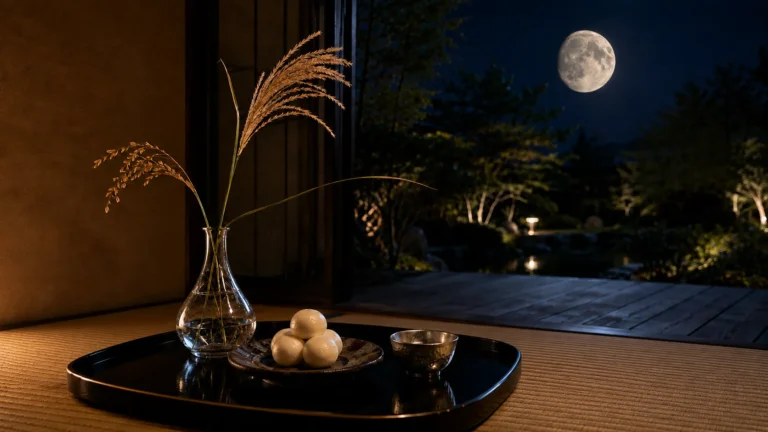
In 2026, Jūgoya (the Mid-Autumn Moon) falls on 25 September. The astronomical full moon, however, comes at 01:49 on 27 September. Because Jūgoya is set by the fifteenth day of the eighth month of the lunisolar calendar (taiin-taiyōreki), it does not always land on the same day as the full moon.
(Source: The Mid-Autumn Moon (September 2026) | National Astronomical Observatory of Japan)
Say “moon-viewing” and most people picture pampas grass and moon-viewing dumplings set out side by side. That alone is enough to enjoy the season, but seen through the lens of craft, tsukimi (moon-viewing) reveals another layer of interest.
What do you rest the dumplings on? What flower vessel do you arrange the grasses in? What kind of light do you place different materials in—wood, lacquer, ceramics, tin (suzu), silver, glass? Once you begin thinking about the relationship between objects and space, moon-viewing begins to look like something other than a simple seasonal decoration.
This article sets out why Jūgoya and the full moon fall two days apart in 2026, what has been offered at moon-viewing, and how to bring stands such as the sanbō and the oshiki, along with vessels and flower vessels, into a contemporary shitsurai (the arranging of a space).
What matters is not forcing everything into a single template of “the correct way to set out Jūgoya.” Moon-viewing offerings and customs vary by region. We’ll look at them while keeping historically verifiable custom separate from proposals for contemporary spaces made with craft.
Table of Contents
Jūgoya 2026 falls on 25 September | Why is the full moon on 27 September?
In 2026, the Mid-Autumn Moon is on 25 September, and the astronomical full moon is at 01:49 on 27 September. Because Jūgoya and the full moon are determined in different ways, there are years when they do not fall on the same day.
Jūgoya and the “full moon” do not mean the same thing
The first thing to keep in mind is that Jūgoya and the astronomical full moon are not set by the same standard.
According to the National Astronomical Observatory of Japan, the “Mid-Autumn Moon” refers to the moon seen on the night of the fifteenth day of the eighth lunisolar month. In 2026, the new moon arrives at 12:27 on 11 September; because the day containing that new-moon moment—11 September—is the first day of the eighth lunisolar month, 25 September becomes the fifteenth.
The astronomical full moon (bō), on the other hand, is fixed by the moment the moon lies opposite the sun as seen from the Earth. In September 2026, that moment is 01:49 on 27 September.
(Source: The Mid-Autumn Moon (September 2026) | National Astronomical Observatory of Japan)
Why the two-day gap in 2026
In the lunisolar calendar, the day containing the moment of the new moon is counted as the first of that month. But the time it takes to go from new moon to full moon is not always exactly the same.
The moon orbits the Earth on an elliptical path. According to the Ephemeris Computation Office of the National Astronomical Observatory of Japan, the moon’s age at the moment it becomes full varies between roughly 13.9 and 15.6 days. On top of this variation, because the calendar counts dates in whole days, a gap can open up between the calendar’s fifteenth night and the date of the full moon.
(Source: About the Age of the Moon | Ephemeris Computation Office, National Astronomical Observatory of Japan)
That the Mid-Autumn Moon and the full moon fall on different dates is not in itself unusual. The National Astronomical Observatory of Japan does, however, describe a two-day gap like that of 2026 as “somewhat rare.” The last two-day gap was in 2017; the next will be in 2043.
(Source: The Mid-Autumn Moon (September 2026) | National Astronomical Observatory of Japan)
Editor’s Note
Hearing that “it’s Jūgoya, but not a full moon” can feel a little incomplete. Yet this is where the interest of moon-viewing culture lies. Jūgoya is not “a day for seeing only a perfectly round moon”; it is a day for being aware of the moon within the calendar and the season. The movement of the heavens and human time do not overlap exactly. Taking in the moon together with that slight gap seems to reveal a felt distance from the season that a modern calendar alone tends to obscure.
Jūsan’ya 2026 falls on 23 October
Japan has not only Jūgoya but also the custom of jūsan’ya, viewing the moon of the thirteenth day of the ninth lunisolar month.
The National Astronomical Observatory of Japan introduces several names for jūsan’ya: “chestnut moon” (kuri-meigetsu) and “bean moon” (mame-meigetsu); the “later moon” (nochi no tsuki), when the Mid-Autumn Moon is taken as the “earlier moon”; and, together with Jūgoya, the “moon of two nights” (futayo no tsuki). In 2026, jūsan’ya falls on 23 October.
(Source: The Mid-Autumn Moon (September 2026) | National Astronomical Observatory of Japan)
Once you have brought out vessels and a flower vessel for moon-viewing, there is no need to put them away after 25 September alone. For jūsan’ya, change the flowers and the food and use the same vessels again. Do that, and the craft pieces begin to look less like “decorations reserved for Jūgoya” and more like tools used along with the season.
What do you set out for Jūgoya? The basics of moon-viewing, first
Jūgoya is known for the custom of offering moon-viewing dumplings, farm produce, and grasses such as pampas grass. The kinds, numbers and shapes of the offerings, however, vary by region, and there is no single answer shared across the whole country.
Moon-viewing dumplings
One of the things that symbolise moon-viewing today is the moon-viewing dumpling.
The Ministry of Agriculture, Forestry and Fisheries introduces Jūgoya as an autumn event for admiring the harvest moon, with its origins in the Chinese Mid-Autumn Festival. After it reached Japan, the ministry explains, it also became tied to gratitude for the rice harvest and prayers for a good crop, and a culture of offering dumplings likened to the moon took shape.
(Source: Japan’s Annual Events and Food: “Jūgoya and Moon-Viewing Dumplings” | Ministry of Agriculture, Forestry and Fisheries)
That said, there’s no need to think that “because it’s Jūgoya, you must set out exactly fifteen dumplings.”
The Ministry of Agriculture, Forestry and Fisheries’s “Our Local Cuisines,” for instance, introduces heso-mochi, a moon-viewing dumpling handed down in central and western Shizuoka Prefecture, and a local custom of offering twelve—thirteen in a leap year—set on a bundle of fresh straw.
(Source: Heso-mochi, Shizuoka Prefecture | Ministry of Agriculture, Forestry and Fisheries, Our Local Cuisines)
Rather than treating one number as the formal rule, knowing that the shape of moon-viewing differs from region to region gives a more accurate understanding of the culture.
Pampas grass and autumn grasses
Pampas grass is the plant most often shown together with moon-viewing. Look at actual regional customs, though, and it is not the only plant that has been used for moon-viewing.
Records introduced by the Hokkaido Regional Agricultural Administration Office of the Ministry of Agriculture, Forestry and Fisheries include cases of pampas grass, bush clover (hagi), and Chinese lantern, along with that season’s harvest, being offered towards the moon. The plants and offerings for moon-viewing have differed by region and by household.
(Source: Autumn Events and Dishes | Hokkaido Regional Agricultural Administration Office, Ministry of Agriculture, Forestry and Fisheries)
Even when enjoying it in a modern home, there’s no need to “assemble every plant that looks right for Jūgoya.” A single stem of pampas grass, or a small arrangement of whatever autumn grasses you can find, is enough to feel the season.
Look not only at the flowers themselves but at the shadows they cast on the wall or floor. Even a single grass, combined with light, changes the character of a space considerably.
Taro, chestnuts, edamame and other offerings that survive in the regions
Jūgoya is not only “the day of dumplings.” It has been deeply tied to farm produce and the harvest season.
The Ministry of Agriculture, Forestry and Fisheries notes that the Mid-Autumn Moon is also called the “potato moon” (imo-meigetsu), and explains the relationship between moon-viewing and harvested produce such as taro. In some regions, too, there are examples of offering fruit or beans grown in that area.
(Source: Japan’s Annual Events and Food: “Jūgoya and Moon-Viewing Dumplings” | Ministry of Agriculture, Forestry and Fisheries)
This view can be brought into moon-viewing today as well. You don’t need to seek out special “Jūgoya decorations” from far away; you can pile chestnuts or fruit bought nearby into a single vessel. That, too, is a way of connecting the season with daily life.
There is no “one set form”
The number of moon-viewing dumplings, the plants and the produce all differ by region and household. For that reason, this article does not present them as etiquette shared across the whole country—no “you must have this many dumplings,” “you must have pampas grass,” or “you must set them out in this order.”
What are Jūgoya, the Mid-Autumn Moon and shitsurai?
Jūgoya originally means the night of the fifteenth day in the lunisolar calendar. Today, in the context of moon-viewing, “Jūgoya” generally refers to the Mid-Autumn Moon of the fifteenth day of the eighth lunisolar month.
The Mid-Autumn Moon is the moon seen on the night of the fifteenth day of the eighth lunisolar month. It does not necessarily fall on the same day as the astronomical full moon.
Shitsurai, in this article, is used to mean arranging a space by combining vessels, flowers, food, tools, light and empty space to suit a season or occasion. It does not mean that there is a fixed style of shitsurai for Jūgoya shared across the whole country.
Keeping verifiable tradition separate from proposals adapted to modern life is the starting point for enjoying moon-viewing while respecting craft and regional culture.
What is the “shitsurai” of moon-viewing? How does craft change the space of moon-viewing?
In moon-viewing today, rather than simply reproducing traditional customs as they were, you can combine vessels, flower vessels, stands, grasses, food, light and empty space to arrange a space in which you are aware of the moon.
Thinking of “traditional moon-viewing” and “contemporary shitsurai” separately
When combining moon-viewing with craft, one distinction matters from the start.
One is the moon-viewing custom handed down in a region or household. The other is the seasonal space we make today using craft pieces.
These two have points of contact, but they are not the same thing.
Place moon-viewing dumplings on a lacquer tray, for example, and it makes a fine composition as a contemporary moon-viewing shitsurai. But you cannot, on that basis alone, explain that “there has long been a rule of using lacquer trays for Jūgoya.”
If you are introducing craft as culture, it matters not to confuse historical custom with contemporary styling and spatial interpretation.
Editor’s Note
What I find interesting in combining moon-viewing with craft is not that special “Jūgoya goods” are required. It is that a single tray or vessel I usually keep on the dining table looks different from usual simply because the place it sits and the light around it have changed.
Try taking moon-viewing not as “an event about what to display” but as “a time to look again at what you usually see.” There, I think, is room for craft and a seasonal observance to connect naturally.


Making a stand—sanbō, oshiki and trays
When arranging a shitsurai, using a stand or tray is one of the clearest ways to define a focal area.
Instead of placing things directly on a shelf or table, gathering them onto a sanbō, an oshiki or a tray visually gathers them into a single composition.
What matters is not worrying about the prestige or formality of the objects. It is creating a small area within the space that draws the eye.
Sanbō
The sanbō has the form of an oshiki-like tray fitted with a stand, and has been used as a ceremonial tool, including for presenting shinsen (food offerings to the deities).
In this article, however, the sanbō is not positioned as “an essential tool for Jūgoya.” If you do not have one at home, there is no need to obtain one for moon-viewing alone.
What a contemporary shitsurai can borrow from it is the idea of setting what you offer slightly apart from the everyday tabletop and making a place where the eye gathers.
Oshiki
The oshiki is a kind of rimmed tray or serving stand, used for holding tableware and the like.
Today there are oshiki of many kinds—bare wood, lacquered and so on. To bring one into moon-viewing, gathering a small vessel and a flower vessel within a single oshiki is enough to pull the composition together.
Rather than “using an oshiki because it’s Jūgoya,” if you think of it as a tool for framing a space, it becomes easier to bring into a contemporary dining table or shelf too.
Wooden trays and lacquer trays
Even without a sanbō or an oshiki, an everyday wooden or lacquer tray is fine.
Indeed, using tools you already use day to day for a seasonal observance makes the relationship between craft and daily life more natural.
Use a round tray and you can enjoy a play of form with the moon. This, though, is a proposal for contemporary spatial styling, and does not mean that “round trays have traditionally symbolised the moon.”
Holding the flowers—a single flower vessel
Moon-viewing grasses do not necessarily become more beautiful as you add more of them.
A single stem of pampas grass or one spray of autumn grass can sometimes leave more empty space in the composition. What matters then is the vessel that holds them.
With ceramics, glass, metal, wood, lacquer and so on, the reflection of light and the shadows change with the material and the surface finish. Even among ceramics, the impression differs between an earthy pottery and white porcelain, or between a glossy glaze (yūyaku) and a matte finish.
For that reason, it matters not to decide by material alone—”ceramics are rustic,” “metal is formal.”
Look not only at the flowers themselves but at the flower vessel and the shadow that forms behind it. In the shitsurai of moon-viewing, try looking at it this way.
Catching the moon in a vessel—craft materials and light
Moon-viewing turns the mind to the moon in the sky, but turn your attention back indoors and there are many kinds of light there too.
A small light reflected in the sheen of lacquer. Reflections spreading across the surface of metal. The shadow of a plant stretching through glass. The shading born of the unevenness of a glaze.
Craft pieces have a character that a photograph of the object alone cannot show. In an actual space, people move, the direction of the light changes, food and water go into the vessels, and the way they look changes with it.
You cannot decorate the moon. That is exactly why you arrange the space on the receiving side of its light.
This is one important view when thinking about moon-viewing through craft.
Lacquer, wood, ceramics, tin, silver—how do you choose materials that suit moon-viewing?
Rather than choosing by perceived formality, craft pieces for moon-viewing are easier to judge by how they take the light, their surface texture, their use, their care, and whether they can also be used in everyday life.
| Material | How light and surface appear | Uses that work well for moon-viewing | Points to note when choosing |
|---|---|---|---|
| Wood | Varies by species and finish; tends to show light relatively gently | Trays, oshiki, stands, vessels | Check each product’s instructions for handling moisture and dryness |
| Lacquer | On glossy finishes, reflected light shows up clearly | Trays, oshiki, bowls, plates, sake cups | Check use, storage and cleaning in the maker’s or workshop’s guidance |
| Ceramics | Character varies greatly with clay, glaze, firing and surface finish | Plates, bowls, flower vessels, sake vessels | Check individually for food use and suitability for microwave, dishwasher, etc. |
| Tin | Has the reflection characteristic of metal; the impression also changes with polishing and surface working | Sake vessels, vessels, flower vessels | Check each product’s notes on deformation and care |
| Silver | Reflection and tone change with the state of polishing and finish | Sake vessels, vessels, small items | Check the care method for tarnishing |
| Glass | Transmits and reflects light; the look changes with thickness, colour and cut | Flower vessels, sake vessels, bowls | Take care with chipping, tipping over and sudden temperature change |
This table does not indicate the superiority of one material over another. Even within the same material, the look differs greatly with the maker’s technique, form, thickness, colour and surface finish.
Comparison table by material
When choosing a material, do not judge it only by whether it looks expensive.
If you are serving dumplings or dishes, the relationship of colour with the food, and whether it can be used for food, matter too. For a flower vessel, there is the stability when water is added and the balance of height with the plants. For a sake vessel, you need to think as far as the feel in the hand, the capacity and the care.
A photograph captures a craft piece in a fixed state, but in daily life it is constantly changing through use—being held, set down, washed, lit, and filled with food.
Choosing a vessel for moon-viewing too from “how it looks and how it can be handled when actually used” leads to a more practical choice.

Materials that “reflect” light and materials that “receive” it
In the shitsurai of moon-viewing, looking at how a material handles light makes combinations easier to think through.
Polished metal or clear glass, for instance, and wood or a matte pottery look different under the same lighting.
What matters is not which is superior.
Gather only strongly reflective pieces and the artificial lighting can begin to dominate the space. Put together only dark tones, on the other hand, and outlines can sink into the night-time interior.
So try combining a few materials of differing character—”a wooden tray and a metal sake vessel,” “a lacquer oshiki and white porcelain,” “an earthy pottery and a glass flower vessel.”
Rather than increasing the number of craft pieces, show the difference between two materials. That can suit the quiet space of moon-viewing better.
If you were to choose just one craft piece
If you are bringing craft into moon-viewing for the first time, there’s no need to look among “Jūgoya-only” products.
What to consider first is one of a tray, a vessel or a flower vessel—something you can use even when the season changes.
With a single wooden tray, you can set dumplings and a flower vessel on it for Jūgoya, and gather tea things, sake vessels or a sweets dish on it in another season. A flower vessel can be used not only for autumn grasses but for winter branches and spring flowers.
Spend a year with a single craft piece.
That is also a way of not consuming what a maker or workshop has produced as “decoration for a seasonal event,” but growing a relationship with it in daily life.
Moon-viewing shitsurai you can do at home | Three arrangement examples
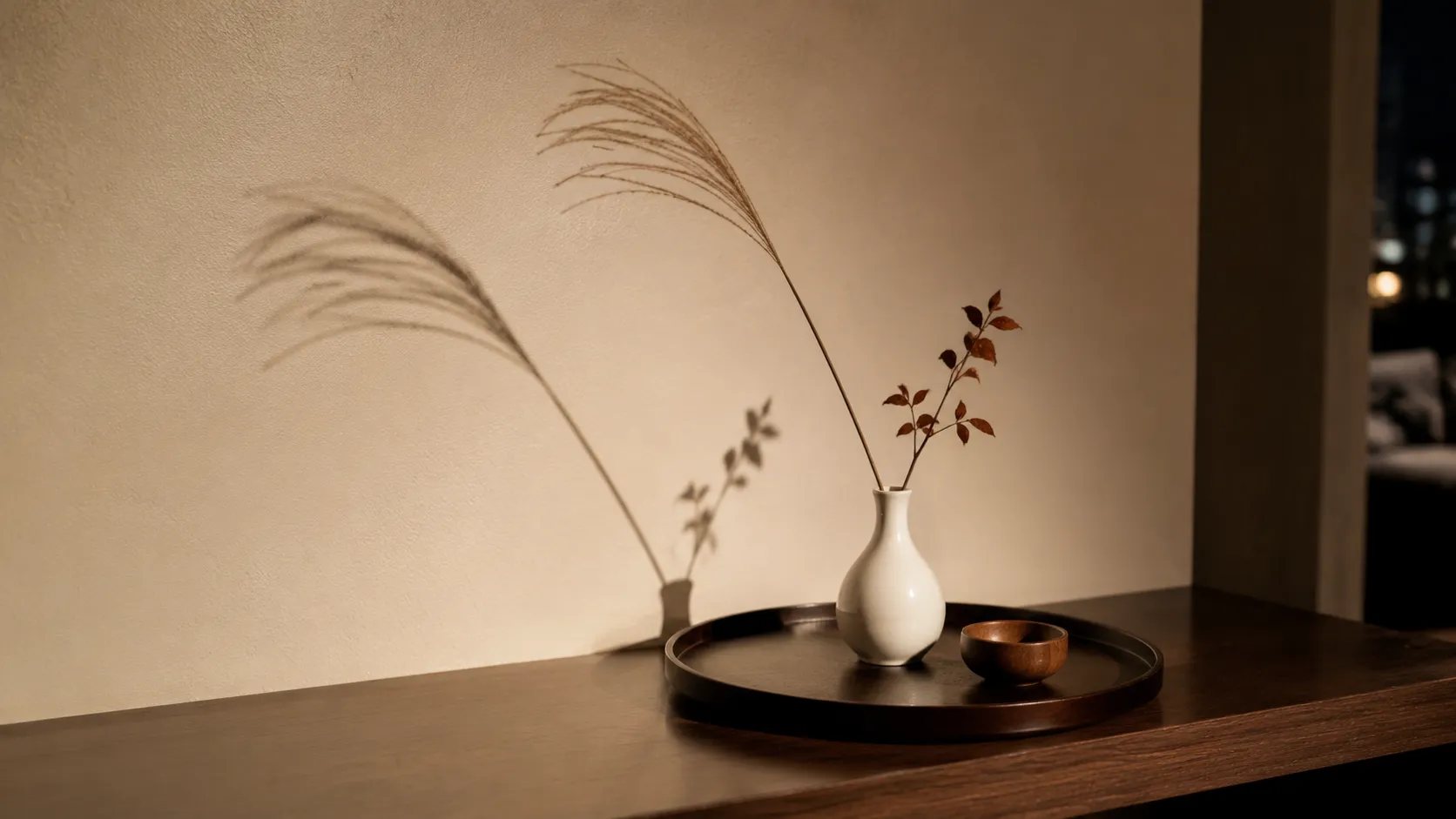
You can make a moon-viewing shitsurai without a large Japanese-style room or special tools. The point is to decide on one focal element and arrange height, depth, light and empty space.
① A “small moon-viewing” for the entrance or a shelf
The easiest place to begin is a corner of the entrance or a shelf.
- A small tray or oshiki
- A small flower vessel
- Pampas grass or autumn grasses
- A small vessel or the season’s fruits
This much is enough.
The point is not to line everything up in a single row or in the centre. Place a taller flower vessel at the back left and a low vessel at the front right, for example, and you create differences in height and in depth.
If a wall is close by, look at where the shadows of the grasses fall.
Think not only about “what to place” but about “what becomes visible as a result of placing it.” This alone takes the arrangement beyond simple decoration.
② “Food and moon-viewing” at the table
Moon-viewing is one of the seasonal observances easiest to link naturally with the dining table.
Serve the moon-viewing dumplings in a vessel other than the usual one. Set chestnuts or autumn fruit on a tray. If you enjoy sake, change one sake vessel. That much is fine.
There’s no need to unify everything into “Japanese style,” either.
Add a single lacquer tray to the table you use every day. Set a tin lipped pourer beside white porcelain. Adding just one material of a different kind makes each one’s texture easier to see.
When you will actually use them with food or drink, check with the maker, workshop or manufacturer whether the piece is intended for food use, along with its cleaning method, heat resistance and suitability for a dishwasher.
③ “Moon-viewing by light” at the window
If the moon is visible from your window, the thing you most want to stand out indoors is, after all, the moon.
In this case, there’s no need to add too many decorative pieces. Set a single flower vessel or vessel at a low position by the window and, if you can, dim the room lighting a little.
There’s no need to line up the moon and the craft pieces in a straight line, either. It is enough for each to enter your view as your gaze moves through the space.
Don’t let the craft pieces stand out more than the moon. This, too, is a kind of spatial design.
Arrangements that work in a flat, too
In a flat or an urban area, the building’s orientation or the surrounding architecture can mean the Mid-Autumn Moon is not visible from indoors.
Even so, that does not mean moon-viewing is impossible.
Set one autumn ingredient on the table. Arrange a single stem of pampas grass or autumn grass. Use a vessel you usually keep put away. It is the same on a day when the moon is hidden by cloud.
Seeing the moon, and spending an evening mindful of the moon, are a little different.
Moon-viewing shitsurai: a seven-point checklist
- You have decided on one vessel or flower vessel to lead
- You have checked the positions of the moon, the window and the room lighting
- You have combined things of differing height
- You have left empty space where nothing is placed
- You have not introduced too many different materials
- If placing food, you have checked the vessel’s use and handling
- Where the maker, workshop or region is known, you have looked into that background too
There’s no need to meet all of them. When in doubt, rather than adding one thing, try taking one away.
In moon-viewing, more than “decorating,” what matters is creating the conditions in which things can be properly seen.
For hotels, restaurants and shops: don’t let moon-viewing end as “seasonal decoration”
If you bring moon-viewing into a commercial space and go beyond simply placing pampas grass and dumplings—designing it as far as the craft pieces’ materials, makers, production areas, and their relationship with the food or the venue—it becomes a seasonal display with cultural background.
Hotels and inns
In a hotel or inn, setting up one large “Jūgoya corner” in the lobby is not the only method.
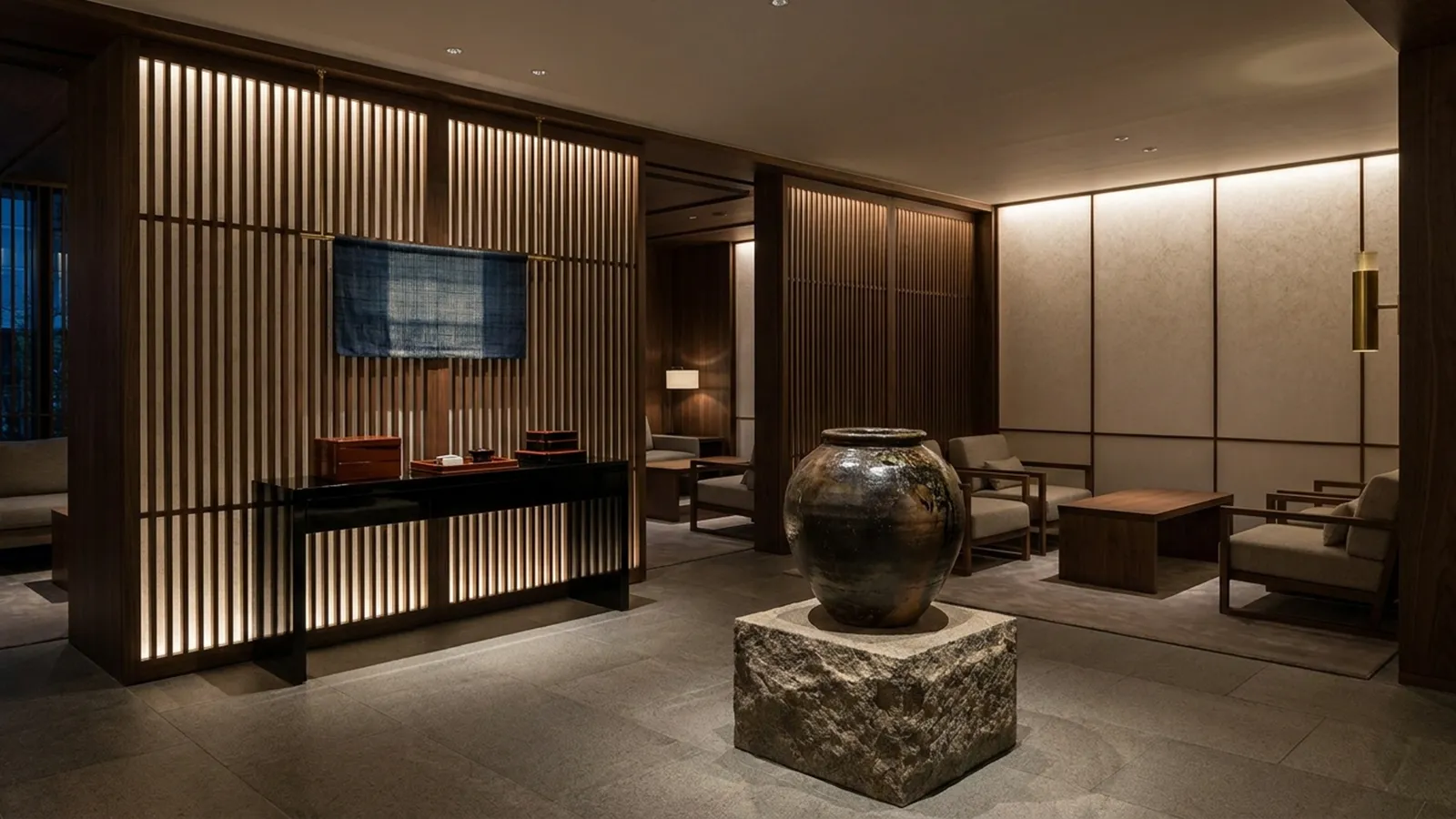
You might divide the roles of the craft pieces by space, for instance—flower vessels in the lobby, small vessels in the guest rooms, sake vessels in the lounge, and vessels used for the food in the restaurant.
For seasonal displays especially, there is the option not only of purchase but of renting or exhibiting for a set period. The rental terms, insurance, procedures for breakage, installation and removal, and whether photography is permitted differ by provider, however, so they need checking in advance.
Restaurants
A restaurant is a place where moon-viewing and craft link together naturally.
The vessels the food is served in, the sake vessels, and the flower vessel on the table become the seasonal display in themselves.
On the other hand, works for display and the vessels actually used to serve food need to be thought of separately. Being a maker’s piece does not mean all of them suit food use, commercial dishwashers, high-temperature conditions and the like.
It also matters not to reduce the season to simple signs alone—”brown pottery because it’s autumn,” “round plates because it’s Jūgoya.”
When you consider the food, the vessels, the lighting, the table and the background materials together, do they connect naturally with the venue’s food and concept? Only when you have thought that far does a craft piece become part of the space.
Shops and showrooms
In a shop, seasonal display and product merchandising tend to become mixed.
Line up a large quantity of products for moon-viewing and it makes a “Jūgoya fair,” but that heads in a different direction from a quiet shitsurai.
There is also the method of deliberately placing just one work and adding, briefly, the maker’s name, the material, the technique, the production area, and why it was chosen for this season.
This way, rather than treating the craft piece as mere background decoration, you can convey the background of the maker and the material to visitors as well.
Five points to check when introducing it
- Display period: whether for the day of Jūgoya only, or as a seasonal display from September into October
- Risk of breakage or tipping: check customer flow lines, positions within reach, watering of flower vessels, and so on
- Whether food use is possible: distinguish works for display from vessels that can actually be used for food and drink
- Maker, workshop and place of production: verify the proper names given in captions and the like against official information
- Storage, return and maintenance: for rentals, check packing, return, and procedures for breakage in advance
For those considering a space that connects the season with craft in a hotel, inn, restaurant or shop
Kogei Japonica welcomes enquiries about selecting craft pieces to suit the season, rental, spatial styling, and working with makers and workshops.
Beyond simply “placing something that looks right for Jūgoya,” considering craft pieces with the venue’s local character, food, clientele, lighting and display period in mind lets you design a seasonal experience suited to that place.
Frequently asked questions about Jūgoya
From the 2026 dates to the difference from the full moon, pampas grass, dumplings, the sanbō and jūsan’ya, here in brief are the points that tend to cause hesitation when preparing for moon-viewing.
- Q. When is Jūgoya in 2026?
- The Mid-Autumn Moon in 2026 is on 25 September. It corresponds to the fifteenth day of the eighth lunisolar month.
(Source: The Mid-Autumn Moon (September 2026) | National Astronomical Observatory of Japan) - Q. When is the full moon in 2026?
- The full moon in September 2026 is at 01:49 on 27 September. It is two days after the Mid-Autumn Moon.
(Source: The Mid-Autumn Moon (September 2026) | National Astronomical Observatory of Japan) - Q. Why are the dates of Jūgoya and the full moon different?
- Jūgoya is fixed by a calendar date—the fifteenth day of the eighth lunisolar month—while the astronomical full moon is fixed by the positional relationship of the sun, Earth and moon. Because the time from new moon to full moon also varies, there are years when they do not fall on the same day.
- Q. Must I always display pampas grass?
- Pampas grass is the representative plant known together with moon-viewing, but there is no nationwide rule that “without it, it isn’t moon-viewing.” Regional records include examples of offering autumn grasses or farm produce other than pampas grass.
- Q. How many moon-viewing dumplings should I offer?
- There are examples of offering fifteen, but that is not a single number shared across the whole country. Local customs of offering twelve—thirteen in a leap year—are also recorded, as with the heso-mochi of central and western Shizuoka Prefecture. It is better to respect regional and household traditions where they are known.
(Source: Heso-mochi, Shizuoka Prefecture | Ministry of Agriculture, Forestry and Fisheries, Our Local Cuisines) - Q. Can I do moon-viewing without a sanbō?
- You can. This article does not position the sanbō as essential equipment for Jūgoya. At home, using a tray, oshiki or plate you already use, and gathering what you offer in one place, is enough.
- Q. Can I enjoy moon-viewing even if the moon isn’t visible?
- You can. Even when the moon is not visible because of cloud or your housing situation, you can still be mindful of the Mid-Autumn Moon through autumn food, grasses and vessels. Rather than making the moon’s visibility the only condition, there is a way to enjoy it as a time for being aware of the season.
- Q. When is jūsan’ya in 2026?
- Jūsan’ya in 2026 is on 23 October. It is also called the “chestnut moon,” “bean moon,” “later moon,” and so on.
(Source: The Mid-Autumn Moon (September 2026) | National Astronomical Observatory of Japan)
For Jūgoya, there’s no need to assemble a large quantity of special tools.
Bring out a tray you use every day. Arrange a single grass. Set chestnuts or dumplings in a vessel other than the usual one. And, if you can, dim the lighting a little.
That alone changes how the same room, and the same vessels, look.
Craft is not something to appreciate for the object alone. As people pick it up, serve food, arrange flowers and use it within the season, a relationship with the object grows.
Editor’s Note
That the Jūgoya of 25 September 2026 is not a full moon feels, in a way, symbolic for thinking about this culture.
Moon-viewing is not about seeing only a perfectly round moon. Being aware of a moon not quite full, and looking a little more carefully than usual at the vessels, flowers and light around you—within that time, craft pieces too shift in how they look, from “things to display” to “tools for receiving the season.”
Rather than the moon itself, you arrange your own side, the side that views it. In that, perhaps, lies the meaning of reconnecting moon-viewing and craft within modern life.
