

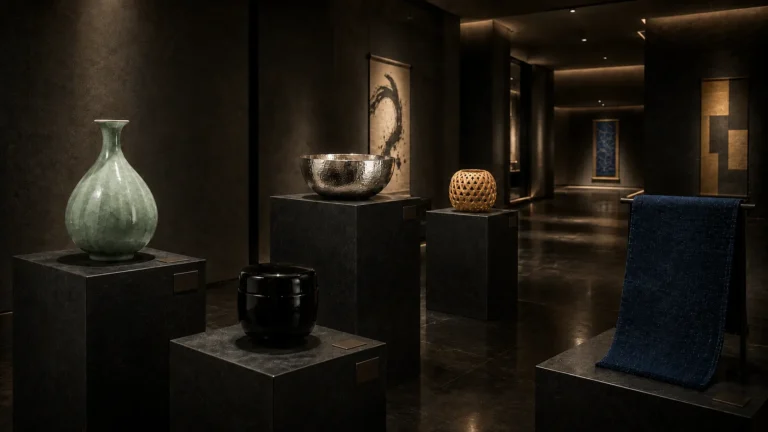
Have you ever arrived at a craft exhibition, stood in front of a piece, and wondered, “Where am I supposed to look?” It can feel as though you can’t enjoy the work without knowing the maker’s name or the technique, or the wall text leaves you with nothing but specialist vocabulary.
But you don’t need to memorise anything before you go. Just keeping seven simple points in mind—material → form → surface → technique → light → sides and edges → maker information—makes the differences between works far easier to see.
And in autumn 2026, exhibitions across Japan give you the chance to try that way of looking with real works, in person. On September 2, “The 73rd Japan Traditional Kōgei Exhibition” opens at Nihonbashi Mitsukoshi in Tokyo, then tours the country through March 2027. On September 6, the Mashiko Museum of Ceramic Art opens an exhibition on three ceramic artists—Ezaki Issei, Kamoda Shōji, and Mori Tōgaku.
This article does more than explain “how to look at crafts.” It connects that method to which exhibitions you can actually visit in autumn 2026, and what to look at once you’re there, in concrete terms.
What you’ll learn in this article
- The seven points to look at first at a craft exhibition
- How to look at each material—ceramics, textiles, lacquerware, metalwork, and more
- Craft exhibitions you can visit from autumn 2026
- The nationwide touring schedule for The 73rd Japan Traditional Kōgei Exhibition
- How to enjoy the work without knowing makers’ names or techniques
Table of Contents
Autumn 2026: which craft exhibitions can you visit? Four to know first
Autumn 2026 brings a run of exhibitions that let you approach crafts from different angles—from a broad open-submission show, to a focused ceramics exhibition, to displays centred on pattern and design. If it’s your first craft exhibition, one approach is to choose the show by what you want to practise looking at.
| Exhibition | Dates | Venue | What to look for |
|---|---|---|---|
| The 73rd Japan Traditional Kōgei Exhibition | Tokyo: September 2–15, 2026 Touring nationwide thereafter |
Nihonbashi Mitsukoshi and other venues | Compare different materials side by side—ceramics, textiles, lacquerware, metalwork |
| Independent Study for Kids and Grown-Ups: Wonderful Patterns² | July 3 – September 23, 2026 | National Crafts Museum, Kanazawa, Ishikawa | Look at pattern, colour, repetition, and surface |
| Ezaki Issei, Kamoda Shōji, Mori Tōgaku, 1969–71: Crossings of Ceramics in Transformation |
September 6 – November 29, 2026 | Mashiko Museum of Ceramic Art, Mashiko, Tochigi | Compare how each artist approaches form within the same medium: ceramics |
| Design Chronicle: What Was Born, What Changed? | October 9, 2026 – January 11, 2027 | National Crafts Museum, Kanazawa, Ishikawa | Look at how crafts and design relate to their historical moment |
Exhibition dates, opening hours, and closed days are subject to change. Always check the latest information from each venue or organiser before you visit.
The 73rd Japan Traditional Kōgei Exhibition | For those who want to compare different materials at once
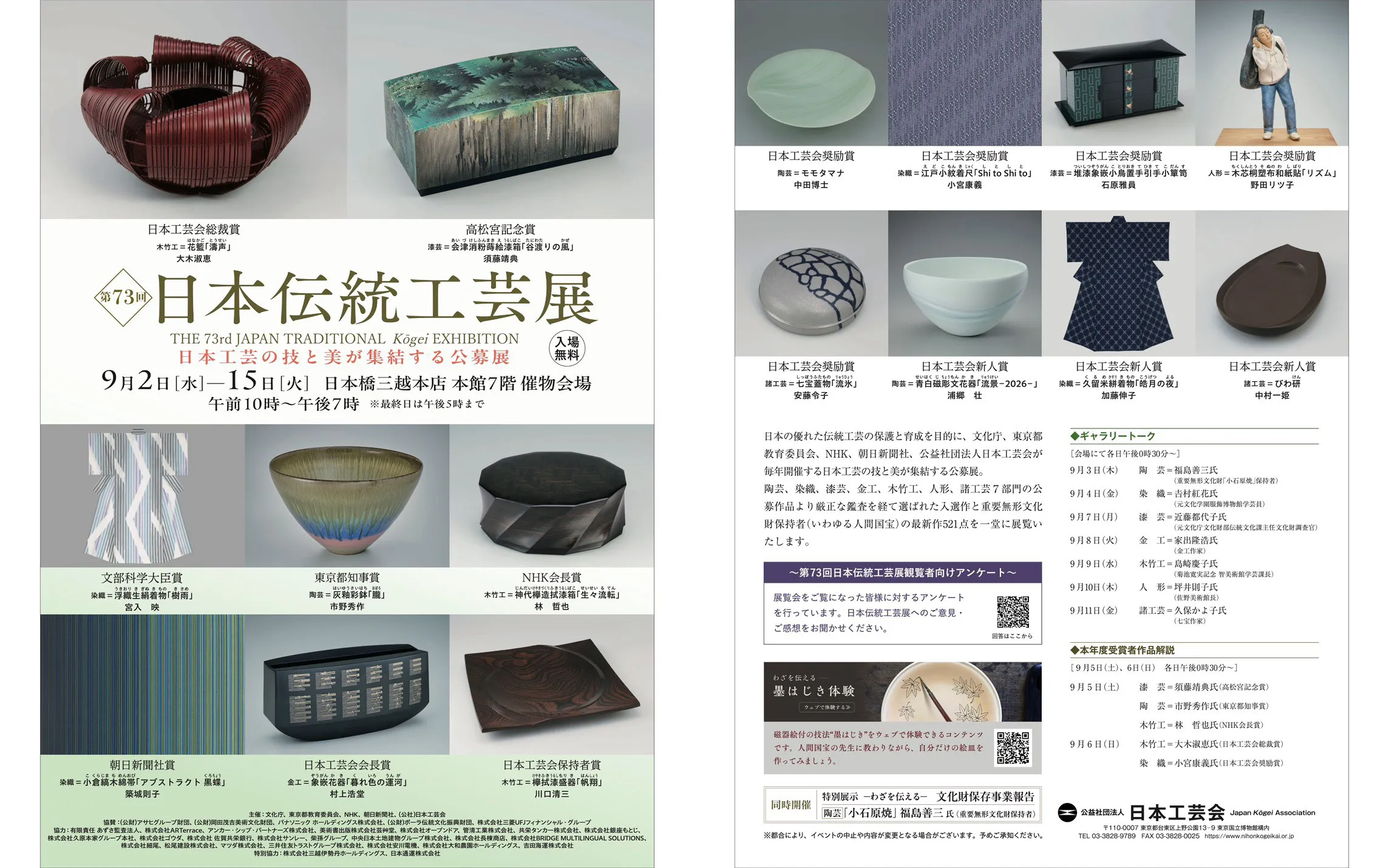
The exhibition where the seven steps in this article are easiest to put into practice is “The 73rd Japan Traditional Kōgei Exhibition,” which opens on September 2, 2026.
Officially, it is organised into seven fields: ceramics, textiles, lacquerware, metalwork, wood and bamboo work, dolls, and miscellaneous crafts. In other words, a single venue lets you look across different materials, techniques, and forms.
The Tokyo showing is scheduled for Wednesday, September 2 to Tuesday, September 15, 2026, in the event hall on the 7th floor of the main building at Nihonbashi Mitsukoshi, open 10:00 to 19:00, with free admission. After Tokyo, it travels to Aichi, Kyoto, Osaka, Miyagi, Ishikawa, Okayama, Shimane, Kagawa, Fukuoka, and Hiroshima.
(Reference: The 73rd Japan Traditional Kōgei Exhibition | The Japan Kōgei Association)
How to look at The 73rd Japan Traditional Kōgei Exhibition
You don’t have to try to understand all seven fields from the start. For example, pick one piece each from ceramics and lacquerware and compare only how their surfaces respond to light. Then look at textiles and wood and bamboo work, and pay attention to the structure of the material itself. Even that much begins to show how differently crafts can look depending on the material.
The nationwide touring schedule for The 73rd Japan Traditional Kōgei Exhibition
| Region | Dates | Venue |
|---|---|---|
| Tokyo | September 2–15, 2026 | Nihonbashi Mitsukoshi |
| Aichi | September 25 – October 5, 2026 | Furukawa Art Museum / Tamesaburo Memorial Hall |
| Kyoto | October 7–12, 2026 | Kyoto Takashimaya |
| Osaka | October 14–18, 2026 | Osaka Takashimaya |
| Miyagi | October 21–26, 2026 | Sendai Mitsukoshi |
| Ishikawa | October 30 – November 8, 2026 | Ishikawa Prefectural Museum of Art |
| Okayama | November 12–29, 2026 | Okayama Prefectural Museum of Art |
| Shimane | December 2–25, 2026 | Shimane Art Museum |
| Kagawa | January 2–17, 2027 | Kagawa Prefectural Museum |
| Fukuoka | February 3–8, 2027 | Fukuoka Mitsukoshi |
| Hiroshima | February 17 – March 7, 2027 | Hiroshima Prefectural Art Museum |
Admission fees and opening hours differ by venue. Tokyo, Miyagi, and Fukuoka are free according to official information, but some touring venues charge admission. Be sure to check the details for the venue you plan to visit.
(Reference: The 73rd Japan Traditional Kōgei Exhibition Schedule | The Japan Kōgei Association)
The prospectus for the 73rd exhibition also lists associated events such as commentary on the displayed works and a “traditional crafts children’s viewing course.” Check the latest information for specific dates and participating venues before taking part.
(Reference: The 73rd Japan Traditional Kōgei Exhibition Prospectus | The Japan Kōgei Association)
Mashiko Museum of Ceramic Art | Seeing what changes from one ceramic artist to another
If you want to look at ceramics a little more closely, another exhibition worth seeing is “Ezaki Issei, Kamoda Shōji, Mori Tōgaku, 1969–71: Crossings of Ceramics in Transformation,” scheduled for Sunday, September 6 to Sunday, November 29, 2026 at the Mashiko Museum of Ceramic Art.
According to the museum, the exhibition looks back on a three-person show held from 1969 to 1971 at Gallery Te in the Kotsu Kaikan building in Yūrakuchō, Tokyo, centring on the works shown at that time.
(Reference: Annual Schedule | Mashiko Museum of Ceramic Art)
What to try here is not to lump everything together as “this is what ceramics is,” but to see how differently artists who all work with clay and firing approach form, surface, colour, and the material itself.
If a general craft exhibition is a place to compare different materials side by side, a focused exhibition like this can be thought of as a place to look more closely at a single material. That makes choosing which craft exhibition to attend easier, too.
National Crafts Museum, “Wonderful Patterns²” | Practising how to look, with pattern as the way in
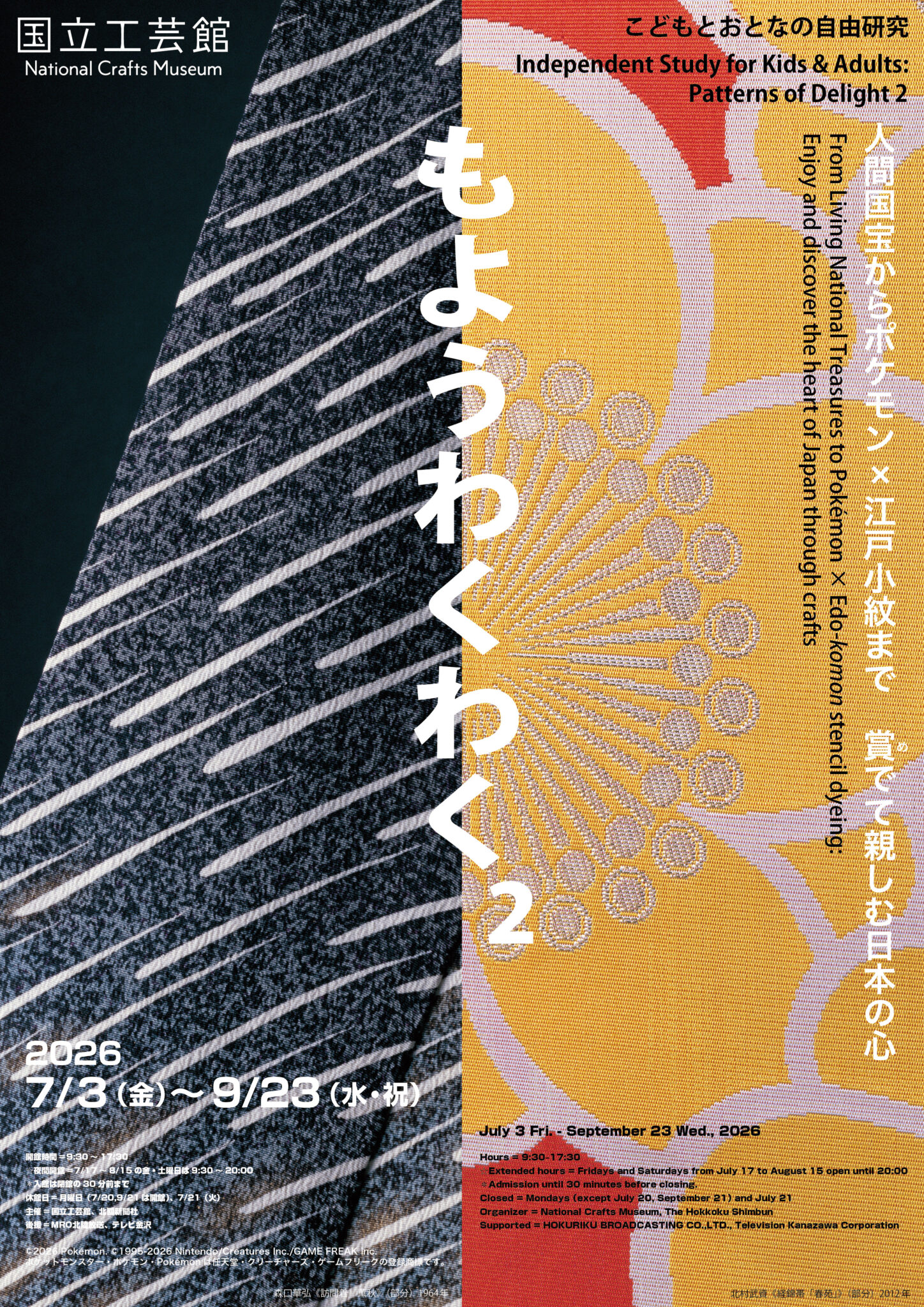
Until Wednesday, September 23, 2026 (a national holiday), the National Crafts Museum in Kanazawa, Ishikawa is holding “Independent Study for Kids and Grown-Ups: Wonderful Patterns².” It runs from July 3 to September 23.
(Reference: Independent Study for Kids and Grown-Ups: Wonderful Patterns² | National Crafts Museum)
Pattern is an approachable starting point for beginners, but you don’t have to look only at what is depicted.
How the same pattern repeats. How the look of a line changes with the material. How a pattern placed on a curved, three-dimensional surface reads differently from the front than from the side.
This exhibition is also a good place to practise the “form → surface → light” approach introduced here.
National Crafts Museum, “Design Chronicle” | Seeing the era, not just the object
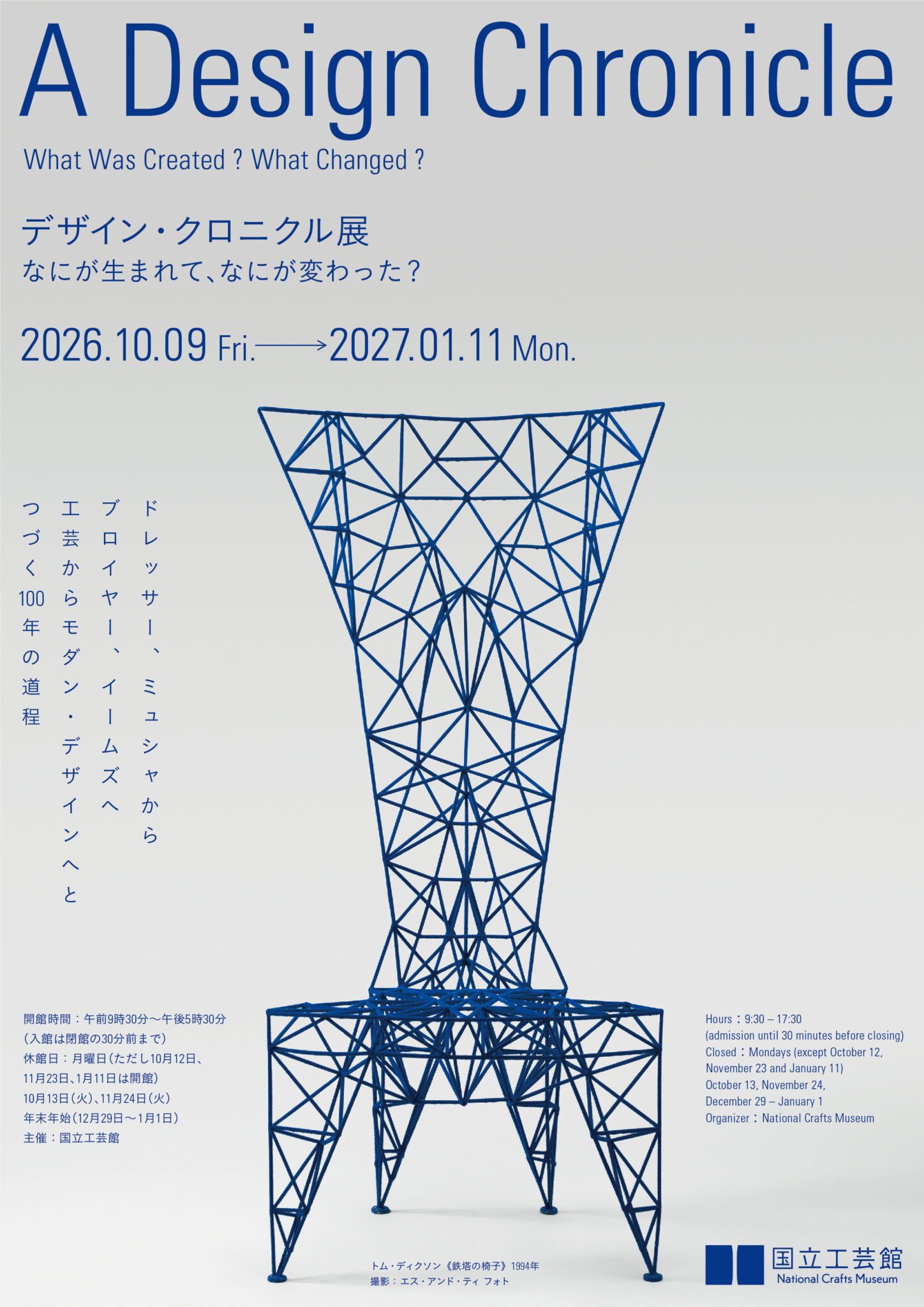
From Friday, October 9, 2026 to Monday, January 11, 2027 (a national holiday), the National Crafts Museum will hold “Design Chronicle: What Was Born, What Changed?”
(Reference: Design Chronicle: What Was Born, What Changed? | National Crafts Museum)
When you look at crafts, focusing only on material and technique can leave your viewing stuck at “how it was made.” But works and designs are also connected to the daily life, industry, and values of the era in which they were made.
Here, if you extend the “maker information” at the end of the seven steps a little further and ask “why was this form or material needed in this era?”, another way of seeing opens up.


Where should you start at a craft exhibition? The seven steps: “material → form → surface → technique → light → sides and edges → maker information”
If you lose track of what to look at during a craft exhibition, try using the order material → form → surface → technique → light → sides and edges → maker information as one guide.
This is not an official viewing method set by a museum or craft organisation. It is a viewing framework that Kogei Japonica has put together so that even beginners can notice more in a work.
What matters is not checking all seven items in order, but finding one question to ask about the work.
Why read the maker information later rather than first
There’s nothing wrong with learning the maker’s name or awards first. But setting that information aside for a moment changes the attention you bring to the work itself.
Rather than “I’m looking because the maker is famous,” you begin from “for some reason, this is the piece that made me stop.”
Editor’s Note
What I value at an exhibition is thinking about why I stopped in front of a particular work. Was it the colour, the form, or the surface? It’s fine if you can’t put it into words at first. When you then learn about the material, the technique, and the maker’s background, the unease or attraction you first felt often starts to make sense.
Maker information is not an “answer key.” Read it as something that adds another layer to your first observation and broadens your interpretation.
Steps 1–3 | How should you look at material, form, and surface?
In the first three steps, you begin with what you can see, before bringing in any specialist knowledge. Looking in the order of material, form, and surface makes it harder to stop at a vague “that’s nice.”
Material | Start by asking “what is it made of?”
Clay for ceramics, urushi (lacquer) for lacquerware, thread and cloth for textiles, metal for metalwork, wood and bamboo for wood and bamboo work—in crafts, the material itself is deeply tied to the expression.
You don’t need to know the material’s name. Feeling that something looks “hard,” “thin,” “heavy,” “soft,” or “highly reflective” is itself observation.
If you go to The 73rd Japan Traditional Kōgei Exhibition, for example, try looking at ceramics and metalwork one after the other. Even when both are three-dimensional objects, clay and metal handle surface and light differently.
Looking at crafts is not a quiz about naming materials or techniques. First, it matters to pick up how they look to your own eyes.
Form | Looking at the relationship between use, the body, and shape
Next, check the overall form from a little distance.
Height, width, outline, thickness, centre of gravity, left-right balance. For a vessel, also look at how the mouth opens, the swell of the body, and the line running towards the base.
There’s no need to force an either/or between practical item and artwork here. A vessel intended for use can have a strong formal quality, and contemporary craft also includes works that cannot be explained by function alone.
What is the form for? Is there a relationship to the body? And beyond that function, what kind of shaping emerges? It’s important to look from several viewpoints.

Surface | Looking at glaze, maki-e, weave, hammer marks, and more
The surface is one of the richest sources of information in a craft object.
In ceramics you begin to see glaze (yūyaku) and the clay’s texture; in lacquerware, the coating and decoration (kashoku) such as maki-e (sprinkled-metal decoration); in textiles, thread and dyeing; in metalwork, hammer marks (tsuchime), carving, and colouring.
- Smooth, or uneven
- Uniform, or full of variation
- Glossy, or holding the light back
- Whether traces of making remain
- Whether the impression changes up close versus far away
What matters here is not to assume that the more precise and uniform something is, the higher its value.
Some works deliberately leave the traces of material and process—shaving marks, hammer marks, the movement of glaze, the waver of the fibres. Your looking deepens when you consider not how fine it is, but why this surface.
Steps 4–5 | How should you look at technique and light?
When looking at technique, what matters is not memorising names but working backwards from the finished piece to ask how it was made. And looking at light makes differences in surface and structure even easier to see.
Looking for traces of technique | Thinking in What, How, and Why
As you look at a work, try thinking in these three stages.
- What: what is it made of
- How: how is it made
- Why: why were this material, technique, and form chosen
In ceramics, you might consider the traces of shaping on the wheel, or brush marks (hakeme); in textiles, the arrangement of warp (tate-ito) and weft (yoko-ito); in metalwork, processes such as casting, hammering, carving, and colouring.
The Japan Kōgei Association introduces casting (chūkin), hammering (tankin), and chasing (chōkin) as major metalwork techniques.
(Reference: Metalwork | The Japan Kōgei Association)
That said, technical difficulty is not the same thing as the overall quality or value of a work.
What matters is seeing how technique connects with material, form, and expression.
Looking at light | The impression changes with where you stand
The gloss of glaze, the surface of urushi, the reflection of metal, the transmission of light through glass, the shading of woven cloth—all change with the light.
Without touching the work or the display case, change your position slightly within the normal viewing area.
A surface that looked uniform from the front may reveal unevenness, or the reflection off lacquer or metal may change.
The art appreciation education introduced by the National Center for Art Research also presents a focus on formal elements such as form and colour, material and light.
(Reference: Training for Instructors to Enhance Appreciation Education Using Art Museums | National Center for Art Research)
| Field | What to do first at the venue | What to compare next |
|---|---|---|
| Ceramics | Step back and look at the form | Clay texture, glaze, mouth rim, thickness, the expression from firing |
| Textiles | Look at the overall colour and pattern | Thread, weave, dye, how it reads at a distance |
| Lacquerware | Look at the surface and outline | Coating, decoration, curved surfaces, reflection of light |
| Metalwork | Look at the overall form | Hammer marks, carving, colouring, joins, reflection |
| Wood and bamboo work | Look at the lines of the material | Grain, shaving, joinery, weave, structure |
| Dolls | Look at the pose and overall composition | Expression, costume, material, detailed shaping |
| Miscellaneous crafts | First check the material | Reflection, transmission, surface, and joins particular to the material |
Steps 6–7 | How much should you look at the sides, edges, and maker information?
A craft work is not always complete when seen from the front alone. Within what’s visible from a normal viewing position, look at the sides, the rim, and the form running towards the base. When you then read the maker information, new details are added to your first observation.
Why look at the foot ring, the sides, and the finish
For a vessel, the form continuing to the foot ring (kōdai) and the mouth rim (kōen); for a three-dimensional piece, the sides and joins; for textiles, the edges and the overall finish—all hold clues to understanding the work.
That said, there’s no need to lean over the display stand or press extremely close to the case to see the underside. The basic rule is to look only at what you can safely check from a normal viewing position.
Even looking at a single foot ring, rather than judging whether the form is good or bad, it helps to look at its relationship to the work as a whole—how the shaping connects from the body to the base.
Maker information broadens interpretation; it is not the “answer” to your observation
Here you check the maker’s name, the title, the material, the technique, the year, and the background of making.
It doesn’t matter if it differs from your own guess.
If you find that what you thought was metal was another material, or that a pattern you thought was accidental came from a specific process, return to the work and look again.
Look → question → learn → look again.
Once you can move back and forth like this, a craft exhibition changes from mere information-gathering into your own experience of looking.
Can you enjoy a craft exhibition without knowing the titles or the makers’ names?
The short answer is yes, more than enough. Especially while you’re a beginner, rather than trying to understand everything, try aiming to take home one discovery about one work.
At an exhibition with several fields side by side, like The 73rd Japan Traditional Kōgei Exhibition, the number of works on display is large, too.
At times like that, after going around the venue once,
“If I had to choose just one today, which would it be?”
is a good question to ask yourself.
It doesn’t have to be the most famous work.
“Because it’s beautiful” is fine, so is “because it caught my attention even though I don’t quite understand it,” or “because I wondered how it would look in my own home.”
A seven-step observation checklist for craft exhibitions
- Material: consider what it’s made of
- Form: look at outline, thickness, centre of gravity, and relationship to use
- Surface: look at gloss, unevenness, colour, and traces of making
- Technique: imagine the process it was made by
- Light: change position within a safe range and look at reflection and shadow
- Sides and edges: look at the rim and structure from a normal viewing position
- Maker information: check material, technique, and background, then look at the work again
It’s fine if you can’t do all of them. If there was even one moment when you thought “why is that?”, your viewing has already begun.
Common questions about your first craft exhibition | FAQ
- Q1. If I’m going to my first craft exhibition in autumn 2026, which one do you recommend?
- If you want to compare a range of crafts at once, The 73rd Japan Traditional Kōgei Exhibition is a clear option. You can look across ceramics, textiles, lacquerware, metalwork, wood and bamboo work, dolls, and miscellaneous crafts.
- Q2. Can I see The 73rd Japan Traditional Kōgei Exhibition outside Tokyo?
- Yes. After the Tokyo showing in September 2026, it tours Aichi, Kyoto, Osaka, Miyagi, Ishikawa, Okayama, and Shimane, and is scheduled for Kagawa, Fukuoka, and Hiroshima in 2027. Dates, fees, and opening hours differ by venue.
- Q3. Where should I start at a craft exhibition?
- If you’re unsure, try starting with material, form, and surface, then look at technique, light, and the sides and edges, and finally read the maker information.
- Q4. Can I enjoy it without knowing the titles or the makers’ names?
- Yes. One effective approach is to first note what drew you in, and only then learn about the maker and technique.
- Q5. Is it better not to read the caption first?
- There’s no rule. But if you’re unsure what to look at, try looking at the work alone first, then reading the caption, then looking at the work again—this makes it easier to connect your observation with the information.
- Q6. Can I take photographs?
- Whether photography is allowed differs by exhibition, venue, and work. There may be no-photography rules or limits on flash and video, so check the on-site signage and the organiser’s latest information.
- Q7. Can I enjoy a craft exhibition with children?
- Form, colour, pattern, and material can be observed without specialist knowledge. The prospectus for The 73rd Japan Traditional Kōgei Exhibition also lists a “traditional crafts children’s viewing course” among its associated events. Check the latest official announcement for specific dates and venues.
- Q8. About how many minutes should I look at one work?
- There’s no set time. Rather than time, prioritise finding one thing that caught your attention.
- Q9. Do I need to know the names of techniques to understand the work?
- No. Wondering how something was made and looking up the technique afterwards is itself part of appreciating crafts.
- Q10. How can I tell whether a craft work is “good”?
- It can’t be judged by a single standard. Beyond the precision of the technique, you need to look from several viewpoints—material, form, technique, use, expression, and the background of making. Start by putting into words what drew you in.
Conclusion | This autumn 2026, put your eye to the test at a craft exhibition
When you’re unsure how to look at a craft exhibition, try using the seven viewpoints—material → form → surface → technique → light → sides and edges → maker information—as one guide.
And autumn 2026 brings a run of chances to put this approach into practice, in front of the works themselves.
- To compare different craft fields: “The 73rd Japan Traditional Kōgei Exhibition”
- To compare ceramics closely: Mashiko Museum of Ceramic Art, “Ezaki Issei, Kamoda Shōji, Mori Tōgaku, 1969–71: Crossings of Ceramics in Transformation”
- To look with pattern as the way in: National Crafts Museum, “Wonderful Patterns²”
- To think about the relationship between works, era, and design: “Design Chronicle”
Learning to look at craft is not something you master all at once by memorising terms.
You stop at a single work and ask a question: “why this material?” “why this form?” “why does the light fall differently only here?” From that question, you look into the technique or the maker, and look at the work again.
Editor’s Note
When conveying crafts, leaning only on easily grasped values—”advanced technique,” “long making time,” “a famous maker”—leaves the act of actually looking at the work behind. You can forget a work’s title and still have the experience of “I can’t forget that surface” or “for some reason, that one form stays with me.” I think it’s fine to enter crafts from that kind of discovery, the kind that comes before words. If you visit a craft exhibition in autumn 2026, rather than understanding everything, first look closely at just one work.
At Kogei Japonica, rather than reducing craft to a visual shorthand for “Japan” or a tourist attraction, we present it as a culture where material, technique, form, and the maker’s decisions intersect.
If you’d like to find more upcoming craft exhibitions, see our 2026 craft exhibition guide as well.
Please note that the exhibition information in this article is organised from official information available as of August 17, 2026. Dates, opening hours, closed days, fees, and related events are subject to change. Always check the latest information from each organiser or venue before you visit.
