

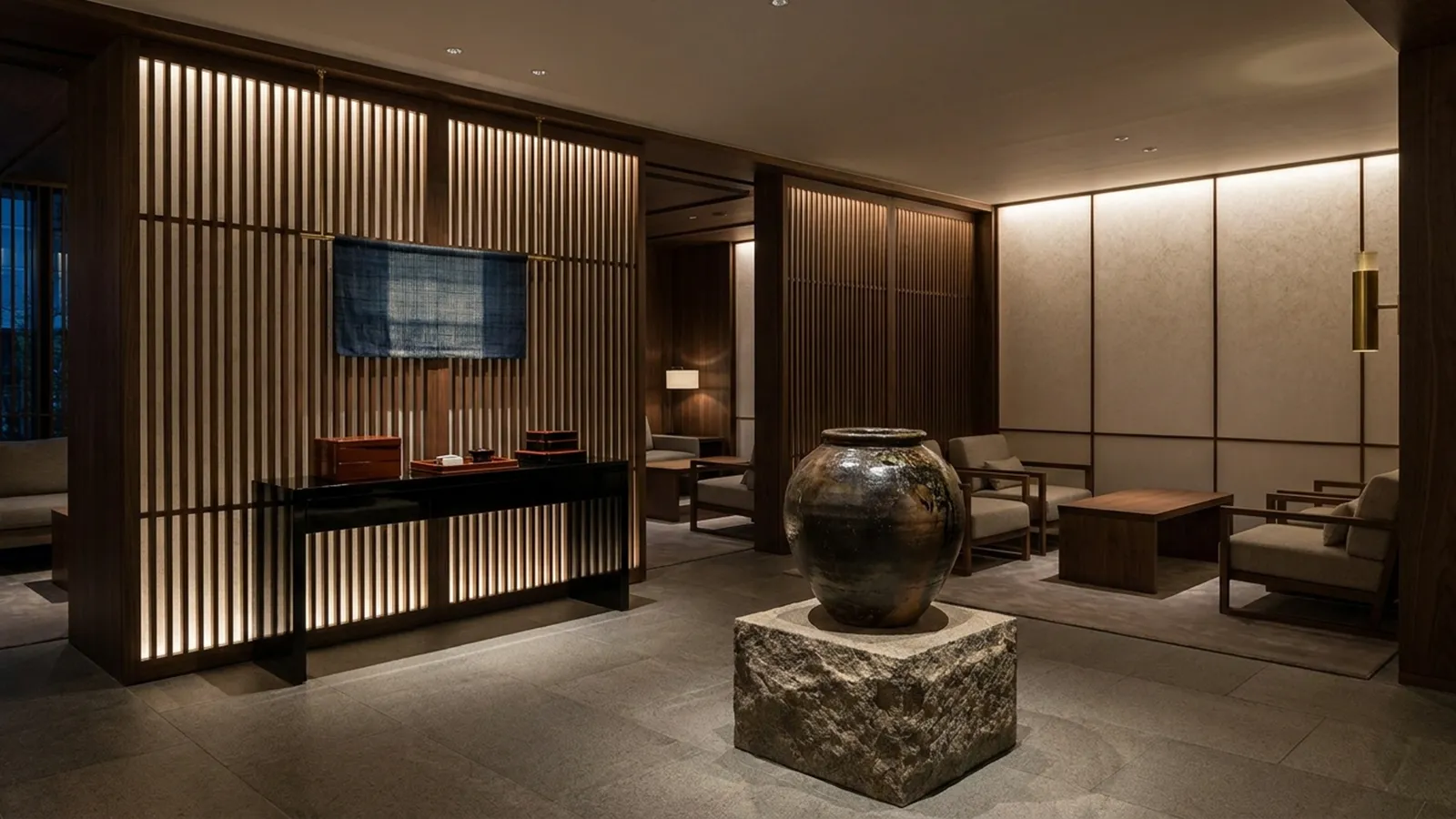
“We’d love to bring kogei works into our space, but committing to a purchase feels premature.” This is a familiar position for hotel and facilities managers, as well as teams planning offices, commercial interiors, or hospitality spaces. The hesitation isn’t purely budgetary. There’s the desire to rotate pieces with the seasons, to trial something before making a permanent decision, or simply the absence of adequate storage and management infrastructure. When several of these factors converge, rental tends to surface as the practical answer.
This guide is written for B2B decision-makers working through that exact question. It covers the mechanics of kogei rental, use-case breakdowns for hotels, offices, and events, the operational details of pricing and insurance, contract points that tend to arise in internal approval processes, and what to prepare before making an initial enquiry. The aim is to give you a clear picture of how realistic — and how operationally viable — it has become to bring kogei into a space without committing to ownership.
Table of Contents
What Kogei Rental Is — and Why the Non-Ownership Model Is Gaining Ground
Kogei rental refers to a service in which craft objects are made available for display over a defined period under agreed conditions, without transferring ownership. Because costs can be distributed over time and the displayed works can be rotated, it has become an increasingly practical entry point for hotels, commercial facilities, and corporate clients who want to incorporate craft into their spaces without the commitments that ownership entails.
“We don’t need to own something permanently, but a bare space isn’t working either” — or: “We’d like to test the response before deciding whether to go further.” That kind of incremental approach maps well onto the rental model.
Purchase, Lease, Rental, and Subscription: What’s the Difference
There are four main frameworks for introducing craft objects into a space. The table below sets out the key differences.
| Model | Ownership | Upfront Cost | Term Flexibility | Rotation / Swap |
|---|---|---|---|---|
| Purchase | Transfers to buyer | High | None | Self-managed |
| Lease | Remains with lessor | Moderate | Fixed medium-to-long term | Generally not permitted |
| Rental | Remains with provider | Low to moderate | Flexible short-to-medium term | Often available |
| Subscription | Remains with provider | Low | Configurable, often monthly | Periodic rotation may be built in |
Outright purchase suits long-term, fixed installations, though it may require asset registration in your accounts. Leasing was designed primarily for durable equipment and doesn’t always translate cleanly to art and craft objects. Rental and subscription formats are better suited to short-to-medium-term programming and trial installations — and both are now the subject of growing B2B service development in the art and craft sector.
Which model makes most sense depends on the intended display period, budget, and management capacity. The starting point is simply: when, where, and for what purpose.
Why Demand Is Increasing Across Hotels, Offices, and Events
Several converging factors are driving interest in this space.
One is the recovery of inbound tourism and the broader shift toward experience-led hospitality. According to figures from the Japan National Tourism Organization (JNTO), inbound visitor arrivals reached approximately 3.46 million in February 2026, continuing a sustained recovery trajectory. International guests often respond more strongly to spaces that feel rooted in a specific place and culture, rather than to interiors that could exist anywhere. Craft objects can carry that sense of specificity — but acquiring and maintaining them on a purchase basis involves significant procurement and management overhead. Rental makes seasonal and event-driven rotation feasible.
(参照:Visitor Arrivals to Japan, February 2026 Estimates | Japan National Tourism Organization (JNTO))
A second driver is growing corporate investment in workplace wellbeing. More organisations are now drawing a direct line between the quality of their physical environment and employee experience. In this context, kogei works — particularly pieces that bring material texture and a strong sense of place into a room — offer something that most standard interior elements don’t.
There is also a sustainability dimension. As organisations move away from disposable décor toward longer-term material cycles, renting kogei — keeping objects in circulation rather than in storage — fits naturally within that shift.
ARTerrace RENT’s PoC Launch as a Market Signal
At least one operator has already moved from concept to practice. On 1 April 2026, ARTerrace launched a proof-of-concept (PoC) for ARTerrace RENT, a high-end kogei rental service for corporate clients, with the announcement made on 9 April. The service targets offices, commercial facilities, and hotels.
(参照:ARTerrace Begins PoC for High-End Kogei Rental Service | PR TIMES)
This launch is a concrete data point: kogei rental has moved from a theoretical option to an operational one. The fact that suppliers and distributors are now building dedicated B2B rental infrastructure means that, for corporate enquirers, there are real parties to contact and real services to evaluate.
For an overview of subscription-based services in this space, see the related article linked below.


Kogei Rental by Use Case — Hotels, Offices, Events, and Design Briefs
The operational priorities for kogei rental vary substantially depending on the context. This section breaks down four primary use cases: hotels and ryokan, offices and commercial facilities, events and trade shows, and design and interior coordination practices. Start with the one closest to your situation.
Hotels and Ryokan — Lobbies, Guest Rooms, Restaurants, and Experience Programming
In hotel and ryokan settings, the primary goals are enhancing the guest experience and connecting the property to its local cultural context.
Works placed in lobbies and guest rooms help shape the first impression a guest forms of the property — a sense of what this particular place is. For international guests especially, ceramics, lacquerware (urushi), and dyed textiles carry a material and cultural weight that goes well beyond decoration.
Common placement points include:
- Lobby and entrance: Large ceramic vessels or flower vases installed to anchor the arrival experience
- Guest rooms: Smaller lacquerware pieces or woven textiles used as wall hangings or desktop objects to give the space a distinct character
- Restaurant and bar: Tableware and chopstick rests on display, or dyed textiles mounted on walls
- Experience programming: Where the maker of a displayed piece is based nearby, rental can be linked to studio visits or making workshops as part of a curated stay offering
If seasonal rotation is part of the plan, confirm with prospective rental providers whether a scheduled exchange service is available.
Offices and Commercial Facilities — Entrances, Meeting Rooms, and Shared Spaces
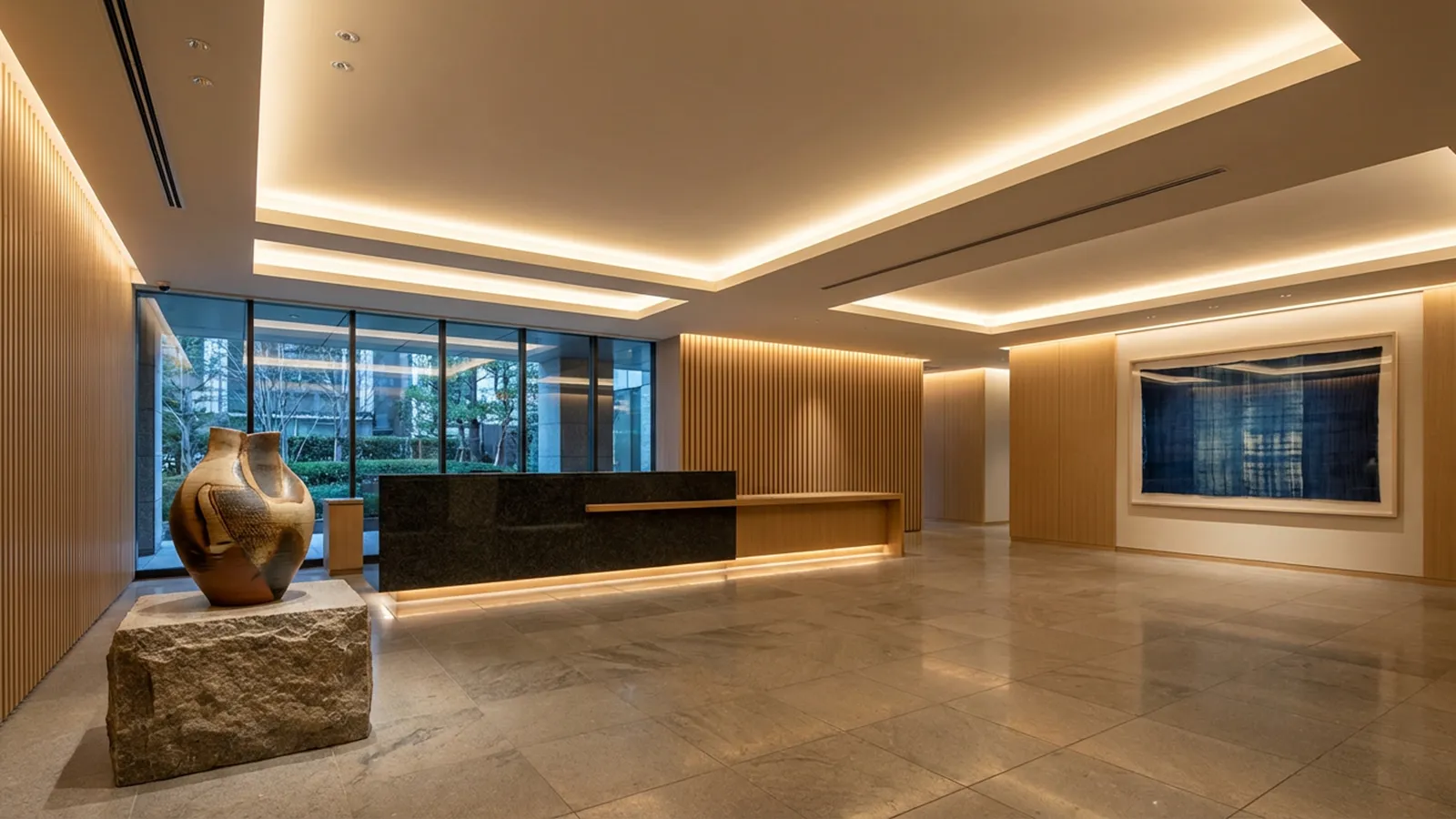
For corporate offices and commercial properties, the primary motivations are impression management with external visitors and the quality of the working environment.
Placing kogei works in an entrance or on an executive floor communicates a company’s sensibility to first-time visitors — clients, investors, and prospective hires — before a word is spoken. A dyed textile or wood-turned piece on a meeting room wall can materially shift the character of that space.
In commercial facilities, craft pieces are deployed in concept zones or event spaces — used as tools for brand positioning and tenant attraction, raising the perceived register of a space through material quality.
Because rental allows for time-limited installation, programming around specific periods — the New Year, Golden Week, Lunar New Year — is operationally straightforward.
Events and Trade Shows — Short-Term Rental from One Day to Several Weeks
For trade show booths, corporate receptions, or cultural events run by public institutions, where dates are fixed and the display window is defined, short-term rental tends to offer the clearest cost-benefit calculation.
The operational sequence typically runs as follows:
- Pre-event confirmation: Venue dimensions, loading dock access, temperature and humidity conditions, security arrangements
- Specification sign-off: Objects selected, quantity confirmed, display method agreed (plinths, wall-mounting, lighting)
- Delivery and installation: Specialist fine art logistics handling unpacking and placement
- Event-period management: Handling briefing for on-site staff, incident reporting procedure confirmed
- De-installation and return: Repacking and collection by the logistics provider after the event closes
For single-day rentals, delivery and collection costs represent a significant proportion of total spend. It is worth exploring whether the rental can span multiple dates or be combined with a nearby event to improve the unit economics.
Architecture and Interior Design Practices — Integrating Rental into Client Proposals
For architects and interior coordinators, kogei rental functions as a way to extend the scope of what a completed space can offer a client over time.
Introducing craft works as a variable element alongside fixed furniture and materials gives clients the ability to adjust the character of their space after handover. This is particularly relevant in hospitality, food and beverage, and healthcare interiors, where operators often want to refine the atmosphere through lived experience rather than locking everything in at opening.
Key items to clarify when building rental into a proposal:
- What documentation the rental provider can supply (quotations, specifications, installation records)
- Whether subletting arrangements — the practice of an architect or coordinator contracting on behalf of the end client — are permitted under the rental terms
- Physical requirements for installation (lift dimensions, floor load ratings, access restrictions)
Bringing the rental provider into the conversation during the design phase allows lighting plans and plinth specifications to be developed around the actual objects, rather than retrofitted afterward.
Pricing — What to Check in Any Quotation
Rental costs for kogei vary considerably depending on the objects, the duration, and the service scope. Rather than trying to establish a market rate, the more useful preparation is understanding what drives the price — which makes quotation comparison and negotiation substantially more straightforward.
What Determines the Rental Fee
The main pricing variables are:
- Appraised value and maker profile: The market valuation of the work and the standing of the artist are the primary price anchors. Works by artists designated as Living National Treasures — a government recognition for practitioners of important intangible cultural heritage — are handled and priced very differently from commercially produced pieces.
- Scale and weight: These directly affect logistics complexity. Large ceramic installations or heavy metalwork require specialist handling that adds to cost.
- Rental duration: Monthly or annual contracts typically offer better day-rate economics than short-term arrangements.
- Rotation frequency: If seasonal exchange is included, the associated service cost is added to the base fee.
- Transport distance: Fine art logistics is a specialist service, distinct from standard freight, and distance-based costs apply accordingly.
- Included services: Installation, de-installation, plinths, lighting, and insurance coverage all affect the total figure depending on how they are bundled.
What Is and Isn’t Included in the Base Fee
When you receive a monthly figure, always clarify exactly what it covers. Scope varies between providers, and additional costs surfacing after agreement is reached are a common source of friction.
Commonly included
- The rental fee for the object itself
- Basic packaging and transport (depending on provider)
- Insurance coverage (structure varies — confirm the details)
Commonly charged separately
- Long-distance transport surcharges
- Specialist crating materials
- Installation and de-installation labour
- Scheduled rotation service fees
- Display plinths and lighting rental
- Cleaning or restoration costs on return (condition-dependent)
When comparing quotations from multiple providers, standardise the scope first — compare like with like before drawing any conclusions.
When Rental Makes More Sense Than Purchase — and When It Doesn’t
Rental tends to be the more rational choice when:
- The intended display period is under a year, or has a defined end date
- Seasonal or thematic rotation is part of the programming plan
- The preference is to trial before committing capital
- There is no suitable storage or management infrastructure in place
Purchase may be more appropriate when:
- The installation is intended to run for five years or more
- There is a strong conceptual or relational reason to hold a specific maker’s work
- The cumulative rental cost over the intended period approaches the purchase price
The two are not mutually exclusive. Some providers support a pathway from rental to purchase — trialling a work before buying it. It is worth asking about this option at the initial enquiry stage.
Insurance, Damage, and Contracts — The Questions That Arise in Approval Processes
When kogei rental is under internal review, legal, administrative, and facilities teams will reliably raise one question: what happens if something is damaged? This section addresses the practical points needed to move an approval process forward. Note that this is an overview of general operational considerations — specific insurance products and contract terms should always be reviewed with your own legal and insurance advisers.
Insurance — Who Covers What
Kogei rental typically involves movable property insurance and specialist fine art coverage for transport and display. The precise structure depends on how responsibilities are allocated between the rental provider, the client, and the logistics operator.
The Agency for Cultural Affairs, Japan, has noted the importance of appropriate insurance frameworks for art loans, recognising the need for coverage across transport, display, and storage phases.
(参照:On Insurance Systems for Art Objects | Agency for Cultural Affairs, Japan)
In practice, there are two main configurations:
- Provider-held insurance: The rental provider carries the policy and the premium is embedded in the rental fee. This simplifies administration for the client, but the scope and exclusions of coverage still need to be confirmed.
- Client-held insurance: The client is required to arrange coverage, typically by adding a rider to an existing policy. Check in advance with your insurance contact whether your current arrangements can accommodate this.
Confirm that coverage is continuous across all phases: transport in, installation, display period, de-installation, and transport out. Pay particular attention to hand-off moments — for example, the period between when the logistics crew unpacks the crate and when the installation team takes over — where responsibility can become ambiguous.
Fine art logistics in Japan is a specialist discipline, with providers who handle packaging, crating, climate control, and insurance as an integrated service.
(参照:Fine Art Logistics and Storage | Terrada Art Assist)
Damage, Theft, and Deterioration — Establishing Liability
How liability is allocated in the event of damage, theft, or deterioration is determined by the contract. The standard points of discussion are:
- Normal wear and tear: Gradual deterioration from extended display is generally outside the client’s liability — but if the definition is left vague, disputes are more likely. Get the boundary in writing before signing.
- Accidental loss: For events outside the client’s control — earthquake, flooding, accidental falls — confirm in advance whether insurance covers these scenarios or whether they fall under client liability.
- Gross negligence or wilful damage: Damage resulting from clear carelessness or deliberate action by the client is typically the client’s responsibility. The method for calculating compensation — acquisition cost, current market value, independent appraisal — should be explicitly set out in the contract to avoid post-incident disputes.
Contract Checklist — Key Points to Confirm Before Signing
- Valuation method: How is the compensation figure calculated if damage occurs? (Acquisition price, current market value, independent appraisal?)
- Photography and publication rights: What use of images of the work is permitted — social media, press materials, marketing collateral?
- Subletting restriction: Is the client permitted to make the work available to a third party?
- Location restrictions: Can the work be moved to a location other than the one specified in the contract?
- Return conditions: What condition standard applies at return, and are there specific packaging requirements?
- Early termination: What are the conditions and penalties for ending the agreement before the contracted term?
- Intellectual property: Copyright in the work remains with the maker. Commercial use — catalogue reproduction, video content — typically requires separate written permission from the artist.
Most of these points can be reviewed before any commitment by simply asking prospective providers to share their standard contract in advance. Build in time to read it properly rather than signing under deadline pressure.
Post-Installation Operations — Managing Kogei in the Space
Bringing craft works into a space is the beginning of the process, not the end. If day-to-day management becomes burdensome for on-site staff, renewal becomes harder to justify. This section sets out a practical operational framework from delivery through to return.
Standard Workflow: Delivery, Installation, Rotation, and Return
- Initial consultation and briefing: Compile photos and measurements of the installation space, along with the purpose, preferred aesthetic, and budget parameters, and share these with the rental provider.
- Site assessment and proposal: The provider reviews the space (in person or remotely) and proposes specific works, installation methods, and pricing.
- Quotation and contract: Once the scope is agreed, the contract is signed. Insurance arrangements, object valuations, and termination conditions should be finalised at this stage.
- Delivery and installation: A specialist fine art logistics provider delivers the works in purpose-built packaging; installation staff position and mount them. Arrange for a designated staff member to be present throughout.
- Operational period management: Brief on-site staff on handling protocols and establish a clear incident reporting chain.
- Rotation (if applicable): For scheduled exchange services, agree the calendar in advance and hold to it.
- Return and de-installation: At the end of the contract, the provider repacks and collects the works. Condition assessment at this stage should be conducted with representatives from both parties present.
Handling Guidelines for On-Site Staff
A brief, clear set of handling protocols for the team working around the pieces is one of the most effective tools for preventing incidents. Key points to cover:
- Cleaning: Do not touch the objects directly. Remove dust from surrounding surfaces using a soft hand blower or dry mop only. No wet cloths or cleaning products on or near the works.
- Direct contact: Handling with bare hands transfers oils and residue. If a piece must be touched, cotton gloves should be used.
- Climate conditions: Woodwork, lacquerware, and dyed textiles can be sensitive to sharp changes in temperature and humidity. Avoid positioning them in direct airflow from HVAC systems.
- Incident reporting: If a crack, discolouration, or fall is noticed, staff should not attempt to address it independently. The matter should go immediately to the designated contact, who alerts the rental provider.
A single A4 sheet covering these points, laminated and posted in the back-of-house area, is often enough to materially change how staff engage with the pieces day to day.
Measuring the Impact
Having some basis for evaluating the installation — beyond a general sense of whether it worked — makes renewal decisions and internal reporting considerably more straightforward.
Qualitative indicators
- Guest, visitor, and staff comments — collected through surveys or noted informally
- Unsolicited photographs and posts on social media
- References to the space in conversations with clients or job candidates
Quantitative indicators
- Guest satisfaction scores (for hotels, review platform ratings can serve as a proxy)
- Dwell time near the display (where camera-based measurement is available)
- Downstream effects on enquiries or conversions in event and retail contexts where attribution is traceable
Where precise measurement isn’t practicable, recording the responsible person’s assessment alongside a clear renewal intention provides enough of a paper trail to support the next budget or approval cycle.
Preparing for an Enquiry — What to Have Ready Before You Make Contact
The clearer the brief you bring to an initial conversation, the faster that conversation can move to practical specifics. Here is a summary of what is useful to have prepared.
Five Things to Clarify Before Your First Enquiry
- Venue details: Type of facility (hotel, office, event venue), dimensions of the intended installation space (height, width, depth), loading access dimensions, lift availability
- Purpose and use case: Permanent display or time-limited; for visitors or internal use; general Japanese aesthetic or a specific theme
- Preferred objects or aesthetic direction: If you have a category preference — ceramics, dyed textiles, lacquerware — be specific. If not, a descriptive sense of the atmosphere you are working toward is a useful starting point
- Timing and duration: Intended start date and end date (or renewal preference). Aim to make contact one to two months ahead of the intended installation date
- Budget range: Monthly or total — either works. If the budget is genuinely undecided, say so; providers can work with that, and it is better than an artificial number
Evaluating Providers — What to Look For
- Transparency about the works and their makers: Artist name, regional origin, and production context should be clearly available for any piece on offer
- Insurance arrangements: Coverage status for transport and display, and a clear process for handling damage incidents
- Installation track record: Documented experience with commercial installations and the capacity to provide on-site support
- Contract clarity: A written contract that addresses valuation, early termination, and image use rights — available for review before any commitment is made
- Ongoing support: Capacity to manage scheduled rotations, maintenance needs, and emergency contact situations
- Flexibility in selection: Whether the provider can make tailored recommendations based on your space, brief, and tone
The quality of a provider’s responses to initial questions — their pace, specificity, and willingness to share documentation before a contract is on the table — is itself a useful signal.
Enquiries to Kogei Japonica | Consultation for Corporate Craft Integration
Kogei Japonica accepts enquiries, quotation requests, and document requests from corporate contacts. For questions about introducing kogei into your space, or about working with us on a collaborative project, please use the contact form below.
Summary
Kogei rental is a practically grounded option for organisations that want to bring craft works into their spaces without the commitments of ownership. The specific priorities vary by use case, but addressing the three core areas — pricing, insurance, and operational management — in advance gives any internal approval process a solid foundation.
Starting with a rental trial rather than a purchase is not a sign of hesitation. If anything, it is the more considered approach: how a piece sits in a particular space is something that often only becomes clear once it is there. Rental makes that discovery possible without the associated financial risk.
The April 2026 launch of ARTerrace RENT as a PoC is a concrete indicator that this market is in active development. We will be watching how the broader circulation of kogei through rental and related models develops from here.
If you are at the evaluation stage — whether you are working on a spatial brief or building the case internally — the most useful next step is usually a conversation. Bring what you have: the space, the direction, and a rough sense of timing. That is enough to begin a practical conversation.
