




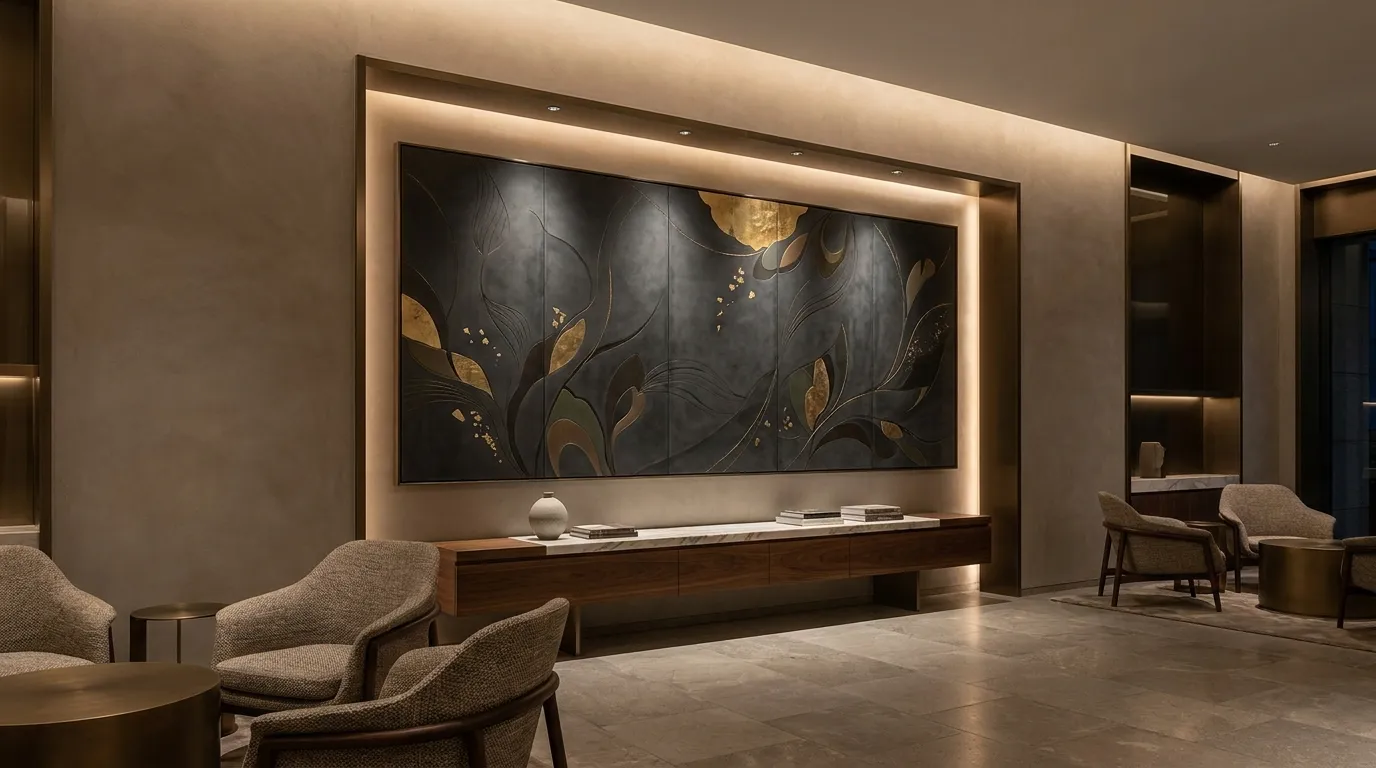
You have a vision: a lacquerware panel in a hotel lobby, a kinma composition on the wall of a ryokan guest room, a chinkin surface anchoring the far end of a restaurant. And then the questions arrive — who do you contact, what does this actually cost, is it even feasible within a construction schedule? Many hospitality and retail procurement teams stall at exactly this point.
This guide addresses the practical commissioning of lacquerware panels — with a focus on chinkin and kinma — for hospitality and commercial interiors. It covers technique selection, sourcing routes, pre-order conditions, and copyright considerations, written from the perspective of a B2B buyer. The underlying premise is that urushi lacquer is not a decorative accent with cultural associations but a material with specific spatial behaviors, and that commissioning it well begins with understanding those behaviors.
What this article covers
With the right preparation — understanding the installation environment, technique characteristics, and appropriate sourcing routes — lacquerware panels can be realistically evaluated for hotel lobbies, lounges, guest rooms, private dining rooms, and meeting spaces.
This article organizes the spatial differences between chinkin and kinma, how to choose a sourcing route, and what conditions to clarify before placing an order — written for B2B procurement teams.
Table of Contents
Can lacquerware panels actually be used in hotels and commercial interiors?

Yes — provided the conditions are clearly defined. Lacquerware panels can be considered for hotel and ryokan lobbies, guest rooms, restaurants, offices, and other commercial wall installations. The more productive question is not whether it is possible, but under what conditions, with whom, and through what process. Getting that clarity early is what makes these projects run smoothly.
What is a lacquerware panel?
In this article, the term “lacquerware panel” refers to decorative works in which urushi — the refined sap of the urushi tree — is applied to a wooden or metal ground and used for wall-mounted display, freestanding installation, or architectural integration. The format ranges from framed works hung like paintings to pieces designed into a space from the earliest stages of construction.
Urushi is a natural material that, when properly handled, is highly durable. At the same time, it requires consideration of the installation environment: direct sunlight and rapid fluctuations in temperature or humidity can affect the surface over time. The decorative technique applied to the lacquer ground determines the work’s visual character, and that choice has direct consequences for how the piece reads in space.
The two techniques this article focuses on — chinkin and kinma — are described in detail in the sections that follow.
Glossary
Chinkin: A lacquerware decoration technique in which a design is incised into the lacquer ground with specialized chisels, lacquer is worked into the grooves, and gold powder or gold leaf is applied to fix the pattern. Closely associated with Wajima lacquerware.
Kinma: A technique in which a design is carved into the lacquer surface, colored lacquers are packed into the carved grooves, and the surface is polished flat to reveal the pattern. One of the defining techniques of Kagawa lacquerware.
Lacquerware panel: A general term for lacquerware works produced for architectural or interior use, including wall decoration, room dividers, and furniture elements.
Kagawa lacquerware: A category of Japanese lacquerware designated as a national Traditional Craft (February 26, 1976) that encompasses five techniques: kinma, choshitsu (carved lacquer), zonsei, Goto-nuri, and Zoukoku-nuri.
Chinkin and kinma are not limited to vessels
Both chinkin and kinma are best known as decorative techniques applied to bowls, trays, and tableware. Their application to wall-mounted panels and spatial installations is possible in some cases, but whether a given artist or workshop can take on an architectural commission depends on the individual — scale constraints, environmental requirements, and coordination with contractors are a different set of demands from studio production. Confirming this capability before entering a conversation is good practice for both sides.
The difference between placing a work in a space and building one into it
Editor’s note
The presence of craft in hotel and commercial interiors is becoming less unusual. What I notice more, though, is the distance between works that have simply been placed somewhere and works that have been genuinely integrated into a space.
In the first category, what lacquerware actually does — its conversation with light, the way its surface changes as you move toward it, the density of the material — tends to disappear into the surrounding noise. In the second, the lighting has been designed around the piece, the wall dimensions considered, the sightlines of arriving guests thought through, the duration of a typical visit factored in.
Using lacquerware well in a space is not about adding a Japanese accent to an interior. It is about asking how this material behaves in light, and at what distance a guest will actually encounter it. A commission that starts from those questions treats both the work and the space honestly.
How do chinkin and kinma read differently in a room?
Chinkin communicates through line and the behavior of gold in directional light. Kinma communicates through color and the structural logic of its pattern. In practice, the choice between them turns on lighting conditions, viewing distance, and the scale of the wall surface.
Chinkin: characteristics and spatial behavior
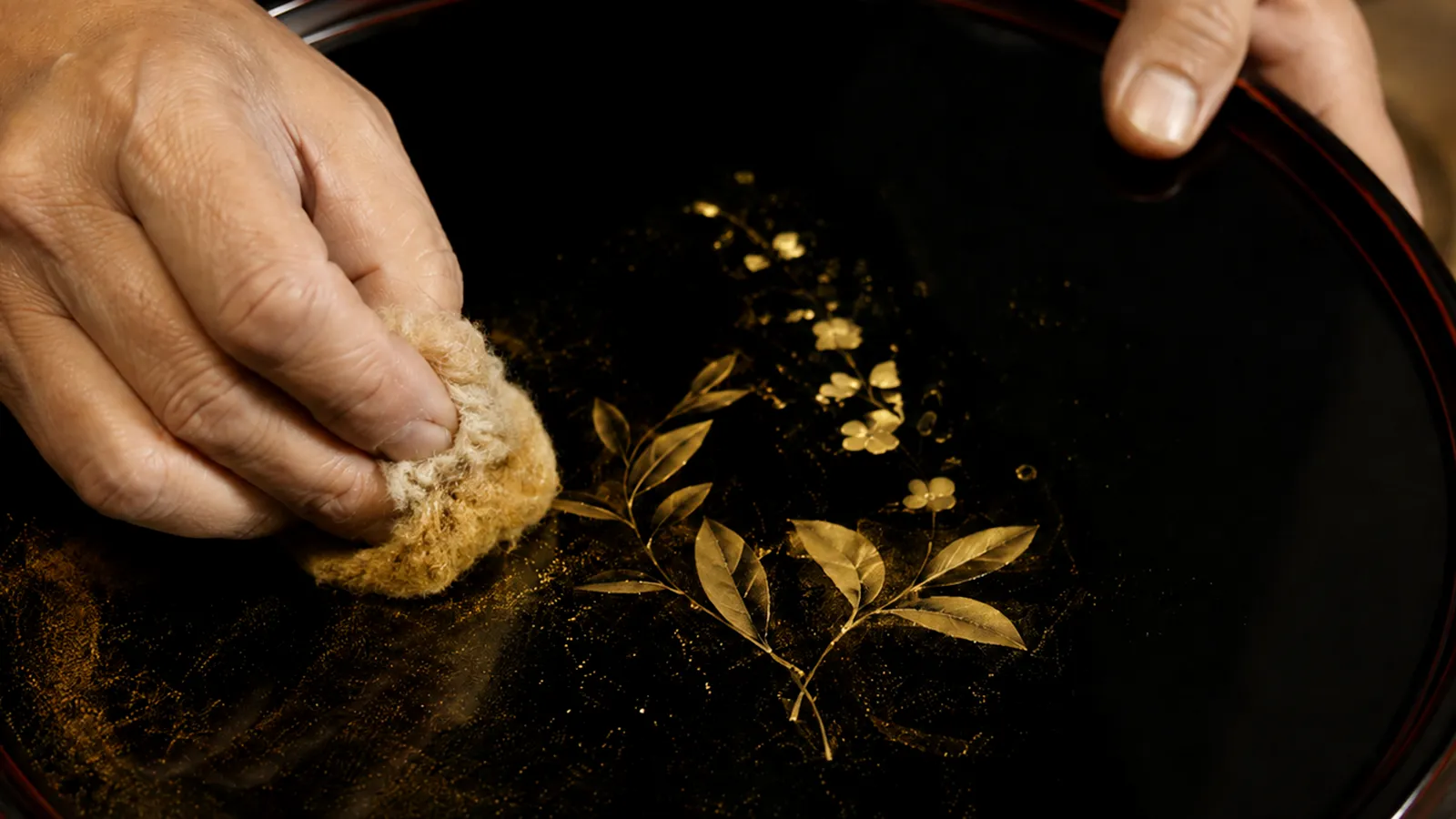

Chinkin is produced by incising a design into the lacquer ground, working lacquer into the grooves, and fixing gold powder or gold leaf into the recessed lines. The result is a surface where gold is, in a precise sense, embedded in carved channels — and this structure determines how the work behaves in a room. The angle of incident light changes the legibility of the gold lines; depending on the work and the lighting, the pattern reads differently from directly in front than from an oblique angle.
This quality suits spaces where guests move through rather than stay: entrances, corridors, lounge walls. As someone walks past a chinkin panel, their changing viewpoint draws out the surface’s variations in a way that a static position cannot.
The corollary is that chinkin loses much of its character in poorly planned lighting. If you are considering a chinkin installation, the type of light source (spot, diffuse, color temperature) and its placement relative to the surface need to be part of the design conversation from the beginning — not an afterthought.
Kinma: characteristics and spatial behavior
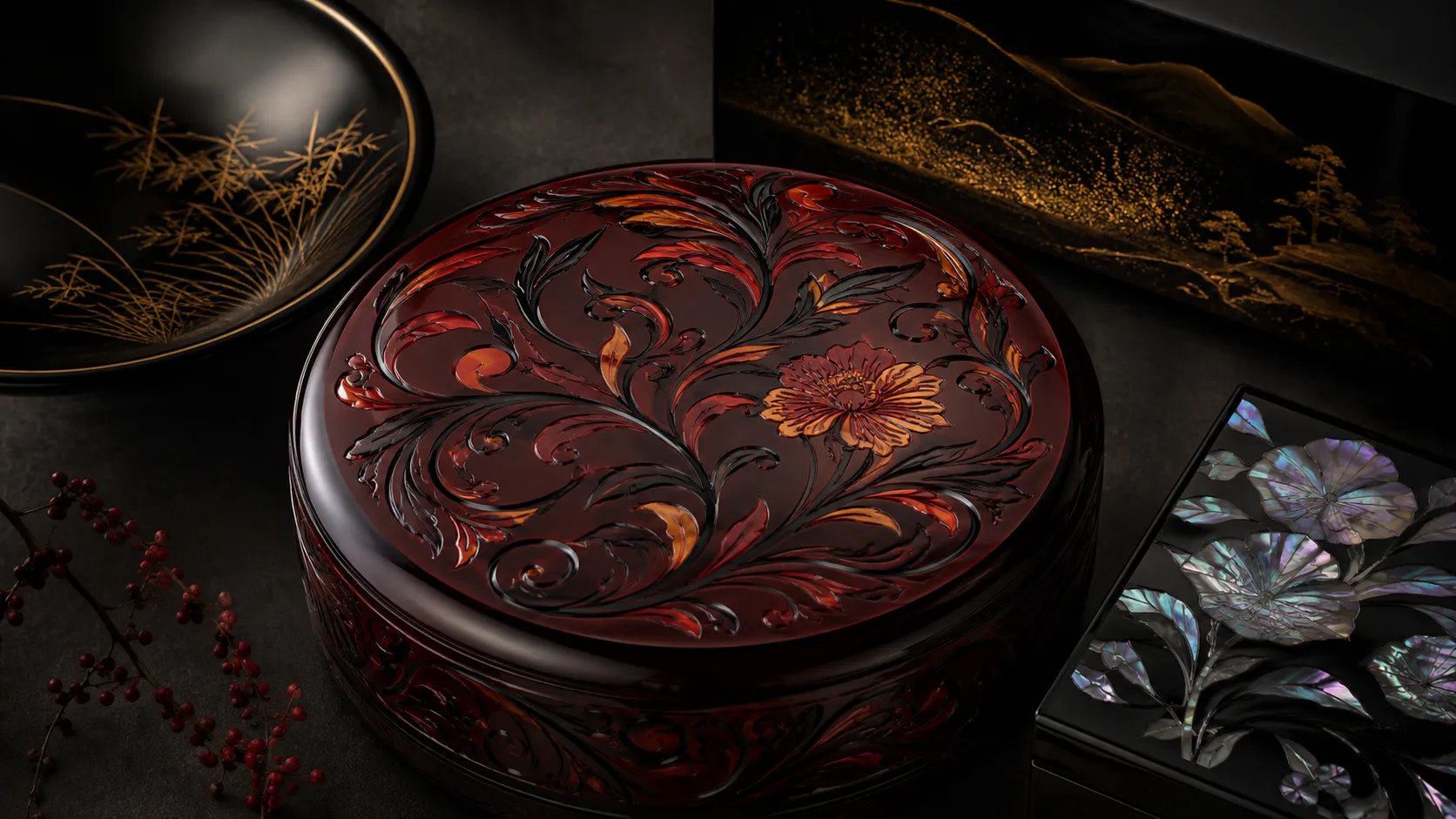

Kinma is produced by carving a design into the lacquer surface, packing colored lacquers into the grooves, and polishing the surface flat until the pattern is revealed. Unlike chinkin, it works with a broad palette — vermilion, black, green, yellow, and combinations of these — and its effect is primarily one of color field and pattern composition.
Where chinkin addresses the viewer through reflected light, kinma addresses through color and structural form. Depending on the palette and pattern design, it can sit comfortably in contemporary interiors without registering as period-specific.
In spaces where guests spend time in close proximity — guest rooms, private dining rooms, small meeting rooms — the layered color and depth of the carved surface in a kinma panel register as details that accumulate over the course of a stay rather than landing as an immediate impression.
Comparison: chinkin, kinma, maki-e, and choshitsu
The table below compares the major lacquerware techniques from the perspective of spatial application. Price ranges vary substantially depending on artist, scale, and sourcing route; the relevant factors are listed here as variables to clarify during the quoting process rather than as fixed figures.
| Technique | Visual character | Relationship to light | Color range | Legibility at distance | Close-range viewing | Suitable spaces | Key commissioning consideration | Maintenance items to confirm at commissioning |
|---|---|---|---|---|---|---|---|---|
| Chinkin | Gold lines embedded in incised channels; surface reads differently with changing light angle | Directional light brings out line definition | Primarily gold and silver | Unified, composed quality | Fineness of line work readable | Entrances, corridors, lounges, VIP spaces | Share lighting plan with the artist before fabrication begins | Care instructions for gold powder areas and lacquer surface; who to contact for restoration |
| Kinma | Colored lacquer inlaid into carved grooves, polished flat | Color and pattern read as a surface field regardless of angle | Broad (vermilion, black, green, and others) | Color composition carries well | Layered color and carved depth readable | Guest rooms, private dining, restaurants, contemporary interiors | Allow adequate lead time for color and pattern development discussions | Whether carved areas can be cleaned and how; how to handle dust accumulation in recesses |
| Maki-e | Gold powder and other materials applied to lacquer-drawn designs | Varies with materials used — gold powder, raden shell inlay, and others read differently | Gold, silver, raden (mother-of-pearl) combinations | Strong visual presence, high legibility | Density and precision of powder application readable | Formal or ceremonial spaces, private suites | Complex designs may extend production timelines significantly | Care instructions for gold powder areas; confirm cleaning protocol |
| Choshitsu (carved lacquer) | Thick-built lacquer layers carved in relief; pronounced three-dimensionality | Carving casts shadow and depth under raking or angled light | Monochrome or limited palette | Volume and sculptural presence read clearly | Sharpness of carving and depth readable | Furniture, room dividers, freestanding objects | Weight and wall-fixing method must be confirmed early | Cleaning protocol for dust and debris accumulation in carved areas |


Where in a hotel, ryokan, or retail space does a lacquerware panel work best?
Lacquerware panels tend to work well in spaces where lighting and viewing distance can be controlled: entrances, lounges, guest rooms, private dining rooms, and meeting spaces. The more useful planning question is not where to hang something but what kind of experience is possible at that location — and whether the work is designed for it.
Entrance and reception
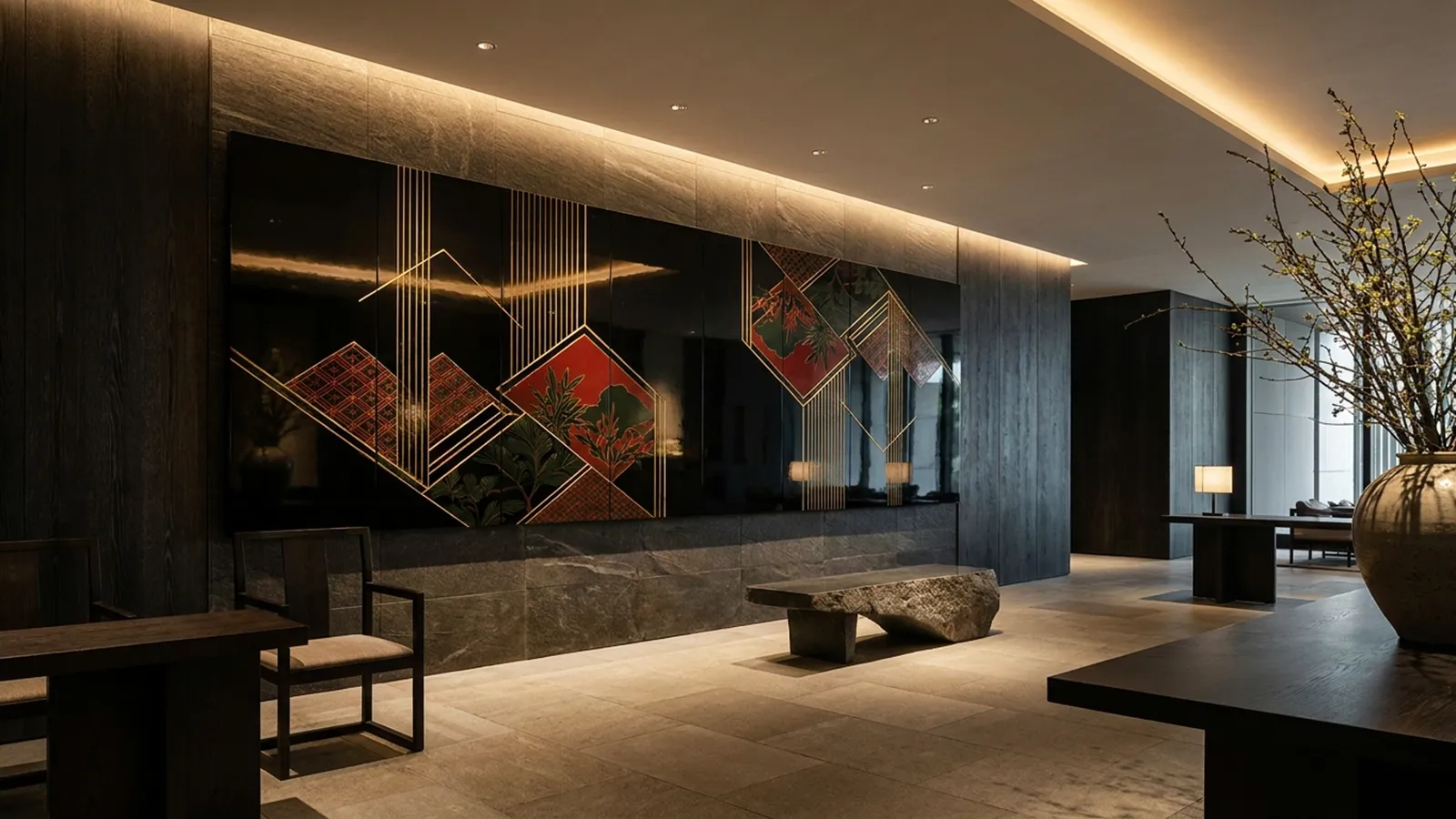
The entrance is one of the stronger locations for lacquerware, for a convergence of practical reasons: guests pause there, spot lighting is relatively easy to place, and the wall surface is often one of the few uninterrupted vertical planes in a building. It is also where a property’s material values make their first physical impression.
For large-format works, confirm the delivery route — elevator width, door height — and the fixing method before fabrication begins. Problems at the installation stage are almost always the result of information not being shared early enough between the artist or maker and the fit-out contractor. Integrating lighting design from the earliest stages of the space plan is strongly advisable.
Lounge, restaurant, and bar
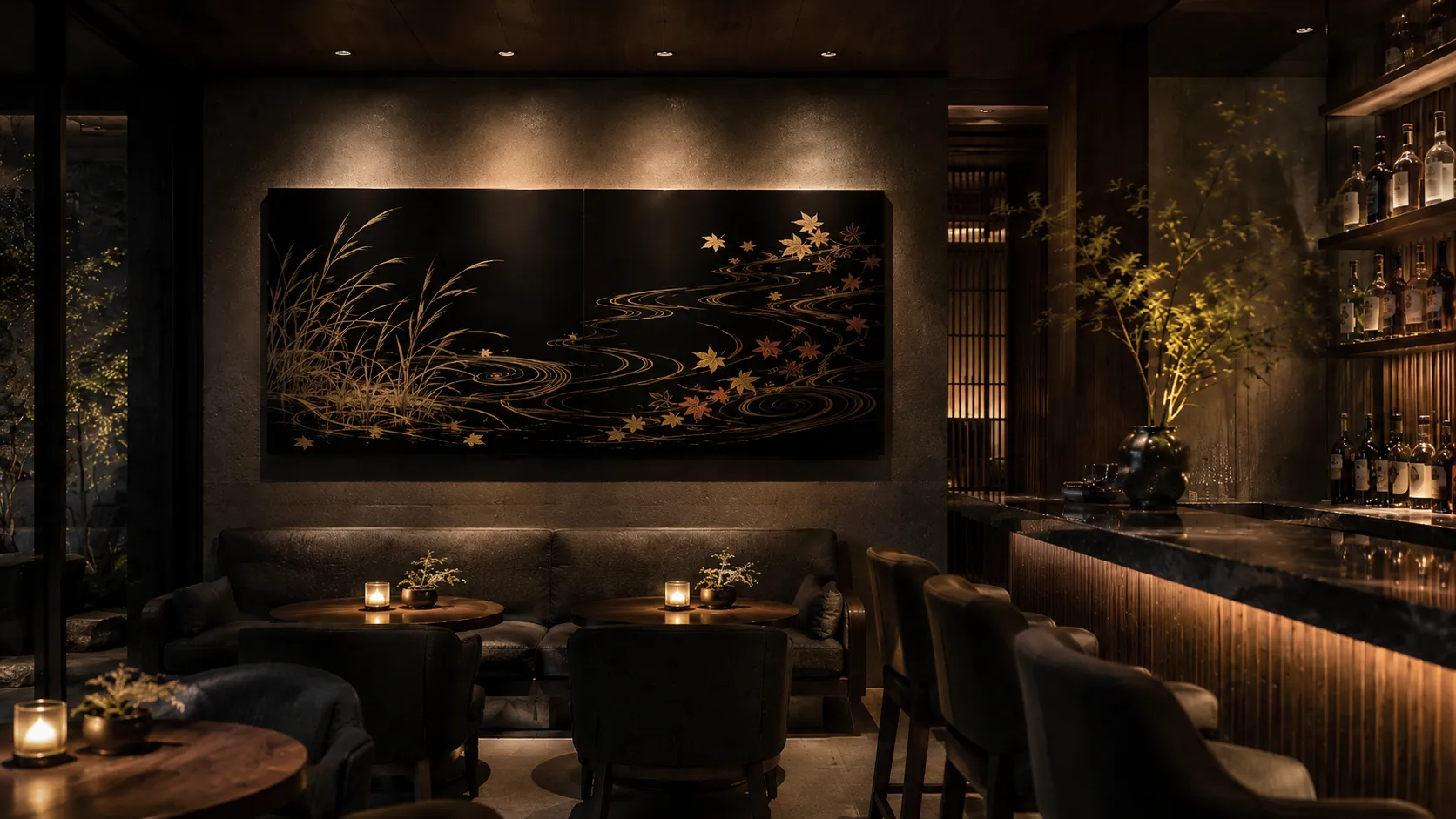
In spaces where guests stay for an extended period, material depth communicates gradually rather than immediately. A lacquerware panel on a restaurant wall does not need to announce itself — it rewards the guest who notices it over the course of a meal.
Food and beverage environments introduce specific considerations: cooking fumes, ambient humidity, and the heat output of some light sources can affect urushi surfaces over time. Confirm installation environment details with the artist or a specialist before proceeding. Placement within arm’s reach of guests also carries contact risk and should be factored into the positioning decision.
Guest rooms, private suites, and VIP rooms
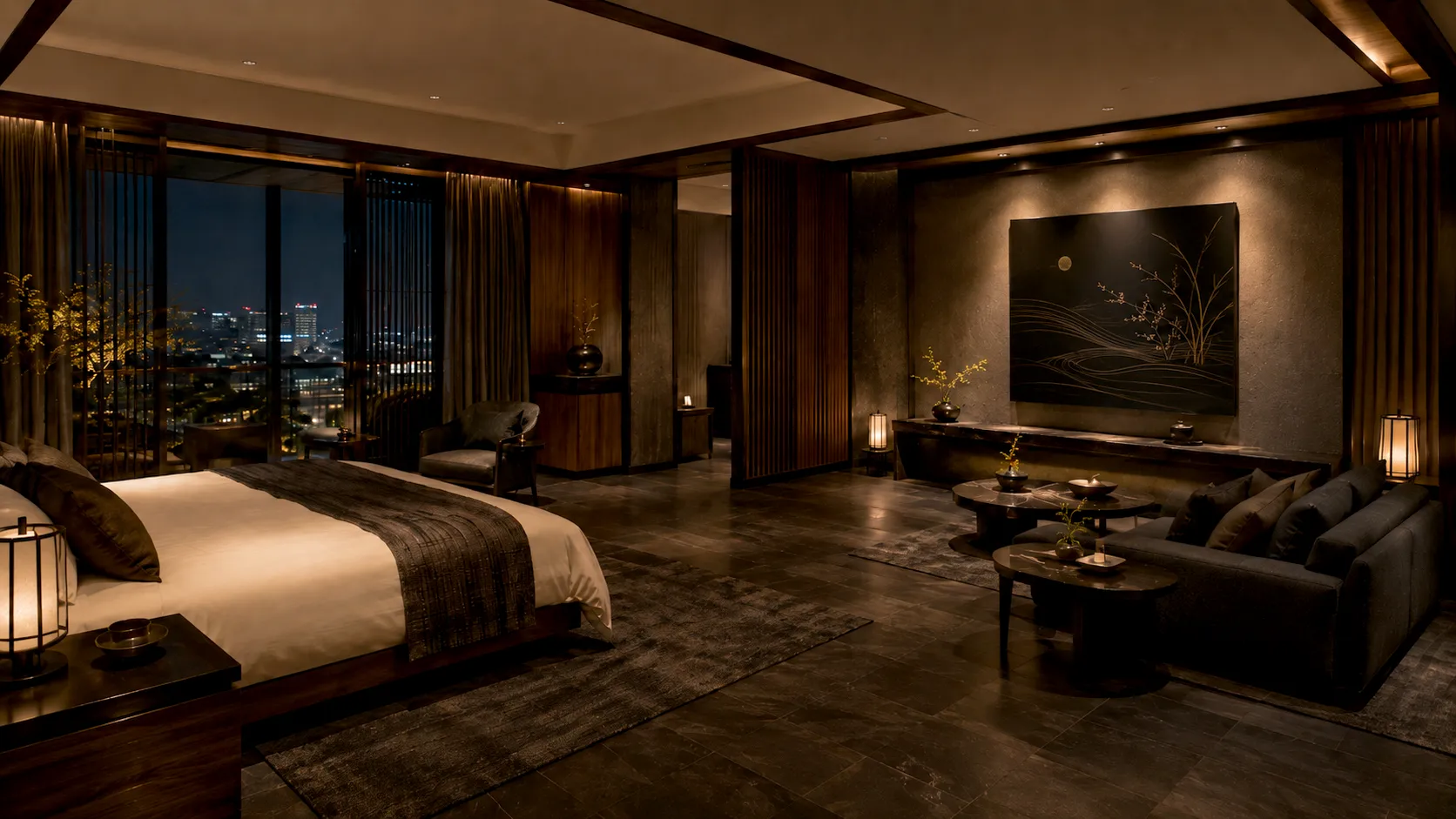
Guest rooms and private suites offer conditions that suit lacquerware well: close viewing distance, extended time in the space, and the ability to absorb detail that would be lost in a busier environment. The layered color of kinma and the line precision of chinkin both communicate things that only become apparent when a viewer is within a few feet of the surface.
A single original work in a guest room is not merely decorative — it gives that room individual character. A label or card providing the artist’s name, technique, and place of production can extend a guest’s engagement with the work beyond the stay itself.
Smaller and mid-scale works, as well as series commissions, are practical options here, and rolling out across multiple rooms in related compositions is a realistic scenario to plan for.
Offices, showrooms, and meeting spaces
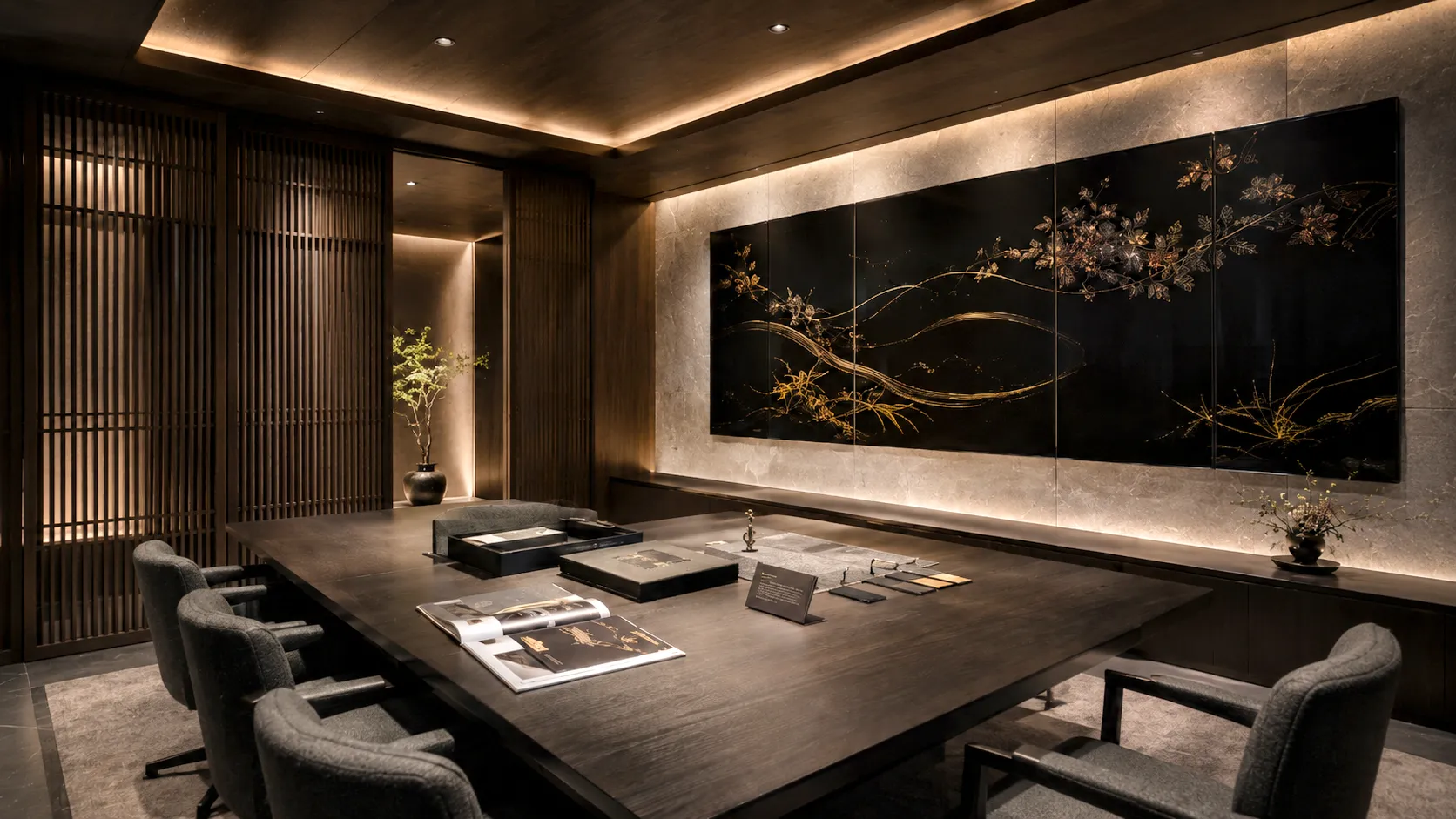
A lacquerware panel in a corporate meeting room or showroom can communicate a company’s relationship to material culture without requiring any verbal explanation — which matters particularly when receiving guests from overseas for whom Japanese craft materials carry a degree of immediate interest.
In this context, pairing the work with accessible information — a small card or booklet with the artist’s name, technique, and region — allows the object to serve as the opening of a conversation rather than a closed statement. Staff who can speak briefly to the work add another layer to that exchange.
Who should you contact, and in what order?
The main sourcing routes are: direct contact with an artist, approach through a regional workshop or craft association, and engagement through a gallery, specialist dealer, or craft coordinator. The right route depends on what is already decided and what isn’t. Knowing which category you are in before making contact makes the initial conversation more productive for everyone involved.
Working directly with an artist
Direct engagement suits buyers who have a specific artist in mind or who want to develop the concept collaboratively from the beginning.
That said, an artist’s technical mastery and their capacity to handle an architectural commission are separate things. Scale, deadline, contract structure, and site-coordination requirements are all variables that differ significantly from studio work. Aligning the buyer’s expectations for a site-responsive outcome with the artist’s working process is a conversation that needs to happen early.
Before making contact, prepare: photographs and drawings of the installation site, wall dimensions, a description of the lighting environment, a rough budget range, and a required delivery date. Having these ready allows the artist to respond with something concrete rather than a holding reply.
Working through a regional workshop or craft association
Approaching a production center — Wajima, Kagawa, and others — through their workshops or regional associations suits buyers who want to source by technique or region, or who want to compare multiple makers before committing.
At the time of writing, the details of which regional bodies have established processes for handling architectural or commercial commissions vary and should be confirmed directly. Contact the relevant association or guild through their official channels, or reach out through the Kogei Japonica inquiry desk for guidance.
Working through a gallery, specialist dealer, or coordinator
For B2B commissions, routing through a gallery, craft specialist, or coordinator is often the most practical approach. These intermediaries can handle not only artist selection but the full project scope: contract structure, shipping and installation arrangements, and post-installation support.
If the buyer’s team does not have in-house craft expertise and wants to manage this as a standard project procurement, this route typically runs most smoothly. Coordinator fees and management charges apply and should be built into the budget from the planning stage to avoid surprises later.
Consult Kogei Japonica
Kogei Japonica accepts inquiries at any stage of the process — including before the brief is defined. Whether you need help structuring the brief, identifying appropriate artists or regions, or understanding which route suits your project, the inquiry desk is available as a planning resource. Start wherever you are.


What conditions should be clarified before placing an order?
Before commissioning, the following need to be documented: installation location, dimensions, lighting, delivery route, budget, timeline, copyright, and maintenance provisions. Having this information organized in advance fundamentally changes the quality of the first conversation with an artist or coordinator — on both sides of the table.
Site and installation conditions
Begin with the basic physical parameters of the installation environment.
- Installation location (lobby, guest room, restaurant, office, etc.)
- Wall dimensions (width, height, available depth)
- Weight limits (wall structure and fixing method constraints)
- Delivery route (elevator width, door height, corridor turning radius)
- Lighting (type, position, color temperature, angle)
- Direct sunlight exposure (orientation, UV levels)
- Climate control (HVAC provision, seasonal variation range)
- Whether the piece will be within reach of guests (height, proximity to circulation)
- Cleaning protocol (frequency and method used by housekeeping staff)
As a natural material, urushi can be affected by extreme temperature or humidity fluctuation and sustained UV exposure over time. Documenting these conditions in writing before the production conversation begins is advisable.
Production conditions
Next, clarify the parameters that bear directly on what is being made.
- Dimensions (what proportion of the wall surface the work should occupy)
- Technique preference (chinkin, kinma, or other — or open to recommendation)
- Artist or workshop preference, if any
- Single work or multiple pieces (whether a series across several rooms is being considered)
- Required delivery date (working back from the construction handover date)
Timeline is consistently the most underestimated variable in lacquerware commissions. The curing of urushi depends on temperature and humidity conditions, and production time varies considerably with technique, scale, and the artist’s or workshop’s current schedule. For bespoke commissions, the lead time can be substantial. Begin the conversation as early in the project schedule as possible.
How to structure the budget
Quoting a single figure for a lacquerware panel commission is not meaningful — the range is too wide, depending on scale, technique, artist, and sourcing route. More usefully, the following cost categories should each be estimated separately.
- Fabrication cost (varies with technique, scale, and production time)
- Project management and coordination fees (if working through a coordinator)
- Shipping and handling (packaging, insurance, delivery method)
- Installation (fixing, protective measures, specialist labor if required)
- Insurance (coverage during transit and installation)
- Maintenance (restoration and cleaning provisions over time)
- Photography and communications rights (if separate licensing applies)
Projects that budget for fabrication alone frequently encounter unexpected costs at later stages. Plan across all categories from the start.
Copyright, ownership, and usage rights
Purchasing a lacquerware work transfers physical ownership, not copyright. This distinction matters and should be confirmed in writing before the contract is signed.
Copyright ordinarily remains with the artist unless explicitly transferred by separate agreement. Use of the work in hotel websites, social media, printed collateral, and advertising each represents a distinct use case that should be addressed in the contract. Note that Japanese copyright law does provide certain exemptions for the display of original works by their owners; the applicable scope should be confirmed with legal counsel at the time of contracting.
Items to confirm in writing:
- Copyright ownership and the scope of any license granted to the buyer
- Permission for use in the property website, social media, and print materials
- How the artist’s credit should be displayed (work title, artist name, technique)
- Any secondary uses — broadcast, advertising, press — requiring separate confirmation
Rental, temporary installation, and smaller-scale entry points
A bespoke commission does not have to be the first step. Renting an existing work, running a temporary exhibition, or introducing a single piece on a trial basis are all viable approaches. Testing compatibility between a work and a space before committing to fabrication is a reasonable process for both the buyer and the artist.
Using rental to test compatibility
Craft rental services allow you to place a work in the intended space before a purchase or commission decision is made. Short-term hotel and retail installations, seasonal or event-based displays, and pre-commission evaluation are all uses this model supports. It reduces the risk on both sides and creates a basis for a more informed subsequent decision.
Existing works versus bespoke commissions
| Factor | Existing work (purchase or rental) | Bespoke commission |
|---|---|---|
| Lead time | Potentially shorter (subject to availability) | Can be substantial (varies with scope and schedule) |
| Budget | Easier to plan around | Requires separate budgeting for fabrication and associated costs |
| Fit with the space | Limited by available dimensions and aesthetic | Can be developed for the specific site and brief |
| Artist relationship | Acquiring an existing body of work | Conceptual development possible with the artist |
| Communications and brand value | Limited | Can be presented as a commissioned work, with associated PR potential |
Developing an artist collaboration
A spatial installation can also be the starting point for a broader working relationship with an artist. From an initial temporary display, it is possible to develop pieces produced for specific spaces or seasons, staff-oriented craft talks, and corporate gift programs — a layered engagement that builds something a one-off purchase cannot.
For collaboration and project inquiries, contact Kogei Japonica through the inquiry desk.
Pre-commissioning checklist
The following checklist is structured for use in internal approvals or briefing sessions with designers and contractors.
Site and installation
- Is the installation location (room and wall position) confirmed?
- Have wall dimensions (width × height) been measured on site?
- Have weight limits and wall structure been verified?
- Has the delivery route (elevator width, door height, corridor constraints) been checked?
- Is lighting (type, position, color temperature) incorporated into the design?
- Has direct sunlight and UV exposure been assessed?
- Has climate control (HVAC provision, seasonal variation) been documented?
- Has the risk of guest contact been considered in the placement decision?
- Has a cleaning protocol been established and confirmed with housekeeping?
Work and artist
- Has a technique preference (chinkin, kinma, other, or open) been decided?
- Has a preference for a specific artist or workshop been determined?
- Has the decision been made between a single work and a series?
- Has a decision been made on whether and how to display artist credit?
- Has the artist’s or workshop’s capacity to handle an architectural commission been confirmed?
Contract and operations
- Has the budget been broken down into fabrication, shipping, installation, insurance, maintenance, and coordination?
- Has a production start date been set, working back from the handover date?
- Has copyright ownership and the scope of any usage license been confirmed?
- Has permission for use in digital and print communications been confirmed?
- Has a maintenance and restoration contact been identified?
- Have care instructions been prepared for housekeeping staff?
Frequently asked questions
- Can lacquerware panels be used for wall decoration in hotels and retail spaces?
- Yes, provided the installation environment (lighting, climate, delivery route) and commissioning conditions (dimensions, timeline, budget) are clearly defined and shared with an artist, workshop, or coordinator. Begin by organizing those conditions.
- How do you choose between chinkin and kinma for a commercial interior?
- Chinkin works well where directional lighting can be planned in advance — entrances and lounges where the surface’s response to light is part of the design. Kinma offers a broader color palette and, depending on the pattern and palette chosen, can integrate into contemporary interiors without reading as period-specific. Lighting conditions and viewing distance are the primary variables in both cases.
- Who do you contact to commission a lacquerware panel?
- There are three main routes: directly with an artist, through a regional workshop or craft association, or through a gallery, specialist dealer, or coordinator. If you are not sure where to start, the Kogei Japonica inquiry desk can assist with orientation at any stage of the process.
- How should budget be approached?
- Fabrication cost varies considerably with technique, scale, artist, and sourcing route. In addition to fabrication, budget separately for shipping, installation, insurance, maintenance, coordination fees, and any photography or communications licensing. Budgeting for fabrication alone is a common source of later cost overruns.
- How much lead time is required?
- This depends on technique, scale, and the artist’s or workshop’s current capacity. Bespoke commissions can require substantial lead time. Begin discussions as early in the project schedule as possible, working back from the required installation date.
- Can large-format wall works be produced?
- Whether a large-format commission is feasible depends on the artist, technique, ground material, and delivery conditions. If scale is a defining requirement, confirm feasibility early in the process.
- Is maintenance and restoration possible after installation?
- Urushi surfaces can, in many cases, be addressed through professional restoration as they age. The conditions for this vary by artist and workshop. Confirm who to contact for maintenance and restoration at the time of commissioning.
- Is it possible to trial a work through rental before purchasing?
- Craft rental services allow for temporary installation before a purchase or commission decision is made. Contact the Kogei Japonica inquiry desk for details.
- Should artist credit and a work description be displayed alongside the piece?
- This is generally advisable. Providing the artist’s name, technique, and place of production gives guests a point of reference and can sustain engagement beyond the immediate encounter. Confirm the display format with the artist in advance.
- Can inquiries be made from hotels or restaurants outside Japan?
- Initial inquiries from overseas properties are accepted. The appropriate response will depend on the scope and specifics of the project. Contact the Kogei Japonica inquiry desk to begin.
Commissioning lacquerware panels and craft works: where to start
If the spatial brief and project conditions are reasonably defined, a conversation about lacquerware panels, craft rental, or an artist collaboration can move forward quickly. If nothing is fixed yet, that is also a workable starting point — the brief can be developed as part of the process.
Spatial design consultations for hotels, ryokan, retail, and offices
Hotel, ryokan, restaurant, retail, and office teams considering lacquerware panel installations are welcome to contact the Kogei Japonica spatial design inquiry desk. Having site photographs, drawings, a sense of the brief, a budget range, and a target timeline ready will allow the initial conversation to move more quickly — but none of these needs to be finalized before making contact.
Inquire about craft installation for hospitality and commercial spaces
If you have site photographs, drawings, a project brief, budget range, and target timeline, the initial consultation can move into specifics immediately. If none of these are fixed, the process of defining them can be part of the conversation.
Craft rental and temporary installation
For teams who want to assess how a work sits in a space before committing to a purchase or commission, or who are planning a short-term or event-based display, rental and temporary installation options are available through Kogei Japonica.

Artist and workshop collaborations
Bespoke commissions for corporate and hospitality clients, branded gift programs, PR-linked production projects, and artist participation in events can all be developed through Kogei Japonica. Inquiries are accepted through the contact desk.
For artists and workshops
Artists and workshops with the capacity to take on spatial and architectural commissions are welcome to inquire about listing with Kogei Japonica and being included in B2B project matching. The inquiry desk accepts both listing and collaboration inquiries.
Summary
Commissioning chinkin or kinma for a space is not a matter of selecting a technique and placing an order. It starts with prior questions: what will the lighting illuminate, where will a guest pause, at what distance and for how long will they be in the presence of the surface. A commission that begins from those questions gives both the work and the space what they need.
There is no single correct sourcing route — the right path depends on budget, timeline, and how much is already defined. What matters is beginning with an honest account of what is not yet decided. Lacquerware takes time to make. Whether the artist and the buyer can use that time in a relationship of mutual trust is what determines the quality of what ends up on the wall.
If this guide helps one more lacquerware work find a space where it genuinely belongs, it has done its job.


