




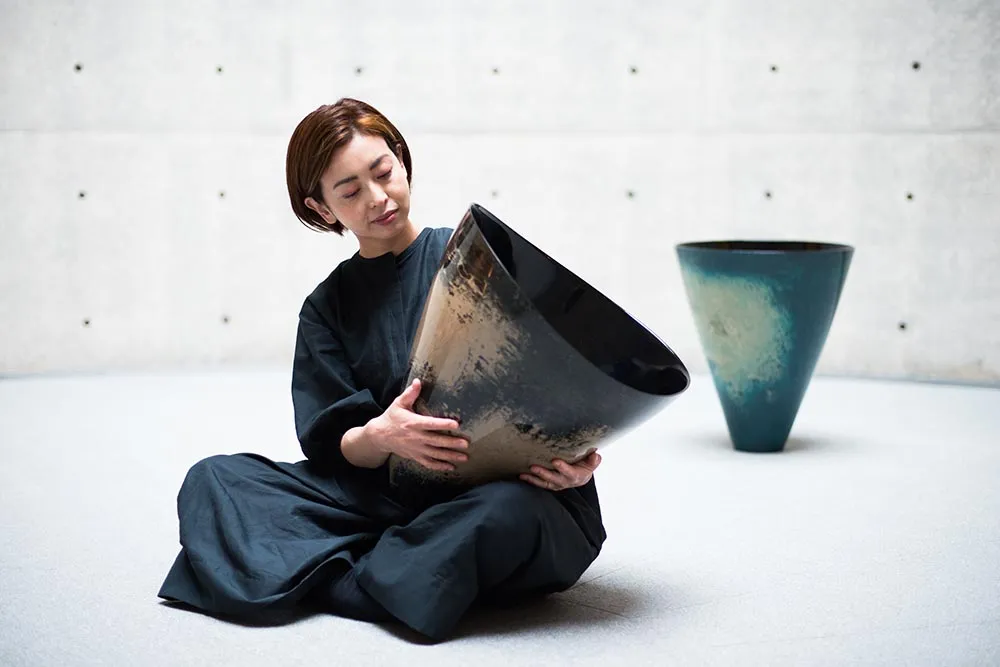
In 2026, work by Mayu Nakata is on view in Venice.
Nakata is taking part in an exhibition titled “Ethnography of the Body and Material — Slowness and Depth in an Accelerated Society”, held to coincide with the 61st International Art Exhibition of La Biennale di Venezia. It is a separate project from the Biennale itself, staged in Venice during the same period, and it reconsiders contemporary craft through material, the body and time.
Nakata is a lacquer artist whose practice centres on kinma, a technique in which a lacquered surface is carved, the incisions filled with iro-urushi (pigmented urushi), and the whole surface then polished back. In her work, roughly forty layers of pigmented urushi — and the months or even year of making that they require — are bound up with the expression itself.
This article sets out Mayu Nakata’s background and technique, what to look for in the work, and the 2026 Venice showing, drawing on primary sources throughout.
Table of Contents
Who Is Mayu Nakata? From Kagawa Lacquer Training to International Recognition

Mayu Nakata trained in lacquer at the Kagawa Prefectural Institute of Lacquer Arts and continues to work with kinma as her principal technique. She is a full member of the Japan Kogei Association, and in 2019 she was selected as a finalist for the LOEWE FOUNDATION Craft Prize with “Flame”.
(Source: Mayu Nakata, Works | Japan Kogei Association)
(Source: Craft Prize 2019 Finalists | LOEWE FOUNDATION)
Biography | From Hokkaido to Kagawa, and on to Kanazawa

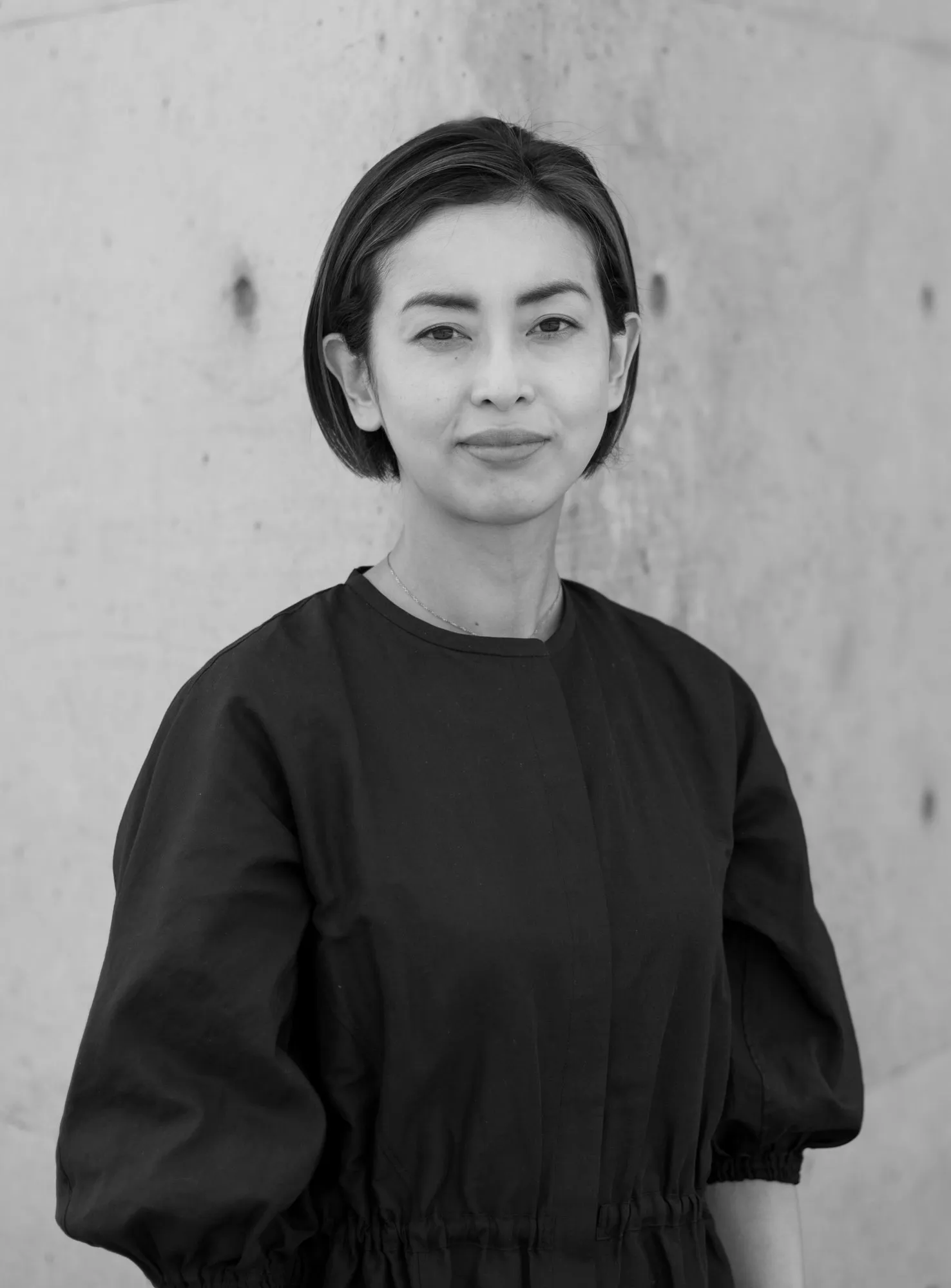
Nakata was born in Hokkaido in 1982. She graduated from the Faculty of Fisheries Sciences at Hokkaido University in 2005 before turning to lacquer art. She completed her training at the Kagawa Prefectural Institute of Lacquer Arts in 2017 and entered Kanazawa Utatsuyama Kogei Kobo in 2018. The current profile published by A Lighthouse called Kanata states that she completed her time at the workshop in 2021.
What can be confirmed is that she studied fisheries science at university and then turned to lacquer. Her own reasons for that change, however, are not something the primary sources consulted here set out. Rather than infer a motive from the chronology, we would prefer to put the question to her directly should the opportunity for an interview arise.
Within the Japan Kogei Association she is a full member in the lacquer division, affiliated with the Ishikawa branch and its lacquer section. Works including “Kanshitsu Kinma Water Jar: Thunderclouds”, “Kinma Bowl: Wind and Sea” and “Rising Clouds” show a sustained body of work built around kinma.
(Source: Mayu Nakata, Works | Japan Kogei Association)
Awards and Recognition (With Sources Noted)
One thing worth noting about Nakata’s career is that recognition has come from two directions: domestic juried exhibitions and an international craft prize.
Official records held by the Japan Kogei Association list Encouragement Prizes at the 58th Shikoku Traditional Kogei Exhibition in 2015 and the 59th in 2016. In 2019 she received the 60th Anniversary Meitetsu M’za President’s Prize, a department-store award, at the 60th Ishikawa Traditional Kogei Exhibition, and in 2025 an Encouragement Prize at the 65th edition of the same exhibition.
(Source: Mayu Nakata, Awards and Works | Japan Kogei Association)
The official profile published by Kanazawa Utatsuyama Kogei Kobo also records the Ohi Toyasai Jury Special Prize at the 4th Kanazawa World Craft Triennale, “Crafts Crossing Borders”, in 2019.
(Source: Mayu Nakata, Artist Profile | Kanazawa Utatsuyama Kogei Kobo)

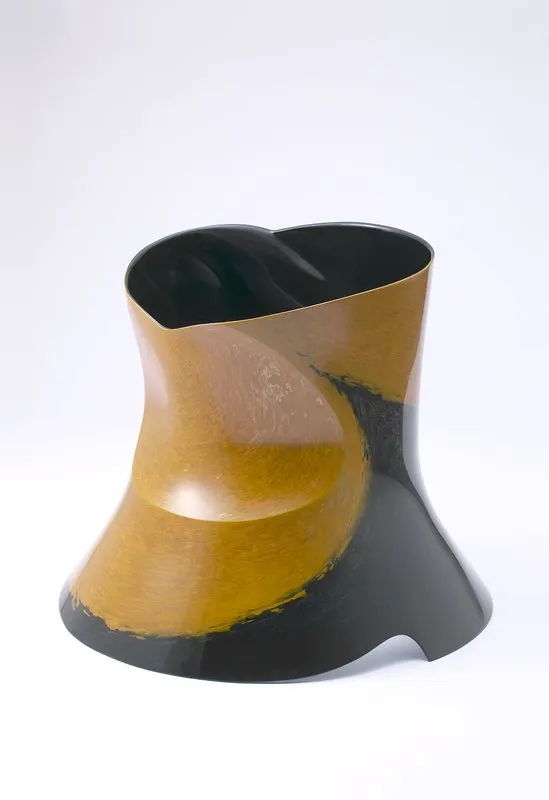
Then, in 2019, she was named a finalist for the LOEWE FOUNDATION Craft Prize with “Flame”. The foundation’s own introduction to her work notes that by carving more deeply than kinma conventionally requires, she produces a more complex surface.
(Source: Mayu Nakata / Flame | LOEWE FOUNDATION Craft Prize 2019)

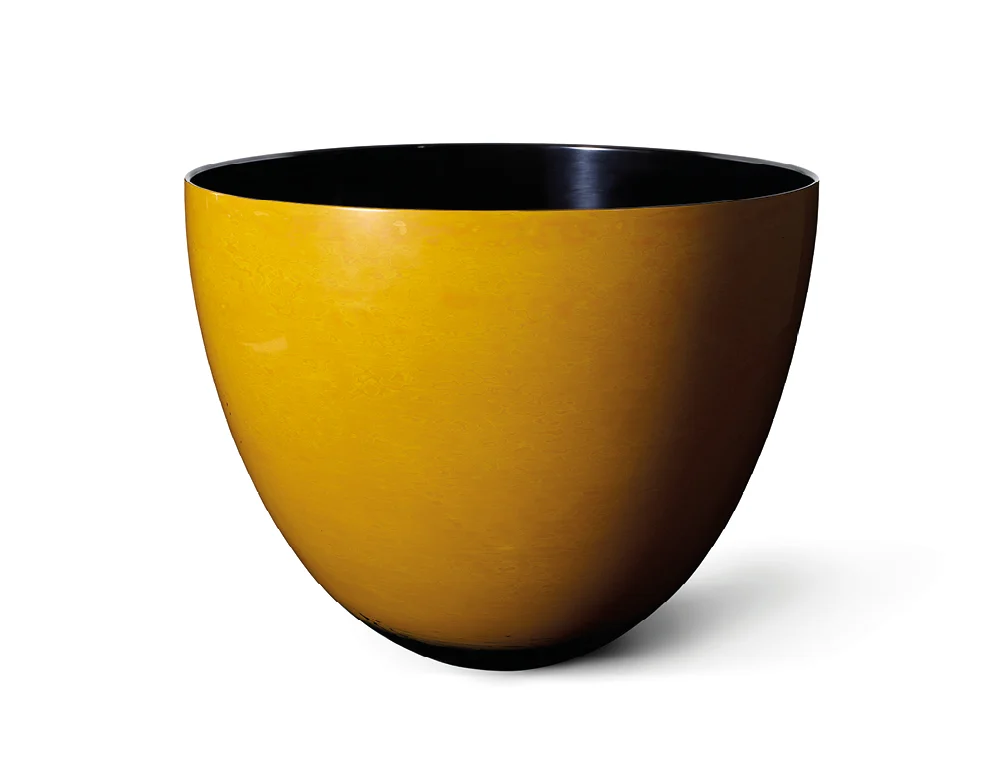
LOEWE FOUNDATION Craft Prize 2019 | LOEWE official
The point here is not to conclude that the work has value because it reached an international shortlist. She has continued to develop her technique while exhibiting in domestic juried shows, and her work has also been presented within an international craft context. Seeing both together gives a clearer sense of the territory she moves across in her practice.
What Is Kinma? A Technique in Which Layered Lacquer and Polishing Make Time Visible
Kinma is a lacquer technique in which a design is carved into a surface built up from repeated coats of lacquer, the incisions are filled with pigmented urushi, and the surface is finally polished to bring the design out. To understand Mayu Nakata’s work, you need to know that the sequence of layering, carving, filling and polishing sits beneath the finished pattern, not only the pattern itself.
Definition | What Kinma Is
Kinma
A decorative technique in which lacquer is built up in repeated coats on a form made of bamboo, wood or kanshitsu (dry lacquer), a design is cut into it with a specialised carving blade, the incisions are filled with pigmented urushi, and the surface is then polished flat so that the design appears.
The Kagawa Prefectural Institute of Lacquer Arts explains that tenshitsu, an inlaid-lacquer technique from southern China, travelled to Thailand and Myanmar and reached Japan around the end of the Muromachi period. In Kagawa it developed through the work of Tamakaji Zokoku and others, and it is now one of the techniques most closely associated with Kagawa lacquer.
Nakata does not simply carry the technique forward. By carving more deeply, she increases the number of pigmented urushi layers that can sit within the incisions. Her own website explains that carving deeper than conventional kinma, and introducing more layers of colour, is what produces the complexity of her patterns.
(Source: NAKATA Mayu Official)
The official commentary published by GO FOR KOGEI in Venice is more specific still. In Nakata’s work, around forty layers of pigmented urushi are built up within a total thickness of roughly 0.5 mm. A single piece takes at least four months to make, and in some cases close to a year.
(Source: Mayu Nakata | GO FOR KOGEI in Venice)
Half a millimetre, taken on its own, is a very thin layer. Within it, though, some forty layers of colour exist. This is where the essential character of Nakata’s work lies.
The colour is not painted on in a single pass. It is applied, left to cure, carved, made to receive another colour, and finally polished. As a result, only part of what lies beneath comes to the surface.
In Nakata’s work, polishing is not merely a finishing stage but an act of forming, selecting which of the accumulated layers come to the surface. Seen that way, the pattern on the surface can be read not just as a design but as a cross-section through the layers of lacquer.


The article above sets out the kinma process in detail, along with how it differs from chinkin, maki-e and raden.
Technique Comparison | Kinma, Chinkin, Zonsei and Kanshitsu
To place Nakata’s technique in context, the table below sets kinma alongside chinkin, zonsei and kanshitsu, three techniques often discussed in relation to it. The final column is not a ranking of the techniques; it indicates what to look for when viewing work, in the terms this article uses.
| Technique | Key steps | Where it is typically seen | What to look for here |
|---|---|---|---|
| Kinma | The lacquered surface is carved, the incisions filled with pigmented urushi, and the surface polished back | One of the techniques most associated with Kagawa lacquer | How the depth of carving and the layers of colour come through in the final pattern |
| Chinkin | Lines and dots are carved into the lacquered surface and filled with gold or silver leaf or powder | Known from Wajima lacquerware, among others | How the carved lines and dots, and the metal powder or leaf within them, catch the light |
| Zonsei | A design is painted in pigmented urushi, outlines and details are then carved, and in the most typical method gold powder or leaf is set into the incisions | One of the three Kagawa techniques | The relationship between the painted colour and the carved outline |
| Kanshitsu | Methods include building up a body by layering hemp cloth with lacquer | Three-dimensional work, vessel bodies, Buddhist sculpture | The form itself, made from cloth and lacquer rather than a wooden core |
Looking at Nakata’s titles in the Japan Kogei Association records, several works name both techniques together — “Kanshitsu Kinma Water Jar: Thunderclouds”, “Kanshitsu Kinma Serving Vessel: Mist”.
In other words, the technique that establishes the form and the technique that makes its surface need to be read as one.
It would not be right to conclude that forty layers make a work superior. The labour and time that go into a piece of craft are not, on their own, a measure of its value.
In Nakata’s case, though, GO FOR KOGEI explains that the memories and impressions that shift during the making are themselves taken into the work.
In that sense, the long making time is not simply a burden on production but bears on the content of the work itself.
Is the Venice Showing Part of the Biennale Itself? Reading the Primary Sources

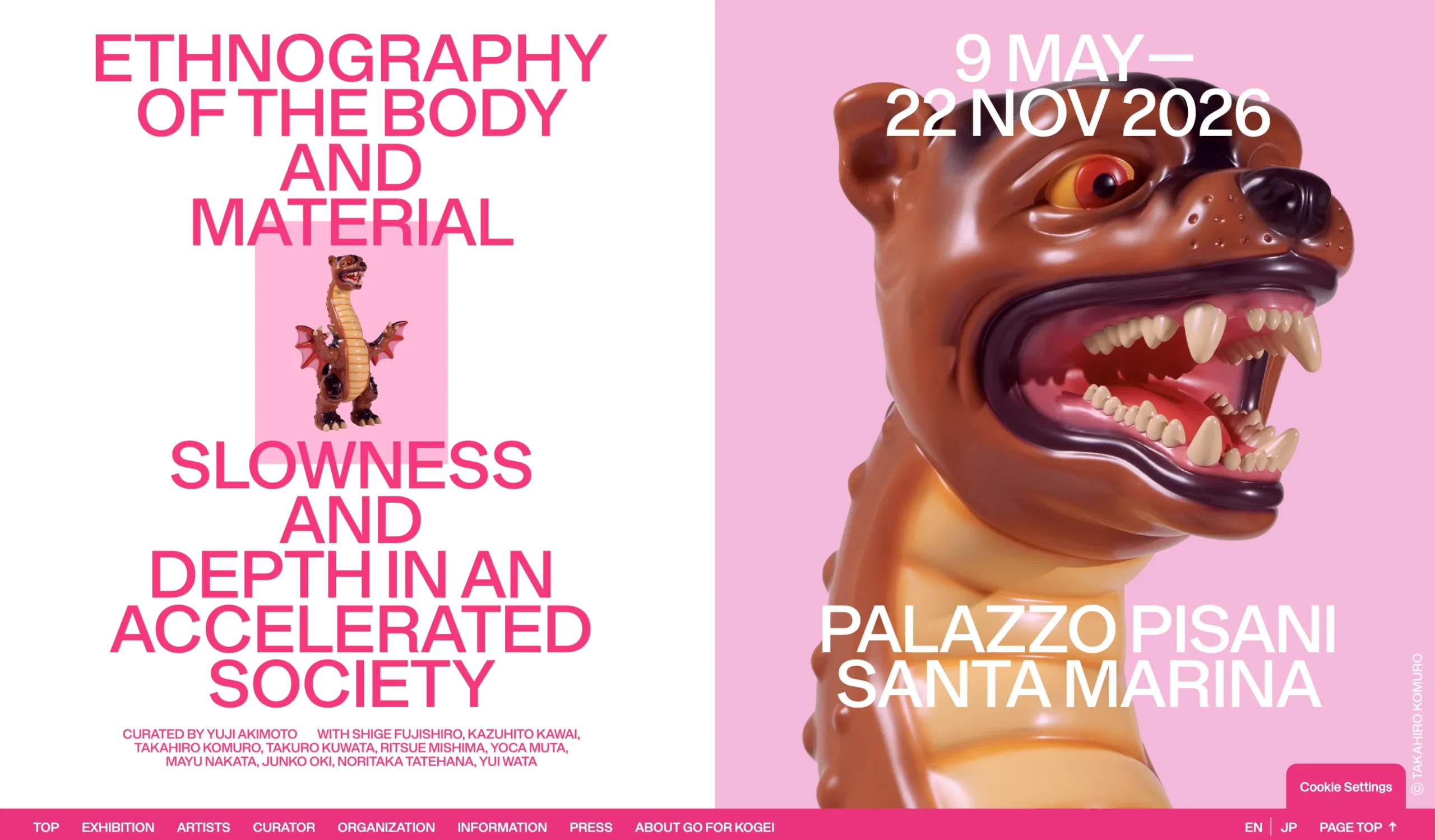
As noted at the outset, “Ethnography of the Body and Material”, in which Mayu Nakata is taking part, is a separate project from the Biennale’s main exhibition. This section sets out its position more precisely, from the primary sources.
The exhibition is neither a Japan Pavilion presentation nor a Collateral Event officially recognised as such by La Biennale di Venezia. It is an independent exhibition organised by the certified NPO Shuto Kanazawa, held in Venice during the same period as the 61st International Art Exhibition of La Biennale di Venezia.
For 2026, La Biennale di Venezia has announced 100 National Participations and 31 Collateral Events as its official programme. “Ethnography of the Body and Material” does not appear on those lists. GO FOR KOGEI, for its part, describes the exhibition as running concurrently with the 61st International Art Exhibition, using the phrase “Presented in parallel with”.
(Source: National Participations and Collateral Events of the Biennale Arte 2026 | La Biennale di Venezia)
(Source: Ethnography of the Body and Material | GO FOR KOGEI)
Exhibition Outline | “Ethnography of the Body and Material — Slowness and Depth in an Accelerated Society”
The exhibition in which Nakata is taking part is titled “Ethnography of the Body and Material — Slowness and Depth in an Accelerated Society”. In Japanese it is given as “Shintai to Busshitsu no Ethnography — Kasoku Shakai ni okeru Ososa to Fukasa”.
It runs from 9 May to 22 November 2026, closed on Tuesdays. The venue is Palazzo Pisani Santa Marina in Venice.
Opening hours announced by the organisers are 11.00 to 19.00 until 30 September, and 10.00 to 18.00 from 1 October to 22 November.
The curator is Yuji Akimoto, artistic director of GO FOR KOGEI.
The participating artists are Shige Fujishiro, Yujin Kawai, Takahiro Komuro, Takuro Kuwata, Ritsue Mishima, Yoka Muta, Mayu Nakata, Junko Oki, Noritaka Tatehana and Yui Wata — ten in all.
The exhibition is not simply a presentation of Japanese craft.
Rather than treating craft as a self-contained discipline, the organisers position it as a way of rereading contemporary art itself, through deep engagement with material, embodied knowledge and repeated manual work.
Against a society that prizes speed and immediacy, it offers the different sense of time held by material and the body. That is the background to the subtitle, “Slowness and Depth in an Accelerated Society”.
(Source: Ethnography of the Body and Material — Slowness and Depth in an Accelerated Society | GO FOR KOGEI)
What “Taking Part” Actually Means Here
What it means for work to be shown in Venice becomes clearer when you look past the word “Biennale” to the context in which the work has been selected.
During the run of the Biennale’s main exhibition, Venice hosts a great many shows: official National Participations including the Japan Pavilion, official Collateral Events, and alongside them exhibitions mounted by museums, foundations, galleries and cultural organisations.
So beyond the fact that a work is on view in Venice, looking at the organiser, the curator and the theme shows you the standpoint from which the work is being presented.
The exhibition Mayu Nakata is taking part in is an independent project, distinct from the Japan Pavilion and from the Biennale’s official Collateral Events.
At the same time, the fact that her lacquer work is presented under Yuji Akimoto’s curation alongside questions of material, the body and time is an important point in understanding the exhibition.
Building up around forty layers of pigmented urushi, carving and polishing over a long span of time, Nakata’s practice connects readily with the exhibition’s overarching theme of slowness and depth in an accelerated society.
Looking not only at which institutional category a show falls into, but at why this artist’s work has been chosen for this place, gives a fuller understanding of the relationship between the exhibition and the work.
For reference, at the 61st International Art Exhibition of La Biennale di Venezia in 2026, Japan’s official National Participation is commissioned by the Japan Foundation, with “Grass Babies, Moon Babies” by Ei Arakawa-Nash presented in the Japan Pavilion. It and the GO FOR KOGEI exhibition are organised separately, within different frameworks.
(Source: Japan — Grass Babies, Moon Babies | La Biennale di Venezia)
Works on Show | “Soundscape” and “Mirage”
As to which of Nakata’s works are on show in Venice, the information published by the organisers differs between sources, and the published record is therefore not fully consistent.
In the installation views released by the certified NPO Shuto Kanazawa when the exhibition opened, “Soundscape” (2024) and “Mirage” (2026) are given as her works on display.
The GO FOR KOGEI in Venice website, as it stands in September 2026, instead lists “Mirage” (2026) and “Thunderclouds” (2021) as on exhibit.
(Source: Mayu Nakata / Works | GO FOR KOGEI in Venice)

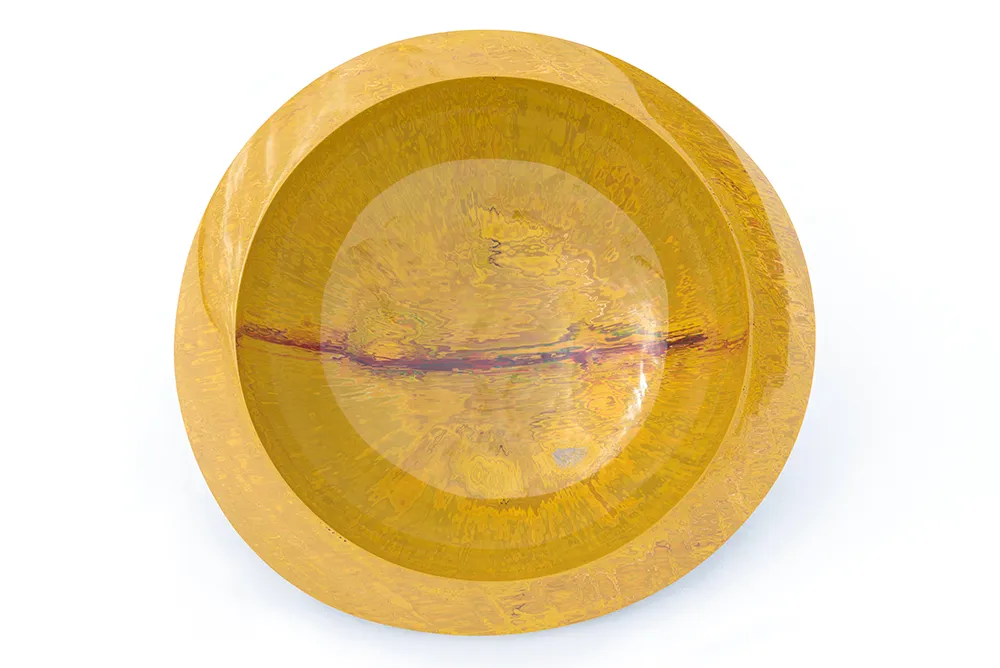

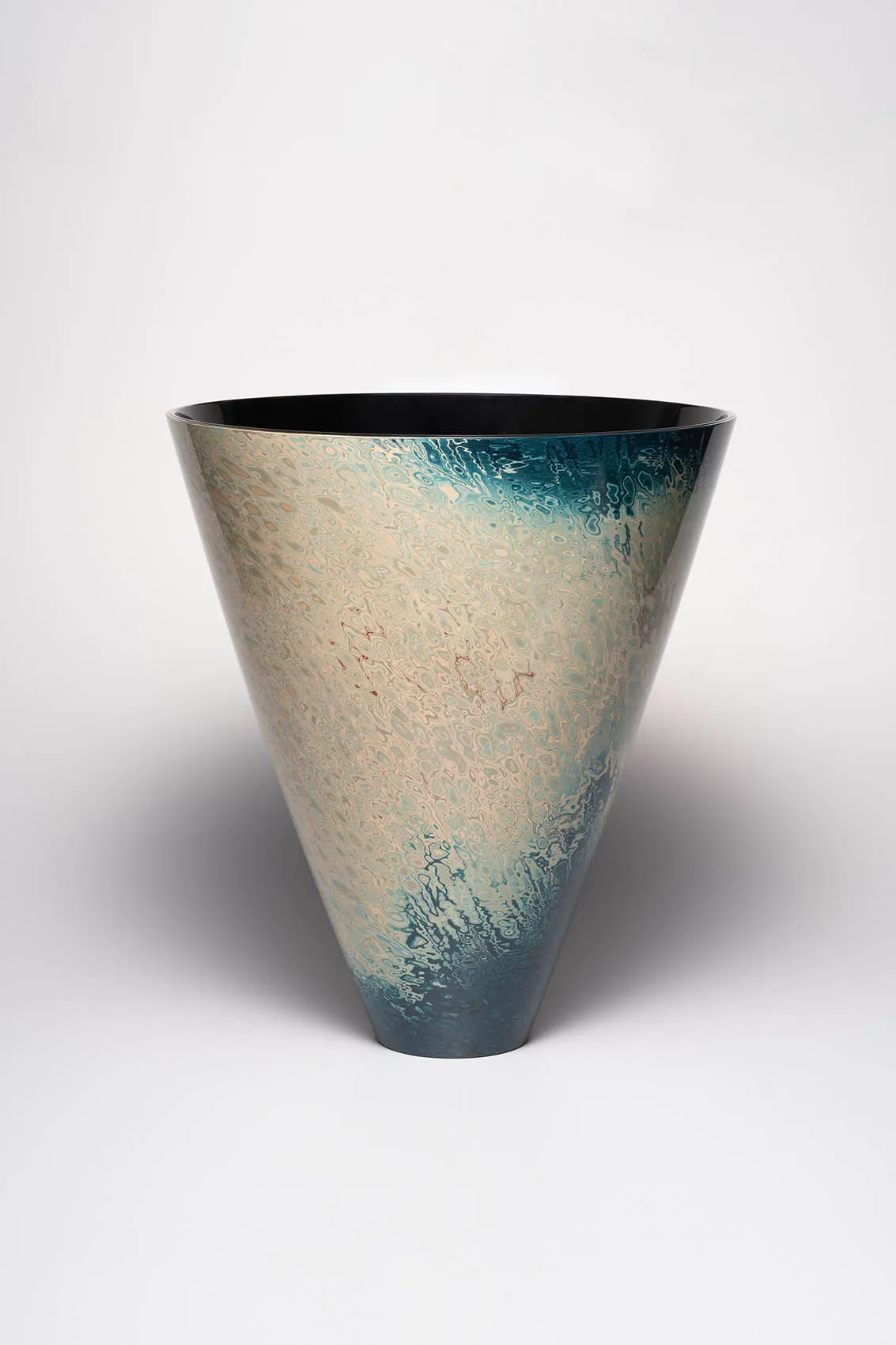
What to keep in mind when looking at “Mirage” is not only the finished pattern.
GO FOR KOGEI explains that Nakata’s work renders as layers of colour the memories left by actual experience — lightning, clouds, birds in flight. It also notes that the daily shifts across a making period of at least four months, and sometimes close to a year, enter the work, so that the original memory itself begins to waver.
(Source: Mayu Nakata | GO FOR KOGEI in Venice)
Here you can see why her work connects with the exhibition’s theme of slowness and depth.
Building around forty layers means forty layers’ worth of process, and the time that passes in between.
Over that span, the memory of a cloud first seen, and the artist’s own sense of it, can both change. Time in Nakata’s work means not simply that a piece took a long while to make, but the span of continuing to work while the memory itself shifts.
Where Can You See Mayu Nakata’s Work, and How Should You Look at It?
Rather than judging Nakata’s work solely on technical grounds — how fine the carving is, how even the finish — it becomes easier to grasp what is particular to her by taking the layers of colour, the polishing, the relationship of pattern to form, the viewing angle and the making time together.
A Checklist for Looking at the Work
When looking at Nakata’s work as contemporary lacquer, observing in roughly this order makes its structure easier to see.
- Look at the boundaries between colours, not the colours themselves: noticing where different colours emerge and how they meet brings the structure of polished-back layers into view.
- Look at the layers the carving produces: rather than judging fineness alone, consider how the depth of the carving translates into the overlapping of colours.
- Look at what the polishing brings to the surface: rather than assessing evenness, pay attention to how the colours beneath are being exposed.
- Look at pattern and three-dimensional form together: follow how the design runs across the curve, and which parts are hidden or revealed depending on where you stand.
- Move between close and distant viewing: up close for the fine layers of colour, then a few steps back for the larger movement across the whole piece.
- Consider making time as part of the context: think about how forty or so layers, and four months to a year of work, relate to shifts in memory and motif.
- Go back to primary sources for exhibition and award histories: if you are buying or collecting, check official information from museums, the Japan Kogei Association and prize organisers, not only the artist’s profile.
GO FOR KOGEI also notes that the work shows a different face depending on where the viewer stands. Rather than taking it in from one fixed point, it is worth moving, and changing your angle, where the display allows.
(Source: Mayu Nakata | GO FOR KOGEI in Venice)

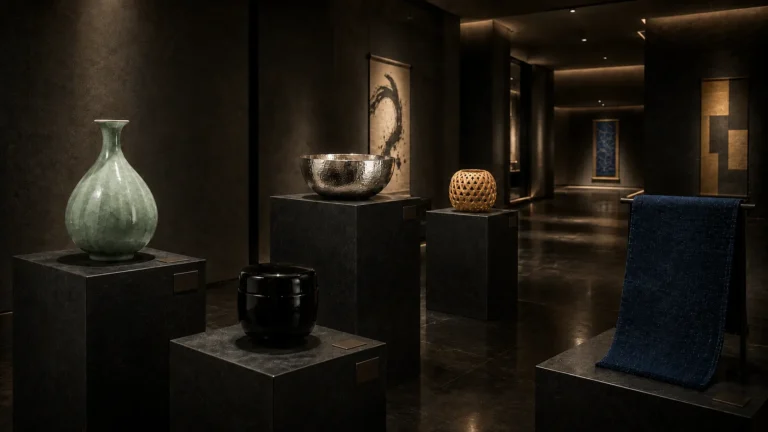
If you are unsure how to approach craft works more generally, the article above sets out ways of looking at them through material, form, surface, technique and light.
Where the Work Is Shown, and Which Galleries Handle It
Nakata’s work has been shown through Japan Kogei Association exhibitions and museum programmes, and also through galleries.
A Lighthouse called Kanata continues to publish an artist page for Mayu Nakata, with works up to 2025. In 2024 the gallery held a solo exhibition, “The Skies Above – Kinma by Mayu Nakata”. Availability and whether a given work can be purchased change over time, so individual pieces need to be checked with the gallery directly.
(Source: Mayu Nakata | A Lighthouse called Kanata)
If you are considering a purchase, it is worth confirming not only price but the title, year, materials and technique, dimensions, provenance, exhibition history and any accompanying documentation.
Prices vary with the size of a work, the year it was made and the sales channel, so inferring a market rate from publicly available information alone is best avoided.


The article above explains how to check provenance, condition, the tomobako (the artist’s signed storage box) and the seller when buying craft works by named artists.
If you are considering showing lacquer work in a hotel, shop or office, the planning needs to cover lighting, installation, temperature and humidity, maintenance and coordination with the artist or gallery, not only the work itself.

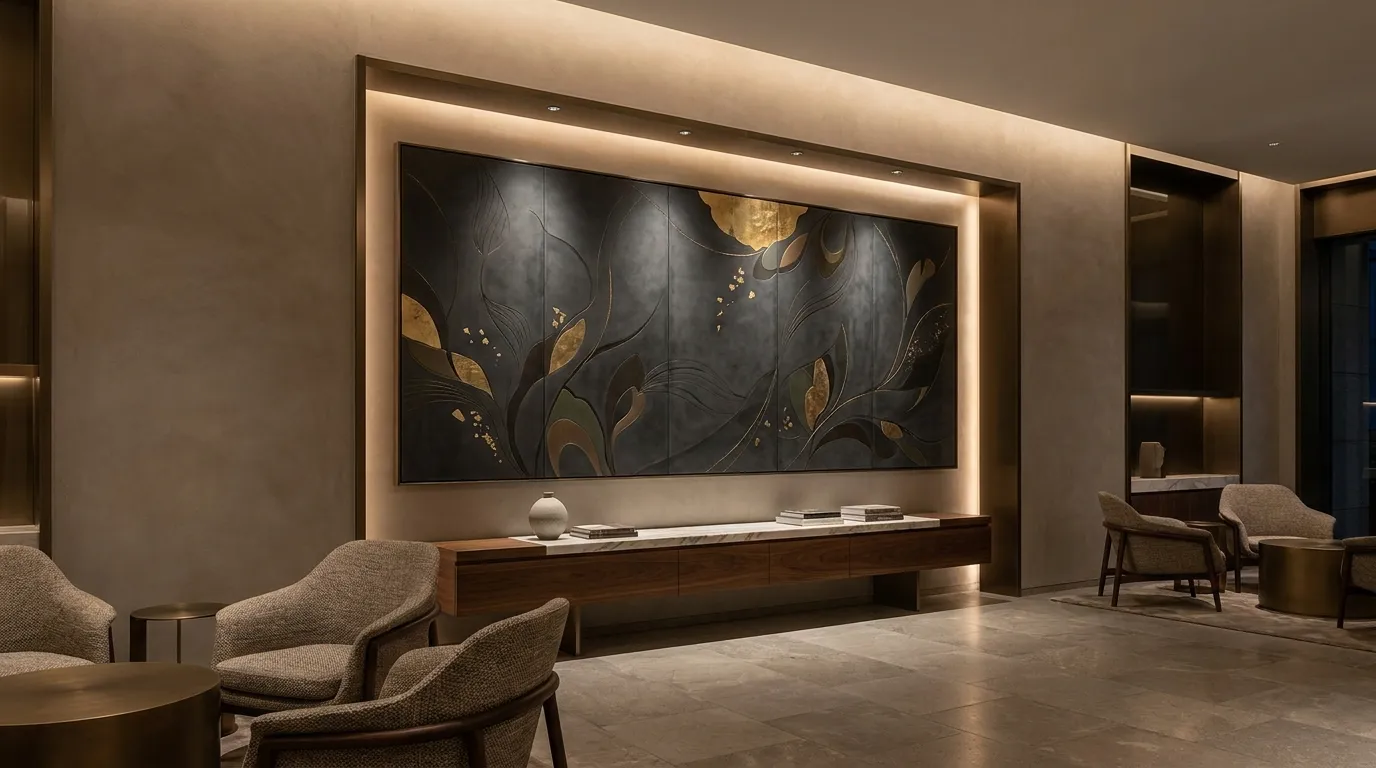
Kogei Japonica advises on bringing craft and lacquer works into interior spaces, and on collaborations with artists and workshops. We do not, however, guarantee the availability of a particular artist’s work or act as an intermediary for it. For purchases, please check current availability directly with the artist or an authorised gallery or dealer.
Frequently Asked Questions
Below are brief answers to the questions that most often come up about Nakata’s technique, background and the Venice showing.
- Q1. What technique does Mayu Nakata work in?
- She is a contemporary lacquer artist working principally in kinma. In some works she also uses a kanshitsu body, carving deeply into the lacquered surface, layering several pigmented urushi coats and polishing back to produce complex colour.
- Q2. Is Mayu Nakata exhibiting in the Biennale itself or the Japan Pavilion?
- No. “Ethnography of the Body and Material”, in which she is taking part, is an independent exhibition held in Venice during the same period as the 61st International Art Exhibition of La Biennale di Venezia. It is neither a Japan Pavilion presentation nor an official Collateral Event.
- Q3. When and where can the “Ethnography of the Body and Material” exhibition be seen?
- It runs from 9 May to 22 November 2026 at Palazzo Pisani Santa Marina in Venice, closed on Tuesdays. Please check opening hours and other details on the official GO FOR KOGEI information before visiting.
- Q4. How do kinma, chinkin and zonsei differ?
- In kinma, the lacquered surface is carved and the incisions filled with pigmented urushi, then polished back. In chinkin, carved lines and dots are filled mainly with gold or silver leaf or powder. In the form of zonsei typical of Kagawa, a design is painted in pigmented urushi, outlines are then carved, and gold powder or leaf is set into the incisions.
- Q5. How many layers of lacquer go into Mayu Nakata’s work?
- GO FOR KOGEI in Venice describes her method as building around forty layers of pigmented urushi within a total thickness of roughly 0.5 mm. This does not mean every work follows the same specification; it is the figure given in that exhibition’s account of her technique.
- Q6. What is Mayu Nakata’s connection to the LOEWE FOUNDATION Craft Prize?
- In 2019 she was selected as a finalist for the LOEWE FOUNDATION Craft Prize with “Flame”. This is confirmed in the foundation’s official records.
- Q7. Where can Mayu Nakata’s work be seen or purchased?
- Her work has been presented through Japan Kogei Association exhibitions and at museums and galleries. A Lighthouse called Kanata continues to publish artist and work pages, but availability and prices change, so please check current availability with each gallery or dealer.
- Q8. What should collectors and gallerists look for in Mayu Nakata’s work?
- Beyond the fineness of the carving: how the layers of colour emerge, the boundaries between colours created by polishing, the relationship between pattern and three-dimensional form, how the work changes with viewing angle, and the relationship between making time and motif.
Conclusion | Reading the Artist Through Technique, Not Credentials
Mayu Nakata trained in lacquer at the Kagawa Prefectural Institute of Lacquer Arts, went on to Kanazawa Utatsuyama Kogei Kobo, and has developed a body of work built around kinma. She continues to work as a full member of the Japan Kogei Association, and in 2019 became a LOEWE FOUNDATION Craft Prize finalist with “Flame”, with her work presented in craft and contemporary art contexts in Japan and abroad.
What most concisely defines that work is carving more deeply, introducing multiple layers of pigmented urushi, and polishing so that the colour within comes to the surface — kinma taken further. The figures given in GO FOR KOGEI’s account, around forty layers within a total thickness of roughly 0.5 mm, offer a way of grasping that density.
And the 2026 Venice exhibition repays a closer reading when you attend to how her work has been placed within the show’s questions of material, the body and slowness in the making.
With craft, what prize a work won or which international exhibition it appeared in is sometimes the first thing said about it. But a career summary alone does not let you see the work itself.
From the Kogei Japonica editorial team
If you have the chance to see Mayu Nakata’s work, try for a moment to widen your attention beyond the beauty of the pattern. Where did that colour come from? How many layers of lacquer lie beneath the surface? How does a design wrapping around a curve change with where you stand? And how much time passed before that surface was finished?
Rather than settling on “the technique is advanced, so the work is impressive”, look again once you know how it was made. That the work looks different the second time is, we think, one of the pleasures of coming to know craft.
In Nakata’s case, what remains in the layers of lacquer is not only colour. Applying, waiting for it to cure, carving, filling with colour, polishing back. Taking in the memories that shifted across that span reveals another dimension of her work: the relationship between material and time.


