
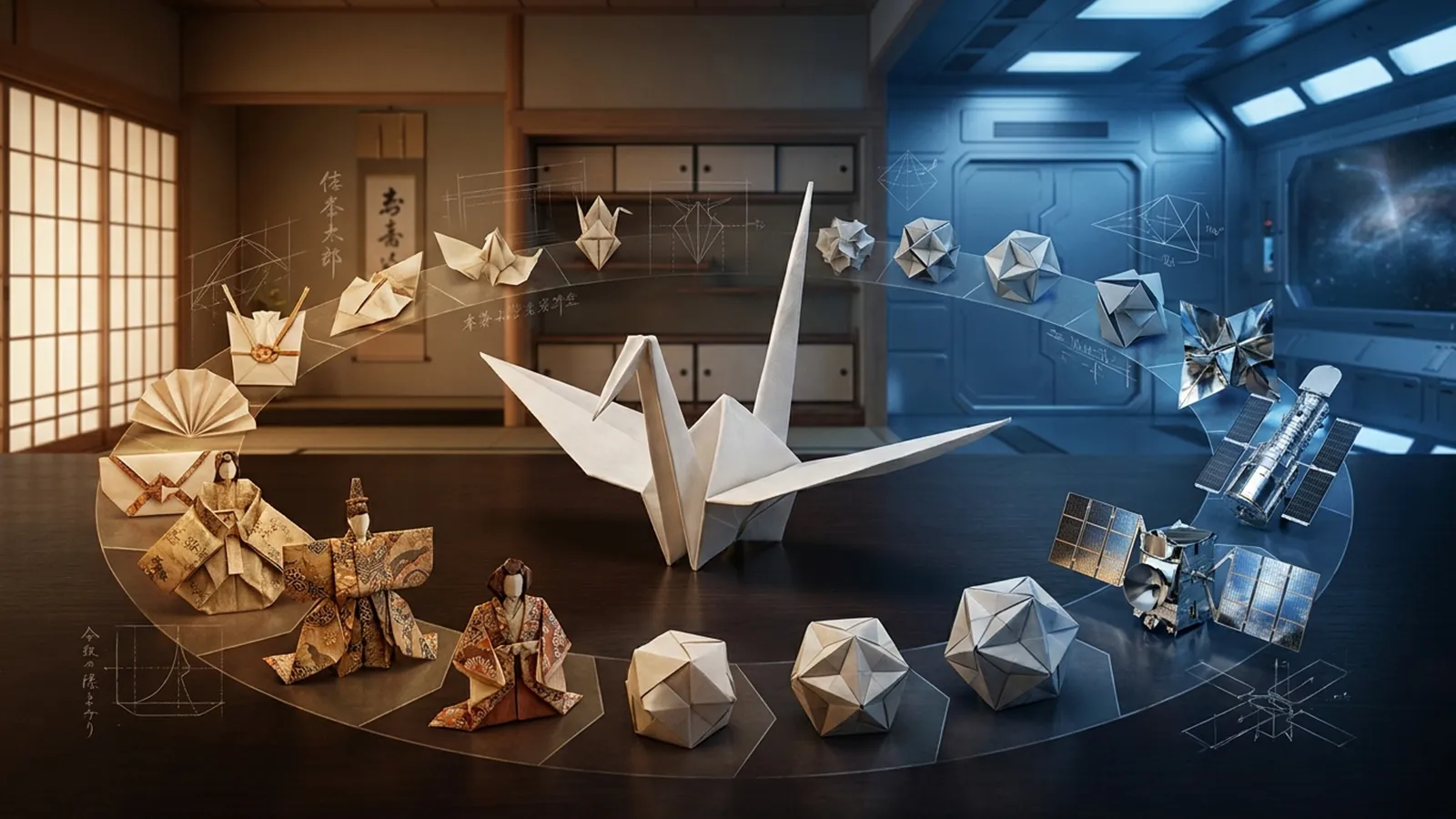
Origami is widely known as a children’s pastime, but it is equally a cultural practice that has grown from Japanese papercraft, ceremonial etiquette, and classroom education into contemporary art, architecture, and aerospace engineering. The word itself — combining ori (to fold) and kami (paper) — passed into global use without translation, a signal of how completely the practice has been absorbed into international culture.
This article addresses a set of questions that go beyond the basics: when and how did origami emerge? Who gave modern origami its international form? And why do engineers designing space telescopes turn to paper-folding for answers? By approaching origami as a tradition where craft intelligence and formal knowledge meet, its significance becomes considerably clearer.
What this article covers
- The origins of origami and the distinction between its two main lineages: ceremonial origata and recreational origami
- Akira Yoshizawa’s contribution to modern origami and the notation system that carried the practice worldwide
- How senbazuru, STEAM education, and international organizations have shaped origami’s global reach
- Origami’s applications in mathematics, architecture, and aerospace engineering — including the James Webb Space Telescope and JAXA
Table of Contents
What Origami Is — and Why the Word Traveled
To understand origami only as a children’s activity is to stand at the threshold of a considerably larger subject. Origami is the practice of creating form through folding paper alone — but it is also a cultural practice deeply interwoven with Japanese ceremony, religious observance, pedagogy, and mathematics. Today it functions as an internationally recognized art form and as a design methodology with direct applications in engineering and space exploration.
The reason “origami” entered global usage intact, rather than being replaced by a translation, has to do with how thoroughly the practice was formalized and disseminated from the mid-twentieth century onward — a process inseparable from the work of one particular artist.
Origami and Origata: Two Distinct Traditions
Any serious account of origami’s history begins with a distinction that is easy to overlook: the difference between origami and origata.
Origata refers to the formal system of paper folding that developed within warrior-class society during the Muromachi period (roughly the fourteenth to sixteenth centuries). In this tradition, the correct folding of paper was inseparable from the correct conduct of ceremony. Gifts, ritual objects, sake vessels, and wedding ornaments were all presented with paper folded according to precise protocols — folding was not decoration but an expression of propriety. Origata belongs to the history of etiquette as much as to the history of craft.
Recreational origami, by contrast, is the practice of folding paper into cranes, flowers, and other figures for pleasure — a tradition that spread broadly through Edo-period popular culture.
What this distinction reveals is more than a difference in purpose. A formal system of prescribed forms gave way, over time, to open-ended creative play — and in Japan, those two registers remained connected rather than diverging into separate worlds. The cultural respect for the act of folding that origata cultivated became part of the soil in which recreational origami grew. When people today use the word “origami,” they are generally referring to the recreational tradition, but the ceremonial lineage is part of what gave paper folding its cultural weight in Japan.
Why “Origami” Became the Global Term
The consolidation of “origami” as an international term occurred primarily in the mid-twentieth century, when the art form began to circulate through Western exhibition spaces and educational networks. As origami artist Akira Yoshizawa gained recognition in European galleries and a shared notation system was developed that worked across languages, the practice and its Japanese name traveled together. Like “judo” or “haiku,” origami entered English and other languages as a complete cultural package — the word and the thing it named arrived simultaneously.
Terms such as “paper folding” and “paper craft” exist in English but carry different connotations; in artistic and academic contexts, “origami” has become the standard designation.
The History of Origami — From Ceremony to Education
Origami’s history is not a single straight line. It is a set of overlapping traditions — ceremony, recreation, education, art, and engineering — that developed at different moments and in different social contexts, and gradually converged into what the world now recognizes as origami. The thread connecting them is the act of folding paper itself, and the accumulated knowledge that act has produced.
That history is inseparable from the history of paper in Japan. Papermaking technology is thought to have reached Japan in the early seventh century, and during the long period when paper was a scarce and costly material, the act of folding it carried a significance that was partly ceremonial and partly social. The Japanese phrase “origami-tsuki” — meaning certified, genuine, guaranteed — derives from the practice of folding documents of authentication, a reminder of how closely paper handling was bound up with trust and formal conduct.
Washi and the Material Basis of a Folding Culture
The development of origami in Japan is partly a story about a particular material. Washi — traditional Japanese paper made from plant fibers including kozo, mitsumata, and gampi — is both strong and thin, and it holds a crease with unusual clarity. That quality, the sharpness and beauty of a fold line, is the material foundation of origami’s expressive range.
Washi was also the medium of Shinto ritual objects such as gohei (paper streamers used in shrines) and of the ceremonial wrappings of formal gifts — contexts that positioned the folding of paper as something inherently careful and considered, not casual. This cultural framing shaped how the practice was understood and transmitted.
There is a broader point here about the relationship between material and thought. Oil painting cultivates a logic of layering and accumulation; ceramics require thinking backward from the kiln. Origami cultivates a logic of transformation without cutting — of changing form entirely through folding. The strength and flexibility of washi made that logic not just possible but natural. A material does not only support a practice; it shapes the thinking the practice produces.
Origata in the Muromachi Period — The Ogasawara and Ise Schools
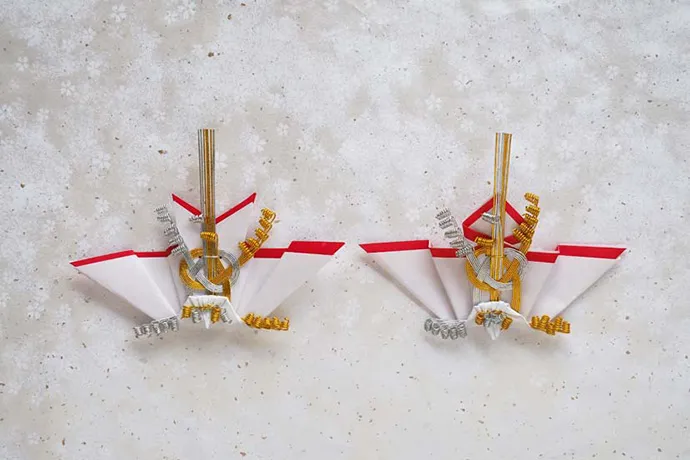
The formal codification of origata was carried out primarily by two warrior-class households: the Ogasawara school, which oversaw the etiquette of archery and horsemanship, and the Ise school, which managed ceremonial protocol across both court and military contexts. Paper folding was embedded within those broader systems of conduct. Forms such as noshi-ori (the folded paper accompaniment to a gift) and various wrapping styles survive, in modified forms, in Japanese gift-giving culture to this day.
The fact that origata prescribed correct forms precisely — that a wrong fold was a breach of propriety — is significant. Folding carried meaning and social weight. This is one source of the careful, deliberate quality that has historically characterized Japanese engagement with the act of folding paper.
Recreational Origami in the Edo Period
As washi production expanded during the Edo period (1603–1868) and paper became available to a broader population, origami developed a stronger recreational character. Cranes, frogs, and inflatable balloons were folded as children’s pastimes, and adults folded paper as leisure or as decorative accompaniments to gifts. The folded crane became established as a symbol of longevity and good fortune, and was used as an offering at shrines and as decoration at celebratory occasions.
Hiden Senbazuru Orikata — The Earliest Known Origami Publication
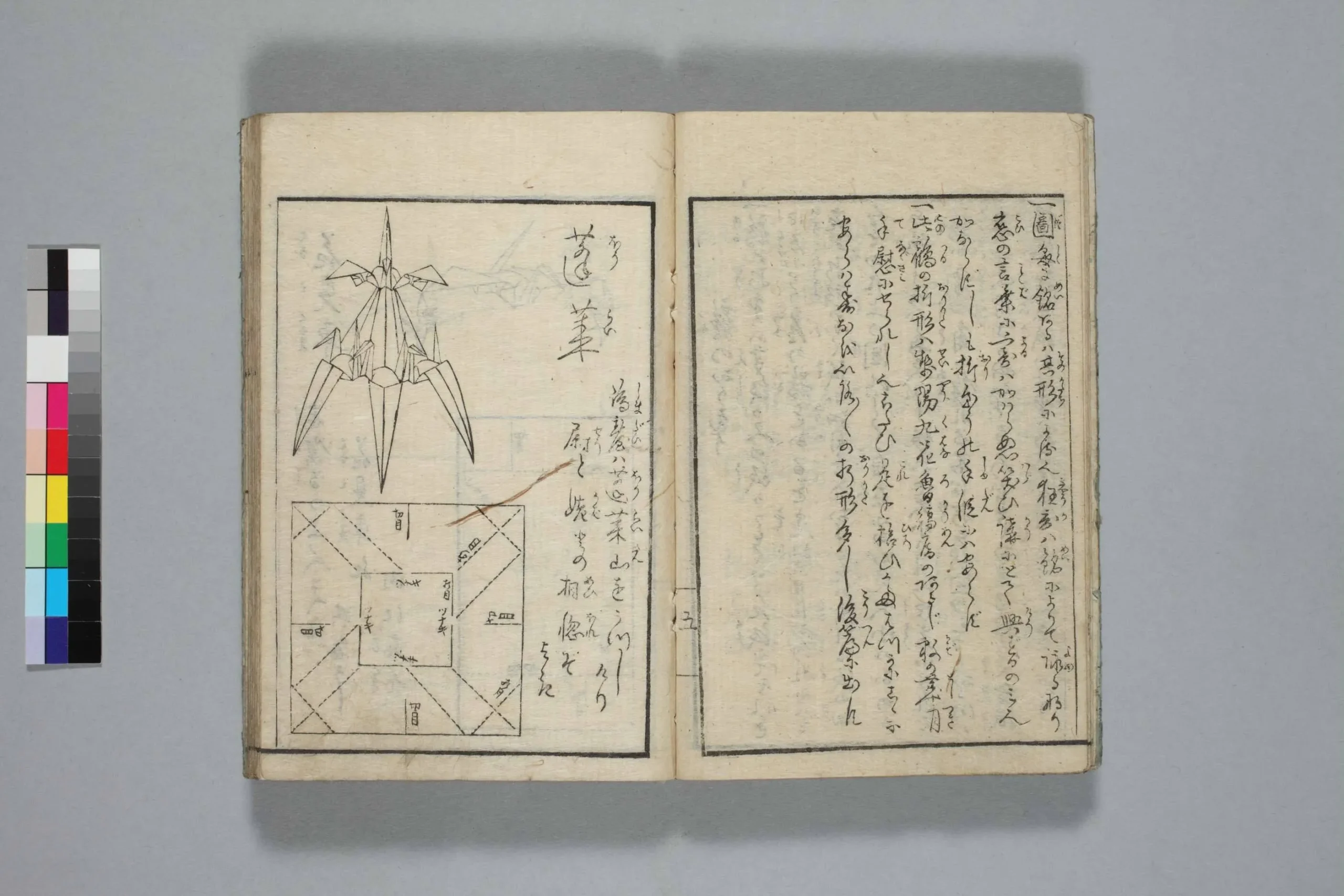
Published in 1797, Hiden Senbazuru Orikata (Secret Techniques of Thousand Crane Folding) is among the earliest known books devoted entirely to origami. Written by Sōkan Gido under the pen name Shiga Sanjin, with illustrations by Nishioka Jōan, it documents 49 variations of renzuru — linked cranes folded from a single uncut sheet of paper.
Renzuru requires a high degree of technical skill: multiple cranes emerge connected, without any cutting, from one piece of paper. The book’s existence signals something important — that origami was being treated not merely as a pastime but as a discipline worth documenting with care.
(Reference: Hiden Senbazuru Orikata, National Institute of Japanese Literature)
Origami in Meiji-Era Education — The Fröbel Connection
Origami’s entry into formal education in Japan came partly through the reception of Western educational theory during the Meiji period. Friedrich Fröbel, the German educational thinker, developed a set of learning objects he called “gifts” (Gaben in German, translated into Japanese as onmotsu) for use in early childhood education. Among these was the folding of square sheets of paper. Fröbel’s kindergarten model spread through Europe from the 1840s onward and reached Japan as part of the broader adoption of Western educational structures during the Meiji reforms.
In Japan, this Western pedagogical framework overlapped with an existing paper-folding culture, and the combination helped establish origami as a standard element of classroom practice. The resulting educational tradition was a product of that overlap — a case of Western educational thinking and Japanese material culture reinforcing each other.
The Figures Who Shaped Modern Origami — From Yoshizawa to the Present
If there is a single turning point in origami’s history that can fairly be called a transformation, it is the emergence of Akira Yoshizawa (1911–2005). Before the mid-twentieth century, origami was a folk practice with no systematic means of documentation or transmission. Yoshizawa changed that — and is recognized by the Nippon Origami Association (NOA) and the international origami community as the figure who moved origami from folk craft to international art form.
(Reference: Yoshizawa Origami Museum, Kaminokawa)
What Akira Yoshizawa Changed
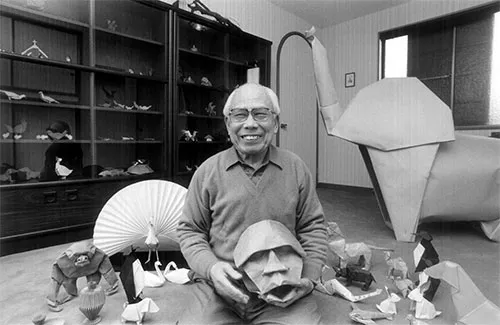
Yoshizawa came to origami through self-directed study after working in a factory, and from the 1950s onward he brought his work to Western art exhibitions, demonstrating through the work itself that origami was capable of genuine artistic expression. Over his lifetime he is said to have created more than 50,000 pieces.
But Yoshizawa’s contribution was not only artistic. He was also the person who converted origami from an individual, unteachable hand skill into a recordable form that others could learn from — giving the practice a shared visual language that crossed national borders. In doing so, he was simultaneously an artist and a format designer: the person who made origami transmissible at scale. The founding of the Nippon Origami Association (NOA) in 1973 was part of the international trajectory he had opened.
Wet-Folding and the Possibility of Three-Dimensional Form
Wet-folding is a technique in which washi or other relatively heavy paper is lightly dampened before folding, then allowed to dry in place, fixing curved three-dimensional surfaces that would be impossible to achieve with dry paper. Standard origami is defined by straight fold lines; wet-folding allows those lines to give way to organic curves — the rounded musculature of an animal, the subtle arc of a bird’s wing. The finished piece has something of the quality of modeled sculpture.
This technique moved origami from a medium of flat geometric play into one capable of sculptural expression. It is partly what earned Yoshizawa’s animal figures serious attention in European exhibition contexts.
The Yoshizawa–Randlett System — A Shared Language for Folding
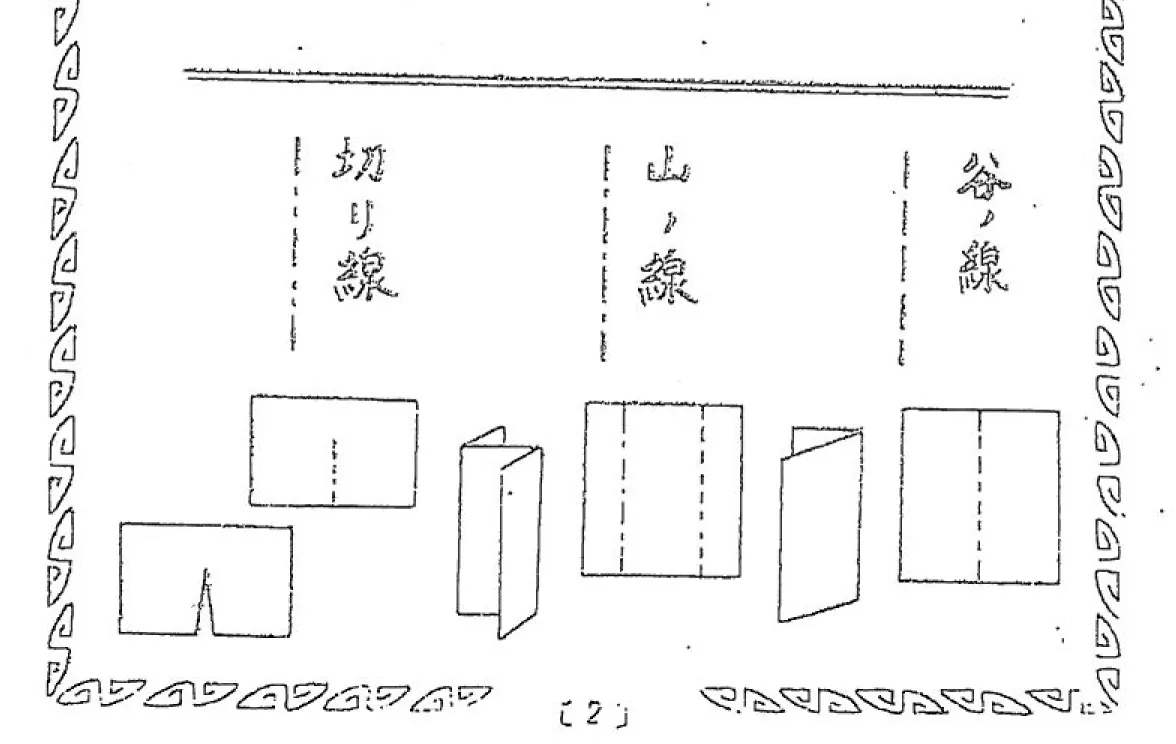
Yoshizawa developed and refined a system of diagrammatic notation for origami instructions. In the 1960s, American origami advocate Samuel Randlett further organized and standardized this system; the result, known internationally as the Yoshizawa–Randlett system, became the global standard for origami diagrams — a history documented in detail by OrigamiUSA.
The system’s elegance lies in its simplicity: mountain folds and valley folds are indicated by distinct line types, and the resulting diagrams require no language to read. A folder in Tokyo, Paris, or São Paulo works from the same page. It functioned, in effect, as sheet music functions for musicians — a notation that made the practice reproducible and teachable across cultural and linguistic boundaries.
(Reference: On the Evolution of the Notation System, OrigamiUSA)
Maekawa, Kamiya, and Robert J. Lang — Complex Origami Today
After Yoshizawa, origami evolved toward what is now called complex origami — work of a structural and mathematical intricacy that earlier generations could not have anticipated. In Japan, Jun Maekawa developed theoretical frameworks for origami’s mathematical properties, while Satoshi Kamiya, working in the 2000s, produced pieces of unprecedented complexity — among them the “Ryujin” (divine dragon) — that are recognized internationally as representing the current limits of the form.
In the United States, physicist and origami artist Robert J. Lang developed TreeMaker, software that uses mathematical algorithms to generate fold patterns for complex subjects — insects, animals, figures — that would previously have required intuitive genius to design. By establishing origami as a domain of engineering-grade design, Lang’s work helped move the practice beyond any single national tradition into an international field spanning Japan, the United States, and Europe.
Why Origami Has Found a Global Audience — Peace, Education, and Community
The global reach of origami is not simply a product of its accessibility — the fact that it requires no tools and little space. Origami has functioned, at different points in its history, as a medium for collective prayer, as a pedagogical instrument, and as a vehicle for cross-cultural exchange. Each of those roles has contributed to its international presence.
Senbazuru and the Symbolism of Peace

The crane’s association with peace in an international context is inseparable from the story of Sadako Sasaki, who was exposed to radiation in the Hiroshima bombing of 1945 and died of leukemia in 1955. Her story became central to postwar Japanese peace education, and has since traveled well beyond Japan. In 1958, the Children’s Peace Monument — built in her memory at Hiroshima Peace Memorial Park — was completed, and paper cranes from around the world continue to arrive there today.
The custom of folding a thousand cranes, senbazuru, predates Sadako’s story, but her story gave the folded crane a universality it had not previously carried in international contexts — and became one of the channels through which the word “origami” became associated, globally, with the idea of peace and collective intention.
(Reference: Paper Cranes and the Children’s Peace Monument, City of Hiroshima)
The Role of Origami in STEAM Education
Origami has attracted renewed attention in contemporary STEAM education — curricula that integrate science, technology, engineering, art, and mathematics — as a practice that develops several cognitive skills simultaneously.
- Folding a square sheet engages angles, symmetry, and proportion at an intuitive level
- Understanding how a three-dimensional form unfolds into a flat sheet develops spatial reasoning
- Working through a sequence of folds toward a specific outcome builds logical thinking
- The fact that mistakes cost nothing but a sheet of paper makes origami naturally compatible with iterative, learn-from-failure approaches to problem-solving
Educational use of origami has spread well beyond Japan — it is part of classroom practice in North America, Europe, and across Asia.
The Organizations and Spaces That Support Origami Worldwide
The Nippon Origami Association (NOA) was established in Japan in 1973 and has since been a primary driver of origami education and outreach domestically and internationally. November 11th was designated Origami Day by the NOA in 1980. The association maintains a membership structure, a regular journal, and a certification program for origami instruction.
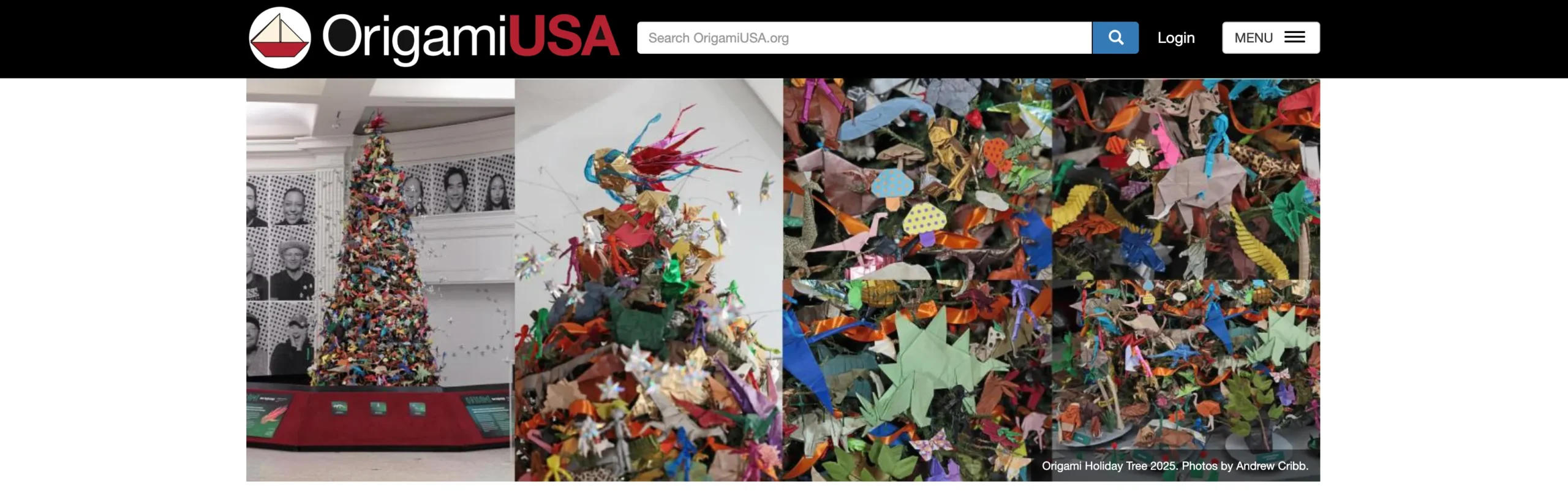
OrigamiUSA, based in New York, holds an annual convention that brings together folders and researchers from around the world. National organizations such as the British Origami Society operate independently in their own regions.
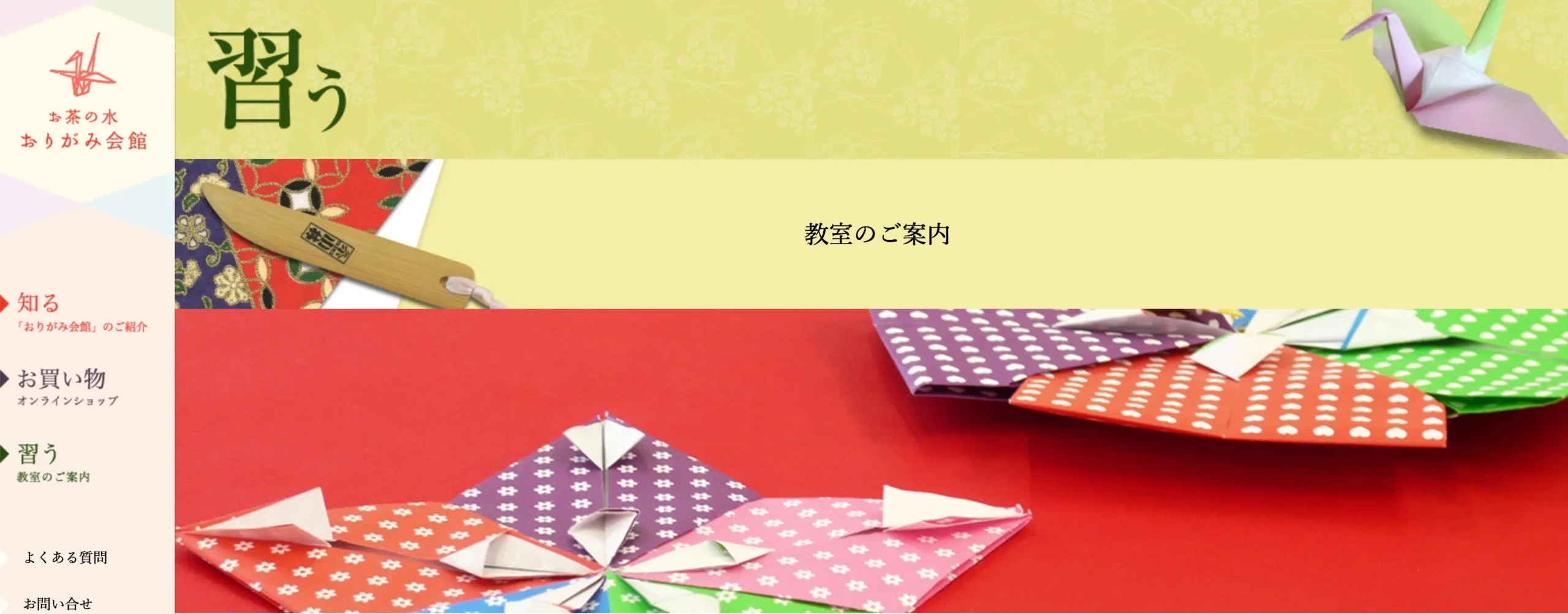
In Tokyo, the Ochanomizu Origami Kaikan in Yushima serves as an accessible public center for the craft — offering exhibitions, a retail selection of washi and origami papers, and hands-on classes that are open to international visitors.
(Reference: Origami Day, Nippon Origami Association)
(Reference: English Guide, Ochanomizu Origami Kaikan)
How Origami Entered Mathematics, Architecture, and Space Engineering
When origami met contemporary science and engineering, the result was not a nostalgic revival of traditional craft. It was a practical solution to problems that other design approaches had not resolved. Modern engineering eventually arrived at problems that origami was uniquely suited to solve — and the encounter produced results that neither field could have reached alone.
The core capability at stake is straightforward: folding something large and complex into a compact form that can be reliably deployed when needed. That capability corresponds directly to constraints that space engineering, architecture, and materials science all face.
Computational Origami and Mathematics
The mathematical study of origami has developed into an established field known as computational origami. One of its foundational results is Kawasaki’s theorem, formulated by Japanese mathematician and origami artist Toshikazu Kawasaki, which gives the mathematical conditions under which a single vertex can be folded flat. This theorem provides a theoretical basis for the design of complex origami structures.
Robert J. Lang’s TreeMaker software takes a different approach: a designer inputs the desired shape as a tree structure, and the algorithm generates a crease pattern that will produce that shape. Origami subjects that once required exceptional intuitive skill to design — complex insects, animals with fine anatomical detail — can now be approached mathematically. The work demonstrates that origami is simultaneously an art form and an applied mathematics problem.
Origami Architecture and Masahiro Chatani
“Origami architecture” refers to a specific technique developed in the 1980s by architect Masahiro Chatani, Professor Emeritus at the Tokyo Institute of Technology. In this approach, a single sheet of paper is scored and folded to produce a three-dimensional architectural model when opened — a form that sits between pop-up cards and traditional origami. Chatani’s technique has spread internationally through architectural education, art instruction, and greeting card design, and is now recognized under the term “origami architecture” worldwide.
In architecture and product design more broadly, folded structures have been explored for facades, spatial enclosures, and material systems. The shadow patterns, structural rigidity, and deployability that folded geometry produces have practical as well as aesthetic applications.
Miura-ori — A Folding Pattern with Engineering Applications
The Miura-ori fold was developed in the 1970s by aerospace engineer Koryo Miura. The pattern consists of parallelograms folded in alternating directions, producing a structure with a single degree of freedom: the entire sheet can be fully deployed or fully collapsed by pulling or pushing at a single point.
This property — a large surface area that folds compactly and deploys without complex mechanisms — has been applied to maps, solar panels, and building materials. JAXA has documented applications of the Miura-ori pattern in the design of large solar array paddles for satellites that must be compactly stowed for launch and reliably deployed in orbit.
(Reference: Miura-ori and Satellites, Fan!Fun! JAXA)
NASA, JAXA, and the Webb Telescope — Origami in Aerospace Engineering
The most widely cited example of origami thinking in aerospace is the James Webb Space Telescope (JWST). NASA has described the telescope’s folding deployment mechanism as “origami-style”: the five-layer sunshield — roughly the area of a tennis court at approximately 21 by 14 meters — was folded to fit within the rocket fairing at launch and then unfolded in space. The design challenge was precisely the one origami addresses: how to store a very large, precise surface in a very small volume and deploy it reliably.
In origami-based engineering design, Robert J. Lang has also contributed foundational research. His work demonstrates the connections between origami mathematics and structural problems in aerospace, with documentation available through his own research publications.
(Reference: Webb and Origami, NASA Science)
(Reference: Space Applications, Robert J. Lang Origami)
How to Write and Talk About Origami for an International Audience
Origami’s history is not a single straight line. It is a set of overlapping traditions — ceremony, recreation, education, art, and engineering — that developed at different moments and in different contexts, and gradually came to inform one another. What connects them is not a continuous institution or a single school of thought. It is the act of folding paper itself, and the accumulated knowledge that act has produced across centuries.
Key Points for Communicating Origami as Japanese Cultural History
For anyone writing or speaking about origami in an international context, five reference points tend to anchor the subject well:
- ① The material basis: washi — Origami’s expressive possibilities are inseparable from the specific properties of Japanese paper. The clarity of the fold line is a material fact before it is an aesthetic one.
- ② The two lineages: origata and origami — Conflating the ceremonial and the recreational traditions produces historical inaccuracies. The distinction is fundamental.
- ③ Education as a connective tissue — From the Meiji period onward, the convergence of Western kindergarten pedagogy and Japanese paper culture gave origami a classroom presence that has only grown since, most recently through STEAM frameworks.
- ④ The international turning point — Yoshizawa’s development of a recordable notation and its subsequent standardization as the Yoshizawa–Randlett system is what made origami transmissible across languages and cultures.
- ⑤ Present-tense applications — The Miura-ori fold, Chatani’s origami architecture, and the structural design of the James Webb Space Telescope are not historical footnotes. They are current applications of a living design logic.
Four Editorial Principles for Writing About Origami
These considerations apply whether the context is journalism, education, or cultural programming:
- Pair the how with the why
Even the simplest folded crane carries a history that includes etiquette, prayer, and pedagogy stretching back well over a thousand years. Instruction and cultural context together produce a more complete picture than either does alone. - Be careful about origin claims
The documentary record for recreational origami’s origins is incomplete, and scholars continue to debate the specifics. Phrasings such as “is thought to have” and “is generally dated to” are more accurate than definitive statements. - Do not reduce origami to children’s craft
Origami is used in early childhood education, but it is also a medium for adult artistic expression, mathematical research, and engineering design. The audience and context should determine which dimension is foregrounded. - Cite sources for engineering applications
The JWST sunshield design and JAXA’s use of Miura-ori are verifiable through NASA and JAXA’s own published materials. These claims carry more weight when presented with attribution rather than as interesting anecdotes.
Editor’s Note — Why Origami Repays Closer Attention
Origami occupies an unusual position in Japanese culture — familiar enough to seem simple, yet dense with history at every level. Looked at closely, it connects formal ceremony, material knowledge, classroom pedagogy, artistic expression, mathematical theory, and structural engineering. That range is not accidental.
The essential quality is not the beauty of a finished crane. It is something more structural: the capacity to compress a complex form into a minimal volume and deploy it accurately when needed. That logic has been demanded by origata, by space engineering, and by much in between. The knowledge was always there. Modern engineering eventually arrived at problems where it was exactly what was needed.
Knowing that history, a sheet of paper and the act of folding it carry considerably more than they appear to at first glance.
Summary
Origami’s history spans roughly fourteen centuries — from the arrival of papermaking technology in seventh-century Japan, through the ceremonial origata of the warrior class, the recreational folding of the Edo period, the educational reforms of the Meiji era, and the international expansion of the twentieth century, to contemporary applications in aerospace engineering. That is a long arc for a practice centered on folding a single sheet of paper.
Akira Yoshizawa gave origami an artistic language; Koryo Miura gave it an engineering grammar; Robert J. Lang gave it a mathematical logic. At each stage, origami extended the scope of what it could do — and what it could be used for.
The point most worth holding onto is that the value of origami lies not only in what it produces — the finished object — but in what it embodies: a body of knowledge about compression, structure, and deployment that has proven relevant across centuries and disciplines. It is a traditional practice. It is also a current design methodology. Those two things are not in tension.
For those who want to engage further, the Nippon Origami Association’s education programs and the Ochanomizu Origami Kaikan in Tokyo are both accessible starting points.
(Reference: Nippon Origami Association (NOA) / Ochanomizu Origami Kaikan)
