




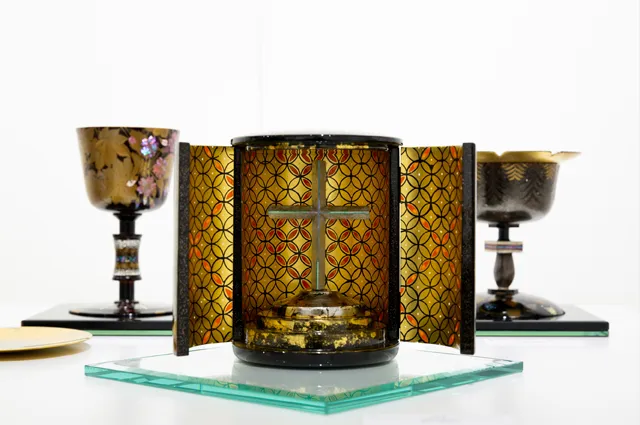
Yasunori Sutoh is a globally recognized contemporary Japanese lacquer artist who seamlessly bridges centuries-old tradition with modern spatial design. Rooted in the heritage of Aizu Nuri (Aizu lacquerware), Sutoh elevates the medium through his absolute mastery of the Kanshitsu (dry lacquer) technique and intricate Makie (metal powder decoration). Unlike traditional figurative lacquerware, his acclaimed works feature sharp geometric aesthetics and profound spiritual themes, famously resulting in a papal commission in 2019. By applying a scientific understanding of materials to ancient craftsmanship, Sutoh creates striking, highly durable art pieces that interact dynamically with light and shadow. For international art collectors and spatial designers, his award-winning masterpieces offer more than just aesthetic beauty—they serve as profound architectural elements that transform modern interiors into contemplative, deeply atmospheric spaces.
For centuries, Japanese traditional crafts have drawn out the intrinsic qualities of materials, elevating the beauty of nature into timeless form. Today, a compelling movement is redefining this legacy—repositioning craft as Contemporary Art for Spatial Design: works that do not merely decorate a room, but fundamentally transform how a space is perceived. At the forefront of this movement stands Japanese lacquer artist Yasunori Sutoh, who draws on the deep heritage of Aizu Nuri (lacquerware from the Aizu region of Fukushima Prefecture) while presenting an entirely modern vision of light, shadow, and form in lustrous black lacquer. His work commands intense admiration from art professionals and collectors around the world.
In this article, we examine from the perspective of art collecting and spatial design why Sutoh’s work is so highly prized—exploring his distinguished exhibition awards, advanced technical methods, and the critical role of lighting in experiencing his art. Three key points lie at the heart of this discussion:
- Yasunori Sutoh is one of Japan’s foremost contemporary Urushi (lacquer) artists, bringing together decades of expertise as an educator and materials researcher with a deep commitment to preserving Aizu lacquer traditions. His specialty is precise, geometric form created through the Kanshitsu (dry lacquer) technique—building structure by layering hemp cloth saturated with lacquer over a mold.
- Sutoh has achieved top honors at Japan’s most prestigious craft exhibition, earning the Grand Prize (Japan Kogei Association President’s Award) at the 67th Japan Traditional Crafts Exhibition for his lacquer box “Hyoheki” (Ice Wall), followed by the Japan Kogei Association Holders Award at the 69th edition—establishing exceptional technical authority and credibility in the fine art market.
- At the spiritual core of Sutoh’s work is his Catholic faith. The interplay of glowing metallic Makie powder and profound lacquer black creates what can only be described as “spaces of prayer”—a transcultural aesthetic that resonates deeply with international luxury collectors and contemporary architects alike.
This guide is for those seeking to bring a true lifetime masterpiece into their home or project space—a work that embodies Japan’s finest aesthetic sensibility and creative innovation. Read on for a comprehensive look at what makes Yasunori Sutoh’s art so compelling and how it is valued in today’s global art market.
Table of Contents
Creating “Spaces of Prayer” in the Modern World: Who Is Yasunori Sutoh?

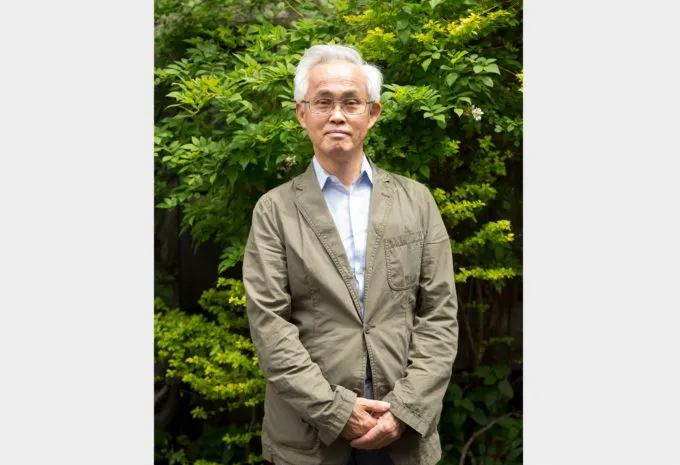
Yasunori Sutoh is a rare artist whose work goes far beyond the creation of beautiful functional objects. His practice is concerned with structuring the very conditions under which a space is perceived—crafting a quiet yet deeply charged presence that changes how a room feels. This quality emerges from his intimate understanding of Aizu lacquer’s rich historical legacy, combined with an exceptionally rigorous approach to materials and process.
Where Sacred Geometry Meets Catholic Devotion: Sutoh’s Distinctive Aesthetic

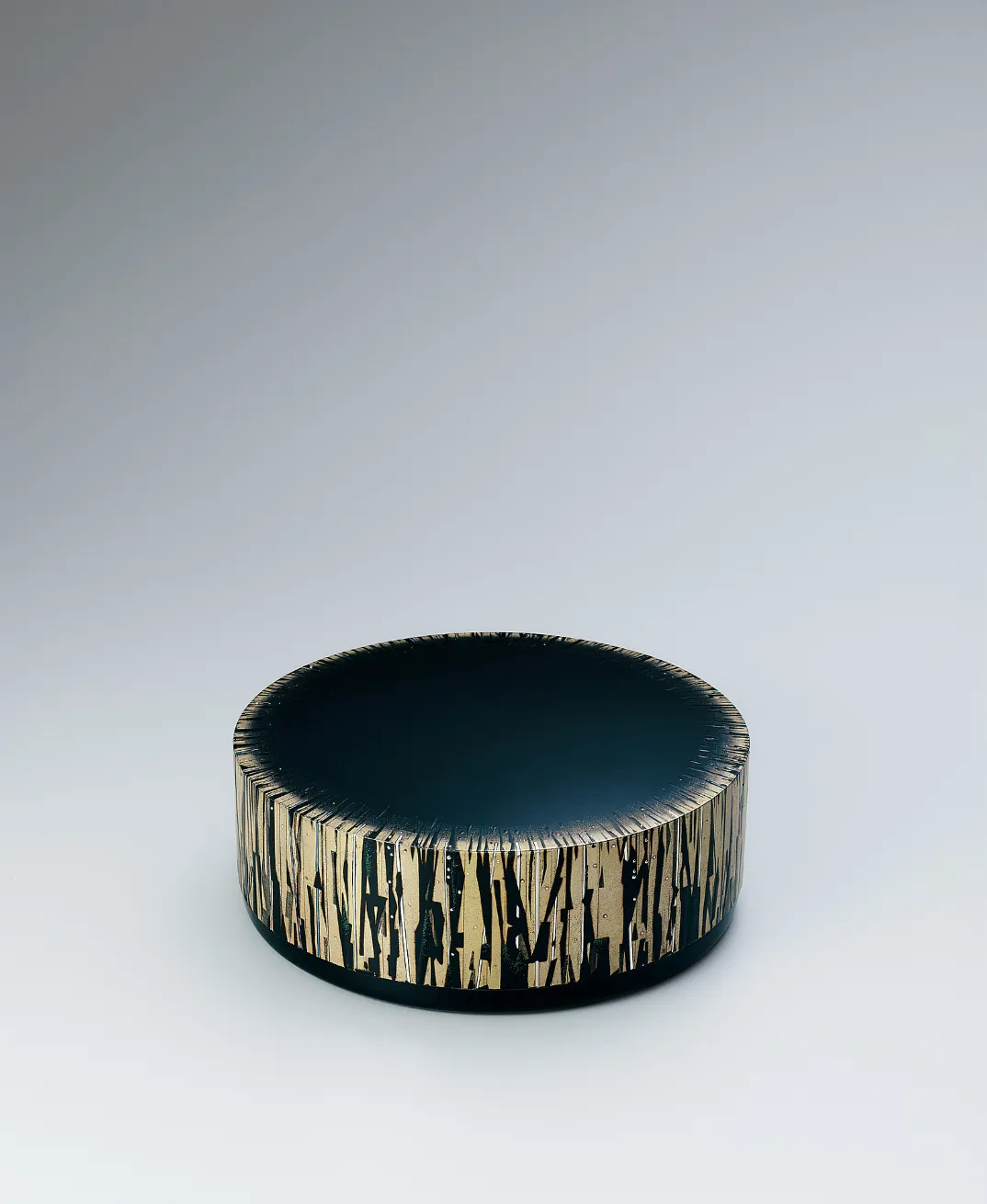
For centuries, Japanese Urushi art (lacquerware) has been defined by figurative imagery—birds, flowers, seasonal landscapes rendered in exquisite detail. Sutoh’s surfaces take a radically different path. Sharp, rectilinear geometric patterns repeat across his works, reducing decoration to the pure relationship between line and plane. This architectural sensibility connects directly to the spatial logic of sacred Christian architecture, and it produces a quiet, meditative tension in the viewer that is as spiritual as it is visual.
The depth of Sutoh’s spiritual commitment is perhaps best illustrated by a remarkable episode from 2019: when Pope Francis visited Japan, Sutoh’s lacquered chalice (Calice)—titled “Tamenuri Sakura Momiji Makie Seihai” (a chalice decorated with cherry blossoms and autumn maple leaves in Tamenuri lacquer and Makie technique)—was presented as a formal gift to the Holy Father. (Source: Gallery Japan)
Materials Science Meets Ancient Craft: The Science Behind Sutoh’s Kanshitsu Technique

What truly sets Sutoh apart is an unusual background that bridges art and science. For many years, he worked as a researcher specializing in lacquerware technology at the Aizuwakamatsu Technology Support Center of Fukushima Prefecture’s High-Tech Plaza—an industrial research institution dedicated to supporting regional crafts and industries through applied science.
This means Sutoh possesses a command of the material conditions governing lacquer that few artists can match: he understands the chemistry of curing, the mechanics of adhesion, the physics of polishing—not just intuitively, but analytically. This scientific grounding translates directly into the flawless precision of his Kanshitsu (dry lacquer) works: edges of architectural sharpness, surfaces of perfect uniformity, reflectivity that holds up under scrutiny from any angle.
Alongside his artistic practice, Sutoh serves as a member of the Aizu Lacquerware Techniques Preservation Society, bearing responsibility for transmitting these endangered methods to future generations. This dual identity—rigorous researcher and devoted cultural steward—forms the bedrock of his extraordinary creative authority.
Award-Winning Excellence: Exhibition Recognition and Market Value
In the world of fine art collecting, aesthetic appeal alone rarely suffices. For discerning collectors, institutional recognition—particularly at exhibitions with rigorous selection processes—provides crucial validation. Japan’s Japan Traditional Crafts Exhibition (Nihon Dento Kogei Ten), organized by the Japan Kogei Association under the patronage of the Agency for Cultural Affairs, represents precisely this kind of authoritative benchmark. It is widely respected by collectors and curators worldwide as the definitive measure of a Japanese craft artist’s achievement.
What the Grand Prize and Holders Award Really Signal to Collectors
Yasunori Sutoh has achieved the extraordinary distinction of winning the Japan Kogei Association President’s Award—the exhibition’s highest honor—at the 67th Japan Traditional Crafts Exhibition, for his Kanshitsu Hyomon Makie lacquer box “Hyoheki” (Ice Wall). He followed this with the Japan Kogei Association Holders Award at the 69th edition. Works such as the celebrated Kanshitsu Makie lacquer box “Hateshinaki” (Endless)” from that exhibition are permanently recorded in the official archives of the Japan Kogei Association. (Source: Japan Kogei Association)

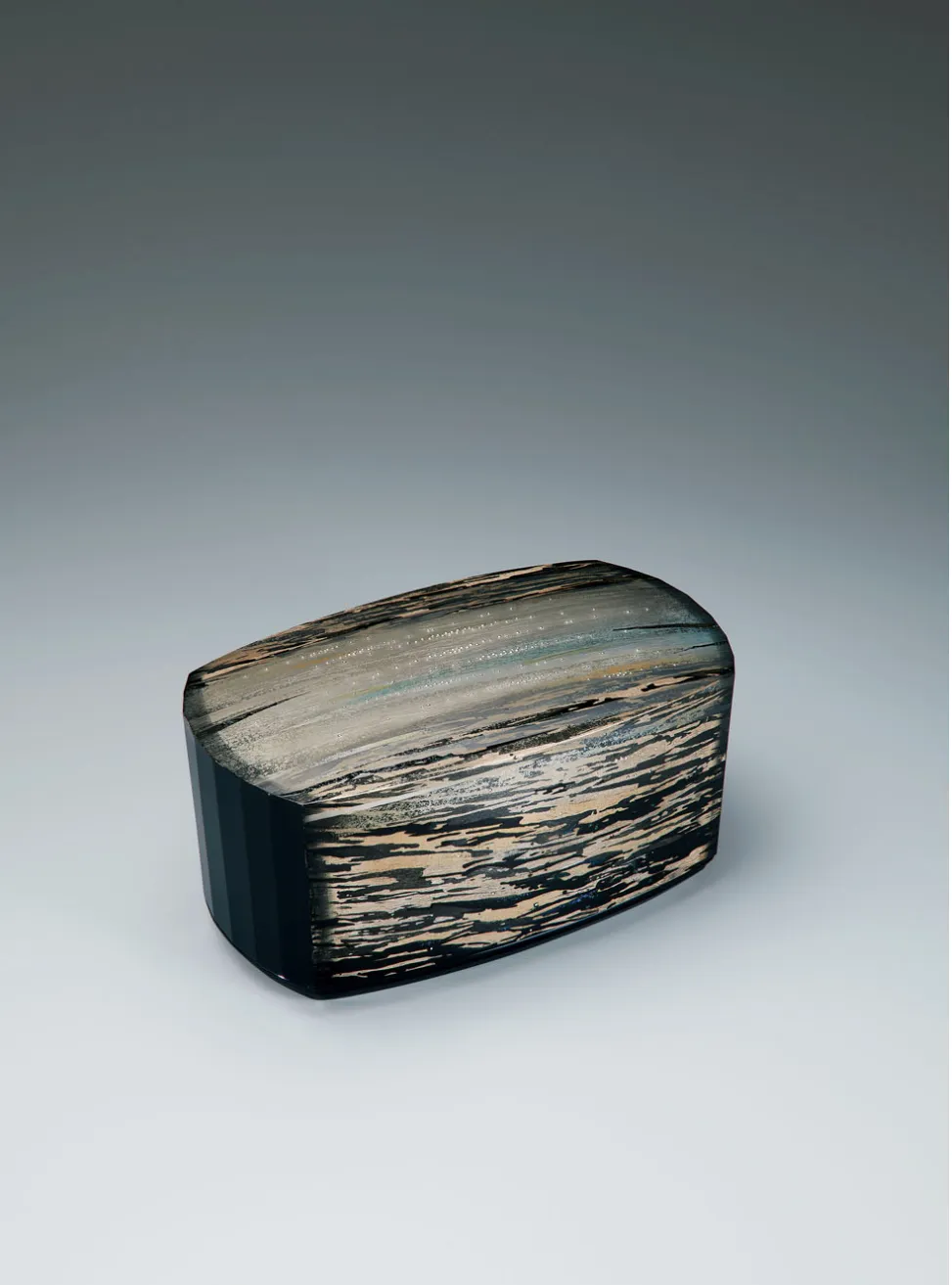
These consecutive top-level recognitions are not merely symbolic. They document—in the most rigorous institutional terms—that Sutoh’s works demonstrate not only innovative design vision but also technical execution of the highest order: precision at the limits of the medium, consistency of surface, and an uncompromising compositional intelligence. For collectors with exacting standards, this constitutes an exceptionally strong foundation of trust and long-term value.
A Visual Language That Transcends Cultural Borders
The visual logic of Sutoh’s work—the profound depth of black lacquer absorbing light, set against the razor-sharp reflection of metallic Hyomon inlay and Makie powder—operates on a level that does not require cultural context to be immediately compelling. It is a universal language of contrast, geometry, and material richness.
In the context of contemporary architecture—spaces defined by concrete, marble, glass, and restrained minimalism—Sutoh’s black lacquer does not merely recede. Depending on the light, it dramatically asserts itself, its edges and surfaces coming alive in ways that transform the entire atmosphere of a room. His works function as sophisticated instruments for amplifying the latent qualities of a space and its lighting, which is precisely why they are gaining recognition not only among Japanese art collectors but among international spatial designers and architects.
Mastering Light and Shadow: The Techniques Behind Sutoh’s Art
The contemporary power of Sutoh’s work lies in the way his chosen materials and techniques reach into the viewer’s spatial experience itself. Here, we unpack the core technical methods that define his art’s unique value.
Kanshitsu Dry Lacquer: Structural Freedom and Uncompromising Durability
The structural foundation of Sutoh’s works is the ancient Kanshitsu (dry lacquer) technique. In this demanding method, layers of hemp or linen cloth are saturated with raw lacquer and applied over a mold—typically plaster—building up the body of the object layer by layer. Once the lacquer cures and the mold is removed, the resulting shell is extraordinarily light, strong, and completely independent of the constraints of wood grain or natural material variation. This liberates the artist to pursue forms of precise, geometric purity that would be impossible in other media.
However, the achievement of perfectly flat planes, razor-sharp angles, and flawless uniform reflectivity demands an almost inconceivable degree of disciplined repetition: layer upon layer of cloth and lacquer, each cycle followed by careful drying and meticulous hand-polishing. The architectural, modernist precision of Sutoh’s finished surfaces—the quality that makes them feel less like craft objects and more like architectural elements—is the direct result of this exacting, iterative process.


Hyomon Inlay and Keshifun Makie: Designing with Reflected Light
Where the black lacquer body of a Sutoh work absorbs light almost completely, the metallic elements embedded in its surface do the opposite. Hyomon (flat metal inlay)—thin sheets or cut pieces of gold, silver, or other metals pressed into the lacquer surface—and Keshifun Makie (decoration using extremely fine metallic powder, one of the most delicate forms of Makie gold decoration) reflect light back to the viewer with sharp intensity.
In Sutoh’s hands, these elements are not applied decoratively but geometrically—positioned with calculated precision so that as a viewer moves through the space, or as daylight shifts across the room, the composition of light and shadow changes dramatically. The work encodes time itself: morning light reads differently from the glow of an evening lamp; a slight change in the viewer’s position reveals new lines, new depths. The result is an art object that simultaneously exists as a beautiful physical form and as a dynamic instrument for editing and recomposing the light of the space it inhabits.
Collecting Sutoh’s Work: Strategy, Spatial Design, and How to Acquire
A Sutoh lacquer work is not simply something to place on a shelf and admire in isolation. Its full value is realized only when it is positioned within a space whose qualities—light, material, proportion—have been thoughtfully considered. The following guidance is aimed at serious collectors and design professionals seeking to integrate his work into residential or project environments.
Lighting Design: The Single Most Critical Factor in Spatial Presentation
Before determining placement, prioritize the design of light. In environments where soft, diffused natural light enters from a distance, the lacquer black of a Sutoh work will seem to dissolve into the space, while the metallic elements emerge as a quiet, ambient shimmer—understated and meditative.
By contrast, in a purposefully darkened study, lounge, or gallery space with a tightly focused spot source aimed directly at the work, the effect shifts entirely. The geometric lines of Hyomon inlay and Makie powder float luminously out of the surrounding darkness—an effect that is both architecturally precise and spiritually charged, as if a sacred boundary has been drawn in light. The most powerful installations are conceived by first designing the lighting and material palette of the space, then selecting the work. This sequence maximizes the transformative impact that is the hallmark of Spatial Design Art at this level.
How to Acquire: Building Relationships Over Time
Because the Kanshitsu dry lacquer technique imposes an exceptionally high process burden—each work demanding hundreds of hours of layering, curing, and hand-polishing—the volume of Sutoh’s work available in the market at any given time is extremely limited. Attempting to acquire through short-term market searches is unlikely to succeed.
The most practical and reliable approach is a long-term one: follow exhibition announcements from the Japan Kogei Association, monitor the fine art galleries of major Japanese department stores with strong craft programs, and maintain relationships with specialist galleries and dealers who focus on Japanese traditional crafts. Sustained engagement with these networks—building trust and demonstrating genuine commitment over time—is the single most dependable path to securing a Sutoh masterpiece. In the world of Japanese lacquer art collecting, patience and relationship are not merely virtues; they are the method.


