
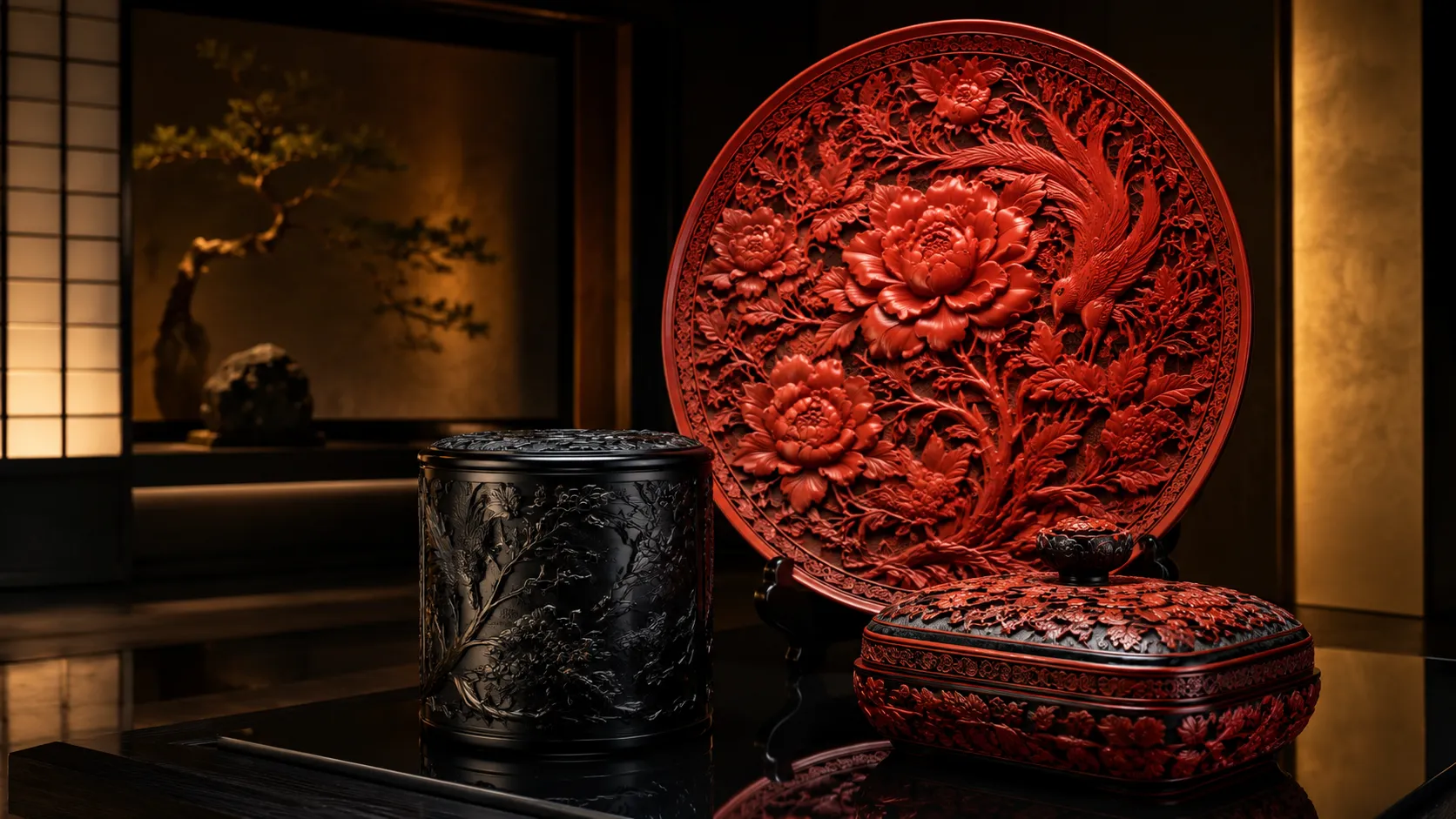
Choshitsu (彫漆) is a lacquer art technique in which layers of urushi lacquer are built up to substantial thickness, then carved to reveal patterns and depth within the lacquer itself.
Anyone researching choshitsu will quickly encounter a cluster of related terms: tsuishu (堆朱), tsuikoku (堆黒), kokarokuyou (紅花緑葉), guri (屈輪). Layer in chinkin (沈金), kinma (蒟醤), Kamakura-bori (鎌倉彫), and Murakami kibori tsuishu (村上木彫堆朱) — all of which involve carving in some sense — and the field becomes difficult to navigate. The difficulty lies in understanding where these terms overlap, where they diverge, and what is actually being carved in each case.
This article works through choshitsu from its basic definition outward: its relationship to tsuishu, tsuikoku, and kokarokuyou; how it differs from chinkin, kinma, Kamakura-bori, and Murakami kibori tsuishu; its place within Kagawa lacquerware; and the specific things worth looking for when examining a carved lacquer work.
At Kogei Japonica, we approach choshitsu not merely as a form of surface decoration, but as a technique in which time — the accumulated time of repeated lacquering — is literally carved into form. Understanding what is being carved, and in what sequence, changes how lacquer art looks.
Table of Contents
What is choshitsu? The fundamentals of carving through built-up lacquer
Choshitsu is a decorative lacquer technique in which lacquer is applied in many successive layers to build up significant thickness, and those layers are then carved along a pattern to produce the design.
Cultural Heritage Online describes choshitsu as “a technique of expressing patterns by carving through thickly built-up layers of lacquer,” and notes that pieces carved from red lacquer (shu-urushi) built up in this way are called tsuishu, while those carved from black lacquer (kuro-urushi) are called tsuikoku.
(Source: Choshitsu Technical Record | Cultural Heritage Online)
The essential point for understanding choshitsu is that patterns are not drawn onto the surface — they are carved out from within the thickness of the lacquer itself. The design is not applied from above; it emerges from below, from the accumulated depth of the lacquered layers.
The Kyoto National Museum describes choshitsu as a technique in which an object is coated with lacquer many times to build a thick layer, and that hardened layer is then carved according to the design. It notes that some works require hundreds of coats of lacquer — making clear that choshitsu is a technique premised on an extended process before any carving begins.
(Source: Chinese Imported Lacquerware — Choshitsu | Kyoto National Museum)
Definition: Choshitsu (彫漆)
Choshitsu is a lacquer art technique in which urushi lacquer is applied in many successive layers to build thickness, and those layers are then carved to express patterns. In English, it is described as carved lacquer or choshitsu. In Chinese lacquerware contexts, the equivalent techniques are referred to as tihong (剔紅), tihei (剔黒), or tixi (剔犀), depending on color and treatment.
Reading and etymology
Choshitsu is read “ちょうしつ” — literally, “to carve” (彫) plus “lacquer” (漆). The name describes the core operation directly.
In practice, the technique is less about simply cutting away lacquer and more about carving through a structure that has been carefully built up in advance: thin layers applied, dried, and built again, in a sequence where the choice of color and order determines what the finished surface will look like at each depth.
Choshitsu is understood to have developed in China and entered Japan alongside Zen Buddhist cultural exchange during the Kamakura and Muromachi periods. The Kyoto National Museum notes that carved lacquer objects imported from China during the Kamakura period came to be held at Zen temples in Japan.
(Source: Chinese Imported Lacquerware — Choshitsu | Kyoto National Museum)
It is worth noting that choshitsu is not a historical technique preserved in archives — it remains a living practice in Japanese lacquer arts. In Kagawa Prefecture’s lacquerware tradition, choshitsu continues to be one of the central techniques in current use.
How do choshitsu, tsuishu, tsuikoku, and kokarokuyou relate to each other?
Choshitsu is the name for the technique as a whole. Tsuishu, tsuikoku, and kokarokuyou are names for specific expressions within the choshitsu family, distinguished by color and visual character.
Cultural Heritage Online explains that pieces carved from built-up red lacquer are called tsuishu, and those carved from built-up black lacquer are called tsuikoku. The key is to understand tsuishu and tsuikoku not as entirely separate techniques but as distinctions within choshitsu, differentiated by color and expression.
(Source: Choshitsu Technical Record | Cultural Heritage Online)
| Term | Reading | Basic meaning | Visual character | Notes |
|---|---|---|---|---|
| Choshitsu | ちょうしつ | The technique as a whole: carving built-up lacquer layers | Shadows from carving depth, layered recession, three-dimensionality | Used as the broad technical category encompassing tsuishu, tsuikoku, and others |
| Tsuishu | ついしゅ | Choshitsu primarily using built-up red lacquer | Intensity of the red layer, depth of carving | The term “tsuishu” used as a regional craft name may involve different processes — confirm per context |
| Tsuikoku | ついこく | Choshitsu primarily using built-up black lacquer | Shadow in black lacquer, subtle receding depth | Some pieces combine black and red lacquer layers |
| Kokarokuyou | こうかりょくよう | Multi-color carved lacquer expressing flowers in red and leaves in green through layering | Multi-color expression through carving depth | Layer construction varies by piece; confirm through specific work descriptions |
| Guri | ぐり | A spiral or curvilinear pattern motif | Strong curved lines, repeating spiral patterns | A pattern name, not a technique name — these categories should be kept separate |
Tsuishu, tsuikoku, kokarokuyou, and guri
Tsuishu is the choshitsu expression built primarily from red lacquer. The intensity of the red lacquer, combined with the shadows produced by carving, gives the surface a sense of weight and presence. In Western auction and museum contexts, tsuishu is commonly described as cinnabar lacquer or red carved lacquer.
Tsuikoku centers on black lacquer. Its visual character lies in subtle depth, shadow, and the quiet recession created by carved black surfaces. Among the object descriptions on Cultural Heritage Online, one tsuikoku piece is explained as a work related to what Chinese lacquerware calls tixi (剔犀) — built on a wooden core with alternating layers of black and red lacquer, the surface left as black lacquer before the pattern is carved.
(Source: Guri-pattern Tsuikoku Rinkabon | Cultural Heritage Online)
Kokarokuyou is described in recent exhibition materials as a multi-color carved lacquer expression in which flowers are carved to appear red and leaves to appear green. Exhibition materials from the Nakanoshima Kosetsu Museum of Art describe a related category — chosaishitsu (彫彩漆), or polychrome carved lacquer — in which multiple colored lacquer layers are built up and carving to different depths produces different colors; within this, the flower-red, leaf-green version is identified as kokarokuyou.
(Source: Chinese Lacquerware | Nakanoshima Kosetsu Museum of Art)
Guri refers to the spiral or curvilinear pattern type frequently seen on carved lacquer objects. It is a pattern name, not a technique name. Keeping that distinction in mind helps considerably when working through choshitsu terminology.
Chinese terminology — tihong, tihei, tixi — and their relationship
Choshitsu has deep historical connections to Chinese lacquerware. What Japanese calls tsuishu, tsuikoku, and kokarokuyou appears in the Chinese lacquerware literature under different names — tihong (剔紅), tihei (剔黒), tixi (剔犀), and others.
The Kyoto National Museum notes that choshitsu techniques known in Japan as tsuishu, tsuikoku, and kokarokuyou correspond to what are called tihong and related terms in China.
(Source: Chinese Imported Lacquerware — Choshitsu | Kyoto National Museum)
In Western auction catalogs and museum labels, the English terms vary: carved lacquer, red carved lacquer, black carved lacquer, cinnabar lacquer. These are not precisely interchangeable, and simply transliterating the Japanese name without explaining the process can generate confusion. When explaining choshitsu to non-Japanese audiences, describing the technique by its structure — built-up lacquer layers that are then carved — is more useful than translating names alone.
At Kogei Japonica, we suggest understanding the structure first — building lacquer layers, then carving through them — before attempting to match individual terms across languages. Once that structural logic is clear, tsuishu, tsuikoku, tihong, tixi, cinnabar lacquer, and carved lacquer become easier to situate relative to one another, even where they do not correspond one-to-one.
How is choshitsu made?
Choshitsu involves preparing a substrate, building up lacquer through many successive applications, and then carving the pattern through the accumulated thickness.
In outline: apply, dry, build, carve, finish. Each step repeated. But the craft reality is that every stage involves precise judgment. Lacquer cannot be applied thickly in a single pass — the process requires thin coats, careful drying, surface preparation where needed, and repeated layering before a carvable structure exists.
Cultural Heritage Online’s technical record of choshitsu documents the production process of a piece by Otomaru Kodo through a series of process samples: a plaster prototype for the kanshitsu (dry-lacquer) substrate, cloth application to the substrate body, the completed kanshitsu base, needle tracing of the pattern, the carving stage, and finishing.
(Source: Choshitsu Technical Record | Cultural Heritage Online)
| Stage | What happens | What to look for when viewing |
|---|---|---|
| Substrate preparation | The base form — wood, kanshitsu, or other material — is prepared | Stability of the form, relationship to intended use |
| Building up lacquer | Lacquer is applied in repeated thin coats to create the thickness needed for carving | Depth of the layers, color relationships within the stack |
| Pattern planning | The design and composition to be carved are determined | Density of the pattern, use of negative space, overall composition |
| Carving | The lacquer layers are cut with carving tools to bring the pattern forward | Depth of cut, quality of carved edges, how shadows form |
| Finishing | Surfaces and carved edges are refined; the work is completed | Sheen, texture, response to light |
Time and labor in choshitsu production
Choshitsu is a technique that requires substantial time. The Kyoto National Museum notes that lacquer is applied many times over, with extraordinary examples requiring hundreds of coats. The Kagawa Prefectural Lacquer Arts Research Institute similarly describes choshitsu as a technique in which lacquer is built up over dozens to hundreds of coats before the pattern is carved.
(Source: Chinese Imported Lacquerware — Choshitsu | Kyoto National Museum)
(Source: The Three Kagawa Techniques | Kagawa Prefectural Lacquer Arts Research Institute)
Production time varies depending on the scale of the object, the substrate, the number of lacquer coats, the complexity of the pattern, and the working method of the individual artist or studio. Stating that choshitsu “always takes a certain number of months” would be inaccurate.
Editor’s note
The value of a choshitsu piece cannot be read from the carved surface alone. If anything, the essential nature of this technique lies in the layering and drying that precede the carving — the stage that leaves no visible trace in the finished work.
The lacquer layers are not merely a material thickness. They are the prepared ground on which the maker’s entire subsequent judgment depends.
When looking at choshitsu, attending to what is not immediately visible — the accumulated process beneath the carved surface — deepens what the work communicates.
How does choshitsu differ from chinkin, kinma, Kamakura-bori, and Murakami kibori tsuishu?
Choshitsu, chinkin, kinma, Kamakura-bori, and Murakami kibori tsuishu all involve a carving stage — but what is being carved, and at what point in the process, differs in each case.
The clearest way into these distinctions is to ask: what is the carving tool cutting through? In choshitsu, it cuts through built-up lacquer layers. In chinkin, it cuts into the finished lacquer surface to receive gold powder or gold leaf. In kinma, it cuts the lacquered surface to create grooves that are filled with colored lacquer, then polished flat. In Kamakura-bori and Murakami kibori tsuishu, the carving operates on the wooden substrate.
| Technique | Reading | What is carved | Process character | How to distinguish |
|---|---|---|---|---|
| Choshitsu | ちょうしつ | Built-up lacquer layers | Thick lacquer layers built first; pattern carved through them | Carving depth, cross-section of layers, three-dimensional shadows |
| Chinkin | ちんきん | The finished lacquer surface | Pattern carved into lacquer surface; gold powder or gold leaf applied to the incised lines | Linear gold luminosity, the quality of incised gold lines |
| Kinma | きんま | The lacquered object surface | Pattern carved; grooves filled with colored lacquer; surface polished flat | Color patterns appearing on a smooth, level surface |
| Kamakura-bori | かまくらぼり | The wooden substrate | Wood carved first; lacquer applied over the carving | Sculptural presence of the wood carving combined with lacquer depth |
| Murakami kibori tsuishu | むらかみきぼりついしゅ | The carved wooden substrate | Wood carved; lacquer built up over the carving and finished | Three-dimensionality of the wood carving, composed surface of red or black lacquer |
A note on kinma: describing it simply as “a technique of carving lacquer layers” in the same terms as choshitsu creates a misleading impression. The Kagawa Prefectural Lacquer Arts Research Institute explains kinma as a technique in which lacquer is applied to an object, a kinma-ken (kinma blade) is used to carve the pattern, colored lacquer is pressed into the carved grooves, and the surface is then polished flat to reveal the pattern. The result and the visual logic are different from choshitsu, which builds three-dimensional relief through carving depth rather than filling and leveling.
(Source: The Three Kagawa Techniques | Kagawa Prefectural Lacquer Arts Research Institute)
For a more detailed treatment of chinkin, see the related Kogei Japonica article:


Kinma is covered separately as part of Kagawa lacquerware:

Choshitsu and Kamakura-bori — a common point of confusion
Choshitsu and Kamakura-bori both produce objects with three-dimensional carved patterning, and that visual similarity leads to confusion. But the sequence of operations is fundamentally different.
In choshitsu, lacquer is applied in many layers first; those lacquer layers are then carved. In Kamakura-bori, the wooden substrate is carved first, and lacquer is applied over the finished carving. Kamakura-bori’s origin, as described in the City of Kamakura’s official materials, lies in Buddhist altar craftsmen of the Kamakura period who, influenced by carved lacquer objects arriving from China, began producing carved and lacquered Buddhist implements using wood carving (mokuchou saishitsu) as their method.
(Source: What is Kamakura-bori? | City of Kamakura)
In other words, Kamakura-bori developed under the influence of choshitsu’s visual language while adopting a different technical foundation — carving wood before lacquering. Does the carving come before or after the lacquer? That single question separates choshitsu from Kamakura-bori clearly.
The same care applies to Murakami kibori tsuishu. Traditional Craft Aoyama Square’s description of Murakami kibori tsuishu specifies that its carving uses hikisage-bori (receding carving) or nikuai-bori (flesh-meeting carving). The Murakami Tsuishu Craft Cooperative describes tsuishu as a representative technique in which wood carving is lacquered several times and finished with red lacquer in a matte surface treatment.
(Source: Murakami Kibori Tsuishu | Traditional Craft Aoyama Square)
(Source: Types of Murakami Kibori Tsuishu | Murakami Tsuishu Craft Cooperative)
Describing Murakami kibori tsuishu as equivalent to the choshitsu of building and carving lacquer layers would therefore be inaccurate. This is not a question of hierarchy between techniques — it is a matter of understanding that the substrate being carved and the process by which a regional craft tradition developed are different.
Where is choshitsu practiced, and who are the key figures?
For understanding choshitsu within Japan’s living craft landscape, Kagawa lacquerware and the work of Otomaru Kodo are the essential reference points.
Choshitsu entered Japan as a technique with Chinese origins and developed within Japanese lacquer arts over subsequent centuries. Within that history, Kagawa Prefecture’s lacquerware tradition stands as a primary contemporary center for choshitsu practice.
Choshitsu in Kagawa lacquerware — the three Kagawa techniques
The Kagawa Prefectural Lacquer Arts Research Institute explains that Kagawa lacquer arts were established by Tamakaji Zokoku, a nineteenth-century lacquer artist, and are characterized by carving and blade techniques alongside the use of colored lacquer. The Institute identifies kinma, zonsei (存清), and choshitsu as “the three Kagawa techniques.”
(Source: The Three Kagawa Techniques | Kagawa Prefectural Lacquer Arts Research Institute)
Traditional Craft Aoyama Square’s overview of Kagawa lacquerware lists kinma, goto-nuri (後藤塗), zonsei, choshitsu, and zokokunuri (象谷塗) as representative techniques. It is worth noting that this does not mean each of the five is separately designated as a traditional craft — they are presented as the representative techniques of Kagawa lacquerware as a craft production area.
(Source: Kagawa Lacquerware | Traditional Craft Aoyama Square)
Any discussion of choshitsu in modern Japan must include Otomaru Kodo. The Cultural Heritage Online documentary “Choshitsu — The Craft of Otomaru Kodo” introduces Otomaru Kodo as a holder of the Important Intangible Cultural Property designation for choshitsu — Japan’s highest formal recognition for a living craft practitioner — and records the production process of applying colored lacquer in thick successive layers, then carving freely in depth to produce the carved pattern.
(Source: Choshitsu — The Craft of Otomaru Kodo | Cultural Heritage Online)
What Kogei Japonica finds worth drawing attention to is that Kagawa lacquer arts are not simply preserving historical techniques unchanged. Kinma, zonsei, and choshitsu each involve carving and colored lacquer, yet each has a different visual logic and process. When looking at Kagawa lacquerware, the more precise question — which technique, used in which way — is what opens the work up.
For a broader overview of lacquer art techniques and history:

For those pursuing lacquer arts professionally, or researching training institutions and technique choices:

Looking at choshitsu — how to find and assess works
When examining a choshitsu work, technique name alone is not enough. Carving depth, color layering, pattern construction, and the background of the artist or production area all matter.
Choshitsu works can be encountered through museum and gallery exhibitions, craft galleries, and directly through artists and studios. For purchase or institutional placement, condition, materials, scale, display environment, and handling requirements all require verification.
Choshitsu is a technique that does not photograph well relative to how it reads in person. The thickness of the lacquer layers, the shadows within the carving, the behavior of light across the surface, the way the pattern rises — these are aspects that become clear only when the object is in front of you. Looking straight on is not always sufficient; shifting the viewing angle reveals the depth of the carving and the behavior of the layer structure.
| What to look for | What to examine | Why it matters |
|---|---|---|
| Depth of carving | Whether cuts are shallow line work or deeply carved three-dimensional relief | Where the technique’s character and the maker’s choices are most legible |
| Color layering | Whether color variation is visible in the cross-section of the carving | Makes the built-up layer structure directly readable |
| Pattern density | Balance between detailed passages and open ground | Overall composition, not just technical fineness |
| Response to light | How shadows and sheen develop across the surface | Display environment significantly affects appearance |
| Work information | Artist name, technique name, materials, date, production area | Directly relevant to purchase, exhibition, and description |
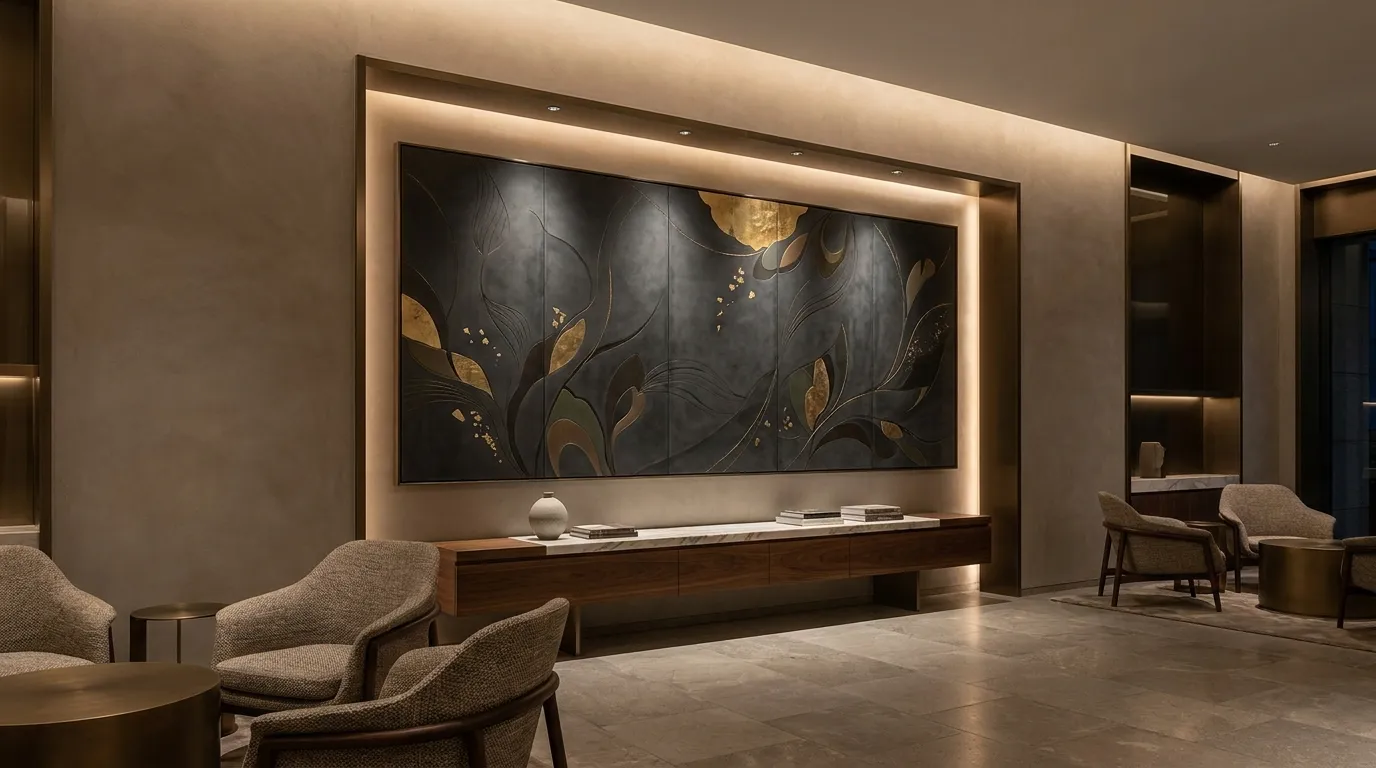
For institutional placement of choshitsu or lacquer art works — hotels, ryokan, restaurants, offices, showrooms, galleries — the considerations extend beyond the object itself to spatial compatibility: lighting type, humidity, direct sunlight, visitor flow, caption display, and terms for photographic use all require discussion.
The Kogei Japonica commissioning and acquisition guide covers these considerations:
Points to confirm when viewing or acquiring choshitsu works
- Does the work description specify the technique — choshitsu, tsuishu, tsuikoku, kokarokuyou, Murakami kibori tsuishu — clearly?
- Can you determine whether the carving operates on lacquer layers or on a wooden substrate?
- Are artist name, studio, production area, date, and materials confirmed?
- Can layer structure and carved edges be examined in person or through detailed images?
- Is the exhibition or sales information based on current, primary-source documentation?
- For purchase or placement, can storage environment, direct sunlight exposure, humidity, and cleaning requirements be discussed?
- For institutional use, can photography terms, display period, insurance, caption text, and English-language description requirements be confirmed?
Kogei Japonica’s perspective
When assessing a choshitsu work, treating intricacy of carving as the primary criterion is limiting. What matters is the relationship between carving depth, the use of negative space, the color layering, and the form of the object. Craft works reveal themselves within their material, function, and spatial context — not through technical accomplishment alone.
Frequently asked questions and glossary
A direct Q&A on the questions most commonly searched in relation to choshitsu.
- Q1. What is choshitsu?
- Choshitsu is a lacquer art technique in which lacquer is applied in many successive layers to build thickness, and those layers are then carved to express patterns. Pieces carved from built-up red lacquer are called tsuishu; those carved from built-up black lacquer are called tsuikoku.
- Q2. How do choshitsu and tsuishu differ?
- In the context of built-up carved lacquer, tsuishu is not a wholly separate technique; it is one of the primary named expressions within choshitsu, referring specifically to works built from red lacquer. Regional craft names using “tsuishu,” however, may refer to different processes and should be checked case by case.
- Q3. How do choshitsu and tsuikoku differ?
- Tsuikoku is the choshitsu expression built primarily from black lacquer. Its visual character lies in subtle depth, shadow, and the quiet recession created by carved black surfaces. Some pieces combine black and red lacquer layers.
- Q4. What is kokarokuyou?
- Kokarokuyou is a multi-color carved lacquer expression within the choshitsu family in which flowers are carved to appear red and leaves to appear green through differentially colored lacquer layers. Layer construction varies per piece; specific work descriptions should be consulted.
- Q5. How do choshitsu, chinkin, and kinma differ?
- Choshitsu carves through built-up lacquer layers to produce the pattern. Chinkin carves the lacquer surface to receive gold powder or gold leaf. Kinma carves grooves that are filled with colored lacquer and then polished flat. All involve carving, but the object being carved and the finishing logic differ.
- Q6. How do choshitsu and Kamakura-bori differ?
- Choshitsu carves through lacquer that has been built up in layers. Kamakura-bori carves the wooden substrate first, then applies lacquer over the carving. The question “does carving come before or after lacquering?” separates the two clearly.
- Q7. Is Murakami kibori tsuishu the same as choshitsu?
- Describing them as the same is inaccurate. Murakami kibori tsuishu — a designated traditional craft from Niigata Prefecture — involves carving the wooden substrate and then building lacquer over it. General choshitsu involves carving through thickly built-up lacquer layers. The substrate being carved and the process of formation differ.
- Q8. Where is choshitsu practiced in Japan?
- Kagawa Prefecture’s lacquerware tradition is among the primary centers for living choshitsu practice in Japan. The Kagawa Prefectural Lacquer Arts Research Institute identifies kinma, zonsei, and choshitsu as the three core Kagawa techniques.
- Q9. How is choshitsu explained in English?
- Choshitsu can be described as carved lacquer or by its Japanese romanization. For international audiences, adding “a technique of carving through built-up layers of urushi lacquer” provides the process context that names alone do not convey. In auction and museum contexts, tsuishu is often described as cinnabar lacquer or red carved lacquer.
- Q10. What should be confirmed before purchasing or installing a choshitsu work?
- Confirm technique name, artist name, materials, production date, dimensions, condition, and care requirements. Pricing varies by artist, work, scale, and market channel — consult official sources from the artist, studio, or gallery directly.
Glossary
| Term | Reading | Meaning |
|---|---|---|
| Choshitsu | ちょうしつ | The technique of carving through built-up lacquer layers |
| Tsuishu | ついしゅ | Choshitsu expression using primarily red lacquer; cinnabar lacquer in English |
| Tsuikoku | ついこく | Choshitsu expression using primarily black lacquer |
| Kokarokuyou | こうかりょくよう | Multi-color choshitsu expression: flowers carved red, leaves carved green |
| Guri | ぐり | A spiral or curvilinear pattern motif; a pattern name, not a technique name |
| Tihong (剔紅) | てきこう | Chinese lacquerware term for red carved lacquer; corresponds broadly to tsuishu |
| Tixi (剔犀) | てきさい | Chinese lacquerware term for a carved lacquer type related to tsuikoku |
| Kinma | きんま | Technique in which carved grooves are filled with colored lacquer and polished flat |
| Chinkin | ちんきん | Technique in which the lacquer surface is carved and gold powder or gold leaf is applied |
| Kamakura-bori | かまくらぼり | Craft in which a wooden substrate is carved, then lacquered |
| Murakami kibori tsuishu | むらかみきぼりついしゅ | A designated traditional craft from Niigata Prefecture: wooden substrate carved, then lacquered |
Choshitsu produces pattern, shadow, and color depth by carving through built-up lacquer layers. Terms like tsuishu, tsuikoku, and kokarokuyou can seem difficult to distinguish at first, but once the underlying structure — building lacquer layers, then carving through them — is clear, they become easier to place.
Chinkin, kinma, Kamakura-bori, and Murakami kibori tsuishu each involve carving, but differ in what is being carved and how the work is finished. Where visual similarities exist, the process sequence resolves the distinction.
At Kogei Japonica, what we want to hold onto is not the accumulation of technical names as information. The more productive question is: what material, in what sequence, under what judgments? With that orientation, lacquer art works become more fully readable.
Choshitsu does not decorate a lacquer surface — it carves time that has been accumulated in layers. For those who look at it, collect it, place it in a space, or consider working with artists and studios, understanding choshitsu is a grounded entry into reading lacquer arts more carefully.
About Kogei Japonica
For inquiries regarding the placement of choshitsu and lacquer art works, spatial presentation in hotels, ryokan, restaurants, and offices, collaborations with lacquer artists and studios, and requests for artist and producer listings, Kogei Japonica is available to discuss options in a way that respects the background and technical context of each work.