

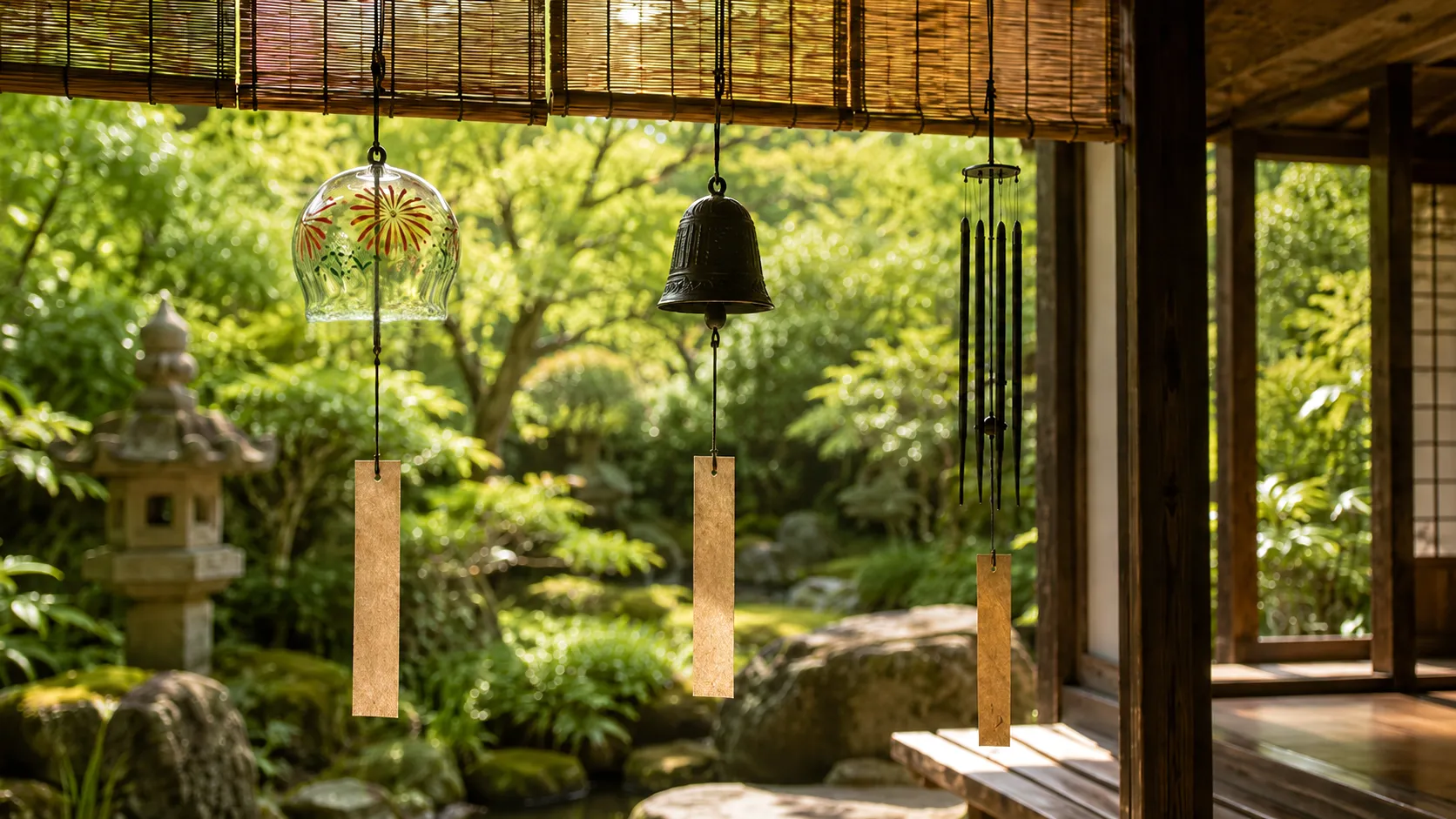
Furin, Japanese wind chimes, produce their sound through the interaction of a hanging body, a clapper, and a tanzaku — a paper streamer that catches even the slightest movement of air. The material of the body and the way it was made determine how that sound behaves: its pitch, its resonance, how long the sound lingers. Edo furin are made of glass; Nanbu Tekki wind chimes are cast in iron; Myochin hibashi furin are made from forged fire tongs. Each comes from a different craft tradition entirely.
Summer in Japan brings furin into view everywhere, but the differences between an Edo furin, a Nanbu Tekki iron wind chime, and a Myochin hibashi furin (明珍火箸風鈴) are not always easy to explain on sight. They look similarly seasonal, but the material, the production method, and the craft history behind each are distinct.
This article organizes where those sound differences come from and compares three representative furin traditions — Edo furin, Nanbu Tekki, and Myochin hibashi — across production region, technique, and designation status.
The short answer is that the sound of a furin is determined not by its appearance alone, but by the combination of material and production method. Free-blown glass shaped without a mold. Iron poured into a cast. Iron rod worked by forging. These differences are what separate one furin’s sound from another’s.
Table of Contents
Where Does a Furin’s Sound Come From? — Material and Method by Production Region
The sound of a furin changes substantially depending on the combination of material and production method. Even within the shared category of “furin,” glass, cast iron, and forged iron produce different pitches, different resonance qualities, and different decays — the way each note fades after being struck.
A furin works through the interaction of three elements: the body that resonates when struck, the clapper (zetsu) that swings to hit it, and the tanzaku paper streamer that catches the wind and sets the clapper in motion. If the material and construction of the body change, so does the way vibration travels through it — and so the same mechanism produces an entirely different listening experience.
Looking at furin through primary sources consistently makes clear that grouping them as “Japanese craft souvenirs” obscures the technical differences between traditions. Edo furin is a glass craft. Nanbu Tekki furin belongs to the tradition of iron casting. Myochin hibashi furin is connected to a specific practice of metal forging. These three furin come from three different craft disciplines that happen to share the same function: turning wind into sound. That is where the interest lies.
Edo Furin, Nanbu Tekki, and Myochin Hibashi — Definitions
Edo furin are glass wind chimes made in Tokyo. They are produced using chubuki — free-blowing, in which molten glass is shaped by breath without the use of a mold. Current production is reported to be concentrated at two workshops: Shinohara Furin Honpo and Shinohara Maruyoshi Furin.
(Source: What Is Edo Furin | Shinohara Furin Honpo)
Nanbu Tekki wind chimes are iron furin drawing on the craft tradition of Nanbu Tekki (南部鉄器), produced primarily in Morioka and the Mizusawa district of Oshu City, Iwate Prefecture. Nanbu Tekki is a cast iron craft designated as a nationally designated traditional craft by Japan’s Ministry of Economy, Trade and Industry (METI) on February 17, 1975.
(Source: Iwate Prefecture: Nanbu Tekki | Tohoku Bureau of Economy, Trade and Industry)
Myochin hibashi furin are wind chimes made in Himeji, Hyogo Prefecture, using hibashi — fire tongs — produced by the Myochin family workshop. The Myochin family traces its lineage to armor craftsmen (katchushi), and the characteristic sound is produced when the tongs strike each other in the wind. Myochin hibashi is designated as a Hyogo Prefecture traditional craft.
(Source: Myochin Hibashi | Hyogo Prefecture)
The term “nationally designated traditional craft” refers specifically to a national system administered under the Act for the Promotion of Traditional Craft Industries, under which Japan’s Ministry of Economy, Trade and Industry (METI) grants formal designation. As of October 27, 2025, 244 categories hold this national designation. Prefectural and municipal designation systems exist separately and should not be read as equivalent to the national designation.
(Source: Traditional Crafts | Ministry of Economy, Trade and Industry)
Edo Furin — Why No Two Sound Exactly Alike
The reason no two Edo furin sound exactly alike is that the glass is shaped by hand, without a mold. The small variations in thickness and form that result from that process translate directly into variations in sound.
The name Edo furin was reportedly given around 1965 by Yoshiharu Shinohara, the second-generation head of Shinohara Furin Honpo, to what had previously been called “glass furin” or “bidoro furin.” According to Shinohara Furin Honpo’s official information, the name reflects that the chimes are made in what was once Edo — present-day Tokyo — using the same production method as in the Edo period.
(Source: What Is Edo Furin | Shinohara Furin Honpo)
The production method is chubuki: molten glass is gathered on a blowpipe and shaped by breath alone, without the use of a mold. Because no mold governs the form, every piece comes out slightly different in thickness and shape.
One further detail distinguishes Edo furin: the opening at the bottom — where the clapper hangs — is deliberately left with a rough, unsmoothed edge rather than being fire-polished. When the clapper strikes this edge, the resulting vibration is lighter and more complex than a smooth rim would produce. The painted motifs are also applied to the inside surface of the glass, not the outside.
(Source: Edo Furin | Tokyo Regional Resources Navigator)
In 2025, Edo furin received recognition from the Acoustical Society of Japan as an “acoustic heritage” (音響遺産) — a designation that positions the object not only as a craft artifact or regional product but as something evaluated for the cultural value of its sound in its own right.
(Source: Acoustic Heritage | Acoustical Society of Japan)
The appeal of Edo furin lies in the fact that the sound is never fully uniform. Unlike a manufactured product where every unit sounds the same, the variation in glass thickness, shape, and rim condition produces a different note in each piece. Selecting one for its specific sound, rather than only its visual appearance, is part of what distinguishes how Edo furin are chosen.
Why No Two Edo Furin Sound Exactly Alike
Three factors combine to produce this variation. First, chubuki — free-blowing without a mold — means every piece varies slightly in glass thickness and overall shape. Second, the deliberately rough, unpolished rim at the opening means the clapper strikes a slightly different surface each time and at slightly different points. Third, the handmade body itself introduces variation in size and form. The combination of all three is what gives each Edo furin its individual character.


Nanbu Tekki Wind Chimes — The Sound of Cast Iron
Nanbu Tekki wind chimes are defined by a clear metallic tone with a calm, lingering resonance — qualities specific to iron. The pitch and resonance of an individual chime will vary with its size, wall thickness, and form, so it is worth checking the sound of a specific piece before purchasing.
Nanbu Tekki is a cast iron craft produced primarily in Morioka and the Mizusawa district of Oshu City, Iwate Prefecture. According to the Tohoku Bureau of Economy, Trade and Industry, Nanbu Tekki developed from two converging traditions: the tea-ceremony kettle production of Morioka, and the everyday cast iron ware that had taken root in the Mizusawa area. It received national designation as a traditional craft under METI on February 17, 1975.
(Source: Iwate Prefecture: Nanbu Tekki | Tohoku Bureau of Economy, Trade and Industry)
Most people associate Nanbu Tekki with the iron kettle (tetsubin). Wind chimes are another application of the same material — one that foregrounds the acoustic properties of iron rather than its thermal ones. Where an Edo furin’s glass body produces a light, airy tone, an iron body produces a sound that registers the density of the material: clear and metallic, with a longer, more settled resonance.
One point worth being precise about: it would not be accurate to describe Nanbu Tekki furin sound as categorically “low.” Pitch and resonance are both affected by the size, wall thickness, and shape of the individual piece. For this reason, “a clear metallic tone with a calm, lingering resonance” is a more accurate characterization of the type than any single pitch descriptor.
The production of Nanbu Tekki involves multiple stages — mold-making, casting, finishing, and surface treatment — and the specifics of how a particular furin is made and finished will vary by manufacturer. For information about specific materials and finishes, check the official information from the producing workshop or retailer.
As an iron product, Nanbu Tekki requires attention to moisture. When hanging outdoors, choosing a position sheltered from direct rain reduces the risk of deterioration. At the end of the summer season, storing the piece dry is advisable.
Myochin Hibashi Furin — Why the Form of Fire Tongs Was Retained
The reason Myochin hibashi furin retains the form of fire tongs is that the chime developed directly from the tool. The hibashi were originally made to handle charcoal. When it was discovered that the tongs produced a distinct, clear sound when struck together, they were adapted into a wind chime. The form of the fire tongs was retained rather than replaced, and the functional object and its history are still present in the form.
The Myochin family traces its lineage to armor craftsmen (katchushi). According to Hyogo Prefecture’s official information, the Myochin family — whose armor-making lineage extends back to the late Heian period — began producing hibashi (fire tongs) during the Meiji era. The tongs were originally utilitarian objects for handling charcoal, but the sound produced when they struck each other led to their being adapted for use as wind chimes and door chimes.
(Source: Myochin Hibashi | Hyogo Prefecture)
According to Myochin Honpo’s official information, the Myochin hibashi furin was developed by the 52nd-generation head, Myochin Muneyoshi, through a period of sustained experimentation, and reached its current form in 1965.
(Source: Myochin Honpo Official Site | Myochin Honpo)
Structurally, the Myochin hibashi furin operates differently from a conventional wind chime. Rather than a clapper striking the interior of a body, multiple tongs hang together and strike each other as they move in the wind. The sound — delicate, clear, and long-sustaining — results from this particular structure.
On materials: describing the hibashi uniformly as “steel” in a fixed way would be an overclaim. The safer and more accurate description is forged iron fire tongs. As specifications may vary between products, pricing, availability, lead times, and material details should be confirmed through official sources, including Myochin Honpo.
What stands out editorially about Myochin hibashi furin is that they were not redesigned to look like conventional wind chimes. The form of the fire tongs was kept, and the acoustic properties were brought forward to create something new from it. The object carries the memory of its original use alongside the sound it now produces. That dual presence is central to what makes it distinctive.
Edo Furin, Nanbu Tekki, and Myochin Hibashi: Comparison Table
Edo furin, Nanbu Tekki wind chimes, and Myochin hibashi furin all go by the name “furin,” but differ substantially in material, production method, production region, and the character of their sound. A comparison table clarifies the distinctions and gives a clearer basis for choosing between them.
| Category | Edo Furin | Nanbu Tekki Wind Chime | Myochin Hibashi Furin |
|---|---|---|---|
| Production region and background | Tokyo. Representative workshops include Shinohara Furin Honpo and Shinohara Maruyoshi Furin. | Iwate Prefecture, centered on Morioka and the Mizusawa district of Oshu City. Draws on the Nanbu Tekki cast iron tradition. | Himeji, Hyogo Prefecture. Developed from the hibashi production of the Myochin family, whose lineage traces to armor craftsmen. |
| Primary material | Glass | Cast iron | Forged iron fire tongs |
| Production method and structure | Chubuki (free-blowing). Glass is shaped by breath without the use of a mold. | Casting. Iron is poured into a mold. Draws on the technical background of iron casting. | Forging. Multiple tongs hang together and strike each other as they move in the wind. |
| Sound character | Light, airy tone with transparency. No two pieces sound exactly alike. | Clear metallic tone with a calm, lingering resonance characteristic of iron. | A delicate, clear tone with a long-sustaining decay. |
| Designation and classification notes | Presented as a traditional craft of Edogawa Ward and listed as a Tokyo regional resource. The designation framework differs from Tokyo Metropolitan Government’s “42 Traditional Crafts of Tokyo” and should be understood separately. | Designated as a nationally designated traditional craft by METI on February 17, 1975. | Designated as a Hyogo Prefecture traditional craft. This is a separate system from the national METI designation. |
| Suited uses | Home window display, summer gift, a gift with an easy story to tell for overseas guests. | Entranceway, eaves, calm interior spaces, corporate gift, Japanese-modern seasonal display. | Ryokan, hospitality guest rooms, gallery, considered gifts, quiet spatial installations. |
| Points to note | Handle with care — glass is fragile. | Iron product — attention to moisture and rust is needed. | Verify pricing, availability, lead times, and material specifications through official sources. |
(Source: Edo Furin | Tokyo Regional Resources Navigator)
(Source: Iwate Prefecture: Nanbu Tekki | Tohoku Bureau of Economy, Trade and Industry)
(Source: Myochin Hibashi | Hyogo Prefecture)
(Source: Tokyo Traditional Crafts List | Tokyo Metropolitan Government Bureau of Industrial and Labor Affairs)
The table is not a ranking. What it supports is a question: which sound, in which space, for which purpose? Looking beyond the visual surface — at material, production method, and production background — is what makes a more specific and more confident choice possible.
A Checklist for Selecting by Production Region and Method
When choosing a furin as a craft object rather than simply a seasonal item, the following points help narrow the decision:
- Can you confirm the production location and the name of the maker or workshop?
- Is there an explanation of the production method and material?
- Is it possible to hear the actual sound — in person or through a video?
- Have you decided whether the installation will be indoors or outdoors?
- Do you understand the care requirements specific to the material — glass, iron, or fire tongs?
- If it is a gift, does the recipient’s living environment suit the sound and the material?
- For institutional or corporate use, have you confirmed quantities, lead times, packaging, and any explanatory materials needed?
These criteria are not a test of authenticity. They are a practical framework for verifying production background and choosing a furin that fits the intended use — whether for personal enjoyment, gifting, or spatial installation.
Frequently Asked Questions
Common questions about choosing between furin types, answered briefly. Because Edo furin, Nanbu Tekki, and Myochin hibashi each use different materials and production methods, the considerations that go into choosing each are also somewhat different.
- Q1. What is the difference between an Edo furin and an ordinary glass wind chime?
- Edo furin are produced using chubuki — free-blowing without a mold — and the opening at the base is deliberately left with a rough, unpolished edge. Not all glass wind chimes qualify as Edo furin. Verify through the producer’s official information when purchasing.
- Q2. Is a Nanbu Tekki wind chime made from the same material as a Nanbu Tekki kettle?
- Both are iron products, but their forms and intended uses differ. The more reliable approach is to understand a Nanbu Tekki wind chime as drawing on the Nanbu Tekki cast iron tradition, and to confirm specific materials and finishes through the producer’s official information.
- Q3. Why does Myochin hibashi furin keep the form of fire tongs?
- The furin was developed directly from hibashi — fire tongs originally made for handling charcoal. The discovery that the tongs produced a clear, resonant sound when struck together led to their adaptation as wind chimes. The form of the fire tongs was retained rather than replaced.
- Q4. Is the sound difference between furin purely about material?
- No. Material is one factor, but the production method — chubuki, casting, or forging — as well as the wall thickness, the overall form, and how the clapper interacts with the body all affect the sound. The combination of all these factors produces each type’s characteristic sound.
- Q5. Can furin be used in an apartment?
- They can, but the sound will carry to neighbors. In shared housing situations, hanging the chime indoors, moving it out of the wind when it becomes too loud, and bringing it in at night are all practical considerations for maintaining good relations with those nearby.
- Q6. Are furin suitable as corporate gifts?
- Yes, for the right recipient and context. That said, it is worth confirming quantities, lead times, packaging, noshi presentation, explanatory cards, international delivery options, and fragility before ordering. Choosing a furin whose production background can be explained adds considerable value to the gift — it becomes something more than a seasonal item.
- Q7. How would you explain a furin to someone overseas?
- In English, “furin” or “Japanese wind chime” both work as descriptions. Adding that the sound changes depending on whether the body is glass, cast iron, or forged metal — and that these differences reflect entirely separate craft traditions — helps frame it as something beyond a souvenir. That framing tends to be more memorable and more accurate.
Using Furin in Commercial and Hospitality Settings
Furin translate well into corporate gift programs and seasonal display for hospitality venues, retail spaces, and offices. Because they produce sound, the choice of where and how to install them requires thought about the setting and the people in it.
For corporate gifting, pricing alone is not the most useful selection criterion. Being able to explain what the gift is — the glass-blowing behind Edo furin, the cast iron tradition of Nanbu Tekki, the armor-making lineage behind Myochin hibashi — is what gives the object context and makes it worth giving. Production background is part of the value being conveyed.
For seasonal display in hotels, restaurants, or retail spaces, both volume and placement require consideration. The right furin for an entranceway is not necessarily the right furin for a guest room. A spot exposed to strong airflow will sound constantly; a spot with gentle, intermittent air movement is more conducive to a pleasant effect. The goal is a presence that registers without becoming intrusive.
For commercial and institutional installations, the following points are worth confirming in advance:
- Is the installation indoors or outdoors?
- Will the sound carry to adjacent spaces or neighboring occupants?
- Given the expected visitor dwell time, will the sound remain pleasant rather than becoming fatiguing?
- Are there provisions for rain, wind exposure, rust, or breakage?
- Has a plan been made for off-season storage?
- Are explanatory cards or POP materials available for display?
- For corporate gifts: have quantities, lead times, packaging, and noshi presentation been confirmed?
- For international guests: is English-language explanation available to accompany the piece?
Editor’s Note
A furin is not only a summer decoration. It converts the presence of moving air into sound, and in doing so slightly changes the pace of a space.
The light, airy note of Edo furin glass. The clear metallic resonance of Nanbu Tekki iron. The delicate, long-sustaining tone of Myochin hibashi. Each material and method produces a different impression of what summer sounds like in a room.
Choosing with attention to material, production method, production region, and the character of the sound — rather than appearance alone — is what allows a furin to become something that stays in a space past the season.
Kogei Japonica is available for consultation on seasonal display using craft objects, corporate gift programs, and spatial installation for hospitality venues and commercial spaces with production background in mind. For those considering a combination of craft objects — not only furin — for a retail, accommodation, or office environment, matching selection to the intended space and use is the starting point.
Furin tend to look similar at a distance. But what the glass of Edo furin, the cast iron of Nanbu Tekki, and the forged metal of Myochin hibashi have in common is only this: each is a different craft tradition that found its way to the same function — turning wind into sound. That is where the interest begins.
Cool air is not only a matter of temperature. Listening for the small sound that remains after the wind passes through is one of the more considered ways to engage with summer craft.
