

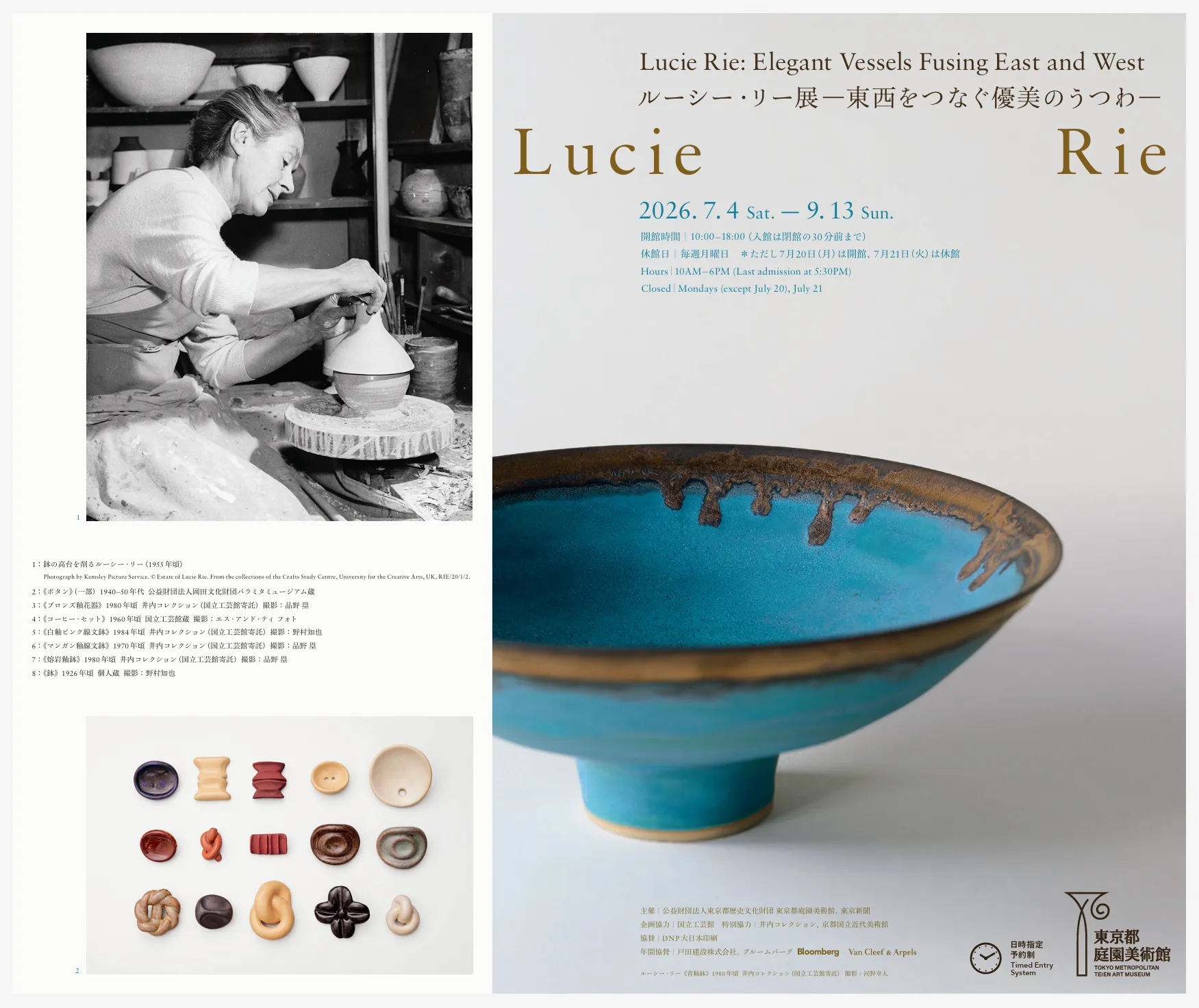
If you have heard about the Lucie Rie exhibition at Tokyo Metropolitan Teien Art Museum and want to confirm the dates, tickets, and admission details, this guide covers the essentials. If your question goes further — who was Lucie Rie, and why has her work found such sustained support in Japan — this article addresses that too.
This guide is organized in two parts: practical visitor information, followed by a closer look at Rie’s ceramics within the context of British studio pottery and Japanese reception.
Lucie Rie (1902–1995) was born in Vienna and relocated to London in 1938. She is one of the defining ceramic artists of the twentieth century, known for wheel-thrown forms of considerable precision, experimental glazes producing deep color and surface variation, and surface techniques including zogan (inlay) and sgraffito that create fine linear expression on the vessel.
That said, describing Rie simply as an artist who “bridged East and West” risks missing what actually matters about her work. What is at stake is not the addition of Eastern and Western elements, but how she translated the cultures, materials, techniques, and relationships she encountered into her own decisions about form, glaze, and line.
This article covers the practical information for “Lucie Rie: Elegant Vessels Bridging East and West” at Tokyo Metropolitan Teien Art Museum, and looks at how British studio pottery and Japanese ceramic sensibility intersect in her work — drawing throughout on the editorial perspective of Kogei Japonica.
Editor’s Note
When I look at Lucie Rie’s work, I find it worth approaching the convenient phrase “East-West fusion” with a degree of skepticism. What deserves attention is not only which cultural influences shaped her, but how much she stripped away and rebuilt as her own form. The distance between what she received and what she made is precisely where her strength lies.
Table of Contents
When and Where Is the Lucie Rie Exhibition?
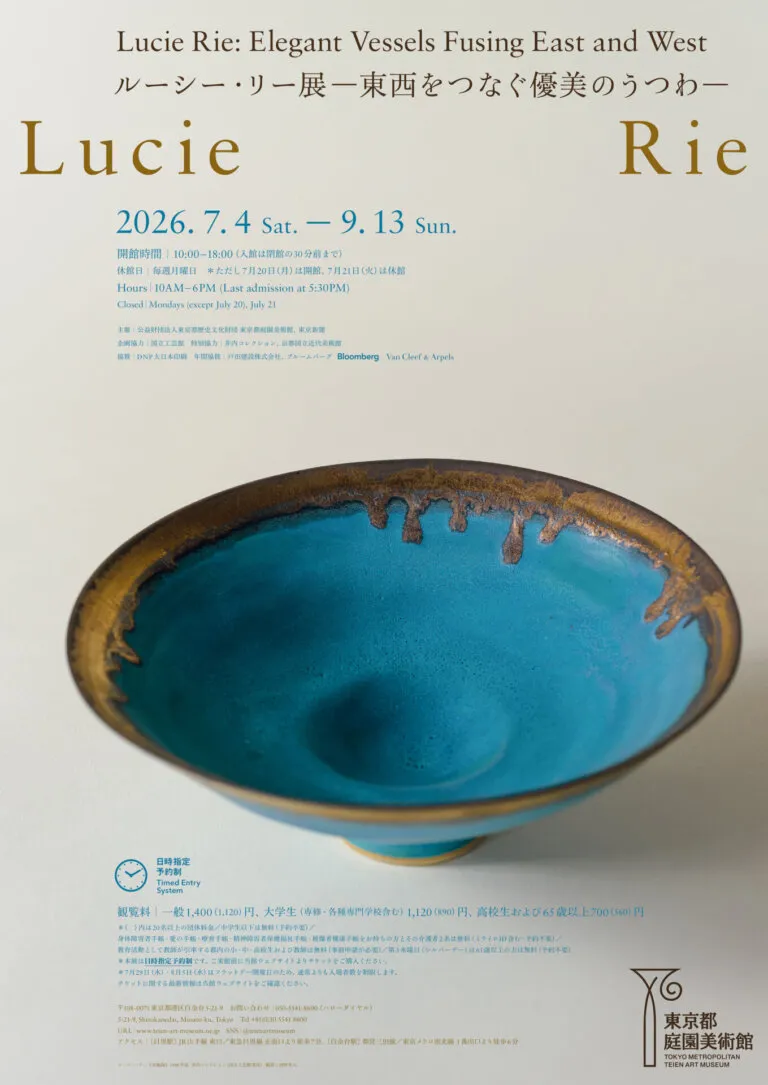
The exhibition runs from Saturday, July 4 to Sunday, September 13, 2026, at Tokyo Metropolitan Teien Art Museum’s Main Building and Annex. The exhibition operates on a timed-entry reservation system, so confirming ticket availability on the official website before your visit is essential.
Dates, Opening Hours, and Closures
“Lucie Rie: Elegant Vessels Bridging East and West” runs from Saturday, July 4 to Sunday, September 13, 2026, at Tokyo Metropolitan Teien Art Museum. The exhibition is held in both the Main Building and Annex.
Opening hours are 10:00 to 18:00, with last admission 30 minutes before closing. On Fridays — August 7, 14, 21, and 28 — the museum extends its hours to 21:00 as part of “Summer Night Museum 2026.”
The museum is closed on Mondays. However, Monday, July 20 will be open, with Tuesday, July 21 taking its place as the closure day. As the exhibition runs through the summer holiday period, be careful not to rely on the standard Monday closure pattern alone when planning your visit.
(Source: Lucie Rie: Elegant Vessels Bridging East and West | Tokyo Metropolitan Teien Art Museum)
| Item | Details |
|---|---|
| Exhibition title | Lucie Rie: Elegant Vessels Bridging East and West |
| Dates | Saturday, July 4 – Sunday, September 13, 2026 |
| Venue | Tokyo Metropolitan Teien Art Museum, Main Building + Annex |
| Address | 5-21-9 Shirokanedai, Minato-ku, Tokyo |
| Opening hours | 10:00–18:00; last admission 30 minutes before closing |
| Extended evening hours | Open until 21:00 on August 7, 14, 21, and 28 |
| Closed | Every Monday. Exception: July 20 open; July 21 closed instead |
| Booking | Timed-entry reservation system |
Admission and Ticket Booking
Admission is ¥1,400 for general visitors, ¥1,120 for university students, and ¥700 for high school students and visitors aged 65 and over. Group rates are also available, but groups of 20 or more require advance application. Children in middle school and younger are admitted free of charge and do not require a reservation.
Holders of physical disability, welfare, therapy, mental health welfare, or atomic bomb survivor health certificates, along with up to two accompanying caregivers, are also admitted free. These visitors are exempt from the reservation requirement but must present their certificate at the venue.
As this is a timed-entry exhibition, general visitors are expected to purchase tickets online in advance. There are, however, cases where reservation is not required — including free admission categories — so please check the museum’s official website for the latest details.
(Source: Exhibition Information | Tokyo Metropolitan Teien Art Museum)
| Category | Standard Admission | Group Rate |
|---|---|---|
| General | ¥1,400 | ¥1,120 |
| University students | ¥1,120 | ¥890 |
| High school students / 65 and over | ¥700 | ¥560 |
| Middle school and younger | Free | No reservation required |
Online tickets went on sale from 10:00 on Thursday, June 4, 2026. Tickets for the extended evening hours (17:00–21:00) on Fridays in August are noted as being scheduled for release during July. A limited number of same-day tickets will also be available for visitors without internet access, but availability is not guaranteed and the museum may sell out.
(Source: Online Ticket Sales | Tokyo Metropolitan Teien Art Museum)
Getting There and Venue Notes
The venue is Tokyo Metropolitan Teien Art Museum, located at 5-21-9 Shirokanedai, Minato-ku, Tokyo. The Main Building was completed in 1933 as the private residence of Prince and Princess Asaka — an Art Deco structure that, alongside the Annex, forms the exhibition space.
The character of this building matters for how the exhibition reads. Lucie Rie’s vessels are not objects that reveal themselves best in a white-walled gallery. Seen within a domestic architectural space, the silhouette of each piece, its relationship to light, and the negative space it creates become considerably more legible.
This exhibition began its national tour at the National Crafts Museum in Kanazawa, Ishikawa Prefecture, and travels from Tokyo to Mie and then Osaka. The full touring schedule is as follows.
(Source: Touring Schedule | Tokyo Metropolitan Teien Art Museum)
| Venue | Dates | Notes |
|---|---|---|
| National Crafts Museum (Kanazawa, Ishikawa) | September 9 – November 24, 2025 | Concluded. Held at the institution where the Iuchi Collection is on deposit |
| Tokyo Metropolitan Teien Art Museum | July 4 – September 13, 2026 | Held in the Art Deco former Asaka imperial residence |
| Mie Prefectural Art Museum | September 26 – December 13, 2026 | Tokai region venue |
| Abeno Harukas Art Museum (Osaka) | December 26, 2026 – March 7, 2027 | Western Japan venue |
Touring exhibition schedules and related event details are subject to change. If you plan to attend at any venue other than Tokyo, confirm dates and program details through that institution’s official website.
Who Was Lucie Rie? The Life of a Ceramic Artist Between Two Worlds
Lucie Rie (1902–1995) was born in Vienna and relocated to London in 1938 — one of the defining ceramic artists of the twentieth century. She is known for refined wheel-thrown forms, distinctive glazes, and surface work using inlay (zogan) and sgraffito techniques.
Vienna to London — 1938 as a Turning Point
Lucie Rie was born in Vienna, Austria. It was at the Vienna School of Arts and Crafts that she became drawn to wheel-throwing, which set the direction of her practice. According to the official account from Tokyo Metropolitan Teien Art Museum, she had established herself as a ceramicist when, in 1938, the circumstances of war forced her into exile and she moved her practice to London.
(Source: Lucie Rie Exhibition Overview | Tokyo Metropolitan Teien Art Museum)
The Victoria and Albert Museum (V&A) positions Rie as one of the most influential figures in British studio pottery, describing her as an artist who brought a continental modernist sensibility to British ceramics and challenged the dominant aesthetic assumptions of the time through refined, spare forms and experimental glazes.
(Source: Lucie Rie: a Modernist revolution in British studio ceramics | Victoria and Albert Museum)
Her fresh start in London was not without difficulty. The V&A notes that during the war years, Rie also took on the production of buttons for the fashion industry. This tends to be overlooked in the light of her later reputation, but it speaks to the instability of her circumstances — and to how she kept her practice as a ceramicist alive through that period.
That said, there is no need to dramatize this background. When it comes to looking at craft objects, what matters is not consuming a maker’s biography as an affecting narrative, but attending to how that experience was translated into the form and surface of the vessel.
Wheel-Thrown Form, Inlay, and Sgraffito — Rie’s Techniques
Lucie Rie’s work is characterized by thin, balanced forms produced on the potter’s wheel, onto which she layered surface work — zogan (inlay), sgraffito — and glazes producing rich color and texture.
| Term | Reading | Meaning |
|---|---|---|
| Rokuro (potter’s wheel) | ろくろ | A technique of shaping clay on a rotating platform. Generates the contour and symmetry of the vessel. |
| Zogan (inlay) | ぞうがん | A decorative inlay technique in which contrasting clay or slip is set into incised or recessed areas of the surface to create a pattern. |
| Sgraffito (kakiotoshi) | かきおとし | A technique of scratching through glaze or slip to expose the layer beneath, creating linear patterns. |
| Glaze (yuyaku) | ゆうやく | A glassy layer applied to the ceramic surface. Produces color, sheen, texture, and waterproofing. |
Worth emphasizing here is that Rie’s surface treatment is not simply “decoration.” The V&A notes that in her work, surface and form operate as a unity — decoration does not subordinate itself to form but contributes to the total effect.
(Source: Lucie Rie: a Modernist revolution in British studio ceramics | Victoria and Albert Museum)
British studio pottery of the period placed considerable value on the visible traces of hand and wheel — the rings and marks left by throwing. Rie, however, diverged from Leach in this respect: rather than foregrounding these traces as an expression of craft character, she smoothed them, offering a different kind of handmade sensibility.
This is not merely a question of different finishing preferences. It is a fundamental position: does showing the marks of making communicate craft? Or does suppressing them allow the tension of form itself to emerge? Rie’s vessels pose this question quietly.

Why Is This Described as “The First Major Retrospective in Japan in Roughly a Decade”?
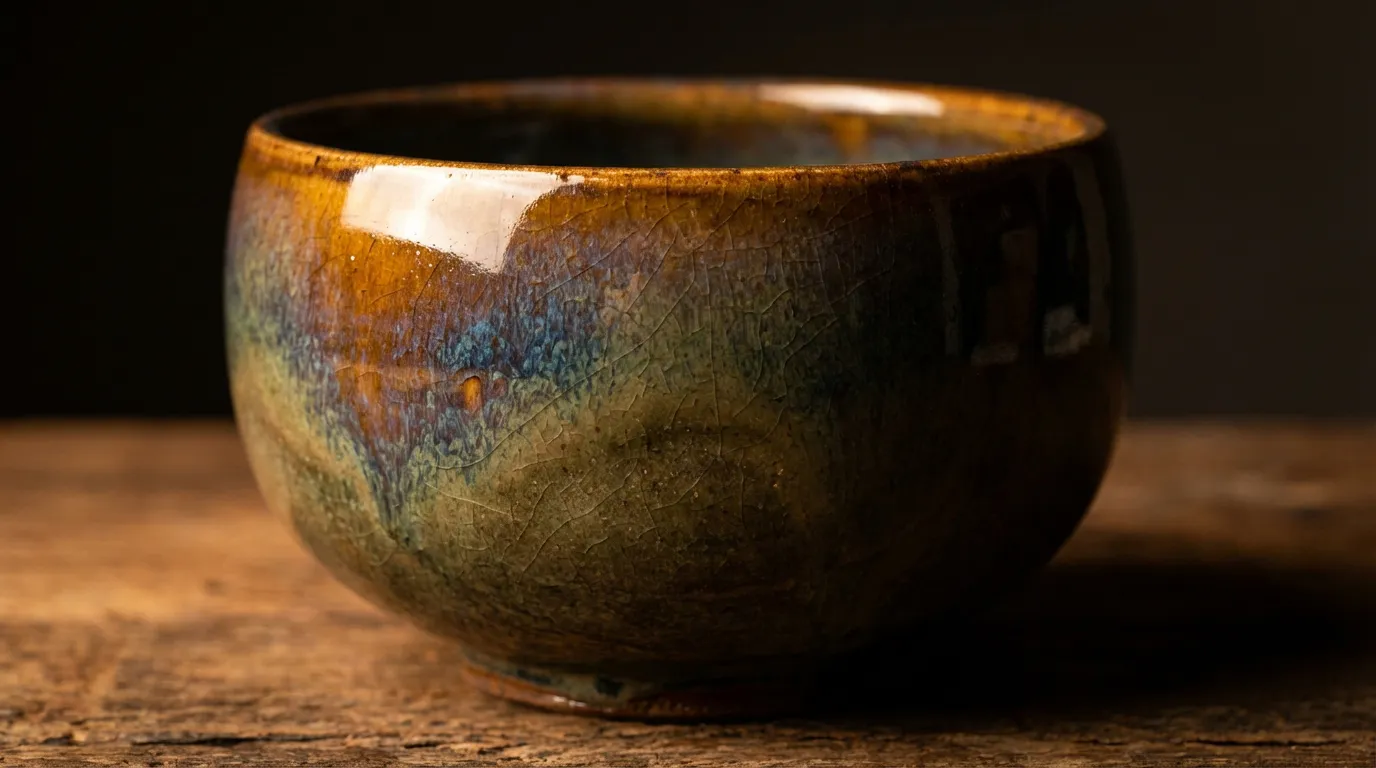
The description reflects both Japan’s specific reception history of Rie’s work and the concentrated body of material centered on the Iuchi Collection. This is not simply a touring show — it should be understood as a significant moment in the ongoing reassessment of Rie’s place within Japanese ceramic culture.
A Reception History That Begins in 1989
According to Tokyo Metropolitan Teien Art Museum’s official account, Lucie Rie’s work was introduced to Japanese audiences in a substantial way at Sogetsu Hall in 1989, and since major exhibitions in 2010 and 2015 has become widely appreciated.
(Source: Exhibition Highlights | Tokyo Metropolitan Teien Art Museum)
It is more accurate to understand the 1989 presentation as a landmark moment of serious introduction rather than a definitive first encounter. What is significant is the arc: 1989, 2010, 2015, and now 2026 — a repeated return by Japanese audiences to Rie’s work, each time with an accumulation of critical context.
The reputation of a craft artist is not established by a single exhibition. Works are shown together; catalogues and criticism accumulate; collections form; and the next exhibition rereads the same work through a different lens. Through this process, a maker’s place in the culture is established gradually.
The Iuchi Collection and the National Crafts Museum
The essential core of this exhibition is the Iuchi Collection, currently on long-term deposit at the National Crafts Museum in Kanazawa. The National Crafts Museum’s official description presents the exhibition as introducing approximately 120 works by Lucie Rie, centered on works from the Iuchi Collection.
(Source: 5th Anniversary of Relocation: Lucie Rie Exhibition | National Crafts Museum)
Tokyo Metropolitan Teien Art Museum’s official information also introduces the exhibition as an occasion for works from the Iuchi Collection on deposit at the National Crafts Museum, together with other Rie works held in Japan, to be seen together in one place.
This matters as a way of thinking about craft works. Ceramic objects exist as physical things. They are susceptible to damage and dispersal. The existence of a collection that can preserve works continuously and present them in concentrated form is indispensable to understanding a maker’s practice.
A collection is not simply an act of ownership. It is a cultural mechanism for passing works to the next generation of viewers. That is part of what it means to see this exhibition as a retrospective roughly a decade in the making.
Why Does the Exhibition Include Leach, Coper, and Hamada Shoji?
The exhibition includes works by artists with whom Rie had significant relationships, allowing her ceramics to be read in relation to the people, places, and period she inhabited. This structure positions Rie not as an isolated figure but as one at the intersection of different ceramic traditions — a lens through which East and West encountered each other.
Josef Hoffmann and the Vienna Connection
One of the artists Rie encountered during her Vienna years was the architect and designer Josef Hoffmann — a central figure in the Wiener Werkstätte, known for his integrated approach to architecture, furniture, craft, and decoration.
The list of featured works at Tokyo Metropolitan Teien Art Museum includes a liqueur glass with decoration by Ueno Richi-Rix and form by Josef Hoffmann. This serves as a material indication of the design environment in Vienna that formed Rie’s starting point.
(Source: Featured Works | Tokyo Metropolitan Teien Art Museum)
Looking at Lucie Rie through ceramics alone reveals only part of her background. The craft education of Vienna, the sensibility of modernist design, the texture of urban life — these converge in the precise forms and surface treatments of her later work.
Studio Pottery as a Context, and Where Rie Diverged from Leach
In London, Rie became connected to figures essential to any account of British ceramics: Bernard Leach and Hans Coper among them. The V&A describes Hans Coper as having been Rie’s assistant and later a frequent collaborator and lifelong friend.
(Source: Lucie Rie: a Modernist revolution in British studio ceramics | Victoria and Albert Museum)
It is more accurate to characterize Coper’s deep involvement in Rie’s working environment — and the influence they had on each other — as developing from the late 1940s onward, rather than pinning it to a specific date.
Hamada Shoji is identified in Tokyo Metropolitan Teien Art Museum’s official information as one of the artists with whom Rie was in contact. However, asserting a specific route of introduction would require additional primary source confirmation. For the purposes of this article, Hamada is positioned as a significant figure for understanding the relationship between East Asian ceramics and British studio pottery.
| Artist | Primary Context | How to Read in This Exhibition | Ceramic Orientation |
|---|---|---|---|
| Lucie Rie | Vienna to London | Central figure of the exhibition | Suppressed wheel-throwing traces; pursued an urban, modernist vessel form |
| Bernard Leach | British and Japanese ceramic exchange | Entry point for thinking about the relationship between British studio pottery and East Asian ceramics | Engaged with East Asian ceramics and mingei (folk craft); emphasized the beauty of use and handmade trace |
| Hans Coper | London ceramic environment | Key figure for understanding Rie’s working context and collaborative relationships | Developed sculptural, architectural forms |
| Hamada Shoji | Japan (Mashiko), mingei movement | Important presence for thinking about the relationship between East Asian ceramics and British studio pottery | Embodied the folk craft aesthetic — beauty of use, material quality, mingei values |
Studio pottery, as a term, refers to the context of modern and contemporary ceramics in which the artist’s studio serves as the foundation, and the full range of material, forming method, glaze, firing, and vessel form is conceived as an integrated whole. It does not necessarily mean that one artist carries out every stage of production independently — what matters is that the studio environment is the site through which the artist’s aesthetic judgment is expressed in its totality.
What I most want to convey through this comparison is the risk of framing this exhibition through words like “Leach-like wabi-sabi” or “East-West fusion.” Leach and Rie occupied the same period, the same British studio pottery context — and produced very different answers.
If Leach and Hamada Shoji found beauty in soil, in the mark of the hand, in the use of the object, then Rie suppressed the traces of the wheel and, through line, glaze, and vessel form, made vessels of a quieter urban strength. This is where the interest lies: not in a simple binary of East and West, but in looking at this exhibition as a place where multiple ceramic orientations intersect.
What Does It Mean to See These Vessels in an Art Deco House?
Seeing Lucie Rie’s vessels in the former Asaka imperial residence at Tokyo Metropolitan Teien Art Museum changes how they appear — not as objects in a display case, but as vessels resonating with the space around them. The venue is one of the exhibition’s defining qualities.
Tokyo Metropolitan Teien Art Museum as a Site
The Main Building of Tokyo Metropolitan Teien Art Museum was completed in 1933 as the private residence of Prince and Princess Asaka — an Art Deco building. The museum’s own presentation of the exhibition highlights the opportunity to experience a dialogue between Lucie Rie’s ceramic world and the architecture of the former Asaka residence, within a domestic architectural space that draws out the inherent qualities of her vessels.
(Source: Exhibition Highlights | Tokyo Metropolitan Teien Art Museum)
Lucie Rie’s vessels are objects that recall, in their very form, the idea of being used in daily life — what in Japanese is called utsuwa, a term for vessels that implies not only their function as tableware but the object’s presence in use, in the hand, and in a room. Yet when displayed in a museum, they also carry the weight of objects made for sustained looking. They occupy the threshold between the used and the seen.
Seeing them in a domestic architectural space raises the stakes for the silhouette of each vessel, the way light falls across its surface, the distance it holds from wall and floor, the height at which it is encountered. Ceramic works change substantially depending on the environment in which they are placed. Tokyo Metropolitan Teien Art Museum is therefore not merely a venue — it is a material condition that shapes what is visible in these works.
Editor’s Note
A craft object does not communicate its value simply by being placed in a room. At what height do you look at it? In what light? At what distance do you approach? The impression a work makes changes with all of these. Rie’s vessels are quiet objects — and precisely because they are quiet, they reflect the quality of the space around them with clarity. This is an important consideration when working with craft objects in any context.
Related Events and Visitor Programs
A number of related programs are planned for the exhibition period: lectures, short talks by the exhibition curator, a workshop in which participants make ceramic buttons, a touch-and-talk viewing session, and designated low-capacity days and baby-stroller hours. Some programs require advance registration; check the official website for registration opening dates and conditions if you plan to attend.
(Source: Related Events and Programs | Tokyo Metropolitan Teien Art Museum)
| Program | Date / Time | Content |
|---|---|---|
| Lecture: “The Evolution of Lucie Rie’s Style — From Vienna to London” | Sunday, July 19, 2026, 14:00– | Lecture by Kaneko Kenji. Covers Rie’s historical context and formal development. |
| Curator Mini-Lecture | Friday, July 31, 16:00–; Saturday, August 8, 14:00– | Short introduction to the exhibition’s structure and key works. |
| Workshop: “Make a Ceramic Button” | Saturday, August 22, 2026 | Inspired by Rie’s ceramic buttons; participants make their own original button. |
| Access Program: “Sawa-kai — Touch and Talk Viewing Session” | Sunday, July 12, 2026 | Viewing session in which participants engage with the building and works through touch and conversation. |
| Low-Capacity Day / Baby Hour | Wednesday, July 29; Wednesday, August 5, 2026 | Days with reduced visitor numbers, and designated times for visitors with strollers. |
Before your visit, the following points are worth confirming:
- The exhibition operates on a timed-entry reservation system; check online ticket availability in advance
- Confirm eligibility for free admission and reservation-exempt categories (children in middle school and under, certificate holders, etc.)
- Note that the museum is closed Mondays, but July 20 is open and July 21 is closed in its place
- Extended evening hours (to 21:00) apply on Fridays, August 7, 14, 21, and 28
- Photography is permitted for most works, but flash, reflectors, tripods, selfie sticks, telephoto lenses, video recording, and commercial photography are restricted
- Lectures and workshops require advance registration; check the opening date for applications
Photography is permitted for most works in the exhibition. However, flash photography, reflectors, tripods, selfie sticks, telephoto lenses, video recording, and commercial photography are all prohibited or restricted. When sharing images on social media, take care to ensure other visitors are not identifiable in your photographs.
(Source: Photography Policy | Tokyo Metropolitan Teien Art Museum)
What Collectors, Gallerists, and International Art Professionals Should Take from This Exhibition
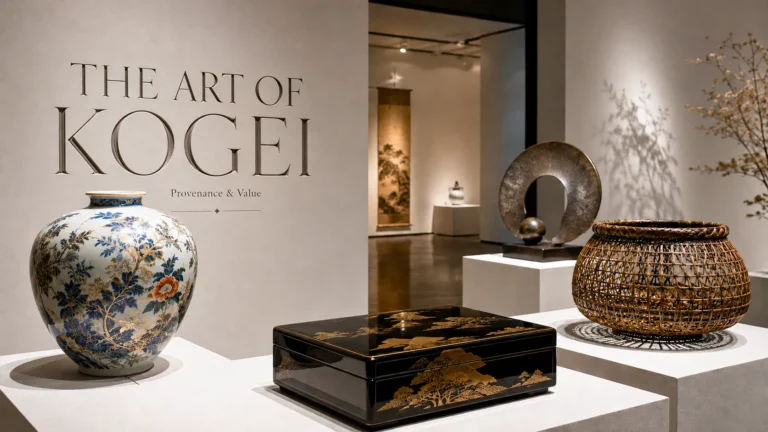
Beyond the practical details, this exhibition is an opportunity to examine how British studio pottery and Japanese ceramic culture have intersected — and continue to intersect. For collectors and gallery professionals, it provides an entry point into reading the value of Rie’s work not through price alone, but through provenance, technique, and exhibition context.
Studio Pottery as a Framework for Evaluation
For international art and design professionals, Lucie Rie is typically situated within the discourse of British studio pottery. The V&A describes her as an artist who brought a continental modernist sensibility to British ceramics, challenging the prevailing aesthetic values of the time.
(Source: Lucie Rie: a Modernist revolution in British studio ceramics | Victoria and Albert Museum)
When looking at Rie’s work from a Japanese perspective, the word utsuwa becomes significant. The English term “tableware” does not convey the full range of what the Japanese concept holds. Utsuwa implies not only the functional dimension of a vessel but the object’s presence in use, in the hand, and in a room — the experience of living with it in daily life.
The reason Rie’s work has found sustained support in Japan is not simply that she was “a Western artist with a Japanese sensibility.” It is that her work naturally inhabits the ambiguous, rich territory between use and beauty, between vessel and artwork, between daily life and display — and this is a territory that Japanese ceramic appreciation has long taken seriously.
Pricing and market conditions vary substantially depending on the specific work, date of production, size, condition, provenance, and sales channel; this article makes no claims in those areas. Anyone considering acquiring Rie’s work should consult a trusted gallery or specialist and verify provenance, condition, restoration history, exhibition history, and collection history with care.
International Communication and Overseas Audiences
This is a domestic touring exhibition, but Lucie Rie is an internationally recognized figure in ceramic art. How her work is being reread in Japan is therefore a matter of genuine interest to collectors, galleries, and design professionals overseas.
When explaining Rie to international audiences, introducing her simply as “an artist close to Japanese taste” would be reductive. The more useful approach is to draw on a range of contexts as the situation requires: Vienna-born British studio potter, modernist ceramics, ceramic vessel, studio pottery, material culture.
Kogei Japonica accepts consultations from craft artists, workshops, galleries, cultural institutions, local authorities, and companies regarding editorial coverage and PR, English-language article production, international communications, and the framing of exhibition and event contexts.
What matters when communicating craft work to international audiences is not mystification. It is the translation of material, technique, production context, the artist’s perspective, and the exhibition’s framing into language that international readers can actually engage with.

FAQ — Common Questions About the Lucie Rie Exhibition
Practical and contextual questions about the Lucie Rie exhibition, answered: dates, booking, the artist, highlights, the touring schedule, and photography.
- Q. When does the Lucie Rie exhibition open and close?
- The exhibition runs from Saturday, July 4 to Sunday, September 13, 2026, at Tokyo Metropolitan Teien Art Museum’s Main Building and Annex. Check the museum’s official website for the latest details before your visit.
- Q. How do I get to Tokyo Metropolitan Teien Art Museum, and how do I book tickets?
- The museum is located at 5-21-9 Shirokanedai, Minato-ku, Tokyo. As this is a timed-entry exhibition, general visitors are expected to purchase tickets online in advance. Some categories — including children in middle school and younger — do not require a reservation.
- Q. Who was Lucie Rie as a ceramic artist?
- Born in Vienna, Austria, and relocated to London in 1938, she was one of the defining ceramic artists of the twentieth century. She is known for her wheel-thrown forms, distinctive glazes, and surface work using inlay (zogan) and sgraffito techniques.
- Q. Why does the exhibition include works by Bernard Leach, Hans Coper, and Hamada Shoji?
- To allow Rie’s ceramics to be read in relation to the people, places, and period she inhabited. The exhibition presents works by artists with whom she had significant contact, as part of exploring the sources of her formal development.
- Q. How does the 2026 exhibition differ from the 2010 and 2015 exhibitions?
- No detailed official comparison has been published, but the current exhibition is described as the first major retrospective in Japan in approximately a decade, structured around the Iuchi Collection now on deposit at the National Crafts Museum.
- Q. Does the exhibition travel beyond Tokyo?
- Yes. Following its presentation at the National Crafts Museum in Kanazawa (now concluded), the exhibition comes to Tokyo Metropolitan Teien Art Museum before traveling to Mie Prefectural Art Museum and Abeno Harukas Art Museum in Osaka.
- Q. Can I take photographs in the exhibition?
- Photography is permitted for most works. However, flash photography, reflectors, tripods, selfie sticks, telephoto lenses, video recording, and commercial photography are prohibited or restricted. Follow the instructions of museum staff on the day.
Summary — Kogei Japonica’s Perspective
The Lucie Rie exhibition is more than a matter of dates, tickets, and admission details. The significance of seeing it at Tokyo Metropolitan Teien Art Museum; the concentrated body of material centered on the Iuchi Collection; Rie’s relationships with Leach, Coper, and Hamada Shoji; and the intersection of British studio pottery with Japanese ceramic sensibility — taken together, these make the exhibition not only a retrospective but an occasion for reconsidering how ceramics are looked at.
What Kogei Japonica wants to emphasize most is the importance of not collapsing Lucie Rie into the phrase “artist who bridged East and West.” Her work retains its force today not because she combined the two but because of what she chose, what she stripped away, and how she converted what she encountered into her own decisions about form, glaze, and line.
Looking at craft involves more than knowing the material and technique. It involves asking what the artist received, what they retained, and what they removed. The Lucie Rie retrospective is a particularly rich entry point for cultivating that way of looking.
