

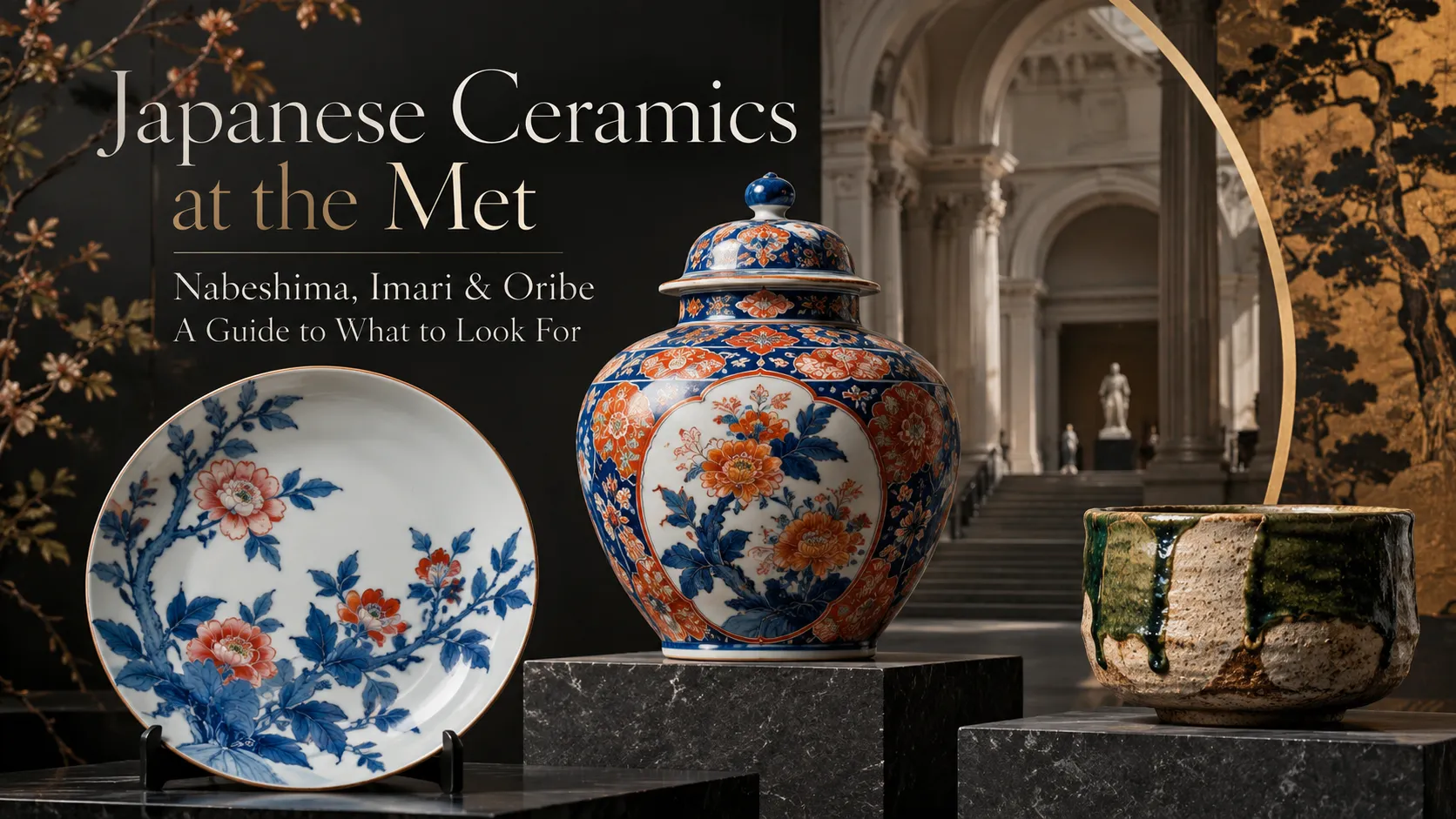
The Metropolitan Museum of Art is currently showing The Infinite Artistry of Japanese Ceramics, a survey that follows Japanese ceramics across a span of roughly 13,000 years. If you have come here looking for Japanese ceramics at The Met, you are probably asking three things: what can actually be seen right now, what separates Nabeshima, Imari and Oribe, and what to look for when you are standing in front of a piece.
Drawing on The Met’s official information as of 16 September 2026, this article sets out the rotation schedule and the works that can be confirmed on view, then sets out how to read Japanese ceramics through form, technique and use.
The aim is not to memorise style names. Look in turn at the shape of a vessel, its material, its glaze, its decoration, how it was used and who it was made for, and the single phrase “Japanese ceramics” begins to separate into distinct technical systems with distinct social conditions behind them.
| Exhibition details | |
|---|---|
| Exhibition | The Infinite Artistry of Japanese Ceramics |
| Dates | 19 January 2026 – 8 August 2027 (selected works exchanged across five rotations) |
| Venue | The Metropolitan Museum of Art (The Met Fifth Avenue), second floor, Arts of Japan Galleries (Galleries 223–232) |
| Address | 1000 Fifth Avenue, New York, NY 10028 (nearest entrance: Fifth Avenue at 82nd Street) |
| Opening hours | Sunday, Monday, Tuesday, Thursday: 10am–5pm Friday, Saturday: 10am–9pm |
| Closed | Wednesdays, Thanksgiving Day, 25 December, 1 January, the first Monday in May |
| Admission | No separate ticket is required for this exhibition; it is included in general museum admission. Adults $30 (as of 16 September 2026) New York State residents and certain other visitors are eligible for pay-what-you-wish admission |
| Curator | Monika Bincsik, Japanese decorative arts, The Met |
| Official site | The Infinite Artistry of Japanese Ceramics | The Metropolitan Museum of Art |
Opening hours, closing days and admission rates are subject to change. Please check the official website for current information before travelling or visiting.
(Source: The Infinite Artistry of Japanese Ceramics | The Metropolitan Museum of Art / Plan Your Visit: The Met Fifth Avenue | The Metropolitan Museum of Art / The Metropolitan Museum of Art official website | The Metropolitan Museum of Art)
Table of Contents
What Is on View Right Now? A Guide to The Met’s Rotations
As of 16 September 2026, the exhibition is in its third rotation. The Infinite Artistry of Japanese Ceramics runs from 19 January 2026 to 8 August 2027 in the Arts of Japan Galleries (Galleries 223–232) at The Met Fifth Avenue.
The current exhibition page divides the run into five display periods, with a schedule for exchanging part of the selection. Not everything changes at once. Instead, some works come off view between periods and are replaced by others.
(Source: The Infinite Artistry of Japanese Ceramics | The Metropolitan Museum of Art)
| Display period | Dates |
|---|---|
| Rotation 1 | 19 January – 12 May 2026 |
| Rotation 2 | 14 May – 16 August 2026 |
| Rotation 3 | 29 August – 8 December 2026 |
| Rotation 4 | 10 December 2026 – 28 March 2027 |
| Rotation 5 | 10 April – 8 August 2027 |
A visit in October 2026 therefore falls within Rotation 3, and part of the display will differ from what was shown in May or from what will be shown after 10 December 2026. A long run does not mean an unchanging one.
One point worth noting: the press release of 13 January 2026 announcing the exhibition described some 350 works presented across three rotations. The current exhibition page lists five display periods, Rotation 1 through Rotation 5. When planning a visit, the updated exhibition page is the more reliable reference.
(Source: Exhibition at The Met Explores the Artistry of Japanese Ceramics | The Metropolitan Museum of Art)
Editor’s Note
This is less a show to tick off in a single visit than one that looks different when you return to it after an interval. If a piece holds your attention, note down its accession number as well as its title. That makes it far easier, next time, to tell whether you are looking at the same work or at something that has taken its place.
Where the Galleries Are, and What Admission Costs
The exhibition occupies the Arts of Japan Galleries (Galleries 223–232) on the second floor of The Met Fifth Avenue. The exhibition page states that it is free with museum admission, so no separate ticket is required for this show.
(Source: The Infinite Artistry of Japanese Ceramics | The Metropolitan Museum of Art)
As of 16 September 2026, general admission for adults is $30. New York State residents and certain other visitors are eligible for pay-what-you-wish admission, under which the visitor decides the amount paid. Eligibility conditions and rates may change, so check the official website before travelling or visiting.
(Source: The Metropolitan Museum of Art official website | The Metropolitan Museum of Art)
What Is the Packard Collection, and Why Does It Matter Here?
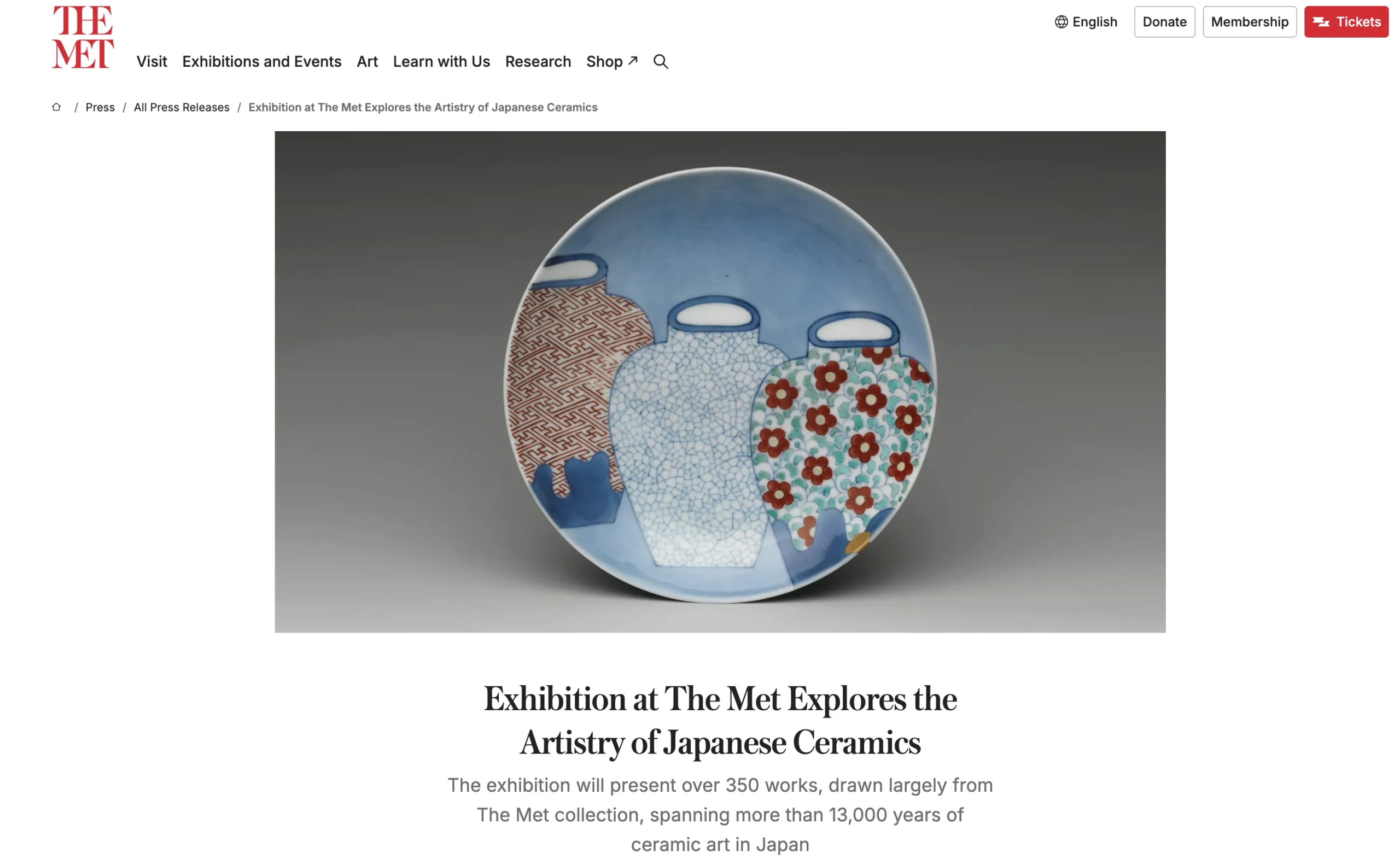
One thing to understand about this exhibition is the part played by the Harry G. C. Packard Collection. The Met presents the show as marking the fiftieth anniversary of that collection’s acquisition. The exhibition draws primarily from The Met’s own holdings, and the Packard Collection accounts for a substantial share of it.
(Source: Exhibition at The Met Explores the Artistry of Japanese Ceramics | The Metropolitan Museum of Art)
The Packard Collection was assembled by the collector Harry G. C. Packard (1914–1991). In 1975, The Met acquired more than 400 works by gift and purchase, including archaeological material, medieval Buddhist sculpture and painting, folding screens, hanging scrolls and ceramics. The acquisition significantly expanded both the scale and the range of The Met’s Japanese art holdings.
(Source: Five Thousand Years of Japanese Art: Treasures from the Packard Collection | The Metropolitan Museum of Art)
The exhibition is curated by Monika Bincsik, who is responsible for Japanese decorative arts at The Met. According to the museum’s announcement, the selection includes works that have rarely, or never, been shown before.
(Source: Exhibition at The Met Explores the Artistry of Japanese Ceramics | The Metropolitan Museum of Art)
It is worth drawing out that entering a major museum collection does not fix a work’s meaning or standing once and for all. The theme a piece is redisplayed under, what is placed beside it, and the research it is connected to all change how the same object reads.
Editor’s Note
When you look at Japanese craft in a museum outside Japan, it is worth asking not only about the object itself but about why this particular piece has been selected now, and why it has been placed in this sequence. A craft object carries the history of the period in which it was made, and also the history of being collected, researched and shown again.
How Do Form, Technique and Use Actually Differ? A Framework for Comparison
With Japanese ceramics, checking form, then technique, then use makes the differences easier to grasp than memorising kiln names and style labels first.
Form tells you what a vessel was meant to hold, how it was meant to be held and how it was meant to be used. Technique reveals whether you are looking at stoneware or porcelain, and what glazes and decoration have been applied. Use places the object socially: everyday tableware, tea utensil, gift, or a piece made for formal presentation.
Among the works currently on view at The Met is an Edo-period piece, Dish with Three Jars. As of 16 September 2026, it was listed as on view in Gallery 223.
It is a Hizen ware porcelain of the Nabeshima type, with cobalt blue applied beneath a transparent glaze and polychrome enamels added over the glaze. It measures roughly 4.1cm high and 15.2cm in diameter, and its accession number is 1975.268.563. The Met’s object page dates it to the 1680s–90s.
(Source: Dish with Three Jars | The Metropolitan Museum of Art)
Resist stopping at the impression that Nabeshima means luxury, or that enamelled decoration means showiness. Observe the size of the dish, how the flat surface for food has been set out, how the three jar motifs are arranged, and how the blue relates to the overglaze colours, and the design logic of the piece starts to come into focus.
And if you note the accession number from the label, you can return to The Met’s online collection afterwards and check technique, dimensions, credit line and provenance. Titles shift slightly between translations and sources; accession numbers do not, which makes them the most dependable way to follow a specific work.
What Separates Nabeshima, Imari (Hizen) and Oribe?
Nabeshima, Imari and Oribe are not three interchangeable style labels. What each name refers to is different in kind: region of production, distribution, how the kiln was run, materials and intended use.
| Name | Principal material and region | What the name denotes | Context |
|---|---|---|---|
| Nabeshima | Hizen porcelain | Controlled production at the Nabeshima domain’s official kiln | Presentation wares and gifts for the shogunal household and others |
| Imari | Closely tied to Hizen porcelain | Historically, a name applied broadly to porcelain distributed through the port of Imari | A wide range of products, for domestic distribution and export |
| Oribe | Mino stoneware | A group of wares associated with Furuta Oribe and the culture of tea | Tea gatherings, tableware, green glazes and bold forms and patterns |
The Met describes Nabeshima ware as porcelain produced at an official kiln established within the Nabeshima clan’s Saga domain during the Edo period, made as presentation pieces for the shogunal house, senior figures in the shogunate and the three Tokugawa branch houses. Dish with Sacred Jewels, Pine, Bamboo, and Plum, currently in Gallery 223, is another example of Hizen ware of the Nabeshima type.
(Source: Dish with Sacred Jewels, Pine, Bamboo, and Plum | The Metropolitan Museum of Art)
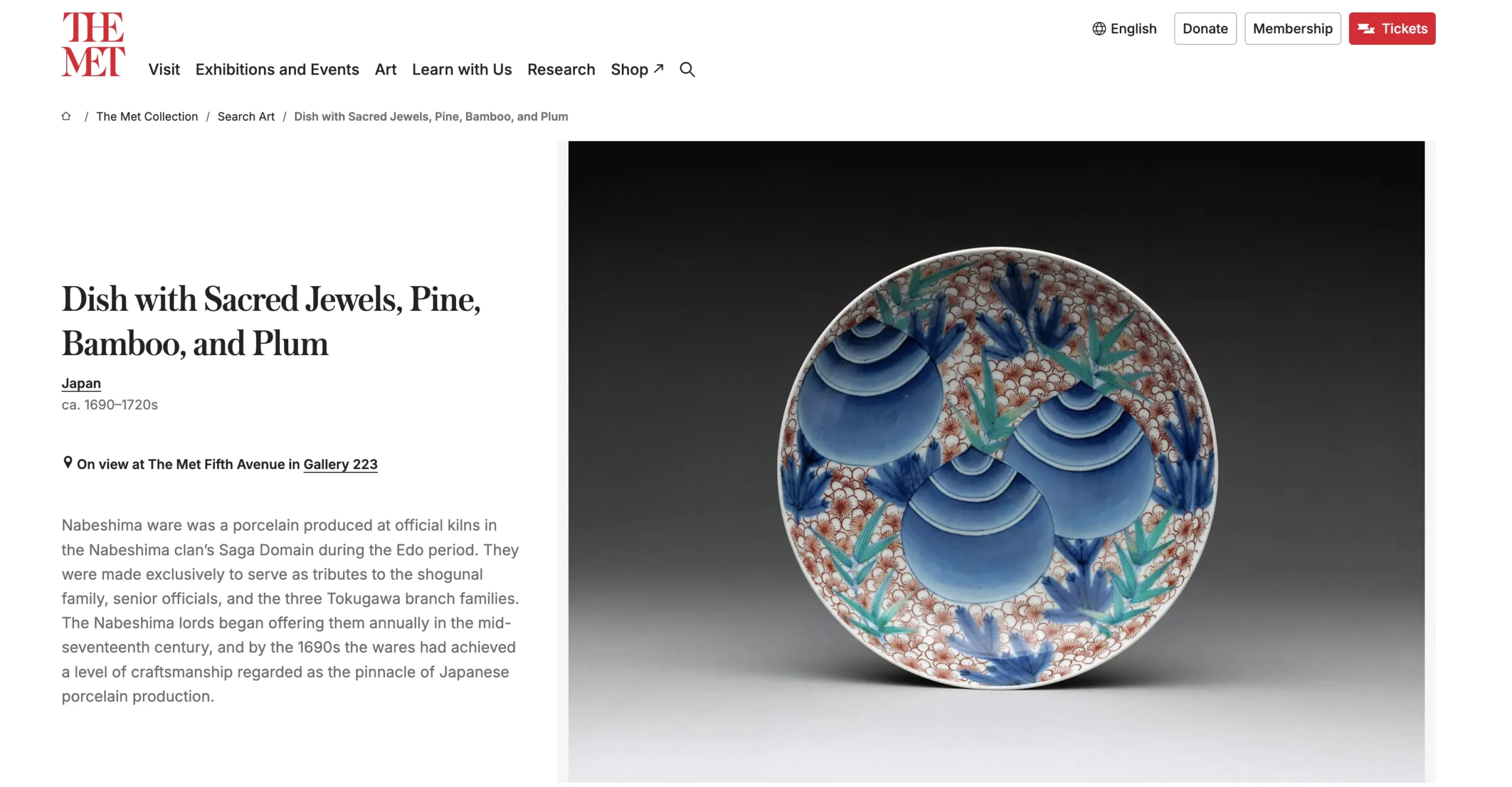
Imari, by contrast, does not name a single official kiln system in the way Nabeshima does. Historically, porcelain made in Hizen, including at Arita, was distributed via the port of Imari, and the name came to be used broadly as a result. Keeping that in mind makes the term easier to handle: Imari does not denote one fixed set of designs.
Kogei Japonica has covered the historical relationship between Arita and Imari, and how the two names are used today, in a separate article.


We would not treat the difference between Nabeshima and Imari as a matter of rank. What matters is the difference in the conditions of production: who controlled the making, who the pieces were made for, and by what routes they were distributed.
Oribe and the Aesthetics of Wabi-cha
Oribe refers to a group of Mino wares associated with Furuta Oribe and the culture of tea. Rather than simplifying it into the idea that Furuta Oribe created a single style, it is more accurate to see it as ceramics formed where kiln technology, the practice of tea, food culture and changes in form intersected between the Momoyama period and the early Edo period.
At The Met, an early seventeenth-century piece, Covered Vessel with Plum Tree, is on view in Gallery 228. It is Mino ware of the Oribe type, using iron for brown decoration, a transparent glaze, and a vivid green glaze derived from copper. The Met explains that the vessel was used to serve food at the meal accompanying a tea gathering.
(Source: Covered Vessel with Plum Tree | The Metropolitan Museum of Art)
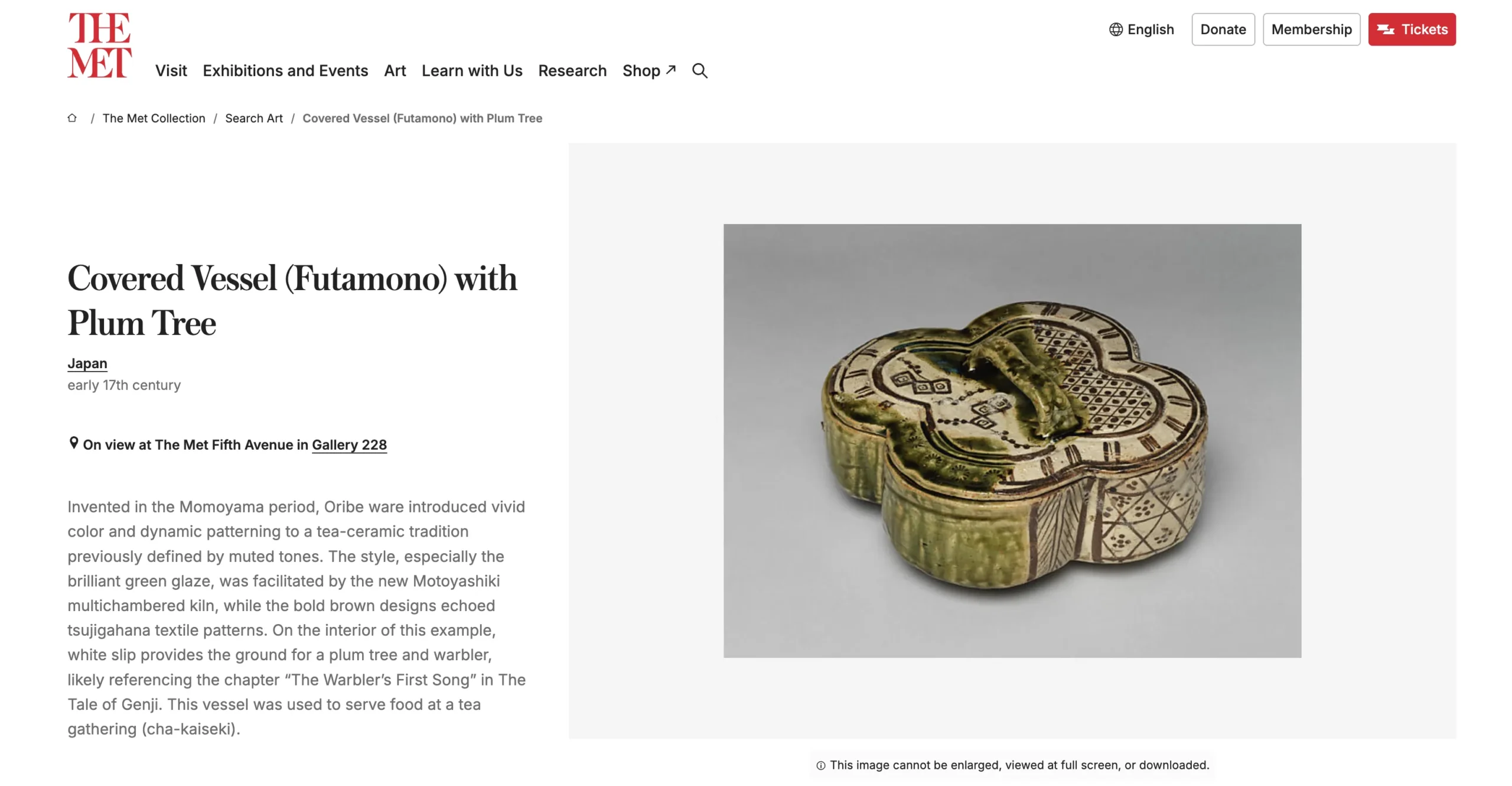
Words such as distortion and imperfection are not enough to account for Oribe. You also need to look at the vivid green glaze, the brown lines, the changes in vessel form itself, the function of the piece as tableware, and its relationship to the visual culture of the period, textiles included.
The same applies to wabi-cha. Reducing it to the idea that imperfection is beautiful leaves out much of what tea practice involves: the selection of utensils, the space, the meal, seasonality and conduct. When visiting this exhibition, it is worth setting aside fixed ideas — that asymmetry equals wabi, or that roughness equals Japaneseness — and observing the structure and function of the actual vessel.
Editor’s Note
Looking at Japanese ceramics in a museum outside Japan, there is a pull towards explaining everything through the phrase wabi-sabi. But the controlled porcelain of Nabeshima and the bold tableware of Oribe differ in material, in use and in the circumstances of their making. Rather than looking for a single idea of Japaneseness, ask what the object was made for and how it was made. That is where understanding of craft deepens.
Kintsugi: Reading Repair as Value Rather Than Defect
Kintsugi is a technique in which a broken vessel is joined with urushi, Japanese lacquer, and the repair is finished using metal powders such as gold. Repaired ceramics form one of the significant themes of this exhibition.
The Met presents kintsugi as a practice that not only restores a vessel’s function through lacquer repair but gives the object new value by emphasising the repaired areas with gold and other metals.
(Source: The Infinite Artistry of Japanese Ceramics | The Metropolitan Museum of Art)
That said, explaining kintsugi solely through contemporary language about ecology, sustainability and waste risks narrowing its historical and art-historical meaning.
At Kogei Japonica, we treat a repair not as a flaw that could not be erased but as one way of reading the record of a vessel being used, broken and repaired. What matters is seeing how the object arrived at its present state, the repaired form included.
How Should You Look at the Works in the Gallery? A Practical Framework
The first things to establish are period, technique, use, credit line and provenance, and current display status. Working through those five points in order gives you a fuller picture of a work’s background than reading the style name alone.
In a museum it is easy to read only the title and move on to the next case. But The Met’s object pages let you check date, materials and technique, dimensions, accession number, credit line, provenance and exhibition history.
Labels in the galleries will not always carry all of that. A practical approach is to check the essentials in the gallery, then use the online collection to fill in provenance and other details afterwards.
Five Things to Check in the Gallery
- Period: when the work was made. For an Edo-period piece, narrowing it down to the early seventeenth century or the eighteenth century makes shifts in technique and use much easier to see.
- Technique: whether it is stoneware or porcelain, which glazes have been used, and whether the decoration is underglaze, such as sometsuke in cobalt blue, or overglaze, such as iro-e polychrome enamels.
- Use: what the piece was made for — tableware, a tea utensil, a storage vessel, a presentation piece.
- How it was acquired: from the credit line or the online collection, whether it came by gift or purchase, and from which former collection.
- Current display status: whether the online object page shows the work as on view, and whether a gallery number is given.
These five points apply well beyond this exhibition, to any show of Japanese ceramics.
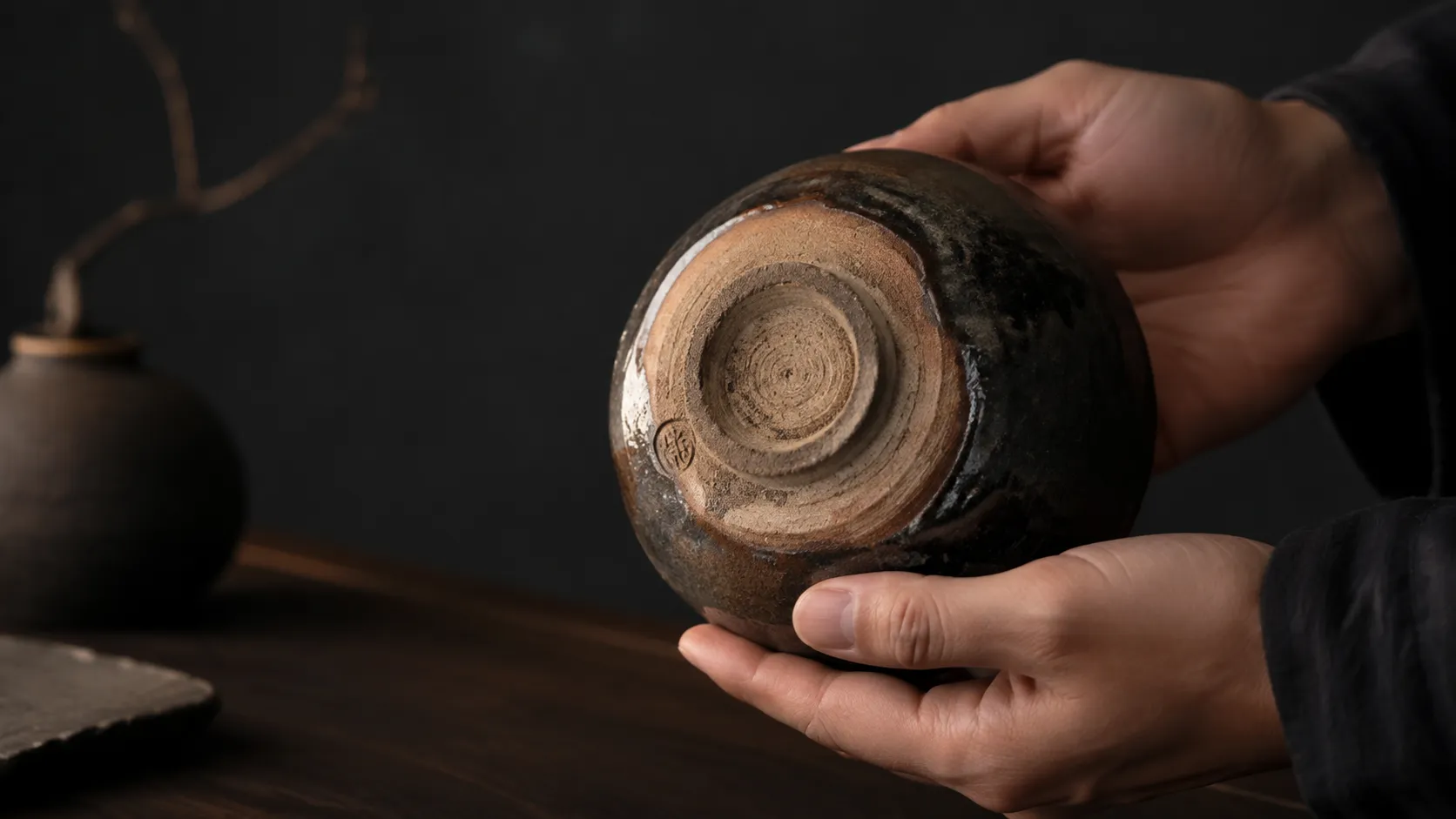
To go a step further, look beyond the upper surfaces to the kōdai, or foot ring, the tatamitsuki where the foot meets the surface, the glaze edge, me-ato or spur marks, and any mark. In a museum, of course, you cannot pick a piece up, so you are limited to what the display and the published images allow you to see.
A viewing sequence worth saving
Form → material → glaze and decoration → use → region and type → circumstances of making → accession number
There is no need to name Nabeshima or Oribe correctly from the outset. Observe the object first, then check it against the label. Technique and kiln names tend to stay with you better that way.
Beyond The Met: What to Know If You Are Thinking About Collecting
Looking at works in a museum and choosing craft objects on the market call for different kinds of information. A museum presents research that has already been done. When buying or collecting, you may have to establish the maker, workshop, region, route of distribution, tomobako storage box, marks, certification papers and certificates of authenticity for yourself.
Avoid relying on any single piece of evidence: that a certification paper means genuine, that a tomobako automatically makes a work valuable, or that a mark means the work of the named maker.
Certification papers indicate information based on particular systems and standards, but they do not necessarily verify that a maker produced a given piece. Marks and storage boxes are important evidence too, but you need to establish separately what each one actually attests to.
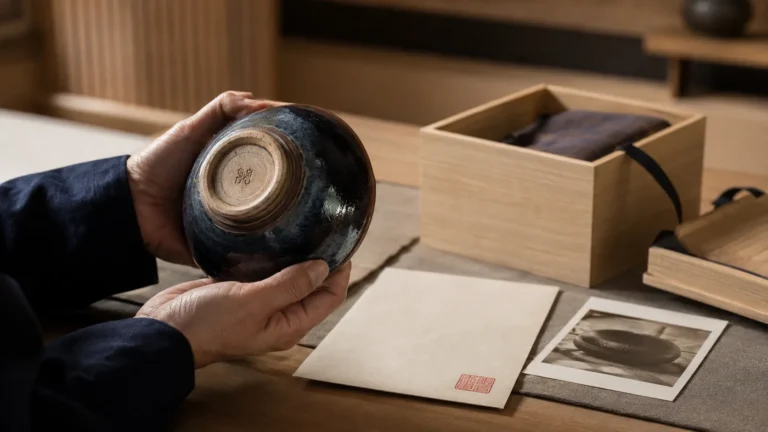
The habit of noting accession numbers in a museum feeds directly into this kind of checking. Looking at materials, dimensions, date, credit line and provenance alongside the title is what lets you separate what has been established about a work from what remains unknown.
Kogei Japonica also takes enquiries from Japanese craft makers and workshops, and from galleries, art-fair organisers, interior designers, hotels and retailers seeking to introduce Japanese work to international audiences. We welcome enquiries about maker introductions, craft research, collaborations and exhibition planning.
Frequently Asked Questions (FAQ)
- Q1. How long does the exhibition run?
- From 19 January 2026 to 8 August 2027. The current official page sets out a schedule dividing the run into five display periods, with part of the selection exchanged between them.
(Source: The Infinite Artistry of Japanese Ceramics | The Metropolitan Museum of Art) - Q2. When is Rotation 3?
- From 29 August to 8 December 2026. A visit in September or October 2026 falls within Rotation 3. Note that the display is not replaced in its entirety with each period.
- Q3. Is there a separate charge for the exhibition?
- The exhibition is described as included in general museum admission. General admission for adults was $30 as of 16 September 2026, but check rates and eligibility on the official website before visiting.
(Source: The Metropolitan Museum of Art official website | The Metropolitan Museum of Art) - Q4. What is the difference between Nabeshima, Imari and Oribe, briefly?
- Nabeshima is Hizen porcelain produced under controlled conditions at the Nabeshima domain’s official kiln, closely tied to presentation wares and gifts for the shogunal household and others. Imari is historically a name applied broadly to porcelain made in Hizen and distributed through the port of Imari. Oribe is a group of Mino wares associated with Furuta Oribe and the culture of tea, including pieces with green glazes and bold forms and patterns.
- Q5. What is the Packard Collection?
- A collection of Japanese art assembled by Harry G. C. Packard. In 1975 The Met acquired more than 400 works by gift and purchase, significantly expanding its Japanese art holdings.
(Source: Five Thousand Years of Japanese Art: Treasures from the Packard Collection | The Metropolitan Museum of Art) - Q6. How can I research a work in detail after seeing it?
- The most reliable way is to note the accession number from the label and search The Met’s online collection. You can check materials, dimensions, how the work was acquired, and its exhibition history.
- Q7. Can I check whether a particular work is on view?
- For some works, The Met’s online collection shows an on-view status together with a gallery number. Dish with Three Jars, for instance, was listed as on view in Gallery 223 as of 16 September 2026.
(Source: Dish with Three Jars | The Metropolitan Museum of Art)
Running over a long period with works exchanged along the way, The Infinite Artistry of Japanese Ceramics does not gather Japanese ceramics under a single aesthetic. It lets you compare different periods, materials, uses and conditions of production.
At Kogei Japonica, we think that asking why a form took this shape, which technique produced this colour, and who used the object and for what builds a more lasting way of seeing than memorising style names first.
The precise porcelain of Nabeshima, the bold tableware of Oribe and a vessel repaired with kintsugi do not need to be explained by one idea of Japaneseness. Follow the material, technique, use, distribution and the background of the people who used each piece in turn. Doing that is what lets Japanese craft come into view as concrete cultural and technical practice rather than as an image.
If you visit The Met again, try choosing just one vessel that holds your attention and checking its form, technique, use and accession number. Following a single work that closely will change how the exhibition looks.
