
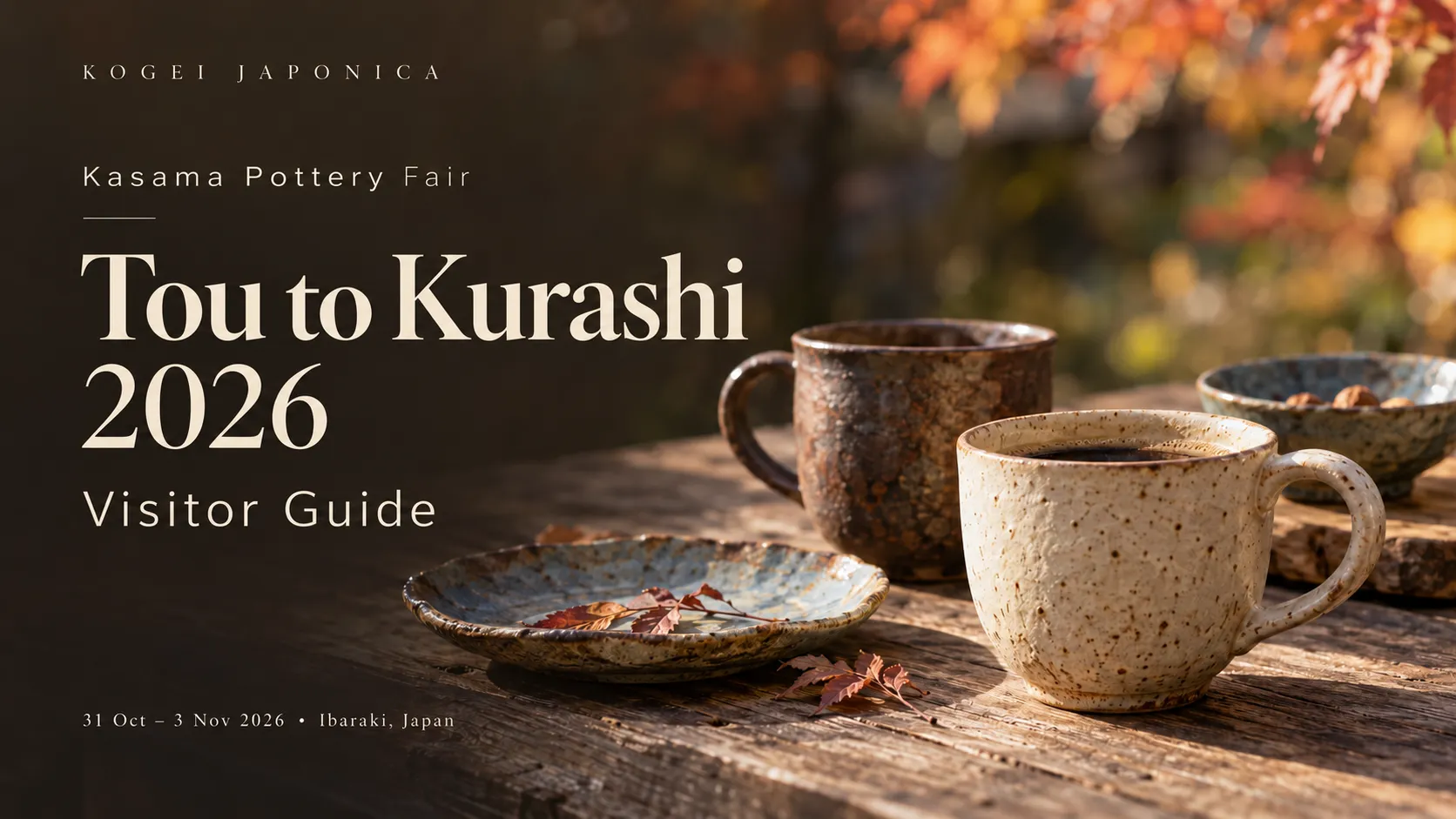
Tou to Kurashi 2026 – the name means “Pottery and Living” – is a pottery fair in Kasama, Ibaraki, running from 31 October to 3 November in the event area at Kasama Craft Hills (笠間工芸の丘, Kasama Kōgei no Oka). Alongside the display and sale of tableware, visitors can try out cups made by the exhibiting potters.
A piece that caught your eye in a photograph can feel quite different once it is in your hand. Equally, qualities you could not see simply by looking may become clear as you raise a cup to your lips.
If you are looking for tableware in Kasama this autumn, it helps to know not only how to reach the venue but also how to judge a piece in use and what to ask the person who made it. This guide covers the essentials, from the event outline and what to check before buying to how to prepare for getting your pieces home.
Note: event and transport details were checked on 26 October 2026. Before visiting, please confirm any changes through the official announcements of the organisers and transport operators.
Table of Contents
When and where is Tou to Kurashi 2026?
The video above was made for the 2023 fair, so some details may differ this year. The 2026 fair runs from Saturday 31 October to Tuesday 3 November, a public holiday, in the event area at Kasama Craft Hills. It closes earlier on the final day, so check the times against your plans for the journey home.
Event details and what to check before you set out
Tou to Kurashi grew out of a wish to see more handmade pottery brought into everyday life. This year marks its 14th edition, with each maker exhibiting and selling Kasama ware, including new work.
| Item | Details |
|---|---|
| Event name | Tou to Kurashi 2026 |
| Dates | Saturday 31 October – Tuesday 3 November 2026 (public holiday) |
| Opening hours | 09:00–16:00; until 15:30 on the final day |
| Venue | Event area at Kasama Craft Hills (笠間工芸の丘), Kasama Art Forest Park, Kasama, Ibaraki Prefecture |
| Address | 2388-1 Kasama, Kasama City, Ibaraki Prefecture |
| Organiser | Tou to Kurashi Organising Committee |
| Venue map | The 2026 map is available on the official website |
| Admission and activity fees | Please check the organisers’ latest announcements |
(Source: Tou to Kurashi 2026 | Official website)
(Source: Access | Tou to Kurashi 2026)
Before setting out, check the venue map, along with how to sign up for any activities you want to join, their fees and any changes due to the weather. The admission fee and rain policy could not be confirmed from the official information reviewed for this article.
Look at the social media accounts linked from the official website as well. Knowing where the stalls and activities you want to visit are located makes it easier to plan your day.
Don’t confuse it with Aki-ichi, the Autumn Market
Around the same time, the Kasama Ware Cooperative Association holds its own Autumn Market, known as Aki-ichi. However, Tou to Kurashi and Aki-ichi are separate events held at different venues.
Tou to Kurashi takes place in the event area at Kasama Craft Hills, while Aki-ichi is held at the event plaza of Kasama Art Forest Park. Because both are in the same park, don’t choose your destination on the strength of “Kasama pottery fair” alone. Check the event name and the venue name together.
(Source: Announcement of the pottery fair “Tou to Kurashi. KASAMA” | Kasama Craft Hills)
What can you learn by trying a cup?
Using a piece draws your attention to how it sits in the hand and how the rim feels against your lips, things its appearance alone won’t reveal. Putting what you notice into words shows you what to ask the maker before buying.
Try a cup at the Toukura Café with your daily routine in mind
The Toukura Café, where drinks are served in cups made by exhibiting potters, is scheduled again for 2026. The food and drink listing shows “Toukura Café + LE MIDI” on all four days of the fair. What sets the café apart is that you can use the pieces with a drink in them, rather than only looking at them on a display stand.
(Source: Announcement of the pottery fair “Tou to Kurashi. KASAMA” | Kasama Craft Hills)
(Source: Food and drink vendors | Tou to Kurashi 2026)
As you drink, rather than grading whether a cup is “good”, picture your own everyday cup. Is it for the coffee you have in the morning, or the tea you linger over between tasks? The size and handle that feel right will depend on how you plan to use the cup.
Notice the weight with a drink inside, how your fingers fit the handle and how the rim feels against your lips. Remember even one small difference, and your conversations at the sales stalls will become far more specific.
That said, this does not mean every piece on sale can be tried. Check at the café counter how cups are chosen and whether there is a charge, and if you find one you like, note the maker’s name and the shape.
Watch potters at work at Tsukuru ga Mieru
Tsukuru ga Mieru, meaning “see the making”, brings visitors closer to the making process through workshops and demonstrations. It also appears in the 2026 event announcement. Check the individual listings for times, how to take part and fees.
(Source: Announcement of the pottery fair “Tou to Kurashi. KASAMA” | Kasama Craft Hills)
Watching a potter at work reveals more than technical skill. Where do they thin the walls, and where do they leave them thicker? Shaping a piece involves decisions about both use and expression. Seeing the process turns the vague “why this shape?” you feel in front of a finished piece into a specific question.
During the fair, the Ibaraki Ceramic Art Museum is also running a collaborative activity, Keramon’s Playland. It includes a chance to hold and touch makers’ tableware, a drawing workshop and a ring toss, and is free to join. It opens at 09:30, which differs from the start time of the fair as a whole. The drawing workshop ends each day once that day’s supply runs out.
(Source: Keramon’s Playland | Ibaraki Ceramic Art Museum)
Treat the items offered for hands-on experience and the pieces displayed at sales stalls as separate things, and follow the guidance for each.
Look up makers in the official exhibitor list
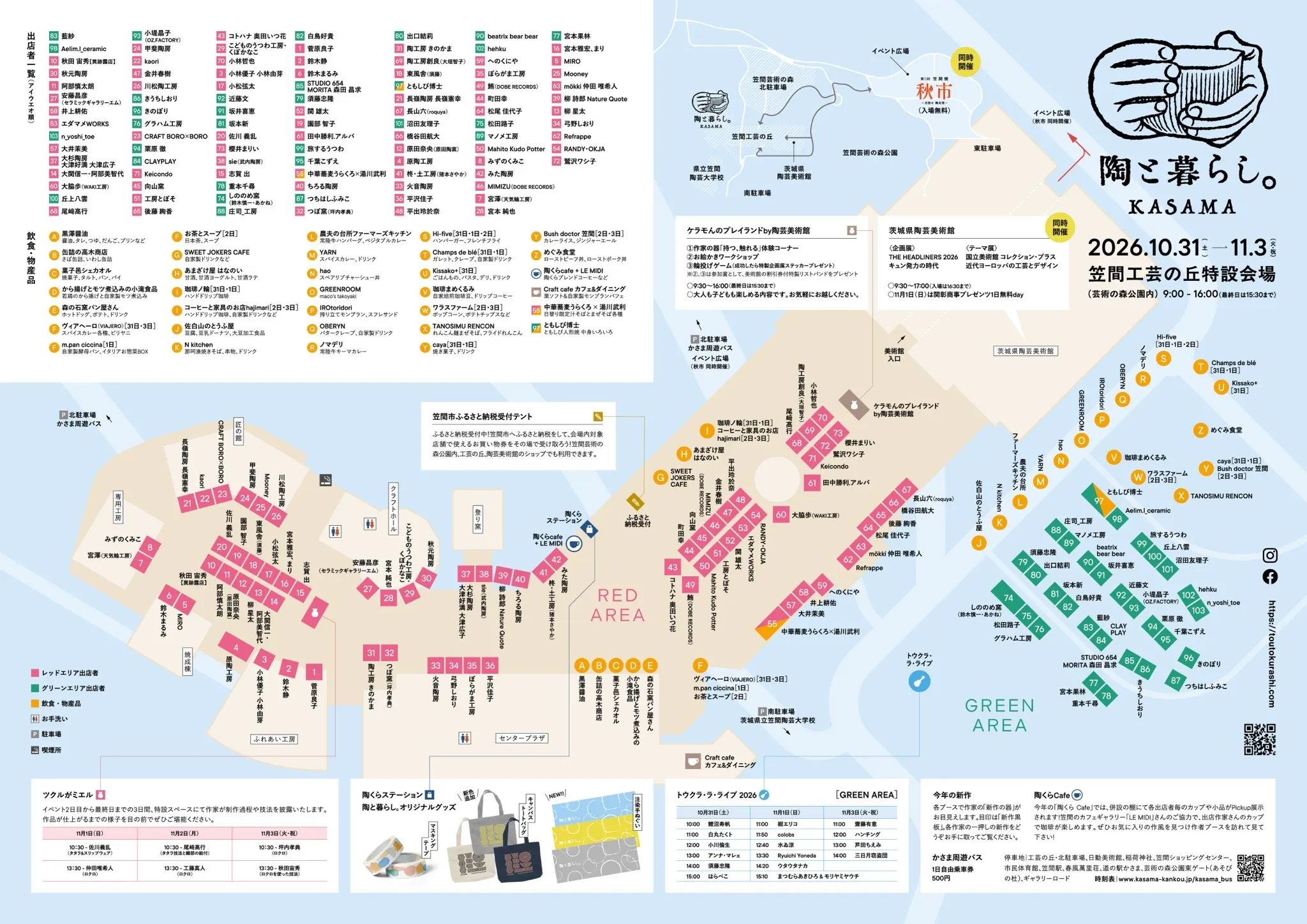
The official website lists the makers exhibiting in 2026. Cross-referencing names that interest you with the venue map will help if you want to return to a stall later.
(Source: Exhibitor list | Tou to Kurashi 2026)
If names are hard to remember, you can, with permission, photograph a piece and add a note of what drew you to it, such as “cup with a round handle” or “deep dish with a white interior”.
What is Kasama ware (Kasama-yaki)?
Kasama ware is pottery produced in and around Kasama City, Ibaraki Prefecture. The production area encompasses a wide variety of materials, techniques and forms of expression, and the name Kasama ware alone does not determine the character or proper use of every piece.
The Kasama Ware Cooperative Association likewise presents diversity of expression as a defining feature of the area. When choosing tableware, rather than assuming “it’s Kasama ware, so it can be used this way”, look into the piece in front of you.
(Source: About Kasama ware | Kasama Ware Cooperative Association)
For more on the area’s history and the background to its range of expression, see the related article below.

How do you choose tableware for everyday use?
Choosing tableware is easier when you start from the meals and drinks of your everyday life. Let your taste guide you, while also checking weight, capacity and storage space.
Compare how it feels to hold, drink from and set down
Ease of holding is not a matter of lightness alone. The shape of the handle, where your fingers rest and whether you can hold the piece naturally all play a part. At the café, pay attention to how a cup feels with a drink inside.
With plates and bowls, think too about how you usually carry them. With one hand, or with both? Picturing the trip from table to sink reveals a kind of fit quite separate from appearance.
| What to compare | What to check | When to check |
|---|---|---|
| Weight and grip | Whether you can hold it naturally, and whether it is comfortable with something inside | When trying it in use; when handling a piece with permission |
| Rim | Whether the thickness and shape of the rim suit you | At the café or wherever drinking is permitted |
| Capacity | Whether it suits your usual drink or portion | When trying it in use; by asking the maker |
| When set down | Whether it sits steadily on a flat surface | When handling a piece with permission |
| Surface | Whether the texture suits you, and whether it changes with use | When handling a piece; by asking the maker |
| Storage | Whether it fits your shelves and can be stacked | By checking dimensions; by asking the maker |
Before lifting, turning over or stacking a piece on display, ask the exhibitor first. Never put displayed pieces to your lips; judge how a rim feels at the café instead.
Even if a cup you liked at the café belongs to the same series as one on sale, the size and finish may not be identical. Check the specific piece you are buying.
Think about washing, drying and putting it away
It is easy to picture a piece on the table, and just as easy to overlook how it will be handled afterwards. For tableware you want to use every day, factor in how you will wash and dry it and where it will live.
Before you go, measure the diameter of the plates you use most and the height of your shelves. A vague condition such as “not too big” becomes a concrete one: “it fits on this shelf”.
Useful words for looking at tableware
Glaze (yūyaku) is the material applied to the surface of a pot that, through firing, gives it colour, texture and other qualities. The foot (kōdai) is the raised base that supports a piece; when it forms a ring, it is often called a foot ring.
When buying, being able to ask “How should I care for this surface?” or “Is there anything to watch out for with the finish on the base?” is more useful than memorising technical terms.
Balance what you love with practical considerations
For each piece that catches your eye, try putting into words one reason it attracts you and one practical consideration.
“I love this blue, and I’d like it for tea on my days off.” “The shape intrigues me, but I want to check it will fit my cupboard first.” Even this much leads to a different decision from one carried along by the atmosphere of the fair.
Editor’s Note
I don’t believe tableware has to be chosen on ease of use alone. Some pieces are worth a little extra care; others you can reach for without a second thought on a busy morning. What matters is understanding that difference when you choose.
You do not have to buy a piece for the encounter to be worthwhile. Remembering a maker’s name and going to see their next exhibition can also be the start of a relationship.
What should you ask the maker before buying?
Begin the conversation from how you want to use a piece rather than from technical terms. Explaining the use, then confirming the care and conditions for that particular piece, will spare you uncertainty once you are home.
Start with “I’d like to use it for this dish”
If you are not sure what to ask, starting from your own daily routine feels natural. English may not be spoken at every stall, so it can help to save your questions in Japanese or have a translation app ready.
For example: “I’d like to use it for coffee every morning.” “I want to serve dishes with plenty of sauce or broth.” “It’s for the whole family, so I’d like to be able to stack them.” Once the maker knows the use, they can more easily decide which aspects of the piece to explain.
If you are curious about how a piece came to be, you might ask, “What led you to this shape?” A detail that first seemed decorative may turn out to relate to how the piece is held or used.
Editor’s Note
Questions are not a way of testing a maker’s knowledge; they are a way of telling them where a piece is going. Simply adding, “I’m looking for a bowl for my morning yoghurt, and I use a dishwasher,” brings the conversation closer to your own life.
The point of choosing face to face, I think, is that you can not only receive an explanation of the work but also say how you want to use it.
When a stall is busy, ask just one question first and check whether you can follow up later. If you plan to get in touch, don’t assume a social media message is welcome; ask which channel and method the maker prefers.
Check microwave and dishwasher suitability, and ask about care
Confirm microwave and dishwasher suitability for each individual piece you buy. As a rule, don’t judge from colour, appearance or the name of the production area.
For any treatment before first use, don’t apply one method to every piece; follow the maker’s guidance. Some pieces may call for a preparatory treatment known as medome, which helps reduce water absorption and staining. Whether it is needed, and how it is done, varies from piece to piece, so ask the maker.
We have gathered what to check at the fair into 10 questions. There is no need to ask them all at once; choose the ones relevant to how you will use the piece.
| Question | What to confirm |
|---|---|
| 1. Can it go in the microwave? | Whether it can be used, and any conditions to follow when heating |
| 2. Can it go in the dishwasher? | Whether it can be used, and precautions when washing and drying |
| 3. Is it oven-safe? Can it go on the hob? | Suitability for each heat source, checked separately from microwave use |
| 4. Does it need any care before first use? | Whether medome is needed, and precautions for the first wash |
| 5. Is there anything to watch out for with certain foods or drinks? | Suitability for your intended use, and how to avoid staining from food and drink |
| 6. Will anything change with use? | Changes in colour or surface, and how to handle them if they occur |
| 7. Can I buy more of the same design later? | Whether it is in ongoing production or can be reordered, and how much pieces vary |
| 8. Is there anyone I can ask if it chips? | Whether repair is possible, who to ask, and conditions for use after repair |
| 9. Who should I contact after buying? | Official contact details, stockists, and where to find exhibition news |
| 10. Can you pack or ship it? | How to take it home, whether shipping is available, costs and dispatch timing |
If there is an information card, take it with you, and note any verbal explanations alongside the piece and the maker’s name. This avoids mix-ups if you buy from several makers.
Follow up later on repeat orders and business use
If you would like to add more of the same piece later, check whether it is in ongoing production and whether it can be reordered. Even if several are on display, you cannot assume they will be available on the same terms in future.
For use in restaurants or hotels, the points to discuss go beyond quantity to include preferred delivery dates, acceptable variation in size, restocking and washing methods. A realistic approach is to make contact on the day while looking at the work, then set out the details together later.
Some makers do not take wholesale orders or additional commissions. Before rushing to ask “How many could you make?”, ask whether they accept enquiries about commercial use.
How do you get there and bring your purchases home?
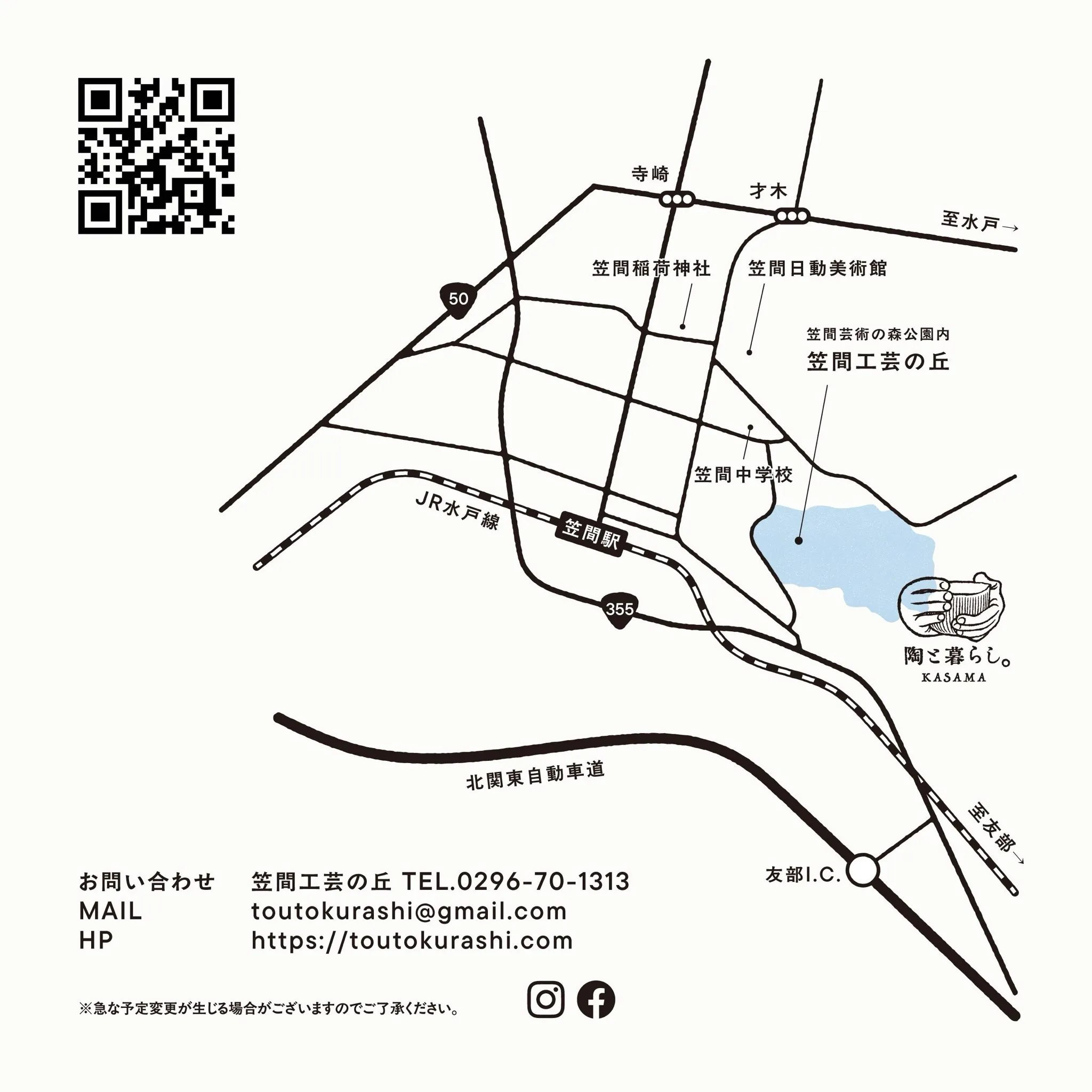
Check access against the 2026 service information. Note the change to the sightseeing bus routes and the temporary bus stops in place during the fair, and plan for both the journey home and carrying your purchases.
Plan both legs of a public transport journey
The Kasama Sightseeing Loop Bus changed its routes on 1 April 2026. It now runs as two services: a Connecting Route between Tomobe Station and Michi-no-Eki Kasama (道の駅かさま), a roadside rest area, and a Loop Route that starts from Kasama Station and calls at sightseeing spots.
If you travel from Tomobe Station by sightseeing bus, you will need to change to the Loop Route at Michi-no-Eki Kasama. From Kasama Station, take the Loop Route towards the Kōgei no Oka / Tōgei Bijutsukan stop (工芸の丘・陶芸美術館), which serves Kasama Craft Hills and the Ceramic Art Museum. Take care not to plan around the earlier direct service.
(Source: Kasama Sightseeing Loop Bus | Kasama City)
Ibaraki Kotsu has also set up temporary bus stops for the autumn period. The Kōgei no Oka Tōgei Bijutsukan stop is affected on weekends and public holidays, and also on Monday 2 November, so on all four days of Tou to Kurashi 2026, buses will pick up and set down at the temporary stop. Check its exact location on the map included in the service notice.
(Source: Temporary bus stops for the Kasama Sightseeing Loop Bus | Ibaraki Kotsu)
For the return journey, check not only when you will leave the venue but also your connections and train times. Save the timetable and the map of the temporary bus stop on your phone.
If you come by car, check parking and traffic restrictions
By car, set your destination as Kasama Craft Hills (笠間工芸の丘) and check its position relative to the event area on the official map. The organisers’ access guide names the Craft Hills car park and the north and south car parks of Kasama Art Forest Park as nearby options, and states that parking within the park is free.
(Source: Access | Tou to Kurashi 2026)
For available spaces and traffic restrictions, follow the information for your day of visit and the directions of staff on site. Not every car park nearby is necessarily free. Nor is the period just after opening necessarily quiet, so allow some leeway in your plans for the return.
It also helps to clear a stable space in the car for your purchases. Plan how you will load them so that wrapped pieces are not pressed under other luggage or left to roll around on a seat.
Ask the seller about wrapping, shipping and payment
Price is not the only thing to confirm before buying. Ask the seller, too, about wrapping, bags for carrying, shipping and payment methods.
If you choose a large plate or several pieces in particular, think about their size and weight once wrapped. If you are going home by train or bus, whether you can carry them comfortably should be part of the decision.
If you ask about shipping, check the cost as well as the dispatch timing and who to contact after delivery. If you would like pieces shipped overseas, discuss this with the seller individually, including which countries they can ship to and how items would be packed.
Planning meals and breaks also helps you compare pieces calmly. The official food and drink listing gives the dates for each vendor, so if there is one you want to visit, match it to your day.
(Source: Food and drink vendors | Tou to Kurashi 2026)
- Note the dimensions of the tableware you already own and how you plan to use new pieces
- Save the venue map, the return timetable and the location of the temporary bus stop
- Bring a bag that can carry your purchases securely
- Confirm payment methods and wrapping and shipping terms with the seller
- Check the weather and the organisers’ latest announcements before you leave
What do first-time visitors usually ask?
As a rule, direct questions about visiting to the organisers, and questions about how to use a piece or its terms of sale to the exhibitor. Knowing who to ask makes it easier to get the answer you need.
FAQ: visiting and activities
- Q. Is it the same event as Aki-ichi, the Autumn Market?
- No, they are separate events. Tou to Kurashi is held in the event area at Kasama Craft Hills, and Aki-ichi at the event plaza of Kasama Art Forest Park.
- Q. Can I freely try the tableware on sale?
- Not necessarily. Distinguish between items offered at the café or for hands-on experience and the pieces on sale, and follow the guidance for each.
- Q. Do I need to book the café or workshops?
- This varies by activity. Check fees, opening times and whether booking is required through the organisers’ latest announcements or on site.
- Q. Is there an admission fee?
- The admission fee could not be confirmed from the official information reviewed for this article. Please check with the organisers before visiting. Charges for the café and other activities should be checked separately from the museum’s collaborative activity, which is listed as free.
- Q. Will it go ahead if it rains?
- The 2026 rain policy could not be confirmed from the official information reviewed for this article. Before setting out, check the official website and the official social media accounts it links to.
FAQ: buying and taking pieces home
- Q. Can I ask a maker questions if I know little about pottery?
- No technical vocabulary is needed. Try starting with how you want to use the piece, for example, “I’d like to use it for my morning coffee.” When it is busy, begin with a short question.
- Q. Can Kasama ware go in the microwave or dishwasher?
- It depends on the piece. Check the maker’s guidance for the specific piece you are buying.
- Q. Can I pay by card or arrange shipping?
- Check with each exhibitor. There may not be a single arrangement that applies across the whole fair.
- Q. Can I buy more of the same piece later?
- That depends on whether it is in ongoing production or can be reordered. Noting the name of the piece and the maker’s official contact details when you buy makes it easier to ask.
Keep a connection with the pieces that caught your eye
When you find a piece you like, jot down briefly what it was you liked, along with the maker’s name: how it felt to hold, its colour, its shape, or the intention behind it that you learned in conversation. Details a photograph alone won’t keep will guide you the next time you see the maker’s work.
If you are considering bringing pieces into a shop or developing a project with a maker or workshop, set out the intended use, quantities and preferred timing, then see Kogei Japonica’s information for businesses. For makers who would like their work introduced and shared, we also offer information on registering as a craft artist or artisan. Registration and listing are subject to review.
The value of Tou to Kurashi 2026 lies not only in seeing a great deal of tableware in one place but also in being able to move back and forth between your own sense of a piece and its maker’s words.
The Kogei Japonica View
“It’s handmade, so it’s good” doesn’t tell you why you yourself would choose a piece. What draws you to it, and at what point in your day would you use it? Thinking about how a piece might fit into your daily life while listening to the maker is, we believe, where the real interest of choosing tableware lies.
Ask one question at the fair, take the piece home and use it. That experience gradually becomes your own basis for judgement the next time you look at tableware.
