

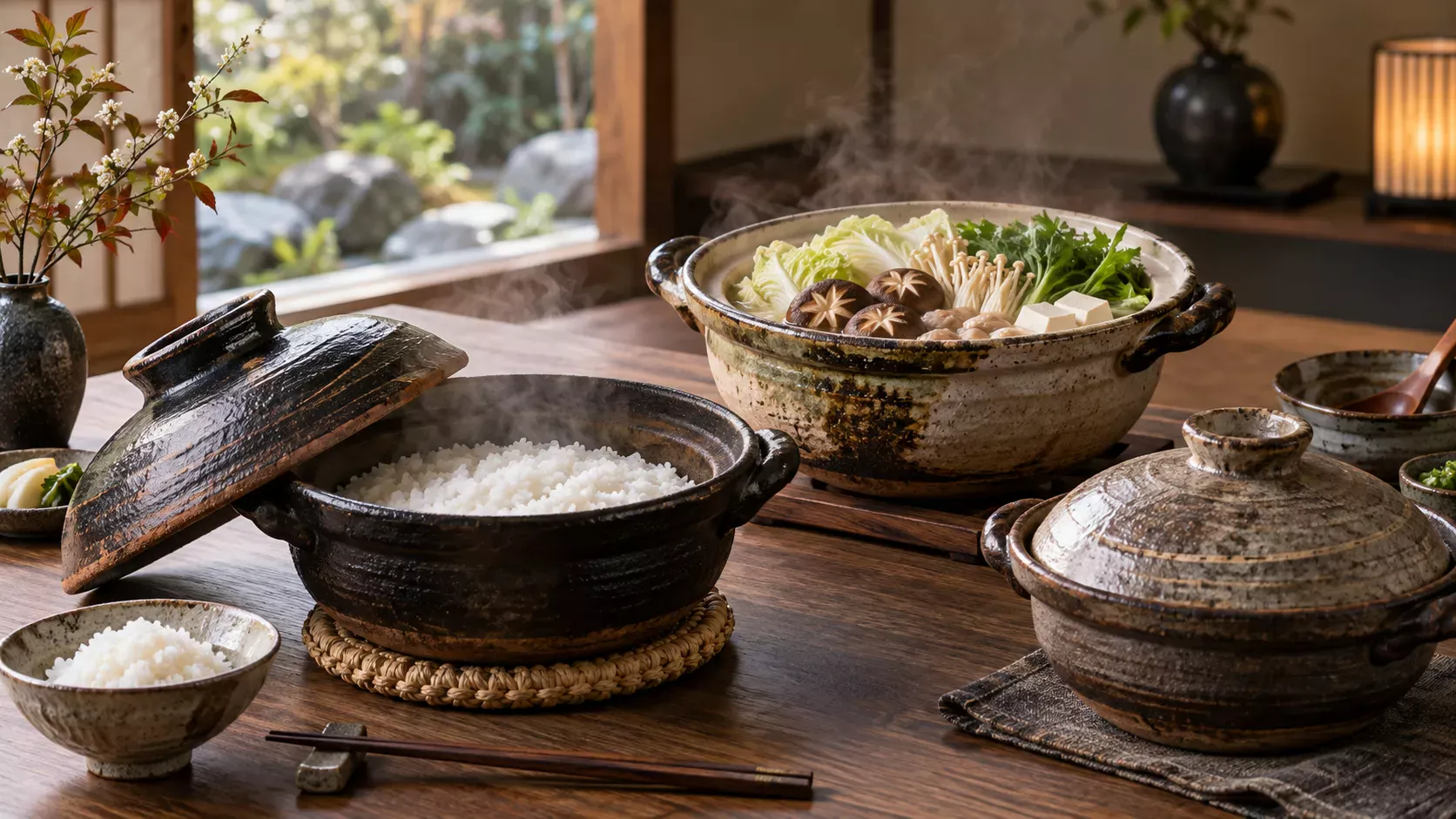
As the colder months approach, more people start thinking about buying a donabe, the Japanese earthenware cooking pot. Once you start shopping, however, there are more variables to consider than you might expect: the unfamiliar gō sizing system, the division between rice-cooking and hot-pot models, and whether the pot can be used on your cooker at all.
A first donabe is best narrowed down not by size alone, but by three questions: what you intend to cook, how much capacity you need, and whether the pot works with the heat source in your kitchen. If you plan to use it regularly, checking the weight of the pot and where you will store it will further reduce the chance of ending up with something awkward to live with.
This article works through the fundamentals of choosing a donabe, the difference between rice-cooking and hot-pot designs, what to watch for when cooking on induction, and the two ceramic traditions most closely associated with these pots: Iga ware (Iga-yaki) and Yokkaichi Banko ware (Yokkaichi Banko-yaki). Manufacturer and prefectural sources are checked throughout.
Table of Contents
What Should You Check First When Choosing a Donabe?
Check three things first: intended use, capacity and size, and heat source. The number of people eating, or the gō size printed on the label, will not on its own tell you whether a pot suits your cooking environment.
Not all donabe are designed for the same purpose. Some are built around cooking rice, some around hot pot shared at the table, and some extend to simmering and steaming as well.
Two pots of similar outer diameter can also hold quite different amounts if their depth differs. And as the body grows larger, so does its weight once water and ingredients are in it.
Working through the following order before you buy makes the choice considerably easier.
- Use: rice, hot pot, simmered dishes — what will you make most often?
- Capacity and size: does it match the quantity you usually cook? Can you store and wash it without difficulty?
- Heat source: gas, induction or otherwise — will it work on the appliance you have?
With induction in particular, it is not enough to read the pot’s own product listing. You also need to establish whether the induction cooktop itself is approved by its manufacturer for use with ceramic cookware. We return to this point in detail below.
Why Does Choosing by Gō Size Alone Lead to Mistakes?
The gō size is one useful indication of how large a donabe is, but it should not be treated as a precise standard for capacity or the number of people served. What matters more are the maker’s published dimensions, capacity and weight.
Japanese product names commonly carry sizes such as “6-gō”, “8-gō” or “9-gō”. Yet donabe come in shallow wide forms, deeper forms, and dedicated rice-cooking forms, and pots of broadly similar outer diameter can hold noticeably different volumes.
When buying online, then, rather than reading the gō size alone, it is worth comparing at least four figures: outer diameter, height, capacity and weight.
Gō Size, Servings and Capacity: What to Compare
Retailers often publish a rough correspondence between gō size and number of diners. Kogei Japonica does not recommend treating these as fixed conversions, because capacity shifts with the shape and depth of the pot.
| What to check | What it tells you | How to use it when choosing |
|---|---|---|
| Size designation (gō) | An approximate indication of how large the pot is | Do not settle servings or capacity on this figure alone |
| Outer diameter | The width of the pot body | Check it fits your burner, your table and your storage space |
| Height and depth | The overall form of the pot | Judge against intended use, such as hot pot or simmered dishes |
| Capacity | The millilitre or litre figure published by the maker | Easiest to grasp by comparing against a pan you already own |
| Weight | The weight of body and lid together | Picture it with water and ingredients added |
Rather than deciding simply that “one person means a small donabe” and “a family means a large one”, check the capacity of the pan you currently use and compare from there. It gives you a far more concrete sense of how the pot will handle day to day.
Why Capacity in Millilitres Matters More Than Gō Size
Capacity is the figure that governs practical use. With rice-cooking donabe in particular, the design question is not what gō size the pot carries but how much rice it is built to cook. Note that Japanese uses two similar-sounding units here: the gō size of the pot, and the gō of rice, a volume measure of roughly 180ml of uncooked grain.
The rice-cooking donabe Kamado-san, made by the Iga ware kiln Nagatanien, is offered in models from one gō of rice up to five. The maker’s published specifications give the one-gō model a capacity of 600ml, the three-gō model 1,500ml and the five-gō model 2,500ml. Body weight also increases as the pots grow larger.
(Source: Kamado-san, Nagatanien)
For a rice pot, the question is not only how many people are eating, but how much rice you cook at a time, and whether you cook once and keep some back for later.
The same logic applies to hot pot. You never fill a pot to its stated capacity with stock and ingredients, so consider depth and headroom alongside the raw capacity figure.
Rice Pot or Hot-Pot Donabe: Which Should You Choose?
If you cook rice frequently, a donabe designed specifically for rice is the better starting point; if you want to range across hot pot and simmered dishes, a more general-purpose donabe makes sense. This is not a question of which is superior, but of matching the pot to the use you will get out of it most often.
A donabe is a ceramic cooking vessel made from clay bodies formulated for heat resistance. Heat travels and is held differently than in a metal pan, but heat resistance, permitted heat sources and whether the pot can be heated dry all vary between products.
So rather than assuming that any donabe can be used in any way, treat the individual product specification as the starting point.
What Defines a Rice-Cooking Donabe: Kamado-san as an Example
In donabe designed for rice, the clay body, the thickness of the walls and the construction of the lid may all carry features worked out specifically for cooking rice.
Nagatanien’s Kamado-san is a thick-walled pot formed from the coarse Iga clay the kiln describes as having high heat-storing capacity, and it uses a double-lid construction of inner and outer lids. The maker explains that the thick body and double-lid design allow rice to cook without fine-tuning the heat as it goes.
(Source: Kamado-san, Nagatanien)
What matters here is that this does not mean every donabe cooks rice in the same way. If cooking rice is your main priority, check the quantity the pot is designed to cook, the heat level the maker recommends, and the heat sources it permits, product by product.
It is also worth noting that the standard Kamado-san models are made for gas and are not compatible with induction. When choosing a rice donabe, compatibility with the heat source in your kitchen comes before design or capacity.
(Source: Sizes and specifications, Kamado-san, Nagatanien)
What Defines a Hot-Pot or Simmering Donabe
If hot pot is the main use, look at whether the opening is wide enough for several people to serve themselves comfortably, and whether the depth and capacity match the quantity you want to make.
If you also expect to use it often for simmered dishes, depth and heat retention are not the only considerations: body weight matters too. A large donabe becomes considerably heavier once water and ingredients are added, so picture carrying it from the cooktop to the table, and washing it afterwards.
Compatibility with ovens, microwaves and dry heating also varies by product. Even within a single kiln’s range, rice pots, simmering pots, steaming pots and vessels rated for dry heating are usually offered as separate lines.
Editor’s Note
A pot that does everything sounds convenient. But every design involves an order of priorities. Someone who cooks rice almost daily and someone who gathers the family around a hot pot at weekends are not looking for the same pot.
Rather than counting functions, look first at whether the pot suits the situation you will actually find yourself in most often. Choosing for your real use is the surest way to end up with a pot you keep using for years.
Gas or Induction? How to Check Donabe Compatibility
If you cook on induction, check the manual for the cooktop itself, not only the pot’s product listing. Even a ceramic pot labelled as induction-compatible may not be permitted by the appliance manufacturer.
This deserves particular attention when choosing a donabe. Induction cooktops vary by model in the pan materials and base shapes they will accept.
Panasonic, for instance, advises against using ceramic cookware such as donabe on certain of its built-in induction cooktops, even where an SG mark or an “for induction” indication is present. The reason given is that ceramic pans may prevent the power control from working correctly, or contribute to a fault in the appliance.
(Source: Suitable pans for induction, Panasonic)
Conditions differ from appliance to appliance. So before buying, confirm both that the donabe is rated for induction and that your own cooktop permits that type of pot.
How Induction-Compatible Donabe Work
Ceramic material does not heat on an induction cooktop in the way that iron and certain stainless steel pans do. Induction-compatible donabe therefore combine the clay body with materials or components that generate heat under induction.
The method, however, differs between makers and products. Rather than assuming all induction-compatible donabe are built the same way, read the individual product description and instructions.
An induction rating also does not imply that every cooking method is available: rice, dry heating and grilling are separate questions. Check permitted heat sources and permitted cooking methods as two distinct things.
If You Want to Use a Non-Induction Donabe on an Induction Cooktop
Avoid putting a donabe that is not rated for induction onto an induction cooktop on your own judgement. Even where heat-conducting accessories are sold, you need to confirm that both your cooktop’s manufacturer and the donabe’s maker sanction that method of use.
In particular, where the cooktop manufacturer states that ceramic pans should not be used, even a donabe labelled as induction-compatible may be ruled out.
If you want to use a donabe you already own on induction, do not decide from general advice. Check the model number of your cooktop and follow the manufacturer’s manual and support information.
Heat Source Compatibility Check
- Is your kitchen fitted with a gas hob or an induction cooktop?
- Does the donabe you are considering state its permitted heat sources?
- For induction, does the cooktop manufacturer permit ceramic cookware?
- Does it also cover the cooking methods you want — rice, dry heating, oven use?
- Where anything is unclear, have you checked the manuals from both the donabe maker and the appliance manufacturer?
Iga Ware or Banko Ware: Which Donabe Should You Choose?
Iga ware and Yokkaichi Banko ware are both deeply bound up with donabe making, but the name of the region should not decide the purchase on its own. Understand the clay and the making behind each, then check capacity, weight and permitted heat sources product by product.
Viewed only as “Japanese-style cookware”, the differences between regions are hard to see. But ceramics are closely tied to local clay, to firing, and to accumulated technical knowledge.
Iga ware and Yokkaichi Banko ware are both Traditional Crafts designated by the Minister of Economy, Trade and Industry. That said, not every product made in either region shares the same material, properties or heat-source compatibility.
What Characterises Iga Ware Donabe
Iga ware is made in and around Iga City in Mie Prefecture. According to the prefectural government, its origins are said to go back roughly 1,200 years to the Tenpyō era, when everyday ceramics began to be fired at Marubashira, an area well supplied with good clay.
From the mid-Edo period onwards, everyday tableware was produced that made use of the fire-resistant qualities of Iga clay. Iga ware has been designated a Traditional Craft by the Minister of Economy, Trade and Industry since 1 November 1982.
(Source: Iga ware, designated Traditional Craft, Mie Prefectural Government)
Donabe remain one of the cooking vessels most associated with the region today. Nagatanien describes the coarse Iga clay it uses as having a high capacity to store heat, and builds that property into the design of its rice-cooking donabe.
(Source: Kamado-san, Nagatanien)
This does not mean that all Iga ware has identical heat-storing performance, or that all Iga ware can be used over a direct flame.
Check intended use and permitted heat sources on each individual product.
What Characterises Banko Ware Donabe
Yokkaichi Banko ware is made in and around Yokkaichi City in Mie Prefecture. The prefectural government identifies heat resistance as its defining characteristic, and notes that this property underpins the large number of cooking vessels, donabe among them, produced there.
Yokkaichi Banko ware has been designated a Traditional Craft by the Minister of Economy, Trade and Industry since 12 January 1979.
(Source: Yokkaichi Banko ware, designated Traditional Craft, Mie Prefectural Government)
The prefecture’s description classifies Banko ware as semi-porcelain, a ceramic body with characteristics between earthenware and porcelain. In practice, contemporary Banko ware uses a range of bodies and production methods according to purpose, so it is more accurate not to treat everything from the region as a single material.
Research and product development around clay bodies that limit thermal expansion has also been one of the factors behind the development of heat-resistant cookware in Banko ware.
| Point of comparison | Iga ware | Yokkaichi Banko ware |
|---|---|---|
| Official status | Traditional Craft designated by the Minister of Economy, Trade and Industry | Traditional Craft designated by the Minister of Economy, Trade and Industry |
| Donabe-making tradition | Cooking vessels have long been made using fire-resistant Iga clay | Large numbers of donabe and other cooking vessels are produced, drawing on heat resistance |
| What to check when buying | Confirm capacity, weight and heat sources product by product | Confirm capacity, weight and heat sources, induction included, product by product |
The Kogei Japonica View
Iga ware and Banko ware are better understood as different ceramic traditions than as competing categories.
A region tells you a great deal about where a tool comes from, but what actually determines how a pot performs is the design of the individual product. Look at the clay, the thickness, the form, the weight, the lid and the permitted heat sources, and choose the one that fits the way you live. That is what it means to live with craft as a working tool.
A Pre-Purchase Checklist and Common Questions
Before buying, work through five areas: heat source, use, capacity, weight and storage. Rather than finding candidates first and comparing them afterwards, writing down the conditions on your own side narrows the field far more quickly.
Pre-Purchase Checklist
- Is your kitchen fitted with gas or induction?
- What will you cook most: rice, hot pot or simmered dishes?
- How many portions do you usually make at once?
- Have you compared the capacity you need against the pan you currently use?
- Will the outer diameter and height fit your storage space?
- Is the body weight something you can handle day to day?
- Could you carry it once filled with water and ingredients?
- Does it cover the methods you need, such as dry heating, oven or microwave use?
- Does it require seasoning before first use?
- Are replacement parts, such as lids, available?
For more on choosing studio-made vessels and ceramics generally, the following article may also be of use.

Frequently Asked Questions
- Q1. How should I decide on the gō size of a donabe?
- Do not decide on the gō size alone. Establish your use and the quantity you need first, then check the outer diameter, height, capacity and weight published by the maker. Pots of similar gō size can differ in capacity and handling depending on their form.
- Q2. Can one donabe serve for both rice and hot-pot cooking?
- It depends on the product. Some are built around rice, with wall thickness and lids designed accordingly; others are intended for a broad range of hot pot and simmered dishes. Check the cooking methods the maker states.
- Q3. If a donabe is labelled induction-compatible, will it work on any induction cooktop?
- No. Depending on the manufacturer and model, some induction cooktops rule out ceramic cookware even when it carries an induction-compatible label. Check the manuals for both the pot and the cooktop.
- Q4. What size donabe suits someone living alone?
- Even for one person, the size needed changes depending on whether you make single-portion hot pot, cook larger batches of simmered dishes, or use it for rice as well. Choosing by capacity and dimensions is more reliable than fixing on a gō size.
- Q5. What size should a family of four choose?
- For a family of four, the right capacity still depends on the quantity and type of ingredients, and on whether you finish the meal with rice or noodles in the pot. Use the maker’s suggested serving numbers as a reference, then check capacity, depth and weight.
- Q6. Donabe are said to be heavy. Should I check the weight too?
- Yes. Larger donabe can weigh several kilograms empty, before water and ingredients are added. Consider how easily you can carry it from the cooktop to the table, and wash it afterwards.
- Q7. Should I choose Iga ware or Banko ware?
- There is no need to decide on the region alone. Iga ware includes cooking donabe that draw on the properties of Iga clay, while Yokkaichi Banko ware has developed donabe making around heat resistance. Ultimately, compare use, capacity, weight and permitted heat sources product by product.
Read only through gō sizes and regional names, a donabe can seem a difficult thing to choose. But settle use, capacity and heat source first, and look at weight, storage, material and region afterwards, and the field narrows considerably.
There is a point to knowing the background of Iga ware and Yokkaichi Banko ware, and it is not to conclude that tradition makes a pot more valuable. It is that understanding why cooking vessels came to be made in a particular place, and with what clay and what technique, lets you read the design of the pot in front of you far more precisely.
A donabe is not a piece of craft that is complete once displayed. It goes on the heat, it sits at the centre of a meal, it is washed and dried and taken down from the shelf again. Its value accrues through that repetition.
Precisely because it is your first, choose not the best known or the most versatile pot, but the one you can see yourself using easily, and for a long time, in the kitchen you actually have.
