
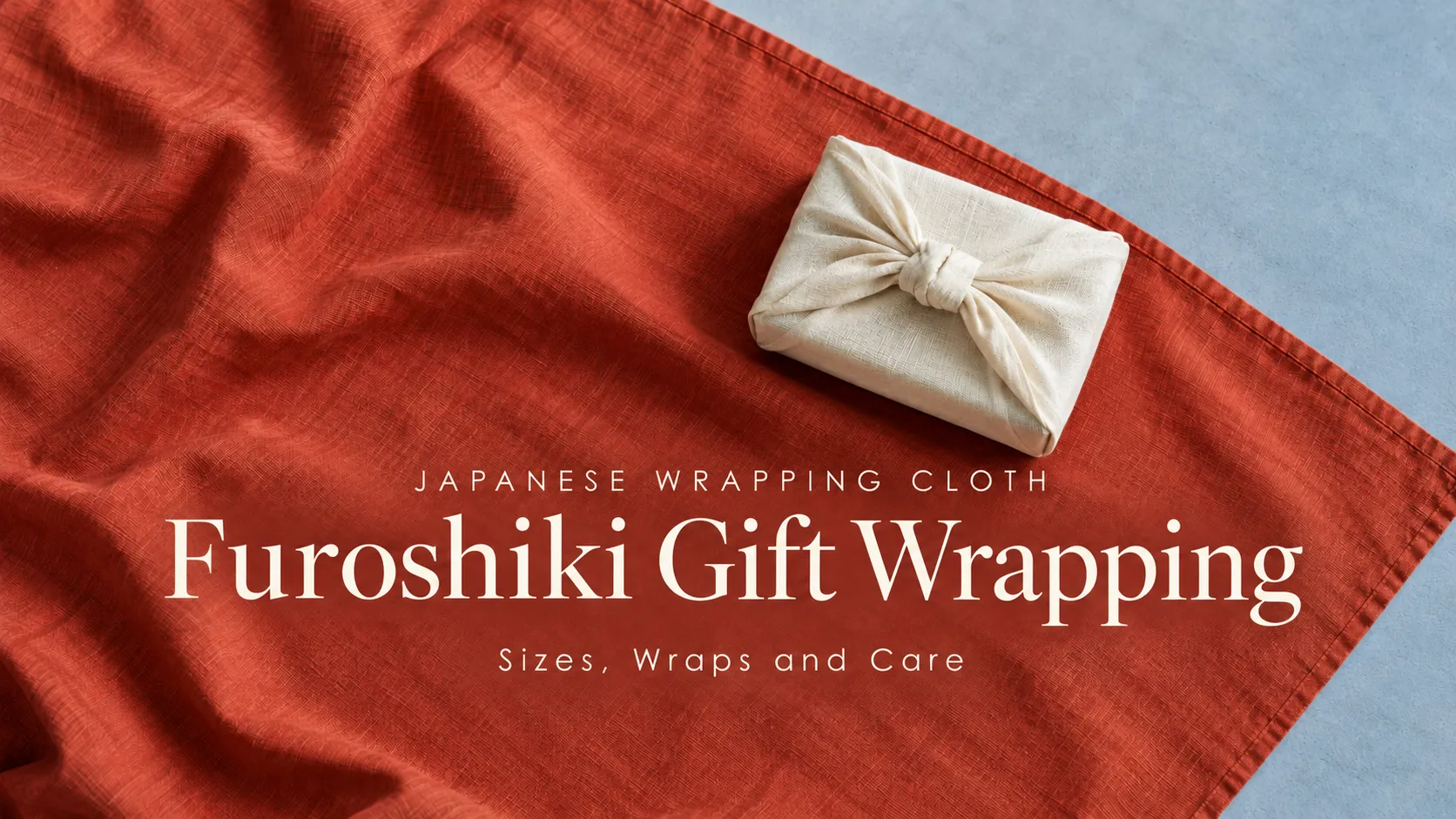
Choose a furoshiki size to suit the length, width and height of your gift and the way you plan to wrap it. Check how easily the fabric ties, too, and protect ceramics before you wrap them.
Found a cloth you love, but unsure whether it will fit your gift, or whether the recipient should keep it? Before choosing a pattern, measure the gift and decide whether the wrapping cloth will be part of the present. Those two decisions make the rest of the choice much simpler.
Drawing on makers’ official size guides, this piece covers how to wrap boxes, bottles and ceramics, how fabrics differ, and how to let the recipient know the cloth is theirs to keep. The size guidelines are based on makers’ recommendations and do not guarantee a fit for every shape, nor any load-bearing capacity.
Table of Contents
Choose the size to suit your gift and wrapping method
Measure the length, width and height of the gift, then choose a furoshiki with your wrapping method in mind. Check the dimensions before buying and, if you can, try a test wrap.
A furoshiki is a wrapping cloth, usually square, used to wrap and carry objects. The Consumer Affairs Agency’s guide to product quality labelling also defines it by its use and shape. Because the term does not refer to a particular fibre or pattern, cloths sold as furoshiki vary widely in size, thickness and feel.
(Source: Furoshiki | Consumer Affairs Agency)
What should you measure on a box, bottle or ceramic piece?
For a box, measure the height as well as the length and width of the base. For a bottle, check the height and the diameter at its widest point. If ceramics are going in a box, work from the outer dimensions of the box you will actually wrap, not the piece itself.
| Item to wrap | What to measure | Also check |
|---|---|---|
| Box | Length × width × height | Protruding lids or decorations, how sturdy the box is |
| Single bottle | Height × maximum diameter | Weight, shape of the neck, condition of the stopper |
| Boxed ceramics | Outer dimensions of the box | Whether the piece moves inside the box |
| Ceramics wrapped in protective material | Length × width × height after protection | Pressure on handles, rims and projections |
Even with the same base, a taller box needs more cloth to cover its sides. Rather than reasoning “it’s a box of sweets, so it must be this size”, start by measuring the gift in front of you.
Read size charts alongside fabric and wrapping method
A cloth measuring around 45–50 cm along one side is a useful starting point for small gifts. For a box of sweets or a wine bottle, start by considering a 68–70 cm cloth. Some makers list around 90 cm as an example size for an isshōbin, the 1.8-litre sake bottle. musubi describes its S size as about 45–50 cm, M as about 68–70 cm and L as about 90–120 cm.
(Source: Furoshiki Sizes and Materials | Maruwa Shogyo)
(Source: Choose by Size | musubi)
| Stated cloth size | Example uses in official guides | What to check when choosing |
|---|---|---|
| About 45–50 cm (18–20 in) | Wrapping small items, small gift boxes | The box’s height and how much cloth is left for the knot |
| About 68–70 cm (27–28 in) | Boxes of sweets, wine bottles | The box’s outer dimensions, the bottle’s height and diameter, the wrapping method |
| About 90 cm (35 in) | Isshōbin sake bottles and similar | Weight, how the cloth settles, how it will be carried |
| About 90–120 cm (35–47 in) | musubi’s L size category (also used for bags) | Whether there is too much excess cloth, whether the knot becomes too bulky |
These are manufacturers’ suggested uses, not results from our own wrapping tests. A size listed in a row will not necessarily fit every item of that kind, so check the fit with your actual gift and chosen wrapping method. Examples for gift boxes and bottles can also be found in musubi’s official wrapping guide.
(Source: How to Wrap and Use | musubi)
Read the stated size as the length of one side, not the diagonal. Check the centimetre measurement in the product listing, too, rather than relying on traditional size names such as futahaba, literally “two widths”. Maruwa Shogyo notes that products in sizes outside the conventional standards are also available.
(Source: Furoshiki Sizes and Materials | Maruwa Shogyo)
When in doubt, try a test wrap before buying
If you have a cloth of a similar size to hand, first check whether its corners reach over the box. This is only a rough check of size, however. A thin cloth may tie easily where a thicker one of the same size needs considerably more fabric for the knot.
If you are asking in a shop, bring the item itself, or a note of its length, width and height. When buying online, include the outer dimensions and the wrap you have in mind in your enquiry, rather than simply saying you want to wrap a box.
Check not only that the corners reach, but that the cloth ties without strain, that the ends are not left very short, and that the excess fabric does not spoil the shape. A larger size will not necessarily solve the problem.
Choose a fabric for its look, ease of tying and care needs
When choosing a fabric, look beyond sheen and pattern to thickness, slipperiness and care. Finishes differ even under the same material name, so check each product’s label.
For the person who receives it, a cloth used to wrap a gift is also something to use next. Weighing both how it looks and how easily it can be handled day to day makes the reasons for your choice clearer.
What should you compare between cotton, silk and polyester?
Start by comparing feel, ease of tying and care. musubi describes cotton as durable and easy to tie, and polyester as relatively wrinkle-resistant. Its guidance on pure silk and rayon, meanwhile, warns that water can cause shrinkage and recommends dry cleaning.
(Source: Washing and Care | musubi)
| Material | What to look for when choosing | What to check for care |
|---|---|---|
| Cotton | Ease of tying and a thickness suited to everyday use | How to wash at home, risk of colour transfer |
| Silk / pure silk | Sheen, colour, soft feel | Whether it can be washed in water, cleaning method |
| Polyester | Wrinkle resistance, slipperiness, thinness of the cloth | Washing method, iron temperature, any special finishes |
| Rayon | Sheen and colour, the texture of chirimen crepe | Shrinkage when wet, cleaning method |
The table above is a starting point for choosing a fabric. Always follow each product’s own label for washing and ironing. musubi also cautions that cotton and polyester can transfer colour through friction while wet.
(Source: Washing and Care | musubi)
Editor’s Note
When I choose fabric for a gift, I want to ask not only “Is this a fine material?” but also “Will the recipient feel at ease using it?” A cloth for someone who enjoys careful upkeep and a cloth you hope will be used again and again can reasonably be chosen by different standards.
Chirimen describes the fabric, not the fibre
Chirimen is not another word for silk. Its defining feature is shibo, the fine crinkled texture on the surface of the fabric.
The Tango Textile Industrial Association describes the technique: tightly twisted yarns are woven in, and the shibo emerges during the scouring process that follows. It also introduces chirimen made from polyester, so the name alone cannot tell you the fibre or how to wash it.
(Source: 5. What Is Tango Chirimen? | Tango Textile Industrial Association THE SILK)
Read a cloth’s description in three parts.
- Use: what the cloth is for, such as furoshiki.
- Material: which fibre it is made from, such as cotton, silk or polyester.
- Fabric and construction: what structure and texture it has, such as chirimen.
When a place of production or a making method catches your eye, read the product description together with the fibre-content label. That turns a visual impression into something you can actually check.
Check how the pattern looks before and after wrapping
A cloth spread flat and a cloth wrapped around a box show different areas. A large central motif may be folded away, while a colour from one corner may surface in the knot.
When choosing, look at wrapping examples as well as flat product photographs. If the design has a direction, or includes lettering, decide in advance which side will face the front.
Editor’s Note
A cloth’s design is not complete at the moment of wrapping. Untie it, and motifs that were hidden reappear as it returns to a single flat cloth. Being able to enjoy that change is part of what makes giving a furoshiki interesting. When explaining the origin of a pattern, follow the description given by the seller or maker, and avoid attaching auspicious meanings after the fact.
A 2015 exhibition at the Takasaki Tower Museum of Art presented original artwork for furoshiki from the Miyai collection, alongside the furoshiki themselves. Through works by artists including Munakata Shikō and Higashiyama Kaii, it looked at how a flat picture becomes three-dimensional once it wraps an object.
(Source: Exhibition leaflet (in Japanese) | Takasaki Tower Museum of Art)
If the differences between dyeing methods have caught your interest, see also Kogei Japonica’s guide to Japanese dyeing techniques.


Start with a simple wrap for boxed gifts
For a boxed gift, learn one basic wrap first, then work on tidying the excess cloth and the knot. Try boxes of different heights, too, so you can tell why a cloth will not tie.
Before adding any embellishment, position the box and let the cloth follow its sides. With a basic wrap, it is easier to see what needs adjusting when the result loses its shape.
Start with the square knot and how to untie it
The square knot, also called a reef knot and known in Japanese as ma-musubi, is the basic way to tie two ends of the cloth together. Tie the left and right ends once, then cross them in the opposite direction for the second tie. Crossing them the same way both times tends to produce a granny knot, which sits differently, so compare your knot with official diagrams or videos at first.
To untie it, don’t tug at the knot from both sides. Instead, pull one end and the cloth attached to it into a straight line, and slide the knot along. musubi shows the square knot and how to untie it in images and video.
(Source: How to Wrap and Use | musubi)
Practise without anything fragile inside. If you know how to untie the knot, you can explain it should the recipient have trouble.
Wrapping a low box, step by step
For a low box, start with otsukai-zutsumi, a basic box wrap in which two opposite corners are folded over the gift and the other two are tied on top. The Ministry of the Environment’s official materials also illustrate it as a basic wrap.
(Source: How to use “Furoshiki” | Ministry of the Environment)
- Lay the cloth with the patterned side facing down, if it has one, and turn it so the four corners point towards you, away from you, and to the left and right.
- Place the box in the centre and fold the near corner over it. Lay any long excess along the far side of the box.
- Bring the far corner over towards you, tucking the tip inside if there is too much.
- Lift the left and right corners, keeping them close to the sides of the box.
- Tie a square knot on top of the box, then tidy the excess at the corners and any slack along the sides.
If the cloth puckers partway through, go back and check the box’s position and the folds rather than pulling hard to force the shape. Thin cardboard boxes can deform under pressure, so avoid pressing down on the lid.
What if the cloth won’t tie around a tall box?
First check whether the box has drifted off-centre, and whether too much cloth is going into unnecessary folds. If the ends still don’t reach far enough, reconsider the cloth size or the wrap.
If, on the other hand, the knot is so large that it hides the box, the cloth may be too big or too thick. “Will it tie?” and “Will it sit neatly?” are separate questions.
For taller boxes, don’t rely on finished photographs alone; check the outer dimensions of the box and the cloth used in them. Testing with the method you will actually use is a more reliable guide than working out the size from a single ratio.
Protect bottles and ceramics before wrapping
For bottles and ceramics, check the size after protection as well as the shape and weight before you wrap. Treat wrapping in cloth and the protection needed for carrying or shipping as separate matters.
Cloth can follow a shape, but that alone does not guard against knocks. With fragile items, decide on protection and how the gift will travel before thinking about how it looks.
For bottles, look at height and diameter, not only capacity
Bottles of the same capacity sit differently in the cloth depending on whether they are tall or broad. When buying, check height, maximum diameter and weight as well as capacity.
In musubi’s bottle wrap with a handle, you begin by standing the bottle in the centre of the cloth and tying two diagonally opposite corners at the neck. Cross the remaining two corners behind the bottle and bring them round to the front. Finally, adjust the upper tie and twist the cloth into a handle. The hand movements can be followed in musubi’s step-by-step images.
(Source: How to Wrap and Use | musubi)
The first time you try it, work on a flat, stable surface and make sure the stopper is firmly closed. Even once the handle has taken shape, don’t lift the bottle without checking the cloth and the knot. When moving it, support the bottle itself, for instance with a hand under the base.
To give two bottles together, you can use awase-zutsumi, a two-bottle wrap. In Miyai’s official guide, you lay the bottles on their sides along the cloth’s diagonal, bases facing each other and 4–5 cm apart, roll the cloth around them, then stand them upright and tie. If the bottles differ in shape, check how they fit and how large a cloth you need. Having cloth between the bottles does not necessarily prevent knocks or breakage.
(Source: Awase-zutsumi (Two-Bottle Wrap) | Miyai)
For ceramics, size the cloth to include the box and protection
For ceramic gifts, a simple approach is to keep the box and protective materials from the purchase and wrap the outside in furoshiki. That way you can choose by the box’s dimensions rather than wrapping the piece directly.
If there is no box, ask the artist or retailer about suitable packaging. Handles, thin rims, lids, decorative projections: the places that should not take pressure differ from piece to piece. For any paper or cloth that touches the surface, too, follow the guidance given for that piece.
Cutting back on protection to show off the piece’s outline works against the purpose of the gift. What matters most is that the piece is in good condition when the wrapping is opened.
Hand delivery and shipping call for different packaging
Don’t use a wrap prepared for hand delivery as the outer packaging for shipping. For shipping, use an outer box and protective cushioning so the contents cannot move.
Japanese courier Yamato Transport advises wrapping tableware piece by piece in cushioning, with lids wrapped separately from the body. For bottles, it sets out steps for closing the stopper, protecting the bottle with cushioning and securing it inside the box.
(Source: Packing Basics | Yamato Transport)
When using furoshiki, the basic rule is not to skip this protection for transit. Choose the shipping box by the outer dimensions of the finished wrap, and check that the knot is not pressed hard against the side of the box.
Make it clear when the cloth is part of the gift, and include care notes
If the cloth is part of the gift, say so in a few words. That removes any question about returning it, and gives you a chance to pass on care information and ideas for using it again.
Wrapping in cloth leaves the recipient to decide what to do with that cloth. For the gift to be received comfortably, a clear explanation matters as much as a beautiful finish.
Giving the cloth or taking it home
Decide first whether the furoshiki is simply for carrying the gift, or whether the cloth itself is part of the present.
If it is just for carrying, one option is to take the gift out, hand it over and keep the cloth. If you are giving the cloth as well, hand the gift over still wrapped and say so, which saves the recipient from wondering.
For formal gift-giving, follow the customs and reception arrangements on the recipient’s side. Rather than assuming there is one correct way to hand over a gift, focus on making clear whose cloth it is and what it is for.
Include a message that leaves no doubt
For a personal gift, a short card might read:
“This wrapping cloth is part of your gift, so please keep it. I hope you enjoy using it again.”
For a corporate gift, something simpler works well:
“This wrapping cloth is yours to keep. We hope you enjoy using it again.”
For care, the most reliable approach is to include the product tag or the maker’s guidance. Avoid adding “machine washable” on the strength of the fibre name alone, and do not give a single ironing temperature; follow that product’s label.
Editor’s Note
Suggesting one or two uses is enough. Rather than assigning the cloth a role (“please be sure to reuse it”), leave the recipient free to use it or not. That kind of consideration, I think, is also part of giving with care.
Describe reuse without overstating environmental benefits
A furoshiki is wrapping that can be untied and used again. That alone, however, does not mean it always has a smaller environmental impact than paper.
Some paper bags and wrapping paper can also be reused, depending on their condition. A fair comparison would have to account for how the cloth or paper is made, transport, washing, the number of uses and disposal. Without that information, no reduction rate or required number of reuses can be given.
Editor’s Note
If you want to mention it, describe what you actually did: “I chose a cloth that can be used again”, “I’ve included care instructions.” Before making broad claims about the environment, think about a size and care routine that make the cloth easy to use next time. That is what makes a difference in the recipient’s day-to-day life.
Test a sample before ordering corporate gift wraps
For corporate gifts, decide quantities, wrapping work and delivery alongside the choice of cloth. Wrap a sample using the actual gift, check the presentation and the time required, and then finalise the specifications.
On its official page presenting furoshiki as a packaging material, Maruwa Shogyo shows product examples by fabric and size. When considering cloth for this purpose, give the manufacturer or seller details of the item and your packing requirements, not only the design.
(Source: Furoshiki as Wrapping and Packaging Material | Maruwa Shogyo)
What should you prepare before making an enquiry?
Having at least the following details ready makes it easier to work out the specifications.
| Item | What to provide |
|---|---|
| Gift item | Name, outer dimensions, weight, whether it is fragile |
| Quantity | Number required, how spares are handled, whether split delivery is needed |
| Budget | Whether it covers wrapping labour, cards and shipping as well as the cloth |
| Preferred dates | When you need it in-house and when it should reach the recipient |
| Wrapping | Who will wrap, whether you want finished wraps delivered |
| Design | Colour, pattern, name or logo printing, any request for original artwork |
| Delivery | A single bulk delivery or individual shipping, domestic or overseas |
“We want to deliver a box of these dimensions, in this quantity, already wrapped” gives a supplier much firmer ground for a quote than “something good within budget”. Confirm minimum order quantities, prices and lead times for each fabric, process and quantity.
Before production, check knot placement, pattern alignment and packing time
When testing a sample, check not only the finished look but also who will wrap and in what order.
Agree on the knot position, the part of the pattern on show and how the card is inserted, and keep photographs of the front and sides so everyone involved can refer to them. If pattern placement or dimensions vary from piece to piece, agree how much variation is acceptable.
Packing time cannot be judged only by how quickly an experienced person wraps one gift. Time the whole process, including spreading the cloth, placing the item, re-tying, inspection and packing into the outer box. The sample serves two purposes: checking the finish, and judging whether the full quantity can be produced without strain.
Include information that keeps the cloth in use
For corporate gifts, give priority to the information the recipient needs over a description of the company. Knowing the material, how to care for it and that the cloth is part of the gift makes it easier to decide to use it again.
When introducing makers or production regions, state specifically the methods and roles you can verify. Knowing who handled the dyeing, weaving, design and sewing deepens understanding of the cloth. As for the logo, picture how it will look not only on the wrapped gift but also when the cloth is spread out and used day to day.
If you are considering developing a product with a workshop, or planning a gift that includes cloth from the outset, you can contact Kogei Japonica’s product development and collaboration service with your aims, intended use, preferred timing and approximate budget.

Furoshiki FAQs: Sizes, fabrics and gift-giving
If you are unsure about size, substitute fabrics, washing or how to hand over the gift, go back to the item itself and the product label. The common questions below lead into a final check before giving.
Size and wrapping
- Q. What size furoshiki should I choose?
- A. Around 45–50 cm for small items, and around 68–70 cm for a box of sweets or a wine bottle, are useful starting points. The size you need changes with the item’s height and the wrap, however, so treat the chart as a guide and confirm with a test wrap.
- Q. Why won’t a cloth of the same size tie?
- A. Thickness, slipperiness, folding and the item’s position all play a part. Check the placement first; rather than pulling hard, reconsider the cloth size or the wrap.
- Q. Can I choose a size for a bottle by its capacity?
- A. Not by capacity alone. Check its height, maximum diameter and weight, and the wrap you plan to use.
- Q. Is furoshiki on its own enough to wrap ceramics?
- A. It may not provide enough protection. Use a box and protective materials, and ask the artist or retailer what packaging suits the piece. Shipping requires separate packing for transit.
Fabric, care and giving
- Q. Can I use a cloth or scarf I already have instead?
- A. It can work, but check its size, slipperiness, wear and the condition of its edges. Delicate fabrics may show knot marks or damage, so think carefully before using a cloth that matters to you.
- Q. Can a chirimen furoshiki be washed?
- A. The word “chirimen” alone will not tell you. Check the fibre content and the product label, and care for it as directed.
- Q. What should I say when the cloth is part of the gift?
- A. A short line such as “This wrapping cloth is part of your gift, so please keep it” makes your intention clear. Pass on any care information that came with the product as well.
Environmental claims and corporate use
- Q. Is it better for the environment than paper wrapping?
- A. That cannot be said across the board. It depends on factors such as material, manufacture, transport, washing and the number of uses. Keep the fact that it can be reused separate from any claim about environmental impact.
- Q. Where should a corporate gift project start?
- A. Set out the item’s dimensions and weight, the quantity, preferred dates, shipping method and who will wrap. Test a sample under those conditions, check the finish and packing time, then confirm the specifications before placing the order.
Final checks before giving
- You have measured the dimensions, including any box and protective materials.
- You have wrapped it for real and checked the excess cloth and the knot.
- Ceramics and bottles have the protection they need.
- You have decided whether the cloth is being given or taken home.
- You can pass care information on to the recipient.
- If shipping, you have an outer box and cushioning ready.
Wrapping a gift in furoshiki is about more than making the moment of giving look special. Once untied, a single cloth stays with the recipient. If they reach for it the next time something needs wrapping, the gift has found a new role in their daily life.
Editor’s Note
At Kogei Japonica, we see the cloth as part of the gift, with a life beyond the moment it is unwrapped. Find out how it was made, check that it suits what you are giving, and pass on what the recipient needs to know to use it. That is how a beautiful cloth becomes a useful one, and it is where much of the pleasure of giving a furoshiki lies.
