
As summer approaches, a familiar question returns in hotels, ryokan, and restaurants: how should the space be refreshed this year? There is a desire to evoke coolness, but the results can start to feel repetitive season after season. Or the intention is there to bring in craft objects, but it is not clear which materials belong in which spaces. These are common practical problems.
For a summer installation that draws on craft, the approach is to combine sudare reed screens, hemp textiles, bamboo basketry, glass, and tinware across the different zones of a space — entrance, guest room, dining table, lighting — rather than placing individual pieces in isolation. By considering light, air movement, tactile character, negative space, and the relationship to food together, a coherent sense of perceived coolness — ryo, in Japanese — can emerge in hotels, ryokan, and restaurants as something a guest actually experiences rather than just sees.
This article organizes the craft materials most suited to summer seasonal installation by spatial zone.
It also covers the practical questions that arise when considering rental, purchase, seasonal display, and collaboration with craft artists and workshops.
Table of Contents
What is a summer ryo shitsurai?
At Kogei Japonica, we use the term ryo shitsurai to describe a seasonal installation designed around ryo — a Japanese sense of coolness experienced not only as temperature, but through light, shade, breeze, texture, and restraint. It involves placing craft objects that act on sight, touch, light, and air movement in specific spatial zones, in order to deepen the sensory experience of summer for guests. This framing comes from the Kogei Japonica editorial team; it is not a standardized industry term. But the logic it describes is one we find consistently present in summer installations that actually work in ryokan, restaurants, and shops.
Simply placing “cool-looking objects” is different from a considered ryo shitsurai. The translucency of a sudare screen softening incoming light, the crisp, dry touch of hemp textiles, the lightness that bamboo basketry brings to a room, the clarity of glass, the composed surface of tinware — each can contribute to a sense of ryo in its own way. But it is when their roles overlap within a space that the experience becomes memorable.
Osaka Kongo sudare, for instance, is described in official Osaka Prefectural Government information as a craft produced mainly in Tondabayashi, Kawachinagano, and Osaka city, designated a national traditional craft by the Minister of Economy, Trade and Industry in 1996. Its development is connected to the high-quality bamboo that grew in the foothills of Mount Kongo and along the Ishikawa riverbanks.
(Source: Osaka Kongo Sudare | Osaka Prefectural Government)
Among hemp textiles, Omi jofu from the Lake Biwa region of Shiga Prefecture is well established. The Omi Jofu Traditional Industry Hall describes it as a hand-woven textile designated a national traditional craft by the Minister of Economy, Trade and Industry in 1977, using plant fibers including ramie (choma) and hemp. The kibi-ra variant is characterized by the use of hand-spun hemp thread for the weft.
(Source: Omi Jofu Traditional Industry Hall)
In bamboo and basketry, Beppu bamboo craft is the primary reference point. The Beppu Municipal Bamboo Craft Traditional Industry Hall describes Beppu chikuzaiku as a craft designated by the Minister of Economy, Trade and Industry as a national traditional craft, and as a practice that has carried forward the technique of weaving bamboo strips.
(Source: Beppu Municipal Bamboo Craft Traditional Industry Hall)
None of these craft materials was made to be consumed as a seasonal prop. Materials, technique, production region, and function in daily life have accumulated together over long periods. The Ministry of Economy, Trade and Industry (METI) lists the designation criteria for nationally designated traditional crafts as including: primarily for everyday use; the main part of the production process is handcraft-based; manufactured using traditional techniques or methods. As of October 27, 2025, 244 items hold this national designation.
(Source: Traditional Crafts | Ministry of Economy, Trade and Industry (METI))
Editor’s note
The point of a summer installation is not to “look Japanese.” It is to think carefully about how a space receives light, how air moves through it, how food and vessels appear together, and at what distance guests will engage with the craft. Craft objects in a space are not merely decoration — they shape the atmosphere of a place, and they hold within them the technique and time of the people who made them.
Why think by space rather than by individual object?
Placing craft objects individually, without considering their spatial role, makes it difficult to achieve coherence — and without coherence, the experience of ryo is unlikely to stay with a guest.
Guests do not receive a hotel entrance, a guest room tokonoma alcove, a dining table, and the evening lighting as separate pieces of information. They experience a stay, a meal, or a visit as a whole and remember it that way. When the character of the entrance installation and the character of the tableware are very different, the overall coherence of the space weakens.
On the other hand, even with restrained materials, if the thread of ryo runs quietly from entrance to dining table, the space leaves an impression without relying on excess. A sudare screen softening light at the entrance, hemp and bamboo in the guest room, glass and tinware on the dining table, and bamboo or washi lantern lighting producing shadow in the evening — giving each zone a distinct role is what makes the whole work.
The Japan Tourism Agency, in guidelines related to raising the value of lodging businesses, references a registration system to promote higher-value hospitality. Introducing craft objects can be framed not as a decoration cost but as a contribution to the experience of a guest’s stay and to the overall positioning of the property.
(Source: Management Guidelines for Raising the Value of Lodging Businesses | Japan Tourism Agency)
What becomes clear when visiting well-executed installations is that the choices behind them have been articulated. If a sudare screen is being used, is it for shade, to manage sight lines, or to introduce a seasonal feel? If glass vessels are on the table, is it to frame the food, or to communicate the temperature of cold sake? When the purpose behind a placement is clear, the craft does not need to be made conspicuous — the overall space becomes convincing on its own.
Which craft belongs where?
The craft genres suited to entrances, guest rooms, dining tables, and lighting each have different properties and operational considerations. In a summer installation, it is useful to think differently about the balance between “displaying,” “touching,” “using,” and “explaining” depending on the zone.
Entrance and entryway
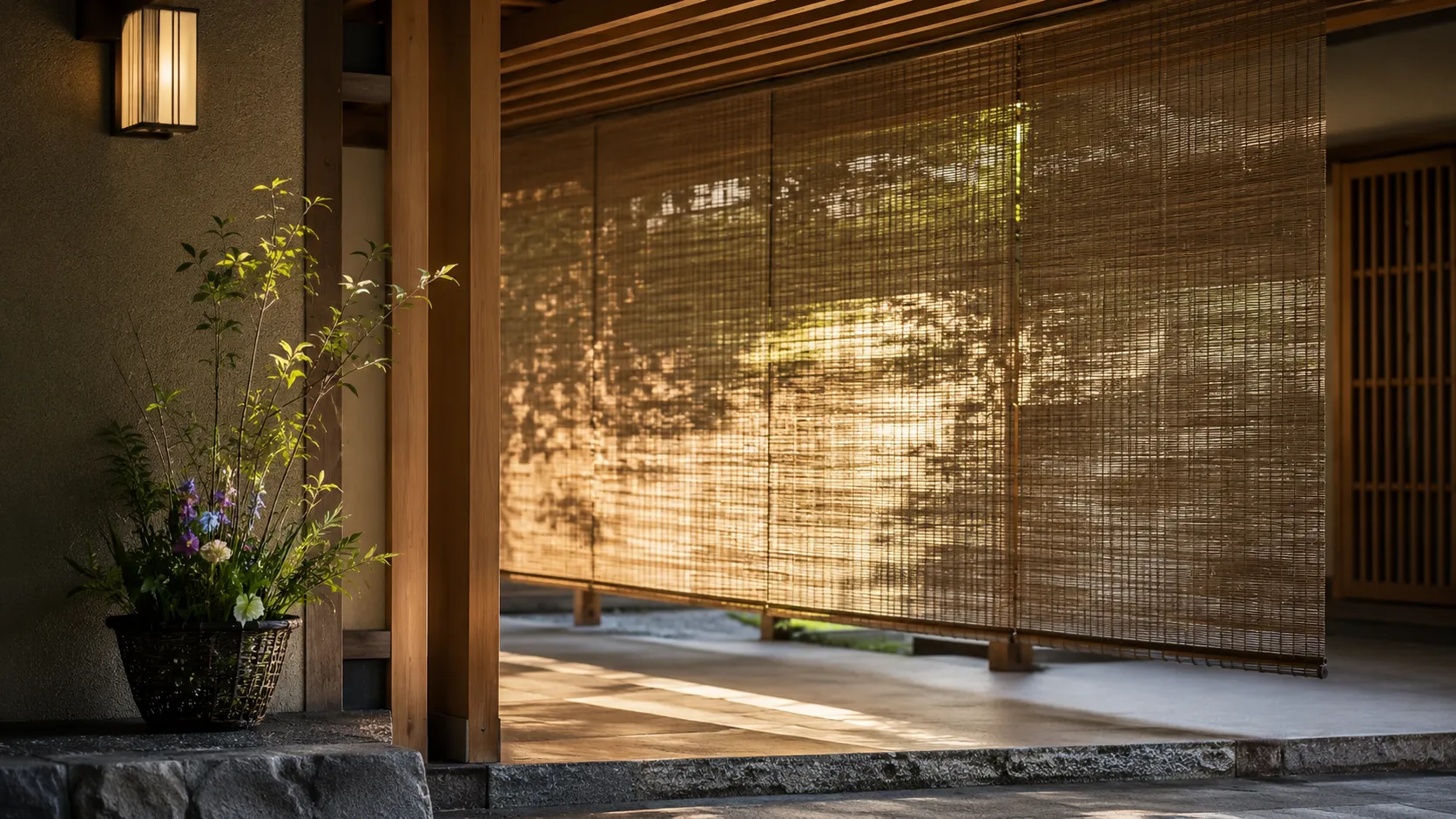
The entrance is where a guest first encounters ryo. Here, the aim is less about strong visual statements than about softening light and moderating the transition between outside and inside. Sudare reed screens work at this boundary — gently connecting exterior and interior and shaping the first impression of the space.
Official information from the City of Tondabayashi notes that Osaka Kongo sudare has a history connected to the formal reed screens used in imperial court settings from the Heian period onward, developing into the tatami-room screens known today. Sudare made from natural materials do more than block light at an entrance or doorway — they give the space formality and quiet.
(Source: Traditional Craft: Osaka Kongo Sudare | City of Tondabayashi)
When using bamboo basketry at an entrance, one option is to place a flower basket with seasonal branches or flowers. However, entrances have significant foot traffic, and there is a real risk of tipping from wind or accidental contact. Confirm the stability of the display surface, the guest circulation path, and how the piece will be handled during cleaning before placing anything.
Guest room and tokonoma alcove
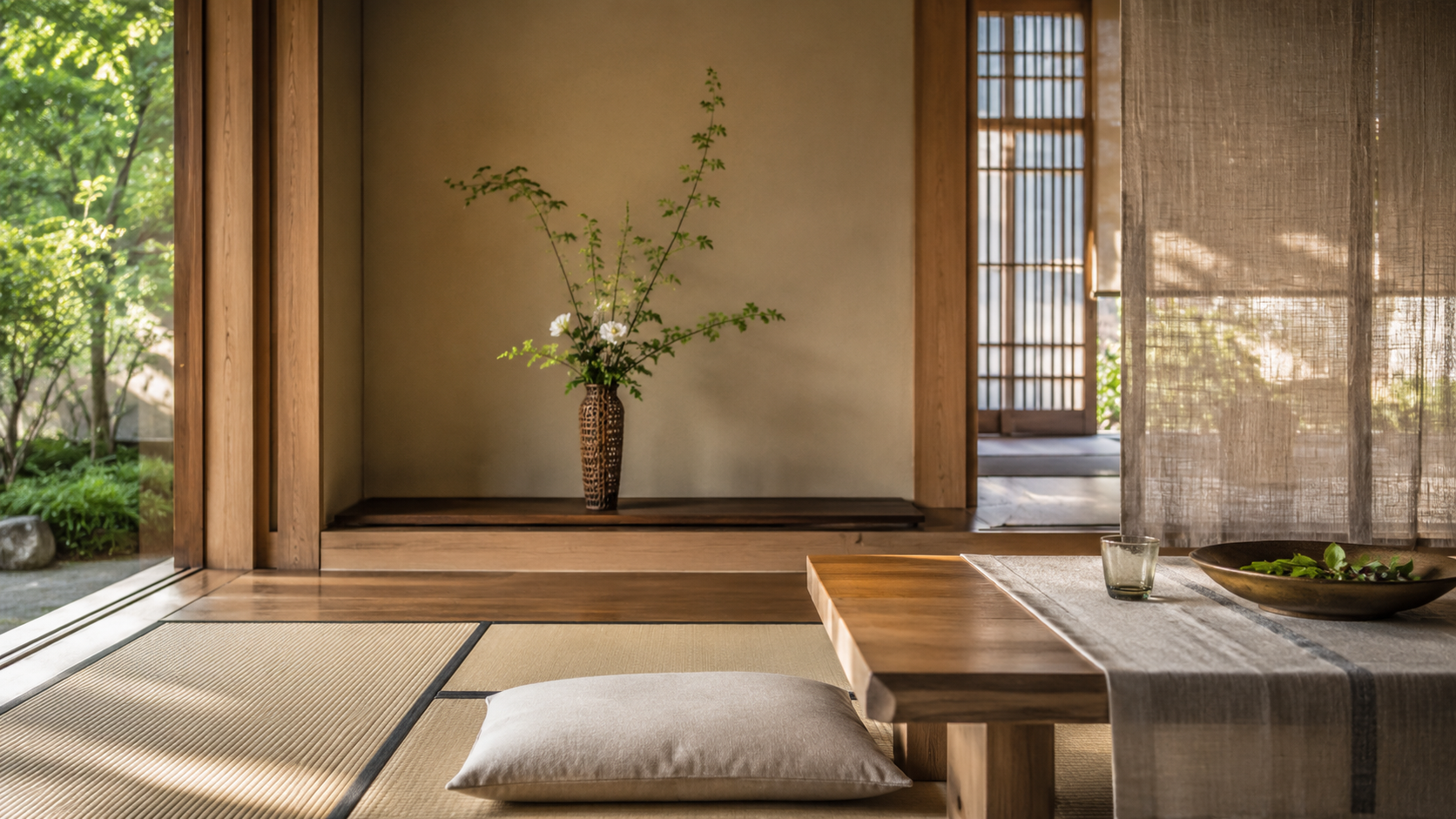
Guest rooms and tokonoma alcoves are the spaces that most determine how settled a stay feels. Here, the craft that works is not visually arresting but conveys ryo through tactile character and negative space.
Hemp cushion covers, noren divider curtains, table runners, and the re-covering of standing screens are all options that combine visual coolness with practical use. Hemp’s translucency, lightness, and the way it moves away from skin give a space a sense of freshness.
In the tokonoma, a single seasonal flower arrangement using a flower vessel or a basket can change the atmosphere of the room. What matters here is restraint. In a summer installation, negative space contributes to the sense of ryo as much as the objects themselves.
When placing artist-made or one-of-a-kind pieces in a guest room, it needs to be clearly established whether guests may handle them or whether they are for viewing only. A short description card noting the artist’s name, materials, production region, and handling notes makes the situation clear for both guests and staff.
The dining table
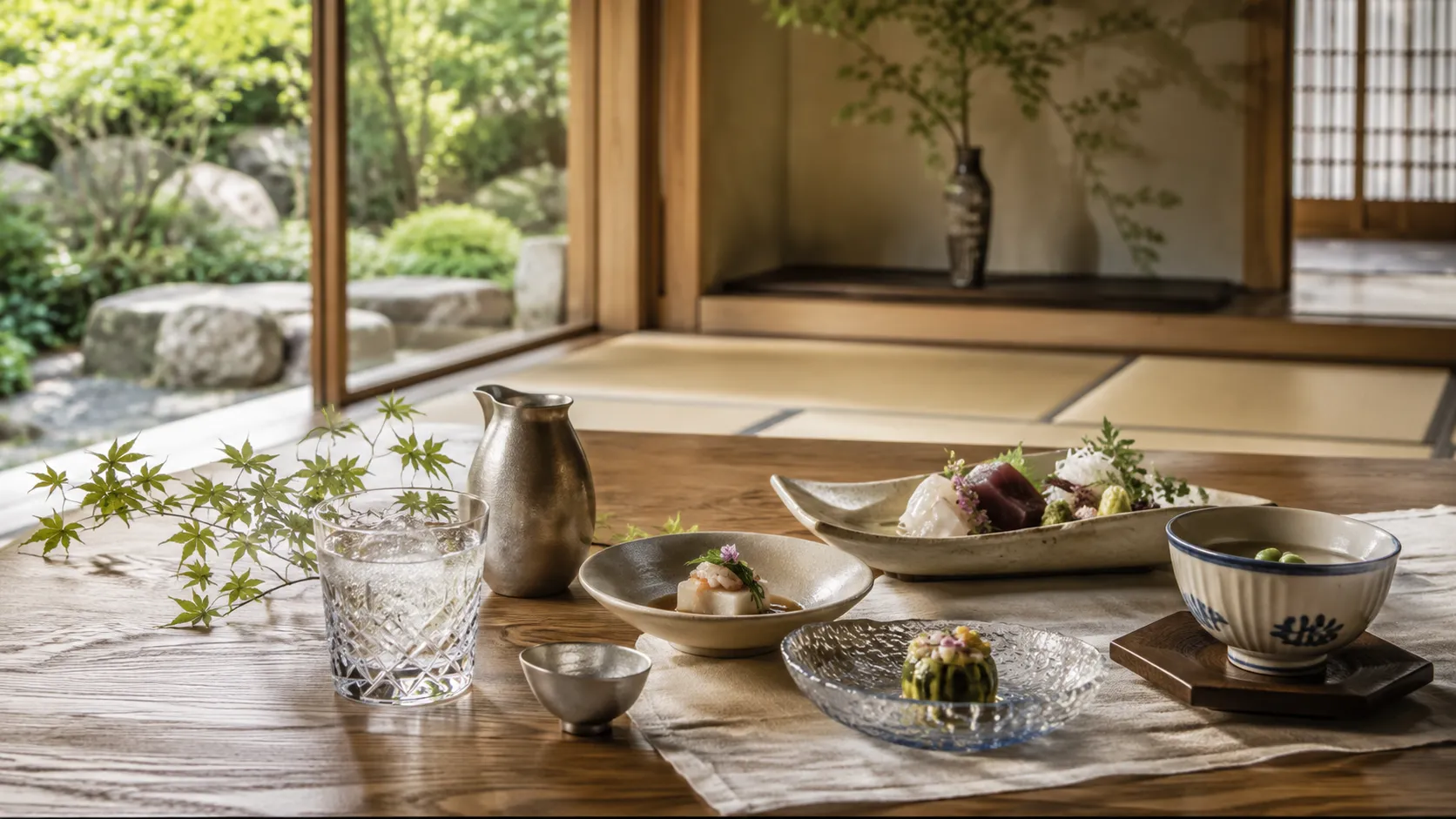
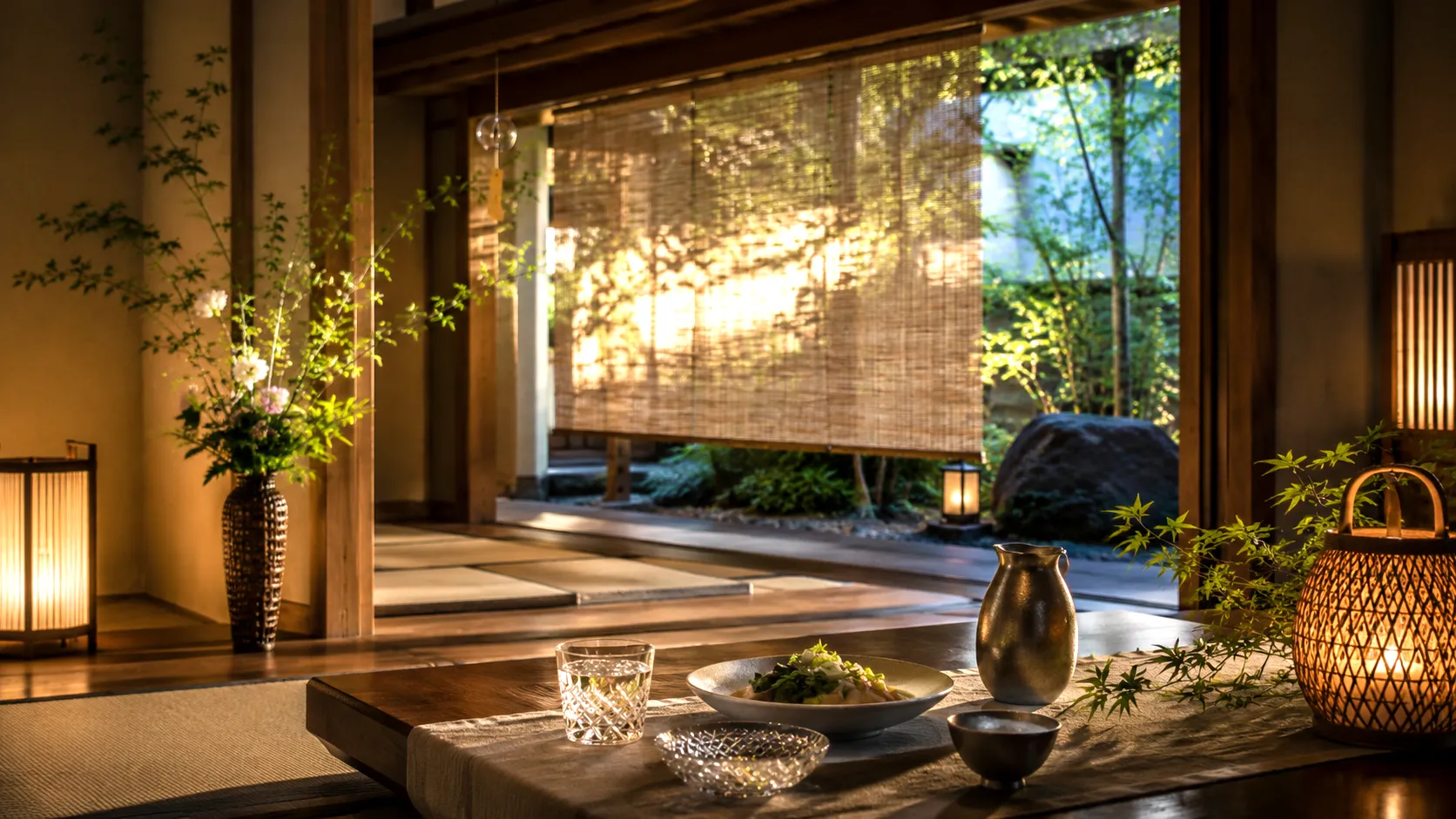
The dining table is where the functional properties of craft are most directly engaged. Summer food and drink read very differently depending on the vessel. Glass, Edo Kiriko cut glass, tinware, thin-bodied ceramics, and summer tea bowls all have the capacity to communicate temperature and seasonal character visually.
Edo Kiriko is described as the collective term for cut glass produced in Edo — present-day Tokyo — from the late Edo period through to today. The Sumida Edo Kiriko Hall notes that Edo Kiriko was designated a Tokyo Metropolitan traditional craft in 1985 and a nationally designated traditional craft by the Minister of Economy, Trade and Industry in 2002.
(Source: What is Edo Kiriko? | Sumida Edo Kiriko Hall)
Edo Kiriko glassware on a dining table sharpens the visual impression of cold drinks and ice. For restaurant or ryotei use, however, the practical questions need to be resolved: washing method, chipping risk, the number of pieces needed, storage, and how to source replacements when breakage occurs. Rather than rolling it out across every seat, using it selectively — in private rooms, for special-course menus, or as a summer-limited offering — is a realistic approach.
For tinware, Osaka Naniwa suzuki (錫器, Japanese tinware) is a recognized example. The Osaka Prefectural Government’s official information describes Osaka Naniwa suzuki as producing sake vessels, tea ware, and flower vessels, with more recent production extending to tumblers and tankards that reflect contemporary use.
(Source: Osaka Naniwa Suzuki | Osaka Prefectural Government)
Tinware is sometimes described by manufacturers and production regions as bringing a mellowing effect to sake. That said, the perception of taste varies between individuals, and it is more appropriate to position tinware as one element in food and drink presentation rather than to make definitive claims about its effect.


Lighting and seasonal display
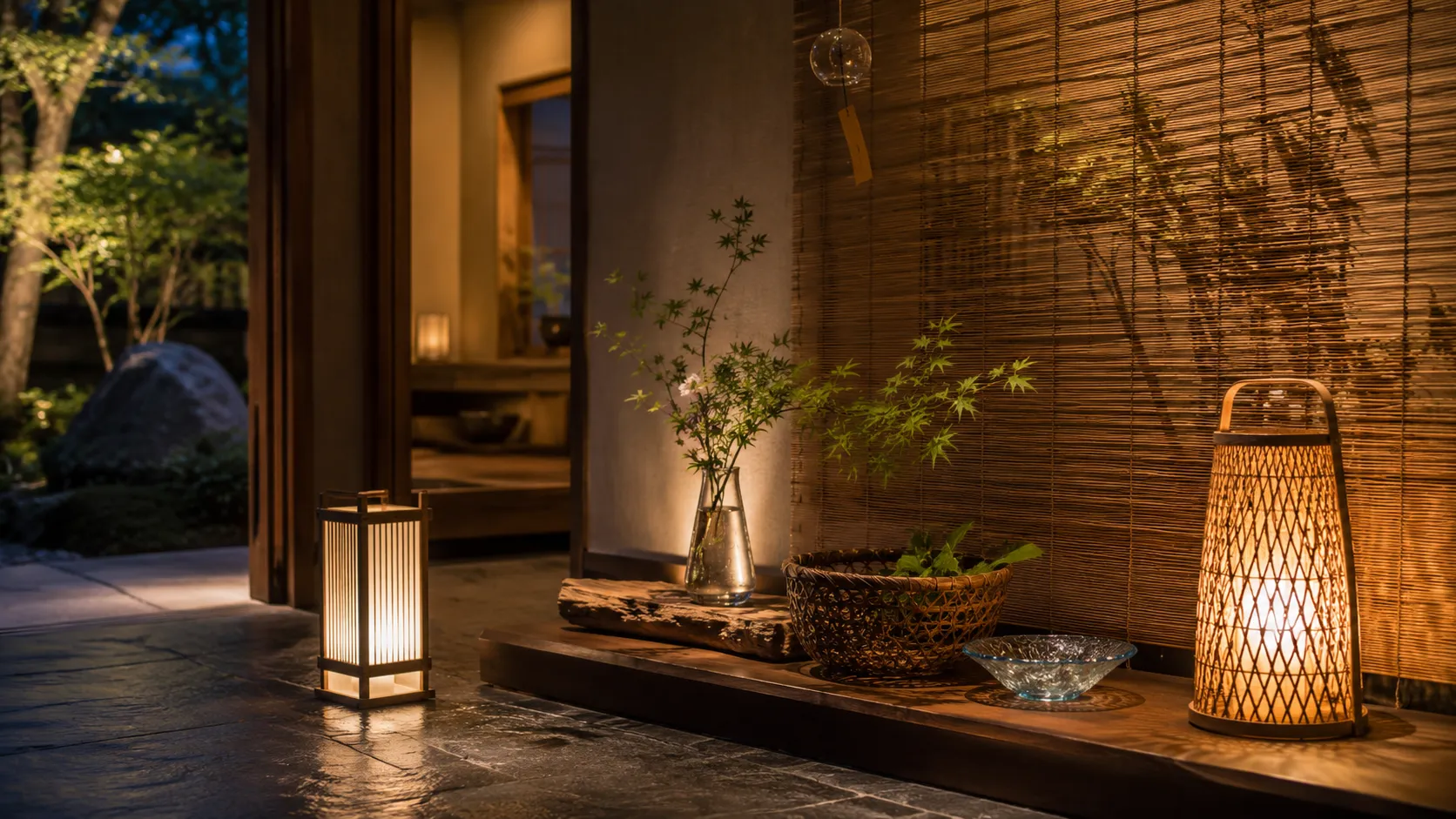
Lighting is the primary tool for evoking ryo during evening hours. In a summer space, creating shadow and reducing light intensity is often more effective than illuminating brightly.
Andon-style lanterns — traditional Japanese standing lights with a paper-and-frame structure — made from bamboo or washi paper soften direct light and cast quiet shadow on walls and floors. Bamboo craft lighting and basket-form lamp shades produce a visual impression of coolness from the light that passes through the gaps in the weave.
For seasonal display rotation, sudare screens, basketry, flower vessels, and glass works used at entrances can be replaced by zone at the end of each season. A dedicated seasonal display area in a hotel lobby or shop corner can become a place guests want to photograph. If photography and social media posting are anticipated, confirm in advance what the artist, workshop, or gallery permits in terms of image use.
Sound also contributes to the perception of ryo: furin wind chimes are a craft object through which this atmosphere can be introduced into a space. Depending on the property environment, the sound of furin can create a sense of freshness — while proximity to neighboring spaces and the overall quietness of the setting also need to be considered.

Craft by zone — comparison table
In a summer installation, the craft genres suited to each space and the associated operational considerations differ. The table below is intended as a starting point for hotels, ryokan, restaurants, and retail spaces considering an introduction.
| Zone | Sudare (reed screen) | Hemp textile | Bamboo basketry | Glass | Tinware (suzuki) | Operational considerations |
|---|---|---|---|---|---|---|
| Entrance / entryway | Suited to light filtration and sight-line management | Can be used for noren curtains | Works well as a flower basket | Possible with limited application | Generally limited use | Confirm wind exposure, tipping risk, and guest circulation |
| Guest room / tokonoma | Suited to formal screen-style presentation | Suited to cushion covers, standing screens, runners | Suited to flower baskets and display baskets | Can be used as a flower vessel | Can be used as a flower vessel | Confirm cleaning routine, humidity, and guest-handling policy |
| Dining table | Generally not suited | Suited to table runners | Can be used for serving baskets, bread baskets | Suited to Edo Kiriko glassware and vessels | Suited to sake vessels and tumblers | Confirm washing method, chipping risk, quantity needed, and storage |
| Lighting / seasonal display | Can be used as a backdrop or light screen | Can be used as a display cloth | Suited to lamp shades | Suited to lamps and display pieces | Possible with limited application | Confirm power source, safety, and photography permissions |
What this table is designed to make clear is that craft objects fall broadly into those meant to be displayed and those meant to be used. In zones where guests come into direct contact — dining tables, guest rooms — durability and ease of cleaning need to be prioritized. In lobbies and tokonoma alcoves, a single strong piece can serve as the spatial anchor of the whole installation.
Rental or purchase — which is the right approach?
Rental is suited to short-term seasonal installations; purchase is suited to objects intended for long-term use as part of a property’s identity. Which is the right choice depends on the type of work, the duration of the installation, budget, storage, and how breakage is handled.
If the intention is to rotate the seasonal installation every year, purchasing everything places a significant burden on storage and maintenance. For summer lobby displays, event-period seasonal installations, photography campaigns, and table settings tied to a limited-season menu, rental or consignment display may be a viable option.
On the other hand, entrance sudare screens, guest room tableware, and the kind of flower vessels that become synonymous with the property are suited to purchase. Some craft objects develop a surface character particular to the property as they are used over time.
When the decision is unclear, a practical approach is to pilot a limited installation in one area, assess how guests respond and how manageable the operational load is for staff, and then decide whether to proceed with purchase or broader introduction.
Purchase, rental, consignment display, and commissioned work
- Purchase: Suited to permanent or long-term use. Appropriate for objects intended to represent the property.
- Rental: Suited to summer-season, event, and seasonal display formats. Reduces the storage burden.
- Consignment display: Worth considering when the installation also serves a product presentation or sales function in a lobby or retail space.
- Commissioned work: Suited to situations where a distinctive piece tailored to the property, its food, or its brand identity is needed.
Pricing, rental terms, how breakage is handled, image rights, and whether selling is permitted all vary depending on the artist, workshop, gallery, and distribution route involved. It is not appropriate to assume “this will fall within a certain budget” or “rental is available” without confirmation.
Kogei Japonica accepts inquiries on spatial installation and craft introduction for ryokan, restaurants, shops, hotels, and commercial facilities.
When considering an introduction, sharing photographs of the installation space, the property concept, the intended timing, and whether purchase or rental is preferred makes it easier to develop a specific proposal.
What needs to be confirmed before introduction?
Confirming light conditions, airflow, circulation routes, cleaning, storage, breakage response, and interpretive text before installation significantly reduces the risk of problems after the fact. When craft is being used in a commercial space, the design process needs to include operations as well as aesthetics.
Items to confirm before introduction:
- Have the light levels, ventilation, and humidity of the installation space been assessed?
- Will the material deteriorate from direct sunlight or water exposure?
- Does the placement interfere with guest or staff circulation?
- Has it been determined whether guests may handle the piece, or whether it is for viewing only?
- Does the piece need to be moved during cleaning?
- Is there storage space for the piece when the season ends?
- Have repair, liability, insurance, and contract terms in the case of breakage been confirmed?
- Can the artist name, production region, materials, and technique be accurately stated in display text?
- Is English-language information needed for international guests?
- Have the terms for photography, social media posting, and press use been confirmed?
- Has it been established whether purchase, rental, consignment, or commissioned work is the appropriate route?
In particular, when handling artist works or workshop pieces, work name, artist name, exhibition history, awards, and sales status should always be confirmed from primary sources. When using official designations such as national traditional craft, intangible cultural property, or traditional craft artisan, accurate use based on official information is required.
The Agency for Cultural Affairs describes intangible cultural properties as intangible cultural products of high historical or artistic value — encompassing drama, music, and craft techniques, among others. Descriptions of holders (hojisha) and holding organizations (hoji dantai) are frequently misused in work and artist profiles; always confirm through official sources.
(Source: Intangible Cultural Properties | Agency for Cultural Affairs)
Information to prepare before an introduction consultation
- Property name, business type, location
- Photographs of the intended installation space
- Introduction timing and duration of installation
- Whether guests will handle the piece, or viewing only
- Preferred materials or craft category
- Whether purchase, rental, consignment, or commissioned work is preferred
- Approximate budget range
- Whether Japanese- and English-language description cards are needed
- Whether photography or social media posting is anticipated
What we want to hold onto is this: the aim is not to consume craft objects as decoration, but to arrange the relationships between the maker, the space, the people who use it, and the people who visit it. Summer is the season when those relationships show themselves most finely.
Frequently Asked Questions
In summer craft installation, the questions most often raised are: purchase versus rental, how to handle materials, how to manage breakage, how to explain craft to international guests, and how to approach artists and workshops.
- Q1. When introducing craft into a hotel or ryokan, is purchase or rental the better approach?
- Rental is better suited to short-term seasonal installations; purchase to objects intended for long-term use as part of the property’s identity. One practical approach is to pilot a limited installation in one space, assess how guests respond and how the operation runs, and then decide whether to move to purchase or broader introduction.
- Q2. What should be considered when using sudare or hemp in a summer installation?
- Confirm how the material will be affected by direct sunlight, humidity, water, wind movement, and how it will be cleaned after installation. Some materials will discolor or deteriorate depending on the conditions — establish the installation location and storage method before committing.
- Q3. Where should we go to source craft objects?
- Production region cooperatives, workshops, galleries, and specialist craft media consultation desks are all possibilities. For confirming artist names, workshop names, pricing, and rental terms, always go to the official source or confirm directly.
- Q4. How should craft installations be explained to international guests?
- Explaining that ryo — a sense of coolness felt through light, shade, breeze, texture, and restraint rather than temperature alone — is what the installation is designed around tends to land clearly for international guests. A short English caption noting the artist name, production region, materials, technique, and seasonal context is the recommended approach.
- Q5. How often should a seasonal craft installation be rotated?
- This should be determined by the operational capacity of the property. Rotating with the seasons — summer, autumn, winter, spring — is one model; making partial changes aligned with events or menu rotations is another. Either is workable.
- Q6. How should budget be approached?
- Craft pricing varies significantly depending on the artist, workshop, materials, technique, scale, distribution route, and whether it is a purchase or rental. Rather than stating a specific figure, we recommend organizing the installation space in photographs and clarifying the intended use before approaching individual consultations.
- Q7. How should a collaboration with a craft artist or workshop be approached?
- Prepare the property concept, intended use, quantity, timeline, budget range, display attribution, and image rights terms before approaching for a discussion. Commissioned work takes time — early consultation is important.
Summary and consultation
A ryo shitsurai is not the placing of individual craft objects — it is the practice of combining materials from entrance to dining table to lighting as a spatial whole, in order to deepen the sensory experience of summer for guests.
The translucency of sudare screens, the crisp, dry touch of hemp textiles, the open construction of bamboo basketry, the clarity of glass, the composed surface of tinware — each has a distinct role. Used by zone rather than at random, these materials together produce a sense of ryo that guests carry with them after they leave.
What mass-produced Japanese-style goods cannot provide is the material depth and the story behind the making. That is the value in using craft. But that value is not communicated through abstract language about “the spirit of the craftsperson.” It comes from understanding the properties of the material, the history of the production region, the technique of the maker, and how to bring those things into a specific space — built up, one layer at a time.
When planning this summer’s installation, rather than looking only at individual pieces, check the coherence of the space as a whole. Working out what sense of ryo you want guests to experience in each zone — entrance, guest room, tokonoma alcove, dining table, lighting, seasonal display — is the first step toward using craft well.